



Your mother mentions it in passing on a Sunday call. She's fine, she says, but she's started holding the towel bar with both hands when she swings her legs over the side of the tub. The bar is screwed into drywall, and it flexes when she pulls on it.
That detail matters more than any specification printed on a box. What makes bathing dangerous for older adults usually isn't a single missing product. It's a movement pattern that asks a person to balance on one leg, on a wet surface, while turning and stepping over a raised edge. A transfer bench removes part of that pattern. It doesn't remove all of it.
This guide treats the bench as one component of a working system: the person's transfer method, the tub or shower geometry, the entry clearance, and the floor space a caregiver needs to stand. Line those four up, and almost any well-built bench will serve. Get them wrong, and the most expensive model on the shelf won't.
Transfer Bench Types and Which Bathroom Each Suits
The right bench depends less on the bench than on the room it lands in. Four styles cover nearly every home bathroom, and the choice among them turns on how the bather moves, what the tub or shower looks like, and how much floor space remains for a caregiver. A model built for wheelchair-level lateral transfers can be the wrong fit for someone who walks in, sits down, and only needs help getting legs over a tub wall about 15 inches high.
The fixture does most of the damage. A standard tub and shower combination asks for a sideways move over a raised wall on a wet surface, and it ranks among the hardest bathroom fixtures for older adults to use, whatever equipment gets added around it.
Catalog labels blur the categories. A product sold as a shower chair with legs parked outside the tub is a tub-overlap bench by another name, and a folding seat screwed to a shower wall behaves like a wall-mounted model even when it isn't marketed that way.
| Bench type | Where it sits | Best for | Check before buying |
|---|---|---|---|
| Tub-overlap bench | Across the tub wall, half the seat inside the tub | Users who sit, then lift each leg over the tub wall | Tub rim width, feet gripping the tub floor |
| Sliding bench | Along the tub rim on rails | Users who slide across the seat instead of lifting legs | Rail lock, seat glides without tugging |
| Freestanding shower bench | On the floor of a walk-in shower | Walk-in showers with a clear entry | Floor slope, drain position, water pooling under the legs |
| Wall-mounted fold-down seat | Fixed to the shower wall, folds up when not in use | Showers with solid wall blocking and room beside the seat | Wall reinforcement, seat height, distance to entry |
A tub-overlap bench works like a bridge: half the seat rests on dry floor outside the tub, half inside it, and the bather crosses seated. Two transfer patterns sit behind the table. In a step-over transfer, the user sits on the outer half, lifts each leg over the wall, then scoots across. In a slide-across transfer, the seat travels along a rail and the user never lifts body weight sideways. The first demands hip strength and enough trunk control to stay upright while a leg swings. The second trades that demand for the ability to sit still while the seat moves underneath.
Three questions settle the choice before any product page opens.
- Can the user lift each leg over the tub wall, one at a time, while seated and holding something that won't move?
- Can they shift their hips across the seat without pulling on the bench frame or a towel bar?
- Is there clear floor area in front of the bench for a caregiver to stand, or for a wheelchair to park?
A no on the first question points to a sliding bench or a powered lift. A no on the third points to a compact frame or a fold-down seat that stows clear of the floor. Any no at all means the standard tub-overlap model is the wrong fit, whatever its reviews say. Measure the open floor directly in front of where the bench will sit, because that patch is where a caregiver stands and where a wheelchair parks, and a bathroom's total square footage says nothing about it.
Backrest and armrests deserve a look before settling on a model. Both cut the balance a seated bather has to hold while washing, the effort that tires someone with low stamina, and both give a caregiver a way to steady the shoulders without gripping a bare arm. If a walk-in shower is part of the plan, the shower design notes from Jennifer Gilmer cover seat positioning and enclosure choices that keep a bench usable instead of in the way. For the wider equipment picture, our guide to bathroom safety equipment for elderly sets benches alongside grab bars, raised toilet seats and rails.
Why Bathing Transfers Put Older Adults at Risk
A bath asks for a chain of small balances: stand on a wet curved surface, turn toward the wall, lift one leg high enough to clear it, then lower onto a seat while the other foot is still outside. Each step depends on the last one going well. The exit repeats the chain after warm water, soap and fatigue have changed the starting conditions.
The CDC report on bathroom injuries gives the pattern in numbers: in 2008, falls caused 81.1% of nonfatal bathroom injuries among people 15 and older, injury rates were highest in or around the tub or shower at 65.8 per 100,000 versus 22.5 per 100,000 on or near the toilet, and bathing, showering or getting out preceded 37.3% of injuries while getting in accounted for 2.2%. The same report isolates the oldest group: among adults 85 and older, bathing or showering injuries reached 79.9 per 100,000 and made up 15.5% of their bathroom injuries.
Read that gap as a systems problem rather than a personal failing. The person, the transfer method, tub height, entry clearance and caregiver space all meet at the same two or three seconds. A bench changes those seconds by moving the risky work to dry floor: sit outside, slide across, bring each leg over while seated. It reduces the chance that one tired single-leg stance has to carry the whole transfer.
A bench still leaves edges in the system. Water can pool on the seat, feet can skid on a smooth tub floor, and a hurried user can grab a towel bar that was never a support. Pair the seat with an anchored grab bar, nonslip surfaces and a practiced transfer, and let a clinician check the movement if strength or cognition is limited. When renovation is already planned, universal design bathroom ideas show how layout, blocking and drainage make room for that equipment. Because bathroom risk sits inside a wider fall pattern, our guide to preventing elderly falls around the home covers lighting, rugs and routines in the rest of the house.
How to Measure Your Bathroom Before You Buy
Measuring is the step often skipped, and it's the reason a bench gets returned. A bench that sits an inch too high over the tub wall forces a hop. A bench that's two inches too deep blocks the toilet, and a bench placed where the door swings leaves a caregiver standing in the hallway.
Accessibility standards give a frame of reference, not a verdict. The 1991 Americans with Disabilities Act Standards required wet-location benches to have slip-resistant surfaces and to prevent water accumulation, and called for shower stalls sized so a person could reach grab bars and walls while seated (U.S. Access Board ADA standards). Current guidance keeps a minimum 36-inch-wide entry into a transfer shower. Public standards aren't a prescription for your bathroom, but they show how much room a seated transfer really consumes.
Do the readings in this order, with the bench still in its box.
- Tub rim width, measured across the top edge of the wall. A tub-overlap bench rests on this surface. On a narrow or heavily rounded rim the outer legs creep, so a wider rim or a bench with rim brackets holds better.
- Tub wall height, from the bathroom floor to the top of the wall. This sets the ceiling on seat height. If the wall is taller than the bench's highest adjustment, the seat ends up below the rim and the user has to climb rather than slide.
- Interior tub floor length and width. The inner legs stand here. The floor needs room for both feet plus the descending legs, and enough flat surface that the frame doesn't rock in the curve.
- Distance from the tub or shower entry to the toilet, vanity and door swing. This measurement kills more purchases than any other. A door swinging into the transfer zone removes the space a caregiver needs to stand.
- Floor slope and drain position, if the bench will sit inside a walk-in shower. Water that pools under one leg leaves that leg sitting in a puddle while the frame shifts.
- Wall studs or blocking behind any wall-mounted location. A fold-down seat anchored in drywall alone won't carry an adult, and there's no workaround short of opening the wall.
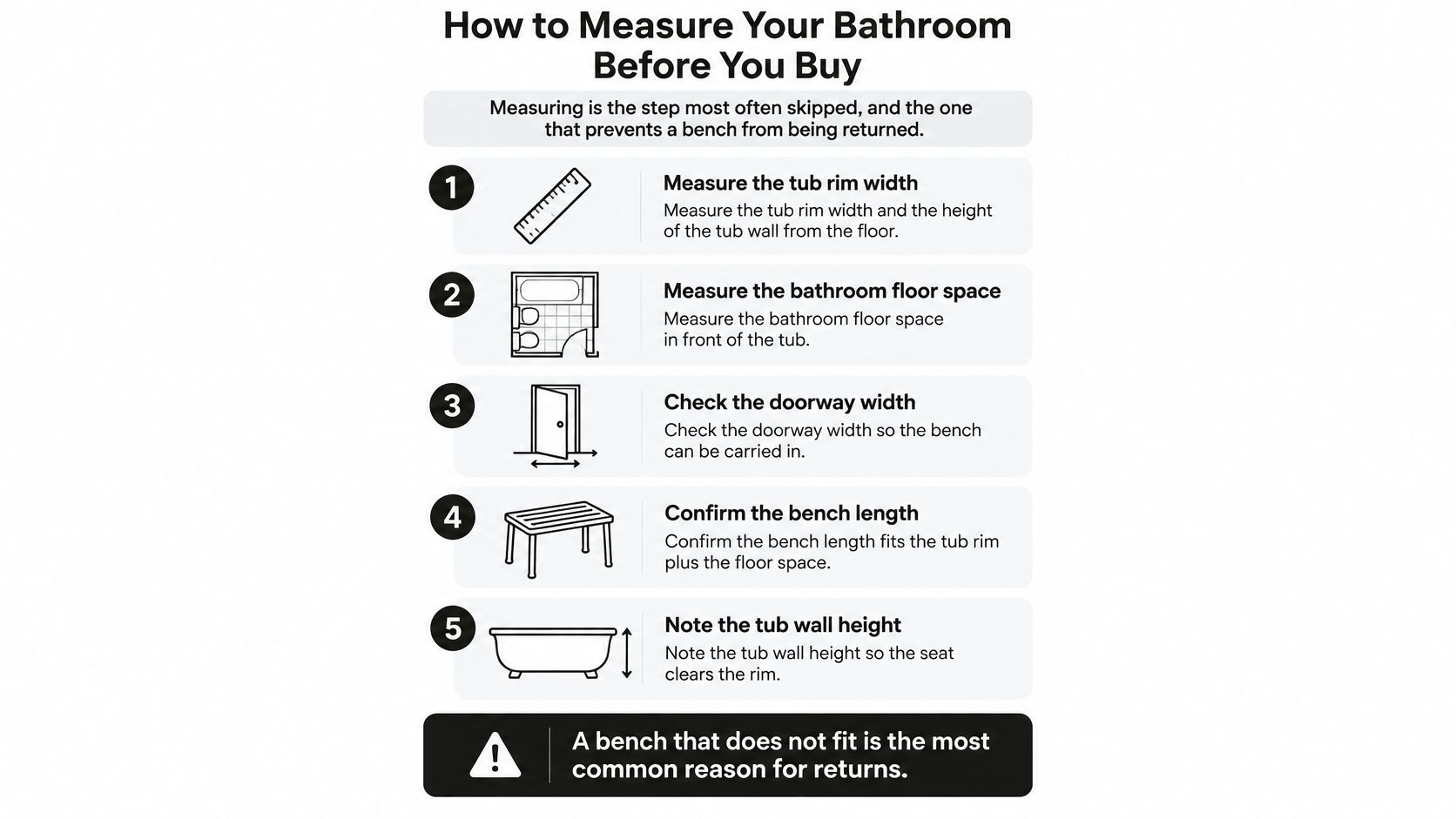
Note the user's transfer side as well, meaning which way they turn and which leg leads. That single note decides whether you need a reversible backrest or a left- or right-entry frame, and it's the detail product photos rarely show.
Now compare numbers instead of impressions. Set the bench's actual seat height range, seat width and depth, leg placement and armrest setup beside your readings before you order. If the tub itself is being replaced, our notes on bathtubs for handicap explain which shell designs remove the wall-height problem at the source.
Weight Capacity and Seat Dimensions to Check
The number on the box is a load rating, not a fit rating. A bench rated for 300 pounds can still be wrong for a 180-pound user if the seat sits too low, the frame rocks on a curved tub floor, or the seat stops four inches short of the shower entry. Published benchmarks let you judge all of it at once.
| Specification | Benchmark | Why it matters |
|---|---|---|
| Safe working load, shower seating | About 110 to 125 kg (243 to 276 lb) | Above this range, choose bariatric-rated equipment |
| Seat height | 17 to 19 inches above the finished floor | Close to common wheelchair seat height, supports stable transfers |
| Seat distance to entry | Within 3 inches of the compartment entrance | Reduces the distance the user moves while transferring |
| Transfer compartment | 36 by 36 inches interior | Room to transfer onto the seat and reach controls from it |
| Entry width | At least 36 inches | Allows a caregiver to stand beside the seat during transfer |
| Threshold height | 1/2 inch or less, edge beveled, rounded or vertical | Prevents catching a foot or walker on the edge |
Read those rows as design targets rather than one product's spec sheet. The load range comes from Queensland Health guidance, which places the general safe working load for shower seating at roughly 110 to 125 kg and directs anyone above it to bariatric-rated equipment (Queensland Health shower seating guidance). The seat height, entry distance and structural figures come from U.S. Access Board guidance for transfer showers, which also requires the seat and its supports to withstand a 250-pound vertical or horizontal force at any point (Access Board guide to bathing rooms).
When the seat sits too high or too low
A seat high enough to leave the feet dangling stops stable foot contact, so the user pushes through the arms and shoulders instead of the legs. A seat set too low does the opposite damage: it increases the hip and knee extension needed to stand up again, which is the part of bathing that individuals with arthritis or a recent joint replacement can't manage. Adjustable legs exist precisely so you can split the difference, and the target is feet flat on the floor with the knees close to a right angle.
What an overloaded frame actually does
Overload isn't a dramatic collapse. It's a frame that flexes, feet that slide on a wet rim, and shear forces across the skin when a caregiver repositions someone on a seat that no longer sits flat. Poor fit does the same thing without any overload at all, because a seat too narrow presses into the hips and a seat too wide forces the user to lean to reach the far edge.
Practical rule: a seat that fits without sliding the user forward is safer than a higher load rating.
Sitting gives a larger base of support than standing, and backrests and armrests lower the balance demand further, so don't treat them as comfort extras.
Write these five numbers down before you compare anything: user weight, hip width, thigh length, transfer side, and the tub-side clearance you measured. Every product conversation gets faster once those exist on paper.
Match Your Bathing Setup to a Bench and Order With Confidence
Start with the room you have, not the catalog you're browsing. The bathing setup narrows the choice faster than any feature list, because a bench that suits a tub with a liftable wall is the wrong bench for a curbless shower with a center drain.
| Bathing setup | Bench type | Check first |
|---|---|---|
| Tub with a wall the user can lift legs over | Tub-overlap or sliding bench | Tub rim width and seat foot stability |
| Walk-in shower with a floor drain | Freestanding shower bench | Floor slope, drain position and water pooling |
| Shower with solid wall blocking | Wall-mounted fold-down seat | Blocking location and seat height from the floor |
| Tight bathroom needing caregiver standing room | Compact or foldable bench | Door swing and space beside the seat |
| User above 110 to 125 kg (243 to 276 lb) | Bariatric-rated bench or shower commode | Rated load, seat width and frame strength |
Then work through the pre-order list. It takes about ten minutes and saves a return shipment.
- Load rating against body weight. Leave headroom rather than matching the rating exactly, since a caregiver leaning on the frame adds load the user's weight doesn't show.
- Seat height against the wheelchair or standing height. If the user transfers from a wheelchair, a seat within a couple of inches of the chair height keeps the move level.
- Footprint against your measurements. Overall length matters as much as seat width, because the outside legs land in the floor space in front of the tub.
- Warranty and return policy. Frames, feet and seat pads wear at different rates, and you want to know which parts are covered.
- Anchoring method against the wall or tub. Suction feet, rim brackets and wall flanges solve different problems, and only one of them suits your bathroom.
Our product pages list load ratings, seat dimensions and tub compatibility for each model, so the comparisons happen on numbers rather than photos. For a user who needs a fixed toileting and bathing seat rather than a straddle bench, the Medline Aluminum Padded Shower Wheelchair Commode carries a 275 lb weight capacity, a 19-inch seat width and a 26-inch overall width, which suits a bathroom where a commode chair rolls in and stays.
If a full renovation is on the table, the shower fittings guide for renovators from Tiles Mate Pty Ltd covers the valves, heads and rails that make a seated shower workable, including a handheld unit on a slide bar so nobody has to stand to rinse.
One action closes this section. Measure the bathroom, write down the user's weight and transfer pattern, and order only the bench whose rating and footprint match those numbers.
How to Install and Test a Transfer Bench Safely
A bench can make bathing less safe than no bench at all. It happens when the frame slides on a wet rim, when it blocks the caregiver from reaching the user's hips, or when it leaves no room to turn. The install and test sequence below exists to catch those failures before anyone is naked and wet.
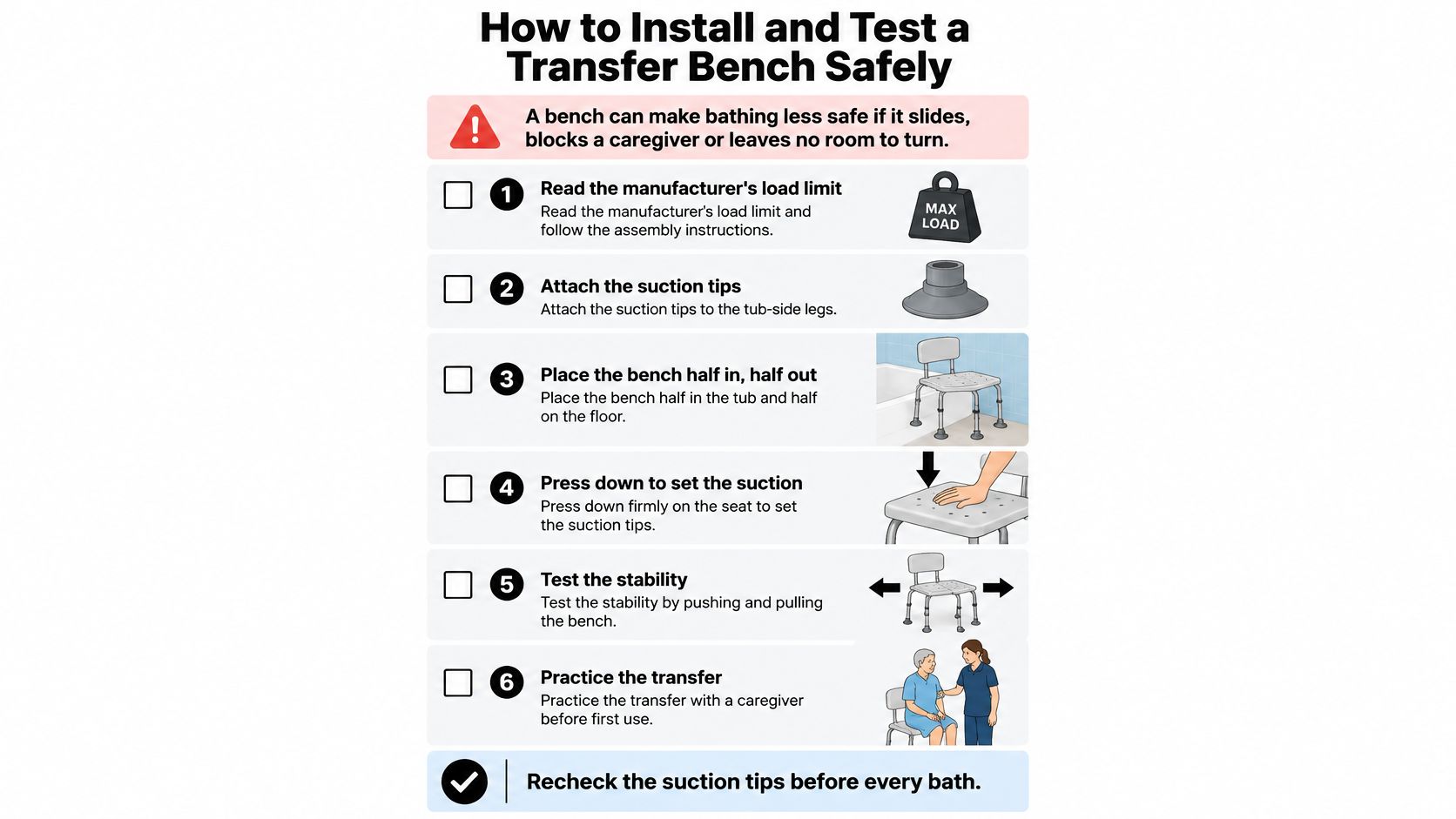
- Read the manufacturer's load rating and confirm it covers the user's weight, plus whatever a caregiver will add by leaning. This is the one step you can't fix later with a wrench.
- Place the bench dry, on the floor outside the tub, and set the seat height using the adjustable legs or the rim brackets. Set it before the first bath, not during one.
- Fit the nonslip feet or rim pads and check that all four legs sit flat. On a tub floor, that means inside the flat zone rather than on the curve where the wall meets the base.
- Anchor a wall-mounted seat into solid blocking. Never into drywall alone, and never into tile backer without a stud or added blocking behind it.
- Install permanent grab bars where the user can push from a stable surface while seated. Suction-cup handholds may not be effective for bathing transfers, and a bar that releases under load is worse than no bar because people trust it.
- Test with no weight first, then with the caregiver pressing down and sideways on the outer end. You're checking for rock, creep and flex, not for how it looks.
- Walk the full sequence with the user: approach, sit, slide, lift the legs over, bathe, and return. Do it clothed and dry the first time, then repeat it with water running.
Watching someone who has done this hundreds of times is faster than reading another paragraph about it.
The three slips that cause the most trouble
A bench that rocks on an uneven tub floor. Fix it by repositioning the inner legs onto the flat section of the tub base, or by adding a nonslip mat under them, rather than by tightening anything.
A bar that pulls away from the wall. Fix it by relocating to a stud or installing blocking, and by replacing suction hardware with anchored bars. A study of assistive-product use found that only 16.1% of participants used a bath seat, bath board or transfer bench, while grab-bar use reached 23.8%, which suggests plenty of households are relying on one piece of equipment where they need two (assistive product use study).
A seat that leaves no space for a caregiver to kneel or stand. Fix it by moving the bench to the other end of the tub, flipping the entry side, or switching to a compact frame.
Recheck the feet and pads before every bath. They harden, glaze over and lose grip long before the frame shows any wear. Our guide to safe patient transfer techniques covers the handling side, including how to guide hips rather than arms.
Materials, Maintenance and Caregiver Tips
Frame material decides how a bench behaves after two years of steam and soap scum. Aluminum resists rust and stays light enough to lift out of the tub, which matters when one bathroom serves the whole household and the bench moves daily. Powder-coated steel feels stiffer under load, yet the coating chips first at the leg joints where the frame flexes slightly, and once bare metal shows, rust starts at that spot. Plastic or blow-molded seats wipe clean in seconds, though a thin seat can flex under a heavier user. Judge the frame and the seat separately, because they age at different speeds.
A bench that lives in the tub faces constant moisture. One lifted in and out faces drops and knocks. Match the material to the wear it will see.
Run a hand across the seat every few weeks. A textured surface with drainage holes sheds water and gives wet skin something to grip; a slick, polished patch where hands and hips land means the surface is wearing through. Soap film on rubber works like ice on a step: it removes the friction the whole transfer depends on, which is why rinsing matters as much as inspecting.
Feet, pads and end caps wear out long before the frame does, and each one is a cheap fix compared to a fall.
A weekly routine takes a couple of minutes.
- Rinse and dry after each use, especially the leg sections that sit inside the tub.
- Check every bolt, foot and anchor monthly, and tighten by hand until snug; plastic inserts crack when overtightened.
- Replace seat pads and feet when grip fades, and keep the manufacturer's part number on hand so the replacement matches the frame.
Caregivers carry half the risk in a transfer, so positioning matters as much as equipment. Stand on the side of the user's stronger leg, keep your back straight, and let your legs do the lifting. Hold a gait belt or the waistband, since gripping an arm gives less control and can pull the user off balance. Guide the hips through the move, because steering from the shoulders leaves the user nothing to push against. The bench, the towel bar and the shower curtain should never serve as handholds during the move, since all three are either movable or built for far less load than a pulling adult.
When the user has trunk or balance limits, have an occupational therapist watch the first few transfers in the actual bathroom. A therapist sees the reaching, the foot placement and the turn that a family member has learned to work around without noticing. For showers where a straddle bench is more than the room needs, our guide to PVC shower chairs covers the lighter-weight alternative.
DME Superstore offers transfer aids, and its product pages carry clear specifications and warranty information, so you can compare models against your own measurements. The 24/7 chat support can help you check a model against your tub rim height and caregiver space before you order. Visit DME Superstore to explore the range.
