



You're beside the bed, the wheelchair is a hand's width away, and the person you help is already sitting on the edge. The gap looks harmless. Then they lean, the chair rocks, and both of you feel how much of their weight has to cross that small space.
A transfer board is a rigid bridge between two seats. It lets someone who can push with their arms move sideways in short lifts. It does not lift a person who cannot help. Learning how to use a transfer board starts with that difference. If they can sit, lean, and push, the board lowers the effort of the gap. If they cannot control their trunk, bear weight, or follow a cue, the board is the wrong tool today.
The same scoot that works beside a level mattress often fails when a car seat sits higher, a bathroom is tight, or a door frame blocks a hand. Setup, participation, and a clear stop rule matter more than the board itself.
When a Transfer Board Is the Right Tool
The bed is already lowered, the person is sitting on the edge, and the wheelchair looks close enough to make the move feel simple. That picture changes the moment they fold forward instead of leaning with control, or they do not push when you ask. The board only spans two seats. What makes the transfer safer is the person's ability to take part, not the wood or plastic under them.
A board fits when the person has enough arm strength and trunk control to stay seated, lean forward, and push. It is not a safer way to lift someone who cannot do those things. Sort the move before anyone practices.
Independent means they scoot while you only guard. Assisted means they do part of the move and you help at a gait belt. Fully dependent means they cannot bear weight, follow instructions, or control the trunk, and a board must not be used. Also weigh cognition, skin integrity, the size difference between caregiver and user, and whether one person can manage an unexpected shift.
A 2024 review of safe-patient-handling biomechanics found that slide-board transfers may reduce some trunk flexion, lateral flexion, and twisting compared with other techniques, but did not consistently eliminate low-back risk or perceived exertion. Caregivers still move substantial body weight, especially when the person is noncompliant or moves unexpectedly. A 2025 RESNA biomechanics presentation found that education produced safer recipient transfers while increasing caregiver trunk flexion and time in non-neutral posture. Better form for the person can still load your back.
Practical rule: If two rows below say no, skip practice and get a clinician or a mechanical lift.
Many how-to pages present a board as a universally safer substitute for lifting. That is the gap that gets families hurt. A board is not a lifting device. When the checklist points away from a board, compare options in this guide to a patient transfer device.
Transfer board readiness checklist
| Situation | Board appropriate | What to do instead |
|---|---|---|
| Sits, leans, and pushes with the arms | Yes, independent or light guard | Practice the bed sequence once with a clinician |
| Can follow cues and hold sitting balance but needs help | Yes, assisted with a gait belt | One trained caregiver at the belt with knees blocked |
| Cannot control the trunk, bear weight, or follow instructions | No | Second caregiver or a mechanical lift |
| Fragile skin, reduced sensation, or bare skin on the board | Only with clothing or a pad | Check skin after every transfer and stop if red or painful |
| Destination clearly higher than the start | Not until heights match | Lower the bed or transfer in the downhill direction |
| Person moves unexpectedly or one caregiver cannot manage the weight | No for one person | Second caregiver, a lift, or clinician reassessment |
One "no" on height can be fixed by lowering the bed so the move runs slightly downhill. Two "no" answers, especially missing trunk control plus a caregiver who cannot manage the weight, mean you do not practice the scoot at all. The later steps apply only when today's row says the board is appropriate.
How to Move from Bed to Wheelchair
The board is in place, but its far end rests on a soft cushion. When the person begins to scoot, the board rocks. Stop and reset it before moving. A board is a bridge for someone who can help with the transfer, not a safer way to lift someone who cannot participate.
For a bed-to-wheelchair transfer, set up the two surfaces before the first scoot. The steps below are for someone who can follow cues, keep seated balance, and use their arms. A restorative nursing guide to transfer readiness explains why upper-body strength and trunk control matter when using a board.
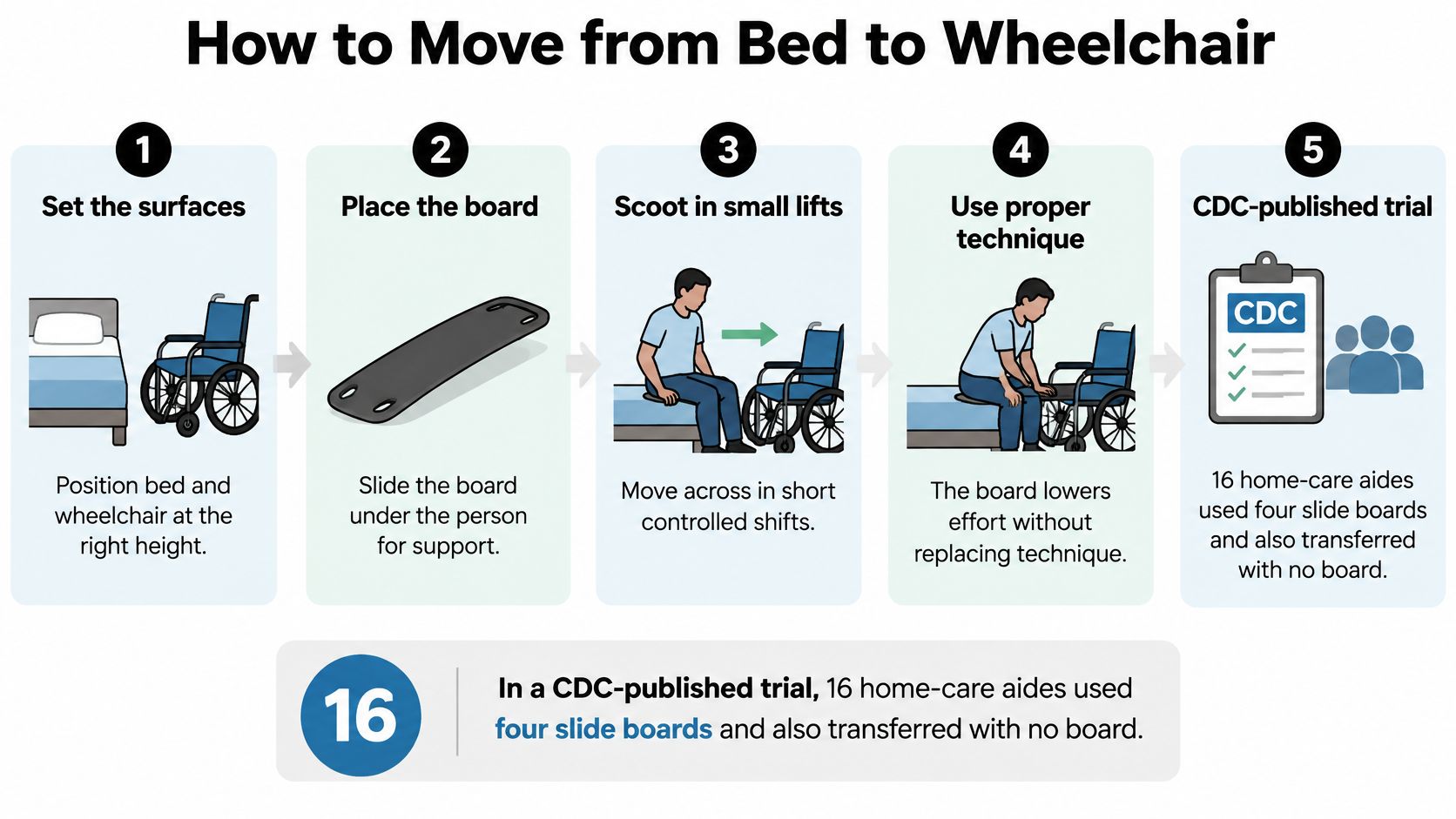
The seven actions
- Match the heights. Set the wheelchair seat level with the mattress or slightly lower. A downhill scoot usually asks less of the arms than an uphill one. If the bed is lower, raise it or reconsider the transfer direction.
- Lock and clear. Angle the chair close to the bed, lock the wheelchair brakes and bed wheels, swing away or remove the footrests, and remove the armrest nearest the bed. A chair that rolls can shift the board during the transfer.
- Set the feet and belt. Place both feet on the floor. Fasten a snug transfer belt around the waist or hips so you can assist at the belt rather than pulling on the arms or shoulders.
- Bridge the seats. Slide one end of the board under the thigh and buttock, where the buttock meets the thigh. About one-quarter to one-third of the board should sit under the hip, and the far end must rest firmly on the wheelchair seat. Avoid a cushion that slides.
- Take your stance. Stand in front with feet wider than your hips and one foot slightly ahead. Keep your back upright as you assist at the belt. Block the knees if they slide forward.
- Scoot in small moves. The person leans forward, “nose over toes,” and presses a flat palm or fist on top of the board. Move across with several small scoots, resetting the hands between them. Pause as needed. Keep clothing between the skin and board; if clothing rides up, place a towel under the contact area before continuing.
- Remove the board. Once both hips are on the chair, the person lifts the hip still resting on the board. Slide the board out, then replace the armrest and footrests. Do not pull the board while it is bearing weight.
For the return to bed, consider the height again. Starting from the higher surface can avoid an uphill push onto the mattress. If the bed cannot be adjusted and the person struggles to move uphill, stop and get more help rather than pulling harder.
Why the board still needs technique
A CDC ergonomic evaluation of slide-board transfers asked experienced home-care aides to perform simulated transfers between a wheelchair and bed, using four slide boards and a manual transfer without a device. Hand forces were mostly lower with slide boards, and downward transfers involved lower forces than upward transfers. A board with a sliding mechanism was also rated easier to use than boards without one. Slide and roller boards can reduce hand forces and muscle activity, but that does not remove the need for a stable setup and controlled movement.
A board can reduce effort. It does not replace locked equipment, a suitable height and angle, or a helper who can manage the transfer.
Keep your stance wide and assist at the belt. Pulling under the arms can strain the shoulders and disrupt the person's balance. Dragging the body across the board can irritate the skin. For more guidance on helper position and transfer cues, read these safe patient transfer techniques. A different chair angle, seat height, or doorway can change whether the same scoot works, so reassess the setup whenever the destination changes.
Car Toilet and Uneven Surface Transfers
The transfer works from bed to wheelchair, then stalls at the car door: the seat is higher, the doorway narrows the approach, and the board no longer rests on both surfaces. A board acts as a bridge for someone who can help with the move. It lowers effort, but it does not make lifting a person who cannot reliably assist safe.
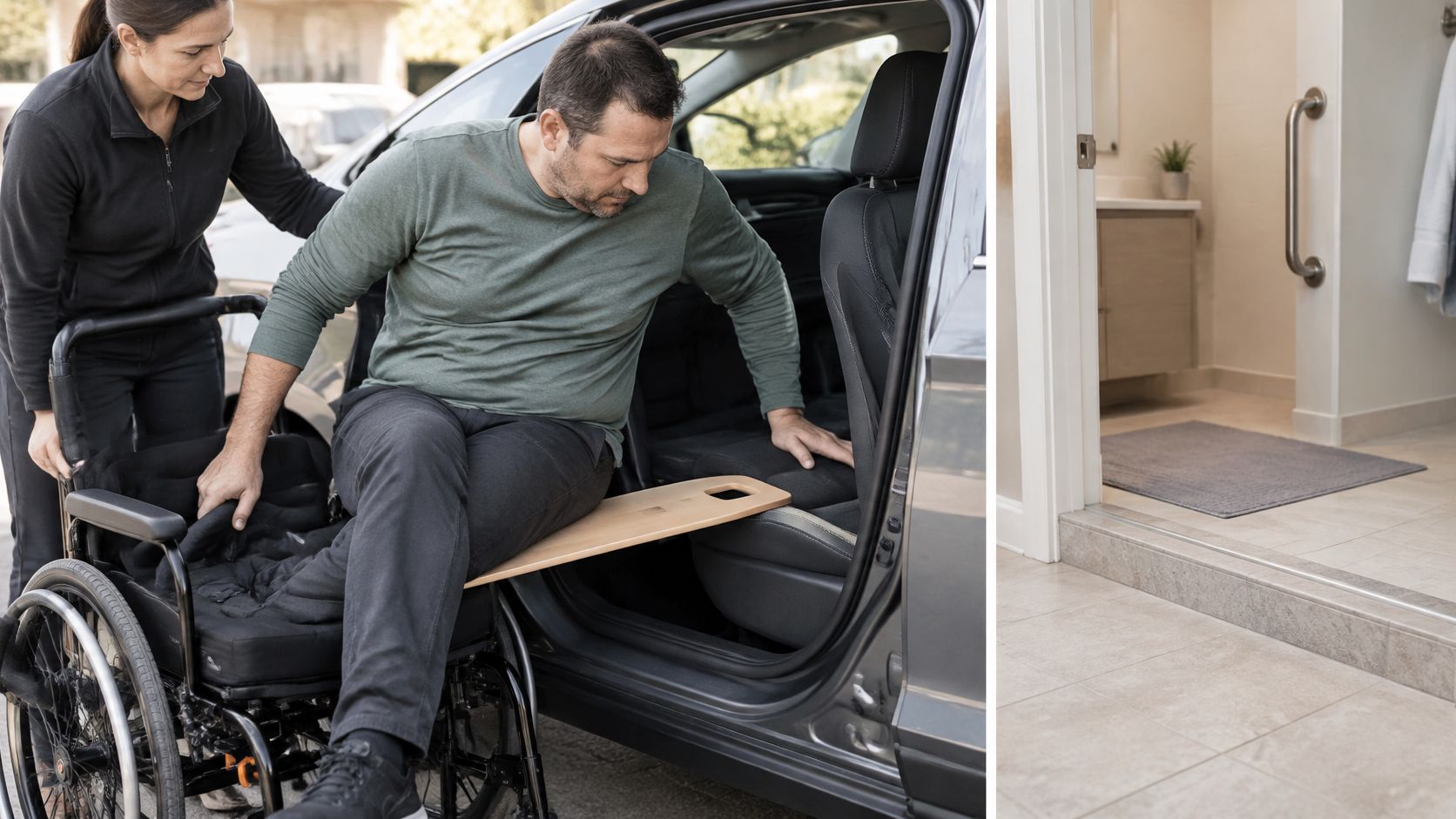
The MSKTC spinal cord injury resource explains that the environment can affect transfer quality even when the person does not feel the move has become harder. Check the actual height, angle, and clearance in each setting. If bare skin may contact the board, use a pad or towel; when one smooth movement is difficult, break the transfer into small scoots.
One car doorway
Open the door fully and slide the car seat back. Lock the wheelchair at a slight angle, as close to the door frame as the space allows, and remove the near armrest. If the door sill blocks a long, straight board, a shorter or curved board may fit, provided it rests securely on both surfaces.
Height can change the direction of the transfer. If the car seat is higher and the person cannot push uphill, stop rather than forcing the climb. Transfer downhill into the wheelchair instead, or get a second person to help. If a hand cannot clear the door, reset the seat and chair angle before trying again. If the doorway still leaves no stable setup, consider car transfer patient lifts rather than extending the board across an awkward gap.
Watch a doorway transfer before trying it with the family car. Compare the demonstration with the seat height and door opening you have at home.
One toilet in a tight room
The board must rest on the toilet seat, not a loose lid. Lock the wheelchair, remove the near armrest, and angle the chair to keep the gap narrow. A cramped bathroom can leave a gap too wide for the board to bridge securely. Grab bars can give the hands a target, but they do not hold the wheelchair in place.
Use clothing or a towel if skin might touch the board. If sliding takes effort, move in small scoots. Stop if the lid shifts, the board rocks, or the skin drags.
A study of trained participants simulating lower-limb disability found that board use could improve transfer efficiency and reduce cardiovascular load. Treat lab findings as a reason to practise, not as proof that a board will suit every person or home.
Bed car and toilet setup differences
| Setting | Height and position | Board and clearance | Stop if |
|---|---|---|---|
| Bed to wheelchair | Seat level or slightly lower, chair angled close | One-quarter to one-third under the hip, near armrest and footrests off, both brakes locked | The board rocks or the gap opens |
| Car | If the car seat is higher, go downhill into the wheelchair or add a second person | Door fully open, seat slid back, chair as close as the frame allows, short or curved board if a sill blocks a long board | The door blocks a hand or the person cannot push uphill |
| Toilet or tight bathroom | Angle the chair so the gap stays narrow rather than leaving a hole | Board on the toilet seat, not a loose lid, near armrest off, grab bars as a hand target only | The lid shifts, the board isn't firm, or skin would touch it without a pad or towel |
A level mattress and a car seat are different transfer problems. Before each move, check the height, angle, and space for the board to rest firmly. If any of those have changed, set up again before the first scoot.
Problems That Stop a Transfer Midway
The board shoots out from under the hip, and the person is stuck between the bed and the chair. That slip is the most common miss, and it is usually setup, not weakness. Too little of the board is under the hip, or the end is sitting on a cushion that moves. Pushing through makes the next second worse.
Use the table the moment a transfer feels wrong. Reset once. If the same row shows up on a second try, leave the board and bring in a second person or a lift.
Transfer problems, causes, and fixes
| What you notice | Likely cause | What to do |
|---|---|---|
| Board slides out | Too little board under the hip or a loose cushion | Reset one-quarter to one-third under the hip on a firm surface |
| Wheelchair creeps | Brake unlocked or chair too far away | Lock brakes and close the angle |
| Fingers pinched | Hand curled under the board edge | Use a flat palm or fist on top and pause if needed |
| Skin drag, redness, or pain | One long pull or bare skin | Small scoots with clothing or a towel, and stop if pain continues |
| Balance lost halfway | Wide gap, poor angle, or trunk fatigue | Guard the knees, pause, and end the session if it happens again |
| Easy at home but hard in a car or bathroom | Height, door frame, or cushion changed | Rematch height and angle before another try |
A pinched finger means the hand went under the edge. The next attempt uses a flat palm or a fist on top, and a pause is acceptable if the person needs rest. Redness, a dragging feeling, or pain means shear from one long slide or from bare skin. Never drag the person across the board.
Loss of balance halfway points to the gap, the angle, or fatigue. Guard the knees and pause. A second loss ends the session. The same method failing only in a car or an unfamiliar bathroom is an environment problem. Pulling harder doesn't fix a door frame.
A biomechanical study summarized in the 2025 SCI upper-extremity guidelines found that boards were only partially effective at reducing upper-limb weight-bearing and produced only a minor improvement in the overall Transfer Assessment Instrument score compared with sitting transfers, so technique quality remains decisive. Stop if the board slips, the wheelchair moves, the user loses trunk control, or pain develops. Keep fingers flat or in a fist rather than underneath the board, and inspect skin after transfers when sensation is reduced. Falls during transfers are associated with human error, poor coordination, patient condition, equipment problems, staffing constraints, and inadequate training.
Don't proceed without an individualized assessment and training, and don't park the board on an unstable cushion.
The belt is what you hold when the knees slide or the trunk tips. If you have been grabbing sleeves instead, review how to use a transfer belt before the next attempt. After any difficult move, check the skin when sensation is reduced. Repeated redness is a stop, not a cue to try a faster slide.
Decide on Practice or a Lift
Match the next action to the readiness row you already marked, not to the board you hoped would work.
If the person can lean, push through the arms, and hold sitting balance, practice the bed sequence with a physical or occupational therapist before doing it alone. Then repeat that same downhill setup at the same time of day until the small scoots feel routine. Fatigue late in the day is a real change in ability. Don't treat an evening failure as a reason to yank.
If trunk control, weight bearing, or following cues is missing, a longer board will not fix it. A board cannot lift a fully dependent person. A sit-to-stand aid is a different tool, for someone who can help with standing. The Molift Transfer Pro is a sit-to-stand patient transfer aid, and it belongs in that standing path, not as a substitute bridge for a person who cannot push. When the person cannot bear weight, follow instructions, or control the trunk, the path is a second trained caregiver or a powered patient lift. Our main categories include Power Mobility, Manual Mobility, Bathroom & Shower, Bedroom, Living Room, and Transfer Aids, so the lift and the board are chosen as separate tools, not as two versions of the same scoot.
Before any purchase, write down sitting balance, arm strength, cognition, skin status, caregiver capacity, and the height gap between bed and chair. Ask a clinician which checklist row applies today. One difficult transfer is a reason to stop and reassess, not to try the same move harder.
If a hoist is the right next tool, funding is a separate question from technique. Cream Home Care outlines funding options for elderly hoists that families can read beside a clinician's recommendation. For the equipment side of that choice, compare patient transfer lifts with the person's current ability, not with last month's best day.
DME Superstore carries transfer aids, patient lifts, and home mobility equipment for the bed, bathroom, and car transfers you make. Match the tool to whether the person can push and sit, or needs a lift instead of a board. Visit DME Superstore to compare transfer aids and lifts against the checklist you just used.
