



You're planning a medical appointment, and the hardest part isn't the visit. It's the walk from the parking lot, the wait in reception, and getting your parent back into the car when they're tired. A transport chair might help, but only if it fits the person, the caregiver, and the journey.
Choosing transport chairs for elderly relatives means checking more than the chair's weight. You need to know who will push, how transfers will work, whether the chair fits your vehicle, and what happens when a short appointment becomes a long day.
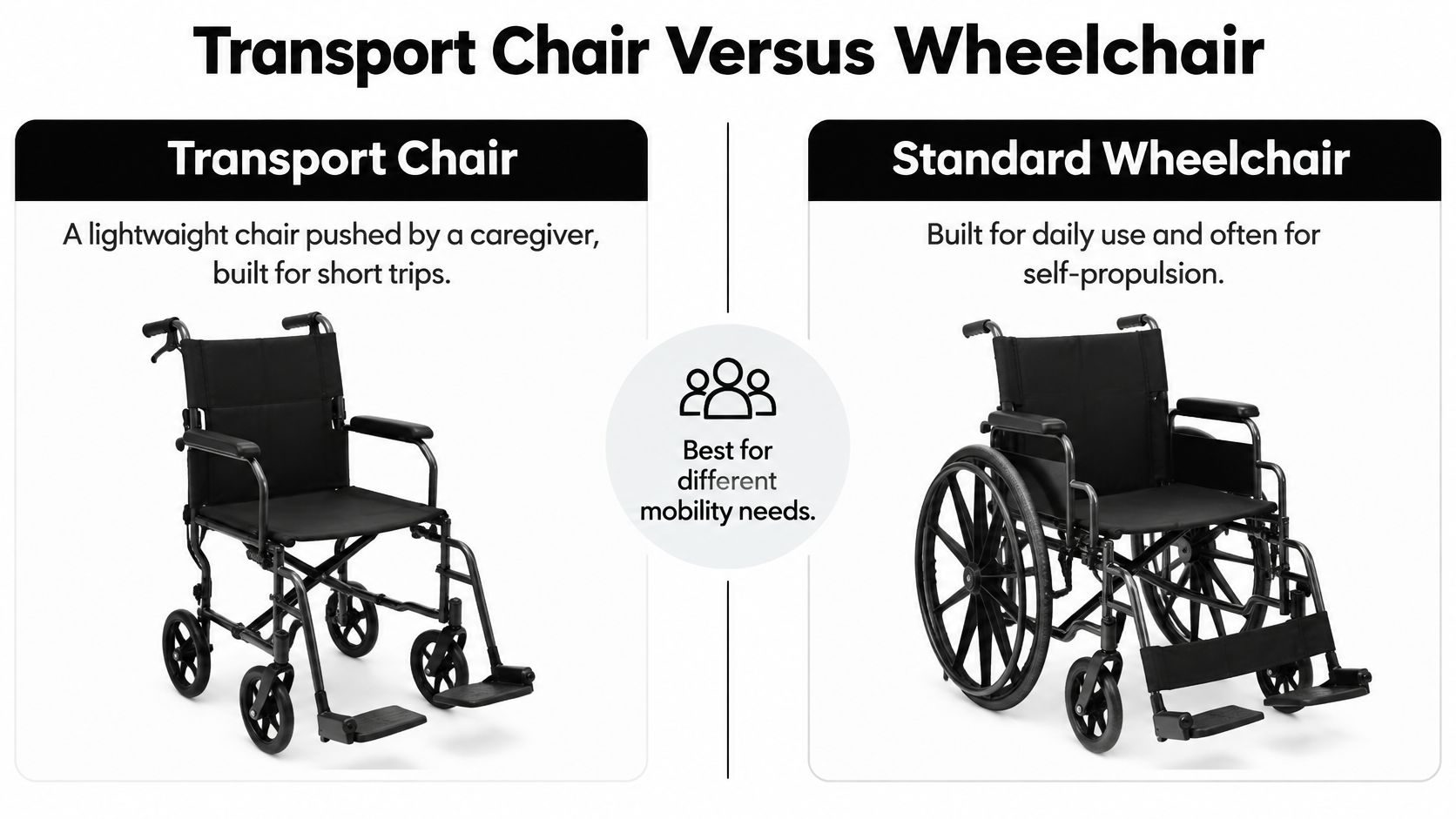
Transport Chair Versus Wheelchair
A transport chair is a lightweight chair pushed by a caregiver, built for short trips, while a standard wheelchair is built for daily use and often for self-propulsion.
Transport chair and standard wheelchair compared
| Feature | Transport chair | Standard wheelchair |
|---|---|---|
| Who moves the chair | Caregiver pushes | User or caregiver |
| Rear wheel size | Smaller, usually around 8 to 12 in | Usually 24 in |
| Folded weight | Typically light enough for one person to lift | Often heavier, folding adds bulk |
| Obstacle crossing | Limited by small wheels | Better on curbs and uneven ground |
| Best use | Appointments, travel, short outings | Daily use and independent mobility |
These are general design differences, not guarantees about a particular model. A folding mechanism reduces storage size, not the weight you must lift, and larger wheels don't make curb handling automatically safe.
Start with independence
The important distinction is who controls movement. Someone using a standard manual wheelchair may be able to approach a table, change position in a room, or leave a crowded area without waiting for help. A transport-chair user generally needs their companion for those movements.
Mobility difficulty is common: the Centers for Disease Control and Prevention's disability report reports mobility disability in 13.7% of U.S. adults in the 2017 survey, with adults aged 65 and older representing 39.5% of respondents reporting mobility disability. That describes mobility limitations, not how many people need or own transport chairs.
Being able to walk doesn't rule out using a chair. Someone may manage the distance between their bedroom and kitchen but need seated mobility through a hospital.
Decision test: Choose for the movement the person needs to do without help, not just the distance you expect to push.
Our guide to choosing a wheelchair can help when independence and daily seating needs outweigh portability. If the person can propel themselves for most of the day, a standard wheelchair may suit them better; if a caregiver will push during appointments, outings, and travel, a transport chair usually fits.
Who Benefits and What to Expect
An older adult who walks around the house but tires during errands is a typical transport-chair candidate. The chair provides another way to complete the outing without requiring them to walk beyond their endurance.
This caregiver-assisted setup shows the kind of support a companion provides.

Useful situations include medical appointments, hospital visits, airport terminals, shopping, and community events. During recovery after surgery, a chair may also support outings when the treating team has clarified walking and transfer restrictions.
Think about the whole schedule rather than the journey's label. An appointment may involve a distant entrance, several waiting areas, a pharmacy stop, and lunch before returning home.
Where a transport chair helps
- Lower lifting burden: Many models are lighter than standard wheelchairs, making occasional vehicle loading more manageable.
- Simple storage: A straightforward folding frame can be convenient to keep in a car.
- Seated rest: The person can conserve energy for activities they value rather than spending it all reaching the entrance.
- Companion-led travel: A caregiver can manage the route while the passenger remains seated.
Where it falls short
- A pusher is necessary: The companion must remain available throughout the outing.
- Rough ground is difficult: Gravel, curbs, and broken pavement can interrupt an otherwise accessible route.
- Independent propulsion is absent: The passenger can't use hand rims to move themselves.
- Basic seating has limits: Someone who cannot transfer safely or tolerate sitting needs assessment, not just a more portable chair.
A demonstration can help you identify handling questions to discuss before using an unfamiliar chair.
A rollator may be more appropriate when the person can walk safely with support and mainly needs occasional seated breaks. Its seat is for stationary rest unless the device is specifically designed for passenger transport. Someone who can't walk the required distance and has a reliable helper often suits a transport chair better.
Don't assume that needing more help automatically makes a transport chair the right choice. Significant weakness, poor sitting balance, or difficult transfers may call for more supportive equipment.
Features That Decide Safety and Comfort
Weight capacity comes first. Compare the rated limit with the person's weight plus belongings carried on the chair, and choose a rating comfortably above that load. Don't treat unused capacity as permission to hang heavy bags from the push handles, which can affect balance.
Next, check the chair's actual lifting weight and folded dimensions. Use a tape measure on the trunk opening, loading lip, and available storage space. A chair can fit inside the trunk yet still be awkward to pass through its opening.
Transport chair features and what to check
| Feature | What to check | Typical target |
|---|---|---|
| Weight capacity | User weight plus belongings against rated limit | Rating well above user weight |
| Folded size and weight | Trunk or back seat fit, one-person lift | Fits vehicle and can be lifted alone |
| Front casters | Diameter and rolling over thresholds | Larger casters for uneven ground |
| Brakes | Hold with fully occupied chair on an intended slope | Hand-operated attendant brakes that lock |
| Footrests | Removal or swing-away for transfers | Removable or swing-away |
| Seat width and back height | Match to measured body dimensions | Use the seated measurement targets below |
Independent lifting is a useful target only when the caregiver can do it safely. Otherwise, plan assistance or a loading aid rather than stretching beyond their capability.
Why wheels and brakes deserve priority
A review of mobility-device safety reports found poor or uneven surface handling mentioned in 46 reports per 10,000 reviews for wheelchairs or transport chairs, compared with 26 per 10,000 for walkers or rollators. These are reported concerns, not injury rates or performance scores for individual chairs.
Small front casters can catch at pavement joints or thresholds. Larger casters may handle those transitions more easily, but caregivers should still slow down, approach obstacles squarely, and choose a smoother route where possible.
Attendant brakes let the caregiver control the chair while pushing. Confirm whether the handles also provide a parking lock, how that lock engages, and whether the manufacturer permits use on the slopes you expect to encounter. Don't test holding ability by releasing an occupied chair on an uncontrolled incline.
A chair that's easy to lift but difficult to stop isn't a low-burden choice.
Check the controls with your own hands
Armrests should support the person without forcing raised shoulders. Back height should match their support needs, while removable or swing-away footrests should clear the transfer path without a struggle.
Our elderly fall-prevention guide can help you assess the surrounding route as well as the equipment. Before buying, operate the brake locks and footrest releases yourself, or arrange a demonstration that clearly shows both.
Measuring Seat Width, Depth and Fit
Measure the person while seated, wearing their usual clothing and footwear. Use a firm, supportive surface, a tape measure, and a written worksheet. Standing measurements won't show how their hips, thighs, and feet settle during sitting.
The clinical reference on wheelchair seating recommends about 1.5 to 2 inches of clearance behind the knees, a suitable cushion, and pelvic, trunk, and foot support. Practical starting targets are summarized below; they aren't a substitute for individualized fitting.
Seated fit measurements and targets
| Measurement | How to take it | Target |
|---|---|---|
| Seat width | Widest point across the hips while seated | Hip width plus about 5 cm (2 in) |
| Seat depth | Back of buttocks to back of knee | Thigh length minus about 5 cm (2 in) |
| Seat-edge clearance | Gap from seat edge to back of knee | About 1.5 to 2 in (4 to 5 cm) |
| Knee angle | Seated with feet supported | About 90 degrees |
| Cushion height | Thickness added with cushion in place | Check armrest and footrest clearance |
| Occupied weight | User weight plus belongings | Well below rated capacity |
Measure the body before choosing the seat
Width: Measure across the widest seated part of the hips. Allow room for clothing without choosing an unnecessarily wide seat, which can reduce lateral support and encourage an uneven posture.
Depth: Measure from the back of the buttocks to the back of the knee. The seat should support the thighs without pressing into the knee crease, where excess depth can cause discomfort and encourage sliding forward.
Feet and knees: Check the posture with both feet supported. Dangling feet, raised knees, or thighs pushed upward by high footrests suggest the setup needs adjustment.
Recheck with the cushion installed
A cushion changes the person's position relative to the armrests, backrest, and footrests. Evaluate all of them together rather than adding a thick cushion after deciding that a chair fits.
- Record the measurements: Compare your worksheet with the chair's usable seat dimensions.
- Check the occupied footprint: Include elbows and footrests when checking doorways and turning space.
- Watch the posture: Leaning, sliding, or persistent discomfort warrants reassessment.
Our wheelchair-width guide helps distinguish seat width from overall chair width. Someone with limited sensation, previous pressure injuries, or prolonged daily sitting needs an individual seating assessment because fit alone cannot remove pressure risk.
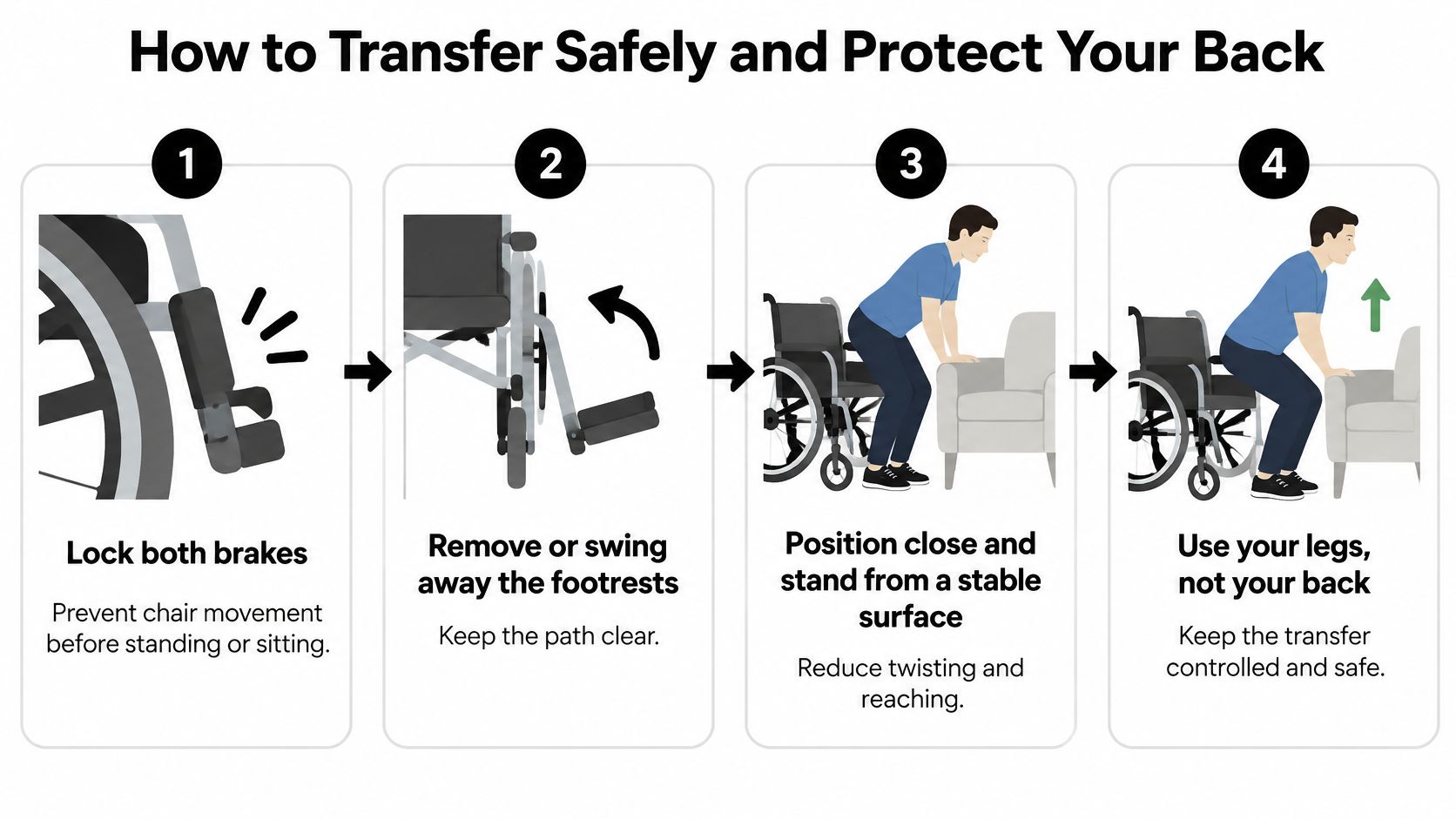
How to Transfer Safely and Protect Your Back
A safe transfer begins before the person stands. Explain the plan, clear the floor, and make sure the destination is stable. The sequence below is for someone who can participate in a standing transfer and has been assessed as safe to do so.
Wheelchair safety guidance emphasizes locked brakes, a clear transfer path, appropriate positioning, and secure components. If the person can't bear weight reliably, becomes dizzy, or needs you to lift their body weight, stop and seek hands-on training and suitable transfer equipment.
Prepare, position, then move
- Lock both brakes. Do this before standing or sitting so the chair cannot roll away under the person.
- Remove or swing away the footrests. Clear them completely from the transfer path, and never let the person stand on the footplates.
- Position the chair close to the destination. Choose an angle that minimizes stepping, reaching, and twisting, using the arrangement taught by the person's therapist.
- Place the feet securely. Set them flat on the floor with knees roughly at right angles, unless the treating clinician has prescribed a different position.
- Check detachable supports. Confirm that any armrest or leg support being used is firmly attached; remove obstructing components only according to the transfer plan.
- Guide the movement without hauling. Have the person push from the stable armrests or support surface rather than pulling on your neck. If trained to assist at the hips, stay close, keep your back neutral, bend through your hips and knees, and turn with your feet instead of twisting.
Use this visual reminder alongside, not instead of, individualized instruction.
Account for the caregiver's whole day
A biomechanical evaluation of caregiver transfer education found that education reduced some non-neutral transfer positions but also increased transfer time and changed knee loading. Safer technique isn't necessarily faster or effortless technique.
Consider the repeated work: unfolding the chair, helping with transfers, pushing, returning to the car, and loading again. A slightly heavier chair with easier controls or better stability may be less demanding overall than a lighter chair that requires awkward handling.
Caregiver check: If a task requires a sudden pull, breath-holding, or an awkward lift over the trunk lip, change the setup rather than relying on determination.
Our safe patient-transfer techniques guide provides further preparation points. Ask a therapist to observe the actual transfer if you're unsure, particularly when the caregiver has back or knee limitations.
Plan help for vehicle loading before leaving home. Lift an empty chair only, follow the manufacturer's lifting instructions, and arrange assistance at the return destination too.
Vehicle Securement and Trip Readiness
Will the person transfer into a vehicle seat, or remain seated in the transport chair? These are different arrangements. A folding frame doesn't make a chair approved for occupied vehicle travel.
For a car journey with a seat transfer, plan where the empty chair will be stowed and secured. For travel while seated in the chair, confirm the manufacturer's transport instructions and compatibility with the vehicle operator before booking.
Separate chair securement from passenger restraint
Under the U.S. transportation accessibility standard for the vehicles covered by this provision, vehicles 22 feet or shorter must provide at least one wheelchair securement location, while longer vehicles must provide at least two, and each wheelchair position must have a compliant passenger seat belt and shoulder harness. The mobility device itself must also be secured.
A positioning belt attached to the chair isn't a substitute for vehicle passenger restraints. Nor should a caregiver improvise tie-down attachment points on removable footrests or other unapproved components.
The U.S. DOT transportation service rules require providers to carry a wheelchair and occupant when the lift and interior can accommodate them. Operators may refuse a device that blocks an aisle or interferes with emergency evacuation, but not because it's a manual wheelchair or unfamiliar device.
Run a trip-specific checklist
- Dimensions: Record folded size and occupied width, length, and height, including projecting footrests.
- Loading route: Confirm ramp or lift compatibility, entry clearance, and room to turn.
- Securement: Verify approved attachment points and the operator's restraint procedure.
- Service policy: Contact the taxi or paratransit provider about the exact chair and assistance required.
- Flights: Ask the airline about handling, storage, retrieval, and airport assistance.
- Help at both ends: Name the person who will assist with transfers and loading at each destination.
For sea travel, CruiseLobster.com's information on cruise ships can help identify the vessel you're considering; confirm accessibility and mobility-device arrangements directly with the cruise line. Include the port transfer and shore transport in those checks.
Our wheelchair transportation guide offers additional planning context, although each device needs its own compatibility confirmation. A chair that works inside the home may still be unsuitable for a particular vehicle or unsupported community journey.
Final Checks, Coverage and Next Steps
Make the purchase decision with a measurement sheet, a realistic route, and the caregiver present. A chair that looks manageable online may feel different when someone must operate its releases or lift it over a vehicle's loading edge.
Complete a pre-purchase routine
- Compare fit measurements with the specification sheet. Record seat width, seat depth, knee clearance, and occupied weight, then check the actual model rather than relying on its general product category.
- Verify the working parts. Confirm adequate rated capacity, brake operation, footrest removal, and the support the passenger needs. Arrange a demonstration or trial when handling remains uncertain.
- Match the chair to real journeys. Check the vehicles and services the person uses, including where transfers occur and who helps when plans change.
- Review the purchase terms. Obtain the complete specifications, warranty terms, and return conditions, including any conditions specific to open-box equipment.
For a concrete specification comparison, our Medline Aluminum Transport Chair with 12" Wheels is available in Blue and Red, has a 300 lb weight capacity and 19" seat width, weighs 26 lbs, and arrives assembled. The Open Box Slightly Used version is priced at $125.00, which is 55% off. Those details help you compare a candidate with your worksheet, but they don't establish individual fit or vehicle-occupant approval.
Ask coverage questions before ordering
Ask the insurer or health plan whether a transport chair is covered for the person's needs. Request the documentation requirements, including what a prescription or clinician's note must explain, and whether a particular supplier or authorization process is required.
- Trial options: Ask whether rental or a trial loan is available through the plan or a local equipment service.
- Clinical review: Arrange assessment before buying when there's limited sensation, pressure-injury history, or difficulty maintaining posture.
- Written confirmation: Keep coverage answers and purchase conditions with your measurement sheet.
Keep the measurements, vehicle details, and assistance plan together. Check every candidate against that same record before ordering, rather than letting price or low weight override a failed safety check.
DME Superstore offers transport chairs, wheelchairs, walking aids, and transfer equipment, with specifications to help you compare options. Visit DME Superstore with your seated measurements and trip checklist, and use them to narrow your choices before purchasing.

