



Choosing a wheelchair is a significant decision that directly impacts daily life and independence. The core principle is to match the device to your specific needs, activities, and environment, not the other way around. This guide is designed to educate you on the key factors to consider, empowering you to select a wheelchair that truly enhances your freedom and comfort.
Taking the time to understand these factors before you start browsing is the single most important step you can take. It’s the foundation for making an informed choice that will serve you well for years to come.
Finding the Right Wheelchair for Your Life

Selecting a wheelchair is a deeply personal process that directly influences your independence and quality of life. A generic, one-size-fits-all approach is rarely effective and can lead to discomfort, limited mobility, and frustration.
Instead of focusing on features first, the initial step is a comprehensive assessment of your real-world needs. Think beyond the basics and ask practical questions that paint a clear picture of your day-to-day reality. A chair that’s perfect for navigating narrow apartment hallways might struggle on an uneven sidewalk, while one designed for rugged outdoor use could be too cumbersome for indoor spaces.
Start With a Personal Needs Assessment
Before you dive into brands like Pride Mobility or Medline, take a moment to reflect on your specific circumstances. This initial self-evaluation will become the foundation for every other decision you make.
To get started, here's a checklist to help you organize your thoughts and pinpoint what truly matters for your situation.
Quick Needs Assessment Checklist
| Consideration | Key Questions to Ask Yourself | Why It Matters |
|---|---|---|
| Primary Environment | Where will I use the chair 80% of the time? Indoors, outdoors on paved surfaces, or on rough terrain like grass and gravel? | An indoor-focused chair needs a tight turning radius, while an outdoor one requires larger, more durable wheels for stability. |
| User's Physical Ability | Can I propel myself, or will I rely on a caregiver? How much upper body strength and endurance do I have? | This is the primary factor in deciding between a manual, transport, or power wheelchair. |
| Caregiver Needs | Will a family member need to lift the chair into a car? How often? Do they have any lifting restrictions? | Portability and weight are critical factors. A 15 lb ultralight chair is much easier to manage than a 50 lb model. |
| Daily Activities | What are my non-negotiable activities? Getting to work, going shopping, attending social events, gardening? | Your chair should enable your lifestyle, not limit it. A bulky chair might not fit under a desk or navigate a crowded cafe. |
| Home Accessibility | How wide are my narrowest doorways? Are there tight corners, steps, or thresholds to navigate? | This determines the maximum width and overall footprint your wheelchair can have. Measuring beforehand is essential. |
Answering these questions honestly provides a clear roadmap, preventing you from choosing a chair that looks great online but doesn't function in your actual life.
The right wheelchair isn't just a mobility aid; it's a tool that empowers you to engage with your world fully. Making a confident, informed choice is crucial for maintaining your lifestyle and comfort.
This need for personalized mobility solutions is a growing trend. The global wheelchair market, valued at USD 9.34 billion in 2025, is projected to nearly double by 2034. This growth is driven partly by an aging population, where 1 in 6 people will be over 60 by 2030.
Currently, electric models hold the dominant market share at 56% in 2024, offering effortless navigation for users with limited upper body strength. You can explore more about these market trends and see how they're shaping wheelchair innovation for the better.
Deciding Between Manual and Power Wheelchairs
The first major decision in your wheelchair selection process is choosing between a manual and a power model. This choice fundamentally shapes your daily mobility. The best option always comes down to your physical abilities, your environment, and your lifestyle goals.
A common misconception is that significant upper-body strength is required for any manual wheelchair. While true for some models, the category is surprisingly diverse. It’s less about raw power and more about matching the chair’s design to your specific needs and the support you have from caregivers.
The World of Manual Wheelchairs
Manual wheelchairs are broadly categorized into two types: self-propelled models for independent users and transport chairs for those who rely on a caregiver for mobility.
Ultralight Wheelchairs for Active Users
Consider an active individual who works in an office, enjoys social outings, and drives their own vehicle. For them, an ultralight manual wheelchair is often the ideal solution. These chairs are engineered for performance and independence.
- Designed for Self-Propulsion: They feature large rear wheels with ergonomic handrims, allowing the user to move with efficiency and control.
- Featherlight Frames: Often constructed from aluminum or carbon fiber, some models weigh as little as 15-25 lbs, making them easy to lift into a car trunk.
- Customizable Fit: Key components like the axle position and back height can be adjusted to optimize posture and propulsion, which is critical for reducing the risk of long-term shoulder strain.
This type of chair is ideal for someone who can and wants to propel themselves, staying physically active while navigating their day with agility.
Transport Chairs for Assisted Mobility
Now, consider a different scenario: an elderly parent who needs assistance for medical appointments or family gatherings. They may not have the strength to push themselves, and their caregiver needs a simple, portable solution. This is where a transport chair excels.
These chairs have four small wheels and are designed to be pushed by a companion. They are significantly lighter and more compact than standard wheelchairs, making them perfect for short trips and easy storage. Their design prioritizes caregiver convenience and user safety for assisted mobility.
Exploring Power Wheelchair Options
Power wheelchairs, or electric wheelchairs, open up a world of possibilities for individuals with limited strength, endurance, or upper-body function. They provide motorized propulsion, allowing you to conserve energy for the activities you enjoy.
The market for electric wheelchairs is substantial, making up 56% of the total market share. This popularity is driven by their ability to reduce physical strain—choosing a power model over a manual one can cut caregiver effort by as much as 50%. This is a significant factor, as 43.7% of demand in North America comes from the geriatric population, where both user and caregiver support are essential. You can discover more insights on the growing wheelchair market to understand these trends.
Compact Models for Indoor Freedom
For someone living in an apartment or an assisted living facility, daily navigation involves narrow hallways, tight turns, and small doorways. A compact power wheelchair with a tight turning radius is a game-changer in such environments.
These models are built for indoor maneuverability. Mid-wheel drive chairs, for example, can often turn 360 degrees on the spot, making them incredibly nimble. An intuitive joystick control allows for precise movements with minimal effort, providing confidence and independence at home.
Heavy-Duty Models for Bariatric Users
For bariatric users, safety and robust support are paramount. A standard wheelchair is not sufficient. Heavy-duty power wheelchairs are constructed with reinforced frames, wider seats, and more powerful motors to provide a secure and comfortable ride.
These chairs often feature:
- High Weight Capacities: Safely supporting users up to 600 lbs or more.
- Robust Suspension: Ensuring a smooth, stable ride over various surfaces.
- Powerful Motors and Batteries: Providing reliable performance and a long battery range for a full day of activity.
Choosing a bariatric model isn’t just about the weight capacity; it’s about ensuring the chair’s entire structure is engineered for maximum safety and durability. If you're exploring electric models, our guide on foldable vs non-foldable electric wheelchairs can offer more specific details.
To help you understand the differences more clearly, here's a comparison:
Manual vs Power Wheelchairs At a Glance
| Feature | Manual Wheelchair | Power Wheelchair |
|---|---|---|
| Propulsion | User or caregiver propels the chair. | Battery-powered motor controlled by a joystick. |
| Best For | Active users with upper body strength or those needing caregiver assistance for short trips. | Users with limited strength, endurance, or upper-body function. |
| Environment | Great for both indoor and outdoor use; lighter models are easier to transport in vehicles. | Excellent for long distances and varied terrain; compact models excel indoors. |
| Portability | Generally lighter and easier to fold and lift into a car. | Heavier and may require a vehicle lift or ramp for transport. |
| Cost | Typically more affordable upfront. | Higher initial cost due to motors, batteries, and electronics. |
| Maintenance | Simpler maintenance (tire pressure, brakes). | More complex (battery charging, motor/joystick service). |
Ultimately, this table is just a starting point. The real decision comes from matching these features to your personal daily life.
Key Takeaway: Your decision isn't just "manual versus power." It's about digging deeper to find the sub-category—like ultralight, transport, compact, or heavy-duty—that solves the specific challenges you face every day.
Taking Measurements for a Perfect Fit
Once you've identified the appropriate type of wheelchair, the next critical step is ensuring a proper fit. An ill-fitting wheelchair can cause serious health issues, including pressure sores, poor posture, and chronic pain. It can also make propulsion difficult and exhausting.
A few simple measurements are all it takes to avoid these problems. Using a standard tape measure, you can ensure the wheelchair provides optimal comfort and support, feeling like a natural extension of your body.
This flowchart breaks down the entire selection journey, showing how everything starts and ends with the user's specific needs.
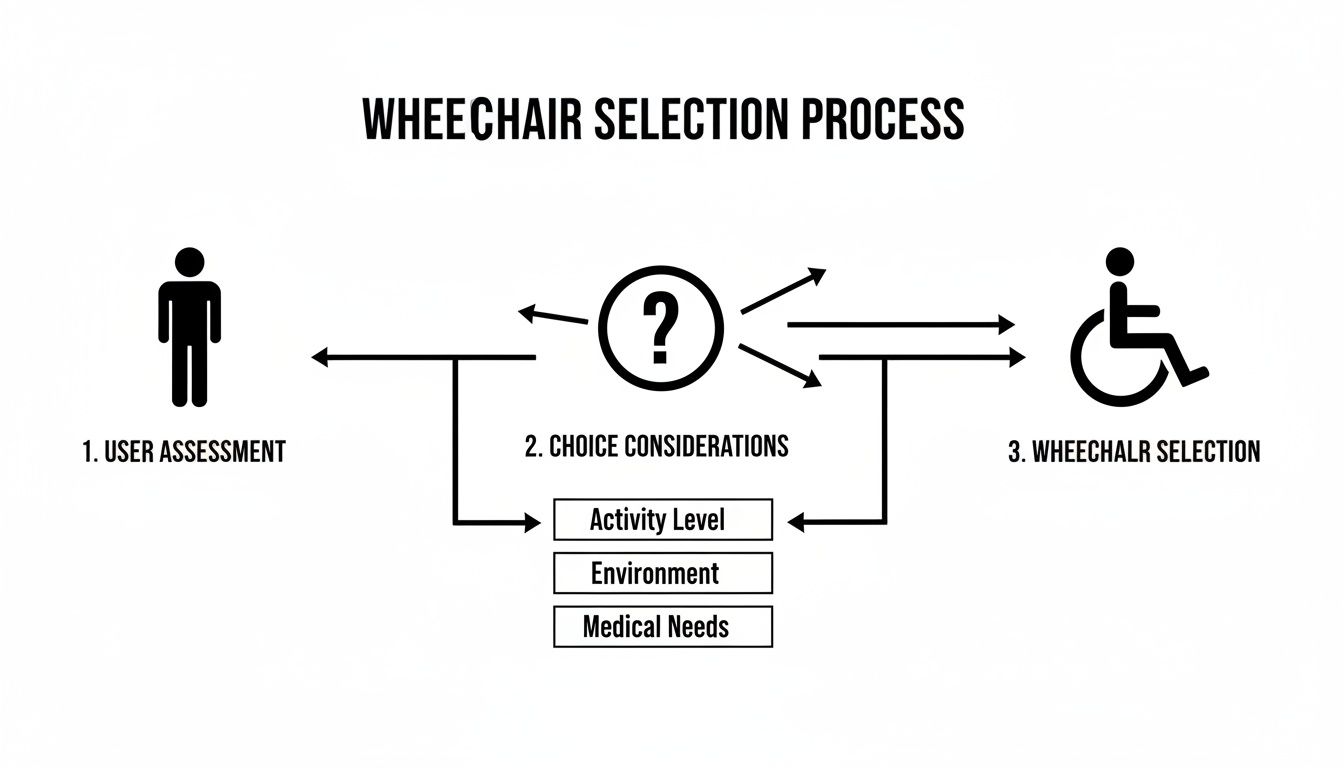
As you can see, the process is all about you before it's about the product. This personalized approach is the key to finding the right chair.
Measuring for an Accurate Seat Width
Seat width is arguably the most important measurement for comfort and stability.
To measure, sit on a firm, flat surface (like a dining chair). Have someone measure across the widest point of your hips or thighs. Then, add one to two inches to this measurement. This extra space is crucial.
Here’s why that buffer matters:
- Comfort: It prevents the frame from digging into your sides.
- Clothing: It accommodates bulkier clothing, such as a winter coat.
- Movement: It allows for slight shifts in position to relieve pressure.
A seat that’s too narrow will cause painful friction. Conversely, a seat that is too wide may lead to poor posture as you lean for support, and it can make reaching the handrims for self-propulsion more difficult.
Determining the Correct Seat Depth
Proper seat depth ensures adequate leg support and promotes healthy circulation.
To measure, sit up straight with your back against the back of the chair. Have someone measure from the back of your hips to the bend behind your knees. From this measurement, subtract one to two inches.
That small gap between the front edge of the seat and the back of your knees is non-negotiable. It’s what prevents the seat from cutting off circulation to your lower legs and causing skin irritation.
A seat that is too shallow will not properly support your thighs, leading to instability and strain on your lower back. If it's too deep, it will press into the back of your calves, potentially restricting blood flow and causing you to slide forward.
Finding the Right Back and Armrest Height
Proper back and arm support helps maintain correct posture and prevent fatigue in the neck and shoulders.
- Back Height: While sitting upright, measure from the seat surface to your armpits. For users who need significant upper-body support, a higher backrest is ideal. For active self-propellers, a lower backrest that ends below the shoulder blades offers greater freedom of movement.
- Armrest Height: Sit with your shoulders relaxed and elbows bent at a 90-degree angle. Measure from the seat surface to your forearm. The armrests should support your arms without causing your shoulders to hunch or sag.
Many quality wheelchairs feature adjustable armrests, a valuable feature for fine-tuning your fit for all-day comfort.
While measuring for your body, it is also wise to consult guides on measuring a room for furniture to ensure your new chair can navigate your home with ease.
Applying Your Measurements for a Smart Purchase
With your key measurements, you can now shop with confidence. On sites like DME Superstore, you can use these numbers to filter your options.
For example, you can select for a "seat width 18 inches" or a "weight capacity 400 lbs" to instantly see only the models that are a perfect match. This saves time, eliminates guesswork, and ensures the wheelchair you choose is built for your body from day one. A few minutes spent measuring is a direct investment in your long-term comfort and health.
Essential Features and Customization Options
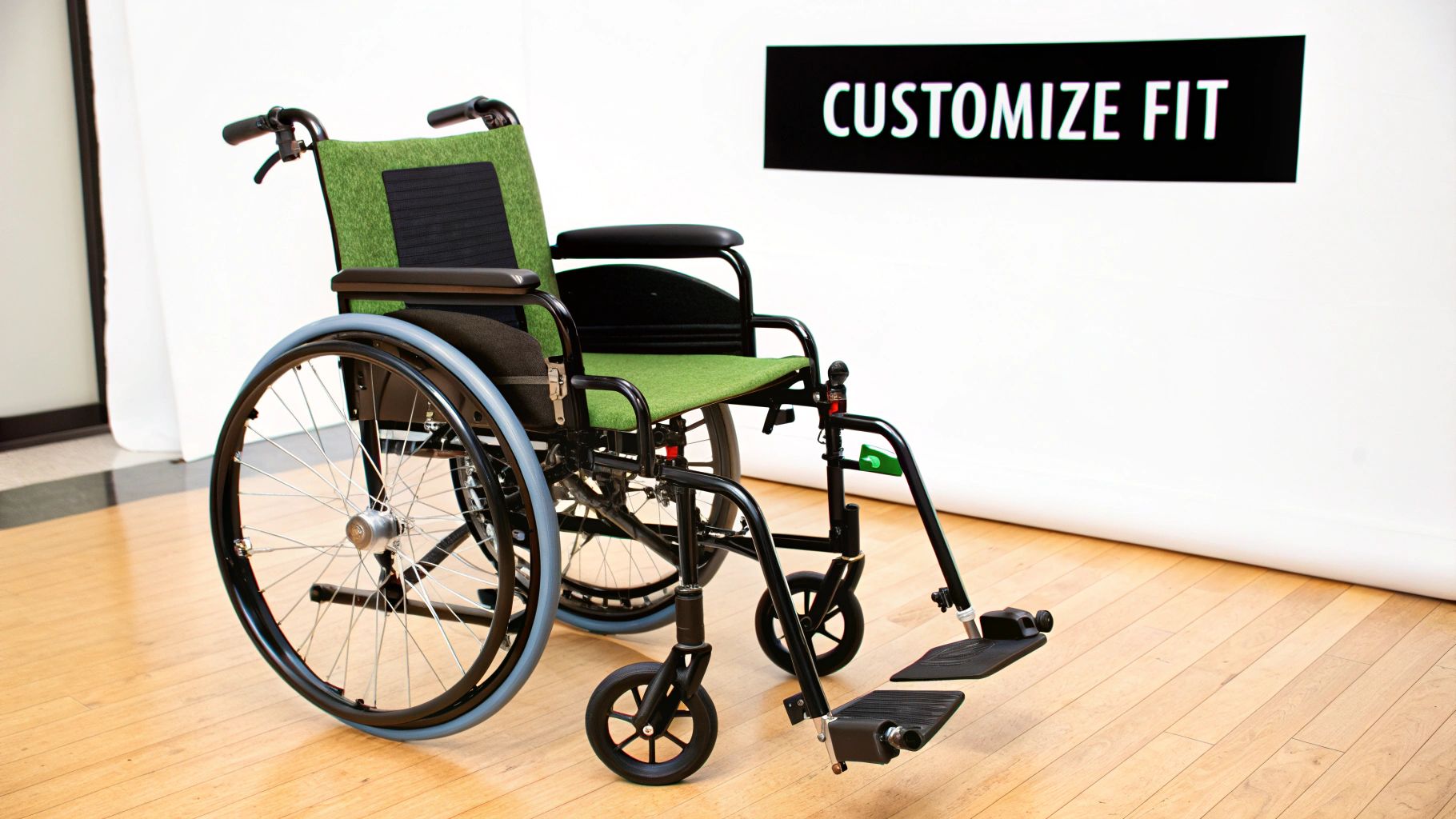
Once you’ve determined the right type of wheelchair and taken your measurements, you can focus on the details that transform a basic frame into a personalized mobility tool.
These components—from the tires to the armrests—directly impact your daily comfort, safety, and independence. It's helpful to distinguish between "must-have" features and "nice-to-have" additions. The right features can make a significant difference in your daily routine.
Wheels and Tires for Your Environment
The wheels are your wheelchair’s connection to the world, so choosing the right ones is critical for smooth navigation. Your primary environment is the key factor here.
- Standard Indoor Wheels: These are typically solid rubber tires. They are maintenance-free and glide easily over smooth indoor surfaces like tile, hardwood, or low-pile carpet.
- Pneumatic (Air-Filled) Tires: If you spend significant time outdoors, these tires provide a much smoother, cushioned ride by absorbing shock from uneven surfaces. The trade-off is that they require regular air checks and can get flats.
- All-Terrain Treads: For users who navigate grass, dirt trails, or other challenging surfaces, a deeper, more aggressive tread offers superior traction and stability.
A simple rule of thumb: consider where you'll spend 80% of your time. If you're mostly indoors, solid tires are a practical choice. If outdoor activities are a regular part of your life, pneumatic or all-terrain tires are essential.
Portability and Frame Weight
For many users and their caregivers, the ease of transport is a major consideration. The frame's weight is the most significant factor here, and modern materials have made a substantial difference.
Manual wheelchairs are particularly advantageous for portability, with some lightweight frames weighing as little as 15-25 lbs. They can often fold to just 12 inches wide, making them easy to fit into a car trunk.
However, weight isn't the only factor. Research from Maximize Market Research highlights that improper wheel height is linked to shoulder pain in 60% of users within six months. This makes features like an adjustable axle position and ergonomic handrims vital for long-term health.
Pro Tip: Look for models described as "ultralight" or made from materials like carbon fiber. They may have a higher upfront cost, but the ease of handling can be a significant benefit for caregivers who frequently lift the chair.
Cushioning for Pressure Relief and Comfort
A wheelchair cushion is a crucial piece of medical equipment designed to prevent painful pressure sores, improve posture, and enhance stability. Prolonged sitting creates high-pressure zones, particularly over bony areas, which can lead to serious skin breakdown.
There are several main types of cushions:
- Foam Cushions: These provide basic comfort and support, suitable for users at low risk for skin issues.
- Gel Cushions: These contain a fluid-like gel bladder that conforms to your body, offering excellent pressure distribution and a cooling effect.
- Air Cushions: Featuring interconnected, inflatable air cells, these cushions offer the highest level of pressure relief for users at high risk of developing sores.
A hybrid solution often works best. For example, our selection of Medline Gel-Foam Wheelchair Cushions combines the firm support of foam with the pressure-relieving properties of gel, offering the best of both worlds.
Must-Have Accessories for Safety and Convenience
Finally, a few key accessories can significantly improve the safety and functionality of your wheelchair.
- Anti-Tippers: These small wheels attach to the back of the frame to prevent the chair from tipping backward, an essential safety feature when navigating ramps or curbs.
- Braking Systems: Ensure the brakes are easily accessible for either the user or caregiver. Some chairs offer brake handle extensions for individuals with limited hand strength.
- Onboard Storage: A simple under-seat pouch or a backpack that hangs on the handles provides a convenient place to carry personal items, enhancing independence.
Navigating Payment Options: Insurance, FSAs, and Financing
Choosing the right wheelchair is the first step; determining how to pay for it is the next. The financial aspect can seem daunting, but several options are available, including tax-advantaged accounts, insurance benefits, and flexible payment plans.
One of the most direct payment methods is using a Flexible Spending Account (FSA) or a Health Savings Account (HSA). Wheelchairs are a qualified medical expense, allowing you to use these pre-tax dollars to cover the entire cost. All our mobility products at DME Superstore are eligible for FSA/HSA spending, simplifying the process.
Understanding Insurance Coverage
Insurance coverage for wheelchairs varies significantly by provider and plan. Medicare, Medicaid, and private insurance companies often cover a portion of the cost, but they have strict requirements and require specific documentation to prove the wheelchair is a medical necessity.
To prepare, you will likely need:
- A prescription from your doctor detailing why a wheelchair is medically necessary.
- Detailed clinical notes from an evaluation by a physical or occupational therapist.
- A formal quote for the specific wheelchair model selected with your therapist.
Navigating the financial side of a major medical purchase is a good reason to carefully choose the right health insurance plan to understand your coverage and potential out-of-pocket costs. It is always advisable to contact your insurance provider early to get clarity on their coverage and required paperwork.
Exploring Flexible Financing
If insurance does not cover the full amount or you need to cover the cost upfront, financing is an excellent option. This approach breaks the total cost into smaller, predictable monthly installments, making a high-quality wheelchair more accessible.
Financing is not just about managing cost; it's about gaining immediate access to the equipment you need to improve your mobility and quality of life without delay.
For instance, we offer financing through partners like Affirm, which allows you to set up a payment plan that fits your budget. By exploring all these avenues—FSA/HSA, insurance, and financing—you can create a payment solution that works for you and your family.
Your Final Checklist Before You Buy
Making the final call on a wheelchair is a big moment. You’ve put in the work—researching, measuring, and weighing your options. Think of this checklist as your final walkthrough, the last crucial step to ensure the chair you’ve picked will genuinely improve your comfort, safety, and daily life.
Before you complete your purchase, take a moment to run through these final points. This ensures your choice is a perfect fit for your world.
Confirming the Details
First, let's confirm the fundamentals that determine a good fit.
- Review Your Measurements: Compare your notes on seat width, depth, and back height against the product specifications. Do they match perfectly? This is non-negotiable for comfort and proper support.
- Verify Weight Capacity: Double-check that the chair’s maximum weight capacity is comfortably above your own weight. This is a critical safety checkpoint.
- Check Environmental Fit: Visualize the chair in your home. Will its total width fit through your narrowest doorway? Can it navigate tight corners? A fantastic chair is useless if it cannot move through your living space. If you have steps, our guide on choosing the right wheelchair ramps for your home can be helpful.
Involve Your Support System
You’re not in this alone. Getting a second opinion on your final choice can provide clarity and confidence.
Involve your caregiver, a trusted family member, or your physical therapist in the conversation. Show them the model you've selected and explain your reasoning. They may notice something you missed, especially if they will be assisting with transport or transfers. Their perspective is invaluable.
A collaborative decision is often the best decision. Involving your support network ensures the wheelchair works for everyone who will interact with it, creating a smoother experience for both the user and the caregiver.
Understand the Fine Print
Finally, a confident purchase means knowing what happens after the sale. Review the terms and conditions carefully.
- Warranty Information: What does the warranty cover, and for how long? Look for details on the frame, motor (for power chairs), and other components.
- Return Policy: What is the process if the chair isn't right upon arrival? At DME Superstore, we offer a 30-day return policy on most items, giving you time to be sure.
- Customer Support: What happens if you have a question later? Knowing help is available is important. Our 24/7 chat support is always there to handle any questions you might have.
Working through this checklist transforms uncertainty into empowerment. You’re not just buying equipment; you’re investing in a tool that will become a part of your daily routine.
Your Top Questions About Choosing a Wheelchair, Answered
Even after thorough research, some questions may remain. This section provides expert answers to common queries to help you finalize your decision with confidence.
How Do I Know If I Need a Standard or Heavy-Duty Wheelchair?
This is a critical safety question, and the answer comes down to one number: weight capacity.
Most standard wheelchairs are designed to support users weighing up to 250-300 lbs. If your weight is near or above this range, a heavy-duty (or bariatric) model is essential. These chairs are built with reinforced frames, wider seats, and more durable components to safely handle weights up to 600 lbs and beyond.
Always choose a chair with a weight capacity well above your own weight to ensure safety and longevity.
What’s the Real Difference Between a Transport Chair and a Wheelchair?
The primary distinction is the method of propulsion.
A standard manual wheelchair has large rear wheels with handrims, designed for the user to propel themselves independently.
A transport chair has four small wheels and is meant to be pushed by a companion. Because they lack large self-propulsion wheels, transport chairs are significantly lighter and more compact, making them ideal for short outings where assistance is available.
Are There Wheelchairs That Are Actually Easy to Travel With?
Yes, portability is a key feature in modern wheelchair design. For manual chairs, look for models described as "ultralight" or "travel-friendly." These often use lightweight aluminum or carbon fiber frames, with some weighing less than 30 lbs, and fold compactly to fit in a car trunk.
Even power wheelchairs can be travel-ready. You can find specific "airline-approved" models with FAA-compliant batteries for air travel.
Travel Tip: Before you book a flight, always call the airline directly. Ask about their specific policies for bringing a power wheelchair and its batteries on board. A quick phone call can save you from a major headache at the airport.
Can I Use My FSA or HSA Funds to Buy a Wheelchair?
Yes, you can. A wheelchair is a qualified medical expense, making it fully eligible for purchase using your Flexible Spending Account (FSA) or Health Savings Account (HSA). This allows you to use pre-tax dollars to cover the cost.
All mobility products here at DME Superstore can be purchased with your FSA or HSA card, making the entire process seamless.
At DME Superstore, our mission is to provide you with the knowledge and tools needed to live a more independent life. From feather-light transport chairs to robust, heavy-duty power models, we have a solution that fits your world. Explore our complete collection of wheelchairs and find your perfect match today.


1 comment
Thank you for the afticle on choosing a wheelchair. I’m getting a much clearer idea of the steps involved. At least I know the questions to ask now.