



You can still walk a few steps, but getting breakfast ready leaves you needing a rest. Your hallway is narrow, your bathroom doorway is awkward, and your family wants you to join an upcoming trip. A power wheelchair could help with all of that, but the chair that turns neatly beside your kitchen counter may not be the easiest one to load into a car.
Choosing among power wheelchair types starts with your daily routine, not a product photo. Where you'll drive, how you'll operate the controls, and who will transport the chair matter more than a promising speed or range figure.
The Main Power Wheelchair Types at a Glance
For a retiree who tires while moving around the kitchen, the first question isn't whether a chair looks compact. It's whether the chair can approach the refrigerator, turn out of the hallway, and leave enough room for a safe transfer. A family trip adds a different requirement: someone must be able to load and unload it.
The World Health Organization's wheelchair provision guidelines estimate that approximately 80 million people are likely to require a wheelchair. Powered chairs can help people who can't propel a manual chair, need to travel farther, or find varied terrain too tiring.
Start with use, control and transport
Ask where the chair will spend most of its time, who will control it, and how it will get moved between destinations. These questions help separate a useful feature from one that adds weight or complexity without helping your routine.
This visual connects common daily situations with the kind of chair worth investigating.
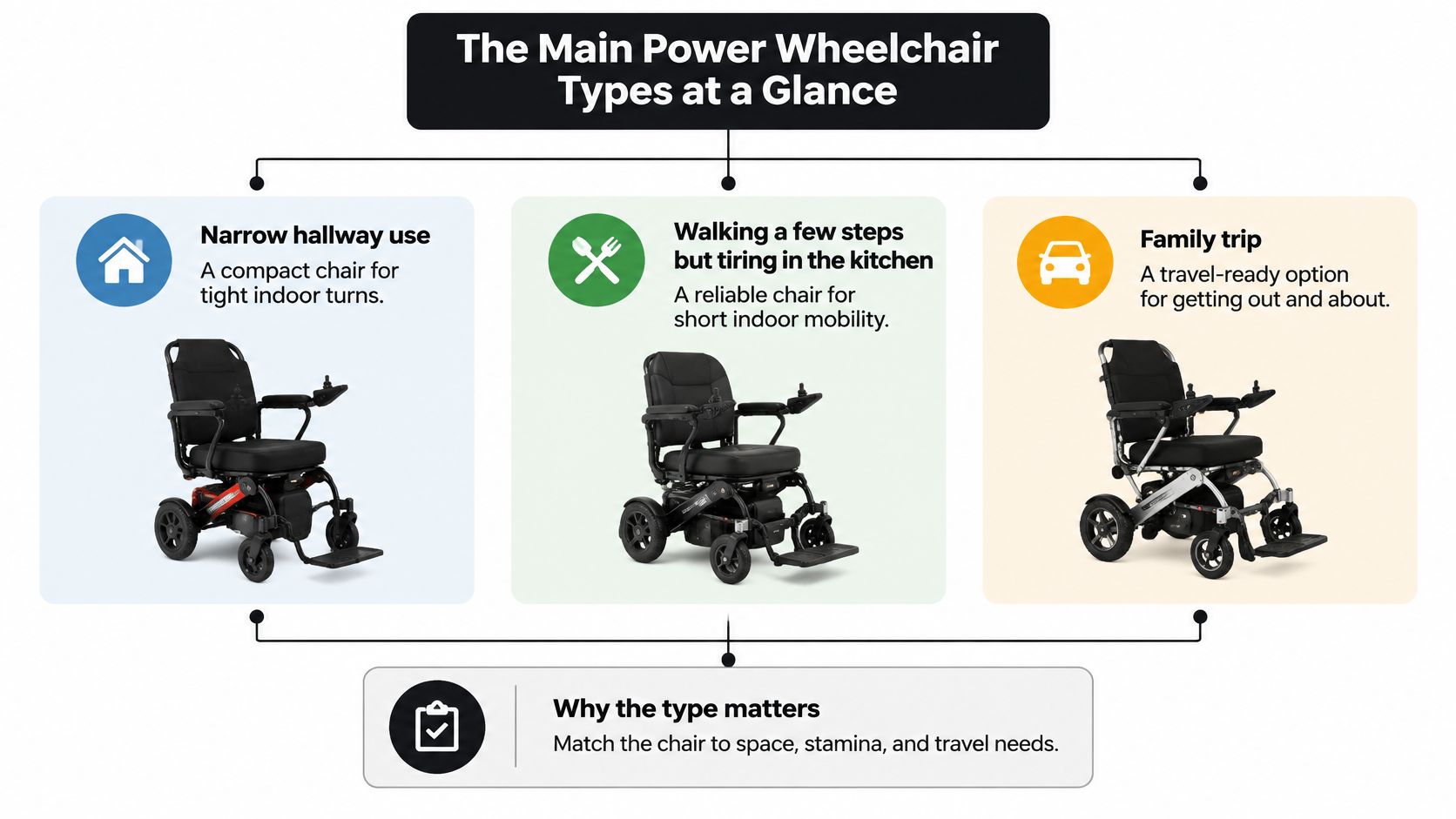
Power wheelchair categories by use case
| Type | Best for | Core design | Main trade-off |
|---|---|---|---|
| Compact indoor | Home-only users in tight rooms | Small footprint with mid-wheel or front-wheel drive | Limited outdoor and curb performance |
| Indoor/outdoor | Users moving between home and neighborhood | Sturdier frame, larger tires, often rear-wheel drive | Wider turning radius indoors |
| Portable and travel | Users who fold and transport the chair | Folding frame and potentially removable battery | Often lower capacity and added battery-handling requirements |
| Heavy-duty and bariatric | Users above standard weight ratings | Reinforced frame and wider seat | Heavier and harder to transport |
| Tilt, recline and standing | Users needing pressure redistribution or positioning | Powered seat geometry | Shifted center of mass and additional maintenance |
| Pediatric | Children needing correctly sized seating | Smaller seat and adapted controls | Needs refitting as the child grows |
These categories overlap. A portable chair can also have a higher weight rating, while an indoor/outdoor base may support powered positioning.
Check the product category before comparing models. Medicare's power mobility guidance separates power wheelchairs from power-operated vehicles, commonly called scooters; WHO distinguishes powered chairs from manual chairs.
Find the row that matches your home, body and transport situation, then compare individual models. A category name is a starting point, not proof that a particular chair will fit.
How Drive Configuration Changes Handling
Think of the drive wheels as something like the pivot point of a shopping trolley. Their position helps determine where the chair turns around you and how its weight shifts when you accelerate or stop. The analogy isn't exact, but it explains why chairs with similar dimensions can feel different to drive.
The main layouts place the powered wheels in front of, near, or behind the user's center of mass. This comparison shows the basic arrangement.
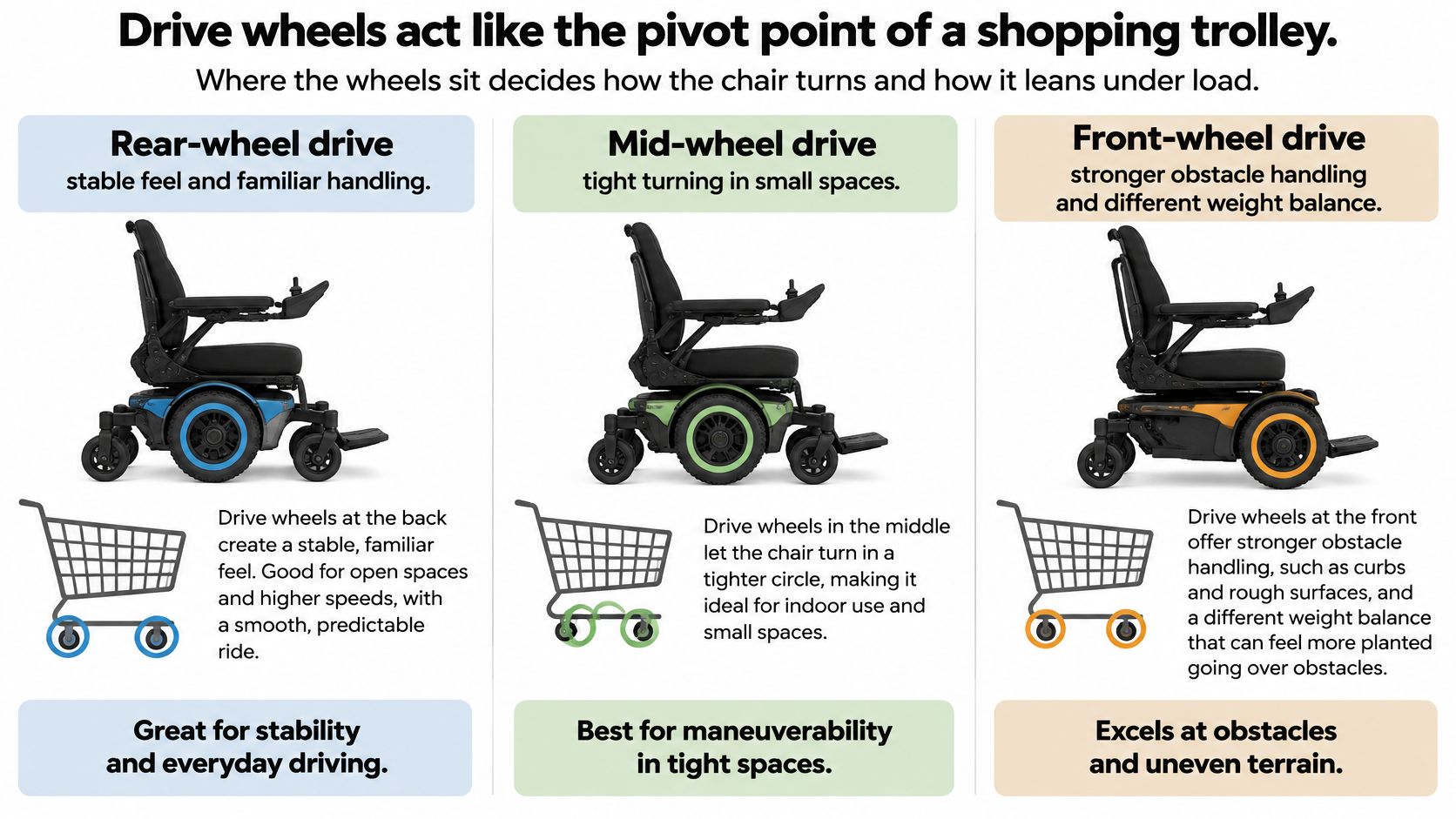
What each layout changes
Front-wheel drive places the drive wheels ahead of the user's center of mass. Those wheels approach obstacles first, which can help the chair negotiate suitable thresholds and curb transitions, but the rear of the chair needs room to swing during turns.
Mid-wheel drive places the powered wheels near the user's center of mass, making tight indoor turns its defining advantage. Rear-wheel drive generally offers predictable straight-line tracking and a stable outdoor feel, but requires more turning space.
Drive layouts and their handling trade-offs
| Drive layout | Turning behavior | Strength | Weak spot |
|---|---|---|---|
| Front-wheel drive | Turns with drive wheels ahead of the body | Approaches curbs and obstacles well | Needs tighter steering control |
| Mid-wheel drive | Pivots near the user's center of mass | Tightest turning radius | Slopes and rough ground demand careful model-specific assessment |
| Rear-wheel drive | Predictable straight-line tracking with broader turns | Outdoor directional stability | Wider turns in tight rooms |
These are tendencies, not safety guarantees. Suspension, caster arrangement, seating position and loading can change how a particular chair behaves.
For a closer look at tire and wheel considerations, our power wheelchair wheels guide helps distinguish the wheel assembly from the drive layout.
Why a tight turn doesn't prove outdoor suitability
During acceleration, braking and slope travel, the load shifts between the wheels. At a threshold, a caster may meet the raised edge before a powered wheel can provide traction, or the base may approach its clearance limit.
Say a mid-wheel chair turns neatly inside a bathroom but loses traction on a wet ramp. That hypothetical situation doesn't mean all mid-wheel chairs are unsuitable outdoors. It means indoor maneuverability doesn't establish traction or stability on a different surface, and a wet ramp isn't an appropriate place to experiment.
Practical rule: Evaluate the complete chair on its intended route, not just the location of its largest wheels.
Ask for these specifications in writing:
- Turning radius and overall dimensions: Check both the turning space and the clearance needed by footrests.
- Ground clearance and obstacle capability: Compare them with actual thresholds.
- Maximum slope and suspension: Establish the model's operating limits and terrain suitability.
- Total mass and rated occupant mass: Confirm the tested loading conditions and transport burden.
ISO 7176-2:2017 defines dynamic-stability testing for electrically powered wheelchairs and scooters with maximum nominal speeds up to 15 km/h. A speed or range claim alone doesn't answer those stability questions.
Watch how the base moves around the seated user when comparing layouts.
Your first decision is whether confined indoor turning or outdoor directional stability creates the greater everyday challenge. Then confirm that the specific model handles both safely.
Tilt, Recline and Standing Models Explained
Tilt-in-space is like tipping an entire supported seat backward while keeping the angle between your thighs and torso unchanged. Recline is closer to raising or lowering the back of a hospital bed: the angle at your hips opens. Standing adds a lifting movement, somewhat like a lift chair, but with a wheelchair-specific support system.
If you're unfamiliar with household lift seating, the Willis Furniture & Mattress lift chair guide provides useful context for that comparison. A lift recliner and a standing wheelchair aren't interchangeable, however, and their support and operating requirements differ.
Match the movement to the need
Tilt rotates the seating system together. A clinician may use it to redistribute interface pressure and support posture without opening the hip angle.
Recline can help with rest and care tasks, but substantial recline can create shear, the sliding force between the body and the seating surface. Coordinating the backrest, seat movement and leg-rest position matters because leaning farther backward isn't automatically better positioning.
Seat elevation can improve access to counters and eye-level conversation. Standing systems provide a different supported position, but neither feature should be assumed suitable for every transfer or every user; our guide to power wheelchairs that stand explains the distinction.
A useful seating movement must remain controllable and stable in the situation where you'll actually use it.
Check the whole adjustment range
Raising or repositioning the body changes the combined center of mass and the loads on the chair's mechanisms. ISO's posture-changing wheelchair standard, ISO 7176-30, requires safety and performance testing in critical configurations throughout the adjustable range, including combinations of tilt, recline, elevation and standing.
A clinician or caregiver should check:
- Usable movement: Whether the available travel meets the person's positioning needs.
- Coordinated actuators: How the backrest, seat and leg supports move together.
- Emergency lowering: What happens if power or a positioning mechanism fails.
- Control access: Whether the user can still reach and operate the controller after repositioning.
- Transport restraints: Which configurations and attachment arrangements are permitted.
- Slope restrictions: Which seating positions are allowed on an incline.
Consider someone who tilts on a sloped driveway and feels the chair become unstable. The safe response is to stop using that combination and have the setup reviewed, not to assume the feature is safe because it works on a level floor.
Ask for test documentation and operating restrictions for each intended configuration, rather than treating a brochure's positioning illustration as approval.
Portable Travel Models and Their Battery Rules
A folding power wheelchair isn't automatically cabin-ready. Portable usually describes a folding frame, lighter structure, and a battery that may or may not be removable. It doesn't establish how an airline will stow the chair or accept its battery.
The U.S. Department of Transportation's assistive-device stowage guidance explains that powered wheelchairs are generally too large and heavy for passenger cabins and usually travel in the cargo compartment; airlines may require up to 48 hours' advance notice on aircraft with fewer than 60 seats.
Separate portability from airline acceptance
For car travel, the main questions are whether the folded chair fits the opening and whether someone can lift or load it safely. Flying adds battery acceptance, aircraft dimensions and handling procedures.
This checklist highlights the physical features to examine before planning transport.
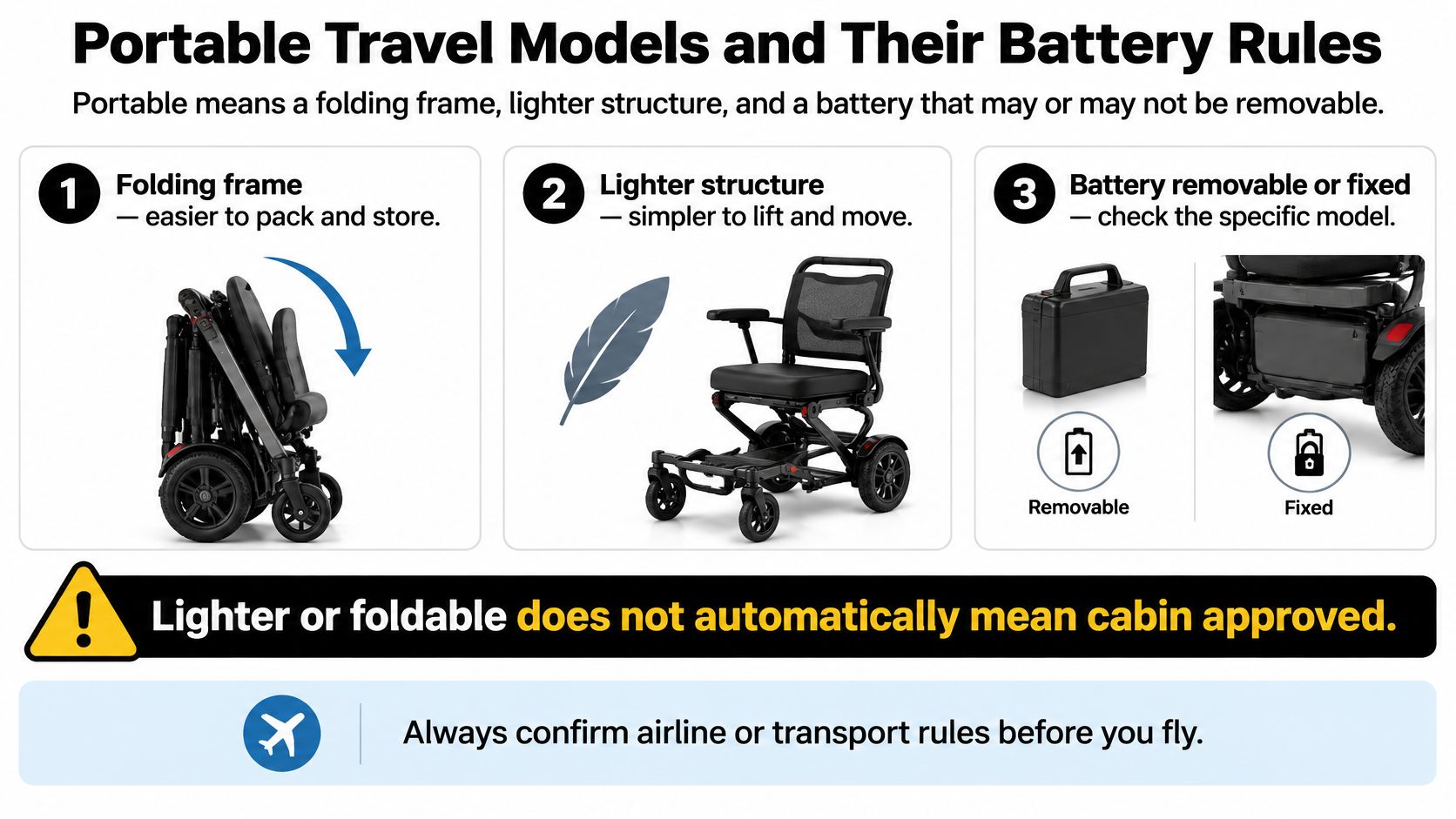
Our portable electric wheelchair guide for adults can help you compare transport-oriented designs. Keep the complete chair-and-battery configuration in view rather than choosing by frame material alone.
Verify the battery before booking
FAA battery guidance describes a 300 Wh limit for removable lithium-ion mobility-device batteries, requires removed batteries to travel in the cabin with terminals protected, and allows either one spare up to 300 Wh or two spares up to 160 Wh each. Installed batteries must be securely attached and adequately protected by the device's design; confirm the applicable arrangement with the airline rather than applying a removable-battery limit to every installed system.
Protection against short circuits and accidental activation matters alongside capacity. Tell the airline where the battery is located and provide the manufacturer's instructions for isolating power.
Say a traveler arrives with a folded chair expecting cabin storage. Staff determine that the chair must go in the hold and that its removable battery must travel separately in the cabin. The folding mechanism hasn't resolved either requirement.
Before departure, prepare the following:
- Battery identification: Record chemistry, watt-hours and the number of batteries.
- Removal instructions: Carry the manufacturer's steps, including any tools and terminal protection needed.
- Documentation: Keep the chair manual, battery specifications and airline correspondence accessible.
- Handling instructions: Identify safe lifting points, the power-isolation method and freewheel operation.
- Loading plan: Check folded dimensions, the vehicle opening and the caregiver's lifting ability.
- Arrival arrangements: Establish how you'll move while waiting for the chair to be returned.
Travel check: Confirm acceptance of the exact chair and battery configuration, not just a model's travel-oriented label.
Practice the loading and battery-handling routine before the journey. If a caregiver can't complete it safely at home, a busy departure area won't make it easier.
Heavy-Duty, Bariatric and Pediatric Power Chairs
A caregiver chooses a chair with an adequate weight rating, then discovers that the seat presses against the user's hips and leaves little room for a transfer. The chair may meet its load specification and still be the wrong fit. Capacity is a structural limit, not a seating assessment.
Heavy-duty, bariatric and pediatric chairs address different body and support needs. Frame construction, motor capability, tires, cushion compatibility and turning space all need consideration alongside the label.
Use capacity labels cautiously
There isn't a single capacity or seat width that reliably defines every chair in a category. Use the manufacturer's specification for the exact model and configuration, rather than assuming a category name establishes a universal range.
Weight capacity and seat sizing by category
| Category | Typical weight capacity | Typical seat width | Fit note |
|---|---|---|---|
| Standard power chair | Use the exact model's rated occupant limit | Match measured hip width and support needs | Suits adults whose dimensions and needs match the available seating |
| Heavy-duty power chair | Confirm the reinforced model's stated rating | Select from its documented seat options | Stronger frame and drive components can add transport weight |
| Bariatric power chair | Verify the complete configured chair's allowable load | Measure for adequate hip clearance and transfers | Account for bags and accessories under the manufacturer's loading rules |
| Pediatric power chair | Use the model's child-specific rating | Size to the child's body and prescribed supports | Refit as the child grows |
A heavy-duty design may use larger drive components or additional battery capacity to support its intended load. Those features can increase chair weight, but a higher capacity doesn't guarantee a longer usable range or easier outdoor handling.
Our heavy-duty power wheelchair guide helps identify the specifications to compare. Include the assembled chair's width and loading method, because a suitable seat is little help if the base can't reach the bedroom.
Fit the person, not just the rating
For bariatric seating, measure hip width, thigh length and lower-leg support needs. A seat that's too narrow can restrict movement; one that's unnecessarily wide may make arm support and control access awkward.
Ask how the manufacturer defines occupant capacity and total loading. Bags, oxygen equipment and mounted accessories must be accounted for within the applicable limits, not assumed to be weight-free additions.
Check the transfer setup as carefully as seated comfort:
- Arm supports: Establish whether they move out of the transfer path.
- Seat height and cushion: Compare the finished seating surface with the bed or transfer surface.
- Foot supports: Confirm they can be positioned without obstructing the transfer.
- Clearance: Leave room for the caregiver and any transfer equipment.
For a child, seat depth and height must suit their current body, while controls must match reach, coordination and understanding. Growth adjustment is useful only when the supports remain correctly positioned; buying an oversized seat isn't a substitute for refitting.
Confirm bariatric and pediatric selections through a clinical seating assessment. The goal is supported, usable mobility throughout the day, not just staying below a number on a specification sheet.
Matching the Type to Your Driver, Home and Next Step
Consider an older adult with arthritis in both hands who can steer with a light touch but can't comfortably grip a standard joystick. Their daughter loads the chair into a car each week. The right choice must accommodate both the user's control needs and the daughter's loading routine.
CMS power-mobility guidance requires the patient to be mentally and physically able to operate the power wheelchair, unless an available, willing and able caregiver can operate it safely. Strength, endurance, range of motion, coordination and upper-extremity function therefore help determine the appropriate control arrangement.
Establish who drives
A joystick-controlled chair may work when the user can make consistent directional movements. An adapted joystick or alternative input may be appropriate when grip, reach or coordination makes the standard control unsuitable; caregiver-operated controls require their own assessment and practice.
Don't equate caregiver-operated with portable. A caregiver who drives the chair may still need substantial seating support for the user, while a caregiver who only transports it needs a manageable loading arrangement.
Medicare's power mobility coverage policy ties eligibility to limitations affecting home activities such as toileting, feeding, dressing, grooming or bathing, requires that a fitted cane or walker not safely and sufficiently resolve the limitation, and considers whether the person can propel an optimally configured manual wheelchair. Coverage decisions aren't based solely on a preference for powered travel.
Vehicle loading deserves a hands-on check with the person who will do it.
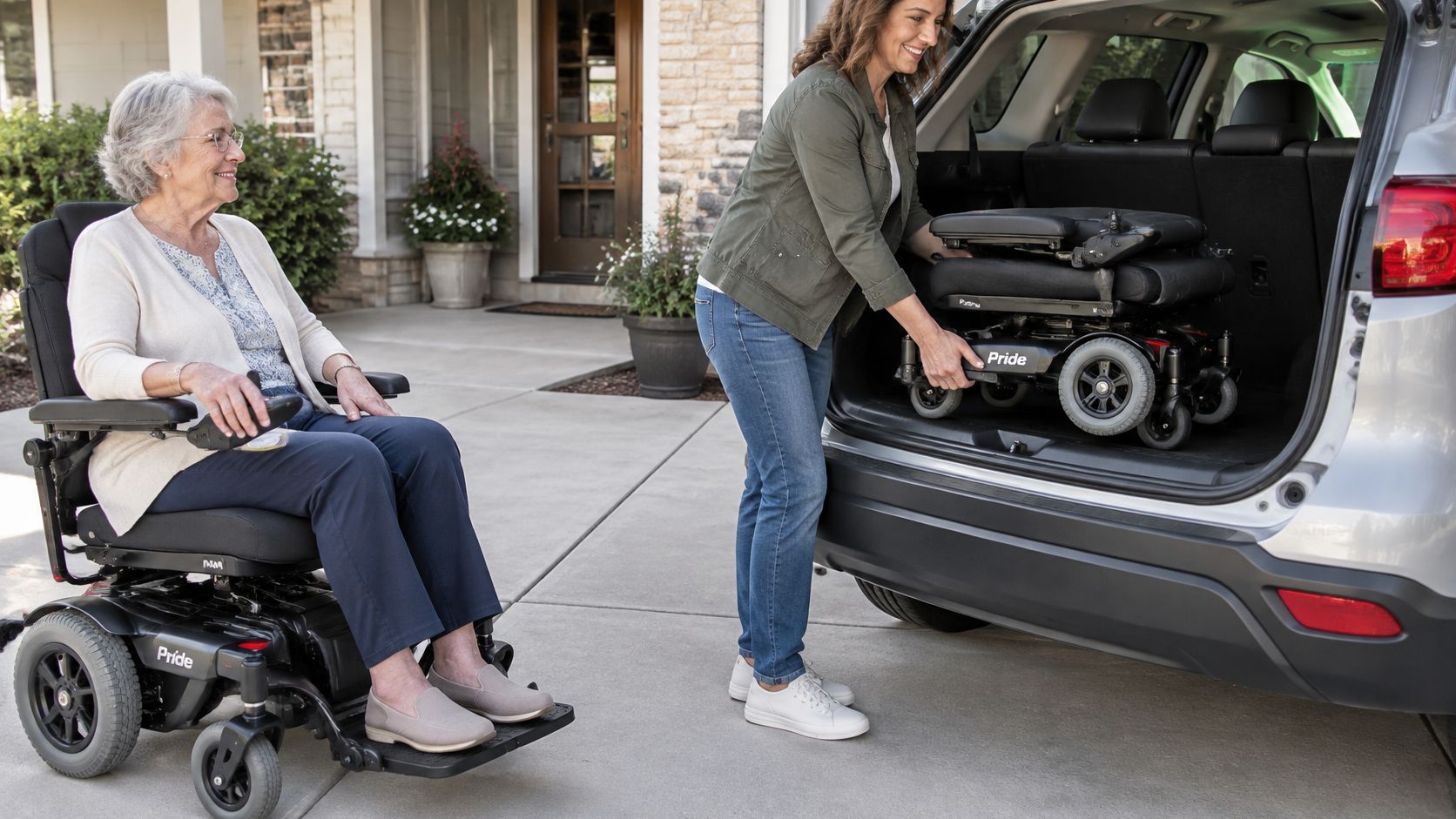
Run the checks in a practical order
Use our power wheelchair assessment guide to prepare a written comparison, then work through these checks:
- Environment audit: Measure clear door openings, thresholds and turning areas. Record floor surfaces, ramp slopes, transfer side, storage and charging location.
- User-ability check: Identify who drives and which controls remain comfortable and dependable when the user is tired.
- Transport check: Document battery specifications, removability, folded dimensions and the actual loading method.
If the user drives, prioritize accessible controls and predictable handling. If a caregiver drives, confirm control placement and visibility; if they also lift the chair, assess transport weight separately. In a narrow home, test the complete turning path rather than relying on overall width.
Our product examples show why labels need careful reading: the Pride Jazzy Carbon HD Bariatric Portable Powerchair has a 400 lb capacity, weighs 32 lbs without its battery, and includes Quick Fold; the SuperPi P2 Portable Electric Wheelchair is an aviation-grade carbon fiber folding electric wheelchair. Our Medline Guardian Extra-Wide Bariatric Wheelchairs have a 500 lb capacity, 20 to 26 inch seat widths, and fold easily, but they're manual wheelchairs, not interchangeable powered alternatives.
Request turning radius, maximum slope, rated occupant weight, battery specifications, and applicable stability or posture-testing documentation. Review the shortlist with a clinician and, when seeking coverage, your insurer before purchasing.
Write down the category that matches your home and driver, followed by the features you can't compromise on. That becomes a more useful shopping guide than the longest range claim.
DME Superstore offers powerchairs, manual mobility equipment and home-access solutions, with specifications that help you compare fit and transport requirements. Visit DME Superstore with your doorway measurements, control needs and loading plan to narrow your options before reviewing the final choice with your clinician.

