



You're comparing portable electric wheelchairs for adults because ordinary mobility has started to depend on logistics. A caregiver may need to lift a folded chair into a sedan, get it through an apartment doorway, and bring it on a trip without discovering at the airport that the battery must be handled separately. The chair that looks easiest to carry in a product photo may be awkward to use, uncomfortable after a short outing, or unsuitable for the surfaces outside your home.
The market is growing because the need is real. One industry forecast places the global adult electric wheelchair segment at US$1,686.5 million in 2024, with a projection of US$3,529.5 million by 2030, at about 13.1% compound annual growth over that period. In the United States, the market generated US$643.1 million in 2023 and is projected to reach US$1,044.3 million by 2030. Adults represented 68.89% of U.S. electric wheelchair revenue in 2024, according to the adult electric wheelchair market forecast.
This guide takes a firm position: portability isn't a weight number. It's a system of folded size, battery compliance, occupied weight, seat fit, and destination terrain. Judge every chair against those five constraints, and you'll avoid the expensive mistake of buying a model that travels well in theory but fails in your daily routine.
A Real Moment That Shows Why 'Portable' Is Complicated
A daughter folds her father's chair beside the curb while rain starts to fall. The product page called it lightweight, so she expected an easy lift into the sedan. The folded frame fits the trunk, but the rear wheels catch on the opening, and once the chair is inside, there's barely room for the battery and a walker. At the destination, the chair clears the apartment doorway but struggles on the entrance ramp with her father seated in it.
That same problem appears in different forms. A carbon-fiber chair weighing 26 pounds without its battery can use dual 150 W brushless motors, a 24 V 10 Ah lithium pack, and provide about 10 miles of range. A heavier foldable chair weighing around 56 to 69 pounds may support a 300-pound user and claim roughly 12.5 to 13 miles. Those examples from portable electric wheelchair listings show why the lightest frame isn't automatically the most useful one.
A narrow frame can clear a doorway yet provide a cramped seat. A larger battery can extend an outing yet add lifting weight and create more airline paperwork. A powerful motor can help on ramps, while smaller wheels and a compact wheelbase may still feel harsh on broken pavement.
Practical rule: The right chair is the one your household can lift, your body can fit, your vehicle can carry, and your destination can support.
Before choosing, write down the actual obstacles. Measure the trunk opening, not just the trunk volume. Measure the narrowest doorway. Identify who will lift the chair, whether the battery comes out, and whether the route includes ramps, grass, gravel, or uneven sidewalks. Portability only exists when all five conditions work together.
What a Portable Electric Wheelchair for Adults Actually Is
A portable electric wheelchair for adults is a motorized mobility device designed to give an adult powered movement while making transport easier through folding, partial disassembly, or a compact frame. Some models are treated as FDA Class II medical devices. For example, Pride Mobility identifies the Go Chair Med as an FDA Class II device and assigns it HCPCS code K0821 for a Group 2 Standard Portable power wheelchair, as shown on the Go Chair Med product information.
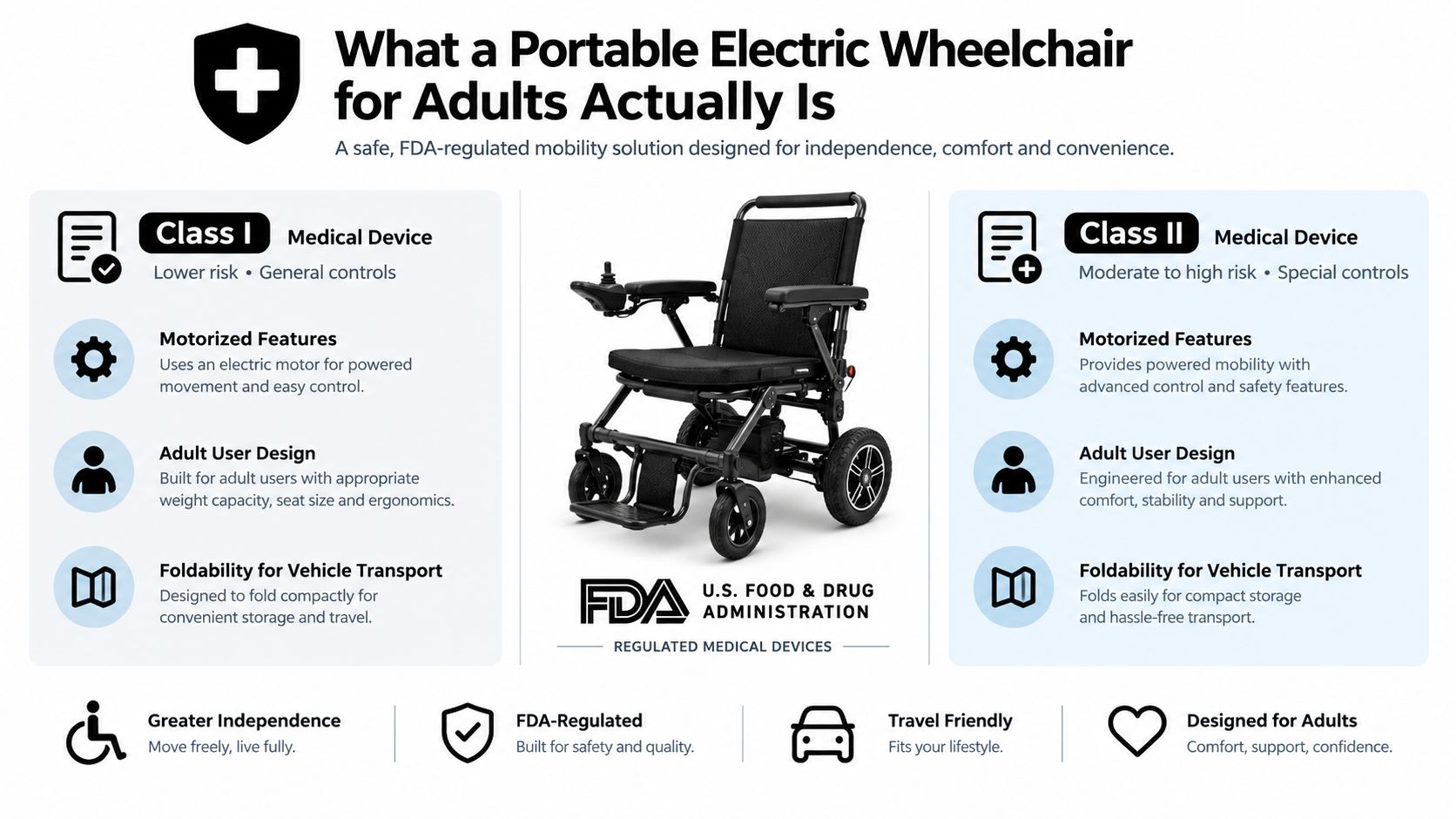
The category sits between a manual wheelchair and a full-size powerchair. Portable models generally use lighter frames, smaller battery systems, compact drive bases, and shorter wheelbases. Full-size chairs usually prioritize seating support, range, stability, suspension, and adjustment over being lifted into a car.
The intended use matters more than the label. A travel-focused chair can be excellent for errands, indoor movement, visiting family, and occasional trips. It may not be suitable as an adult's only mobility base if the person needs all-day positioning, advanced seating support, frequent outdoor travel, or dependable performance over rough ground. A guide to different kinds of wheelchairs can help place portable powerchairs within the broader mobility category.
Read the label as a starting point
Manufacturers use “portable” loosely. A chair may fold but still require two people to lift it. Another may disassemble into manageable sections but occupy more storage space than expected. Some products are marketed for travel without making the battery removal process or airline documentation clear.
Check the manufacturer's classification, user manual, battery specifications, warranty, and service information. Don't rely on a marketplace title alone. A genuine portable design should explain how it moves from driving mode to transport mode, who can manage each component, and what restrictions apply to the battery.
Key Specifications That Decide Whether a Chair Fits Your Life
Start with the five specifications that determine whether a chair works beyond the showroom. Product pages often highlight the lowest frame weight and maximum range, but those figures rarely describe the complete transport and driving experience.
Weight means lifting weight
Separate curb weight, battery weight, seat assembly weight, and the weight of any removable parts. Adult portable chairs commonly occupy a practical range of roughly 33 to 70 pounds, but the number that matters is the heaviest piece the caregiver or user must lift.
A chair that weighs less than its competitors may use a smaller battery, narrower seat, or lighter motor system. Ask, “What is the heaviest component I'll lift into my vehicle, and is that figure with the battery installed?”
Folding style changes storage
Manual pull-fold designs are simple, but they may remain tall or wide when folded. Two-piece designs reduce lifting strain, while tool-free quick-release systems can make repeated loading easier. Ask for folded length, folded width, and folded height in inches, then compare those measurements with the actual trunk opening and closet space.
Battery data needs more than a range claim
Look for battery chemistry, voltage, amp-hour rating, watt-hours, charging method, and whether the battery is removable. Portable adult chairs often claim roughly 8 to 15 miles per charge, but terrain, rider weight, temperature, tire condition, and stop-and-go driving affect practical performance.
Ask, “What is the battery's watt-hour rating, and what range should I expect on my route with my weight and terrain?” A range claim without battery details is an incomplete comparison.
Seat dimensions protect daily comfort
Seat width, seat depth, and back height determine whether the chair supports the adult comfortably. A seat that feels acceptable for a short store visit may become restrictive during a longer outing. Ask for the usable seat width, not only the outside chair width, and check whether the armrests, cushion, and joystick position can be adjusted.
Capacity isn't a comfort guarantee
Many portable models fall around 250 to 330 pounds of user capacity, but capacity doesn't describe stability, transfer support, or comfort at the upper limit. A marketed example lists a 500 W motor, up to 12 miles of range, a 51-pound item weight, and a 264-pound support limit on its portable electric wheelchair listing. Another advertises a 30-pound chair, a 220-pound capacity, folding in less than 3 seconds, and 10 to 12 miles of claimed travel distance in its ultra-light folding wheelchair listing.
| Spec | Typical Adult Portable Range | Question to Ask |
|---|---|---|
| Transport weight | About 33 to 70 pounds | What is the heaviest piece I'll lift? |
| Folded or disassembled format | Varies by design | Will it clear my trunk opening and storage area? |
| Battery and range | About 8 to 15 miles claimed range | What are the watt-hours and realistic conditions? |
| Seat dimensions | Must be matched to the user | What are the usable width, depth, and back height? |
| User capacity | Commonly 250 to 330 pounds | Does the capacity leave room for clothing and accessories? |
For a deeper explanation of foldable versus non-foldable electric wheelchairs, focus on the mechanism's effect on your routine, not the marketing language.
Portable Powerchairs Compared to Full-Size Powerchairs
Portable and full-size powerchairs solve different mobility problems. A portable model earns its place through transportability. A full-size chair earns its place through endurance, support, and outdoor capability.
| Attribute | Portable Powerchair | Full-Size Powerchair |
|---|---|---|
| Portability | Folds or separates for vehicle transport | Usually needs a lift, ramp, or accessible van |
| Range and battery | Smaller battery system and shorter travel focus | Larger batteries and longer daily-use capability |
| Ride comfort | Compact seating and limited suspension are common | More seating options and stronger suspension potential |
| Frame and electronics | Lighter construction with transport in mind | Heavier base designed for sustained use |
| Cost over ownership | Lower purchase burden may be offset by replacement batteries or service needs | Higher initial commitment, often with more integrated support |
A portable chair is usually the better choice for an adult who has a dependable manual chair or walks part of the day, travels by car, and needs powered assistance for selected outings. A full-size chair is the more responsible choice when the user spends most of the day seated, needs specialized positioning, or regularly crosses rough outdoor surfaces.
One mid-size folding chair can narrow the gap. A model with a 250-pound capacity and a 12-mile range may work well as a daily car-trunk chair without pretending to replace a full-size power base. That middle ground suits many households, provided the seat fit and terrain match the user.
A smaller chair isn't a smaller version of every capability. It's a different set of priorities.
Use the comparison to answer three questions. Does the adult need the chair for occasional or continuous mobility? Who will transport it, and with what vehicle equipment? What terrain and seating support does the daily route demand? Those answers determine which compromises are acceptable.
For a broader comparison of manual wheelchair versus power wheelchair, consider the adult's full mobility routine rather than the number of hours spent outside the home.
Airline, Cruise, and Road Transport Rules You Should Know First
Travel rules can turn a promising portable chair into a trip problem. Verify the battery and handling requirements before booking, not at the airport counter.
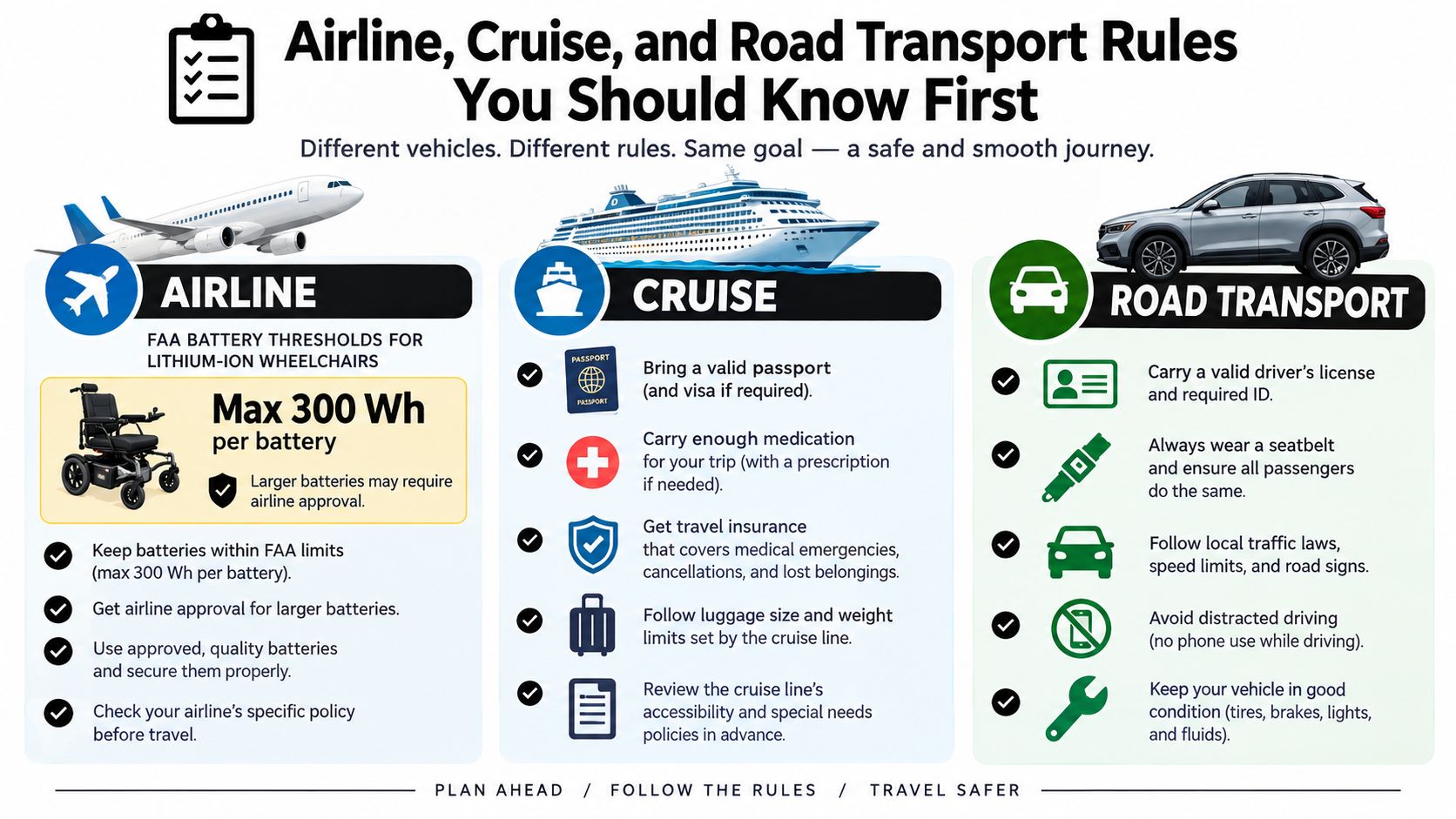
The FAA discusses mobility-device batteries through its airline passenger battery guidance. Lithium-ion battery rules depend on the design, watt-hour rating, whether the battery is installed or removed, and the airline's approval. Some configurations use a 300 Wh threshold, while airlines may apply additional restrictions or refuse certain spare batteries.
Run the airline checklist
- Confirm the battery rating: Record the watt-hours from the battery label and manual.
- Ask about removal: Find out whether the airline wants the battery installed, removed, protected, or carried separately.
- Request approval early: Some airlines may require 48 hours' notice, particularly for certain aircraft under 60 seats, according to U.S. DOT guidance.
- Plan for the cargo hold: Most battery-powered wheelchairs are too large for cabin stowage and travel in the cargo hold or through gate-check handling.
- Label every component: Keep battery labels, operating instructions, and removal instructions with the chair.
- Get the airline's answer in writing: Airport staff need clear documentation when a configuration has special handling requirements.
A chair advertised as airline approved still needs airline-specific confirmation. “Portable” doesn't mean the device fits in the cabin, and a removable battery doesn't eliminate the need to check the aircraft, route, and carrier rules.
Cruises and road trips need their own measurements
For a cruise, measure the chair's operating width and the narrowest expected cabin or bathroom doorway. Ask the cruise line about gangway clearance, cabin access, and tender-boat procedures on port days. A chair that handles a terminal may not be accepted on every excursion or small transfer vessel.
For road transport, calculate the weight of the folded or disassembled chair, battery, accessories, and any lifting equipment. If a rider remains seated during vehicle transport, use an approved occupant restraint and follow the vehicle and chair manufacturer's instructions. A trunk that accepts the frame may not accommodate the battery, cushion, and caregiver equipment.
Before travel, watch the practical handling demonstration below, then confirm the same steps with the airline, cruise operator, or transport provider.
The power wheelchair transportation guide is useful for planning the vehicle side of the journey, but it cannot replace confirmation from the carrier handling your specific trip.
Three Adult Portables That Show How the Category Splits
“Portable electric wheelchair for adults” describes a broad range, not a single design. The right profile depends on who drives, who lifts, how long the chair is used, and where it rolls.
The frequent solo traveler
This user prioritizes a lightweight carbon-fiber or aluminum frame near 35 pounds without batteries. The goal is manageable handling, compact storage, and a battery configuration that the chosen airline accepts. The trade-off is usually a narrower seat, lower capacity, less substantial suspension, and reduced tolerance for rough surfaces.
A lightweight chair can be the right answer for an adult who transfers independently, travels with limited luggage, and mainly uses the chair indoors or on smooth paved routes. It's a poor choice for someone who needs a wide seat, frequent ramp use, or strong support over broken sidewalks.
The car-trunk daily driver
The middle profile centers on a foldable chair around 55 pounds, a 250-pound capacity, a claimed 10 to 15-mile range, and a 17- to 18-inch seat width. This is the practical compromise for errands, medical appointments, family visits, and cruise travel.
The chair is heavier than the solo traveler's model but can provide a more usable seat and a larger battery. The caregiver still needs to test the lift, because a folded chair's shape can make a moderate weight feel awkward. Review the Metro Mobility iTravel Plus portable electric wheelchair by checking its complete transport weight and dimensions against your vehicle.
The higher-capacity outdoor user
The third profile needs capacity beyond 300 pounds, stronger motors, and larger rear wheels for uneven terrain. The frame may weigh roughly 65 to 75 pounds, making independent lifting less likely. A ramp, vehicle lift, or two-person loading plan may be necessary.
This chair gives up easy portability to gain stability, seat room, and more confidence outside. It still may not replace a full-size powerchair for all-day positioning or demanding terrain. The correct decision isn't “light or heavy.” It's whether the adult's support needs make the lighter option unsafe or impractical.
A Buyer's Checklist for Choosing the Right Adult Portable
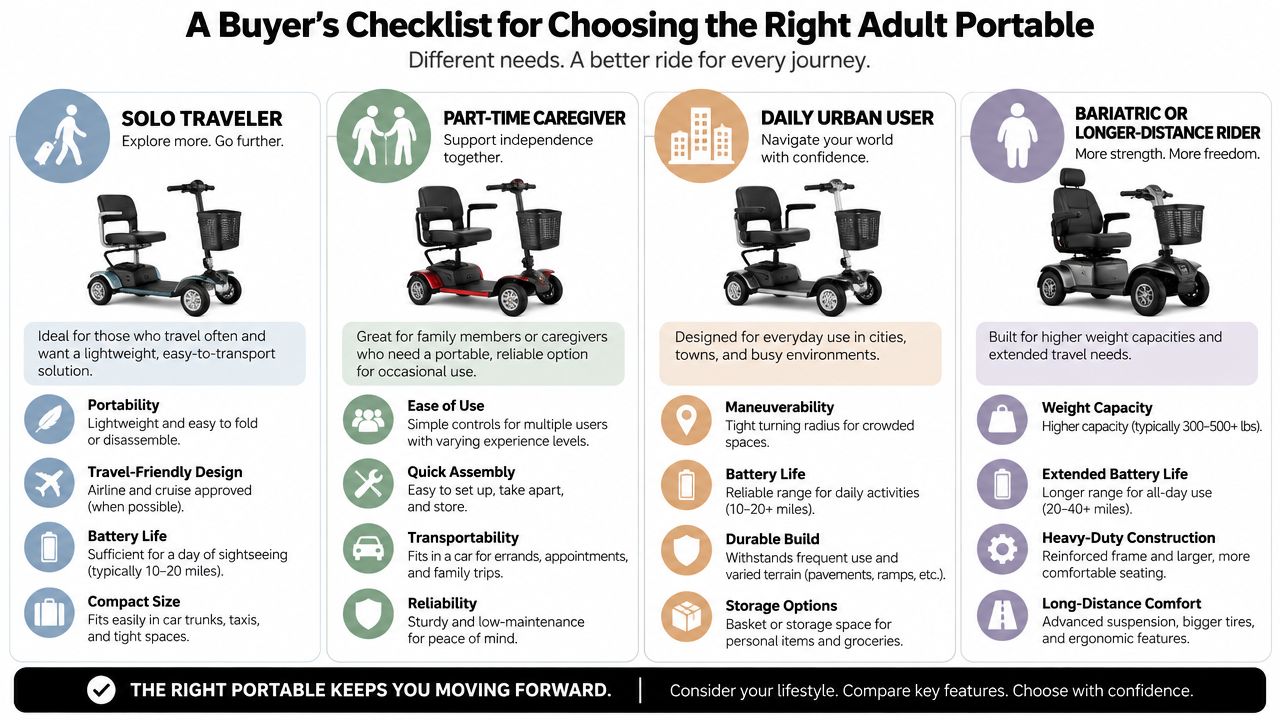
Use four user profiles to build a shortlist. Don't begin with a brand. Begin with the person, the vehicle, and the route.
Solo traveler
Prioritize the lightest manageable component, folded dimensions, removable battery design, and airline documentation. Confirm the seat width before choosing a model marketed for cabin or airport travel. A light frame that leaves the adult unstable or cramped isn't a successful travel chair.
Part-time caregiver
Focus on the heaviest lift, grip points, folding sequence, and whether the battery can be carried separately. Have the caregiver perform the entire loading process during a demo. If the person loading the chair can't repeat the process without twisting, dropping, or rushing, the model fails the transport test.
Daily urban user
Give more weight to seat fit, turning clearance, curb transitions, battery reserve, and handling over rough pavement. Compact adult powerchairs report turning radii of about 25.5 to 29.9 inches, while some larger foldables are closer to 33 to 35.4 inches. The compact powerchair specifications illustrate how a tighter turning radius can help indoors while smaller wheels may limit rough-surface performance.
Bariatric or longer-distance rider
Start with user capacity, seat width and depth, motor output, wheel size, and battery capacity. Don't allow a low transport weight to override safe fit or stability. Check whether the warranty and service network support the chair's expected daily workload.
Score each candidate against the five constraints: folded size, battery compliance, occupied weight, seat fit, and terrain. Mark every constraint as pass, borderline, or fail. A chair that wins on weight but fails the seat-fit or terrain test should leave the shortlist.
Before purchase, verify insurance eligibility, warranty terms, local service, replacement batteries, tires, chargers, and controller availability. During a retailer demo, flag joystick lag, difficult folding, unexpected frame flex, poor foot support, pressure points, unstable transfers, and any need to lift the chair from a position that strains the caregiver.
Putting It All Together Before You Click Buy
Treat every chair as a five-part system. Folded size determines whether it fits the vehicle and storage area. Battery compliance determines whether it can travel on the chosen airline. Occupied weight affects lifting equipment and transport planning. Seat fit determines whether the adult can use it comfortably. Destination terrain determines whether the motors, wheels, and stability match the route.
Bring these questions to any retailer, including DME Superstore:
- What is the total transport weight, and what is the heaviest single piece?
- What are the folded dimensions, and will they clear my trunk opening?
- What is the battery watt-hour rating, and has my airline approved this setup?
- Does the seat fit my width, depth, and transfer needs?
- How does the chair perform on the actual ramps, sidewalks, and surfaces I use?
Try a demo whenever possible. Test the folding rhythm, joystick feel, turning clearance, transfer support, and seated comfort. Confidence comes from matching the chair to real conditions, not from choosing the smallest number on a specification sheet.
DME Superstore offers portable powerchairs, including folding and travel-oriented models, with product specifications, compatibility information, and warranty details for comparison. Review the available options at DME Superstore, then contact its support team to confirm fit, transport requirements, and battery documentation before ordering.
