



A transfer from bed to wheelchair can turn an ordinary morning into a stressful test of strength. You may be supporting a loved one who's weak, unsteady, unable to bear weight, or afraid of falling, while also trying to protect your own back and preserve their privacy. Repeating that process for toileting, bathing, meals, and rest can make caregiving feel physically exhausting and emotionally heavy.
Patient transfer lifts offer a more controlled way to move someone between surfaces. The right equipment can reduce manual lifting, support a person's dignity, and help a family caregiver provide care without treating every transfer as a dangerous improvisation. This guide explains how lifts work, how the main types differ, and what to check before bringing one into your home.
The Daily Challenge of Patient Transfers
Mara starts each morning by helping her father move from bed to his wheelchair. He can follow instructions, but his legs don't reliably support him, and his balance changes from one day to the next. On difficult mornings, Mara braces her feet, reaches around his torso, and tries to guide most of his weight while keeping the wheelchair steady.
Neither of them feels comfortable with that routine. Her father worries about slipping, and Mara worries about twisting her back. Even when the transfer goes smoothly, the effort leaves both of them tense before the day has properly begun.
That experience is common among family caregivers. A transfer isn't just a matter of getting from one surface to another. It involves positioning, timing, communication, balance, skin protection, and enough room for the caregiver to work safely. Fatigue can make each part harder, especially when the same movement happens repeatedly.
A patient lift changes the caregiver's role. Instead of trying to act as the person's lifting strength, the caregiver operates equipment that supports the body through the movement. The person being transferred still deserves clear explanations and reassurance, but the caregiver no longer has to carry the full physical demand with their arms and back.
A safer transfer should feel organized, not rushed.
Good technique remains important. Review safe patient transfer techniques, follow the manufacturer's instructions, and ask a qualified clinician or therapist to demonstrate the equipment when possible. A lift isn't a substitute for training, but it can create a much more stable foundation for daily care.
The larger benefit is independence for both people. Your loved one can move with less fear and exposure, while you can continue helping without accepting manual lifting as an unavoidable part of caregiving.
What Are Patient Transfer Lifts and Why They Matter
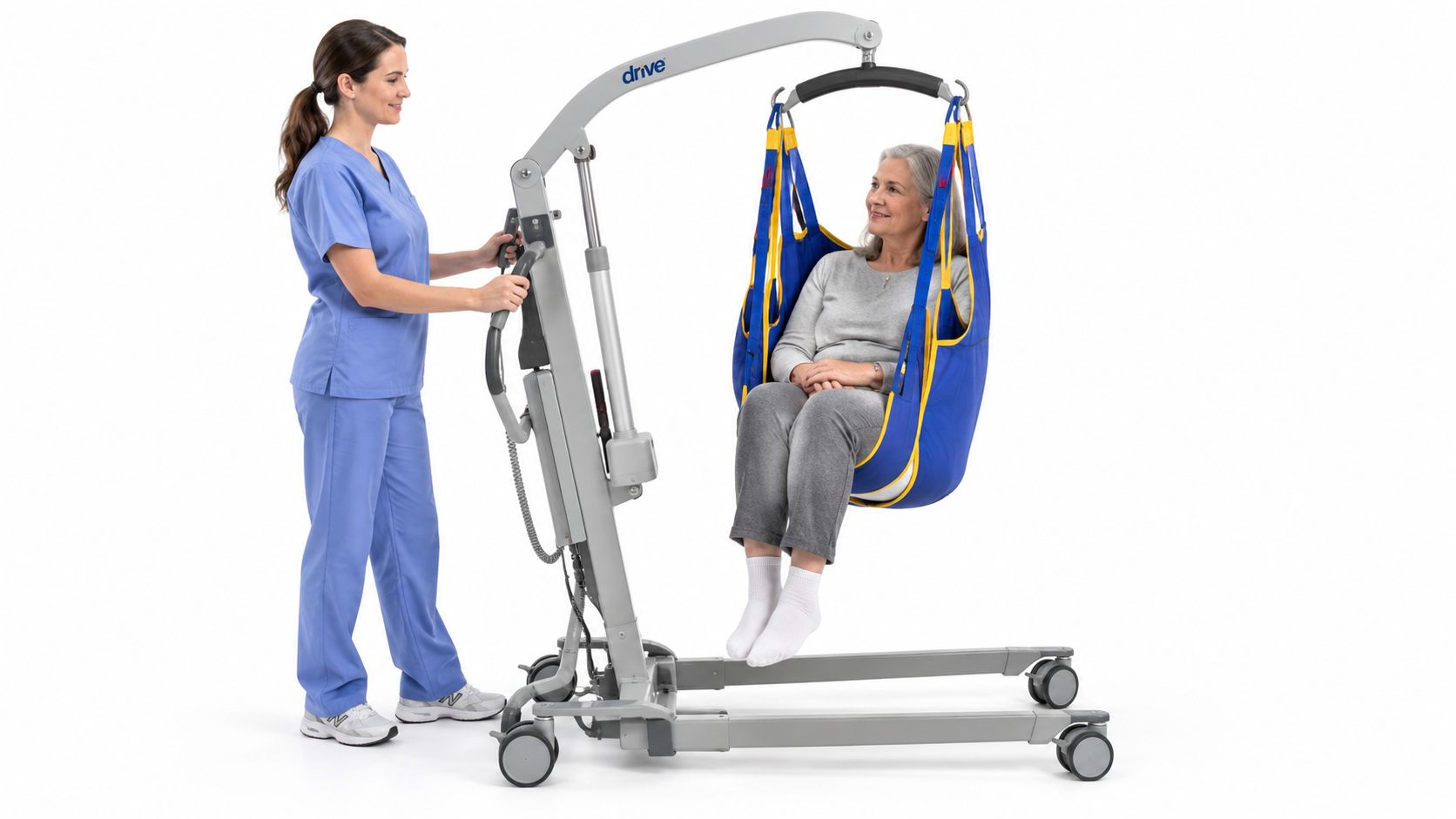
A patient transfer lift is a mechanical device that raises and moves a person between surfaces, such as a bed, wheelchair, commode, recliner, or shower chair. Most systems use a frame or track, a lifting mechanism, a support bar or attachment point, and a sling or other body-supporting component.
A useful analogy is a personal crane for people. A construction crane doesn't ask workers to lift a heavy load with their backs. It uses a stable structure and controlled movement. A patient lift applies the same basic idea on a smaller scale, supporting the person while the caregiver guides the transfer.
The purpose isn't to make the person feel like cargo. Properly selected equipment supports the body evenly and lets the caregiver explain each step, pause when needed, and position the person carefully. That can make the experience feel more predictable and less exposing.
The mechanical safety difference
Manual transfers can place substantial force on the caregiver's lower back. A biomechanical analysis found that manual methods produced predicted peak low-back compression forces greater than 10,000 N, above the NIOSH upper limit of 6,400 N. Mechanical lift devices kept back-compression forces below their design limits, according to the biomechanical analysis of patient transfers.
That difference matters because a caregiver may be able to complete one difficult transfer through effort, but repeated strain can accumulate. The lift takes over the raising and lowering motion, while the caregiver focuses on sling placement, communication, positioning, and controlling the route.
Mechanical equipment can also support the patient's experience. The CDC's guidance on assistive devices for lifting and transferring notes patient-safety improvements associated with lifting devices, including reduced pressure injuries. A properly fitted sling can reduce dragging and awkward pulling, which may help protect sensitive skin and make repositioning more comfortable.
For families comparing equipment, the key question isn't just, “Can I lift this person?” Ask instead:
- Can the person participate safely? Consider weight bearing, balance, trunk control, and fatigue.
- Can the transfer be repeated? A method that works once may not be sustainable several times each day.
- Can the caregiver maintain good body mechanics? If you're twisting, reaching, or taking the person's full weight, the method deserves review.
- Does the system support dignity? Explain what's happening, protect privacy, and avoid unnecessary exposure.
You can also compare related options in this guide to transfer devices for elderly users, particularly when a lift may be only one part of a broader mobility plan.
The Three Main Types of Patient Lifts Explained
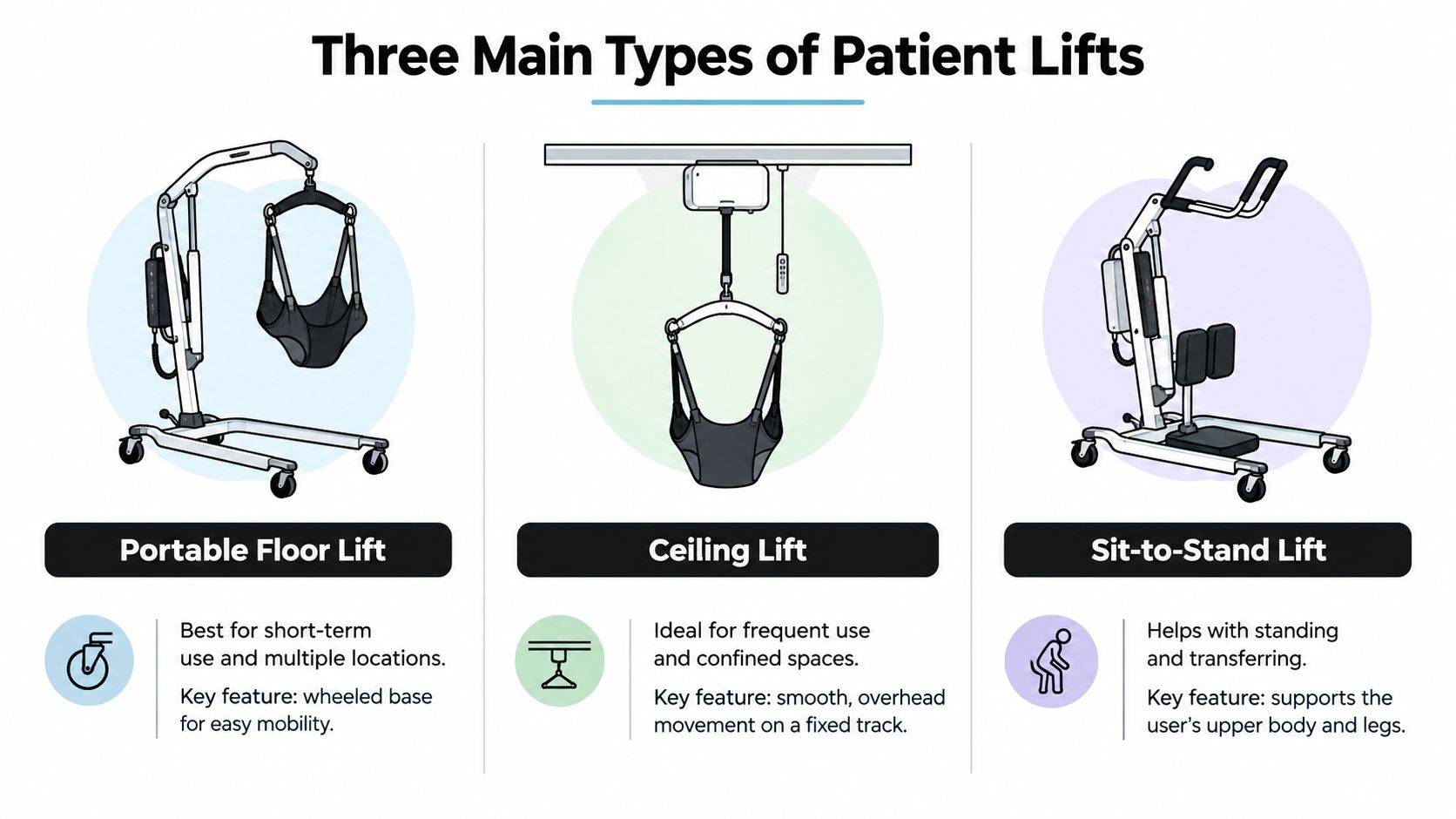
The best lift depends on the transfer pattern, not just the person's diagnosis. A user who can stand with support needs a different device from someone who cannot bear weight. The home layout matters too. A renter may need portable equipment, while a person making frequent transfers in a compact bedroom may benefit from an overhead system.
Portable floor lifts
A portable floor lift, often called a Hoyer lift in everyday conversation, rolls on a wheeled base. The base can usually move around furniture and between transfer surfaces, although the actual clearance depends on the model and the room.
This category suits families who need flexibility. It can be useful in a rental home, in rooms without an overhead track, or when one lift must serve multiple locations. A floor lift typically requires more maneuvering space than a ceiling lift, and the caregiver must guide the base into position without catching furniture, thresholds, or floor coverings.
Choose a full-body floor lift when the person needs substantial or complete support. Choose a portable model when moving the equipment between rooms is more important than keeping the floor clear.
Ceiling lifts
A ceiling lift runs on an overhead track. Because the lifting unit travels above the floor, the system can reduce floor clutter and may make repeated transfers easier in a smaller room. Installation requires professional planning, including attention to the structure supporting the track and the route the lift needs to follow.
Ceiling systems are especially useful when transfers happen frequently along a consistent path, such as between a bed and wheelchair. In a comparative study, bed-to-chair transfers averaged 156.9 seconds with a ceiling lift, compared with 273.6 seconds with a floor lift, and patients were reported to be more comfortable with ceiling-lift transfers. See the comparative transfer study for the cited findings.
The tradeoff is permanence. A ceiling lift isn't an unpack-and-use purchase. It may involve construction, structural review, and planning around room use. For a long-term home-care arrangement, however, the reduction in floor equipment and the consistent route may justify that investment.
Sit-to-stand lifts
A sit-to-stand lift supports an active transfer. The user generally needs to participate by bearing some weight, following directions, maintaining enough trunk control, and using the available handles or supports safely.
This device isn't a smaller substitute for a full-body lift. If the person can't stand or can't participate reliably, a sit-to-stand system may provide insufficient support. For users who can participate, it can help with transfers from a chair, toileting routines, and supported standing.
A practical comparison looks like this:
| Lift Type | Best For | Installation | Portability | Key Advantage |
|---|---|---|---|---|
| Portable floor lift | Users needing full support across rooms | Minimal setup, follow manufacturer requirements | Can move between rooms | Flexible placement |
| Ceiling lift | Frequent transfers along planned routes | Professional overhead installation | Fixed to the track system | Keeps floor space clearer |
| Sit-to-stand lift | Users who can participate and bear some weight | Minimal setup, follow manufacturer requirements | Generally movable | Supports active standing transfers |
Before choosing the active-transfer category, review guidance on a sit-to-stand patient lift. The important distinction is the person's ability to participate, not whether the lift looks compact or convenient.
Safety and Weight Capacity Considerations
A transfer may look routine, yet several parts must cooperate: the lift, sling, attachment points, floor route, and caregiver technique. Like links in a chain, a weak or mismatched part can affect the stability of the whole system. The goal is controlled movement that protects the person's dignity and reduces physical strain on the caregiver.
A 2026 UK National Patient Safety Alert reported an average of two deaths per year since 2015 from incidents involving patient hoists and slings. The UK patient hoist and sling safety alert explains why selection, inspection, sling checks, and caregiver training must receive careful attention.
Start with capacity, then confirm the fit
Use this basic calculation:
Required capacity = the person's actual weight plus a meaningful safety margin.
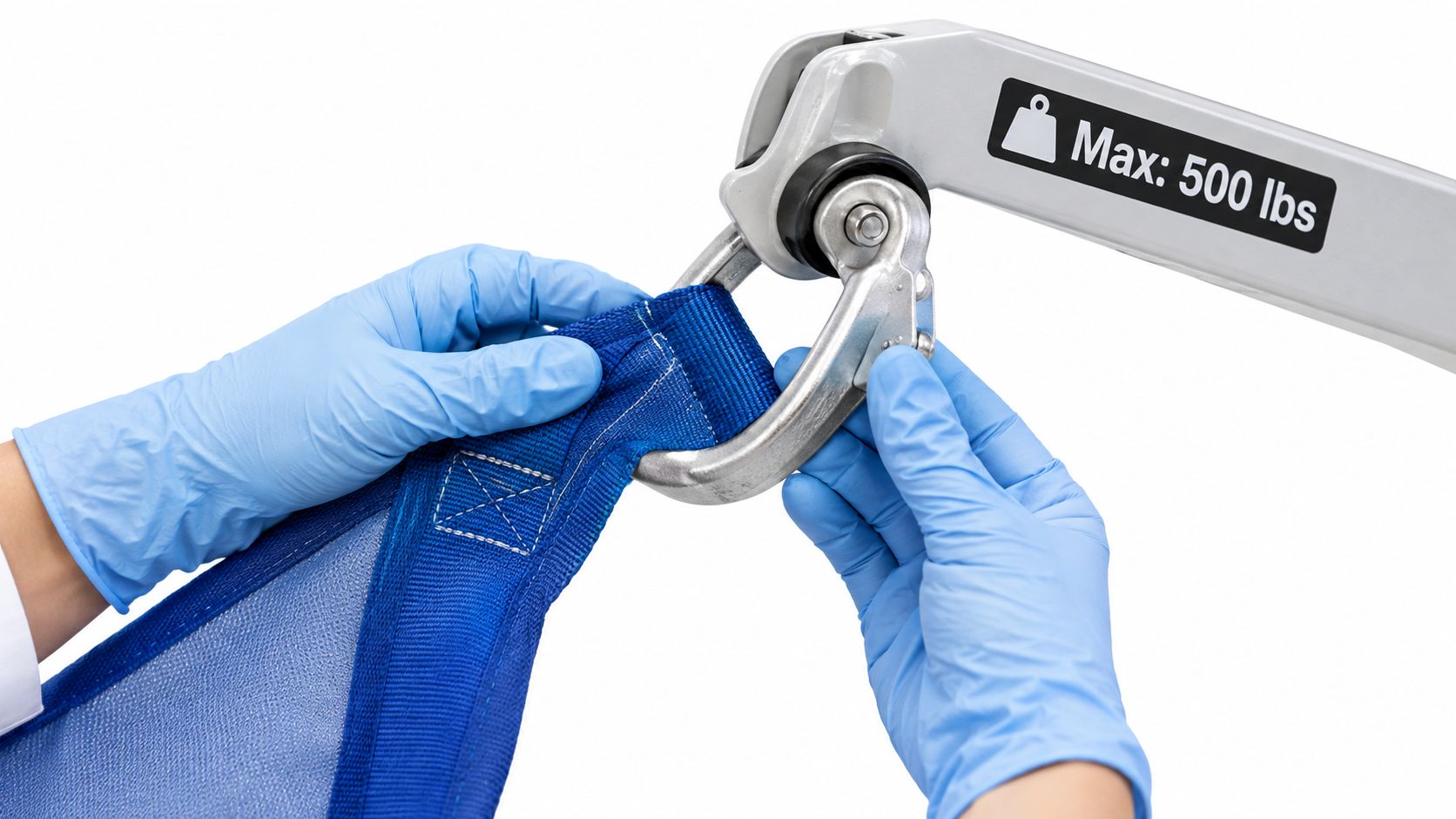
A lift rated exactly at the person's current weight leaves little room for clothing, medical equipment, weight changes, or normal operating variation. Check the rating for the exact lift and sling combination. A general product category is not enough.
Published planning guidance places standard lift capacity ranges from 350 to 600 lb, while bariatric lifts are suggested in the 750 to 1,000 lb range. These benchmarks appear in Hillrom's safe patient-handling design guide, alongside guidance from the Association of Rehabilitation Nurses.
Capacity also depends on the supporting structure. Alberta Health Services specifies that ceiling-lift structures in bariatric-design rooms must support a point load of 453 kg, or 1,000 lb, and that the lift itself must lift and transport at least that amount. The Alberta ceiling and mobile client lift guideline demonstrates why an overhead system requires review of both the equipment and the building structure.
For a clearer explanation of a standard full-body option, review this guide to a standard Hoyer lift. The name describes a familiar lift style, not a universal fit for every person or home.
Treat the sling as part of the lift
The sling carries the person's body, so its design affects security, comfort, positioning, and privacy during care. Its size, shape, attachment style, head support, leg support, and toileting access all matter.
Match the sling to:
- Body measurements: Use the manufacturer's chart for height, weight, torso, hip, and thigh fit.
- Postural needs: Limited trunk or head control may call for more supporting coverage.
- Transfer purpose: Bed-to-chair, bathing, and toileting can require different designs.
- Skin condition: Choose a fit that limits pinching, sliding, and concentrated pressure.
- Lift compatibility: Use only approved sling and attachment combinations.
A sling can appear sturdy and still be unsuitable. A physical therapist, occupational therapist, nurse, or equipment specialist can assess the setup when positioning needs are complex, helping the transfer feel secure for the person and manageable for the caregiver.
Navigating Installation Maintenance and Home Use
A floor lift usually arrives as a movable piece of equipment that must be assembled and checked according to the manufacturer's instructions. A ceiling lift is a home-improvement project as well as a medical-equipment decision. Its track needs suitable structural support, and its path must match the actual movement between the bed, chair, bathroom, or other care surfaces.
Start with the route, not the catalog photo. Measure the path from storage to the transfer location, including doorways, turns, furniture, thresholds, and the space where the caregiver will stand. A lift that fits beside the bed may still be difficult to move through the bedroom door.
A practical home-readiness check
- Doorways and turns: Measure the narrowest passage and account for the lift's base and the user's wheelchair.
- Floor surfaces: Check whether carpets, rugs, thresholds, or uneven surfaces could make rolling difficult.
- Bed clearance: Confirm that the lift can approach the bed and that the bed height supports safe sling placement.
- Destination space: Leave room beside the wheelchair, commode, recliner, or shower chair for controlled positioning.
- Furniture layout: Move nightstands, footstools, and other obstacles that interfere with the lift's base or track path.
- Charging and storage: Choose a location where a powered lift can charge without blocking a hallway or care route.
- Caregiver access: Make sure you can reach the controls and attach the sling without twisting around furniture.
Keep daily checks simple and consistent
Before use, inspect the sling for tears, damaged stitching, stretched straps, or other visible wear. Check the lift's wheels, brakes, hooks, frame, hand control, and emergency-lowering function according to the manufacturer's guidance. For powered models, keep the battery charged and investigate changes in lifting speed or sound rather than working around them.
Clean slings exactly as directed on their labels. Washing methods vary by material, and a sling should be fully dry before use. Never improvise with damaged fabric, replacement parts, or attachments that aren't approved for the model.
Schedule professional inspection and servicing at the interval recommended by the manufacturer or care provider. The CDC describes lifting devices as part of a broader approach to patient safety, including benefits such as reduced pressure injuries, so maintenance protects more than the machine. It helps preserve safe positioning and skin protection during everyday care.
How to Choose the Right Patient Transfer Lift
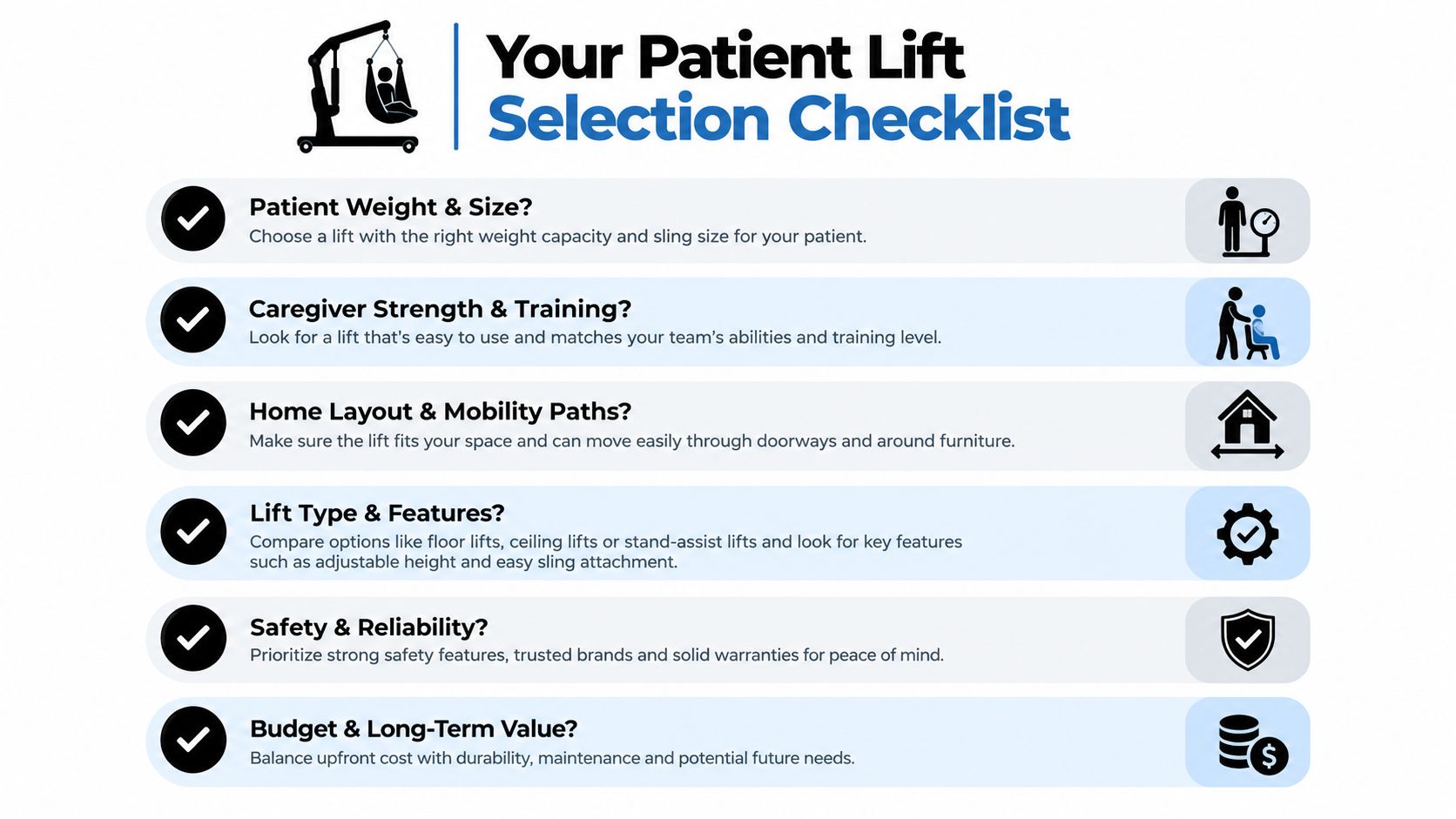
A transfer can begin smoothly at the bedside and become difficult beside a commode or shower chair. The right lift supports the entire routine, helping the person feel secure while reducing the caregiver's need to strain, rush, or improvise. Start with the person, then examine the transfer, the home, and the people who will operate the equipment.
Begin with the transfer ability
Can the person bear weight, follow directions, hold a support, and keep enough balance for an active transfer? If so, a sit-to-stand lift may fit the established care plan. If those abilities are limited, discuss a full-body lift with a qualified clinician. The lift should match what the person can safely contribute, rather than asking them to perform more than they can manage.
List the actual destinations. Bed-to-wheelchair transfers may require different space and sling arrangements than wheelchair-to-commode or bathing transfers. Write down the routine, including where the caregiver stands, where the lift starts, and how it travels. This simple map can reveal problems before equipment arrives.
Match equipment to the home
A portable floor lift may suit a rented home, several care rooms, or a situation where ceiling changes are not possible. An overhead system may fit repeated transfers along one route, especially when floor space is limited. The goal is a setup that works with the home's normal movement instead of turning every transfer into furniture rearrangement.
Home access also includes shared living areas. These universal design kitchen tips offer ideas for clear paths, usable work areas, and comfortable access. Apply the same thinking throughout the home so care does not force the person into a cramped or exposed position.
Confirm capacity, sling, and support
Verify the user's weight, the lift's rated capacity, and the sling's matching size and design. The lift, sling, spreader bar, and attachments function as one system, so compatibility matters as much as the capacity label. Choose equipment that supports stable positioning and preserves the person's dignity during routine care.
Ask who will operate the lift, how often transfers occur, where it will charge or stay, and how training and service will be handled. A clinician may recommend a transfer aid rather than a lift if the person can safely assist. Review this guide to a patient transfer device when comparing equipment categories and transfer-focused options.
DME Superstore offers patient lifts, transfer aids, slings, and other durable medical equipment with product specifications and compatibility information for careful comparison. Visit DME Superstore to review options, ask questions through 24/7 chat support, and select equipment that supports caregiver well-being and the person's independence.
