



If a label says 5, does that mean you're getting five liters of oxygen every minute? That's the gap most families miss when they first read a spec sheet for an oxygen concentrator 5L model. The number looks like a dose, a tank size, or a power rating, and it's easy to assume bigger is safer.
It isn't any of those things on its own. The 5 is a ceiling, and what reaches you depends on the setting your clinician prescribed, the purity at that setting, and whether the machine delivers oxygen continuously or in puffs. Once you see those three pieces separately, product pages get much easier to judge.
What a 5 L/min Oxygen Concentrator Is and How It Works
A 5 L/min oxygen concentrator is a stationary, electrically powered device that pulls in room air, removes most of the nitrogen, and delivers oxygen enriched gas through a nasal cannula or mask. It doesn't store oxygen in a tank. That's why it needs wall power and open ventilation instead of cylinder swaps.
Think of the 5 like a car's top speed, not the amount of fuel in its tank. It tells you the maximum continuous flow the machine can produce, measured in liters per minute. It doesn't mean everyone who uses it receives 5 L/min.
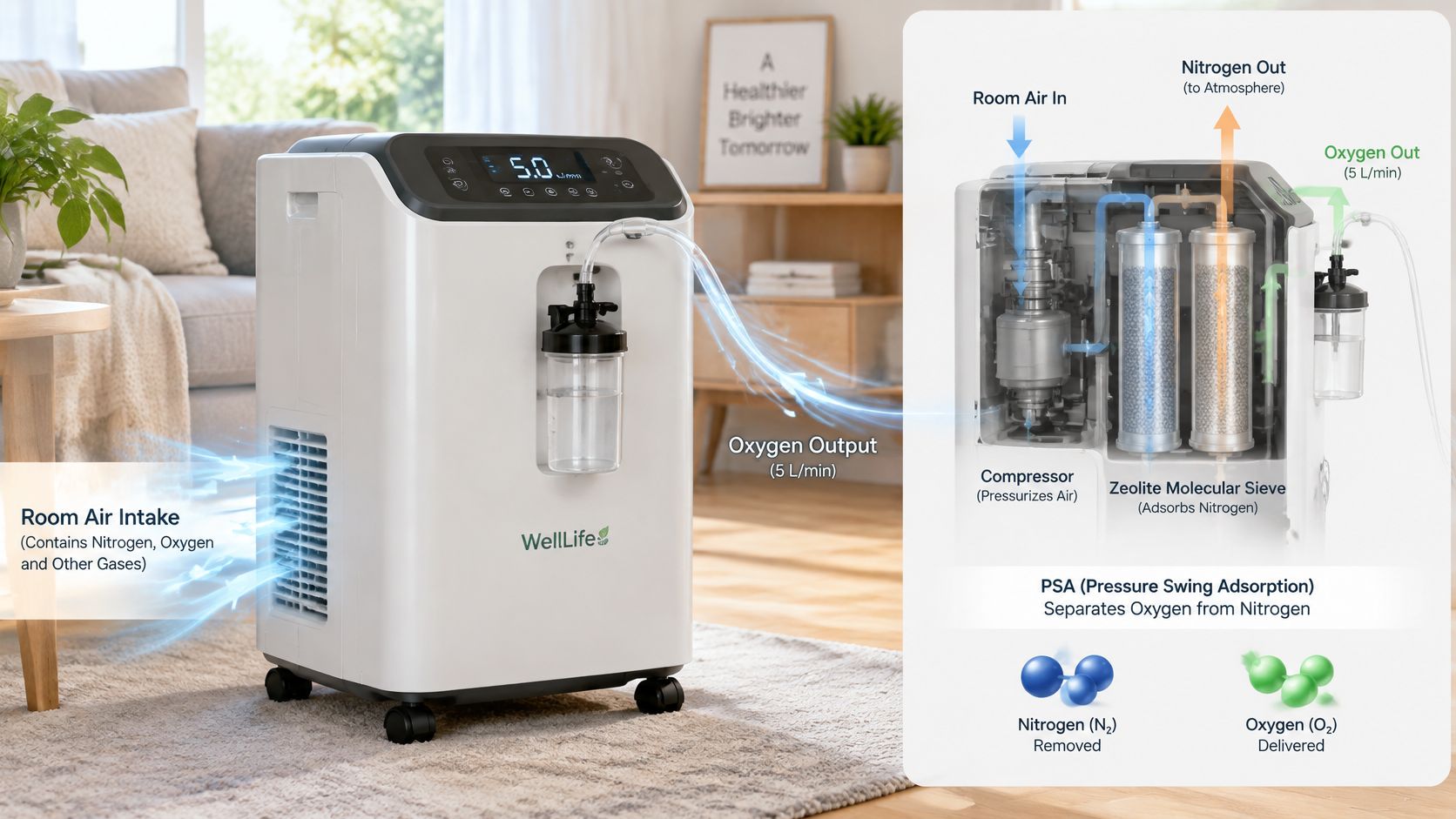
A medical review of oxygen concentrators describes typical concentrator output as approximately 85% to 95% oxygen purity. That purity figure matters as much as flow, because a setting only helps if the gas delivered at that setting stays concentrated enough.
Five Stages From Room Air to Outlet
- Intake filter: The machine draws in surrounding room air and screens out dust and particles.
- Compressor: Pressurized air moves into containers called sieve beds.
- Sieve beds: The beds trap nitrogen, which makes up most of room air.
- Oxygen outlet: The remaining oxygen enriched gas flows to your cannula or mask.
- Oxygen monitor: A sensor checks the output so you and your care team can verify concentration during use.
Because the machine processes air continuously, its performance depends on the intake, filters, sieve beds, and monitor working together. Block the intake with a blanket or let a filter clog, and you're asking the compressor to work harder for less clean air.
A 5 L rating describes capacity, not a fixed dose. Your prescription decides where the dial actually sits.
Say your clinician prescribes 2 L/min at rest. You'd set a 5 L unit to 2, and the extra capacity stays unused unless your prescription changes after testing. The headroom can be useful, but it isn't a reason to turn the flow up on your own.
When you read a spec sheet now, look past the big number. Ask what purity the machine holds at your prescribed setting, how low its flowmeter can be set, and whether it monitors its own output. Those answers tell you far more than the 5 alone.
5 L/min Models Compared by Flow, Purity and Power
Two concentrators marked 5 L/min can differ in adjustable range, oxygen purity, electricity use, weight, and sound. The label is a maximum ceiling, not a delivered dose. Compare the published figures below, and read each one in context.
5 L/min concentrator specifications at a glance
| Model | Max flow | Oxygen purity | Power | Weight | Noise |
|---|---|---|---|---|---|
| Reference 5 L/min spec sheet | 0.5 to 5.0 L/min | 90% (+5.5%/-3%) | 250 W at 2 L/min; 350 W at max | 36 lb (about 16 kg) | About 40 dB |
| GIMA 5L oxygen concentrator | 5 L/min | 93% ± 3% | Not stated | 21 kg | Not stated |
| Direct Supply Attendant 5L | Up to 5 L/min | Not stated | Not stated | Not stated | 50 dB |
| WHO benchmark for a 5 L/min unit | Up to 5 L/min | Above 82%, preferably above 90% | No more than 70 W per L/min (about 350 W at 5 L/min) | No weight value in this benchmark | No noise value in this benchmark |
How to Read Each Column
Flow shows the available range, not necessarily the setting you will use. The representative 5 L/min specification sheet lists an adjustable range of 0.5 to 5.0 L/min, oxygen concentration of 90% with a tolerance of +5.5%/-3%, 250 watts at 2 L/min and 350 watts at maximum, about 40 dB, and 36 pounds.
Purity and its tolerance describe a range around the stated concentration. The GIMA 5L listing gives 93% ± 3% purity at a maximum flow of 5 L/min and a weight of 21 kg. Its listing does not state power use or noise.
Power helps show what running the unit may require, but compare figures at the same flow setting. The World Health Organization technical specification recommends no more than 70 watts per liter per minute, or about 350 watts at 5 L/min, and purity above 82%, preferably above 90%.
Noise can affect how noticeable a unit is in a bedroom. The Direct Supply Attendant 5L listing lists a rated sound level of 50 dB and a price of $523.99. Its listing does not provide purity, power, or weight figures.
For a broader comparison of stationary concentrators and tanks, see this guide to oxygen concentrators versus oxygen tanks. Before choosing a model, compare its published specifications with your prescribed flow and ask your clinician which device and setting are appropriate.
Why a 5 Means Different Things in Continuous and Pulse Modes
Here's the assumption worth challenging. A portable unit set to 5 and a home unit set to 5 L/min sound identical, so families assume they deliver the same oxygen. They often don't.
Continuous flow works like a garden hose that runs steadily whether you're breathing in or out. Pulse dose works like a squeeze bottle that releases a puff when it senses you starting to inhale. With pulse delivery, the volume you receive shifts with your breathing rate and depth.
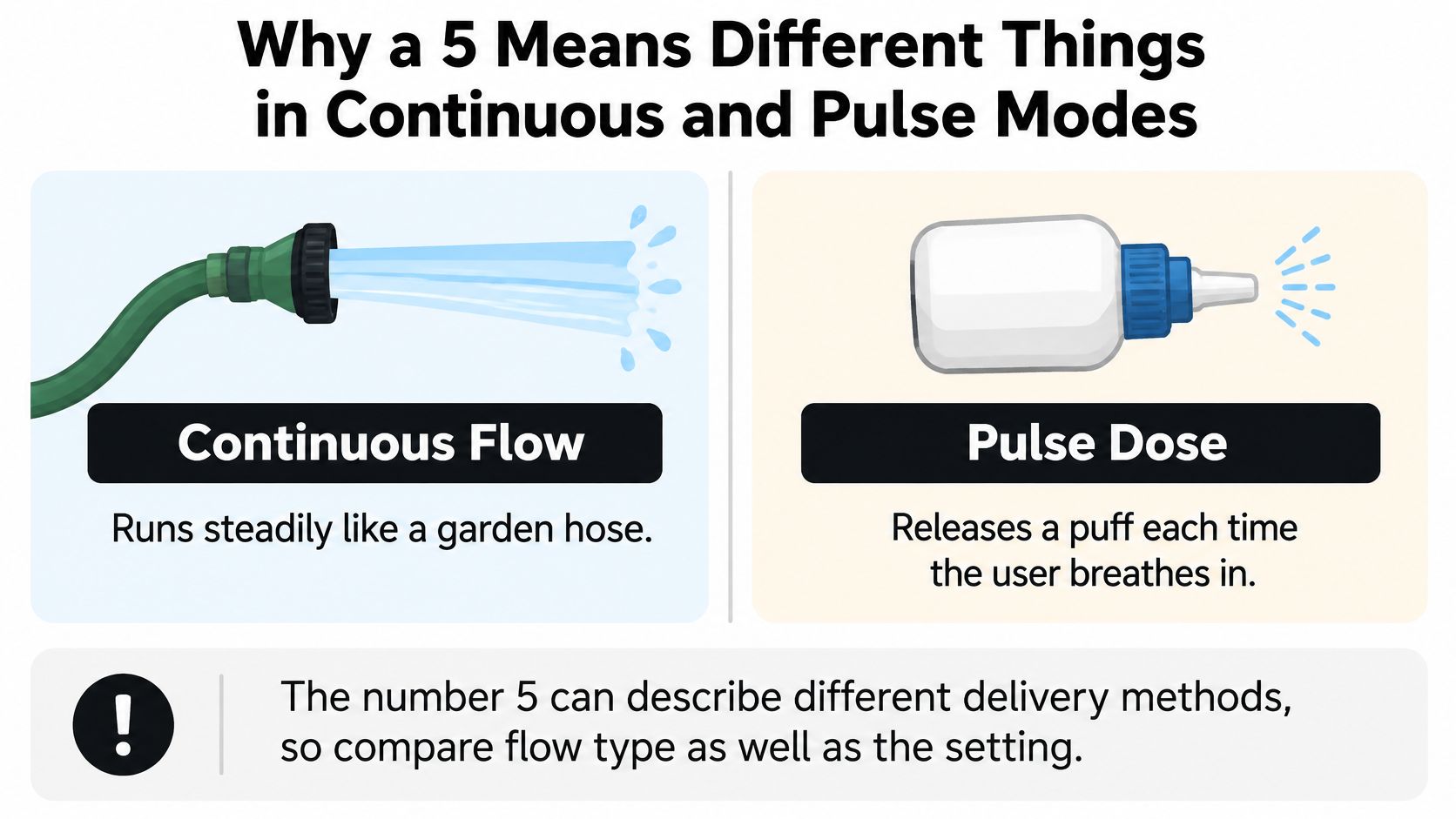
A systematic review of portable oxygen delivery warns that a 5 L/min continuous flow prescription and a pulse dose setting of 5 may deliver different oxygen volumes despite marketing claims. That gap matters when you switch between a stationary unit, a portable unit, a cannula, and a mask during walking, exertion, or sleep.
Continuous flow versus pulse dose
| Factor | Continuous flow | Pulse dose |
|---|---|---|
| How oxygen is delivered | Steady stream through the whole breath | Dose released at the start of each breath |
| What the 5 refers to | Flow in L/min | Dose setting that scales the puff, not a constant L/min |
| Consistency during walking or sleep | Steady output | Volume can change with breathing rate and depth |
| Fit for a prescribed 5 L/min need | Matches the prescription directly | Must be verified by testing; may not match |
The video below shows the two delivery patterns in action, which makes the table easier to picture.
A Four Step Compatibility Check
- Write it down: Record your prescribed flow in L/min and the delivery mode named on the prescription.
- Confirm the mode: Ask your clinician directly whether that prescription is continuous or pulse.
- Test in real conditions: Have oxygen levels checked at rest, during activity, and during sleep.
- Recheck after changes: Repeat testing whenever the device, cannula, or mask changes.
Our guide to portable oxygen concentrator pulse and continuous flow walks through these mode differences in more detail if you're comparing a home unit with a portable one.
Don't change a prescribed flow without clinical direction, even if a higher setting feels like extra insurance. The highest number on the dial isn't the right answer. The tested number is.
Who Really Needs a 5 L/min Concentrator
Who benefits from a 5 L/min concentrator? The answer depends on the prescribed flow and delivery mode, not on the number printed on a device. The “5” is a maximum ceiling, not a dose everyone receives. Your prescribing clinician determines whether that capacity fits your tested needs.
Who May Have a 5 L/min Prescription
- Higher tested need: Your clinician prescribes a higher continuous flow based on oxygen readings at rest or during exertion.
- Confirmed overnight need: A sleep assessment supports a steady oxygen requirement through the night.
- Mostly home-based use: You spend most of the day at home, so a stationary unit may fit your routine better than a portable one.
Who May Not Need One
If your prescription is lower, a smaller or lighter setup may be a better fit and cost less to run. If you mainly need oxygen during activity, ask your clinician whether a portable unit can meet your prescribed settings. Oxygen is a medical therapy, so don't buy it for comfort or energy without a prescription.
Practical rule: Match the concentrator's capacity to your tested prescription. Extra capacity cannot replace testing.
More oxygen is not automatically better. PATH and USAID RISE oxygen concentrator procedure guidance warns that unnecessary oxygen use can cause toxicity. Discuss the right flow and delivery mode with your clinician.
Home oxygen can also bring practical discomforts, including dry mouth or nose, congestion, skin irritation, nosebleeds, and fatigue. Report these symptoms to your clinician rather than raising the flow. A higher setting may worsen dryness without addressing its cause.
For an overview of what to expect after receiving a prescription, read this guide to getting started with medical oxygen.
At your appointment, ask what your resting and exertion readings show, what your sleep assessment found, and whether your prescription specifies continuous or pulse delivery. These answers help determine whether a 5 L/min unit offers the capacity you need. For additional COPD treatment insights from Longevity Medical Institute, discuss any information with your clinician before making treatment decisions.
Power, Batteries and Travel
A stationary 5 L/min unit and a portable concentrator solve different problems, and power is where the difference shows up first. The home unit plugs into a standard outlet and runs as long as electricity flows. The portable trades that unlimited runtime for batteries you must charge, carry, and replace.
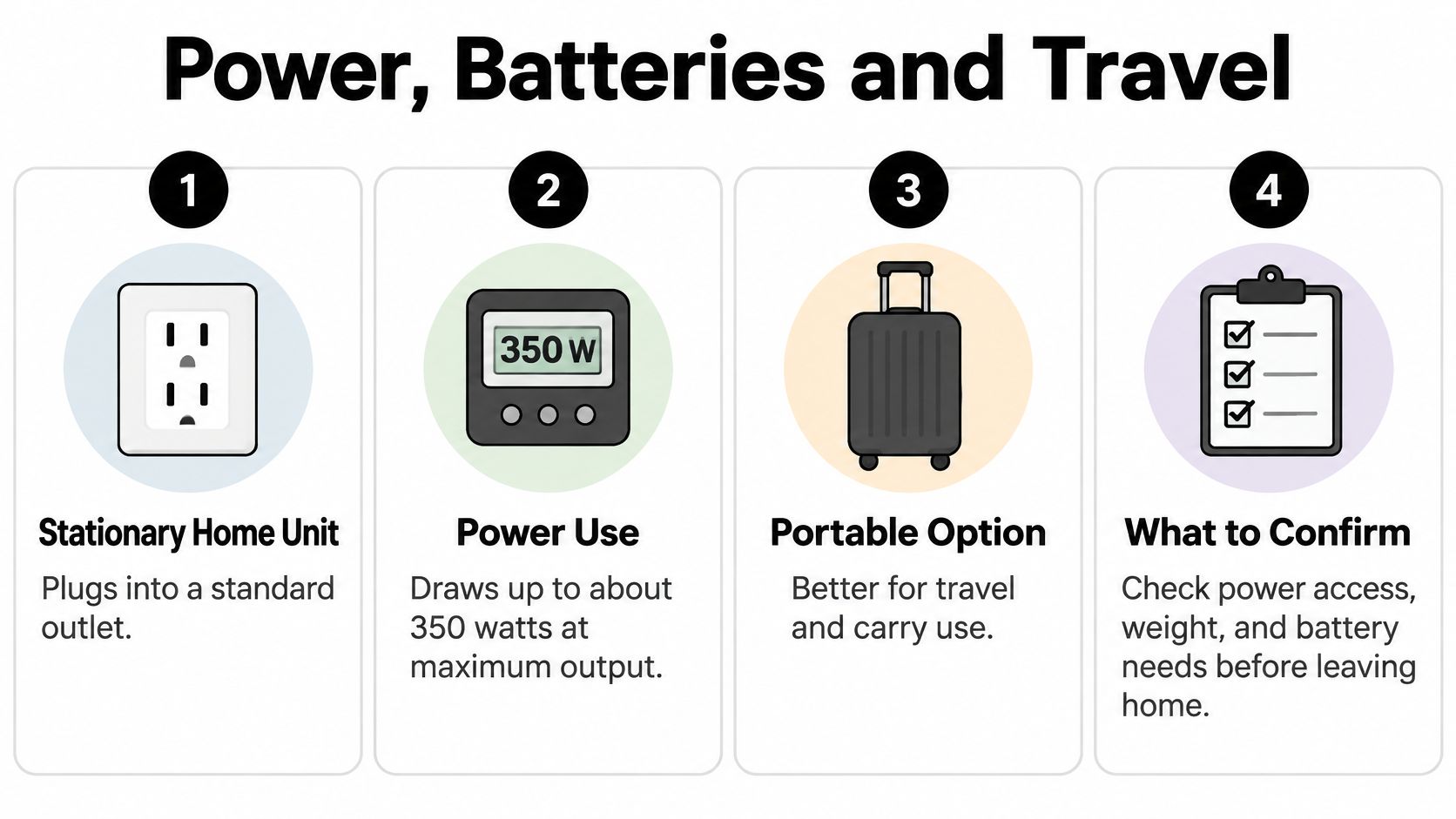
Expect a continuous electricity cost at home, since a full size unit draws substantial power at higher settings for many hours a day. Keep clear space around the intake so the compressor doesn't pull warm, dusty air from against a wall. Heat and restricted airflow work against efficiency.
Battery runtime is where headline numbers mislead. Higher flow drains a battery faster, so the runtime printed in large type usually reflects a low setting you may never use. Look for the manufacturer's runtime table and find the row for your prescribed setting, then plan around that row only.
Many portable units can't supply continuous 5 L/min at all. They deliver pulse doses instead, which brings back the compatibility testing question. Verify continuous capacity in writing before assuming a portable can replace your home concentrator on a trip.
What to Pack and Plan
- Spare batteries: Carry enough charged spares for delays, not just the scheduled journey.
- Adapters: Pack AC and DC adapters plus a car adapter matched to your model, since connectors aren't universal.
- Airline rules: Check your airline's oxygen policy before the trip, including battery limits and advance notice requirements.
- Outage backup: Keep a backup supply at home that matches your prescribed flow, and tell your electricity provider that someone in the household depends on oxygen.
Our overview of portable oxygen concentrator accessories covers cases, batteries, and chargers that make travel days less fragile.
Before you buy for travel, run this check. Confirm maximum continuous flow, find battery runtime at your setting, count spares for a full day, list the adapters you'll need, and weigh the unit as you'd carry it. A machine that fails any one of those tests will frustrate you far from home.
Keeping a 5 L Concentrator Safe and Running Well
A simple maintenance routine helps keep airflow clear and makes changes easier to spot. Follow the intervals in your manufacturer's manual; the table offers a practical starting point to discuss with your supplier.
Routine maintenance tasks for a 5 L/min concentrator
| Task | Typical interval | Why it matters |
|---|---|---|
| Clean or replace the intake filter | Weekly to monthly, per manual | Dust can restrict airflow and affect output |
| Check the oxygen monitor reading | Per manufacturer schedule | Helps identify a change in the unit's reading |
| Inspect cannula and tubing | Weekly | Kinks and cracks can interrupt flow or irritate skin |
| Keep vents and intake clear | Daily check | Blocked airflow can make the compressor run hot and less efficiently |
| Professional service | Annually or per manual | Helps identify wear in the compressor and sieve bed |
For reusable filters, follow the manufacturer's cleaning instructions. This guide to cleaning an oxygen concentrator filter explains the washing and drying process.
Fire Safety Comes First
Oxygen does not burn by itself, but it can make other materials ignite more readily and burn hotter. An FDA adverse event report documents facial burns and death associated with smoking during oxygen therapy. Do not smoke or allow smoking near oxygen equipment.
Keep the concentrator and accessories well away from hot objects, sparks, and open flames, following your supplier's written distance guidance. This includes cigarettes, electronic cigarettes, candles, fireplaces, and gas stoves. A visible no-smoking notice can remind visitors of the rule.
Lowering the flow setting does not remove the fire risk. Oxygen-enriched air around clothing, bedding, and furniture can make those materials catch fire more readily.
Keep ignition sources away from oxygen equipment at every flow setting.
In a bedroom, place the unit on a firm surface away from the bed, with its vents unobstructed. A concentrator that is comfortable to hear in a living room may disturb sleep nearby, and blocked vents can contribute to heat buildup.
If your prescription includes a humidifier bottle, use it as directed. For nasal dryness, use water-based saline gel, and check tubing for cracks that may leak air. Keep a record of nosebleeds, skin irritation, or persistent congestion so your clinician can review the setup.
Stop using the unit and contact your supplier for service if an alarm will not clear, flow drops noticeably, the cabinet feels unusually hot, or you smell burning. An unresolved alarm or burning smell is a reason to get help, not to keep running the machine.
Confirm Your Prescription Before Buying a 5 L Unit
Could a concentrator labeled 5 L/min deliver the oxygen your prescription requires? The label describes a maximum ceiling, not a guaranteed dose. Confirm your prescribed flow and delivery mode before comparing products, because “5 L” can mean different things in continuous and pulse modes.
Five Buying Checks in Order
- Match the flow range: Check that the unit's continuous-flow range covers your prescribed setting and has an adjustment that lets you set it. A maximum rating alone does not confirm that the machine can deliver your required flow.
- Confirm purity and monitoring: Check the stated oxygen purity at your setting and whether the unit has a built-in oxygen monitor. The World Health Organization technical specification for oxygen concentrators states that concentrators should provide oxygen at a concentration greater than 82%, with a flowmeter minimum of 0.5 L/min or less. A simple bubble test cannot confirm purity.
- Compare warranty coverage: Check the warranty length and whether it covers the compressor separately from parts and labor. The compressor and sieve beds do the heavy work of producing concentrated oxygen.
- List included accessories: Check whether the package includes a cannula, extension tubing, humidifier bottle, carrying case, spare filters, or backup battery. Price any items you still need.
- Check payment eligibility: FSA or HSA use may require clinician documentation, so ask your plan administrator before ordering.
A prescribed continuous flow of 5 L/min usually points to a stationary home unit. If you are considering a portable model, ask your clinician whether its delivery mode can meet your prescribed needs, and follow their guidance on testing it at rest, during activity, and overnight.
Compare specifications and warranty terms on retailer product pages, including DME Superstore's. If a listing does not state purity at your prescribed flow or clearly explain warranty coverage, ask before ordering. The store also offers understanding Medicare benefits for dementia care, which may be relevant to broader care planning.
Use one rule to narrow your options: rule out any unit whose flow range does not cover your prescribed setting. Bring your prescription and any test results to the conversation with your clinician. The number 5 on a product label cannot make that decision for you.
When comparing stationary 5 L units, DME Superstore's product pages provide specifications, compatible accessories, and warranty details for home oxygen equipment. Check the prescribed flow and delivery mode against each listing, and use the store's 24/7 chat-based support if a product detail is unclear.
