



You're comparing folding weights at the kitchen table while your parent worries about the sloped driveway, the grocery store aisle, and getting through the bathroom door. That's the purchase. How to choose a mobility scooter isn't about the lightest photo or the highest top speed. It's about whether the scooter clears your narrowest doorway, stays stable on your steepest ramp, and carries a battery that works for your longest regular trip. Work through those checks in order, and the shortlist gets much smaller.
Match the Scooter to the Longest Regular Trip
Say a buyer nearly orders the lightest folding model because it looks easy to lift. Then she pictures the actual week. There's a sloped driveway at home, a crowded grocery aisle on Tuesday, and a car trunk that nobody in the house can load alone. The scooter that looked perfect online may fail all three places.
Start with walking ability, balance, endurance, and environment, not price or color. The U.S. Centers for Disease Control and Prevention disability summary reported that 27% of adults had a disability in its summary of 2020 data, rising from 18.4% among adults ages 18 to 44 to 26.7% among those ages 45 to 64 and 41.6% among adults 65 and older. In separate 2022 local-level data, mobility difficulty was reported by 12.2% of U.S. adults. Those numbers are a reminder that needs change with age and health, so buy for the rider's real function, not for a hopeful best day.
Circle One Row First
Use this table as your first cut. Don't shop across all five rows at once.
Scooter class by the trip you take
| Main use | Class to start with | Device weight | User capacity | Practical range |
|---|---|---|---|---|
| Short indoor trips | Compact 3-wheel | About 35-70 lb | About 250-300 lb | About 8-12 miles |
| Shops and paved errands | Lightweight 4-wheel | About 45-90 lb | About 265-350 lb | About 10-18 miles |
| Neighborhood and parks | Mid-size outdoor | About 90-150 lb | About 300-400 lb | About 15-25 miles |
| Heavy rider or rough paths | Heavy-duty or bariatric | About 150-250 lb | About 400-500 lb | About 12-30 miles |
| Flights or cruises | Airline-approved portable | Often 35-70 lb in pieces | About 265-375 lb | Often 10-15 miles |
A compact 3-wheel scooter turns tightly indoors, which helps in kitchens and clinics. It can feel less planted outdoors, especially on side slopes. A lightweight 4-wheel model usually suits shops and paved errands better because it adds stability without becoming huge.
Neighborhood loops and parks usually need a mid-size outdoor scooter with more battery, larger tires, and higher ground clearance. A heavier rider or rough pavement may need a heavy-duty frame, even if that frame is too wide for some interior doors. That's a trade-off you have to face early, not after delivery.
Practical rule: Circle the one row that covers the longest trip taken most weeks. That row sets your target for weight, width, and range.
Compact scooters are easier to maneuver and transport. Larger models generally give you more seating support, ground clearance, stability, and battery range. Neither is better in the abstract. The right class is the smallest one that safely covers the regular trip.
If you're also fitting seating elsewhere in the home, this mobility chair sizing and fit guide from Gates Home Furnishings helps you think about seat height and transfers in the same practical way. If the rider needs full-day postural support or can't use a tiller with both hands, compare the alternative in this guide to a mobility scooter versus a power wheelchair before you commit.
If weakness, poor balance, cognitive change, or more than one disability overlap, involve a clinician or rehabilitation professional before paying. A scooter demands upright sitting, steering, judgment in traffic, and a safe transfer. When any of those are uncertain, a professional assessment should decide, not a product page.
How to Measure the Rider and the Route
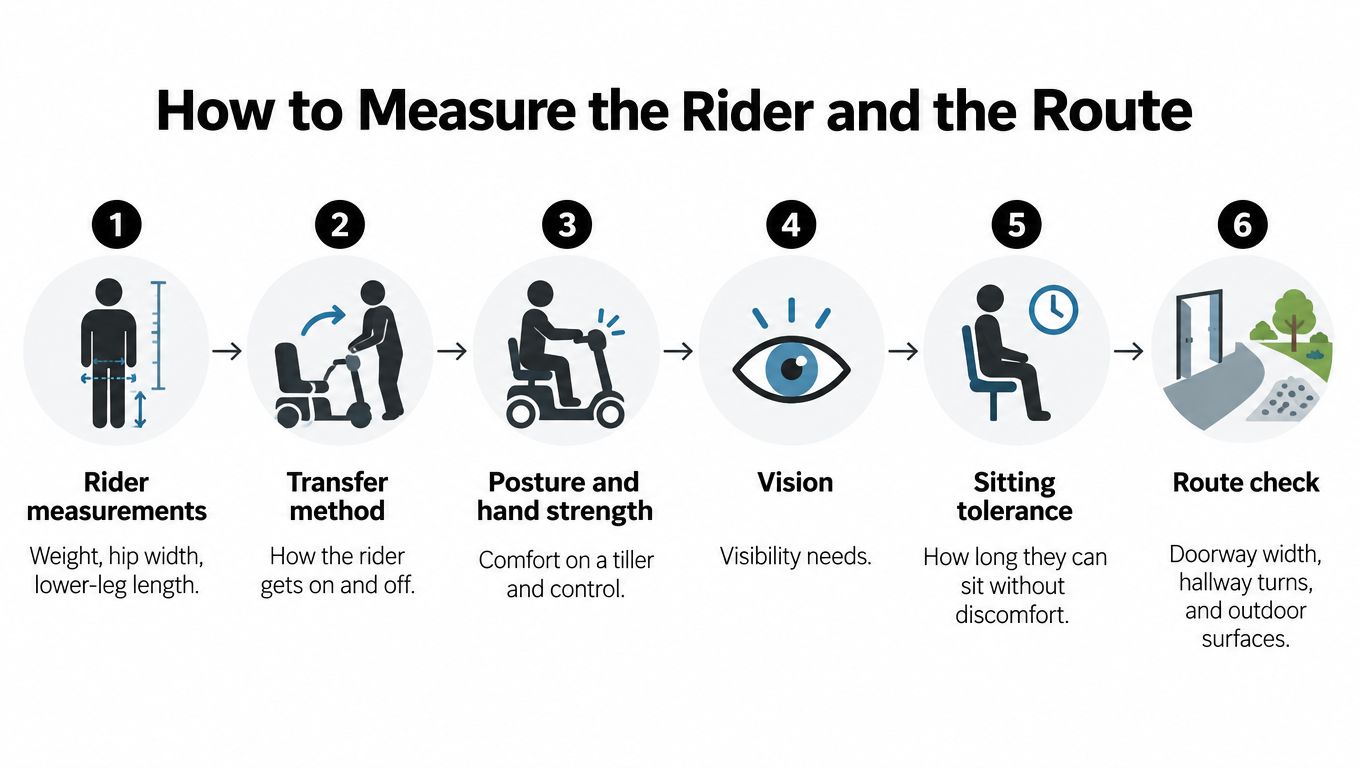
Don't make a brand shortlist yet. Run this sequence first, with a tape measure and a notebook. You'll end with pass or fail numbers you can use on any spec sheet.
Steps 1 to 3 Measure the Person and the Places
1. Write down the rider. Record weight, hip width, lower-leg length, transfer method, posture, hand strength on a tiller, vision, and how long the rider can sit without pain. A seat that fits the hips but leaves the feet dangling will cause sliding and pressure problems. Weak hands matter too, because the tiller controls speed and steering for the whole trip.
2. Measure every opening. Measure doorways including the frame, hallways, the elevator, ramps, and the closet, trunk, or lift where the scooter will live. Record the narrowest clear width and the tightest turn, not the average. The scooter has to pass the worst spot every time.
3. Label the route. Call it indoor, paved outdoor, or mixed terrain. Note the longest round trip in miles and the steepest ramp used in a normal week. A smooth mall floor and a cracked sidewalk with curb cuts are different machines waiting to happen.
Steps 4 to 6 Set Limits and Test Them
4. Set limits above your numbers. User capacity must cover the rider plus a coat, groceries, and an oxygen tank if one is carried. Seat width and height must allow a safe transfer and upright posture. Overall width and turning radius must clear the narrowest door and tightest hall, and claimed range must beat the longest trip with reserve.
That reserve matters because you shouldn't treat advertised range as the distance you'll get. Cold weather, rider weight, hills, low tire pressure, an aging battery, and stop-start driving all cut usable miles. A model that only just matches your longest trip on paper will strand you in real conditions.
5. Run a supervised trial. Repeat starts and stops, reverse, make a 90-degree turn, pass a real doorway, climb and descend the ramp, cross an uneven patch, and practice an emergency dismount. Do it with someone beside the rider. A flat showroom floor hides almost every problem that matters at home.
6. Reject a model that only feels fine indoors. If braking feels vague on the ramp or the turn needs three attempts in the hall, that's a fail. Write pass or fail for width, turn, weight, range, and slope on one page and keep it with you while shopping.
Safety equipment belongs in this test, not on an accessories list later. In a UK trauma database of 1,504 scooter-injury patients, 65.4% of injuries involved vehicle collisions, 29.4% met the definition of major trauma, and the median hospital stay was 12 days, with head injuries associated with the most severe outcomes. Check lights, mirrors, reflectors, and braking during the trial, and ask whether the planned route keeps the rider out of traffic.
If the rider has poor trunk control, cognitive impairment, significant visual loss, or trouble operating the tiller, ask a therapist or mobility specialist to assess them before purchase.
That one-page note now does the shopping for you. Any scooter that fails width, turn, weight, range, or slope is out, no matter how good the discount looks.
Test Stability Without Failing the Doorway
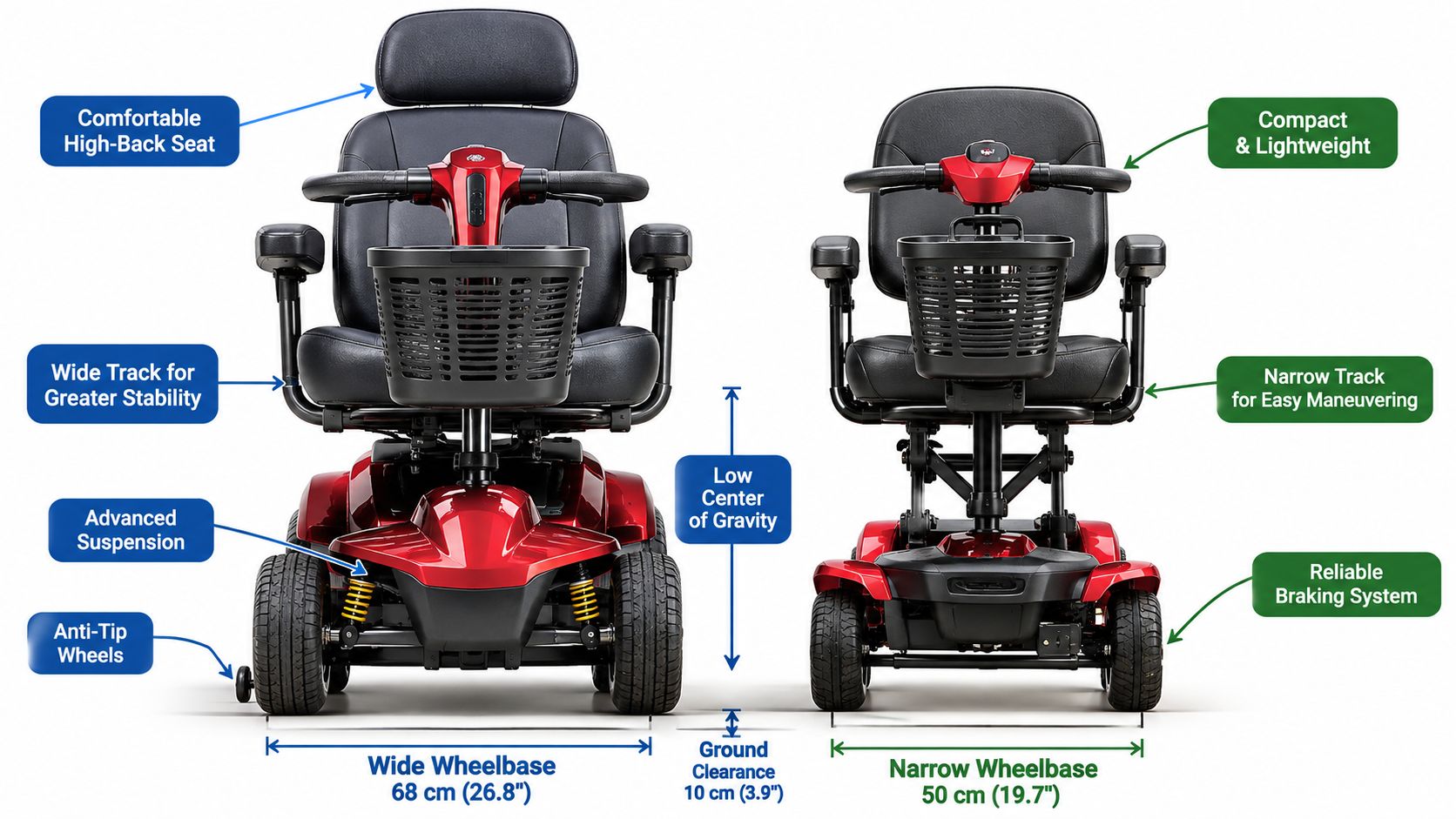
The right pick is the smallest platform that passes both the stability test and the access test. A wider, longer scooter usually resists rollover better. It can also fail your doorway, elevator, vehicle lift, or tightest turn. You don't solve that conflict by guessing. You measure both sides of it.
This comparison shows the basic tension between a wide, planted base and a compact frame that's easier to fit indoors.
What Stability Actually Means
Compare wheelbase, track width, center of gravity, anti-tip wheels, suspension, ground clearance, brakes, and maximum safe slope. A long wheelbase and wide track help the scooter stay planted. A high seat, a heavy basket, or a rider sitting near the weight limit raises the center of gravity and makes tipping easier.
Four wheels don't guarantee safety. In a Dutch emergency-department study of 382 mobility-scooter injuries, 87.2% were single-vehicle crashes and 49.3% involved rollover, while 44.1% of patients sustained a fracture and 28.2% were admitted to hospital. Side slopes, curb cuts, excess speed, and abrupt steering caused real harm without another vehicle involved.
Tire choice affects grip and ride on those surfaces, so compare pneumatic versus solid tires for your route before you assume the stock tire is fine. Pneumatic tires cushion rough pavement but need pressure checks. Solid tires avoid flats but can feel harsh and may grip differently on wet or uneven ground.
Pass rules for the supervised scooter trial
| Check | Measure this | Pass when |
|---|---|---|
| Doorway | Narrowest door and frame | Scooter width is at least 2 inches narrower |
| Turning space | Hall, elevator, or aisle | Turning radius is smaller than the clear space |
| User weight | Rider plus clothes and bags | Total stays under the stated capacity with reserve |
| Seat and transfer | Hip width and seat height | Rider sits upright and can get on and off safely |
| Range | Longest usual round trip | Claimed range is well above that trip, not equal to it |
| Slope and surface | Steepest ramp and roughest path | Fully loaded scooter stays controllable under supervision |
| Storage and lift | Closet, trunk, or vehicle lift | Folded size and each piece are liftable by the person who loads it |
At home, the bathroom is often the tightest test of all. If you're adapting that room, Trademaster Construction's accessible bathroom design guide is useful for thinking about clear floor space and turning room before you blame the scooter for a layout problem.
Practice the Skills That Prevent Rollovers
Watch how controlled cornering and braking look before you practice them on a real ramp.
Add a short supervised skills session to the trial. Corner slowly, brake before a descent rather than on it, cross a slope at a controlled angle, and avoid curbs instead of trying to hop them. Practice loading the scooter the way you'll load it, with the usual bags on board.
Reassess after delivery because seat height, tiller reach, tire pressure, battery condition, and accessory placement change handling. Common misses include chasing top speed instead of control, riding over the stated weight limit, and taking a portable scooter onto ground meant for a full-size model. If the stable model can't enter the home, change the route or storage plan before you size down into a tippy scooter.
Check Watt Hours Before You Trust a Travel Scooter
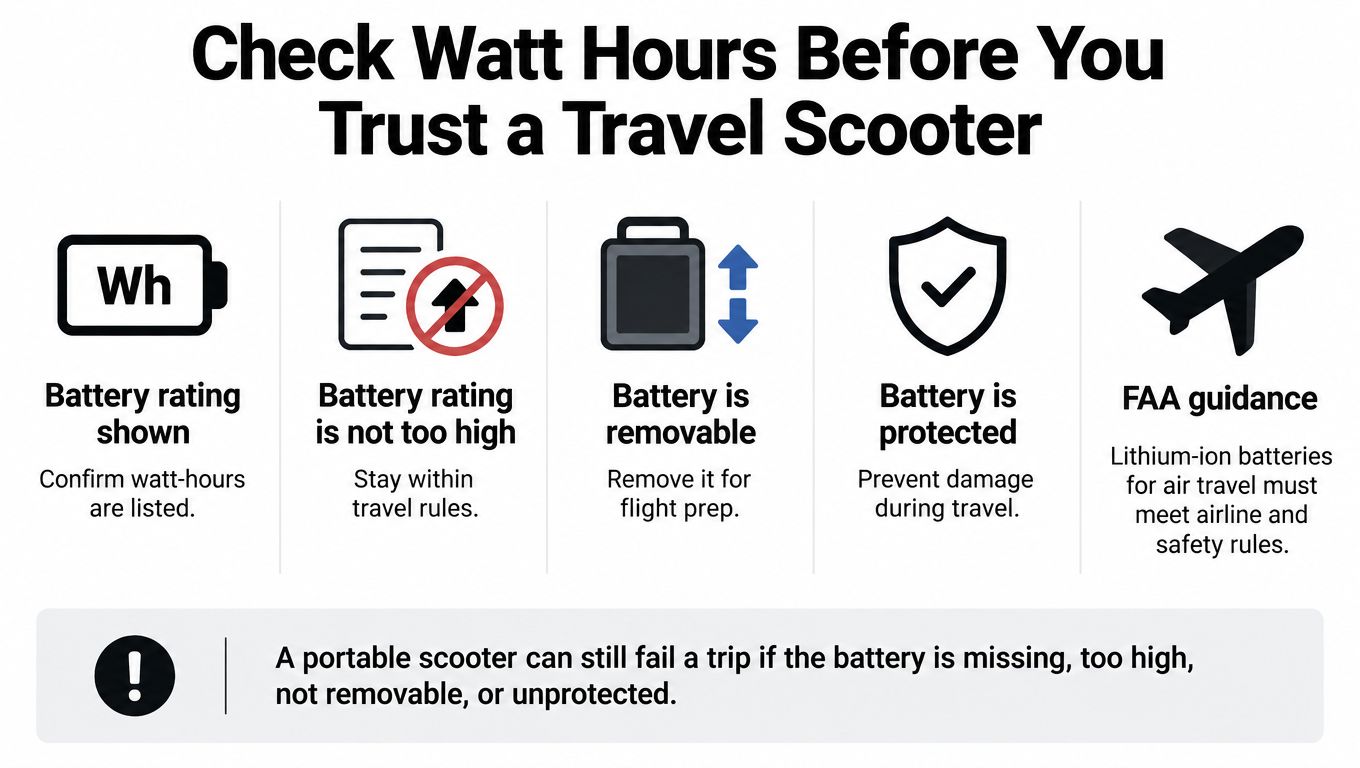
A scooter can fold beautifully and still fail your flight. The battery is the constraint, not the marketing word portable. If the watt-hour rating is missing, too high, not removable when it needs to be, or unprotected, you may learn that at the gate.
The FAA guidance on airline passengers and batteries states that lithium-ion batteries for mobility devices are limited to 300 Wh when removed, while one spare battery up to 300 Wh, or two up to 160 Wh each, may be carried in the cabin. Airlines may impose stricter rules. The FAA also distinguishes devices with batteries installed and protected by design from devices whose batteries must be removed and carried in carry-on baggage.
The Five Item Battery Checklist
Complete these steps before purchase, not before the trip.
- Get the rating in writing. Ask for battery chemistry, voltage, amp-hours, and calculated watt-hours. If the seller can't provide the Wh figure, treat that as a fail for air travel.
- Confirm removal and terminal protection. Ask whether the battery comes off, how the terminals are protected from short circuits, and whether it has a protected housing.
- Read the manufacturer's transport steps. Follow the exact shutdown, removal, and packing procedure for that model. Don't improvise with tape and hope.
- Measure every folded piece. Check the folded size and the weight of the heaviest piece against your car, your cruise cabin, and the person who'll lift it.
- Call the airline with the model and battery rating. Do this before you buy. An airline can be stricter than the general rule, and approval for one carrier doesn't clear a connection on another.
Damaged or recalled batteries aren't a packing problem you solve at the airport. If a battery is swollen, damaged, or recalled, replace it and get documentation before you plan around it.
Federal air-carrier protections help, but they don't erase size and safety limits. Under the airline disability rules in 14 CFR Part 382, airlines must generally accept a passenger's battery-powered wheelchair or similar mobility device as checked baggage when baggage-compartment size and aircraft airworthiness do not prohibit it. For a non-spillable battery, the airline generally cannot require removal and separate packaging when the battery is properly enclosed in the device. If a scooter is not loaded on the scheduled flight, the airline must offer to disembark and rebook the passenger at no additional cost on the next available flight operated by the airline or a partner carrier.
That still leaves practical questions. Can the device travel upright if it has a spillable battery? Is the battery secured well enough? Does it fit the aircraft on your actual route? Our background guide to mobility scooter batteries helps you compare chemistry and capacity once you have the ratings in hand.
Treat airline approval as a checklist result, not a logo on the box.
Caregivers shouldn't assume a foldable frame is cleared for a flight or cruise until watt-hours, removal steps, and carrier rules are confirmed. The time to discover a battery problem is at your kitchen table, with the spec sheet open.
Add What You Need and Plan the Upkeep
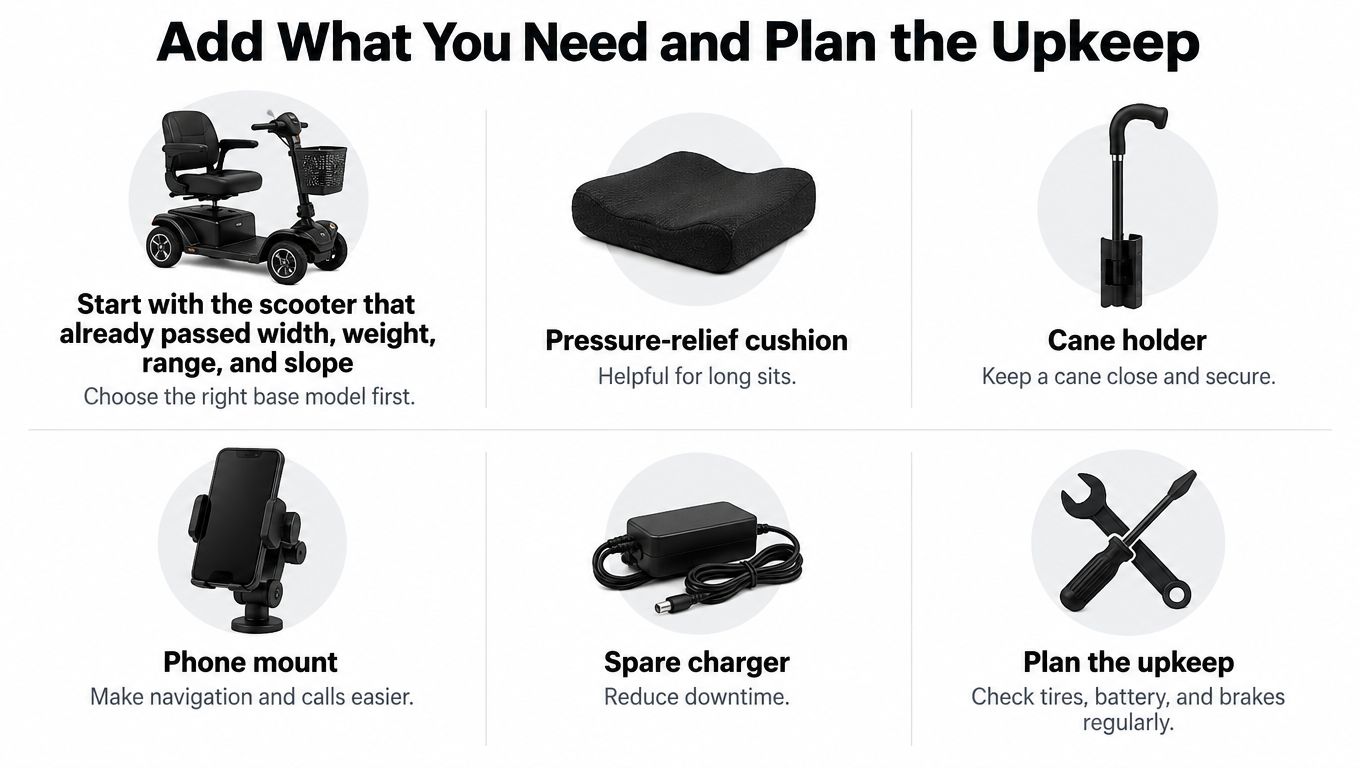
Buy the scooter that already passed width, weight, range, and slope. Then add only what the week requires. Accessories can't fix a wrong base model, and the wrong accessory can make a good scooter harder to use.
Must Haves Versus Nice Extras
- Pressure-relief cushion: Worth it for long sits, especially if the rider already has skin or pain concerns.
- Cane holder: Keeps a cane secure and close without the rider holding it across the lap.
- Phone mount: Useful for navigation and calls if it doesn't block the tiller display or controls.
- Spare charger: Helpful at a second home, office, or family member's house where the scooter regularly ends the day.
- Canopy: Helps in sun or light rain for outdoor users, but check doorway height and wind exposure.
An extra battery can be worthwhile for ground travel. If it will ever fly, it still has to fit airline limits. Skip oversized baskets that sit high and raise the center of gravity, and skip anything that blocks lights, the tiller, or a safe transfer.
Public access also shapes the right size. The ADA guidance on other power-driven mobility devices explains that mobility scooters are treated as wheelchairs under the ADA because they are designed primarily for people with mobility disabilities. Covered entities generally must permit mobility devices, including battery-powered devices, unless a particular device cannot be accommodated because of legitimate safety requirements. The ADA does not create a single universal scooter size, so match dimensions to your actual clinics, stores, elevators, and places of worship.
Paying Without Buying Too Small
Cost shouldn't push you into an undersized scooter that fails the ramp. Many scooters can be bought with FSA or HSA funds when the plan accepts durable medical equipment and a clinician documents medical need. Confirm that with your plan administrator before checkout, because plans differ.
Financing can also make the stable mid-size model affordable when the cheapest fold doesn't pass your route. What matters is the total cost of the right scooter, including a cushion, a spare charger if you need one, and a replacement battery later. A cheap scooter you can't use safely is the expensive option.
A Simple Upkeep Routine
Charge after use with the correct charger, and don't store the battery fully drained. Keep the scooter indoors away from freezing cold and high heat when you can. We publish a guide titled How to Charge a Mobility Scooter Battery Safely, and it pairs well with our scooter maintenance guide once the model is home.
Check tire pressure monthly if the tires are pneumatic, test the brakes regularly, and look at the anti-tip wheels for wear or damage. Plan a yearly service and budget for a replacement battery as range gradually falls. After the first week, revisit seat height, tiller reach, and tire pressure. Setup drift isn't a comfort extra. It's a handling problem you can catch early.
Choose the Scooter That Clears Your Route
Decide with your notes, not with a new feature list. Keep a scooter only if it matches the class row you circled, clears the narrowest door, stays under the weight limit with bags on board, brakes in a controlled way on your steepest ramp, and has range well beyond the longest usual trip. If a flight is part of your year, the watt-hour rating and removal steps have to be in writing first.
Your route includes the buildings you enter every week. In an apartment or clinic, elevator control height and signage requirements from Crane Elevator Company can help you judge whether the rider can reach controls and read floor signs from a seated position. If your entry needs a threshold or portable ramp, compare your slope notes with these ramps for mobility scooters before you order either product.
Three Models as Illustrations of the Rows
These examples show how different rows look in real products. They don't replace your measurements.
- SuperHandy Passport Power Mobility 3-Wheel Scooter: It weighs 35 lbs, has a 275 lb weight capacity, has a range of 13 miles, and is FAA approved. That fits a short-trip portable row if the rider and route pass the stability test.
- ComfyGo Z-4 Ultra-Light Electric Mobility Scooter: It's airline approved, weighs 92 lbs total, has a 350 lb weight capacity, and is priced from $1,249. That's closer to a sturdier errand scooter, so check who can lift or load it.
- Pride Mobility Go Go Super Portable Mobility Scooter: It's FAA approved, weighs 41 lbs, has a 300 lb weight capacity and a range of 10 miles, and costs $2,399 without armrests or $2,499 with armrests. Read the product page for battery chemistry, folded size, and warranty before you assume it fits your trip.
If two models both pass, prefer the one a caregiver can lift and a local shop can service. Read each page for folded dimensions and warranty details, because the class label alone won't tell you whether it fits your trunk.
We offer nationwide free shipping, a 30-day return window on most items, FSA and HSA eligibility, and Affirm financing. Use our 24/7 chat if your doorway measurement and the spec sheet disagree. Order the model that passed your route, then do the first-week recheck of seat, tires, and brakes before the rider relies on it alone.
Bring your one-page pass or fail notes to DME Superstore and compare mobility scooters by width, capacity, range, folded size, and battery documentation, not by photos alone. Our team is available by 24/7 chat to help you match a model to your doorway, ramp, and longest regular trip before you buy.

