



CDC surveillance found that approximately two-thirds of nonfatal bathroom injuries occurred in the tub or shower, according to CDC surveillance on bathroom injuries. That number changes how you should think about shower safety for elderly family members. Age alone isn't the risk. The risk is a wet step, a weak pivot, a curb that's too high, and a hand that can't reach anything solid. A safe setup matches the way this person stands, turns, sits, and gets out. Products help when they're placed for that person's body and anchored into structure. They don't help much when a box says heavy duty but the screws miss the studs.
Why the Shower Is the Fall Hotspot
Say a woman walks to the bathroom with a rollator every morning without trouble. She parks it outside the tub, grips the towel rack, lifts one leg over the rim, and puts a wet foot on smooth acrylic. For two seconds, almost all her weight is on one leg, her hand is on hardware that wasn't built for body weight, and her foot has very little friction. That's the shower problem in one move.
The scale is bigger than one bathroom. A 2021 academic review on falls in older adults reported that more than 1 in 4 U.S. adults aged 65 and older fall each year. In a population-based study of 350 older adults, 46.9% reported experiencing a fall, and the bathroom was the most common location at 26.2%, ahead of the living room at 20.1%. Missing shower grab bars, missing toilet grab bars, and slippery bathroom conditions were among the environmental factors tied to those falls.
What goes wrong during the transfer
Water and soap cut traction underfoot. A tub wall or shower curb then forces a high, one-legged step right at the moment traction drops. Standing up from a low seat adds a third problem, because the person has to shift weight forward and push through the legs with wet hands and no fixed support. Any one of those is manageable on dry ground. Together, they're a fall setup.
Here's a visual summary of why that small room carries outsized risk.
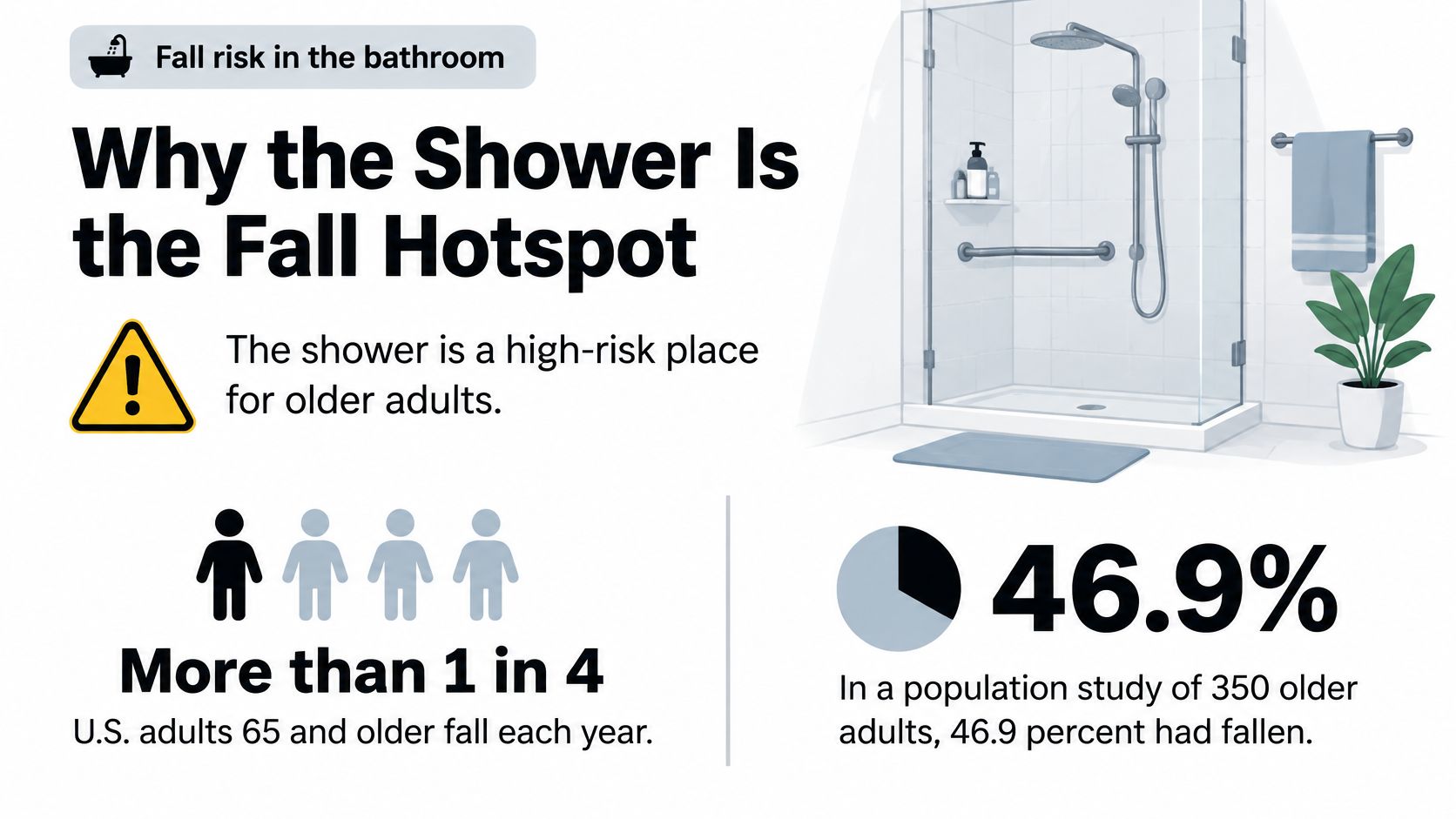
Emergency care numbers point the same way. In 2023, more than 33% of approximately 235,000 annual U.S. bathroom emergency-room visits occurred while bathing or showering, according to Nashville General Hospital. In 2023, more than 37% of bathroom injuries among older adults occurred in the shower or tub, according to Encompass Health.
Three supports that work as a system
You need three things working together, not one product doing three jobs.
- Stable handholds: Bars fixed to structure give the hands a job during entry, turning, and standing.
- Traction underfoot: A grippy surface inside and a dry, firm surface outside stop the slide before balance has to save it.
- A place to sit: A chair or bench removes the need to stand through the whole wash, which is where fatigue turns into sway.
The path counts too. A person who uses a walker, rollator, or wheelchair has to get from the bed to the bathroom door, turn in a small room, and land on dry floor after the shower. A loose rug or a dark hallway can undo good work inside the stall. If you want the wider room-by-room picture first, our guide on how to prevent elderly falls covers the route beyond the bathroom. Inside the shower, though, start with the transfer. That's where most setups pass or fail.
Match the Shower to How They Move
A shower setup should match the person's actual movements, not a generic checklist. Someone may walk confidently on a dry floor yet struggle to lift a leg over a tub wall, pivot on a wet surface, or stand long enough to wash. A review of bathing challenges for older adults describes difficulties older adults may have with raising their arms, reaching parts of the body, using handheld showerheads, maintaining balance, and sitting on unstable shower chairs. The practical question is which movement needs support.
Start with five checks. Observe the person doing each movement while the bathroom is dry, with shoes off and someone nearby to steady them if needed. Age alone does not determine the right setup. The fit depends on how this person stands, pivots, clears a curb, reaches the controls, and exits.
The five checks
- Can they stand through a wash? Notice whether their knees buckle, breathing becomes difficult, or they begin leaning on the wall after a few minutes. If standing becomes tiring, plan for seated bathing. The goal is to match the setup to their endurance, not ask them to push through fatigue.
- Can they lift a leg over a curb or tub wall? Ask them to lift each foot to curb height while holding a counter. A dragging foot, a raised hip, or a twisting torso signals that the wet step may be harder. The transfer surface needs to remove or reduce that movement.
- Can they pivot toward both sides? Some people turn more safely toward one strong leg. Watch which direction feels controlled and which side needs support. Place the seat and handholds to make the stronger, steadier turn easier.
- Can they reach the controls and showerhead without twisting? A fixed showerhead positioned for someone standing may force a seated person to rotate on a wet chair. A handheld hose that can be reached from the seat reduces the need to twist while wet.
- Can they get out alone? Exiting deserves as much attention as entering. A person may be wet, tired, or lightheaded by the time they step to the dry floor. If they cannot stand, turn, and exit safely without help, the current setup does not support an independent shower.
Write down whether each movement is manageable. A difficulty does not automatically mean the person cannot shower at home. It tells you what needs to change: a bench, a properly placed handhold, a handheld hose, an easier entry, or a helper. Test the movement before buying equipment, because a seat can fit the stall and still fail to fit the transfer.
A product labeled heavy duty or stable cannot replace sound structural anchoring and placement that suits the person.
That matters especially with suction handles and clamp-on rails. They may help with balance in some situations, but should not be treated as the sole support for a person's weight. A heavy-duty label does not tell you whether the product is anchored securely or positioned within the user's reach.
Shower setup by how the person transfers
| Situation | What they can do | Safer setup | Do not rely on |
|---|---|---|---|
| Tires while standing | Steps in but cannot stand for the whole wash | Shower chair with back, handheld hose, bar at seated hand height, nonslip floor | A standing-only wash |
| Cannot clear a tub wall | Cannot lift a leg over a curb or rim | Transfer bench across the tub plus bars inside and outside, or a later curb-free opening | Suction cups as the only handhold |
| Uses a wheelchair | Needs level entry and room to turn | Roll-in with no threshold, shower wheelchair or commode chair, controls in reach | A narrow stall with a curb |
| Weak or one-sided strength | Can pivot if the strong side is supported | Stud-mounted bars on the strong side and a seat with back and arms | Towel bars or a diagonal bar |
| Needs a helper to stand | Cannot exit alone after sitting | Seat plus a planned assist or transfer aid, water preset, and a way to call for help | Leaving them unsupervised for the full shower |
Use the table as a first filter, then check the actual room and transfer. A walk-in shower may still have a curb. A roll-in shower has no threshold, or almost none, so a wheelchair can pass into the shower area. Those designs suit different needs. A shower chair stays inside the stall for someone who can step in; a transfer bench spans the tub wall for someone who cannot safely lift a leg over it.
The 7 a.m. transfer may look different from the dry practice. Stiffness, fatigue, and a cold floor can change how easily someone stands or pivots. Plan for the movements that are difficult on an ordinary morning, not just the ones they can manage on a better day.
Three bathrooms, three different answers
The rollator user who freezes on the leg lift. She walks steadily on flat ground but cannot clear the tub rim. A padded transfer bench places two legs inside the tub and two on the dry floor. She backs up to the bench, sits before entering, holds a wall-mounted support, and swings both legs over while seated. A handheld sprayer with a long hose lets her wash without standing to reach a fixed showerhead. The bench changes the hardest part of the transfer: instead of lifting a leg over the rim while standing, she moves her legs while seated.
The prefab shower with a curb that works on good days. He can step over a 4-inch curb in the morning, but his legs feel heavy after a long wash and the exit becomes unsteady. A chair with a back and arms lets him sit; a horizontal bar near seated hip height gives him a handhold when rising. Adhesive strips where his feet land and a reachable caddy for soap and shampoo reduce extra standing and reaching. If he often struggles with the curb or catches a toe, the setup needs a lower-entry solution or assistance for the exit. Being able to do the step occasionally is not enough to make it reliable.
The wheelchair user who cannot remodel yet. If the shower opening is wide and level enough, a shower wheelchair may allow the person to roll in, lock the brakes, and wash seated. If the home has a tub that cannot be removed, a sliding transfer bench offers another route. Bring the wheelchair alongside the bench, lock its brakes, move the footrests out of the way, then transfer across the bench rather than standing over the tub rim. For chairs exposed to water every day, PVC shower chairs provide one option to consider when choosing a frame material.
Details that separate a fit from a guess
Seat height affects both comfort and the effort needed to stand. Feet should rest flat, with knees near a right angle. If the feet dangle, pushing up can be harder; if the seat is too low, standing takes a deeper push from the legs. Chair arms can help a person lower and rise, but they may block a sideways transfer from a wheelchair. For that movement, consider a bench with a removable or cut-out side, or a sliding seat that travels across the tub wall.
Place controls where a seated hand can reach them without twisting. If the valve is behind the person, reaching for it can turn the body on a wet seat. In many showers, a handheld hose on a sliding mount can be positioned within reach without new plumbing. A pause button on the handset also lets the person stop the water while soaping, instead of holding the hose in one hand and washing with the other.
Test the setup in the conditions the person will use. Run the water, wet the floor and seat, then have them enter, sit, reach for soap, stand, and exit while a helper spots them. Shoes should be off. If they reach for the shower door, faucet, or towel rack during the test, they are seeking support that is not where they need it. Mark the needed location with painter's tape, then plan a secure installation there. A good fit comes from matching the room and equipment to each movement, not from choosing a product because it is labeled heavy duty.
Grab Bars That Actually Hold Weight
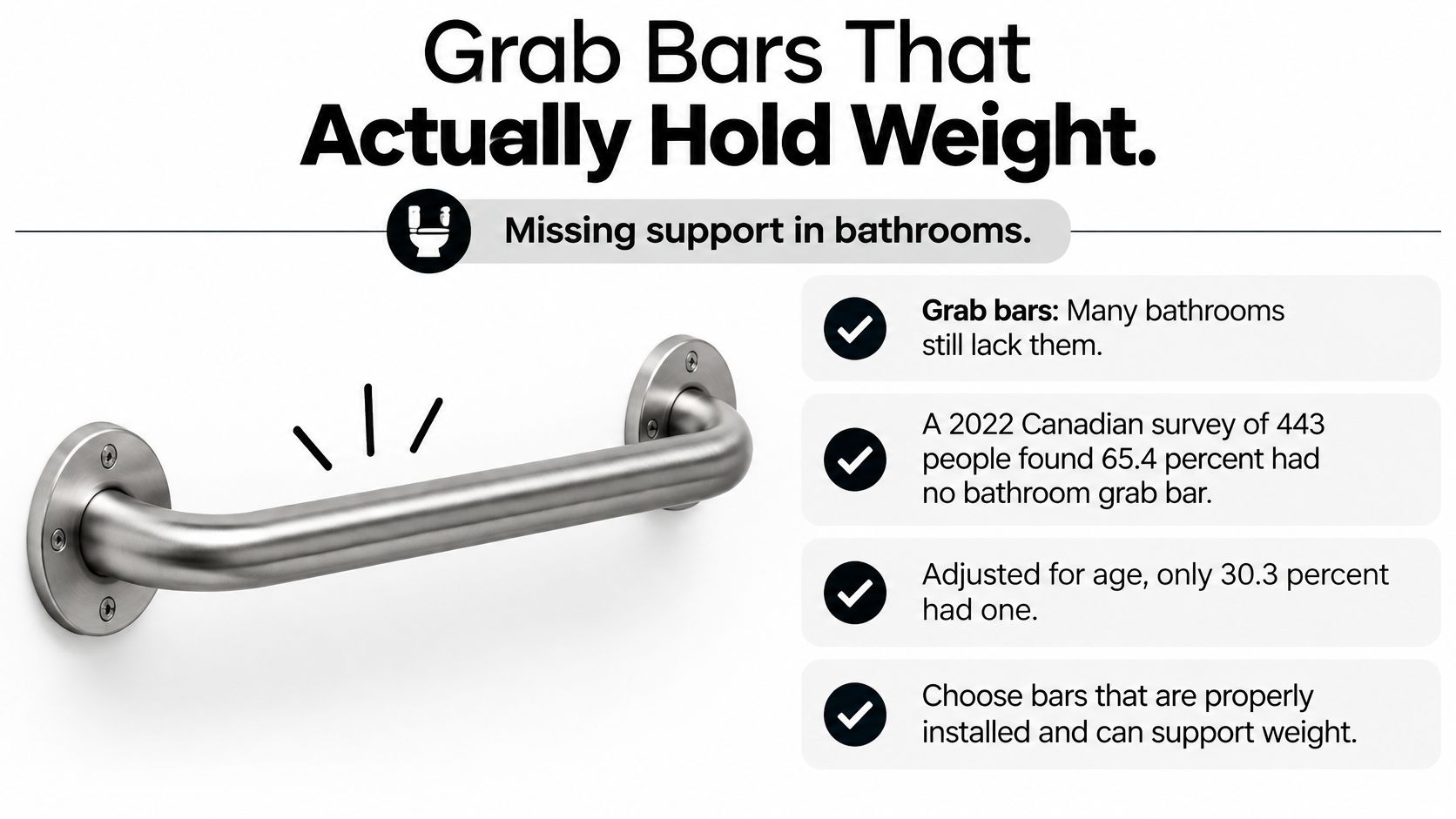
A wet bathroom needs supports fixed where the person shifts weight, not where a bar fits on the wall. In a 2022 Canadian national survey reported in Gerontology and Geriatric Medicine, 443 respondents were surveyed. 65.4% did not have a grab bar in their bathroom, and after adjusting for the age distribution of the Canadian population, only 30.3% had one. A bar is useful only if its placement matches how someone steps in, stands, turns, and gets out.
Suction-cup handholds can provide brief support, but they may be positioned poorly and should not be the only support. The same principle applies to any grab bar: a product labeled heavy-duty cannot make an unsuitable surface or misplaced installation safe. Hardware and location have to work together.
Where the minimum set goes
The National Institute on Aging fall-prevention guidance recommends grab bars near the toilet and on both the inside and outside of the tub or shower. These locations cover the transitions where balance can change quickly.
- Outside the entry: A vertical bar gives the person a handhold before stepping off dry floor.
- Inside near the seat: A horizontal bar provides a place to push down and forward when standing, rather than pulling on a faucet.
- Along the back wall: A second horizontal bar can steady a turn or a reach while the person is standing or seated.
- Beside the toilet: Support there helps with the sit-to-stand transfer before or after showering.
Keep bars vertical or horizontal and anchor them into studs or solid blocking. Avoid diagonal placement, which can let a wet hand slide along the bar as the person shifts weight. A towel bar is not a substitute: its fittings are designed for towels, not for supporting a person.
Grab bar locations and how to fix them
| Location | Mounting | What it supports |
|---|---|---|
| Inside, horizontal near the seat | Into studs or blocking, 1¼ to 1½ inch textured grip, not diagonal | Pushing up from the chair or bench |
| Inside, vertical at the opening | Same structural anchor, within easy reach | Pulling in and steadying while stepping |
| Outside the tub or shower | Fixed on the entry side before the floor is wet | The step or pivot out |
| Beside the toilet | Wall-mounted bar, never a towel rack | Sitting and standing on the way to the shower |
Grip size matters when hands are wet or stiff. A bar 1¼ to 1½ inches in diameter, with a textured or peened finish, lets the fingers wrap around it. Leave room between the bar and wall for the knuckles, and check that the person can close their thumb over the top. If they can only hold it with their fingertips, the bar may be too thick or too close to the wall.
Bar height should follow the person's movement, not a one-size-fits-all measurement. Someone who stands to wash may need a different height from someone who pushes up from a chair. An occupational or physical therapist can observe the transfer and mark positions based on reach, stronger side, and turning direction. For someone using a walker or wheelchair, the approach angle also affects which wall is easiest to reach. The guide to how to install grab bars in a bathroom explains how to locate studs and seal screw holes against water.
Use professional anchoring for someone who cannot stand unaided. Fiberglass surrounds may flex, tile can crack, and hollow-wall anchors do not all hold the same way. Once a bar is installed into the structure, apply a firm one-person tug in each direction the person will use it. That checks the finished installation; it does not replace secure anchoring.
Floors Heat and the Way Out
Think of water temperature as a burn limit you've set on purpose, like a speed limit, not as a comfort dial. MedlinePlus guidance on bathroom safety recommends setting the household water heater no higher than 120°F (49°C), combined with a single-lever mixing faucet so hot and cold water can be controlled with one hand. Reduced thermal sensation, slower protective reactions, impaired vision, and cognitive limitations can all mean a person sustains a scald before recognizing excessive heat.
Florida's state health information service sets the same ceiling. Florida health encyclopedia guidance recommends setting the household water heater to 120°F (49°C) to help prevent burns during bathing. Set the heater once, then test at the shower with a kitchen thermometer under the running water. Heater dials drift, and the number on the tank isn't always the number at the skin.
One hand for water, one hand for balance
A single-lever mixer matters because two-knob faucets ask for two hands or repeated reaching across the body. With one lever, the person can keep one hand on a bar and adjust temperature with the other. Preset the lever position before they get in, and mark the usual spot with a small dot of nail polish if vision is poor.
A handheld hose does the same kind of work for direction. Instead of twisting under a fixed head to rinse soap off, a seated person aims the spray where it's needed. Park the handset in a low mount they can reach from the chair. If they have to stand to retrieve the showerhead, the hose hasn't solved the problem it was bought for.
Two floors, two different hazards
Inside the stall, the hazard is a soapy foot sliding on a smooth base. The CDC STEADI home fall-prevention checklist identifies a slippery tub or shower floor as a safety hazard and recommends placing a non-slip rubber mat or self-stick strips on the floor of the tub or shower. Cover the standing and turning zone, not just a small patch where feet start. Feet move during a wash.
Outside, the hazard flips. The person steps out wet onto hard flooring, often while turning toward a towel. Keep that floor dry and put down a non-skid mat with a rubber back that doesn't travel. A plush bath mat that bunches or slides is a different tool, and it's the wrong one here. For longer-term surface choices, our guide to non-slip bathroom flooring compares mats, strips, and floor finishes by where the water lands.
Inside test: Wet the surface, add soap, and shuffle in bare feet. If your foot glides, theirs will too.
The route to the shower deserves the same attention as the stall. CDC caregiver fall-prevention materials recommend removing small throw rugs or securing them with double-sided tape. A rug edge in a hallway can cause the fall before the water ever runs. Add bright, even light at the bathroom threshold and a night light on the route from the bed, since glare and shadow both hide the curb edge and the mat edge.
Don't expect traction products to fix a failed leg lift. Strips on top of a high curb still leave a high curb. If the earlier leg-lift check failed, the answer is a bench, a lower threshold, or help with the step, not a grippier version of the same obstacle.
A five-minute check you can run tonight
- Heater verified: Water at the shower measures at or below 120°F.
- Inside surface grippy: Mat or strips hold under a soapy shuffle and edges lie flat.
- Outside floor dry: The first step out lands on a firm, non-skid surface.
- Route clear: No loose rugs between the bed and the bathroom door.
- Light working: The threshold and controls are easy to see without glare.
When a Helper Should Stay Nearby
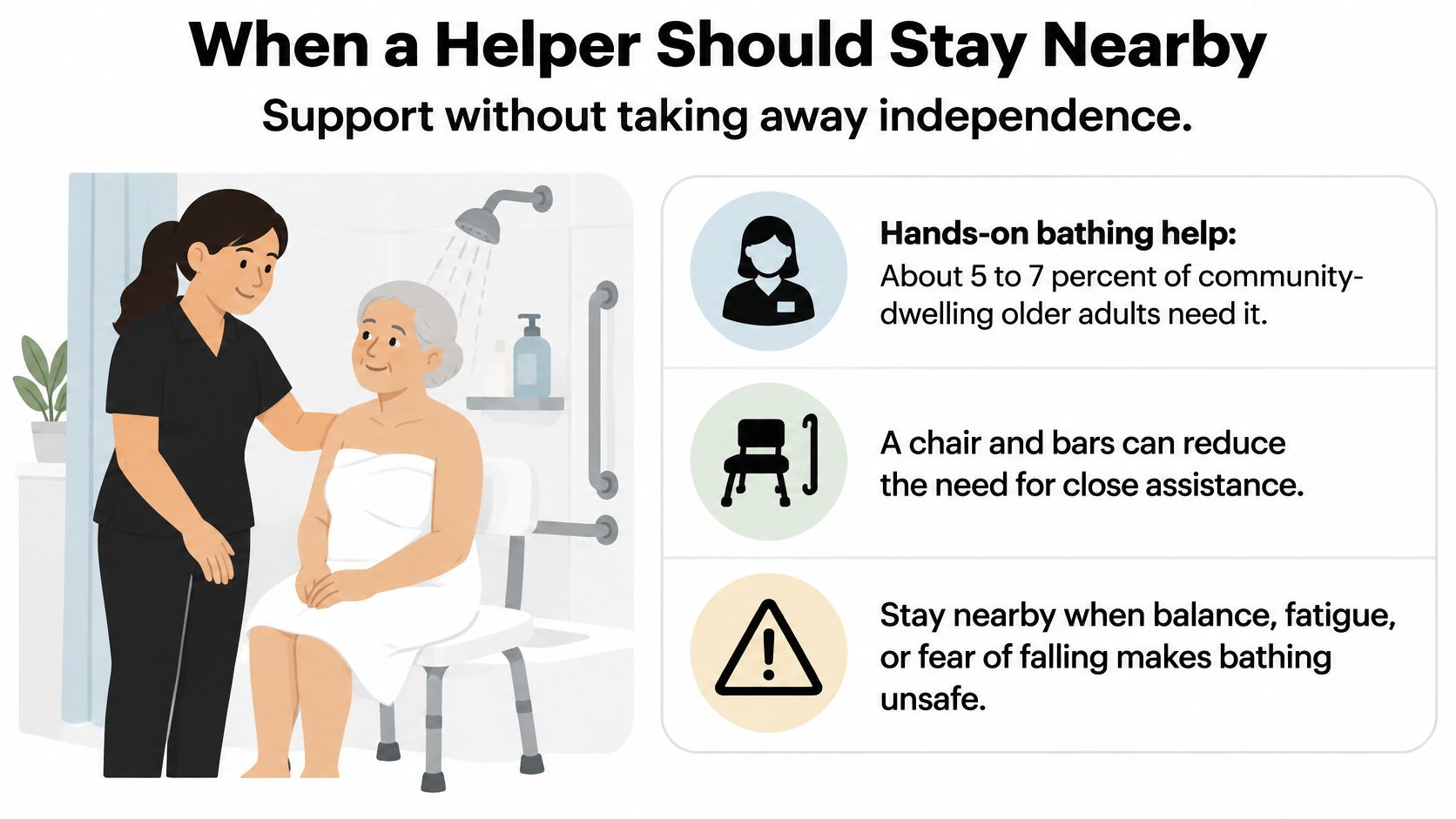
Families often frame this as a choice between full independence and a helper standing in the room for every shower. That framing helps nobody. A review summarized in Marquette University nursing faculty research on bathing assistance reports that roughly 5 to 7% of community-dwelling older adults require personal bathing assistance. The rest sit somewhere on a spectrum. Some need equipment only. Some need a person within earshot. Some need hands on for one transfer and privacy for everything else.
A chair and stud-mounted bars can carry a person who can sit down in a controlled way, reach the hose and soap, and stand again with one arm pushing through the bar. Equipment supports independence when every move in the sequence has a tool matched to it. The picture changes when one link breaks.
Signs a helper should be there for the transfer
- Can't rise from the seat: If standing takes three rocking attempts or a pull on the faucet, someone trained stays for the stand.
- Recent change: New weakness after surgery, a stroke, a hospital stay, or a medication change means the old routine no longer applies.
- Can't follow the sequence: Forgetting to lock brakes, turn off water, or hold the bar points to supervision, not willpower.
- A fall or near fall: Treat the next shower as assisted until the setup gets reassessed.
Caregiver reports include resistance, agitation, inability to follow the bathing routine, and safety concerns. Add the helper's own body to that list. Research on bathing assistance identifies back musculoskeletal disorders among home-care providers. A helper who catches a falling adult on a wet floor can end up injured beside them.
This visual keeps the middle ground in view, support that protects without taking over.
Helping without getting hurt
Set up before anyone gets wet. Towel, clothes, soap, and a dry chair outside the shower should be in place, because a helper who leaves mid-transfer to fetch a towel creates the gap where falls happen. Lock wheelchair or shower chair brakes before any stand. Say the plan out loud. On three, lean forward, push through the bar, stand. Predictable counts beat surprise lifts.
Use a hip hinge, not a back bend, when guiding someone up. Stand close, feet staggered, and let your legs do the rising work while your hand steadies at the hip or a gait belt. Don't lift under the arms. Armpits aren't handles, and pulling there can hurt shoulders and unbalance both people. Our refresher on safe patient transfer techniques shows hand placement for sit-to-stand assists when you want to check your form.
If they can't exit the seat alone, someone trained stays for the stand up, even if they wash privately.
Privacy is part of the safety plan
Dignity isn't decoration. A person who feels exposed rushes, refuses, or tries to shower alone at an unsafe hour to avoid being seen. Keep a towel across the lap until the water runs. Let them hold the handheld sprayer and wash what they can reach. Stay outside the curtain or door, within voice range, and step in only for the transfer or the hard-to-reach spots they've agreed to. Check the water temperature with your inner wrist before it hits their skin.
Agree on a call method for the minutes they're alone. A plastic bell on the shower caddy, a waterproof call button, or a phone in a sealed pouch on the dry ledge all beat shouting through running water. Test it once so both of you know it carries.
Refusal deserves a calm response, not a wrestling match. Shorten the shower, keep the same order of steps every time, warm the room first, and schedule bathing for the time of day when the person is strongest and least confused. Anxiety often drops when the routine never surprises them. If refusal is new, look for a cause such as pain, a recent scare, or water that felt too hot last time.
Reassess after every change that touches strength, balance, or thinking. A new fall, surgery, stroke, dementia progression, or a hospital stay should trigger a fresh run through the transfer checks before the next independent shower. Independence that gets reviewed lasts longer than independence that's assumed.
Recheck the Shower and Get the Right Gear
Equipment drifts out of fit. Suction cups lose grip, mat edges curl, screws loosen a quarter turn at a time, and the person using it all gets a little weaker each season. A monthly pass catches the drift while it's still cheap to fix.
The monthly recheck
- Confirm the heat limit. Run the shower and verify the water still stops at or below the safe ceiling you set.
- Tug every bar. Pull in the directions the person loads it. Retighten only if the bar was mounted into structure. If it moves in the wall, call a pro and don't use it as a handhold until it's refixed.
- Inspect traction. Replace a curling mat, peeling strips, or any surface that feels slick when soapy.
- Clear the walk. Tape down or remove rugs between the bed and the bathroom, and check the night light still works.
- Run the transfer. Sit in the chair, reach the hose and soap, and stand using the bar while a helper spots. Any new grab for a faucet or door frame marks a gap.
- Check wheels and brakes. For wheelchair users, confirm brakes lock hard and the shower opening is still clear of stored items.
- Reset after any change. After a fall, surgery, or new weakness, repeat the five transfer questions before the next shower, not after a second scare.
Put the check on the same day each month, tied to something you already do, like restocking medication organizers. Ten minutes is enough when nothing has changed.
Buying gear that matches the row you picked
Shop from the transfer outward. If the plan is a seated roll-in wash, you need a chair that rolls, locks, and fits the opening. If the plan is a tub transfer the helper can't muscle through anymore, you need mechanical help, not a stronger grip. Durable medical equipment solves most of these rows without a remodel, and you can compare sizes before anyone opens a wall.
We stock Bathroom and Shower and Transfer Aids categories for exactly this kind of matching, with free shipping and FSA or HSA eligibility. Two examples show how to read the specs against a real bathroom. The Medline Aluminum Padded Shower Wheelchair Commode holds 275 lb, has a 19-inch seat width and a 26-inch overall width, and is listed at $374.45. Measure your shower opening before ordering, because overall width decides whether it rolls in or stops at the door. When a tub transfer is too heavy for a helper, the Freedom Aqua Waterproof Powered Patient Lift is electric, weighs 47 lb, is waterproof, and is rated to 300 lb, with open-box pricing from $1,650 for the lift. Have a therapist confirm fit and sling choice before buying any lift, since the right lift used with the wrong sling still creates a bad transfer.
Don't buy for the person you hope they'll be after therapy. Buy for the transfer they can do this week, with a little headroom in the weight rating. Matching shower safety for elderly users to real movement, then rechecking that match every month, beats any single product claim.
Pick one failed move from your checks. Fix it with one product or one proper install. Then set the date for the first monthly recheck before the box even arrives.
Browse shower chairs, transfer benches, grab bars, and powered lifts with clear weight ratings and dimensions at DME Superstore, where our Bathroom and Shower and Transfer Aids categories help you match gear to the exact transfer your family member needs to make safely. Order the setup that fits their strength, reach, and doorway today, and use the monthly recheck above to keep it fitting as needs change.

