



Your parent has returned from hospital, sleeps much of the day, and now has reddened heels. You're comparing mattresses, but the labels raise more questions than they answer: foam, alternating pressure, low-air-loss, overlays. The first decision isn't which technology to buy. It's whether their skin needs clinical assessment and what support their whole day requires, including time in bed, sitting, and transfers.
Pressure relieving mattress guidelines start with the person, not the product. A suitable surface must match their risk, body size, movement, skin condition, and care arrangements. It also needs to work safely with the bed you already have.
Match Your Pressure Injury Risk to the Right Surface
For a family facing reddened heels after discharge, this table provides a starting point for a clinical conversation. It isn't a way to diagnose or stage an injury at home.
Risk level and the surface it calls for
| Risk level | Typical surface | Review trigger |
|---|---|---|
| Low risk, no current injury | Quality standard or high-specification foam | Mobility, nutrition, or health status changes |
| At risk, can shift position | High-specification reactive foam | Redness or discoloration that persists after pressure release |
| High risk or limited repositioning | Pressure-redistribution foam or alternating-pressure overlay on a quality base | Any skin breakdown while on the surface |
| Existing stage 2 or deeper injury, or bottoming out | Alternating-pressure, low-air-loss, or air-fluidized surface chosen with a clinician | Open wound, drainage, odour, or worsening pain |
Before choosing a row, ask a nurse or clinician to document a formal risk assessment. That assessment should cover immobility and activity, height, weight and mass distribution, posture or deformity, existing injury location and severity, skin response, heat and moisture needs, shear exposure, and ability to reposition independently.
The row should match that assessment, not a guess based on how comfortable the person looks. Someone who sleeps peacefully may still be unable to relieve pressure effectively.
What the evidence supports
A Cochrane review of 7 studies involving 2,407 participants found that alternative support surfaces reduced pressure-ulcer incidence compared with ordinary hospital foam, with a pooled risk ratio of 0.38; an earlier review of foam alternatives reported a risk ratio of 0.40. Results varied by mattress type and study quality.
Those findings support choosing an appropriate pressure-redistributing surface for someone at risk. They don't prove that every advanced mattress works equally well, or that the most expensive option is universally better.
Prevention and treatment also need different decisions. An existing wound requires assessment, not just an equipment upgrade. For context on specialist care, Comprehensive Wound Services describes wounds requiring surgical evaluation, which can help families understand when a mattress purchase is only one part of a wider treatment pathway.
Practical rule: Find the risk row that matches the documented assessment, then identify the trigger that means the choice needs review.
Include repositioning, skin inspection, moisture care, nutrition, and heel protection in that decision. A mattress can improve support, but it doesn't remove the underlying risk.
How Pressure-Relieving Mattresses Actually Work
On a crowded bus, standing on one foot concentrates your weight in a small area. Sharing the load across both feet reduces that concentration. A pressure-redistributing mattress applies a similar principle by supporting more of the body rather than allowing a few vulnerable points to carry most of the load.
The comparison below illustrates concentrated versus distributed support.
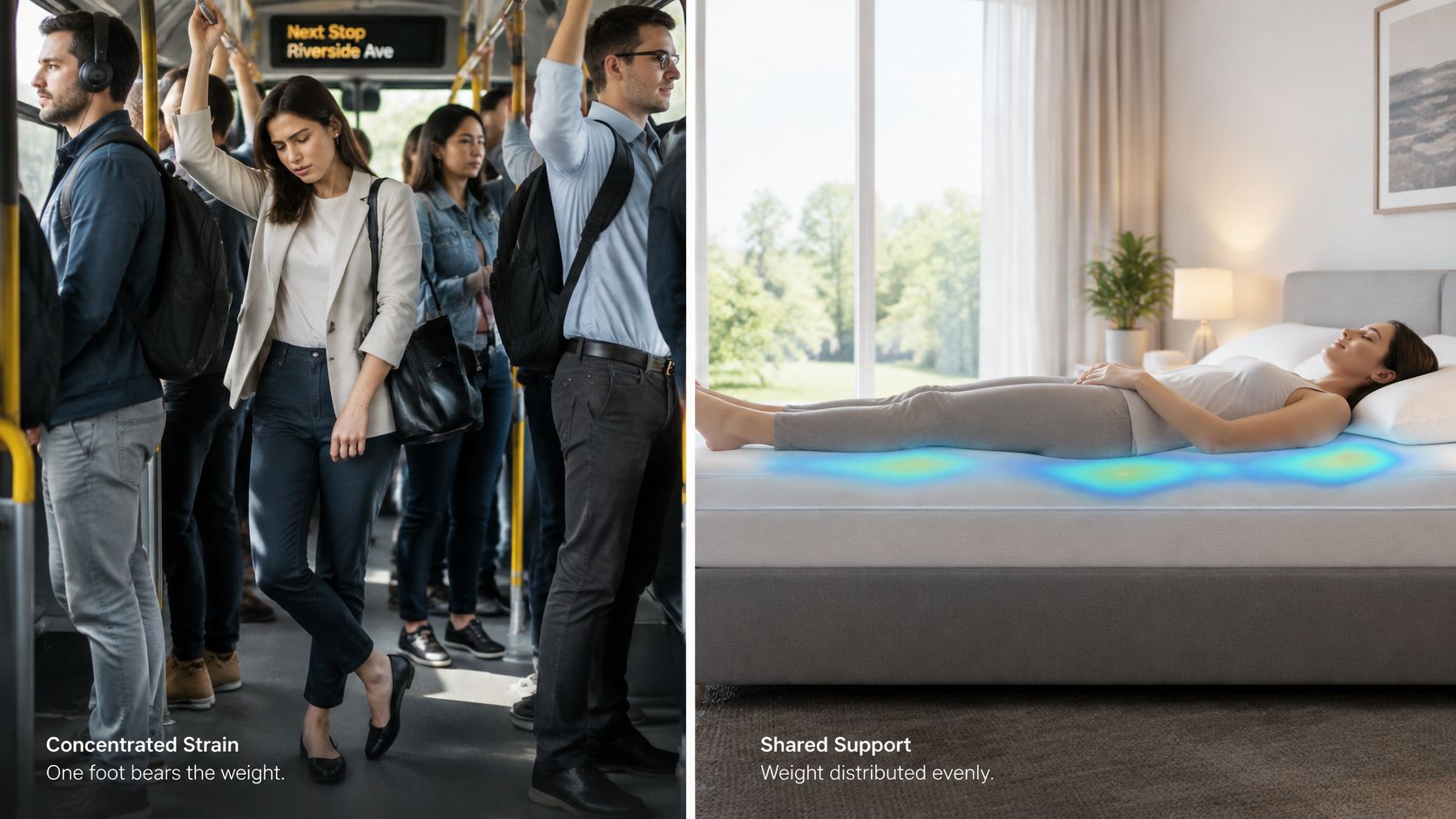
The sacrum, hips, heels, and shoulder blades are vulnerable because bone lies close to the surface. When someone stays still, sustained loading can deform the tissues beneath the skin. A mattress that accommodates the body helps reduce concentrated loading.
Conforming, cycling, and managing the skin environment
Static or reactive support responds to the person's weight and shape. Engineered foam allows immersion, meaning the body sinks into the surface, and envelopment, meaning the surface conforms around it. Dynamic support changes air-cell inflation over time to unload different areas.
Redistribution describes the overall purpose, not a separate guarantee attached to a material. Airflow adds another function: managing the temperature and moisture where skin meets the mattress. Our explanation of what a low-air-loss mattress is separates that function from pressure cycling.
Shear occurs when the body slides while skin remains against the bedding, stretching underlying tissue. Good support, suitable positioning, and smooth, dry sheets help limit this problem. Softness alone tells you little about whether a surface manages these forces effectively.
For a visual companion to these concepts, the following video offers another way to explore mattress support.
NICE's pressure-ulcer quality standard describes pressure-redistribution devices in terms of reducing or redistributing pressure, friction, or shear, rather than comfort alone. The mattress spreads the load, but it cannot remove the need to move the body.
Mattress Types Compared Side by Side
The most complex product isn't automatically the right one. Compare each surface against the actual care problem: concentrated pressure, inability to reposition, trapped moisture, an existing wound, or a combination of these.
Support surface types and their trade-offs
| Type | How it redistributes load | Best suited to | Main limitation |
|---|---|---|---|
| High-specification reactive foam | Engineered foam conforms and spreads load without power | People at risk who still shift position | Can bottom out if overloaded or unsuitable for the person |
| Viscoelastic foam overlay | Slow conforming provides body immersion | Comfort-focused, low to moderate risk after assessment | Can retain heat and moisture |
| Alternating-pressure air | Cells inflate and deflate in cycles to offload tissue | High risk or limited repositioning | Needs a pump and correct settings; overlays need a quality base |
| Low-air-loss | Supported air cells combine redistribution with continuous airflow | Moisture and microclimate control | Requires power, suitable bedding, and regular checks |
| Air-fluidized | Air moving through particles provides extensive immersion | Deep existing injuries, clinician-directed | Heavy, costly, and complex to manage |
An overlay goes on a compatible mattress; a replacement mattress takes its place. Don't treat those formats as interchangeable when comparing prices or planning installation.
The visual comparison also includes static foam and hybrid designs, which combine foam and air support.
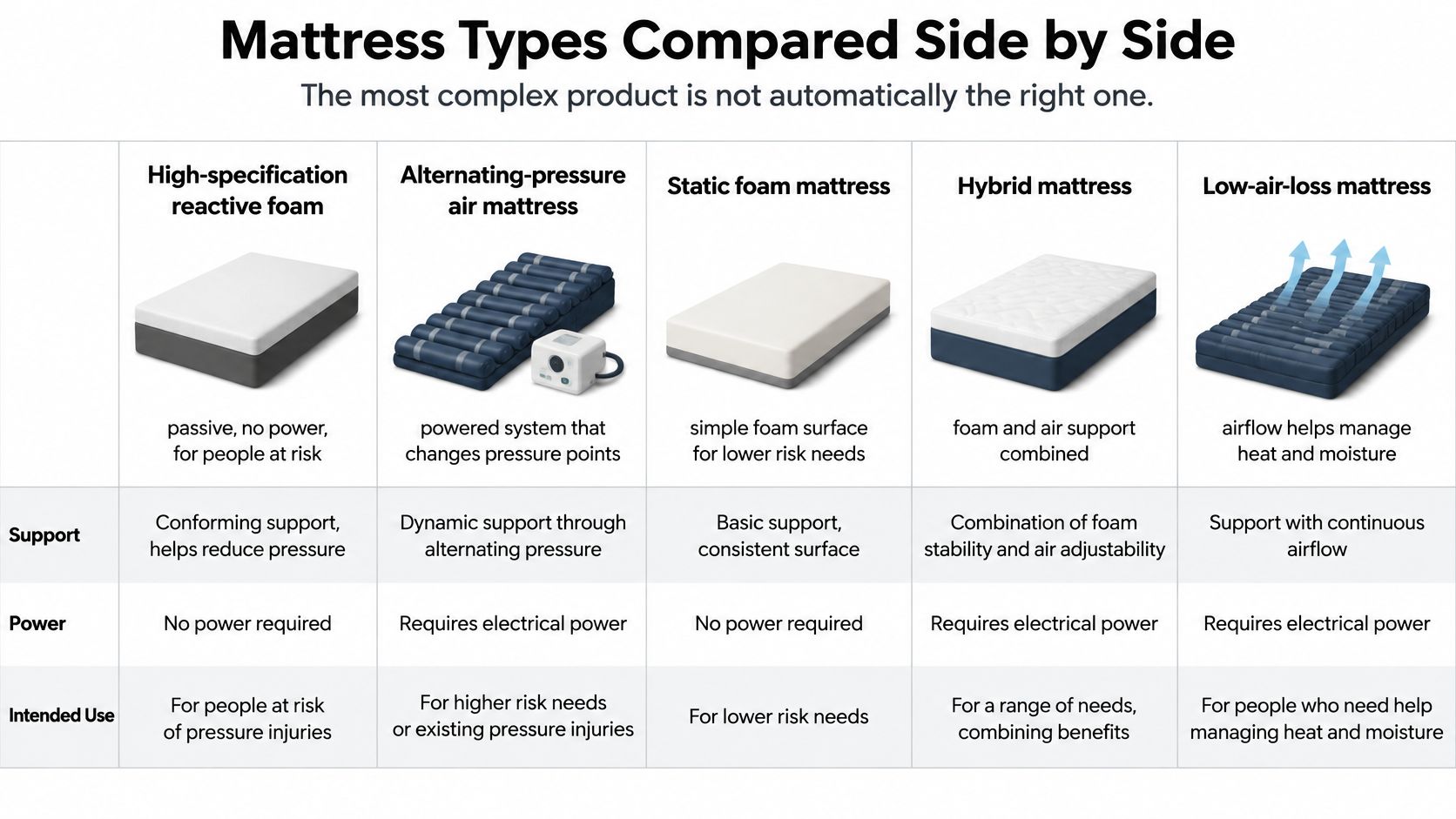
Encouraging findings, with important limits
A Cochrane evidence overview reported pressure-ulcer incidence of 7.4% (83 of 1,125 participants) on alternating-pressure air surfaces versus 10.4% (117 of 1,122) on foam, with a risk ratio of approximately 0.63 (95% CI: 0.42–0.93); another synthesis reported a risk ratio of 0.46 (95% CI: 0.29–0.75) for reactive air versus foam.
These are comparisons between study groups, not a prediction of what will happen to an individual. Evidence remains uncertain about differences between alternating-pressure systems and several other advanced surfaces. Correct inflation, maintenance, and skin monitoring remain essential to real-world performance.
Start with the lowest-complexity surface that meets the assessed need. Move up when a review trigger appears or a clinician identifies an unmet need, rather than assuming that more controls mean better protection.
Specs and Numbers to Check Before You Buy
A specification sheet answers several different questions. Weight capacity concerns safe use, dimensions concern compatibility, and pressure-performance information concerns support under particular test conditions. None substitutes for the others.
Specifications to verify before buying
| Specification | What it tells you | What to check |
|---|---|---|
| Maximum user weight | Manufacturer's upper permitted user load | Rating exceeds the user's weight with an appropriate margin |
| Mattress dimensions | Fit in the frame and relationship to side rails | Length, width, and depth meet the bed manufacturer's compatibility requirements |
| Interface pressure | Pressure measured between the body and support surface | Documented test conditions and suitability for the person, not an isolated marketing value |
| Immersion and envelopment | How the body sinks into and is supported by the surface | Hips and shoulders are accommodated without bottoming out |
| Cell configuration and depth | Support distribution and stability | Stated depth and cell layout suit the user's size |
| Cover and moisture handling | Heat and moisture management | Breathable, stretch cover with compatible waterproof protection |
| Heel protection | Provision for heel offloading | Heel-specific device or zone included or compatible |
| Pump alarms and power-failure mode | Warning and response when inflation is lost | Low-pressure warning and documented instructions for loss of power |
Start with safety limits and fit
Maximum user weight isn't a precise bottoming-out threshold. Someone can bottom out below that rating because of body shape, incorrect inflation, or unsuitable support. Confirm the mattress rating and bed-frame capacity separately.
Measure the actual frame and check the approved mattress dimensions, including depth. A poorly matched mattress can shift or create unsafe spaces around rails and bed components. Don't improvise fillers to correct an incompatible fit.
Interface-pressure results need context. Ask how the measurements were taken, with what load, and in which positions. A single value doesn't establish that a mattress prevents injury for every user.
Check support and accessories together
Immersion should accommodate prominent areas without allowing the person to reach the underlying base. Envelopment should support the body without making movement or transfers unmanageably difficult.
Cell depth alone doesn't prove performance. Cell arrangement, inflation, and edge stability also affect how the person lies, turns, and gets out of bed.
Covers and protective layers must work together. A tight sheet, thick topper, or incompatible waterproof layer can interfere with the intended support or airflow. Heel protection likewise needs an explicit plan rather than an assumption that the full-body mattress handles everything.
Get the weight rating and frame compatibility in writing before paying. Record any specification that hasn't been confirmed instead of filling the gap with an assumption.
For powered systems, keep the alarm and power-failure instructions accessible to every caregiver. Knowing what to do during a fault matters more than merely seeing an alarm listed on the product page.
How to Position and Reposition Safely
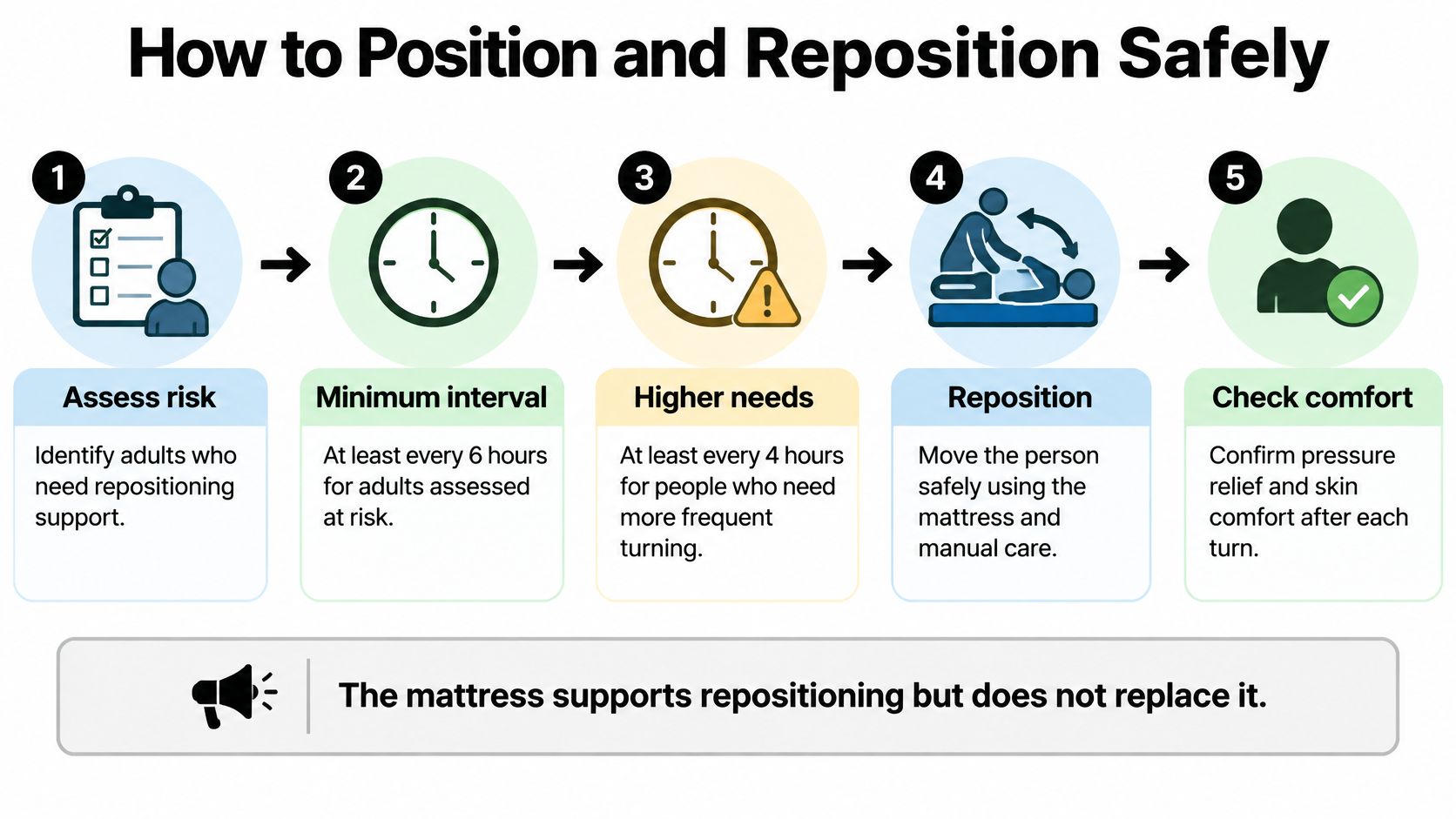
The mattress supports repositioning but doesn't replace it. NICE recommends frequent position changes at least every 6 hours for adults assessed as at risk, and at least every 4 hours for adults assessed as high risk, with the required frequency documented.
These are minimum recommendations, not a schedule to impose on everyone. The clinician should adapt the plan to skin response, mobility, comfort, pain, and other clinical needs.
The process below keeps assessment and comfort alongside the turning schedule.
Make each change purposeful
- Confirm the surface is ready. For an air system, check inflation and pump operation before placing the person on it. An uninflated mattress can leave them inadequately supported.
- Unload vulnerable areas. Use the prescribed pillows or wedges to avoid sustained loading over heels, hips, sacrum, and shoulder blades. Don't place the person directly onto an existing injury unless the clinical plan specifically requires that position.
- Limit sliding. Keep head elevation as low as their medical needs allow. Breathing, feeding, and other treatment requirements may take priority, so ask for an individualized position rather than lowering the bed against clinical advice.
- Lift rather than drag. Keep sheets smooth and dry, and use a suitable repositioning aid. Pulling someone across bedding adds friction and shear.
- Inspect during the change. Look at heels and other bony areas for new discoloration, skin damage, or discomfort.
- Record the time and position. Include pain, tolerance, and skin changes so the next caregiver can follow the same plan.
- Get appropriate assistance. If the person can't move independently, use the help and transfer equipment specified in their handling plan. Don't attempt an unsafe solo lift.
For practical home-care arrangements, our guide to preventing bedsores at home can help caregivers organize the surrounding routine.
The same principle applies after transfer to a chair: someone still needs suitable support and an individualized movement plan. Moving out of bed doesn't end pressure exposure.
Guidelines for Different Patient Profiles
A suitable mattress type can still perform poorly when the person exceeds its rating, the frame is incompatible, or bedding traps heat and moisture. The practical question is whether the complete setup works for that person throughout their day.
Priorities by patient profile
| Profile | First priority | Practical check |
|---|---|---|
| Bariatric user | Rated weight and bed width | Confirm capacity and frame fit before purchase |
| Post-surgery patient at home | Short-term offloading | Daily skin checks on heels and bony areas |
| Wheelchair user | Seated pressure redistribution | Cushion and sitting-time plan alongside the bed |
| Adjustable-bed user | Compatibility with head elevation | Check head-raising limits and sliding |
| Incontinent user | Moisture and microclimate control | Compatible breathable cover and a cleaning routine |
| Family caregiver or facility | Documented baseline and escalation | Written skin log and clear review triggers |
Match the setup to the daily routine
For a larger-bodied user, adequate width matters alongside capacity. Caregivers need room to position the person without leaving them close to an edge, and the transfer method must suit their mobility. A heavy-duty label doesn't replace model-specific documentation.
After surgery, pain or movement restrictions may prevent the position changes someone normally makes. Ask the discharge team which positions are permitted and how long those restrictions apply. Check that the home plan is achievable with the help available.
Wheelchair users need a seating assessment, not just a soft cushion. Consider posture, cushion compatibility, ability to shift weight, transfer technique, and time spent sitting.
MedlinePlus guidance warns that raising the head of the bed above 30 degrees can increase sliding and shear. For adjustable-bed users, reconcile that concern with prescribed breathing or feeding positions, then check support and stability in the positions used.
Protect the areas equipment can miss
Incontinence care requires prompt cleaning and compatible protection rather than piling absorbent layers onto the mattress. Caregivers should also inspect skin beneath devices and around areas that are difficult to see during routine care.
Our guide to heel protectors for pressure sores explains options to discuss when heels need targeted protection.
A whole-day plan names the bed surface, seating support, transfer method, skin checks, and person responsible for acting on changes.
The same mattress can be appropriate for one person and unsuitable for another. Match it to the care routine, not just the diagnosis.
Cleaning, Maintenance and Pump Checks
Before use, confirm that the mattress is inflated, the pump runs, tubing isn't kinked, and the selected setting matches the user and manufacturer's instructions. An under-inflated or leaking system may fail to provide its intended support even when it's new.
International pressure-injury guidance emphasizes correct setup, an appropriate base mattress for alternating-pressure overlays, and reassessment after installation or changes in health or weight. Check comfort, posture, pain, temperature, moisture, and whether the person is bottoming out.
Keep cleaning compatible with therapy
Use only cleaning products and methods approved for the cover. Clean promptly after incontinence, let the surface dry fully, and inspect seams and closures before reuse. Don't soak components or put fluid near the pump unless the instructions explicitly permit that method.
A protective cover must preserve the mattress's intended function. Our guide to mattress waterproof covers helps distinguish protection from adding an unsuitable barrier over a therapeutic surface.
Use this practical routine alongside any stricter manufacturer schedule:
- At routine care checks: Look for wetness, cover damage, loose connections, and trapped tubing.
- During planned equipment inspections: Examine the surface for leaks, sagging, uneven support, or damaged seams.
- After an alarm: Record what happened, follow the troubleshooting instructions, and confirm support has been restored.
- After a health change: Recheck settings and ask whether the surface still meets the person's needs.
Act on failure signs
Escalate a deflating surface, persistent alarm, seam leak, or new skin change that remains after offloading. Contact the equipment service team for faults and the clinical team for skin concerns.
Don't silence an alarm and assume the mattress is safe. Follow the documented backup plan so the person has appropriate support while the fault is resolved.
Confirm Warranty and Coverage Before You Buy
Choose the assessed risk tier, confirm the surface's weight rating and frame fit, then check payment arrangements. Reversing that order can leave you with equipment that's reimbursable but clinically unsuitable, or appropriate equipment without the paperwork needed for coverage.
Read the warranty for duration, exclusions, wear versus defects, and responsibility for shipping or labour. Check whether the pump, cover, and mattress components have separate terms, and read the return conditions before opening or installing the equipment.
Put the paperwork beside the specification
Insurance and Medicare-style programmes may require a clinician's written order, wound documentation, and other evidence supporting the selected surface. FSA or HSA administrators may request medical-necessity documentation. Confirm the current requirements before purchase; our guide to what is considered durable medical equipment explains the broader equipment category.
For a practical fit example, our Flexabed Hi-Low SL Adjustable Bed comes in 74", 80", and 84" lengths. Hi-Lo listings offer Innerspring, Low Profile, Visco Combo, Gel Core, Latex Core, or no mattress, meaning base only. Our Medline MedLite Full-Electric Homecare Bed has a 450 lb capacity, a 14.5" to 22.5" height range, and 3" casters. Those frame details don't establish the clinical suitability or capacity of a separately selected mattress.
Before ordering:
- Confirm the risk tier and its review trigger.
- Obtain written confirmation of mattress weight rating and frame dimensions.
- Check component warranties, including pump and cover.
- Match coverage paperwork to the exact chosen surface.
Obtain clinical sign-off for any stage 2 or deeper injury. Buy once clinical suitability, fit, rating, and paperwork are confirmed.
DME Superstore offers pressure-redistribution foam, alternating-pressure, and low-air-loss mattresses alongside adjustable beds and transfer equipment for home care. Visit DME Superstore to compare specifications and compatibility information, then bring your shortlist and documented care needs to your clinician before choosing a surface.
