



A caregiver changing soaked sheets in the middle of the night has more to think about than whether the mattress feels dry again. The cover underneath needs to fit, stay intact through cleaning, and work with the bed's support system. A post-surgery patient may have a different concern: whether the cover will trap heat or interfere with a pressure-relief mattress.
“Waterproof” can describe very different levels of protection. A cover that catches an everyday spill isn't automatically a tested barrier against body fluids and pathogens, and a barrier that blocks liquid can still be uncomfortable or unsuitable for a specialty mattress. The right choice depends on who uses the bed, what the cover needs to protect against, and how it will be cleaned.
Why Waterproof Covers Matter More Than Most Buyers Realize
A mattress is difficult to clean thoroughly once liquid reaches its inner foam. In a home, that may mean an accident leaves a stain or persistent odor. In care settings, a damaged or inadequate cover can allow contamination to reach material that routine surface wiping can't disinfect effectively.
That's why a mattress waterproof cover isn't always just a spill catcher. For household use, a fitted protector may be enough to shield against occasional accidents. In a clinical or home-care situation involving incontinence, wound drainage, or frequent disinfection, the relevant question is whether the cover is designed and tested to maintain a continuous barrier during use and cleaning.
The distinction matters for older adults, people with incontinence, post-surgery patients, and caregivers choosing a replacement cover. A useful way to compare options is to ask what each one is expected to do:
- Catch household spills: A fitted protector may suit a guest bed or a child's bed when the main concern is everyday moisture.
- Protect against contamination: A fully enclosed, tested cover may be more appropriate when liquid control and cleaning requirements are central.
- Work with a support surface: A cover for an alternating-pressure or low-air-loss mattress must preserve the mattress's intended airflow and surface performance.
For practical advice on comparing household protectors, Tip Top Furniture's mattress protector advice offers a useful additional perspective. If bed protection is part of a broader pressure-care plan, DME Superstore's guide to preventing bed sores at home can help caregivers think about the sleeping surface as part of day-to-day care.
The aim isn't to buy the most protective-sounding product. It's to match the cover's tested performance, fit, and care requirements to the person and mattress that will use it.
What a Mattress Waterproof Cover Actually Is
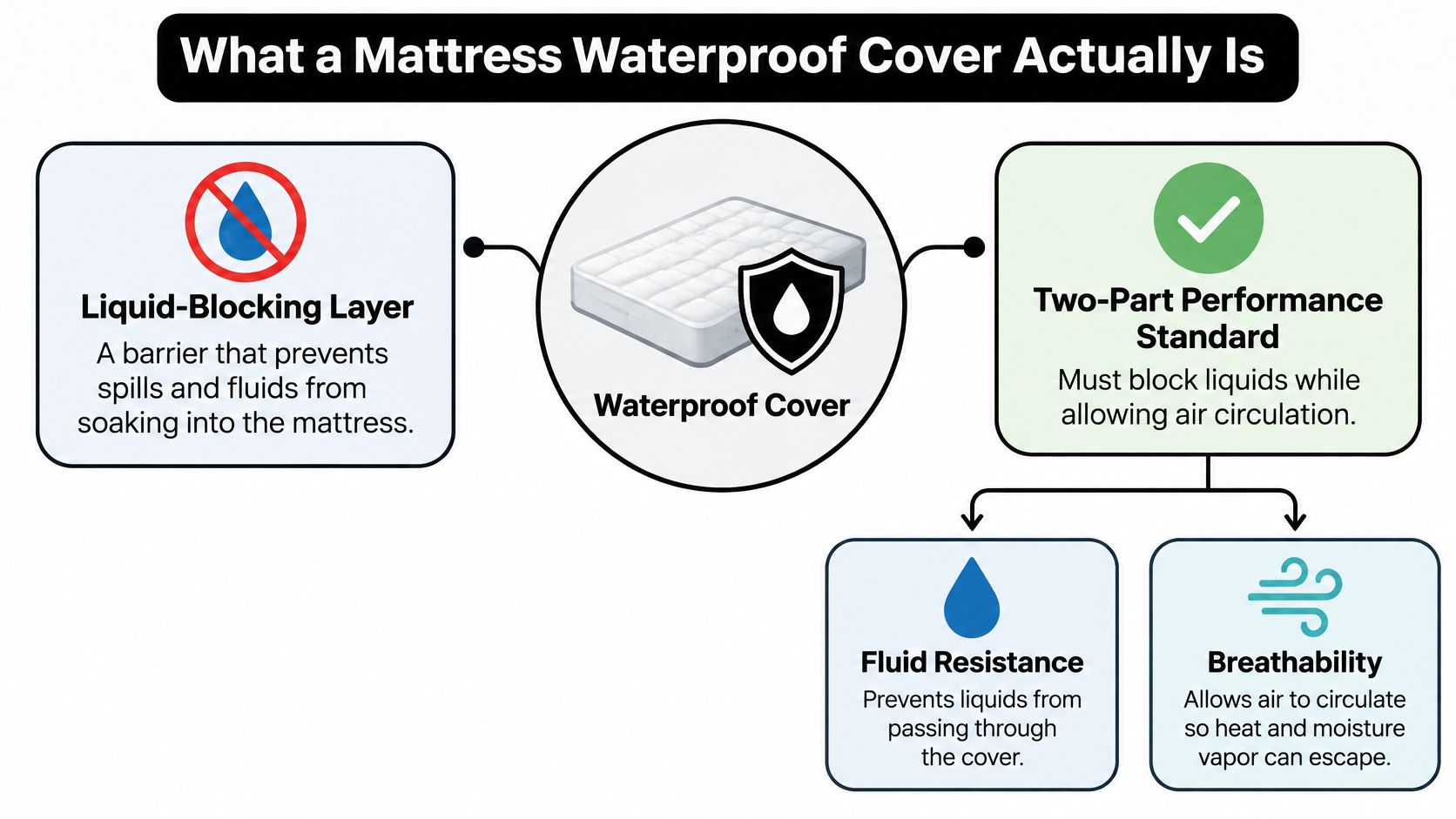
In plain language, a mattress waterproof cover is a layer designed to stop liquid from reaching the mattress. But the word waterproof doesn't tell you whether the cover protects only the top surface, encloses the mattress, or remains effective under the pressure and moisture of real use.
Read beyond the waterproof label
A household cover might repel a small spill on its upper surface, while a healthcare-grade encasing is expected to protect fully. A 2025 S2k hygiene guideline recommends encasings that are impermeable to liquids and pathogens, washable, and suitable for wipe disinfection. It says bacterial impermeability should be demonstrated through testing under both moisture and pressure, conditions that reflect the way body fluids and a patient's weight can challenge a cover during use. (The 2025 S2k hygiene guideline)
This doesn't mean every family needs a clinical product. It means buyers shouldn't assume that a top layer that resists a spill has the same performance as an enclosed barrier tested for demanding care conditions.
Consider liquid and vapor together
A useful cover needs to block liquid without automatically sealing off all moisture vapor. A completely occlusive layer can trap heat and perspiration at the skin-surface interface. That can be an uncomfortable trade-off, particularly for a person spending extended time in bed.
Look for specifications for both liquid resistance and breathability, rather than treating the word “waterproof” as a complete performance description. A guide to choosing mattress protectors from Stahl Home Center can also help readers get familiar with the differences between common bedding products.
Materials and Construction Compared
The material name alone won't settle whether a cover is right for a particular sleeper. The top fabric affects touch and noise, while the waterproof layer, seams, and construction determine how the barrier behaves. Cleaning requirements also matter: a cover that feels comfortable but can't tolerate the household's cleaning routine may not be a practical choice.
| Material | Liquid Barrier | Breathability | Feel & Noise | Wash Tolerance | Best Fit |
|---|---|---|---|---|---|
| Polyurethane or TPU laminate | Depends on film, seams, and closure | Varies by design; check specifications | Often paired with a fabric top for a less noticeable feel | Follow the product's care limits | Everyday use when a documented liquid barrier and comfort are both priorities |
| Vinyl | Can provide an occlusive liquid barrier | Limited compared with vapor-permeable designs | May feel warmer or make more noise | Depends on product instructions | Situations where wipe-clean protection matters more than breathability |
| Knit or terry top with waterproof backing | Depends on the backing and how it is joined | Depends on the backing, not just the top fabric | Soft or absorbent surface fabrics can make the cover feel less like a bare membrane | Check the top fabric and backing instructions | Household beds where surface feel is a key concern |
| Multilayer breathable film | Depends on barrier and construction integrity | Designed to balance liquid blocking and vapor movement | Varies with layers and fabric; assess product details | Manufacturer-specific | Specialty support surfaces when compatibility is confirmed |
Compare performance, not just fabric names
A 2025 randomized clinical study of a microclimate coverlet reported a moisture-vapor transfer rate of 130 g/m²/hr. That figure can serve as a point of comparison when reviewing breathable polyurethane or multilayer laminates. It isn't a universal minimum for every waterproof mattress cover, and products should only be compared when their test methods and conditions are clear. (The microclimate coverlet study)
The liquid barrier can also fail at seams, corners, or zippers even when the main fabric seems intact. Ask how the product handles these weak points and what cleaning methods it permits. For an accessible overview of waterproof cover styles, Casamé Home provides another reference for thinking about the range of protective-cover constructions. For beds used in clinical care, DME Superstore's information about a mattress for hospital use may help with the wider support-surface context.
Fitted Protectors Versus Full Encasements
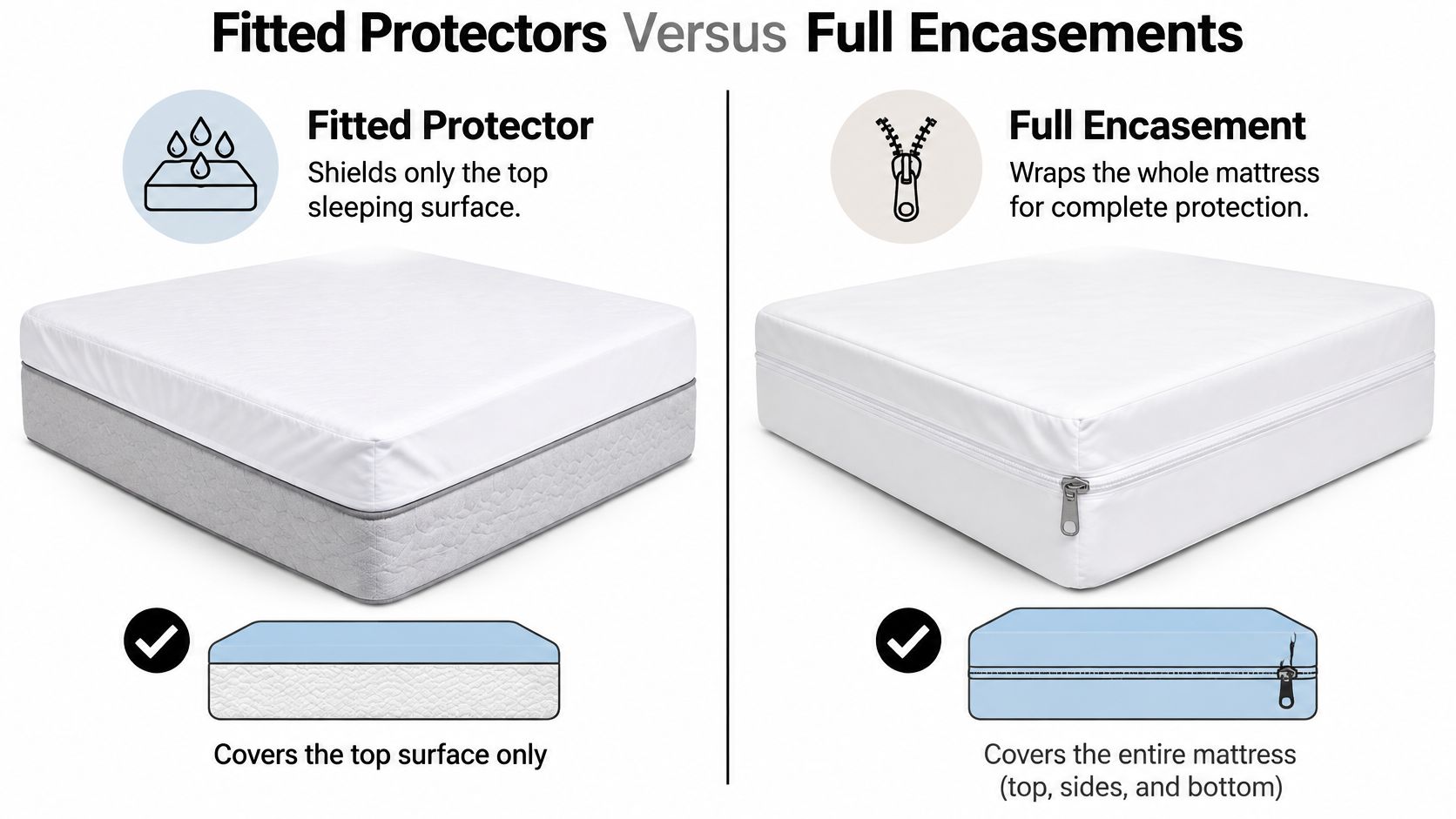
A fitted protector covers the sleeping surface and usually wraps around the mattress edges like a fitted sheet. A full encasement closes around the whole mattress, including the underside. The first is usually easier to remove for routine laundering. The second offers more complete coverage, but its closure, seams, and fit become part of the barrier.
Match coverage to the reason you're buying
For occasional spills on a guest bed, a fitted protector may provide the practical coverage needed. For ongoing incontinence care, a fully enclosed design may be worth considering, provided its material, seams, and cleaning instructions suit the care routine. If the bed has an alternating-pressure or low-air-loss system, don't assume that full coverage is automatically better. The cover must also be compatible with the equipment's airflow and pressure-relief functions.
Bed-bug control is a separate use case. The Alaska Department of Environmental Conservation advises that a bed-bug encasement should cover the entire mattress, use bite-proof fabric with tightly spaced zipper teeth, and remain sealed rather than being removed routinely after installation. (Alaska bed-bug encasement guidance)
The video below provides another look at the difference between common mattress-cover options.
A bed-bug encasement shouldn't be treated as interchangeable with a standard waterproof protector. The coverage and closure are intended for insect exclusion, not spill protection. Likewise, a waterproof cover designed for household use shouldn't be assumed to meet infection-control requirements just because it encloses the mattress.
Choosing the Right Cover for Your Specific Situation
Start with the bed and the person using it, not with a product label. A caregiver buying for someone with limited mobility may need a different balance of protection, breathability, fit, and cleaning convenience than someone protecting a spare bedroom.
Begin with the mattress and support system
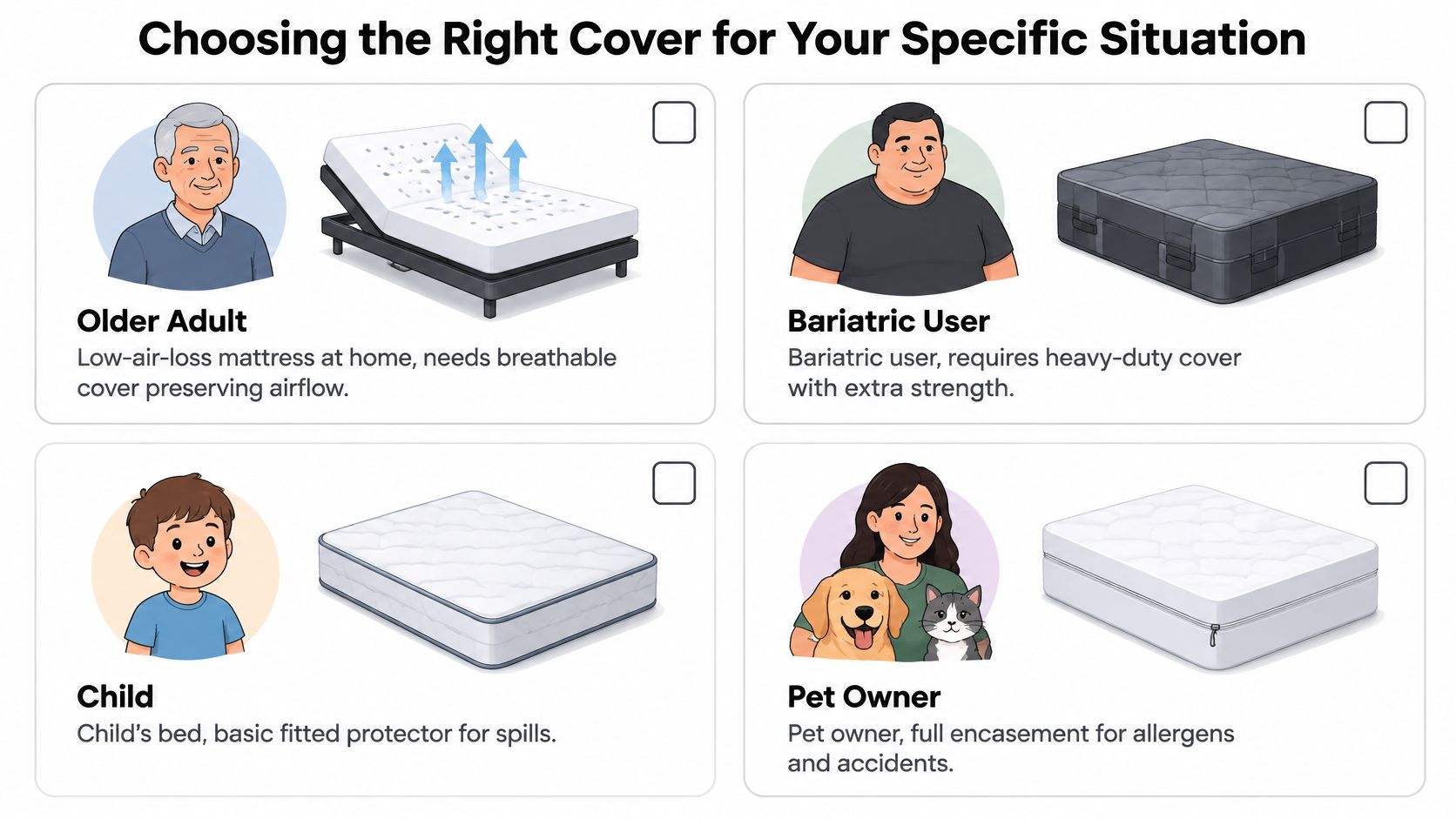
An older adult using a low-air-loss mattress at home may need a breathable cover that preserves the support surface's airflow. Before buying, confirm compatibility with the mattress manufacturer or supplier. A cover that fits tightly but blocks airflow may interfere with the system's intended performance.
For someone using an alternating-pressure mattress after surgery, ask whether the cover can move with the surface without obstructing vents or pulling tightly across the patient. Avoid choosing by fabric alone. The surface system and cover need to work together.
Account for size, load, and care
A bariatric user may need a cover made for the mattress's dimensions and construction, with sturdy seams and a closure suited to frequent use. Check the mattress depth and shape, and ask the retailer whether the cover is designed for that particular bed. “Heavy-duty” on a label isn't a substitute for confirmed fit and compatibility.
For a family caregiver managing incontinence, consider whether a fitted cover will provide enough coverage or whether a fully enclosed design better matches the care routine. A separate guide to urinary incontinence pads may help with the distinct role of absorbent products placed above the mattress cover.
Use this checklist when comparing options:
- Measure the mattress: Record its height and check for unusual contours or adjustable components.
- Confirm the support surface: Ask about alternating-pressure or low-air-loss compatibility.
- Review the barrier: Look for documented liquid-resistance performance and details about seams and closure.
- Check the care instructions: Confirm the permitted wash and disinfection methods.
- Ask about repairs and replacement: The CDC warns that a compromised cover can allow contamination, that patches over tears or holes don't create an impermeable surface, and that visibly stained mattresses should be replaced rather than merely covered. (CDC guidance on mattress covers and bedding)
Installation and Ongoing Care
A correctly chosen cover can still disappoint if it's installed in a way that strains the material or obstructs the mattress system. Start by following the cover and bed manufacturers' instructions. Make sure the cover lies smoothly, the closure is fully secured, and no vents or functional components are blocked.
Fit the cover without restricting the bed
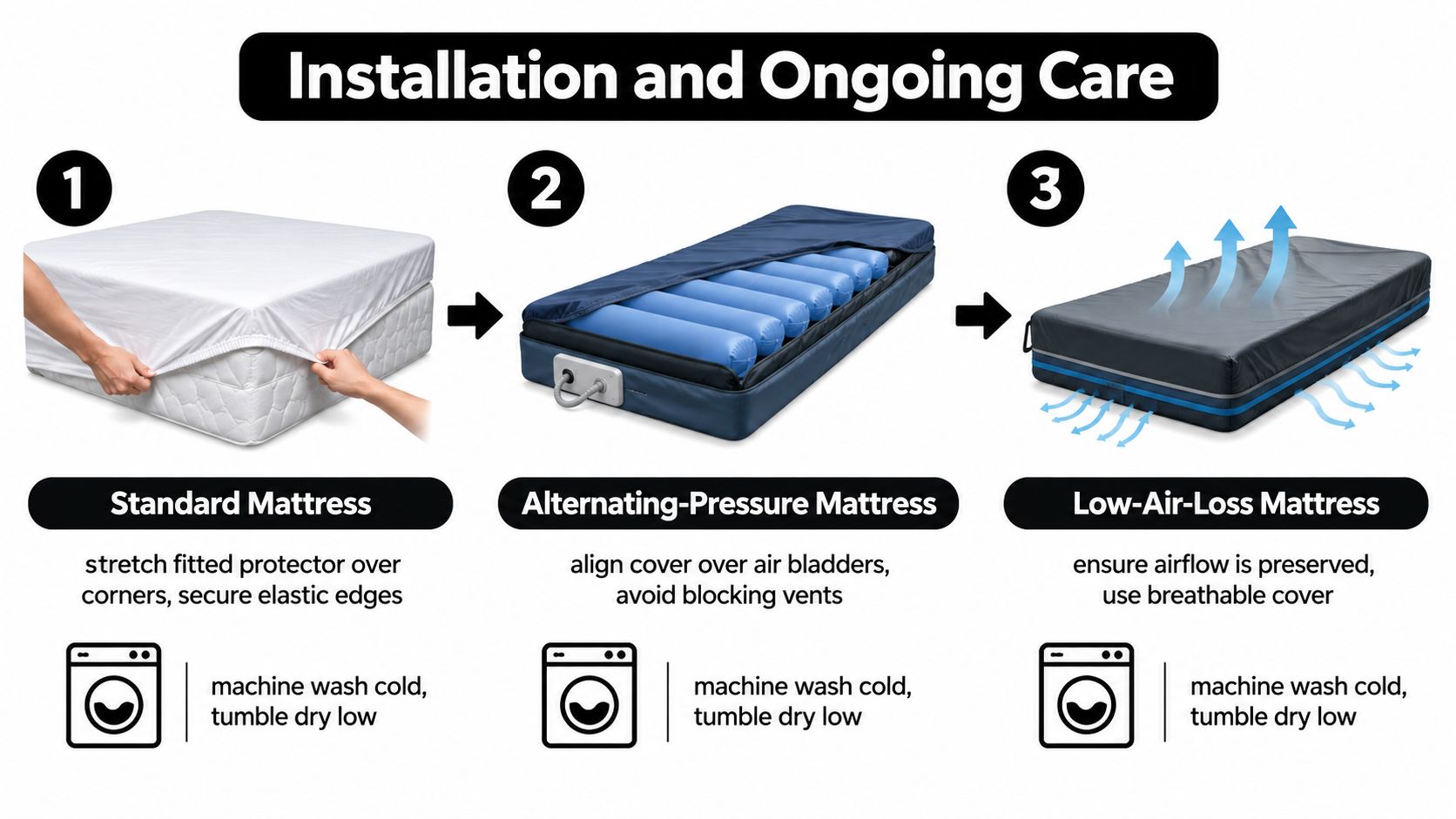
On a standard mattress, stretch a fitted protector over the corners and smooth the surface before adding sheets. With a zippered encasement, position the mattress carefully, avoid catching fabric in the zipper, and confirm the closure reaches its stop.
For an alternating-pressure mattress, align the cover with the mattress surface and follow the equipment instructions for vent placement. On a low-air-loss system, choose only a cover that the manufacturer or supplier confirms is compatible. Avoid a tight, nonbreathable layer that could obstruct airflow or change how the surface supports the sleeper.
Keep inspection and cleaning practical
Make routine checks part of bed care. Look over the seams, corners, zipper, elastic edges, and coated areas for cracks, separation, punctures, or signs that fluid may have passed through. Clean according to the product label, including its temperature, detergent, disinfectant, and drying limits. Don't assume the same laundry method suits household washing and clinical disinfection.
For care between patients, the CDC recommends an EPA-registered disinfectant compatible with the cover material. It rates this recommendation Category IB and warns that unsuitable chemicals can cause tears, cracks, or holes that compromise the fluid barrier. (CDC cleaning and disinfection recommendations) If urine odor is a concern, DME Superstore's guidance on removing urine smell from a mattress may help with the cleaning question, but it doesn't replace the cover manufacturer's care instructions.
Replace a cover when its barrier is damaged, the zipper leaks, seams separate, or fluid appears to have migrated beneath it. Don't patch a tear and assume the cover has regained an impermeable surface.
The Trade-Offs Most Buyers Skip Over
More impermeable doesn't always mean more suitable. A fully occlusive layer may block liquid effectively while also holding heat and perspiration close to the sleeper. On a pressure-relief bed, an unsuitable or overly tight cover can also obstruct airflow, affect how the patient settles into the surface, or increase sliding.
That doesn't make vinyl wrong. A wipe-clean surface may suit a situation where frequent surface cleaning is a priority and the mattress system permits that cover. In a bedroom where comfort and vapor movement matter, a breathable laminate may be a better fit. The deciding factors are the sleeper's needs, the care routine, and compatibility with the bed.
Ask about chemistry and comfort
Water-resistant marketing claims can also raise material questions. Independent testing found PFAS in 9 of 13 stain- or water-resistant bedding items, including 4 of 7 mattress pads or protectors tested. That finding doesn't prove that every waterproof cover contains PFAS, but it makes it reasonable to ask for material disclosure, a PFAS-free statement, or certification details. (Independent bedding testing on PFAS)
A physical polyurethane barrier and a chemical water-repellent treatment aren't the same thing. Ask the seller which construction provides the liquid barrier and what any listed certification covers. If the product is intended for a pressure-relief bed, ask about airflow compatibility as well as chemical disclosure. DME Superstore's explanation of low-air-loss mattresses can help caregivers understand why cover choice matters to that type of support surface.
Your Decision Recap and Common Questions
Before buying, write down the answers to four questions: Who will use the bed? What liquid or contamination risk must the cover address? What mattress or support system will it sit on? How will you clean and inspect it? Those answers narrow the choice more reliably than price or the word “waterproof” alone.
A fitted protector can suit routine household spills. A full encasement offers broader coverage when its closure and materials fit the use case. A specialty pressure-relief mattress calls for a cover confirmed compatible with that system. For any care setting, check the seams and cleaning instructions alongside the main fabric.
Common questions
How long should a waterproof cover last? There isn't a dependable lifespan that applies to every product. Materials, laundering, disinfectants, wear, and the frequency of use all affect how long the barrier remains intact. Inspect it regularly and replace it if the coating, seams, or closure show damage.
Does the protector go over or under the fitted sheet? It generally sits directly over the mattress, beneath the fitted sheet, unless its manufacturer specifies another arrangement. That position helps the cover form the barrier between the sleeper and the mattress. If a separate absorbent bed pad is used, follow its instructions and keep the waterproof layer underneath.
What should I do if a seam fails? Stop using the cover as a barrier and check the warranty and care documentation. Photograph the damage, note how the cover was cleaned, and contact the seller or manufacturer to ask whether the product should be replaced. Don't treat a patch as restoring an impermeable surface.
DME Superstore offers home-care equipment and mattress options with different cover constructions, including removable waterproof covers and waterproof vinyl covers. For caregivers comparing a mattress waterproof cover with a pressure-relief bed, clear product specifications and compatibility information can help make the choice more practical.
If you're choosing a cover for incontinence care, recovery at home, or a pressure-relief mattress, compare its barrier, cleaning instructions, and compatibility before you buy. Visit DME Superstore to explore home-care equipment and mattress options, then review the product specifications or contact the team for help matching a cover to the bed.
