



You're helping someone bathe, and the moment that worries you most isn't the washing. It's the pause at the tub edge, one hand reaching for the wall while the other tries to control a lower, a turn, or a rise. A handicap seat for bathtub use can make that movement more manageable, but only when the seat fits the person, the tub, and the rest of the transfer route.
The safest choice starts with a different question than “Which chair should I buy?” Ask instead: How will this person enter, sit, reposition, and exit? The answers guide the seat type, dimensions, grab-bar placement, and need for caregiver assistance. This guide walks through those decisions with practical measurements, clear comparisons, and installation checks you can complete before ordering.
Why a Bathtub Seat Is Part of a Safer Bathroom
A family caregiver often sees the problem in a single moment. Your spouse places a foot over the tub rim, pauses, and reaches toward the nearest surface. An adult parent lowers onto the seat but slides forward because the surface is wet. You may steady their shoulder while wondering whether the equipment is helping or adding another object to manage.
That concern is reasonable. A bathtub seat reduces the need to stand while bathing, but it doesn't remove the raised rim, wet flooring, or balance demands involved in transferring. A CDC-indexed study found that 17% of injurious falls occurred in bathrooms, compared with 8% of non-injurious falls, and additional CDC reporting noted that 37% of bathroom injuries were preceded by bathing, showering, or getting out of a tub or shower (CDC-indexed bathroom fall evidence).
Practical rule: Choose the seat around the transfer, not around the product photograph.
A safer setup may include the seat, properly positioned grab bars, a nonslip tub surface, adequate lighting, and a clear route to a towel or mobility aid. If you're considering a broader accessibility change, Modern Bathrooms accessibility renovation advice can help you think beyond a single product and assess the room as a whole. For grab-bar planning and installation considerations, review this guide to installing grab bars in a bathroom.
A seat can support independence, but it shouldn't encourage someone to use a towel bar, sink edge, or unstable tub wall for support. Research on bathing environments reports that 12 to 66 percent of community-dwelling older adults experience difficulty with the bath transfer, and people may rely on unsafe supports when appropriate handholds aren't available (bath transfer research summary).
The useful buying process is therefore concrete. Identify the transfer direction, measure the tub, compare seat designs, check the seat height and depth, and test the complete movement before regular use. Those steps give you a more dependable answer than a weight rating or a reassuring photograph.
The Main Types of Handicap Bathtub Seats
The tub rim is the first design problem to solve. A typical tub rim is about 15 to 19 inches high, and a U.S. Consumer Product Safety Commission technical report identifies bathtub entry and exit as significant slip and fall risks (CPSC bathing-surface report). Some seats help a person sit once inside. Others help them avoid stepping over the rim altogether.
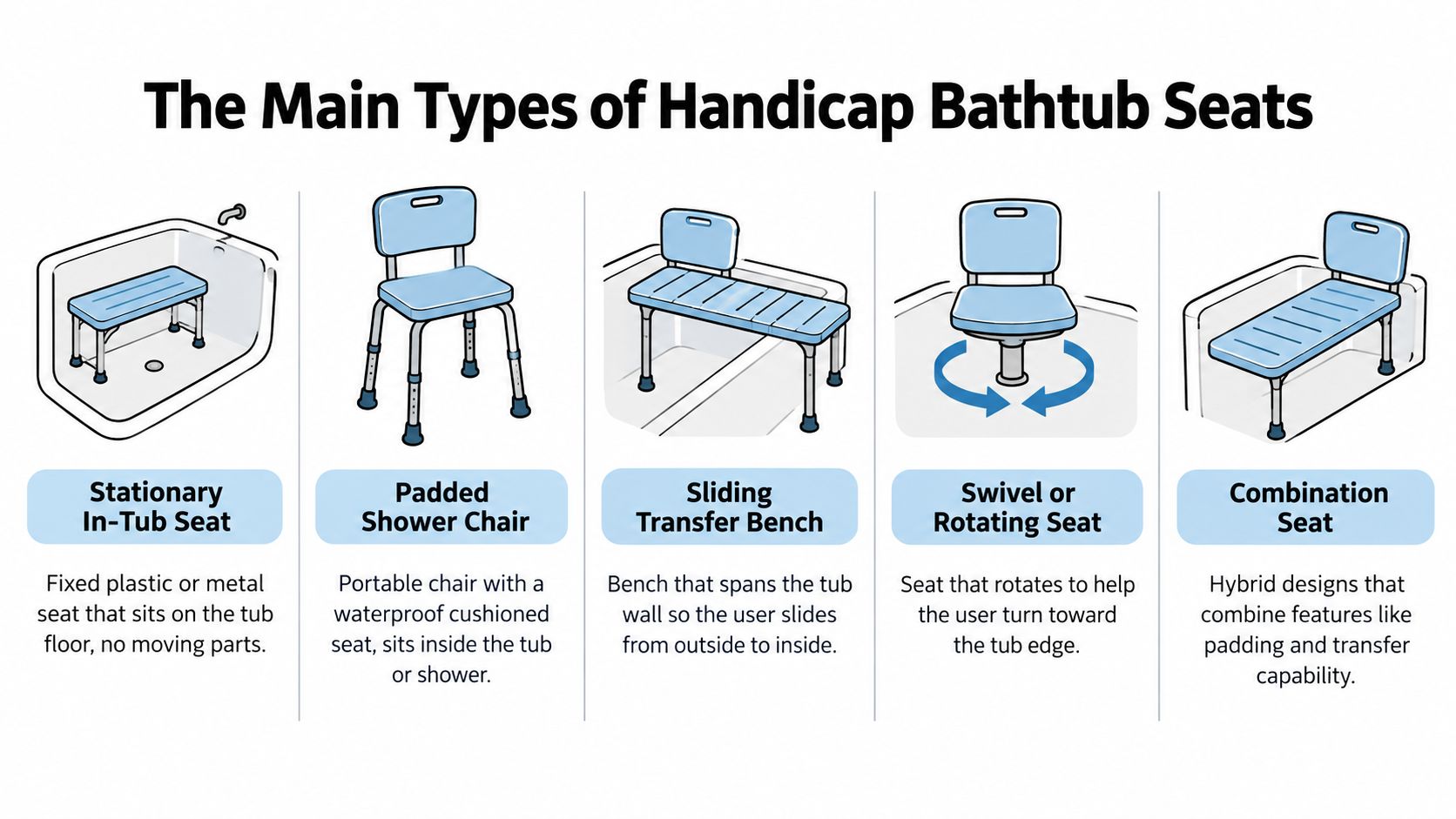
Stationary in-tub seats
A stationary in-tub seat is a fixed or freestanding bench that sits inside the tub. It has no moving parts, so it can work well for someone who can step over the rim, turn, and lower with controlled support. Its simplicity also means there's less to operate, but the user still has to manage the most demanding part of the route, entering and exiting.
Padded shower chairs
A padded shower chair is a portable chair with a waterproof cushioned surface and legs. It can be useful when comfort, pressure relief, or a supportive backrest matters during washing. Check that the legs sit level on the tub floor and bathroom floor, and confirm that the chair doesn't reduce the space needed for the user's legs or caregiver.
Sliding transfer benches
A sliding transfer bench spans the tub wall, with part of the bench outside the tub and part inside. The user sits from the outside, then slides across instead of stepping over the rim. This design can reduce the need for standing, but sliding across a wet surface still requires controlled movement, correct seat height, and enough room for the wheelchair or other transfer surface.
A transfer bench and shower chair comparison can help clarify which design matches the user's transfer ability. If stepping over the rim remains unsafe despite equipment, a different bathing configuration may deserve consideration. A guide to walk-in tubs for aging in place provides useful context for that larger decision.
Swivel or rotating seats
A swivel seat rotates the user toward the tub edge. It may help someone who can sit but has difficulty turning the trunk or lifting both legs into the tub. The rotation must be controlled, and the seat must lock or remain stable during loading and unloading. A swivel feature won't solve an unsafe entry if the person can't maintain seated balance.
Combination seats
Combination designs bring together features such as a bench, padding, back support, or transfer capability. They can be helpful when needs overlap, but more features also mean more compatibility checks. Before choosing one, decide whether the priority is avoiding the step-over, improving sitting support, reducing turning, or making caregiver assistance easier.
Seat Height, Depth, and Width That Matter Most
A transfer can become difficult before the user ever reaches the water. A seat that sits too high, too low, too deep, or too narrow changes how far the person must lower, slide, turn, or reach. Use a tape measure to compare the bathtub, the user's seated position, and the space needed for the transfer. Product labels are useful only after those measurements are clear.
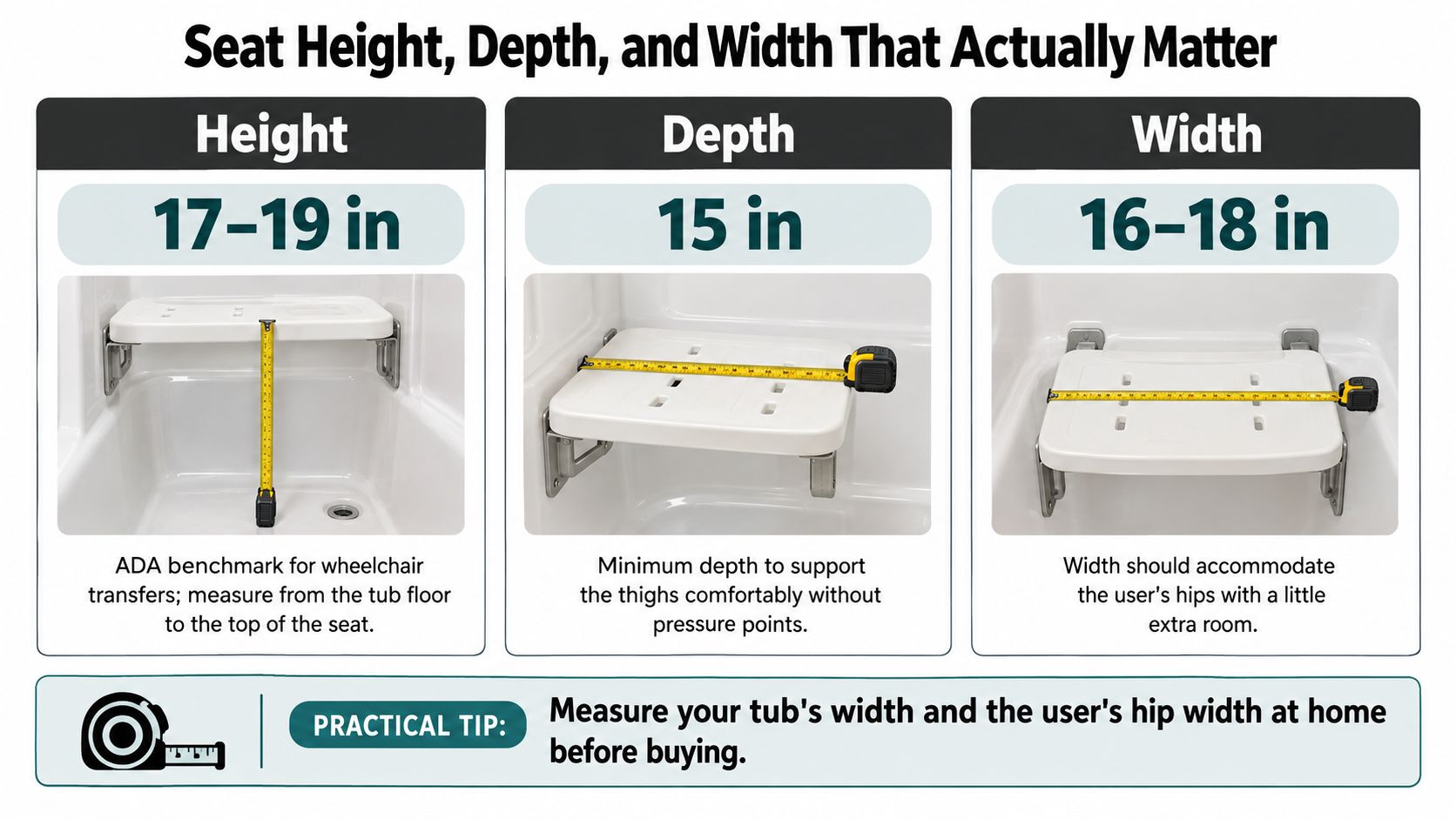
Height changes the effort of the transfer
The 2010 ADA Standards specify that the top of a bathtub seat should be 17 to 19 inches above the finished bathroom floor. For a removable in-tub seat, the standard gives a depth of 15 to 16 inches. A permanent head-end seat must be at least 15 inches deep and extend from the back wall to, or beyond, the tub's outer edge.
These figures work as screening benchmarks, not automatic proof that a product will fit. A wheelchair user may find a seat near wheelchair height easier for a lateral transfer because it reduces the vertical drop and lift. A seat that is too high can require a deeper lowering motion, while one that is too low can make standing harder for someone with limited knee or hip strength.
Measure from the finished bathroom floor to the top of the seat when comparing the ADA height benchmark. Measuring only from the tub floor can give a misleading result. With a freestanding seat, also compare the bathroom floor, tub rim, and seat surface. The user's practical transfer height depends on how these levels meet.
Depth supports the thighs without trapping the legs
Depth should support the thighs while leaving enough room to reposition. The 15 to 16-inch reference range for a removable in-tub seat and the 15-inch minimum for a permanent head-end seat provide a useful starting point. A shallow seat can leave someone perched near the edge. A seat that is too deep may press behind the knees, limit leg clearance, or make sliding more difficult.
Width requires a user-specific measurement. Measure the person's hip width while seated, then compare it with the seat's usable sitting surface. Do not rely on the outside width of the frame. The user needs room to sit without rubbing against the sides, while the seat still needs to fit securely at the tub's narrowest interior point.
Measure the usable sitting surface and the tub's narrowest interior point. The outside width of the frame isn't enough.
The transfer system also includes the approach space beside the tub. The U.S. Access Board bathing-room guidance lists 30 by 60 inches of clear floor space for a parallel approach with an in-tub seat, or 48 by 60 inches for a perpendicular approach. Treat these dimensions as screening references. A bathroom may still need a different arrangement based on the wheelchair, caregiver position, door swing, and the user's turning ability.
For a rotating seat, check more than the turning feature. Compare the user's movement needs with the locking mechanism, transfer path, and available tub clearance. The Nova Medical swivel bath seat shows why the seat mechanism and surrounding space must be assessed as one setup.
Weight Capacity, Materials, and Safety Features
A manufacturer's user weight capacity answers one question, but it doesn't answer every stability question. A transfer can create downward and sideways forces as the user reaches, pivots, or catches balance. ADA guidance requires bathtub seats to resist a 250-pound vertical or horizontal force applied at any point on the seat, fastener, mounting device, or supporting structure (ADA bathroom guidance on bathtub seats).
That requirement is best understood as a structural screening point. Confirm the manufacturer's stated user capacity, but also ask whether the seat can be secured to your specific tub and whether the floor and frame remain stable under lateral loading. A high-capacity label won't compensate for a seat that shifts on a curved tub floor.
Materials affect handling and maintenance
Aluminum frames are often easier to handle and resist corrosion when properly finished. Steel can feel substantial, but the coating and hardware need attention in a wet environment. Plastic seats can be comfortable to clean and may feel less cold, while padded surfaces can improve comfort for someone who needs to sit for longer periods.
Drainage matters. Openings or a contoured surface can reduce standing water, but they also need to be easy to clean. Look for smooth joints and hardware that won't trap soap residue. If the user has sensitive skin, inspect seams and edges for pressure points before committing to daily use.
Support features help only when they fit the transfer
A backrest can improve trunk support for someone who tires or leans backward. Armrests can provide a useful push surface during sitting and rising, but they may obstruct a sliding transfer or restrict caregiver access. A nonslip seat surface is important, yet it shouldn't make repositioning impossible for a person who must slide across the bench.
Bariatric users need more than a larger weight number. Check the usable seat width, the space between armrests, tub-wall clearance, floor stability, and whether the caregiver can reach the user from the intended side. For a material-focused comparison, this overview of PVC shower chairs can help you distinguish frame and surface considerations without treating one material as suitable for everyone.
Treating the Seat as One Part of a Transfer System
A bathing transfer has several distinct demands. The person must enter, sit, reposition, and exit, and each movement can require a different point of support.
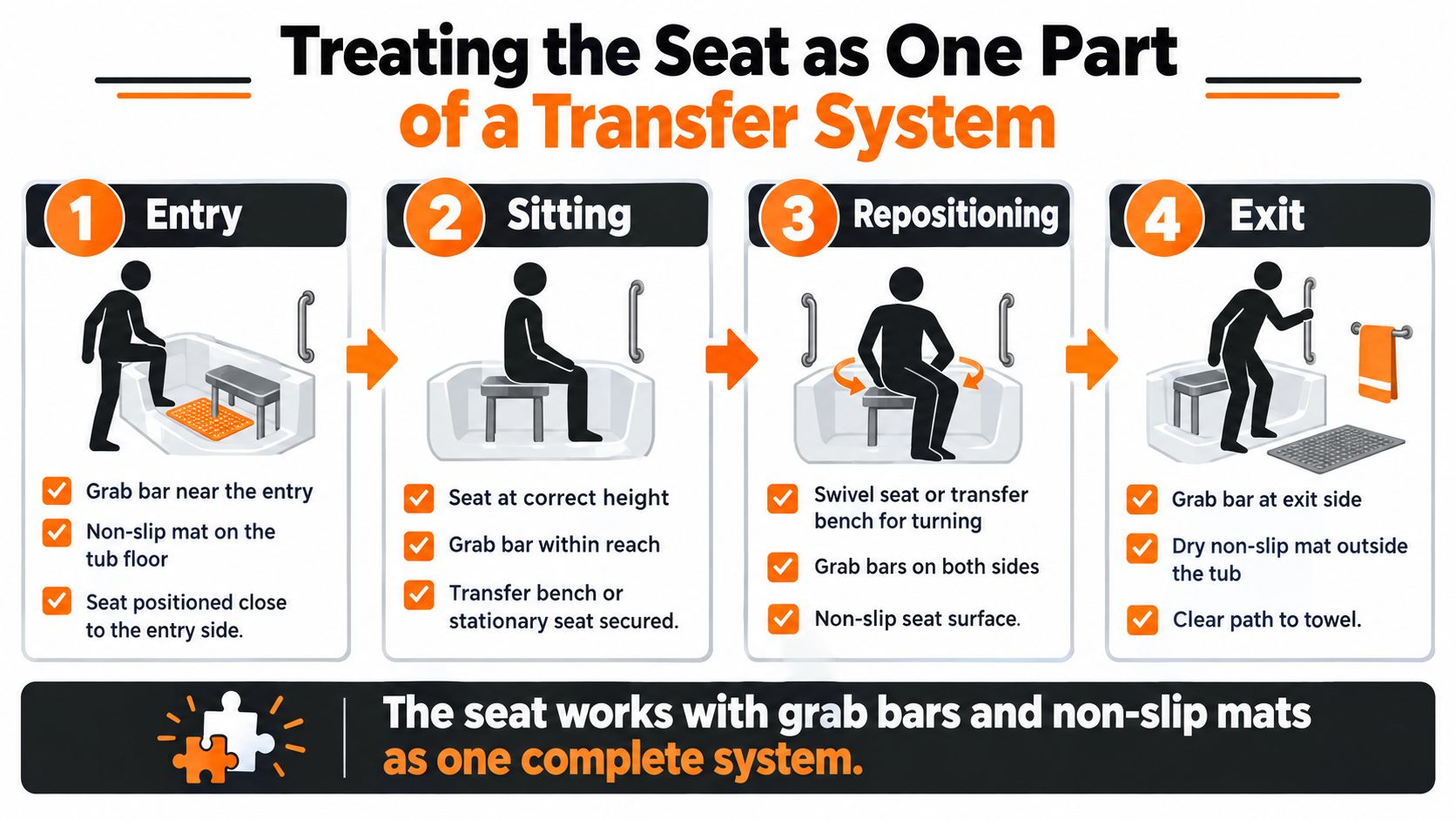
Entry comes before the seat
The first question is where the person places their hands while crossing the rim. A grab bar near the entry side can provide a more dependable handhold than a towel bar or faucet. A nonslip surface inside the tub helps, but the person still needs enough leg strength and balance to cross the rim, unless a transfer bench or another configuration changes the route.
Sitting requires controlled lowering
The seat should be close enough to the entry position that the user doesn't need to take extra steps or twist excessively. The person should reach a stable handhold, feel the seat behind the legs, and lower without dropping. If a caregiver assists, agree on where each person will place their hands before the transfer begins.
The seat surface, height, and back support all affect this moment. A supportive feature that helps one person may interfere with a lateral slide for another.
Repositioning can create sideways movement
Once seated, the user may need to turn, lift the legs, or slide across the tub. A swivel seat or sliding transfer bench may prove more useful than a stationary chair in this context. Grab bars on the relevant sides give the person options, while a nonslip seat can reduce unwanted movement during a controlled turn.
A home-safety remodel resource such as NorCal Construction bathroom safety remodel guidance can help families think through wall reinforcement, flooring, lighting, and access together. A transfer-devices guide for older adults can also help you compare equipment according to the movement it supports.
Exit deserves the same attention as entry
People often focus on getting into the tub and overlook the return route. The user may be tired, wet, and less stable after bathing. Place support where the person will push or pull during the rise, keep the outside floor dry, and clear the path to the towel, walker, or wheelchair.
A complete dry practice is useful. With the tub empty and the water off, rehearse the approach, hand placement, sitting, leg clearance, turning, and assisted exit. Stop if the user loses balance or needs to grab an unsafe surface. That result means the system needs adjustment, not that the person should try harder.
Measuring Your Tub and Placement Tips Before You Buy
Measure the bathroom before comparing products. Record each result, photograph the tub from above and the side, and note anything that could change the transfer, such as a curved wall, narrow doorway, nearby toilet, or uneven floor.
| Measurement | Why It Matters | Target Range |
|---|---|---|
| Seat height from finished floor | Supports controlled sitting and wheelchair transfers | 17 to 19 inches for the ADA bathtub-seat benchmark |
| Removable in-tub seat depth | Provides support without placing excessive pressure on the legs | 15 to 16 inches |
| Permanent head-end seat depth | Provides a stable position for a head-end transfer | At least 15 inches |
| Tub interior width | Shows whether the seat, bench, or frame can fit securely | Measure the narrowest usable point |
| Clear approach space | Allows wheelchair, walker, or caregiver positioning | 30 by 60 inches for a parallel approach, or 48 by 60 inches for a perpendicular approach with a seat |
These target dimensions come from the 2010 ADA bathtub-seat requirements and U.S. Access Board bathtub guidance. Use them as screening benchmarks, then check the product's attachment method and the user's actual transfer technique. A measurement can show that a seat fits while still leaving an unsafe path for the person using it.
Check whether the tub floor supports every seat leg evenly. A clamp or removable seat may suit a rental, but a curved or weak tub wall can make clamping unreliable. Suction-cup supports also require care. Their performance depends on the surface and loading conditions, not only on the product description.
Before permanent installation, perform a dry run with the tub empty and the water off. Place the seat, wheelchair, walker, or caregiver where each will be used. Test leg clearance, turning room, and reach. The caregiver should be able to assist without leaning across the tub or blocking the exit.
CDC injury guidance recommends nonslip strips in the tub or shower and grab bars inside and outside the tub or shower (CDC bathroom fall-prevention guidance). Position these supports along the actual movement path, where the user will reach, sit, rise, or steady themselves, rather than just using the clearest wall space.
Choosing the Right Seat for Your Situation
A post-surgery user who can walk but tires quickly may do well with a stable padded chair, a handheld shower, and carefully placed grab bars. The key checks are seat height, controlled lowering, and whether the person can safely cross the rim without twisting.
A wheelchair user or someone with limited leg lifting may need a sliding transfer bench or swivel design. The priority is reducing the step-over and creating a predictable lateral route. Check whether the wheelchair can approach closely enough and whether the bench leaves room for the user's legs and caregiver.
A bariatric user needs a seat with appropriate structural capacity, usable width, stable legs, and sufficient bathroom clearance. Don't judge fit by capacity alone. The user must also be able to sit without pressure from the frame and transfer without hitting the tub wall or armrests.
For a rental, reversible installation may be important, but convenience isn't the same as dependable risk control. A 2024 study found that 85% of suction-cup handholds met laboratory loading requirements, yet more than half were installed in an unexpected location relative to existing guidance (2024 study of suction-cup handholds). Measure the location and confirm the surface before relying on a temporary support.
Caregiver-assisted transfers require the most honest assessment. If the user can't maintain seated balance, the caregiver must provide high assistance, or the route involves a difficult pivot, seek an occupational-therapy or other qualified home assessment before regular use. A seat is equipment, not a substitute for a safe transfer plan.
DME Superstore offers bathtub transfer benches, shower chairs, swivel seats, and other bathroom safety equipment that can be compared by dimensions, transfer style, and user needs. Visit DME Superstore to review compatible bathing and transfer options, then confirm the measurements with your bathroom before ordering.
