



A pressure relief mattress overlay can be a practical choice when the existing mattress is sound, and the PRESSURE trial found nearly identical new pressure-ulcer rates with alternating-pressure overlays and replacement mattresses, 10.7% versus 10.3%. It's a supplemental support surface placed on top of an existing mattress to redistribute load away from bony areas such as the sacrum and heels, reducing pressure-ulcer risk when combined with repositioning and skin inspection.
You may be caring for someone who spends most of the day in bed and has developed redness on a heel, hip, or lower back. The natural reaction is to search for a completely new mattress, but replacement isn't always the right first step. The condition of the current mattress, the person's weight and mobility, moisture exposure, and your ability to reposition and monitor skin all affect the decision.
An overlay can improve an appropriate bed setup, but it can't correct a sagging base, replace clinical assessment, or make prolonged pressure harmless. The most useful question isn't “Which overlay has the strongest pressure-relief label?” It's “What support surface fits this person and this care routine?”
Understanding Pressure Relief Mattress Overlays
A family caregiver might notice persistent redness on a loved one's heel after several hours in bed. The mattress may still be level and supportive, but the person can't shift position independently. In that situation, an overlay may add a layer of pressure redistribution without requiring the household to remove and replace the entire mattress.
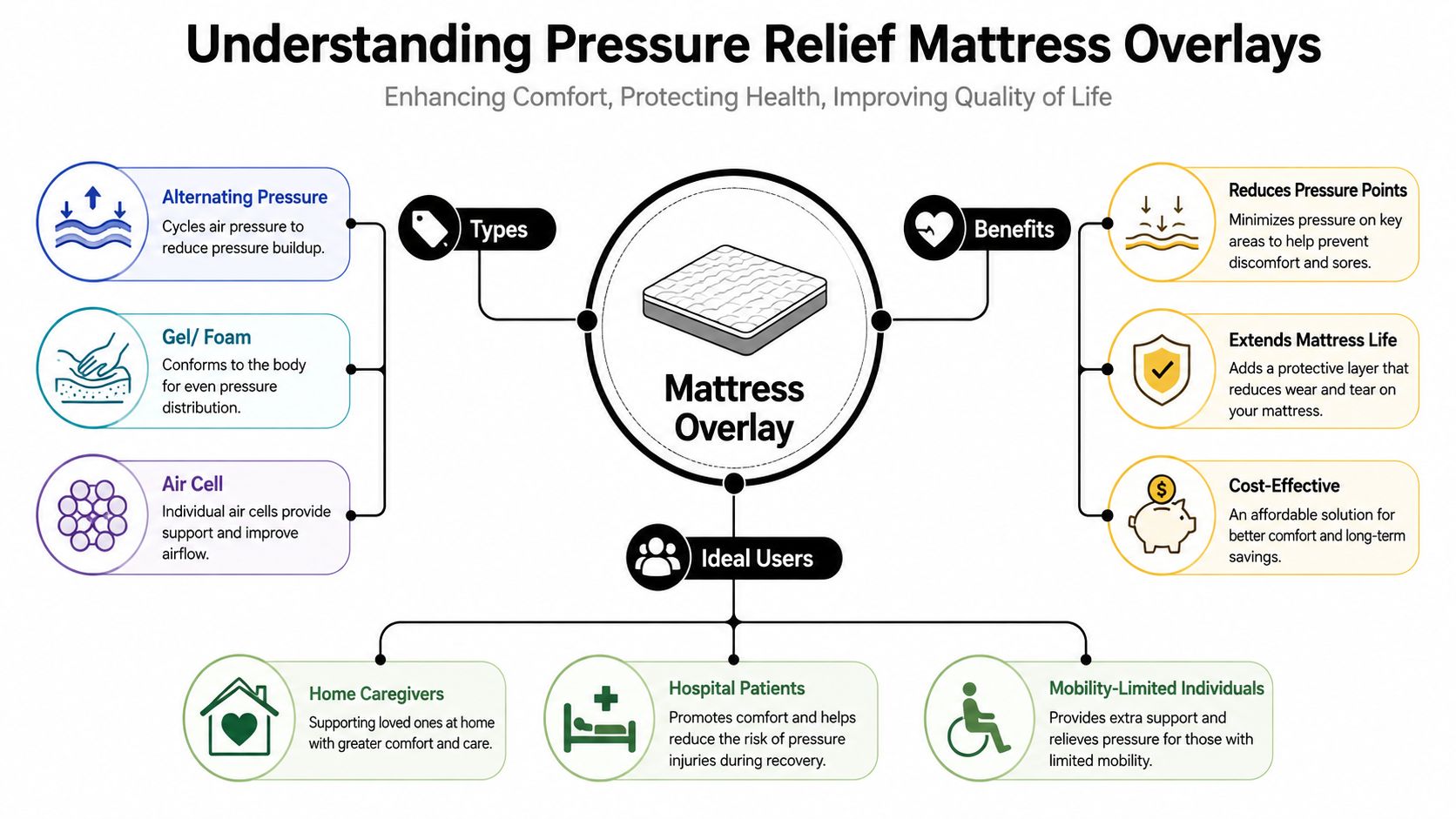
The National Pressure Injury Advisory Panel definition describes a mattress overlay as a supplementary support surface placed directly on, and used with, an existing mattress. It spreads the person's load over a larger contact area instead of allowing force to remain concentrated over bony prominences such as the sacrum, heels, hips, and shoulders.
Redistribution isn't the same as removal
This distinction prevents a common and dangerous misunderstanding. An overlay redistributes pressure, but it doesn't remove every force from the body. Turning or repositioning temporarily unloads one area, although the load then shifts to another part of the body.
Practical rule: Treat an overlay as one part of prevention, not permission to leave someone in the same position indefinitely.
A suitable overlay works alongside an individualized repositioning routine, moisture management, nutrition, heel protection, and regular skin checks. If you're unsure how to evaluate risk or respond to early redness, this pressure care guide from Nursing Assessment Australia can provide useful background before you speak with a clinician.
The existing bed matters just as much as the overlay. A damaged, uneven, or excessively soft mattress can change how the overlay supports the body. Before buying, compare the overlay's dimensions and weight capacity with the bed and the person who will use it. You can also review this guide to pressure redistribution mattresses to understand how different support surfaces fit into a home-care plan.
How Overlays Work Differently by Technology
Pressure-relief products don't all work through the same mechanism. Start by identifying what the person's skin and mobility needs are, then match the technology to that problem.
| Technology | Mechanism | Best for | Key limitation |
|---|---|---|---|
| Polyurethane foam | Conforms to the body and increases contact area | Static support and moderate prevention needs | Performance depends on foam properties and the mattress underneath |
| Gel pad | Provides a conforming layer that can help absorb some loading and movement | Targeted support during positioning and transfers | May not provide dynamic pressure shifting |
| Alternating-pressure air | Cycles air cells between more and less inflated states | People who can't be repositioned easily or frequently | Requires a compatible pump, power, and correct setup |
| Low-air-loss system | Moves air around the surface to help manage heat and moisture | Users with significant moisture or microclimate concerns | Airflow doesn't replace pressure redistribution or repositioning |
Foam and gel provide static support
A foam overlay works by conforming around the body. That can enlarge the contact area and reduce concentrated loading, but thickness alone doesn't determine performance. Foam resilience, density, compression behavior, user weight, shear, and the condition of the base mattress all matter.
Gel has a different feel and may help with conformity and movement during transfers. It isn't automatically more protective than foam, and it doesn't cycle support over time. A gel layer can also become less useful if it interferes with the support surface beneath it.
Air systems change support or the skin environment
An alternating-pressure overlay uses an external pump to inflate and deflate air cells in a repeating pattern. The changing support points can reduce prolonged loading in one location, but the system must be inflated correctly and used within its weight and dimensional limits. This alternating-pressure mattress guide explains the operating principle in more detail.
Low-air-loss technology addresses a different concern. Airflow can help manage warmth and moisture near the skin, which may be important for someone who sweats, uses absorbent products, or spends long periods in bed. A low-air-loss feature doesn't automatically provide the same dynamic pressure cycling as an alternating-pressure system, although some products combine both technologies.
Clinical Evidence on Prevention Effectiveness
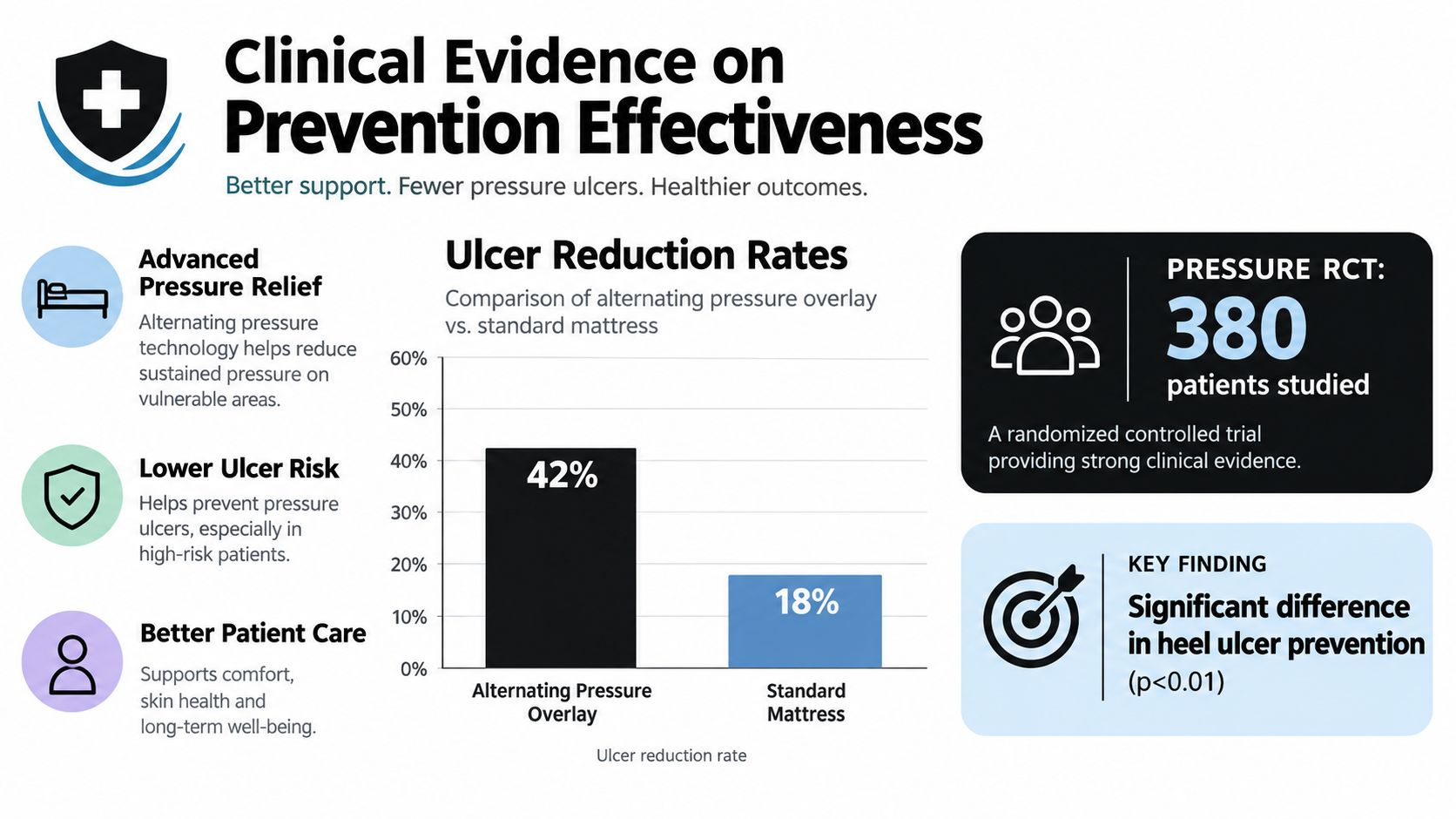
Clinical evidence favors careful matching of the support surface to the person and setting, rather than claiming that one overlay always performs best. In the 2006 PRESSURE randomized controlled trial, researchers compared alternating-pressure overlays with alternating-pressure mattress replacements among 1,972 hospital patients. 990 patients used an overlay, while 982 used a replacement mattress.
New grade 2 or higher pressure ulcers developed in 10.7% of overlay users and 10.3% of replacement-mattress users. The absolute difference was 0.4 percentage points, with a 95% confidence interval from -2.3 to 3.1 percentage points and a p-value of 0.75. Because the difference was not statistically significant, properly used alternating-pressure overlays performed comparably to full alternating-pressure replacements in that hospital setting. The PRESSURE trial report provides the study details.
What broader reviews suggest
A 2021 Cochrane overview examined four reviews containing 68 studies and 18,174 participants. Compared with foam surfaces, reactive air surfaces, including static-air overlays, had a pooled risk ratio of 0.46, with a 95% confidence interval from 0.29 to 0.75. That represented an estimated 54% relative reduction, although the evidence was rated low certainty.
Alternating-pressure air surfaces had a risk ratio of 0.63, with a 95% confidence interval from 0.42 to 0.93, or approximately a 37% relative reduction. Results differed according to technology, patient risk, care setting, and study quality. The Cochrane evidence summary presents both the possible benefit and the uncertainty.
Laboratory findings help explain why products can behave differently, but they do not predict one person's outcome. A study of 30 healthy volunteers recorded mean sacral interface pressure of approximately 31.55 mmHg with a 25-millimetre polyurethane-foam overlay, compared with 56.10 mmHg on a standard mattress, 47.03 mmHg with egg-crate foam, and 57.42 mmHg with gel.
Evidence for healing existing pressure ulcers remains inconclusive. A wound needs assessment and a care plan from an appropriate healthcare professional. For wound-care basics, see these safe wound dressing tips, and this air mattress for pressure ulcers guide explains how air surfaces are used at home.
When an Overlay Makes Sense at Home
An overlay usually makes the most sense when the existing mattress is structurally sound, level, and compatible. It can add pressure redistribution while preserving the current bed frame, which may be helpful in a rental home or during a temporary recovery period. That convenience doesn't outweigh safety, however. A mattress that sags, has broken springs, or allows the person to sink unevenly can undermine the overlay above it.
Consider these questions before choosing:
- Base condition: Does the mattress remain firm and even under the overlay?
- User capacity: Does the overlay support the person's actual weight, including clothing or bedding?
- Bed compatibility: Do the overlay dimensions fit the frame, rails, and head-and-foot adjustments?
- Care routine: Can someone check skin, manage moisture, and reposition the person as advised?
- Pump practicality: Is there a safe place for the pump, and can the household manage hoses, noise, cleaning, and power interruptions?
When replacement is safer
A full replacement system deserves consideration when the underlying mattress is damaged or unstable, when the person exceeds the overlay's weight limit, or when a clinician recommends a full-body active support surface. Replacement also avoids relying on an unsuitable mattress beneath the support system.
A Canadian health-technology assessment reviewed 52 randomized controlled trials and found no significant difference between alternating-pressure mattresses and alternating-pressure overlays. It reported that an overlay is generally the first choice when alternating-pressure equipment is needed, unless weight, safety, or other clinical circumstances favor replacement. The assessment also stresses checking capacity, dimensions, pump compatibility, and base-mattress condition before use. You can review the Canadian support-surface assessment for that decision context.
If replacing a mattress creates a disposal problem, a hotel mattress removal service may explain general removal considerations, although home-care equipment disposal should also follow local requirements.
For practical prevention habits, this guide to preventing bed sores at home can help you build a routine around the support surface rather than treating the overlay as the whole solution.
Setting Up Your Overlay for Maximum Performance
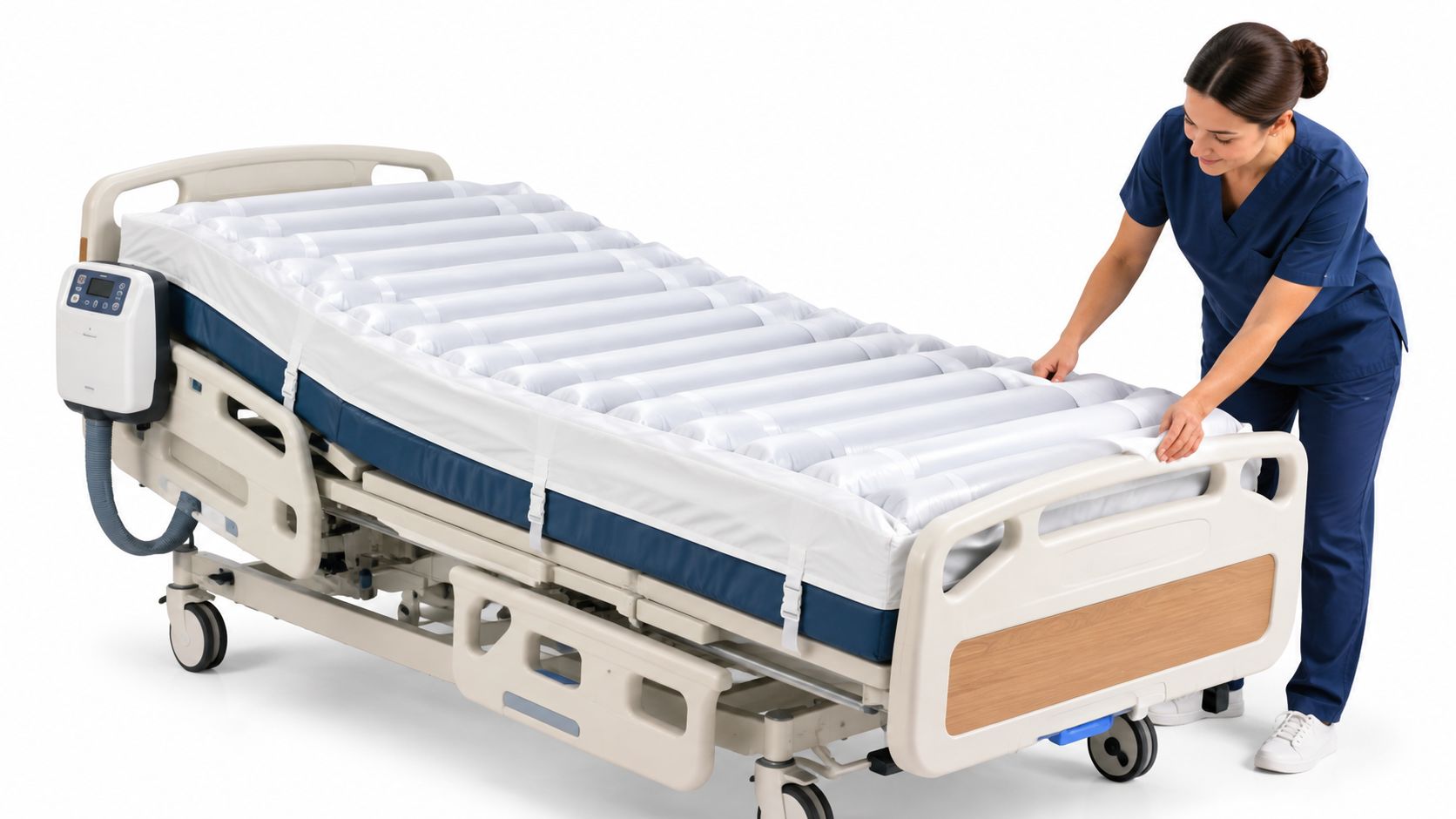
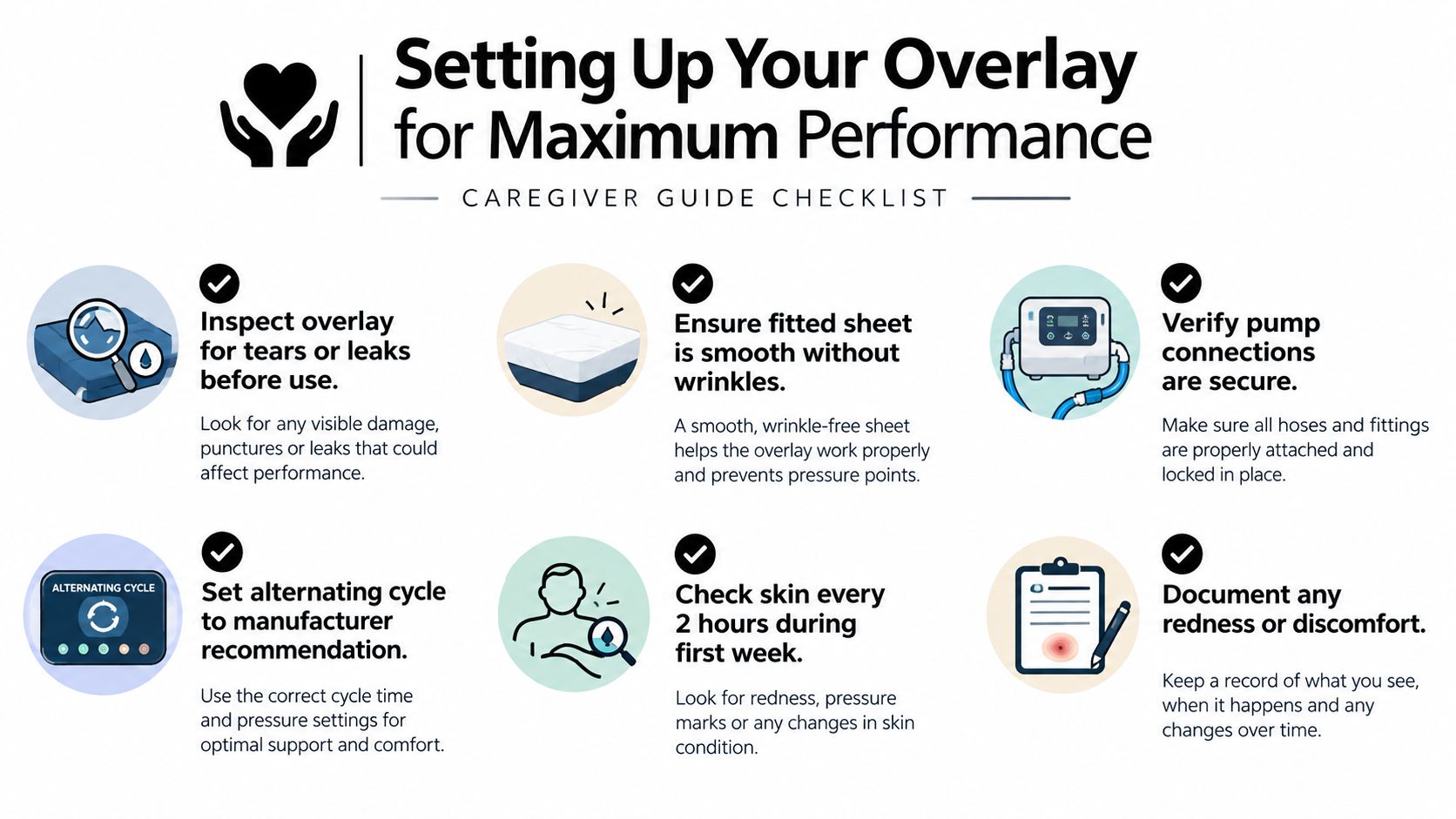
A well-designed overlay can underperform if the installation is rushed. Read the manufacturer's instructions first, place the overlay in the correct orientation, and secure it so it can't slide or fold. Check that the pump sits where air hoses won't kink and where caregivers can reach the controls safely.
Use bedding that lets the surface work
A fitted sheet should be smooth but not pulled so tightly that it restricts inflation and deflation. Avoid thick layers that interfere with the overlay's ability to conform to the body. If an incontinence pad is necessary, place it according to the manufacturer's guidance and keep it as small and breathable as practical, because a bulky or impermeable layer can affect both pressure redistribution and moisture.
Check bed rails, transfer equipment, and the bed's moving parts after installation. The overlay shouldn't create a gap that increases entrapment risk, prevent a rail from locking, or slide during a transfer. The person should be positioned according to their care plan, with particular attention to heel off-loading and areas already showing redness.
Perform the bottom-out check
Clinical guidance warns that an overlay can fail when the user bottoms out, meaning the person's body compresses the overlay enough to contact the mattress below. Check beneath a high-risk area while the person is lying in their usual position. There should be at least about 1 inch of support material between the person and the underlying mattress, as described in this AHRQ pressure-ulcer prevention resource.
Stop and reassess if the person feels the hard mattress beneath the overlay, develops new or persistent redness, or slides into an unsafe position.
Inspect for leaks, loose connections, alarms, and loss of inflation. A pump may make a quiet operating sound, but a new hissing noise can indicate a hose or cell problem. During a power interruption, follow the manufacturer's instructions, keep the person safe, and contact the supplier or clinician if inflation can't be restored.
Skin inspection should be part of daily care. Look at the sacrum, heels, hips, elbows, and any area exposed to moisture or friction. Document redness, pain, warmth, swelling, or changes in the skin, and seek professional advice when the change doesn't resolve or tissue damage appears to worsen. For information about low-air-loss settings, see these low-air-loss mattress settings.
Common Misconceptions About Pressure Relief
Myth one: an overlay removes pressure completely. It doesn't. Support surfaces redistribute load, while repositioning changes which body area bears weight. Clinical guidance states that no support surface provides complete pressure relief, so an overlay can't replace an individualized turning schedule or skin inspection.
Myth two: the most expensive or advanced technology is always the safest choice. More features can add complexity without solving the main problem. Alternating pressure may suit someone whose primary concern is prolonged loading, while low-air-loss airflow may matter more when heat and moisture are persistent. The right choice depends on the person, the bed, and the care routine.
Myth three: every foam overlay performs the same way. Foam construction affects conformity, resilience, compression, and durability. A laboratory comparison found lower measured sacral pressure with polyurethane foam than with the tested standard mattress, egg-crate foam, and gel, but the study involved healthy adults and short-duration testing. Its findings support careful product comparison, not a universal promise.
Look beyond the label
Ask for the overlay's weight capacity, dimensions, materials, cleaning instructions, pump requirements, and warranty information. Confirm that the base mattress is suitable and that the sheet, pads, rails, and transfers won't interfere with the system. If a product description uses terms such as “zero pressure,” “healing,” or “therapeutic,” treat those words as prompts for questions rather than proof of a clinical outcome.
An existing ulcer also changes the decision. Prevention evidence shouldn't automatically be presented as treatment evidence, and a wound that is worsening needs professional assessment rather than a product swap.
Making Your Final Overlay Decision
Use the care situation, not the marketing category, as your starting point. A person with moderate risk and a good base mattress may do well with a suitable foam or gel overlay when caregivers can reposition and inspect the skin consistently. A person who spends long periods in bed and can't be repositioned reliably may need an alternating-pressure system.
Moisture and heat point toward a different conversation. If sweating, incontinence, or a persistently damp sleep surface contributes to skin problems, low-air-loss technology may be more relevant. Some systems combine low-air-loss airflow with alternating pressure, but added technology also means more setup, maintenance, and troubleshooting.
| Home situation | Direction to discuss with a clinician or supplier |
|---|---|
| Sound base mattress and moderate support needs | Foam or gel overlay may be appropriate |
| Limited mobility and difficulty with frequent repositioning | Consider alternating pressure |
| Heat or moisture is a major concern | Consider low-air-loss or combined technology |
| Sagging, damaged, or unsuitable base mattress | Evaluate a full replacement |
| Weight, dimensions, or safety concerns | Verify specifications before purchase |
No overlay should stand alone. Continue individualized repositioning, moisture management, nutrition support, heel off-loading, and routine skin checks. If redness persists, a wound appears, pain increases, or the person no longer seems adequately supported, contact a healthcare professional promptly.
DME Superstore offers alternating-pressure and low-air-loss mattress systems, product specifications, compatibility information, free shipping, a 30-day return policy on most items, and 24/7 chat support for selection questions.
Visit DME Superstore to compare pressure-redistribution and low-air-loss mattress systems by user capacity, dimensions, and support technology. Before ordering, confirm the base-mattress condition and discuss the choice with the person's healthcare professional if skin damage or high clinical risk is present.
