



Ask how many hours a power wheelchair battery lasts and you'll get a confident answer that turns out to be useless. Ask how many miles and you'll get a number that sounds precise until your own weight, your own ramp and your own stop-and-go errands get involved. The gap between those two answers is where most battery disappointment lives.
Power wheelchair battery life isn't a clock. It's an energy budget: a fixed number of watt-hours spent against the current your chair draws from the motors, the controller, the lights and the power seat. Spend that budget on smooth flooring at walking pace and it stretches. Spend it on carpet, a driveway incline and a loaded basket and it doesn't.
That's why the figure worth planning around is usable range, the distance you can reliably count on with a margin still left in the pack when you get home. What follows is how range is measured, what eats into it, and the routines that keep it available on the days you need it.
How Far a Power Wheelchair Battery Goes
A typical power wheelchair covers several miles of real travel on one full charge. The exact number comes from the battery set, the chair's electrical efficiency and the conditions of the day, which is why no one can hand you a dependable figure in hours.
The measurement framework itself is settled. The FDA's standards entry for ISO 7176-4 describes the method: measure the energy a chair consumes while driving, pair that with the nominal energy capacity of its battery set, and you get a theoretical distance range. It applies to powered wheelchairs and scooters with maximum nominal speeds up to 15 km/h and a user mass within the range set by ISO 7176-11. Nominal watt-hours are simple arithmetic, voltage multiplied by ampere-hours, so two 12 V, 76 Ah batteries hold about 1,824 Wh nominally.
That arithmetic is where most published range claims start, and where the trouble starts. Usable energy is always lower than nominal. In the RESNA field-related test described on that same standards entry, 12 V AGM/gel batteries rated at 76 Ah at the C/100 discharge rate produced reduced wheelchair speed once total pack voltage dropped to about 24.0 V, or 12.0 V per battery, with testing at 25 ± 2 °C.
| Battery setup | Nominal energy | Tested range | What the figure means |
|---|---|---|---|
| Single 24 V, 37 Ah battery | 888 Wh (24 V × 37 Ah) | 3.8 to 7.5 miles (6.1 to 12 km) on one indoor route | Controlled test result that varies by chair |
| Two 12 V, 76 Ah batteries in series (24 V) | About 1,824 Wh | Ask the chair maker for the ISO 7176-4 result | Nominal energy only, so request the tested range |
| ISO 7176-4 measurement | Measured energy use combined with battery capacity | Theoretical distance | A comparison method, not a guarantee |
The spread in the first row is the point. On one indoor route, a 24 V, 37 Ah battery produced a low of 3.8 miles and a high of 7.5 miles (6.1 to 12 km) depending on which wheelchair carried it, and the Veterans Affairs rehabilitation study that recorded those runs found range rising as battery ampere-hour capacity increased and falling as the wheelchair's laden weight went up. Same battery, same floor, twice the distance.
Why Nominal Energy Is Not Usable Energy
Deep discharge, voltage sag and controller cutoffs each take a bite before the pack is empty. Your chair's controller stops the motors while charge still remains, which protects the battery but shortens the distance you get. Add underinflated tires, carpet, ramps, a heavier payload, hard acceleration and an aging pack, and the gap between the label and the road widens further.
Here's how that plays out. Say a rider makes a 2-mile round trip to the shops on a chair rated at 3.8 miles at the low end of that controlled test. Two miles leaves 1.8 miles in reserve, which is workable on flat ground in mild weather. Now add a hill on the return leg, a heavier passenger than the test load and a detour across a gravel lot. The trip didn't change. The energy cost did, and the margin is gone.
Usable range, not headline range, is the number worth planning around.
Three Checks Before You Trust a Published Range
- Ask which standard and which conditions produced the figure. A number derived from ISO 7176-4 is a theoretical range measured under defined speed and load limits, and it's comparable between chairs. A number with no method behind it is marketing copy.
- Work out the nominal watt-hours yourself. Multiply voltage by amp-hours. A 24 V, 50 Ah pack holds 1,200 Wh and a 24 V, 75 Ah pack holds 1,800 Wh, a difference you'll feel on hills rather than on the showroom floor.
- Compare the figure with your actual route, then subtract a reserve. A chair rated at 12 miles suits a 6-mile round trip. A chair rated at 8 miles doesn't suit that same trip unless you can charge midday.
Three numbers carry all of this: range rises with amp-hour capacity, range falls as laden weight rises, and every plan needs a reserve. If you're weighing a chair against a scooter, our guide to how far a mobility scooter can travel applies the same method to a different machine.
What Drains a Power Wheelchair Battery Faster
Two chairs with the same pack can finish the day miles apart. The battery didn't change. The demand did.

Outdoors is where the difference shows, because the surface and the grade keep changing under you.
- Rider and payload weight. The motors hold your set speed by drawing more current as total weight climbs. A heavier occupant, a loaded basket or a mounted oxygen cylinder all cost distance, and the effect compounds on any upward grade.
- Terrain. Smooth vinyl and short-pile carpet roll easily. Grass, gravel, thick carpet and ramps don't. Each raises rolling resistance and asks the motors for more torque.
- Speed and driving style. Frequent starts, stops and sharp turns create current spikes. Steady travel at a moderate setting uses less energy over the same route than a stop-and-go run through a crowded store.
- Power seat and accessories. Recline, tilt, lift, lights and phone charging all draw from the same pack. An hour spent reclined is an hour of stored energy that never becomes travel.
- Tire pressure. Soft tires add rolling resistance and heat. Check the sidewall rating monthly and top up before a long day out. If the chair has started pulling to one side, inspect the power wheelchair wheels before blaming the battery.
- Temperature. Cold slows the battery's internal reactions and drops voltage exactly when the motors want current, so winter trips lose range first on the climbs.
- Battery age. An older pack can show a full charge on the gauge while storing noticeably less energy, because internal resistance rises as capacity falls.
A Saturday that starts on a flat indoor concourse and ends on a grass verge at a park tells the story. The first hour barely touches the pack. The last twenty minutes combine a ramp, damp grass and a heavier passenger than usual, and the gauge falls faster than it has all day. Nothing malfunctioned. The route got expensive.
Pre-trip check: gauge reading, tire pressure, the worst surface on the route, and whether the power seat will be used.
Daily Charging Routine That Protects Battery Life
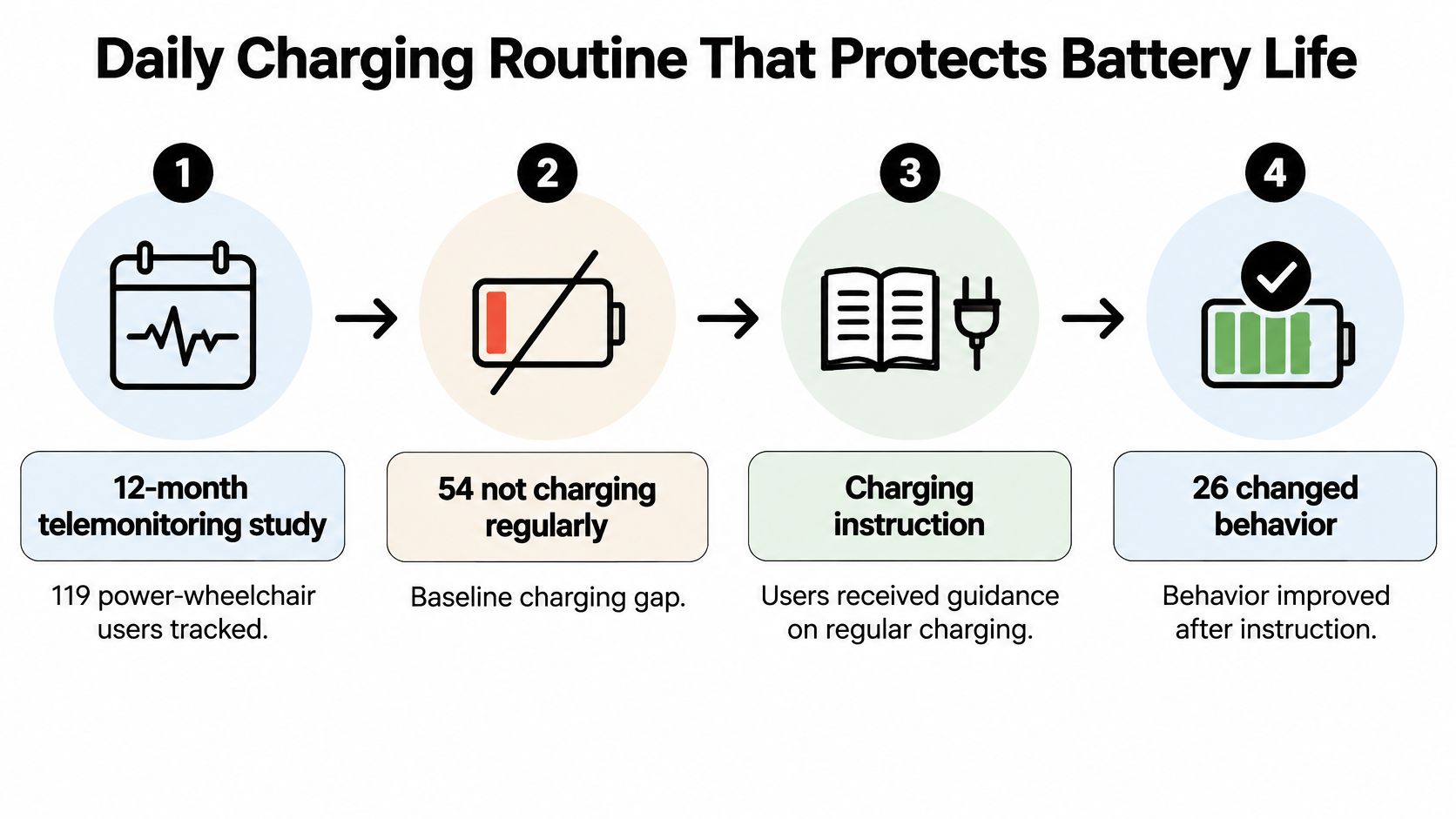
The gap between the range on the box and the range you can count on is usually a habit gap, not a hardware gap. A 12-month telemonitoring study of 119 power-wheelchair users published in Disability and Rehabilitation: Assistive Technology found that 54 people were not charging regularly. After charging instruction, 26 changed their behavior, and the intervention was associated with 18% fewer battery repairs, 11% fewer wheelchair repairs and £3,092 lower repair costs than matched standard care.
Those repair figures come from one retrospective analysis, so treat them as a strong signal rather than a guarantee. The direction is hard to argue with: a pack kept out of deep discharge lasts longer than one repeatedly run flat, and charging habits may do more for reliability and total cost than upgrading to a bigger battery.
The Routine, Step by Step
- Check the gauge at the end of every day. Switch the chair off first, then read the gauge or the app. The slip is skipping the check on busy days, which is exactly when a low pack sits unnoticed overnight.
- Use the charger approved for that battery. Lead-acid and lithium packs need different charging profiles, and a generic charger that fits the plug can still undercharge or overcharge the pack.
- Charge after daily use, not when the gauge is nearly empty. Repeated deep discharge stresses the battery and trims its useful life. A top-up after a normal day keeps capacity in reserve and costs very little.
- Never leave for a long outing on an uncertain charge. If you can't remember the last full charge, charge first. Half an hour on the charger separates a comfortable return from a push home.
- Let the charger finish its cycle. Unplugging early leaves the pack partly charged, and repeated partial cycles are hard to track over months.
- Log any change in range. One line in a notebook is enough: date, route, and whether the gauge fell faster than usual. That log becomes the evidence for the replacement decision later.
Reminders help more than good intentions. A phone alarm at the same time each evening does more for charging consistency than a promise to remember. Our guide on how to charge a mobility scooter battery safely walks through the same steps with scooter-specific charger details.
A consistent week has three parts: a fixed evening charging time, a gauge check before bed, and a log entry whenever the range shifts.
Heat and Aging That Shorten Battery Life
A battery can read fully charged and still store far less energy than it did when new. Research on sealed lead-acid batteries used in power wheelchairs attributes that to electrode degradation and electrolyte breakdown building up with age. The gauge reports voltage, and voltage says nothing about the capacity that has gone missing.
Heat sets the pace of that decline. The same study reports that an 8 °C increase can halve service life, with a battery expected to last about 10 years at 25 °C projected to last about 5 years at 33 °C under the cited model.
| Storage temperature | Modeled service life | Practical action |
|---|---|---|
| 25 °C | About 10 years | Store in a moderate, ventilated space |
| 33 °C | About 5 years | Avoid hot vehicles and sunlit garages |
| Each 8 °C rise | Service life roughly halves | Treat heat as a direct cost to battery life |
Why Heat Costs Capacity
Sustained high temperature accelerates self-discharge, gas generation, charging stress and long-term degradation. Heat can briefly improve some short-term discharge characteristics, and that's the trap: a warm pack feels strong right up until the capacity is gone. Cool storage doesn't add range to a single trip. It preserves the range you'll want next year.
- Store and charge in a moderate, ventilated room. A spare bedroom beats a shed or an unheated garage corner.
- Keep the chair out of hot vehicles. A car parked in summer sun heats faster than any room in the house.
- Charge after use with the approved charger. Heat plus a mismatched charger is the worst combination.
- Investigate short range instead of discharging deeper. Repeatedly running the pack down to find out whether it still works is the fastest way to make sure it doesn't.
A chair that lives in a hot garage through the summer will age faster than an identical chair kept indoors and driven the same number of miles. Same use, different lifespan.
The halves and years above come from a cited model, not a trial of your specific chair. ISO 7176-4 testing is a comparison method rather than a promise of everyday distance, so use these numbers to change where you park the chair, not to predict the month it will fail.
When to Replace a Power Wheelchair Battery
Many users replace a power wheelchair battery only after it fails. That's the most expensive moment to do it, because a chair that dies mid-trip takes a whole day with it.
Battery life also means how long a pack can hold a usable charge, not just how far the chair travels. A Veterans Affairs study covering 166 battery tests found wide variation in battery life between users and reported that the two batteries installed in one wheelchair often became unequal in charge capacity over time. At one rehabilitation center, batteries were generally replaced once measured charge capacity fell below 60% of the nominal rating, a threshold chosen as a compromise between declining range and replacement cost.
A Monthly Check That Beats Guesswork
- Time a known route. Pick a loop you drive often and note how far the chair goes before the gauge drops to the level you'd want on the way home.
- Compare against your first reading. The first entry in your log is the baseline. Everything after it is a trend.
- Have each battery capacity-tested separately. A technician with a load tester measures what each battery delivers under demand, which is more revealing than a resting voltage reading.
- Replace both when one is clearly weaker. Matched pairs drift apart over the years, and pairing a new battery with an old one drags the new one down.
- Act at 60% of nominal. That threshold is a practical stopping point, not a rule of physics, and it's a sensible place to start planning the purchase.
Replacement rule: if a full charge no longer carries you over a route it used to manage easily, measure before you buy.
Three signals are worth acting on: range loss that survives a full charge, early shutdowns under load, and one battery completing its charge noticeably sooner than its partner. A written log turns replacement from an emergency into a scheduled errand. If you're unsure what a normal service life looks like, our guide to how long scooter batteries last covers the lead-acid and lithium timelines.
Flying or Traveling With a Lithium Battery
A full charge can still leave you stuck at the counter. Usable range only counts if the battery that stores those miles is one the airline will accept.

Watt-hours work like the size of a fuel can. The range figure is how far you hope to roll. The airline looks at the can. If a mobility aid's installed batteries exceed 300 Wh, IATA's mobility aid guidance says the airline must consider additional safety measures, and when batteries are removed the cumulative total of removable batteries must not exceed 300 Wh. Lithium-ion batteries should meet UN transport-test requirements.
| Battery situation | Rule | What to do |
|---|---|---|
| Installed battery at or below 300 Wh | Below the threshold that triggers added airline measures | Confirm the watt-hour label with the airline |
| Installed battery above 300 Wh | Airline must consider additional safety measures | Request airline approval before booking |
| Removable batteries | Combined removable total must not exceed 300 Wh | Add the watt-hours of every pack you carry |
| Lithium-ion battery | Should meet UN transport-test requirements | Ask for test documentation |
The order of those steps is easier to follow on video than on a printout. Watch which pack stays installed and which one you carry separately.
The Travel Checklist
- Confirm watt-hours for every pack. Count installed batteries and removable packs as two separate totals.
- Check whether the battery is removable. A pack you can take off is simpler to handle, and it still has its own combined watt-hour limit.
- Gather certification evidence. Lithium-ion wheelchair systems have dedicated safety and test requirements, so ask for the documentation before you travel.
- Confirm charger compatibility. Match voltage and plug type to the destination, and use an adapter that can handle the charger's load.
- Request airline pre-approval before booking. Get the confirmation in writing and keep it with the chair.
- Find backup charging at your destination. A hotel outlet you have checked is a plan. Hoping a friend's garage has the right plug is not.
A smaller pack that clears the airline limit can give you more usable mobility than a larger one that never leaves the house. Start that comparison with airline-approved mobility scooters.
Confirm the Battery Plan Before Your Next Trip
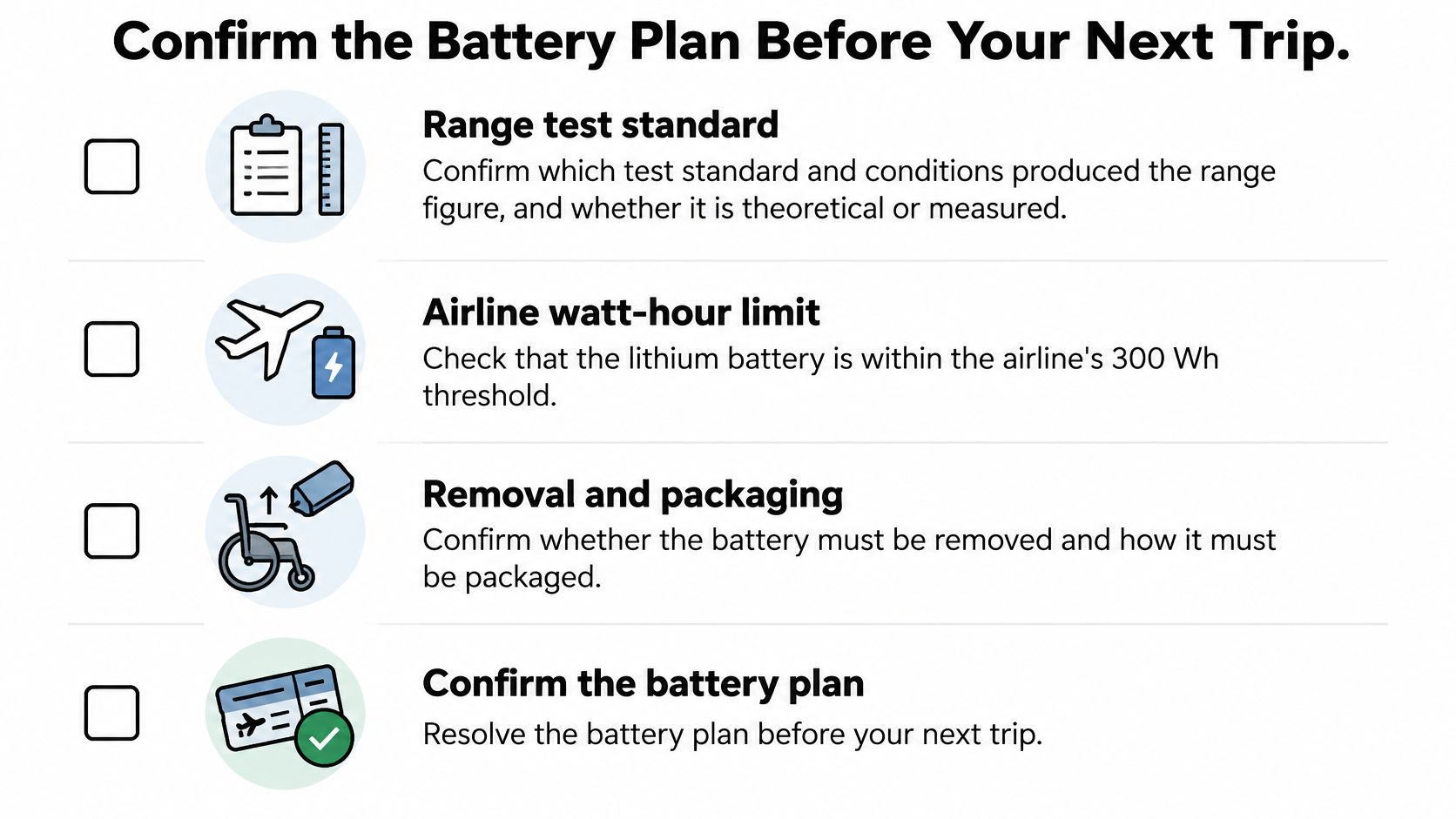
The decision comes down to one question: will this battery get me through my real week and my real trips? Work through the list below before you commit.
- Ask what produced the range figure. A theoretical ISO 7176-4 number and a measured field number mean different things, and only one of them was run under conditions you can inspect.
- Match chemistry to an approved charger. ISO 7176-25:2022 sets requirements and test methods for lead-acid batteries and chargers used with powered wheelchairs and scooters, covering chargers with a rated input of no more than 250 V AC and a nominal output voltage no greater than 36 V, while ISO 7176-31:2023 does the same job for lithium-ion battery systems and chargers.
- Compare configurations on your own route. More capacity means more stored energy, but the distance you get still depends on the chair's efficiency and how you drive it. A single-battery and a dual-battery version of the same chair show this clearly: the Paiseec Q5 Carbon Fiber Electric Wheelchair is $1,599.00 with a single battery rated up to 14 miles and $1,799.00 with dual batteries rated up to 28 miles.
- Add a reserve to your daily route. Plan for the hills, the cold mornings and the detours, not for the best-case day.
- Set the routine and the monthly check. Charging habits and a range log do more for long-term reliability than a bigger pack you never look after.
- Apply the airline rules if you fly. Watt-hours first, then removal, packaging and pre-approval.
Pick the battery setup that matches the miles you drive and the trips you take, then verify the range, warranty and compatibility details on the product page before you pay.
A chair is only as useful as the charge left in it at four in the afternoon, so it pays to compare battery setups the way you'd compare tires: capacity, chemistry, charger and tested range. DME Superstore carries powerchairs and scooters from brands such as Pride Mobility and Golden Technologies, along with replacement and extended batteries, and most items ship free nationwide with a 30-day return policy. Visit DME Superstore to check the range, warranty and charger compatibility on the model you're considering before your next trip.
