



Most mobility scooters travel about 5 to 20 miles per charge under test conditions, while some heavy-duty models are rated past 30 miles. A safe round trip should be well under the advertised maximum, not a journey that uses every last mile.
The popular advice to buy the scooter with the longest range misses something important: you need enough battery to get home on a route you can use. A large mileage figure won't solve a missing curb cut, an inaccessible bus, or a battery that's running low before your appointment ends.
The better question is how far can a mobility scooter travel with you, your belongings, and your return journey accounted for? Start with the rating, then turn it into a practical travel plan.
How Far a Mobility Scooter Travels per Charge
Documented examples in FDA device filings show declared or tested ranges from approximately 8.2 km (5.1 miles) to 25.3 km (15.7 miles) on a fully charged battery. Those figures describe particular devices, not a universal minimum or maximum for every scooter.
The lookup table below separates individual filing examples from broader shopping categories. Read each figure as a ceiling under specified conditions, not a promise about your next outing.
Typical mobility scooter range on one charge
| Scooter or filing | Rated distance | What the test assumes | How to read it |
|---|---|---|---|
| FDA compact example | 5.1 miles (8.2 km) | Declared or tested maximum | Use as a low ceiling |
| FDA mid example | 8.7–9.3 miles (14–15 km) | Full charge, specified test | Compare with your route |
| 2016 lead-acid four-wheel filing | 10.9 miles (17.5 km) | Two 22-Ah batteries, theoretical | Predicate was only 6.2 miles |
| Larger FDA example | 15.7 miles (25.3 km) | Heavier-duty battery design | Still a maximum, not a round trip |
| Many portable travel scooters | About 8–15 miles | Moderate rider, level pavement | Often single digits to low teens |
| Mid-size pavement scooters | About 8–20 miles | Fixed test weight, smooth ground | A benchmark, not a guarantee |
| Some heavy-duty outdoor models | More than 30 miles advertised | Ideal lab or maker conditions | Don't assume an everyday result |
The individual filing figures provide concrete comparisons. The broader category bands are shopping shorthand, and scooters within the same category can have different battery configurations and operating limits.
What a rated mile actually tells you
FDA filings commonly describe travel distance as theoretical or maximum. One filing identifies ISO 7176-4, the testing standard for energy consumption and range of powered wheelchairs and scooters.
Standardized testing is useful because it creates a controlled basis for comparison. But a fixed test rider on level ground isn't the same as a grocery trip with bags, repeated crossings, and a sloping driveway.
A battery specification also needs context. Capacity matters, but so do the scooter's overall design, the load it carries, and the conditions in which it operates. Our guide to mobility scooters with lithium batteries explains another part of that comparison.
Before choosing a model, identify its intended job:
- Indoor movement: Consider maneuverability, doorway access, and ease of parking.
- Paved errands: Look at the complete route and the load you'll bring home.
- Longer outdoor outings: Check surface suitability, stability, and the manufacturer's operating limits alongside range.
A scooter can have an impressive battery rating and still be poorly suited to your daily surroundings. Match the machine to the setting before comparing the biggest mileage figures.
What Shortens Distance Between Charges
Heavier loads, demanding surfaces, low tire pressure, lighting use, and cold weather can pull everyday distance below the published rating. The RoSPA mobility scooter guide identifies these factors and specifically notes that batteries generally perform less effectively in cold conditions.
These influences often arrive together. A winter shopping trip might involve a heavier coat, grocery bags, lights, and a rougher route around an obstructed sidewalk.
Conditions that cut mobility scooter range
| Condition | What changes | Who feels it most |
|---|---|---|
| Heavier rider or cargo | Motor draws more energy per mile | Bariatric users and caregivers with bags |
| Hills, kerbs, grass, or soft ground | Climbing and rolling resistance rise | Riders on outdoor and uneven routes |
| Low tire pressure | Scooter works harder to roll | Anyone who skips a pre-trip check |
| Lights and add-on electronics | Extra drain beside the drive motor | Riders taking evening or winter trips |
| Cold weather | Batteries perform less effectively | Riders in winter or using unheated storage |
| Older or smaller battery pack | Less available energy than a fresh, larger pack | Riders using aging or compact battery systems |
Weight capacity and travel range aren't interchangeable. A scooter may safely support its stated load while traveling less far with that load than it did during its range test.
For a caregiver, the relevant load includes the rider and everything carried on the scooter. Oxygen equipment, shopping, and supply bags should be accounted for within the manufacturer's loading instructions. Don't hang bags where they interfere with steering or make the scooter unstable.
Check the route and the scooter
The UK government's mobility vehicle user guidance also identifies rider weight, riding surface, lights, and correct tire pressure as range factors. It advises considering uneven surfaces, high kerbs, and steep hills when planning a journey.
If your scooter has pneumatic tires, use a tire-pressure gauge and follow the pressure specified for your model. Solid tires don't need inflation, but they still need inspection for damage and wear.
Treat kerbs as an access and safety issue, not just an extra battery expense. Never attempt a height or slope beyond the scooter's stated capability.
For cold-weather planning, our guide to mobility scooters for winter weather helps connect equipment choices with seasonal conditions. Don't respond to lower winter range by assuming the battery has failed, but don't dismiss a persistent change either.
Practical rule: When several unfavorable conditions overlap, shorten the planned outing rather than assuming each will have only a small effect.
A familiar route in mild weather is a useful starting point for learning your scooter. Change the distance gradually, and keep notes about the load, surface, weather, and battery behavior.
Why the Advertised Mile Is Not a Round Trip
Think of the range rating as a fuel-tank estimate from a controlled test day. The outward journey and the journey home both draw from the same tank.
The Watt Guide's mobility scooter battery discussion describes commonly cited test-condition benchmarks of roughly 8–20 miles for many mid-size scooters and more than 30 miles for some heavy-duty models. Those categories help with comparison, but they don't tell you where it's safe to turn around.
Build a route budget before setting off
Use the following method as a conservative planning example, not a manufacturer-certified formula:
- Count the loaded outward journey. Include the approach to the destination, shop aisles, clinic corridors, and any extra movement before you leave.
- Allow for the full return. Don't budget only for the distance shown between your home and the building's map pin.
- Keep a reserve. As an initial planning allowance, hold back about a quarter to a third of the advertised range for detours and unexpected demands. Difficult conditions may require a larger allowance.
Say a scooter is advertised at 15 miles. For a hypothetical first plan, reserving a third leaves 10 miles for all travel, or roughly 5 miles each way before subtracting movement inside the destination.
That's arithmetic, not a prediction that the scooter will reliably complete that distance. If the battery is older, the route is demanding, or you haven't established your loaded range, choose a shorter outing.
The advertised maximum isn't your turnaround point. By then, you've already spent the battery you need to get home.
Make the reserve fit the consequences
A missed recreational loop and a failed journey home from a medical appointment don't carry the same consequences. Bariatric riders, caregivers carrying essential supplies, and people traveling alone should make the backup plan part of the decision, not an afterthought.
Record the route you complete rather than relying entirely on the dashboard gauge. Don't assume the gauge falls evenly with distance, and don't deliberately run the battery empty to discover its limit.
The supplied illustration below depicts unrelated cordless equipment rather than a mobility-scooter range calculation.
The most useful setup isn't necessarily the one with the highest sticker mileage. A battery you can charge conveniently, a scooter you can transport, and a dependable way home may serve your week better than extra theoretical distance.
How Speed Changes the Clock Not the Miles
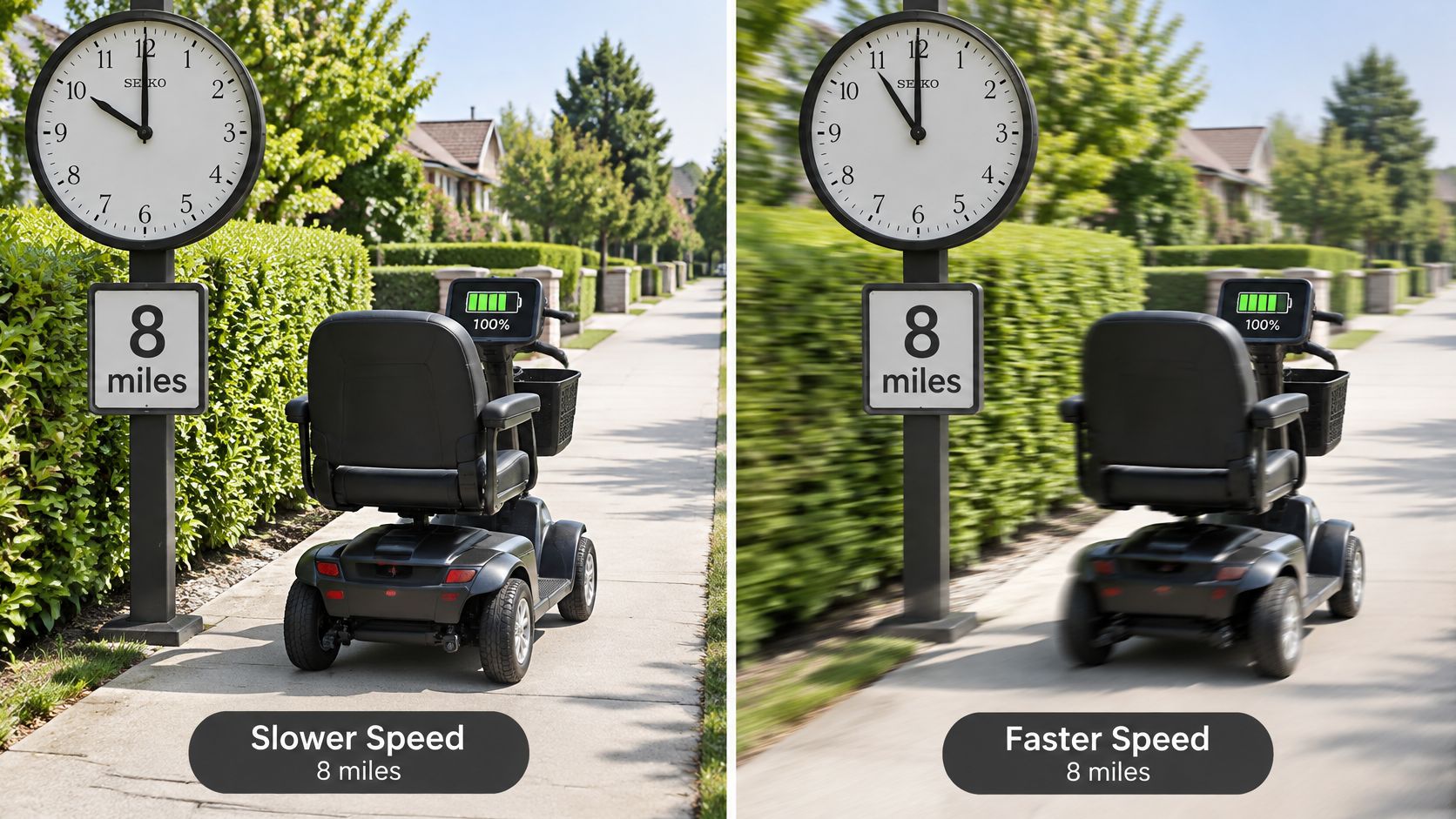
A faster scooter can reduce rolling time where that speed is permitted. It doesn't add stored energy to the battery or make an inaccessible route usable.
The illustration compares speed over the same distance.
Separate travel time from legal access
As a simple calculation, an uninterrupted 8-mile journey at 4 mph takes about two hours of rolling, while traveling the same distance at 8 mph takes about one hour. Neither calculation includes crossings, queues, rest stops, or slower movement around pedestrians.
Those speed settings also need legal context. RoSPA's UK guidance describes Class 2 scooters as limited to 4 mph and generally intended for pavements and footpaths, while Class 3 models can reach 8 mph but must remain limited to 4 mph on pavements.
The National Fire Chiefs Council's UK mobility scooter guidance describes Class 3 scooters as larger vehicles capable of up to 8 mph and states that they must be registered with the Driver and Vehicle Licensing Agency.
| Decision | What to check |
|---|---|
| Choose a speed setting | Local rules, pedestrians, visibility, and surface conditions |
| Estimate arrival time | Legal rolling speed plus crossings, stops, and access delays |
| Choose battery range | The complete journey with a usable reserve |
Don't treat speed as a range upgrade
Faster running changes motor demand and air resistance. You shouldn't assume the highest speed setting produces the longest travel distance.
For additional viewing, the video is embedded below.
In the United States, check the rules for your state and the specific sidewalk, path, or road you intend to use. A UK class label isn't a local permit.
Pick speed for the route open to you. Then size the battery for the reserved round trip, rather than choosing a fast scooter and hoping its range will fit.
When the Route Ends Before the Battery Does
Consider a hypothetical scooter rated for 20 miles that can't complete a 2-mile errand because the sidewalk ends before the destination. The remaining charge doesn't provide a safe crossing or create a curb cut.
Griffith University's publication on mobility scooter users describes how powered mobility users are often expected to use ordinary pedestrian, road, and public-transport networks without special provision. Battery capacity is only part of whether a journey works.
Battery range is how far the battery can propel the scooter. Practical mobility radius is how far you can actually go and still get home safely.
Check the complete journey
- Trace an accessible path. Check curb cuts, crossings, entrance thresholds, and a way around stairs. A pedestrian route on a map isn't proof that the whole route accommodates your scooter.
- Mark difficult stretches. Identify hills and rough patches before departure. Choose a smoother alternative when the original route approaches the scooter's operating limits.
- Confirm rest and charging locations. Identify somewhere you can stop comfortably. If charging is essential, confirm permission, outlet access, charger compatibility, and enough time to charge before relying on it.
- Verify a ride-home option. Confirm whether your scooter can travel in the intended car, accessible taxi, or transit service. Check loading arrangements and device limits rather than assuming someone can lift it.
- Name the backup action. Decide where you'll turn around if access is blocked and who can meet you if necessary. A halfway battery indication can be a warning to reassess, but it isn't proof that enough charge remains for the return.
For older adults, assisted-living residents, and rehabilitation patients, this preparation can make an unfamiliar outing more manageable. Caregivers should also confirm who carries the phone, charger, and destination details.
Look beyond the destination's front door
A clinic may have an accessible entrance but a difficult route from the street. A park may have a paved entrance followed by an unsuitable surface farther along the loop.
For access at a known threshold or step, our guide to ramps for mobility scooters explains considerations that mileage specifications can't answer. A ramp still needs to suit the location, load, and scooter's operating limits.
The illustration below concerns electric-car battery planning, not scooter-specific route access.
When there's no dependable plug at the destination, portability, a removable battery, charging time, and outdoor stability may matter as much as the mileage rating. A shorter-range scooter that fits your confirmed transport plan can be more useful than a longer-range machine you can't bring home if the route closes.
Charging Habits That Protect Usable Range
The Children's Hospital mobility-device safety guideline recommends overnight charging but warns against leaving the device on charge for more than 24 hours, because overcharging can damage batteries. It also advises against leaving the charger connected for extended periods when the scooter isn't being used.
Treat that as safety guidance, not a replacement for your model's instructions. Use the correct charger and follow the scooter manufacturer's charging procedure, including any battery-specific requirements.
Build charging into the daily routine
- Charge after the day's travel. Don't make an empty gauge your routine reminder to connect the charger.
- Check the connections. Inspect the charger, cable, and charging socket for visible damage before use.
- Let the charge finish as directed. Learn what the charger's indicators mean instead of guessing from elapsed time.
- Disconnect when appropriate. Unplug after charging is complete according to the manufacturer's procedure. Don't treat a multi-day connection as a storage plan.
- Prepare for unfamiliar outings. Start with a full charge rather than hoping yesterday's remaining power will cover a new route.
Our guide to how to charge a mobility scooter battery provides a practical companion to your model's manual. Keep the charging setup accessible so that connecting the battery doesn't require awkward lifting or reaching.
If the battery is removable, follow the prescribed removal and reconnection sequence. Don't substitute an apparently similar charger unless the manufacturer confirms compatibility.
Notice a change before it becomes a breakdown
Battery life depends on use and maintenance, so age alone doesn't tell you the distance available today. Pay attention if a familiar outing begins using noticeably more charge or the scooter loses power unusually early.
A completed charging cycle doesn't prove that an older battery can still deliver its original range.
Keep a simple record of familiar journeys and charging behavior. If performance declines, shorten your route and have the battery and charging system checked rather than repeatedly testing the limit away from home.
Also distinguish a missed charge from a persistent loss of capacity. A scooter that wasn't fully charged needs a corrected routine; one that repeatedly underperforms after proper charging needs closer attention.
Battery age, a skipped full charge, or a charger left connected for days can reduce dependable travel distance even while the brochure still displays the original rating. Plan around the battery's current condition, not the number printed when it was new.
Match Range to the Day You Actually Travel
Name the longest out-and-back journey you realistically take. Include movement at the destination, then consider whether you'll need to load the scooter into a vehicle, travel by air, or carry substantial supplies.
A neighborhood errand doesn't automatically call for the largest battery. A clinic day needs a dependable return plan, while a park outing also needs a scooter suited to the surface.
Compare by trip type rather than longest range
Our range includes these distinct options:
| Scooter | Published specifications | What to weigh in your decision |
|---|---|---|
| EASWE M10 Portable Long Range Mobility Scooter | Weighs 44 lbs, supports 265 lb, range up to 30 miles | A long published range in a light travel package |
| SuperHandy Passport Power Mobility 3-Wheel Scooter | Weighs 35 lbs, supports 275 lb, range 13 miles, FAA approved | Shorter portable trips rather than an assumption of all-day touring |
| Golden Buzzaround GB220 CarryOn HD Travel Scooter | Weighs 77 lbs, supports 400 lb, range 22 miles, FAA approved | Higher rider capacity alongside a substantial published range |
These figures describe different trade-offs, not a longest-wins ranking. Check whether the total weight works for your transport arrangement and whether the capacity accommodates the intended load.
Buy for the routine you can verify
For early planning, keeping the complete outing around half to two-thirds of the advertised distance can provide a cautious starting budget. That's an editorial planning allowance, not a guarantee, and difficult conditions may call for less.
Air travel also requires confirmation with the airline about the particular device, battery, and handling arrangements. An approval label doesn't replace that conversation.
Use our guide to how to choose a mobility scooter to compare range alongside fit, portability, and intended use. Choose the range that survives your real day, not the largest number on the label.
DME Superstore offers mobility scooters with clear specifications for travel range, weight capacity, and portability, alongside guides that help you compare those features. Visit DME Superstore with your longest planned round trip, transport needs, and rider requirements in mind to narrow your options to a practical fit.
