



A lot of people start looking for a ramp in the same moment. The scooter is already in the driveway, the doorway suddenly looks taller than it used to, and a step that never mattered before now stops the whole day. You might be helping a parent come home after surgery, adjusting to a new scooter, or trying to make one entrance usable without turning the house into a construction project.
That first purchase can feel bigger than it should. Some families need a simple fix for a threshold lip. Others need something that can ride in a trunk, bridge a curb at appointments, or solve a porch entry that's now part of everyday life. The hard part isn't deciding whether access matters. It's figuring out what kind of ramp fits the place, the scooter, and the person using it.
When a Ramp Becomes Part of Daily Life
A caregiver stands at the front step with a folded chair in one hand and the scooter idling near the curb. The rise at the door doesn't look dramatic. It's just enough to stop the front wheels and force a decision. Do you keep lifting and nudging every day, or do you install something that turns this into a normal entrance again?
That's how ramps for mobility scooters usually enter the conversation. Not as a grand remodel. As a repeated friction point.
The moment the temporary fix stops working
Sometimes the trigger is a hospital discharge. Sometimes it's a parent moving in. Sometimes a travel scooter that worked well indoors now needs a safe path into the van. A family may start with “we only need a little help at the step,” then realize the same person also needs smoother access to the patio, garage entry, or side door.
If you're already planning wider changes at home, it helps to think beyond the doorway. Many families pair entry changes with bathroom remodeling for accessibility so the home works as a whole rather than in isolated pieces.
One useful starting point is to compare home-use options for wheelchair ramps for home. Even if the shopper uses a scooter rather than a wheelchair, the decision points are similar at first glance.
Practical rule: A ramp becomes a daily-living product the moment someone uses it often enough that setup, storage, and confidence matter as much as the slope.
Four questions that make the choice clearer
Most first-time buyers don't need more jargon. They need four plain questions answered:
- What type fits the obstacle: A doorway lip, curb, van, porch step, and deck landing usually need different ramp styles.
- How long should it be: The rise decides the length. Guessing usually leads to a ramp that feels too steep.
- How strong must it be: The rating has to account for the scooter, the rider, and what's carried on the scooter.
- How safe is it in daily use: Grip, side edges, transitions, and storage matter more than shoppers expect.
A ramp that works once for a delivery day isn't automatically the right ramp for every morning, every appointment, and every return home in the rain. That's why it helps to treat the purchase like any other piece of mobility equipment. It has to fit real life, not just clear the step.
The Four Main Ramp Types and Where Each One Fits
Most ramp mistakes happen because buyers match the ramp to the word “scooter” instead of matching it to the obstacle. Start with where the ramp will sit and how often it will move.
Threshold ramps for small rises
A threshold ramp is the simplest category. It's for the small rise that catches a front wheel at a doorway, sliding glass door, or transition into a garage.
These work well when the problem is a low lip, not a full exterior step. They usually stay in place and turn an abrupt edge into a smooth roll-over. Rubber threshold ramps are common indoors and at protected doorways because they sit low and don't need much fuss once fitted.
Portable and suitcase ramps for travel and occasional use
Portable folding ramps solve a different problem. They're meant to move.
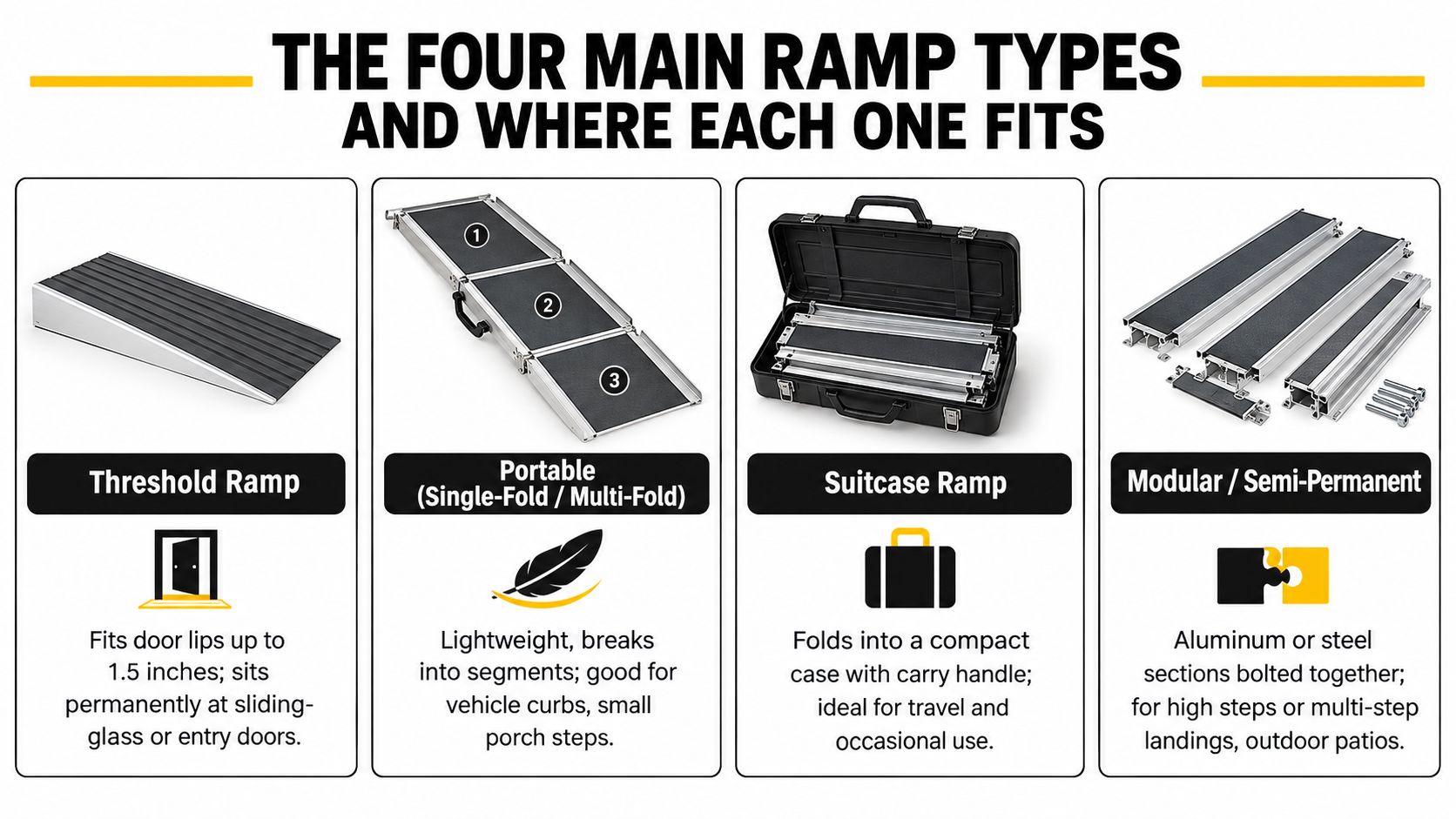
A single-fold or multi-fold portable ramp is useful when the route changes. That might mean a curb at a medical office, a side step into a vehicle, or a small outdoor step at a relative's home. If you want a closer look at this category, this guide to a portable ramp for wheelchairs covers the tradeoffs between transport and setup.
A suitcase ramp is a portable ramp with a carry-friendly folding format. People choose it when they need something compact enough to store in a trunk or closet and deploy without tools. It's a practical travel option, but only within the rise and weight limits it was built for.
A suitcase ramp is for convenience. It is not a substitute for a long exterior access route.
Modular or semi-permanent ramps for repeated outdoor use
If the ramp will stay outside and serve the same entrance every day, look at a modular or semi-permanent ramp. These systems use connected sections and landings to solve taller entries, multiple steps, and awkward porch geometry.
They're the category people often need for a two-step side entrance, a deck landing, or a front stoop that's become the main route. They also give you more room to build proper turns and level areas, which matters for scooters with a wider turning circle.
Where buyers get tripped up
Here's the common mismatch:
- Threshold ramp for a porch step: Too small for the rise.
- Suitcase ramp for a high entry: Usually too short or too flex-prone for everyday comfort.
- Portable folding ramp for a permanent front entrance: Works in a pinch, but storage, weather, and repeated setup become a burden.
- Modular ramp for occasional travel: Overkill if you only need curb access at appointments.
The right ramp isn't the one with the most features. It's the one built for the actual obstacle, the actual scooter, and the way the user moves through the day.
Slope, Length, and Rise Calculations Made Simple
A common scene goes like this. A caregiver measures the doorway, orders a ramp that looks about right, and then finds the scooter scraping at the top transition or struggling on a slope that seemed reasonable on paper. The problem usually is not the math itself. It is using only one rule and missing the scooter-specific details that decide whether the ramp feels usable every day.
Start with rise, because rise controls everything
Rise is the vertical height from the surface where the scooter starts to the surface it needs to reach. Measure that first.
Use a tape measure and a straightedge or level so you are measuring true height, not the diagonal distance along a step or threshold. For a doorway, measure from the lower landing to the top of the threshold or interior floor, depending on where the scooter's drive wheels have to climb.
Once you know the rise, the basic formula is simple:
- Ramp length in inches = rise in inches × 12 for a 1:12 slope
If you want a quick way to test different heights and lengths, a handicap ramp calculator for rise and ramp length planning helps with rough planning.
Worked examples make the numbers easier to trust:
- 6-inch rise = 72 inches of ramp length
- 24-inch rise = 288 inches of ramp length
That second number explains why many porch entries outgrow short portable ramps fast.
What 1:12 means in plain language
The standard U.S. benchmark is a maximum running slope of 1:12. For every 1 inch of vertical rise, you need at least 12 inches of ramp length. That equals an 8.33% grade under the U.S. Access Board ramp guide, which also covers a 1:48 cross slope limit and a 30-inch maximum rise per run in new construction.
The same source shows how quickly the length grows. A 20-inch rise needs at least 20 feet of ramp length, and a 9-foot rise would require 108 feet at the same slope.
The ADA Standards for Accessible Design also state that the maximum slope of a ramp in new construction is 1:12.
Code minimum is only the starting point for scooters
A scooter is not just a person on wheels moving up a textbook ramp. It has a wheelbase, ground clearance, motor strength, and a rider who may slow down or stop at the transition. That changes what "usable" feels like.
A 1:12 slope may meet the rule, yet still feel steep for a heavier scooter, a user with limited trunk balance, or a caregiver walking beside the scooter. Gentler slopes often make starts, stops, and wet-weather use much more manageable.
People get confused. They hear "ADA compliant" and assume "comfortable for my scooter." Those are not the same decision.
A better planning range for scooter users
For many home situations, it helps to compare the legal minimum with slopes that are easier in daily use:
| Rise (inches) | 1:12 ADA Minimum | 1:16 Often Better for Scooters | 1:20 Easier Approach |
|---|---|---|---|
| 6 | 6 feet | 8 feet | 10 feet |
| 12 | 12 feet | 16 feet | 20 feet |
| 18 | 18 feet | 24 feet | 30 feet |
| 24 | 24 feet | 32 feet | 40 feet |
That middle column matters. Many scooter owners do better with 1:16 than with 1:12, especially if the ramp is used every day rather than once in a while. The longer ramp takes up more space, but it lowers the effort needed to climb and reduces the "tippy" feeling some riders notice on steeper portable ramps.
Real-world ramps often miss the target
Field use is often messier than plan drawings. A RESNA conference paper on scooter boardings found that the proposed ADA-style maximum slope was exceeded in many street-level deployments.
That matters at home too. A ramp can be sold as portable and still end up too steep once it is matched to a tall SUV, a high porch, or an entry with limited space. Many slope problems start with a real obstacle that needs more length than the available footprint allows.
Scooter fit issues that the 1:12 rule does not solve
Slope is only one piece. Transition fit matters just as much.
Some scooters have low clearance underneath the frame or anti-tip wheels at the rear. If the ramp meets a threshold or landing with too sharp an angle, the scooter can bottom out even if the ramp length is technically correct. The same issue can happen at the top, where the scooter shifts from the ramp onto the porch or interior floor.
Wheelbase matters too. A short scooter may handle a breakover point differently than a long, heavy model. This is similar to how one car clears a driveway easily while another scrapes its underside at the same spot.
Before buying, check:
- Ground clearance
- Wheelbase length
- Approach angle at the bottom
- Departure or breakover angle at the top
- Whether the landing is level enough for the full scooter footprint
Those checks prevent a common mistake. The ramp is long enough by formula, but the scooter still feels unstable or catches at the transition.
One state rule that surprises homeowners
California adds an extra point many buyers do not expect. Under Title 24, an accessible-route surface steeper than 1:20 (5 percent) is treated as a ramp, and the same rules repeat the 1:12 maximum for new construction, as outlined in California Title 24 ramp requirements.
For a caregiver comparing options, the practical lesson is simple. Measure the rise first, calculate the minimum length second, and then ask whether your specific scooter needs a gentler slope or smoother transition than the code minimum. That extra margin is often what turns a ramp from "technically workable" into something the user can trust every day.
Weight Capacity and Why Combined Load Matters More
A caregiver may see a ramp rated for 600 pounds and assume the question is settled. Then the scooter climbs it, slows near the top, and the ramp flexes more than expected. That happens because the posted rating is only the starting point.
The number on the label doesn't tell the full load story
A ramp supports the combined load of the scooter, the rider, and anything carried on the scooter, such as a bag, oxygen equipment, or groceries. It supports that weight while it is rolling, turning slightly, and transferring on and off the ramp. Those moments can place more stress on the ramp than a simple parked-weight figure suggests.
For day-to-day use, a safety margin matters. If the scooter and rider together are close to the ramp's maximum rating, normal movement can make the ramp feel less steady, especially on folding models or longer portable spans. A good rule for shoppers is simple: add up the scooter, the rider, and the gear first, then look for capacity above that number rather than treating the rating as a target.
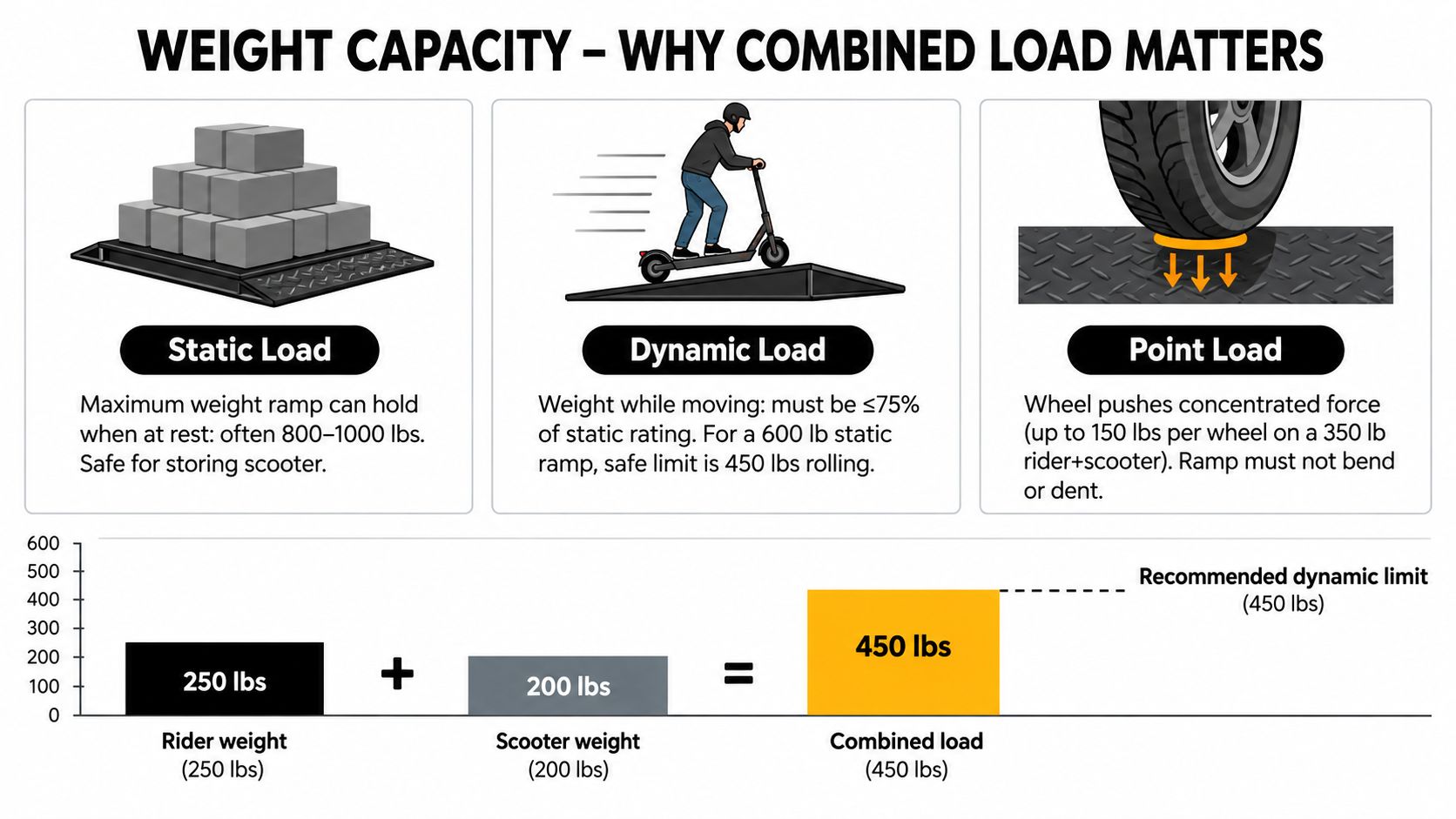
Static, dynamic, and point load
Three load types explain why a ramp can seem fine in a product photo yet feel different under a scooter.
- Static load: The weight the ramp holds when the scooter is stopped.
- Dynamic load: The added stress created while the scooter is moving up or down.
- Point load: The concentrated force where one wheel presses on one small area, often near a lip, seam, or hinge.
A suitcase on a bed spreads its weight across a wide area. A scooter wheel works more like the leg of a heavy table pressing into one spot on the floor. That is why hinge lines and transition points deserve extra attention, especially with heavier scooters that carry more of their weight over fewer contact points.
Shopper check: Ask whether the listed capacity reflects rolling use, and whether the manufacturer explains how the ramp handles hinges, transitions, and the full unsupported span.
Scooter fit changes the stress pattern
Capacity is only one part of the fit. Scooter design changes how that weight is delivered to the ramp.
A compact travel scooter and a larger four-wheel scooter can have the same total weight but stress a ramp differently because their wheel spacing, tire size, and motor placement are different. One may roll across a hinge smoothly. Another may place a stronger point load right at the fold. That is one reason scooter users often run into problems on ramps that technically meet basic guidelines.
Analysts in a University of Washington accessibility study found that mobility scooter users had particular difficulty with low-quality curb ramps. The practical lesson for a home ramp buyer is straightforward. Capacity, width, and slope can all look acceptable on paper while the scooter still feels unsettled during real use.
If you are comparing models used by power mobility customers, this guide to a ramp for power wheelchair is useful because it raises many of the same transition, load, and wheel-placement questions.
Materials and Compatibility With Your Scooter
Ramp material affects handling, weather resistance, traction, and how the ramp feels under load. But material alone doesn't tell you whether the ramp will work with your scooter.
Aluminum, rubber, and steel in real use
Aluminum dominates portable ramps for a reason. It keeps weight manageable, resists corrosion well, and works for buyers who need to fold, carry, or stow the ramp often. For travel scooters and ramps that move between home and vehicle, aluminum is usually the practical starting point.
Rubber is common at thresholds. It's quiet, simple, and useful for low rises at doorways or sliding-door tracks. It also sits securely without the hollow feel some metal threshold pieces can have on indoor surfaces.
Steel is usually a better fit for heavy-duty or more permanent outdoor setups where carrying the ramp isn't the goal. The tradeoff is obvious. More weight can mean more stability, but also more effort during installation and more attention to coatings and weather exposure.
Ramp Materials vs Scooter Compatibility
| Material | Best Use | Traction | Weight | Corrosion Resistance |
|---|---|---|---|---|
| Aluminum | Portable and folding ramps | Usually good with textured surface | Light | Strong |
| Rubber | Door thresholds and small transitions | Good in dry conditions, often reassuring underfoot | Heavy for size, but stationary | Strong |
| Steel | Semi-permanent and heavy-duty outdoor systems | Varies by finish | Heavy | Depends on coating and maintenance |
Material doesn't solve geometry problems
A well-made aluminum ramp can still be wrong for the scooter if the geometry is off. Before buying, compare the ramp with the scooter's:
- Wheelbase length: Shorter devices can feel twitchier on abrupt transitions.
- Ground clearance: Low-clearance scooters can scrape at the top or bottom lip.
- Turning radius: A landing that looks roomy on paper may still be awkward for a scooter.
- Tire width and track: Narrow channels or raised edges can create fit issues.
This is why some buyers report that a ramp “works” for one mobility device and not another in the same household.
Surface grip matters more outside
Rain, leaves, grit, and winter residue change how a ramp feels. Textured aluminum can perform very differently when dirty than when clean. Rubber thresholds can feel secure indoors but may not be the ideal answer for every exposed doorway.
For permanent outdoor ramps, the surface finish and the transition plates deserve as much attention as the frame. A smooth rolling entry and exit usually matter more to scooter users than a caregiver expects at first, especially when the scooter has smaller front wheels or limited clearance.
Installation, Safety Checks, and Routine Maintenance
Good ramp selection solves only part of the problem. A well-chosen ramp still needs correct placement, clean transitions, and routine checks to stay safe.
A visual checklist helps before the first setup:
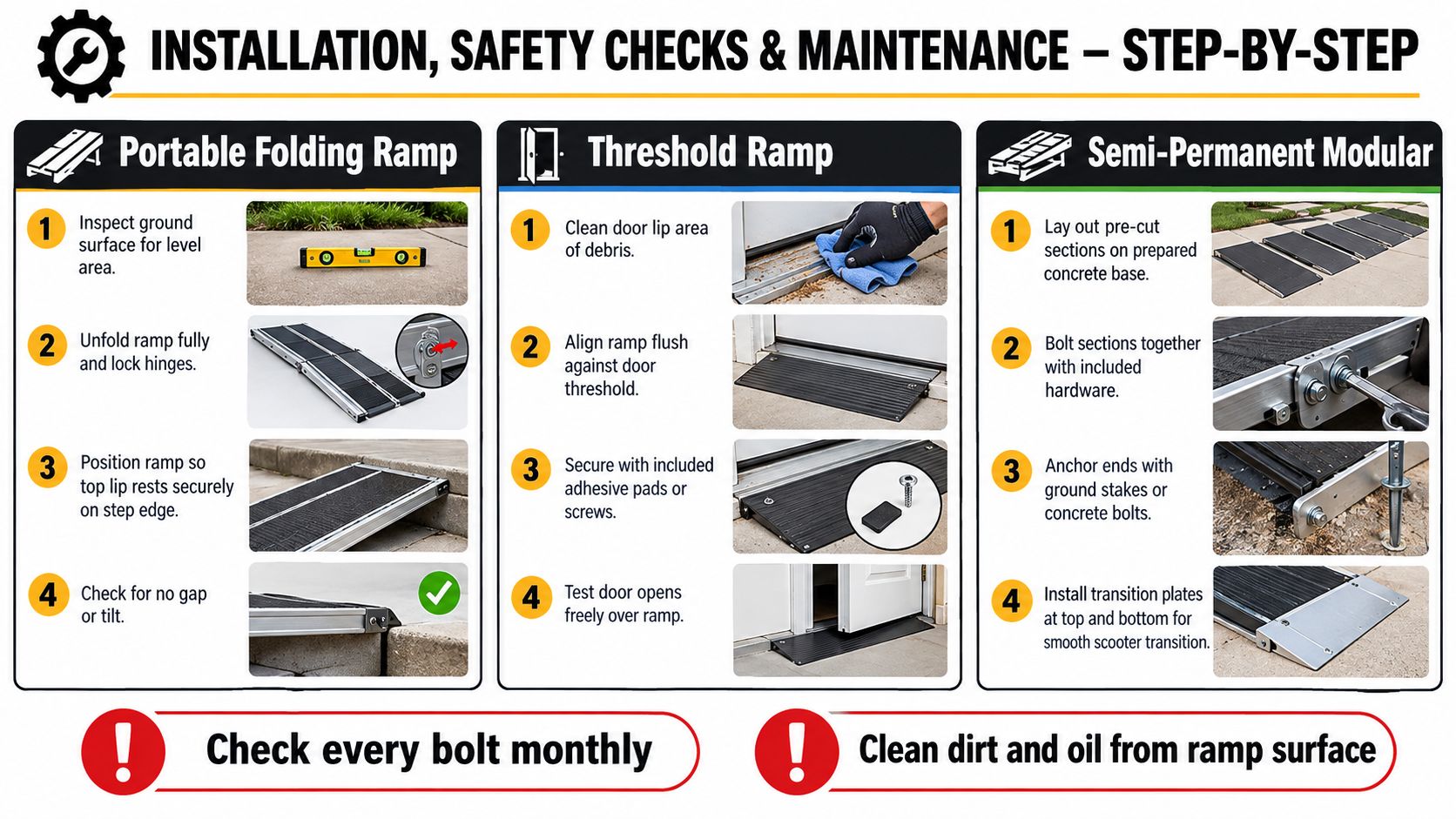
Set each type on the right surface
Portable folding ramps need a level base at both ends. The top lip has to sit fully engaged on the step or vehicle edge, with no rocking and no visible gap that could shift under the front wheels.
Threshold ramps need a clean contact area. Dust, grit, or a slightly uneven threshold can create a tiny wobble that becomes obvious once a scooter rolls over it.
Semi-permanent modular systems need the most prep. Ground contact, anchoring, and transition plate alignment matter because the user may rely on the same route every day.
A short pre-use safety routine
Before anyone rides up a newly placed ramp, check three things:
- Landing space: The scooter needs room to approach straight and room to stop at the top.
- Lip engagement: The upper end should sit flush and secure, without bounce.
- Surface condition: Wet leaves, mud, and garage dust reduce traction quickly.
California guidance adds another point many homeowners miss. It states that handrails are required on ramps that exceed 1:20 slope, with limited exceptions at certain exterior-door landings, and for ramps over 24 inches of rise and steeper than 1:12, handrails are required on both sides with the top of the handrail 30 to 38 inches above the ramp surface (California handrail and ramp code summary).
Clean ramps grip better and feel less steep. Dirt changes traction before rust or wear become visible.
A short demonstration helps many families more than any written instruction:
Maintenance that matches the ramp style
Portable ramps usually need inspection for transport damage. Look at hinges, rivets, carrying handles, and edge sections after loading and unloading from a trunk.
Permanent and semi-permanent ramps need weather attention. Sweep debris, watch for standing moisture, check fasteners, and inspect the surface where tires repeatedly track. Caregivers don't need a complicated service schedule. A simple monthly visual check and a quick wipe-down after bad weather catches many problems early.
Buying, Comparing, and Paying for the Right Ramp
The cleanest buying decision comes from matching three things: the obstacle, the scooter, and the way the ramp will be used. When one of those gets ignored, returns and regrets go up.
A simple comparison framework
Start with the user's routine. A person who needs a ramp at one exterior doorway every day usually needs a different solution than someone who stores a scooter in the car for appointments.
Then compare the device itself. Ground clearance, total travel weight, turning space, and wheel placement affect fit far more than shoppers expect. DME Superstore is one retailer that lists mobility ramps alongside scooters, powerchairs, and related specs, which can help when you're comparing equipment categories in one place rather than guessing from a general marketplace listing.
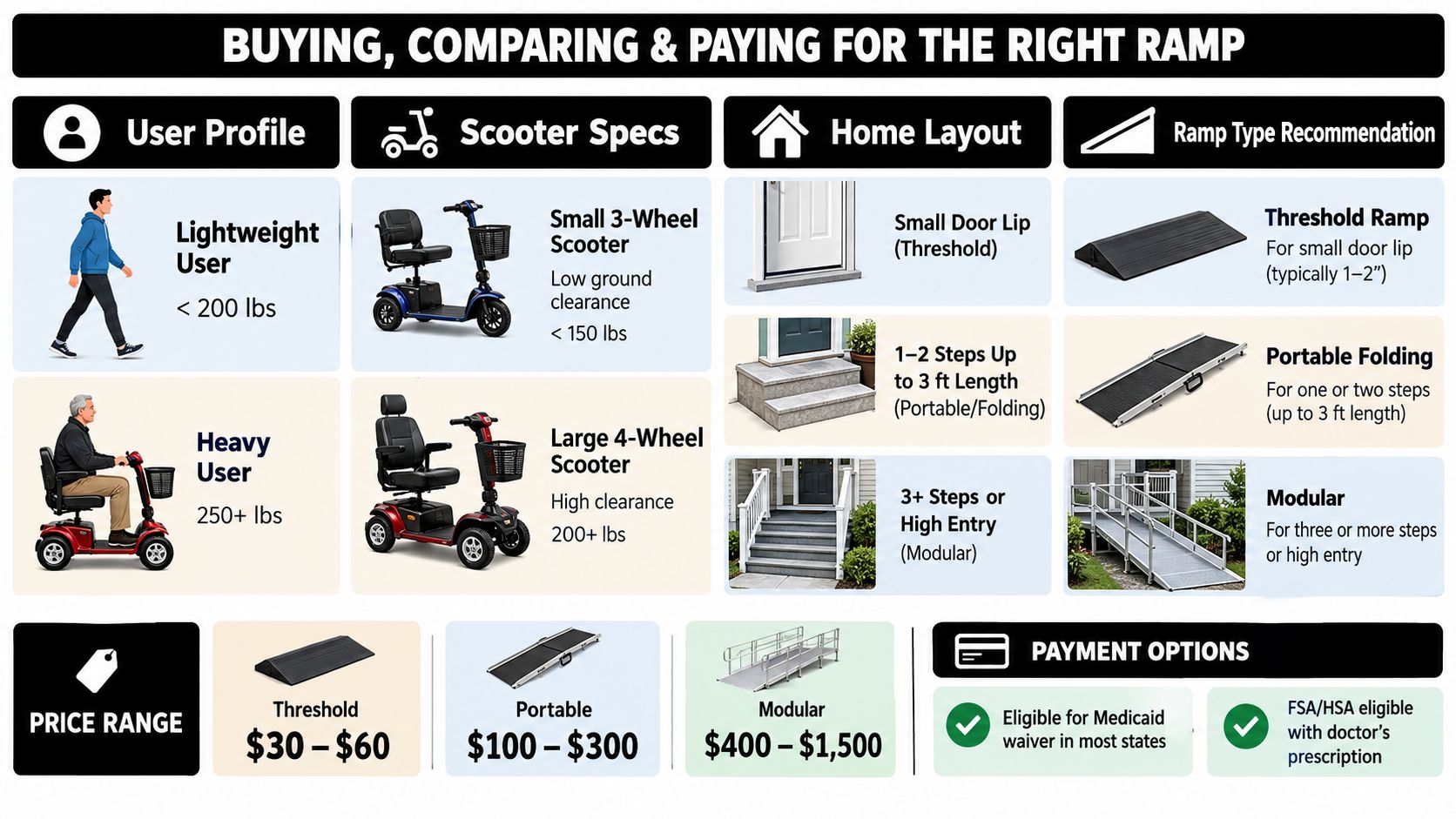
Where to buy and what to compare
Medical supply retailers, accessibility dealers, big-box stores, and online sellers all carry some form of ramp. The useful differences usually aren't just price.
Look for:
- Clear slope guidance: The seller should make it easy to match rise to length.
- Specific capacity language: Vague labels create risk when you're buying for a scooter.
- Return details: Fit problems often appear only after setup at home.
- Installation support: This matters more for modular systems than for threshold pieces.
- Compatible accessories: Transition plates, edge guards, and anchoring hardware shouldn't be an afterthought.
If you're also sorting out benefits and reimbursement questions, this overview of will Medicare cover wheelchair ramps is a practical place to start.
Paying for the right solution instead of the cheapest one
Portable and modular ramps are often treated as durable medical equipment purchases by families, especially when the need ties directly to mobility and home access. FSA and HSA spending may help, and some buyers also explore physician documentation, local home-modification programs, Medicaid waiver routes, VA housing-related benefits, nonprofit assistance, or assistive technology loan programs.
The exact funding path depends on where you live and how the ramp is being used. What matters most at the buying stage is keeping your paperwork organized. Save the product description, specifications, invoice, and any clinical note that explains why the ramp is needed for safe entry or exit.
Red flags worth taking seriously
A ramp listing deserves extra scrutiny when it leaves out basic decision details.
- Missing slope information: If the seller won't connect rise to ramp length, you're being asked to guess.
- Vague weight labels: “Heavy duty” is not a technical specification.
- No transition details: The lip and landing matter as much as the flat ramp surface.
- No traction description: Outdoor use without surface information is a gamble.
- Poor scooter fit information: A generic “wheelchair/scooter compatible” label doesn't answer width, clearance, or turning questions.
The right ramp should feel boring after installation. It should let the user come and go without a discussion at the doorway every single time.
DME Superstore offers mobility ramps alongside scooters, powerchairs, and other home accessibility equipment, so you can compare ramp styles in the same context as the device they need to support. If you're choosing between a threshold ramp, a portable folding option, or a home-entry setup, visit DME Superstore to review current products, specifications, and buying guidance.
