



A power wheelchair typically costs roughly $1,200 to $12,000 for standard to mid-range models, while high-end complex rehabilitation chairs can exceed $5,000. In the United States, Medicare Part B typically covers 80% of the Medicare-approved amount, leaving the beneficiary responsible for 20% coinsurance after the annual Part B deductible.
You may be looking at product pages with one chair priced below $2,000 and another priced above $10,000, wondering whether either figure represents a normal power wheelchair cost. A family caregiver may also be comparing a basic indoor chair with a bariatric model, a travel chair, or a complex seating system, without knowing which features affect the bill.
The price difference usually isn't random. It reflects the chair's drive system, frame, battery, weight capacity, seating, electronics, service requirements, and the way insurance calculates its allowed amount. A lower sticker price can also become less affordable if the chair needs frequent repairs, doesn't fit the user's home, or requires transportation changes.
This guide treats cost as total ownership math, not just the amount shown beside a product photo. You'll see how chair categories compare, which upgrades matter, how Medicare and other payment sources work, and what to check before placing an order. If you're helping an older adult, a person recovering from surgery, or someone who needs bariatric support, the aim is straightforward, practical clarity.
Introduction to Power Wheelchair Cost Today
A daughter and her father may leave a mobility showroom with more questions than answers. One chair looks compact and simple, another includes power seating and a larger battery, and a third supports complex rehabilitation needs. The price tags differ because the equipment solves different problems, not because one product name explains everything.
Start with the broad U.S. market range. Many standard and mid-range power wheelchairs cost roughly $1,200 to $12,000, while advanced or custom models may cost considerably more, as explained in Medical News Today's guide to electric wheelchair coverage. These figures cover several equipment classes, so treat them as orientation rather than a single shopping target.
Why two power chairs can have very different prices
A basic indoor chair may use a compact frame, standard seating, and straightforward controls. A complex rehabilitation chair may require specialized positioning, adjustable seating, stronger drive components, or a custom configuration. Each addition affects the invoice. It may also require assessment, fitting, documentation, and ongoing service.
Travel and heavy-duty chairs follow the same pricing logic. A lightweight model prioritizes portability and storage. A bariatric model may need a stronger frame, higher capacity, and components built for demanding use. The chair's purpose matters as much as its brand. Reviewing different kinds of wheelchairs can help clarify which category matches the user's daily needs.
The sticker price is only the first number. Seating, batteries, accessories, repairs, and transportation changes can alter the total amount paid over time.
Practical rule: Don't ask only, “How much is the chair?” Ask, “What equipment, support, and coverage rules determine what I'll actually pay?”
Medicare adds another part to the calculation. After the Part B deductible, beneficiaries generally pay 20% of the Medicare-approved amount, whether Medicare purchases the chair as a lump sum or pays through monthly rental arrangements, according to Medicare's wheelchair and scooter coverage guidance. The approved amount may be lower than the supplier's retail charge, so the calculation begins with the allowed amount, not necessarily the advertised price.
That distinction explains why a retail price and a patient's final bill can look unrelated. Compare the chair's configuration, expected support, and payment rules together, then estimate the ownership cost rather than judging the product by its photo or headline price.
How Much Power Wheelchairs Cost by Type
Start with the mobility problem, then compare prices within the right equipment category. Manual wheelchairs, standard power wheelchairs, and specialty powerchairs serve different needs. A lower sticker price can become a poor value if the chair does not match the user's strength, daily routes, or storage situation.
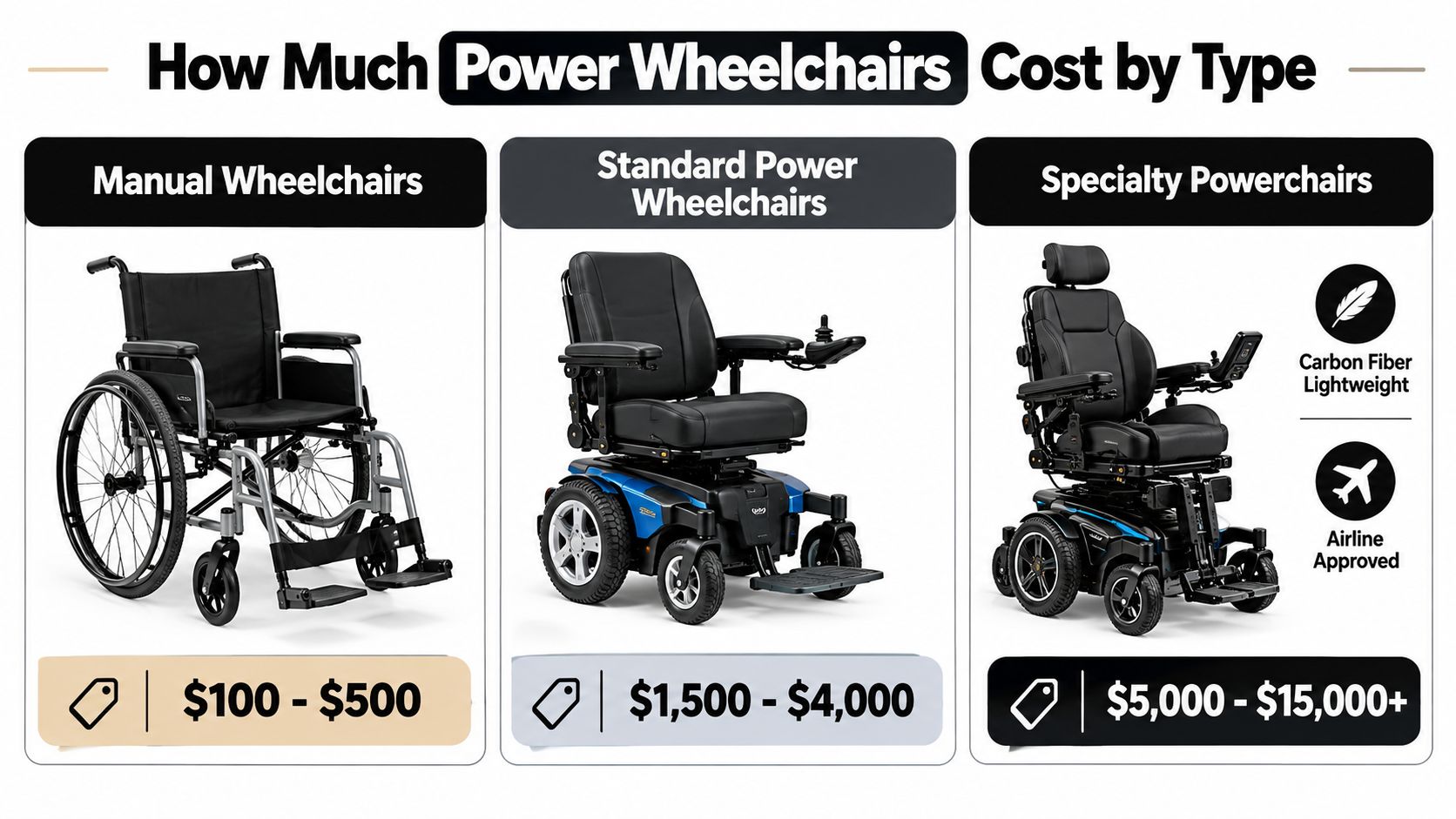
The infographic provides a useful retail comparison, but its figures are only a starting point. Many standard and mid-range power wheelchairs fall roughly between $1,200 and $12,000 in the U.S. Actual spending depends on the configuration, supplier, seating, accessories, and whether the chair is new, open-box, or customized. Coverage rules can also change the amount paid out of pocket, so the purchase price is not the same as total ownership cost.
Manual wheelchairs
Manual wheelchairs usually have the simplest mechanical design. The user propels the chair, or a caregiver pushes it, so the equipment generally has no motor, battery, or electronic control system. That can reduce weight and make lifting, storage, and transport easier. The tradeoff is physical effort from the user or caregiver.
A manual chair may fit someone who can propel safely across the distances required each day. It can also serve as a secondary chair for appointments or vehicle transport while a power wheelchair handles primary mobility. Compare the chair's purchase cost with the caregiver time and transportation help it may require.
Standard power wheelchairs
Standard power wheelchairs use motors and battery-powered controls to reduce the effort needed for movement. They may suit people whose strength, endurance, pain, or coordination makes manual propulsion unreliable.
The standard category includes several configurations. A compact indoor model, a folding travel chair, and a full-size chair for frequent outdoor use can differ in frame design, battery arrangement, seating, and storage needs. Review the specifications rather than assuming every standard chair offers the same value. Portability can also affect the long-term calculation. A guide to the best lightweight power wheelchairs can help identify which weight, folding, and transport features matter.
Specialty powerchairs
Specialty models include carbon fiber lightweight chairs, airline or cruise-friendly designs, and bariatric heavy-duty powerchairs. Their engineering priorities are different. A lightweight travel chair focuses on handling and storage, while a bariatric chair focuses on structural strength, stability, and capacity.
Advanced seating and rehabilitation configurations can raise the price because they require additional components and more involved fitting. Choose those features when they address a specific posture, transportation, capacity, or daily-use requirement. A specialty label alone does not make a chair a better purchase.
For a clearer comparison of mobility categories, review this guide to different kinds of wheelchairs. The right category gives you a more useful starting point for calculating what the chair will cost to own.
What Drives Power Wheelchair Pricing
A power wheelchair is more like a vehicle than a single piece of furniture. The frame is the body, the motors are the drivetrain, the battery is the fuel system, and the seating package determines how comfortably the driver can remain in position throughout the day.
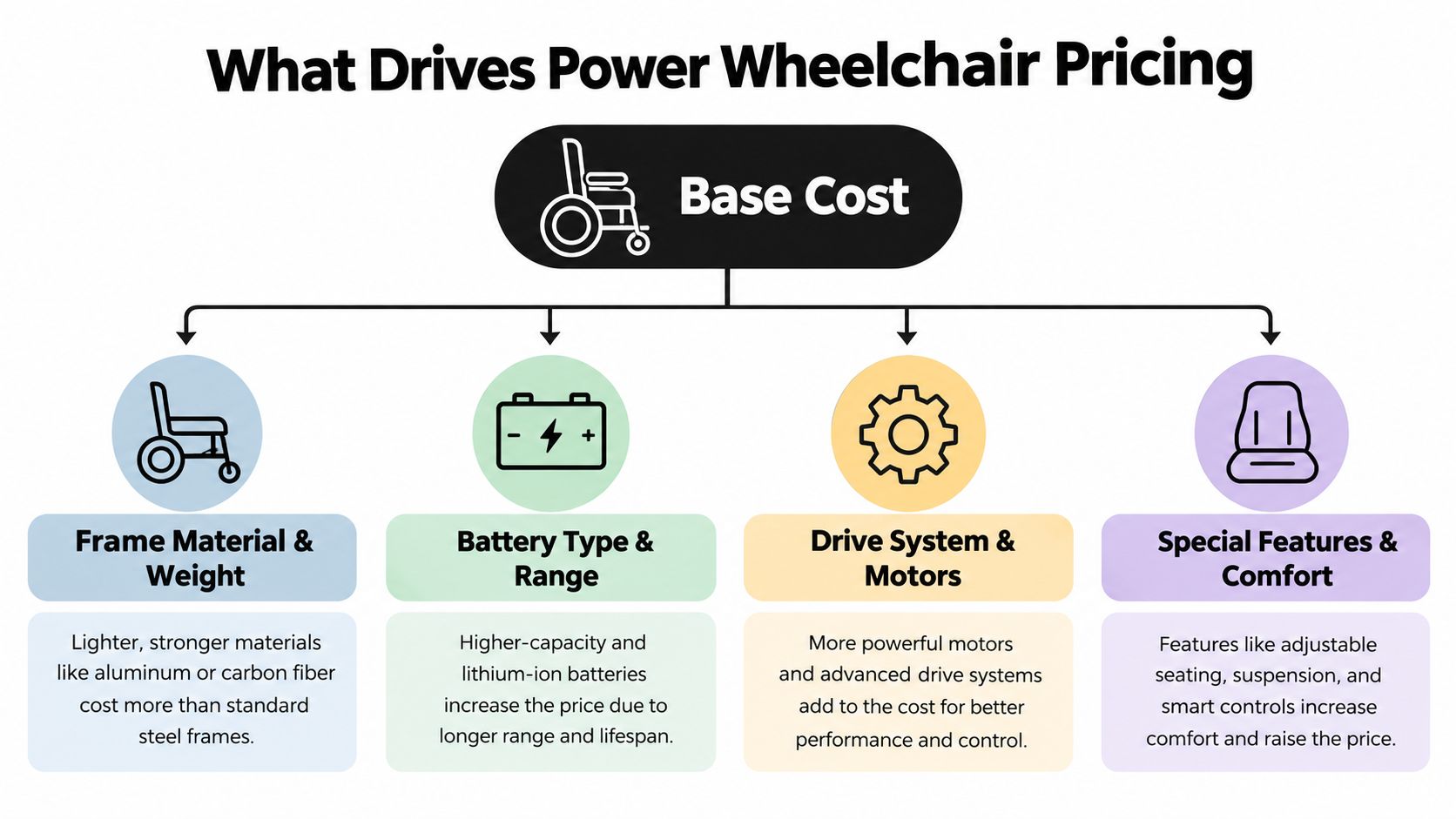
Frame material and weight
A lightweight frame can make storage, loading, and travel easier. Carbon fiber construction may command a higher price because manufacturers use specialized materials and design the chair around portability. A heavier frame may cost more for a different reason, particularly when it must support a higher weight capacity or tolerate demanding daily use.
Before paying for lighter construction, consider who will handle the chair and how often. A lighter chair may be valuable if a caregiver loads it regularly, but a heavier-duty structure may matter more if stability and capacity are the primary concerns.
Battery type and range
Battery choices affect how often the chair needs charging and how well it supports a full day away from home. More range can be useful for community mobility, but it may also add weight, size, or replacement expense. A person who mainly moves around a small home may not need the same battery setup as someone attending appointments and social activities across town.
Treat range like a vehicle's fuel capacity. More isn't automatically better if it adds cost without solving a daily problem.
Drive system and motors
The motor and drive configuration influence acceleration, traction, turning behavior, and performance on different surfaces. Indoor maneuverability may favor a compact configuration, while outdoor routes may call for stronger traction and a more durable frame.
Read the motor specifications alongside the intended environment. A chair designed for smooth floors may not be the right tool for uneven outdoor paths, even if its purchase price looks attractive.
Seating and positioning
Standard seating can be sufficient for some users. Others need a specialized cushion, adjustable back support, head support, lateral positioning, or power seat functions. These aren't cosmetic upgrades. They can affect posture, comfort, pressure management, transfers, and the ability to remain seated during daily activities.
Seating should be assessed with the user's body measurements and routine in mind. Buying the least expensive base chair and adding poorly matched seating later can undermine the original savings.
Capacity and customization
Higher-capacity chairs may require stronger frames, motors, wheels, and seating components. Custom configurations can also increase the number of parts that need to be selected, fitted, documented, and serviced.
UK guidance illustrates the broad effect of specification. The NHS wheelchair and mobility scooter guidance places basic electric wheelchairs around £2,000, while other UK mobility guidance describes powered chair purchase prices from roughly £900 to £5,000 or more, depending on specification. The market and currency differ from the United States, but the underlying lesson is useful. Complexity moves the price.
For buyers comparing performance, a focused look at the power wheelchair motor can clarify which motor features are necessary rather than merely appealing.
Insurance Medicare and FSA HSA Coverage Explained
A power wheelchair can have one price on the supplier's page and a different cost for the buyer. Insurance applies its own rules to the chair, its approved configuration, and the person's coverage. An approved claim can still leave a deductible, coinsurance, or items outside the benefit.
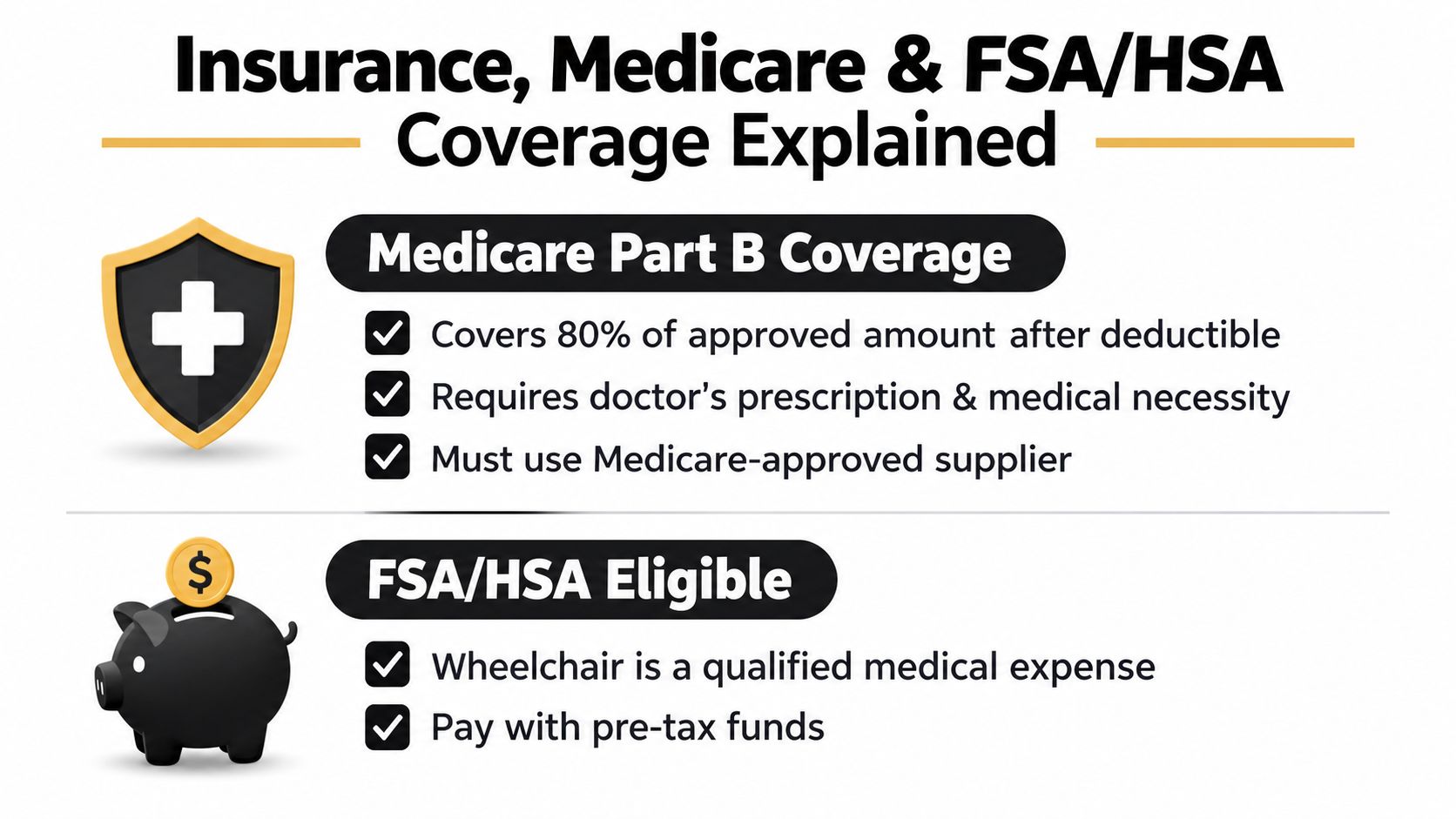
How Medicare calculates the patient share
Under Medicare Part B, the beneficiary generally pays 20% of the Medicare-approved amount after meeting the annual Part B deductible. CMS explains that this cost-sharing structure can apply whether the equipment is purchased through a lump-sum arrangement or rented monthly.
The Medicare-approved amount is the number that drives the patient share, not necessarily the chair's retail price. For durable medical equipment, the approved amount is the lower of the supplier's charge or Medicare's fee schedule. In practical terms, coverage math works like a receipt with an allowed total. The coinsurance is calculated from that total, provided the equipment and configuration meet Medicare's requirements.
For example, if the approved amount is $3,000, 20% would be about $600 before supplemental coverage. If the approved amount is $5,000, 20% would be about $1,000, also before supplemental insurance. These examples show the calculation only. Your responsibility depends on the deductible, approved amount, plan details, and equipment eligibility.
CMS also describes the lump-sum purchase structure in its power wheelchair coverage overview. Under that structure, Medicare pays 80% of the allowed purchase price and the beneficiary pays the remaining 20%.
What to verify before ordering
Ask the supplier and insurer to confirm these points in writing:
- Medical necessity: Which prescription, clinical evaluation, and supporting records are required?
- Supplier status: Is the supplier enrolled or approved for the coverage being used?
- Allowed amount: What amount will the payer recognize for this chair and configuration?
- Included equipment: Are the battery, cushion, seating system, joystick, and accessories included?
- Patient responsibility: Will a supplemental plan cover the coinsurance or deductible?
- Authorization: Must the plan approve the equipment before shipment?
Private insurance plans may use different deductibles, networks, documentation rules, and authorization processes. Medicare Advantage plans can also set their own supplier and approval requirements. Confirm the details with the plan instead of applying Original Medicare rules automatically.
FSA, HSA, and payment plans
A power wheelchair is generally treated as a medical expense for eligible FSA or HSA use, although account rules and documentation requirements can vary. Keep the prescription, invoice, product description, and payment record. Those documents connect the purchase to the medical purpose if an account administrator requests proof.
If coverage leaves a balance, compare affordable medical payment options with your budget before selecting a payment plan. Financing spreads payments over time, but it does not automatically lower the total cost. Review repayment terms, fees, approval conditions, and the timing of any expected insurance reimbursement.
Before speaking with a supplier, review this guide to power wheelchairs and Medicare for a product-focused explanation of eligibility and documentation. The goal is to compare the covered amount, your share, and any excluded equipment before you commit.
Smart Ways to Save on Your Power Wheelchair
Saving money doesn't mean choosing the least capable chair. It means matching the equipment to the need, comparing the complete offer, and avoiding features or services that don't improve daily use.

Start with the required features
Write down the essential requirements before looking at sale prices. These may include doorway width, seating dimensions, weight capacity, battery access, joystick placement, turning space, and transportation needs. A chair that fails one essential requirement isn't a bargain.
Then separate useful upgrades from attractive extras. A seating feature that improves posture may deserve priority over a convenience accessory. A battery that supports the user's routine may be more valuable than a heavier setup chosen only because it has a larger advertised range.
Compare new, open-box, and refurbished options
Open-box equipment can reduce the purchase price when the product has been returned or its packaging has been opened. Check whether the chair has been used, which accessories are included, what warranty remains, and whether the return policy applies.
Refurbished equipment can also make sense when a qualified seller clearly explains the inspection, replacement parts, battery condition, and service coverage. Review refurbished wheelchair options with the same attention you would give a new product. The lower price matters only if the chair remains safe, compatible, and supportable.
Evaluate the complete retailer offer
A price comparison should include more than the chair itself. Check whether the offer includes shipping, delivery setup, warranty support, compatible accessories, and a workable return policy. Price matching can help when the competing product has the same configuration and service terms, not merely a similar photograph.
At DME Superstore, shoppers can compare powerchairs, open-box products, compatibility accessories, warranty information, financing through Affirm, and white-glove delivery details. The retailer also states that it offers nationwide free shipping, a 30-day return policy on most products, and 24/7 chat-based support. Verify the current terms for the specific product before purchase.
Choose payment timing carefully
If you use an FSA or HSA, confirm eligibility and timing with the account administrator before charging the purchase. If you use financing, compare the full repayment obligation with the cash price and any insurance reimbursement. The most affordable path is the one that leaves you with a suitable chair and a payment schedule you can maintain.
Total Cost of Ownership Beyond the Purchase Price
The initial power wheelchair cost is only one line in the ownership budget. Batteries eventually need attention, tires and casters wear with use, seating may need adjustment, and electronics can require qualified service.
A useful estimate starts with the user's routine. Indoor use on smooth surfaces may be gentler on tires than frequent outdoor travel. Heavier use, uneven terrain, higher capacity, and frequent transport can increase wear on different components. Manufacturer guidance and service records should determine the actual maintenance schedule.
Costs to consider after delivery
Battery replacement is often the most important future expense to plan for, even when the chair itself remains mechanically sound. Ask which battery type the model uses, how replacement is handled, whether the battery is covered under warranty, and whether the chair's design allows straightforward access.
Seating deserves its own budget line. Cushions, backs, positioning supports, and pressure-management components may need replacement or adjustment as the user's body, posture, or clinical needs change. A chair can remain operational while its seating no longer provides a suitable fit.
Transport and accessories also affect total cost. A ramp, lift, tie-down system, tray, cup holder, oxygen holder, or storage bag may be essential for the user's routine. Check compatibility before purchasing accessories because a low-cost add-on that doesn't fit the chair creates wasted expense.
| Expense Category | Typical Consideration | Budget Tip |
|---|---|---|
| Battery | Replacement planning, charging equipment, and battery compatibility | Ask about replacement availability before selecting the chair |
| Tires and casters | Wear from flooring, outdoor surfaces, and frequent travel | Choose components suited to the places the chair will actually be used |
| Seating and cushions | Comfort, posture, pressure management, and future fit | Prioritize clinically important seating over decorative accessories |
| Repairs and service | Motors, joystick controls, electronics, brakes, and wiring | Confirm warranty coverage and local service arrangements |
| Transportation | Ramps, lifts, vehicle storage, and securement | Measure the home and plan the vehicle before ordering |
| Accessories | Trays, bags, holders, chargers, and positioning supports | Verify compatibility and buy only what supports daily tasks |
The cheapest chair at checkout isn't always the least expensive chair to own.
Keep a folder with the invoice, serial information, warranty terms, battery details, manuals, and service contacts. That record can make troubleshooting and warranty claims easier. Before purchasing, ask how long common replacement parts remain available and who performs repairs when the chair is no longer covered.
Choosing the Right Power Wheelchair for Your Budget
A sensible purchase begins with function, not a price filter. Decide whether the user needs a compact indoor chair, a portable travel model, a standard powerchair, a bariatric frame, or a complex seating configuration. Then compare the features that affect daily safety and independence.
Use this short checklist:
- Fit: Confirm seat width, depth, user weight, doorway clearance, and turning space.
- Use environment: Match the drive system, tires, and battery plan to indoor and outdoor routes.
- Seating: Identify which cushion, back, head, or positioning supports are necessary.
- Coverage: Verify the Medicare-approved amount, private insurance rules, authorization, and patient responsibility.
- Ownership: Review battery access, repair support, warranty coverage, accessories, and transportation.
- Purchase terms: Compare the cash price, financing obligation, return policy, delivery service, and condition of any open-box or refurbished chair.
A chair that fits the body, home, routine, and financial plan is usually a better value than a cheaper model that creates new problems. Take your measurements, collect the coverage questions, and compare complete configurations rather than headline prices.
DME Superstore offers powerchairs across standard, lightweight, travel, and bariatric categories, along with open-box options, compatibility accessories, warranty information, financing, and delivery services. Visit DME Superstore to compare specifications and build a power wheelchair budget based on the equipment you need.
