



When you begin researching the best lightweight power wheelchair, you'll encounter a variety of models designed for different needs. The most popular options today often focus on a blend of portability, power, and practical features for daily living. Many of these chairs weigh under 60 pounds and incorporate smart folding designs, making them an excellent choice for travel and daily errands. Understanding the technology and features behind these chairs is the first step toward making an informed decision.
Your Guide to Choosing the Right Lightweight Power Wheelchair
Welcome to our educational guide on selecting a lightweight power wheelchair that truly complements your lifestyle. Choosing the right mobility aid is a significant decision—one that can greatly enhance independence and open up a world of possibilities. This article is designed to be a trusted resource, helping you navigate the features, specifications, and considerations that matter most. We aim to translate complex technical specs into clear, practical knowledge you can use.
Our mission is to empower you, your caregivers, and your clinicians with the information needed to choose with confidence. From understanding what ‘lightweight’ truly means in engineering terms to comparing battery technology and navigating travel regulations, we're here to provide clarity.
Why This Guide Matters Now
The demand for portable mobility solutions has grown significantly. The global market for these chairs was valued at $2.74 billion in 2025 and is projected to expand rapidly. This growth is fueled by an aging population and remarkable technological advancements that make modern chairs lighter and more capable than ever. Additionally, supportive government policies are improving affordability, leading to a 15-20% increase in adoption in key markets. This progress is making advanced mobility aids more accessible to a wider audience.
A power wheelchair is more than a mobility device; it's an essential tool for maintaining confidence and independence. The right chair can profoundly improve access to travel, social events, and daily activities, enabling you to live life on your terms.
What You Will Learn in This Article
This guide serves as a comprehensive roadmap to finding the right fit. We will explore key topics to simplify your decision-making process, including:
- Defining 'Lightweight': We’ll break down the engineering and material science behind the term, explaining the crucial difference between a chair's total weight and the weight of its heaviest piece.
- Key Specifications: You'll learn how to interpret and compare critical metrics—like turning radius, battery range, and seat dimensions—that directly impact daily use.
- Travel and Portability: Gain practical knowledge and checklists for traveling by car, plane, or cruise ship with your chair.
- Funding and Accessories: We’ll provide an overview of payment options and introduce essential add-ons that enhance comfort and safety.
By the end of this guide, you will have the foundational knowledge needed to select the best lightweight power wheelchair for your unique lifestyle. For more foundational tips, our broader guide on how to choose a wheelchair is an excellent starting point.
What Lightweight Really Means for a Power Wheelchair
When shopping for a lightweight power wheelchair, the term "lightweight" is a primary selling point. However, its practical meaning can be nuanced. Understanding the factors that contribute to a chair's weight and portability is the first step to finding a model that genuinely makes your life easier. It’s less about a single number and more about how the chair is engineered for real-world handling.
To illustrate, consider this analogy: would you rather lift a single 70-pound suitcase into your car, or two separate 35-pound bags? For most people, the two lighter bags are far more manageable. The same principle applies to power wheelchairs.
Total Weight vs. Heaviest Piece
To accurately compare models, it's essential to understand two key specifications: total weight and the weight of the heaviest piece. These numbers provide different insights into a chair's true portability.
-
Total Weight: This is the combined weight of the entire chair, including the frame, wheels, seat, motors, and batteries. While it’s a useful baseline, it doesn't fully describe the ease of lifting if the chair can be disassembled.
-
Heaviest Piece Weight: This is often the more critical number for users and their families. It represents the weight of the single heaviest component after the chair is folded or taken apart. This is the maximum weight you will actually need to lift into a car trunk or carry over a threshold.
For example, a chair with a total weight of 60 pounds might seem cumbersome. However, if it disassembles and its heaviest component is only 28 pounds, it becomes a much more practical option for daily travel.
The true measure of a 'lightweight' power wheelchair isn't its total weight, but how easily you or a loved one can handle its heaviest part. A chair that breaks down into lighter, manageable pieces often provides more practical portability than a slightly lighter one-piece model.
The Role of Modern Materials
How have modern power wheelchairs become so light without sacrificing strength? The answer lies in advances in material science. Manufacturers have moved away from heavy steel frames, adopting advanced materials that offer superior strength-to-weight ratios.
Aircraft-grade aluminum is a widely used material, valued for its excellent durability and corrosion resistance. It creates a sturdy, reliable frame that remains relatively easy to lift and handle.
More recently, carbon fiber has become the gold standard for premium lightweight models. This composite material is both incredibly strong and significantly lighter than aluminum, often reducing a chair's frame weight. A carbon fiber frame can decrease a chair's overall weight by up to 30% compared to older materials, without compromising on safety or structural integrity.
This focus on weight reduction is a key trend in all types of travel equipment. For a broader perspective on this concept, it's useful to see how these principles apply elsewhere; there’s a great resource for understanding what 'lightweight' really means in the context of luggage. The core principle is universal: balancing durability with portability. By understanding these material and design factors, you can look beyond marketing claims and focus on what will truly impact your independence.
Decoding the Most Important Specifications
Reviewing a power wheelchair's specification sheet can be overwhelming, with its array of numbers and technical terms. However, this data is essential for understanding how a chair will perform in your daily environment. This section aims to demystify these specifications, translating them into real-world benefits. We will explore the seven most important metrics to help you confidently compare different models.
This flowchart provides a visual framework for evaluating a chair's weight. True portability is a combination of total weight, the heft of the largest component, and the ease of disassembly and reassembly.
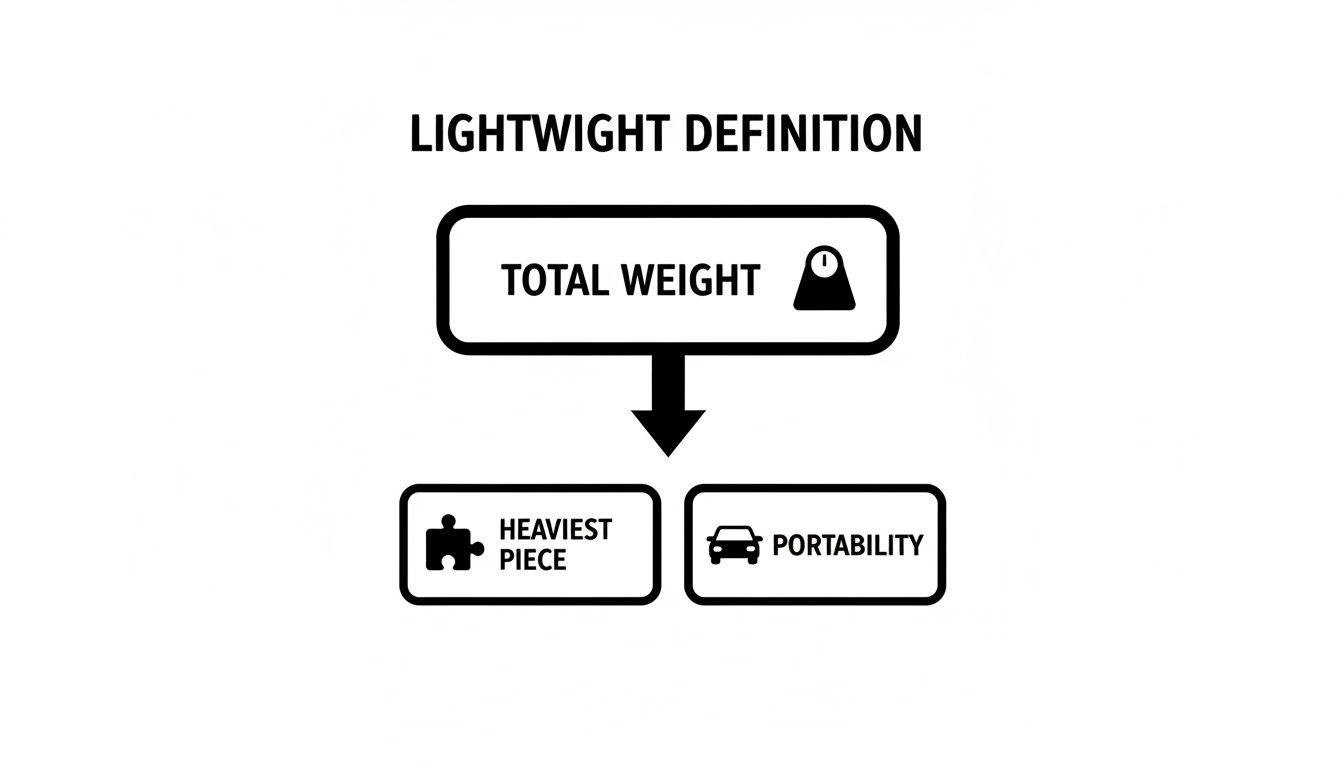
The key lesson is to avoid focusing on a single number. Instead, consider the entire process of lifting, storing, and preparing the chair for use.
Turning Radius: The Key to Indoor Agility
The turning radius is a critical specification for indoor maneuverability. It measures the smallest circle the chair can pivot within, and for navigating homes and offices, a smaller number is always better.
A chair with a 25-inch turning radius can easily navigate tight hallways, small kitchens, and bathrooms. In contrast, a model with a 33-inch radius might require multiple-point turns to pass through a doorway. This single metric can have a major impact on your independence within your own home.
Battery and Range: Understanding Your Travel Capacity
The battery is the power source of your wheelchair, determining how far you can travel on a single charge. This distance, or range, is typically listed in miles. While crucial for an active lifestyle, the advertised range requires some context.
Manufacturers measure range under ideal test conditions: a flat, smooth surface, a lighter user, and a consistent, moderate speed. To estimate a more realistic range, consider your daily environment. If you plan to navigate varied terrain or use your chair for extended periods, a model with a range of at least 10-15 miles is advisable. For users who primarily stay at home, a shorter range may be sufficient.
The listed battery range is a valuable baseline, but remember that terrain, user weight, and speed will affect real-world performance. It’s wise to choose a chair with slightly more range than you anticipate needing.
Weight Capacity: Safety and Performance First
Every power wheelchair is designed with a maximum weight capacity, a crucial safety specification that should never be exceeded. Exceeding this limit places excessive strain on the frame, motor, and braking system, which can lead to component failure and unsafe operation.
Always select a chair with a weight capacity that comfortably accommodates your weight. This not only ensures safety but also allows the chair to perform as intended, providing the stability and durability necessary for peace of mind.
Seat Dimensions: Your Foundation for All-Day Comfort
Proper seat sizing is analogous to wearing correctly-fitted shoes. The right seat width and depth are fundamental for maintaining proper posture, ensuring comfort, and preventing the development of pressure sores.
- Seat Width: The seat should be snug but not restrictive. A general guideline is to allow for about one inch of space between your hips and the chair's armrests on either side.
- Seat Depth: The cushion should support the full length of your thighs without pressing against the back of your knees. You should be able to fit two or three fingers between the front edge of the seat and the back of your knee.
Investing the time to measure for the correct seat dimensions will significantly improve your comfort, especially if you spend several hours a day in your chair.
The mobility market is evolving to meet the demand for more advanced, user-centric chairs. The global electric wheelchair market is projected to reach $41.56 billion in 2025 and an estimated $69.45 billion by 2035. In the U.S. alone, sales are expected to grow from $2.54 billion in 2025 to $6.28 billion by 2035. This growth is driven by consumer demand for better mobility solutions, with North America accounting for 43% of global revenue. You can explore these market dynamics in this in-depth analysis on PrecedenceResearch.com.
Controller Type: Your Command Center
The controller, typically a joystick, is your primary interface with the chair. It governs speed, direction, and overall navigation. While most lightweight models use a standard joystick, it's important to consider its placement and responsiveness.
Nearly all joysticks can be mounted on either the right or left armrest to suit your preference. While highly specialized chairs may offer alternative control systems (like head arrays or sip-and-puff devices), the simple, intuitive joystick provides excellent control and is easy for most users to master.
To help you organize this information as you research different models, we've created a reference checklist. Use this table to compare the key specifications of each chair you are considering. This will make it easier to see how they stack up and which one best meets your personal requirements.
Lightweight Power Wheelchair Feature Checklist
| Feature | What to Look For | Why It Matters for You |
|---|---|---|
| Total Weight | A number under 60 lbs is a good target. Note the weight with and without batteries. | The lighter it is, the easier it will be for you or a caregiver to lift into a car or carry up a step. |
| Heaviest Piece Weight | For chairs that disassemble, look for a piece under 35-40 lbs. | This is the real-world lifting weight. Make sure it's a number you can manage comfortably and safely. |
| Turning Radius | Anything under 25 inches is excellent for indoor agility. | A smaller radius means you can easily navigate tight hallways, kitchens, and bathrooms without getting stuck. |
| Battery Range | 10-15 miles for active users; 6-9 miles for mostly home use. | Match the range to your lifestyle. More is better, but don't pay for extra range you'll never use. |
| Weight Capacity | Choose a capacity at least 20-30 lbs more than your body weight. | This is a crucial safety feature that also impacts the chair's performance and durability. Never compromise here. |
| Seat Dimensions | Width and depth that match your body measurements (e.g., 18" W x 16" D). | The right fit is the key to all-day comfort, good posture, and preventing pressure sores. |
| Controller Type | An intuitive joystick that can be mounted on your preferred side (left or right). | You'll be using this all day. It needs to feel natural and be easy for you to control precisely. |
Using this checklist can transform an overwhelming process into a structured comparison, empowering you to focus on the features that will genuinely enhance your mobility and independence.
Traveling with Your Lightweight Power Wheelchair
A key benefit of a lightweight power wheelchair is the freedom it provides for travel, making vacations, road trips, and flights more accessible. While traveling with mobility equipment may seem intimidating at first, a little preparation can make the process smooth and stress-free. This section offers practical guidance for traveling by car, plane, or cruise ship, allowing you to focus on the journey itself.
Navigating Air Travel with Your Chair
Flying with a power wheelchair, particularly a model designed for travel, is more common and straightforward than many realize. Airlines are legally required to accommodate passengers with mobility devices. Following a few key steps will ensure a seamless experience from check-in to arrival.
First, notify the airline when you book your ticket, or at least 48 hours before your flight, that you will be traveling with a battery-powered mobility device. This allows them to make the necessary arrangements with the ground crew.
Plan to arrive at the airport earlier than usual to allow ample time for check-in and to address any questions without feeling rushed. You are permitted to use your own wheelchair all the way to the boarding gate.
At the time of boarding, the airline staff will gate-check your wheelchair. This means they will take it directly at the aircraft door and stow it in the cargo hold. Upon arrival, it will be returned to you at the aircraft door, minimizing the time you need to spend in an airport-provided wheelchair.
Understanding FAA Battery Regulations
The battery is the most regulated component of your wheelchair for air travel. The Federal Aviation Administration (FAA) has specific rules for lithium-ion batteries, which are used in nearly all of the best lightweight power wheelchair models.
- Non-Removable Batteries: If the battery is integrated into the chair, it must be securely attached, and the power must be disconnected before it is stowed.
- Removable Batteries: If your battery is designed to be removed, you must take it out and carry it with you into the cabin. To ensure safety, place it in a protective pouch or cover the terminals with tape to prevent short circuits.
It is helpful to know your battery’s watt-hour (Wh) rating. Most are well within the FAA’s limit for medical devices, but having this information available (e.g., as a screenshot on your phone) can expedite the check-in process.
Packing for Car Trips and Cruises
For road trips, portability is key. A foldable electric wheelchair offers a significant advantage, as it can often fit into a standard car trunk. To learn more about how this feature simplifies travel, you can read our article on the benefits of a foldable electric wheelchair. Before your trip, it's a good idea to practice folding and lifting the chair to become familiar with the process.
To protect your chair during transport, consider using a travel bag or cover. This simple accessory can prevent scratches and protect the joystick from being damaged by other luggage.
Cruises are typically very accommodating for wheelchair users. When booking, inform the cruise line that you will be bringing a power wheelchair. They can assist you in selecting an accessible stateroom with wider doorways and a roll-in shower. Modern cruise ships are designed with ramps and elevators, making it easy to access all decks and amenities.
Making Your Investment: Payment and Funding Options
A high-quality power wheelchair is a significant investment in your independence and quality of life. Although the initial cost can seem high, several payment and funding options are available to make it more affordable. Understanding these pathways is the first step toward acquiring the right chair without undue financial strain.
The demand for advanced mobility solutions is on the rise. The global wheelchair market was valued at $8.9 billion in 2025, with a strong emphasis on lightweight power models. This reflects a growing need driven by an aging population and increased awareness of neuromuscular conditions. You can read more about these global wheelchair market trends to understand the industry's direction.
Using Tax-Advantaged Health Accounts
One effective way to pay for a power wheelchair is by using pre-tax funds from a Health Savings Account (HSA) or Flexible Spending Account (FSA). Power wheelchairs are considered qualified medical expenses, making them eligible for purchase with these accounts.
By using untaxed funds, you effectively receive a discount equivalent to your income tax rate. This can result in significant savings on an essential health-related purchase.
Exploring Financing and Monthly Payments
If paying the full amount upfront is not feasible, financing offers a practical alternative. Services like Affirm allow you to divide the total cost into predictable, manageable monthly payments. This approach enables you to obtain the chair you need immediately while spreading the expense over time.
Financing transforms a large, one-time purchase into a manageable monthly budget item. This makes it easier to invest in a high-quality chair that meets all your needs without draining your savings.
Questions to Ask Your Insurance Provider
Navigating insurance coverage for durable medical equipment (DME) like a power wheelchair can be complex. While we cannot provide specific insurance advice, we can equip you with the right questions to ask your provider to get clear answers.
Before contacting your insurance company, have the specific wheelchair model information and your doctor's prescription ready. Then, ask your representative the following questions:
- Is this specific power wheelchair model covered under my plan as Durable Medical Equipment (DME)?
- What is my deductible, and how much of it have I met for the year?
- After my deductible, what are my coinsurance or copayment responsibilities for DME?
- Do I need pre-authorization, and what documentation is required? (This often includes a letter of medical necessity from your doctor).
- Are there specific, in-network suppliers I must purchase from to receive coverage?
Asking these direct questions will help clarify your out-of-pocket costs and the steps needed to utilize your benefits, demystifying the insurance process.
Keeping Your Chair in Top Shape: Accessories and Maintenance
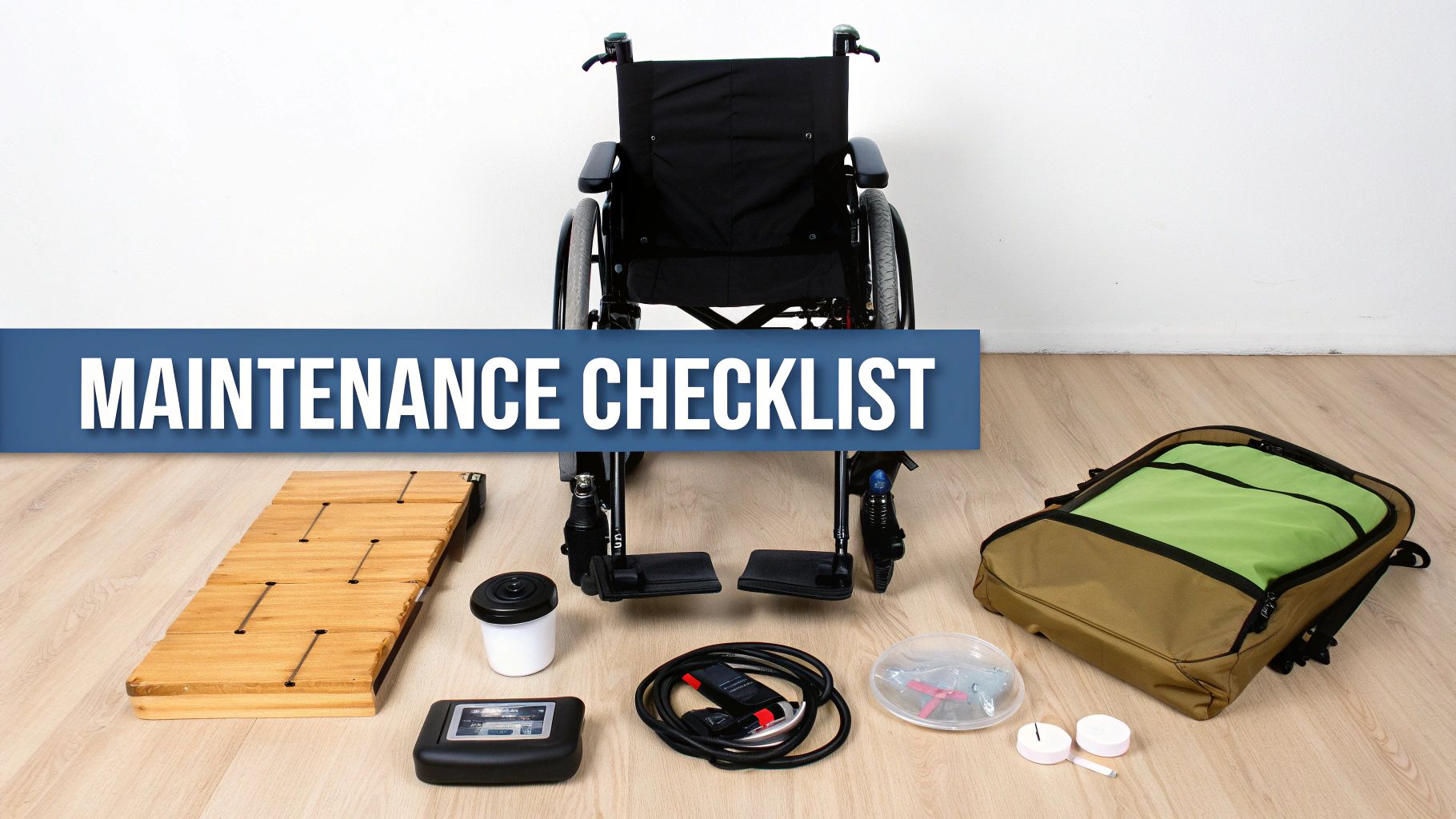
Your power wheelchair is an integral part of your daily life. Like any important piece of equipment, it performs best with regular care. The right accessories can customize it to your specific needs, while simple maintenance habits will help protect your investment and ensure its longevity.
Personalizing your chair with a few smart additions can transform a great mobility device into one that feels like a natural extension of yourself. These small upgrades can solve everyday challenges and make your routine smoother and more enjoyable.
Upgrading Your Chair for Everyday Life
Accessories are designed to make your chair more functional and comfortable. A few well-chosen additions can address needs ranging from storage to seating support, helping you maximize the utility of your power chair.
Here are a few popular accessories that provide significant benefits:
- Pressure-Relief Cushions: For those who spend extended periods in their chair, an upgraded memory foam or gel cushion is essential. It helps distribute weight evenly, which is critical for preventing discomfort and protecting skin integrity.
- Storage Bags and Baskets: Under-seat bags, armrest pouches, and baskets provide convenient, hands-free storage for personal items, groceries, or medical supplies.
- Cup Holders: This simple accessory adds a great deal of convenience, keeping a beverage secure and within easy reach.
- Travel Covers: A durable cover protects your chair from scuffs, scratches, and dust during transport. Investing in a quality option like a Comfygo electric wheelchair travel bag is a wise choice to keep your chair in excellent condition.
- Vehicle Lifts: For individuals who are unable to lift their chair into a vehicle, a lift provides an automated solution. These systems handle the heavy lifting, making travel significantly easier for both users and caregivers.
Simple Maintenance for a Long-Lasting Chair
You don’t need to be a technician to keep your power wheelchair in excellent condition. A few minutes of routine care each month can prevent common issues and significantly extend the life of your chair.
Regular maintenance isn’t just about performance—it’s about safety. A well-maintained chair is a reliable chair, giving you the confidence to go about your day without worrying about breakdowns.
Follow this simple checklist to keep your chair running smoothly:
- Battery Care is Everything: Proper charging habits are the #1 factor in battery longevity. Always charge the batteries fully after use and avoid letting them drain completely. This practice helps maintain their capacity and ensures reliable power.
- Give Your Tires a Quick Look: Inspect your tires weekly for wear. If they are pneumatic (air-filled), check the pressure. Clean, properly maintained tires provide a smoother, safer ride.
- Keep It Clean: Regularly wipe down the frame, seat, and joystick with a damp cloth and mild soap. This not only keeps your chair looking good but also prevents dirt and debris from accumulating in moving parts.
- Check the Connections: Once a month, perform a quick visual inspection. Ensure that all nuts and bolts are tight and that electrical connections are secure. A loose connection can impact performance.
Your Questions Answered
When researching lightweight power wheelchairs, several common questions often arise. Whether this is your first mobility device or you are looking to upgrade, clear information is key to making a confident choice. Here are answers to some of the most frequently asked questions.
Can I Take My Power Wheelchair on a Bus or Train?
Yes, public transportation systems, including buses and trains, are required by the Americans with Disabilities Act (ADA) to be accessible to mobility devices. To ensure a smooth experience, it is helpful to be prepared.
Before traveling, know your chair's dimensions and turning radius. It is also a good idea to check your local transit authority's website for any specific guidelines. This preparation will help you board and secure your chair efficiently.
What Is the Lifespan of a Lightweight Power Wheelchair?
With proper care and routine maintenance, a quality lightweight power wheelchair can be expected to last for five years or more. The components that typically require replacement first are the batteries and tires, similar to a car.
The longevity of your chair depends on several factors:
- Frequency and Type of Use: Daily use on varied or rough terrain will result in more wear than occasional indoor use.
- Regular Upkeep: Simple maintenance, like checking connections and keeping the chair clean, can prevent larger issues from developing.
- Battery Care: Following recommended charging practices is the single most effective way to maximize the lifespan of your batteries.
A small investment of time in maintenance can significantly extend the life of your chair.
Are Lighter Chairs Less Durable Than Heavier Models?
This is a common misconception. Modern lightweight chairs are engineered with advanced materials such as aircraft-grade aluminum and carbon fiber. These materials possess an exceptional strength-to-weight ratio, providing the durability needed for daily use without the bulk of traditional steel frames.
Modern lightweight power wheelchairs are built for both portability and real-world resilience. They go through tough testing to make sure they can handle the demands of daily life, proving you don’t have to trade strength for convenience.
Manufacturers have perfected designs that deliver robust frames that are strong enough for daily activities yet light enough for easy transport. This allows users to enjoy the benefits of both durability and portability.
At DME Superstore, we understand that finding the right mobility solution is the first step toward a more independent life. Our team is dedicated to providing the information and support you need to choose the perfect lightweight power wheelchair for your lifestyle. Explore our curated collection today and take the next step toward greater freedom.

