



When you begin researching the best heavy duty mobility scooters, you are exploring a category of mobility aids engineered for superior durability, safety, and performance. Unlike standard models, these scooters are built from the ground up to provide a robust and reliable solution for individuals who need greater support or want to navigate more challenging environments.
What Makes a Mobility Scooter Heavy Duty?
Understanding the distinction between a standard and a heavy-duty mobility scooter is key to making an informed choice. Think of the difference between a family sedan and a rugged pickup truck. Heavy-duty models are not simply larger versions of standard scooters; they are fundamentally re-engineered for greater strength, stability, and power to meet more demanding needs.
This distinction is crucial for riders who require higher weight capacities or wish to travel over varied terrains like grass, gravel paths, and uneven sidewalks. A heavy-duty scooter is designed to provide confidence and stability, ensuring a safe and comfortable ride no matter the destination.
Built on a Foundation of Strength
The core of any heavy-duty scooter is its frame. While standard models often use lighter materials for portability, heavy-duty scooters are constructed with reinforced steel frames. This provides the structural integrity necessary to safely support higher weight capacities, which typically range from 350 to over 500 pounds.
A critical specification to understand is the payload capacity. This figure represents the maximum safe carrying limit of the scooter, including the rider and any personal items. This robust construction does more than just support more weight; it prevents the frame from flexing or fatiguing under stress, ensuring a secure and stable ride for years to come.
Enhanced Power and Performance
Moving a heavier load effectively, especially over varied terrain, requires a more powerful motor and an advanced transaxle. Heavy-duty scooters are equipped with these upgraded components, which translate into several practical benefits for the user:
- Greater Torque: This is the rotational force that allows the scooter to climb hills and inclines without losing speed or straining the motor.
- Higher Top Speeds: Many heavy-duty models can safely reach speeds of 8-10 mph, making them practical for longer outdoor journeys.
- Smoother Acceleration: Power is delivered gradually and without jerking, ensuring a controlled and comfortable start every time.
A scooter's power isn’t just about speed; it's about having the reliable strength to handle real-world obstacles like ramps, sloped driveways, and grassy parks with ease. This power ensures consistent performance, regardless of the challenge.
The demand for these powerful mobility solutions is growing as more people recognize the freedom they provide. The global mobility scooter market was valued at approximately $2.21 billion in 2024, with the heavy-duty segment being a significant driver of this growth. With projections suggesting the market could reach $2.5 billion by 2025, it's clear that users are increasingly investing in the reliability and independence that these advanced models offer.
How to Match Scooter Specs to Your Daily Life
Selecting the right scooter is not about choosing the model with the most features. It's about finding the one that is perfectly suited to you and your lifestyle. The process is similar to buying shoes; the best hiking boots in the world are unsuitable if you only need comfortable slippers for home. The same logic applies when choosing a heavy-duty mobility scooter.
This process begins with an honest assessment of your personal needs and the environments where you will be riding. Before examining product specifications, it's essential to understand your daily routines and translate them into key requirements. This self-assessment is the most important step in ensuring you select a scooter that feels like a natural extension of your mobility.
Your Body and Your Scooter
The first and most critical relationship is between the scooter's dimensions and your own. An improper fit can be more than just uncomfortable—it can lead to fatigue and compromise safe operation.
Let’s start with three crucial specifications:
-
Weight Capacity: This is the absolute maximum weight the scooter can safely support, which includes the rider plus any items you plan to carry. A good practice is to choose a scooter with a capacity at least 20-30 pounds higher than your body weight. This buffer accounts for groceries, a heavy coat, or a shopping bag.
-
Seat Dimensions (Width and Depth): Comfort begins with the seat. To find the right size, sit down and measure the width of your hips, then add an inch or two for comfort. A seat that is too narrow will feel constricting, while one that is too wide may not provide adequate support.
-
Legroom and Deck Space: The space between the front of the seat and the steering column (the tiller) is particularly important, especially for taller individuals. Sufficient room for your knees is essential to avoid feeling cramped during your rides.
This decision tree illustrates how your main priorities—whether durability, power, or comfort—directly influence the type of scooter you should consider.
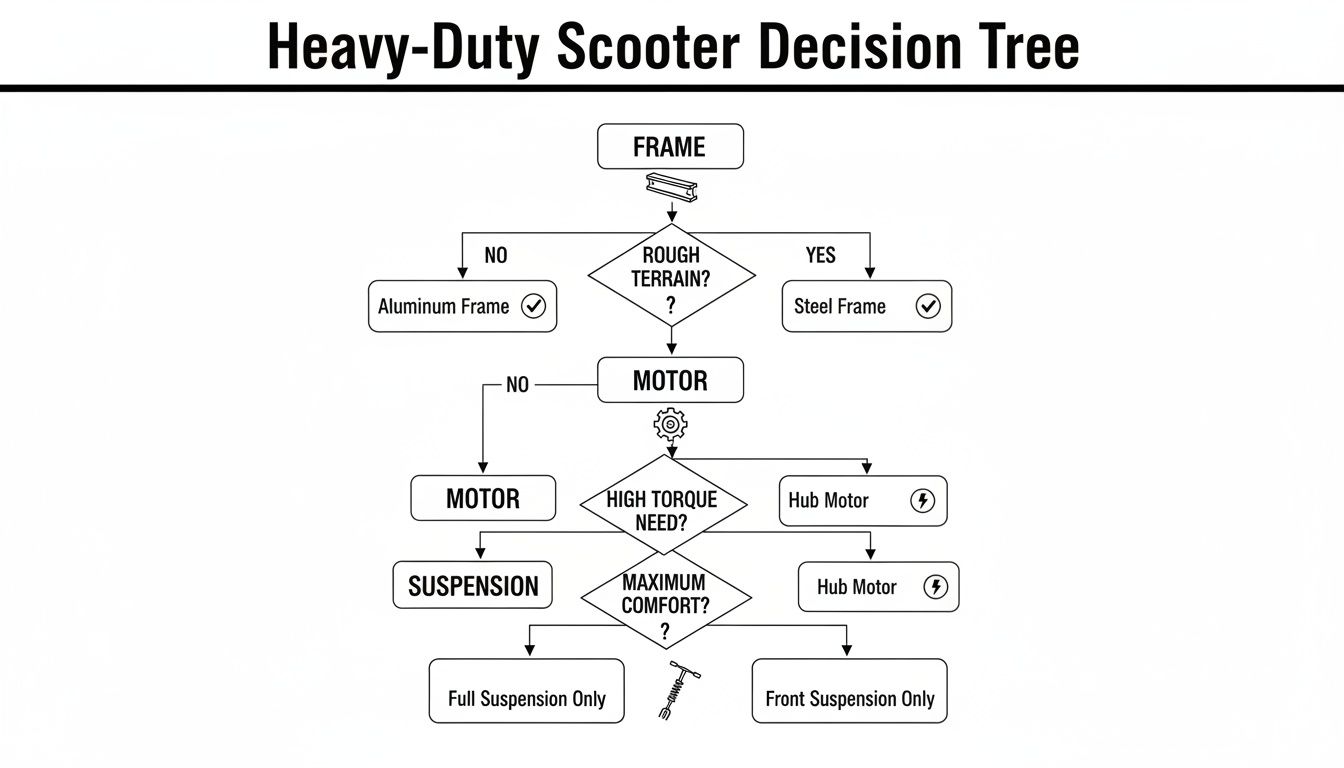
As you can see, the scooter’s frame, motor, and suspension are not arbitrary components. They are engineered to meet the specific demands of your lifestyle.
Your Personal Scooter Specification Checklist
Use this checklist to translate your daily needs into the right scooter features.
| Your Personal Need | Key Scooter Specification to Check | Why It Matters for You |
|---|---|---|
| "I weigh 380 lbs and often carry groceries." | Weight Capacity | Choose a scooter rated for at least 410 lbs to safely support you and your cargo without straining the motor or frame. |
| "I have wider hips and need to sit comfortably." | Seat Width & Depth | Measure your seated hip width and add 1-2 inches. A properly sized seat prevents pinching and provides better support. |
| "I'm over 6 feet tall." | Legroom / Deck-to-Seat Height | Look for generous deck space to avoid cramped knees and ensure you can sit with a comfortable, natural posture. |
| "I'll be using it inside my apartment and at the mall." | Turning Radius | A smaller turning radius (ideally under 55 inches) is critical for navigating tight corners and narrow store aisles with ease. |
| "I plan to ride on park paths and cracked sidewalks." | Ground Clearance & Tire Size | Higher ground clearance and larger, more rugged tires will help you handle uneven surfaces without getting stuck or feeling every bump. |
Taking a few minutes to complete this for yourself will make the selection process much clearer.
Mapping Your Daily Travels
Next, consider the environments where you will be using your scooter. Your surroundings dictate the performance features you will need. A scooter designed for smooth indoor floors might struggle on a gravel park path.
Ask yourself: Will you be primarily indoors, outdoors, or a mix of both?
For indoor use, such as at home or in a grocery store, maneuverability is paramount. The most important specification here is the turning radius, which measures the smallest circle the scooter can make. A tight turning radius is essential for navigating sharp corners and narrow aisles without difficulty.
Conversely, outdoor travel requires stability and the ability to handle rougher surfaces. If your plans include trips over cracked sidewalks, grassy areas, or unpaved trails, you need to consider a different set of features, such as ground clearance and suspension. For a broader look at different options, our guide on the best mobility scooters for seniors is a great resource.
Key Takeaway: Don't just shop for a scooter; shop for a solution. A scooter with a tight turning radius of under 55 inches is fantastic for indoor use, while a great outdoor scooter will have a wider, more stable base and features built for uneven terrain.
By taking these measurements and thinking through your daily life, you can transform a confusing product page of numbers into a clear guide. You can scan for the weight capacity, seat width, and turning radius that match your personal checklist and instantly know if a scooter is right for you. This approach helps ensure you invest in a machine that not only gets you from point A to B but does so with complete comfort, safety, and confidence.
Choosing the Right Scooter for Your Terrain
Your scooter should be equipped to handle your world, whether that means gliding through polished supermarket aisles or navigating a bumpy park path. The terrain you travel most often is a major factor in your decision, as a scooter's design directly impacts its performance and your safety.
Think of it like selecting the right tool for a job. A small hammer is perfect for hanging a picture frame but useless for demolition. Similarly, a scooter built for indoor agility will struggle on uneven ground, while a rugged outdoor model may feel cumbersome in a tight space.
Indoors vs. Outdoors: The Great Debate
The most significant design difference between indoor and outdoor scooters often comes down to the number of wheels. This single choice creates a trade-off between agility and stability, making it essential to match your scooter to your environment.
-
3-Wheel Mobility Scooters: These are the champions of maneuverability. With a single front wheel, they offer a much tighter turning radius, making them ideal for navigating narrow hallways, crowded stores, and sharp corners inside your home. The trade-off is a smaller base of support, which makes them less stable on uneven or sloped ground.
-
4-Wheel Mobility Scooters: Stability is their primary advantage. With a wheel at each corner, they create a wide, secure base that distributes your weight evenly. This design provides unmatched confidence when traveling over cracked sidewalks, grassy fields, or gravel paths. The compromise is a larger turning radius, which can make them less nimble in tight indoor spaces.
For anyone seeking the best heavy duty mobility scooters, 4-wheel models are almost always the recommended choice. Their inherent stability is essential for supporting higher weight capacities and ensuring a secure ride on varied outdoor surfaces. It is no surprise that four-wheel mobility scooters hold approximately 68% of the market share in 2024—a clear indicator of their superior stability and safety.
Why Ground Clearance and Suspension Matter
Beyond the wheel count, two other features are vital for navigating the real world: ground clearance and suspension.
Think of ground clearance as the space between the bottom of your scooter and the ground. A higher clearance—typically 3 inches or more—is essential for outdoor use. It allows you to clear small curbs, door thresholds, and uneven patches without scraping the scooter's underside or getting stuck.
If ground clearance helps you get over obstacles, the suspension system helps you absorb them. A scooter without suspension will transmit every bump and jolt directly to you, resulting in a jarring and uncomfortable ride.
A full suspension system, with shock absorbers on both the front and rear wheels, functions much like a car's suspension. It smooths out rough terrain, reduces vibrations, and provides a dramatically more comfortable and controlled journey.
The Right Tires for the Road
Finally, let's discuss tires. As the scooter's only point of contact with the ground, they play a massive role in ride quality and traction.
- Solid Tires: These are completely maintenance-free and cannot go flat. They are excellent for smooth, indoor surfaces but can feel harsh on bumpy ground.
- Pneumatic (Air-Filled) Tires: These are similar to car tires. The air inside acts as a natural cushion, creating a much smoother ride over imperfect surfaces. They offer better traction, especially in wet conditions or on loose ground, but require occasional air pressure checks.
For users who plan extensive outdoor travel, especially in areas with changing weather, pneumatic tires are almost always the better choice. If you're looking for more specific recommendations, our guide on the best mobility scooters for winter weather can provide additional insights.
By carefully considering the wheels, clearance, suspension, and tires, you can confidently choose a scooter that is perfectly equipped to handle all your daily adventures.
Understanding Battery Power and Real World Range
A scooter's travel range is its promise of freedom, but it is important to understand what the numbers on a product page truly mean. Expecting a scooter to always achieve its maximum stated range is like expecting a car to consistently get its best highway mileage, even in stop-and-go city traffic. The real-world performance of your scooter's battery depends heavily on how and where you ride.
"Range anxiety" is a common concern, but it can be managed by understanding the factors at play. Your scooter's battery constantly works against forces like friction, gravity, and resistance. The harder the motor works, the faster it consumes its stored energy.
Understanding these variables is key to setting realistic expectations and, most importantly, choosing a scooter with sufficient battery power for your daily needs.
Factors That Affect Your Real World Range
The maximum range listed by manufacturers is typically tested under ideal conditions: a lightweight rider on a perfectly flat, smooth surface with a brand-new, fully charged battery. Your daily reality will likely be different.
Several key factors will reduce that maximum number and determine how far you can actually travel on a single charge:
- Rider Weight: This is a primary factor. A heavier load requires more energy to move and maintain speed.
- Terrain: Constantly climbing hills and inclines forces the motor to work harder, draining the battery much faster than riding on flat ground.
- Surface Type: A scooter uses less power on a smooth, paved bike path. However, traveling through thick grass, loose gravel, or soft dirt requires much more effort and consumes more battery life.
- Outdoor Temperature: Batteries perform best in mild weather. Extreme cold can temporarily reduce a battery's capacity and your total range by up to 30-40%.
- Tire Pressure: For scooters with air-filled tires, maintaining proper inflation is crucial. Low pressure creates more friction and drag, which silently depletes battery range.
Just as a car's fuel efficiency decreases in city driving, your scooter's range will drop when navigating hills, carrying heavy loads, or traveling over rough ground. A practical rule of thumb is to plan for about 70-80% of the maximum stated range. This provides a much more realistic estimate for your typical travel distance.
SLA vs. Lithium-ion Batteries
The power source for most heavy-duty scooters is one of two types: Sealed Lead Acid (SLA) or Lithium-ion. Each has distinct characteristics, and the right choice for you will depend on a balance of performance, cost, and convenience.
| Battery Type | Key Advantages | Key Considerations |
|---|---|---|
| Sealed Lead Acid (SLA) | Lower upfront cost, widely available, and a long track record of reliability. | Very heavy, shorter overall lifespan (fewer charge cycles), and can be damaged if fully drained. |
| Lithium-ion | Significantly lighter, much longer lifespan, charges more efficiently, and provides consistent power until empty. | Higher upfront cost. |
For years, SLA batteries were the standard due to their affordability. However, many of the best heavy duty mobility scooters now offer Lithium-ion upgrades for good reason. Their lighter weight can make the scooter feel more agile, and their longer lifespan means they require less frequent replacement, which can lead to cost savings over time.
Regardless of which type you choose, proper care is essential. It is good practice to fully charge your scooter's battery after every use, even for short trips. This simple routine helps maintain the battery's health and ensures you always have the maximum possible range available for your next outing.
Prioritizing Your Safety and Comfort Features
A heavy-duty scooter is more than just a powerful motor and a robust frame. The best models are designed to be a true extension of your freedom, which comes down to the details—the features that ensure your safety and comfort throughout the day. These are the elements that elevate a good machine to a great one.
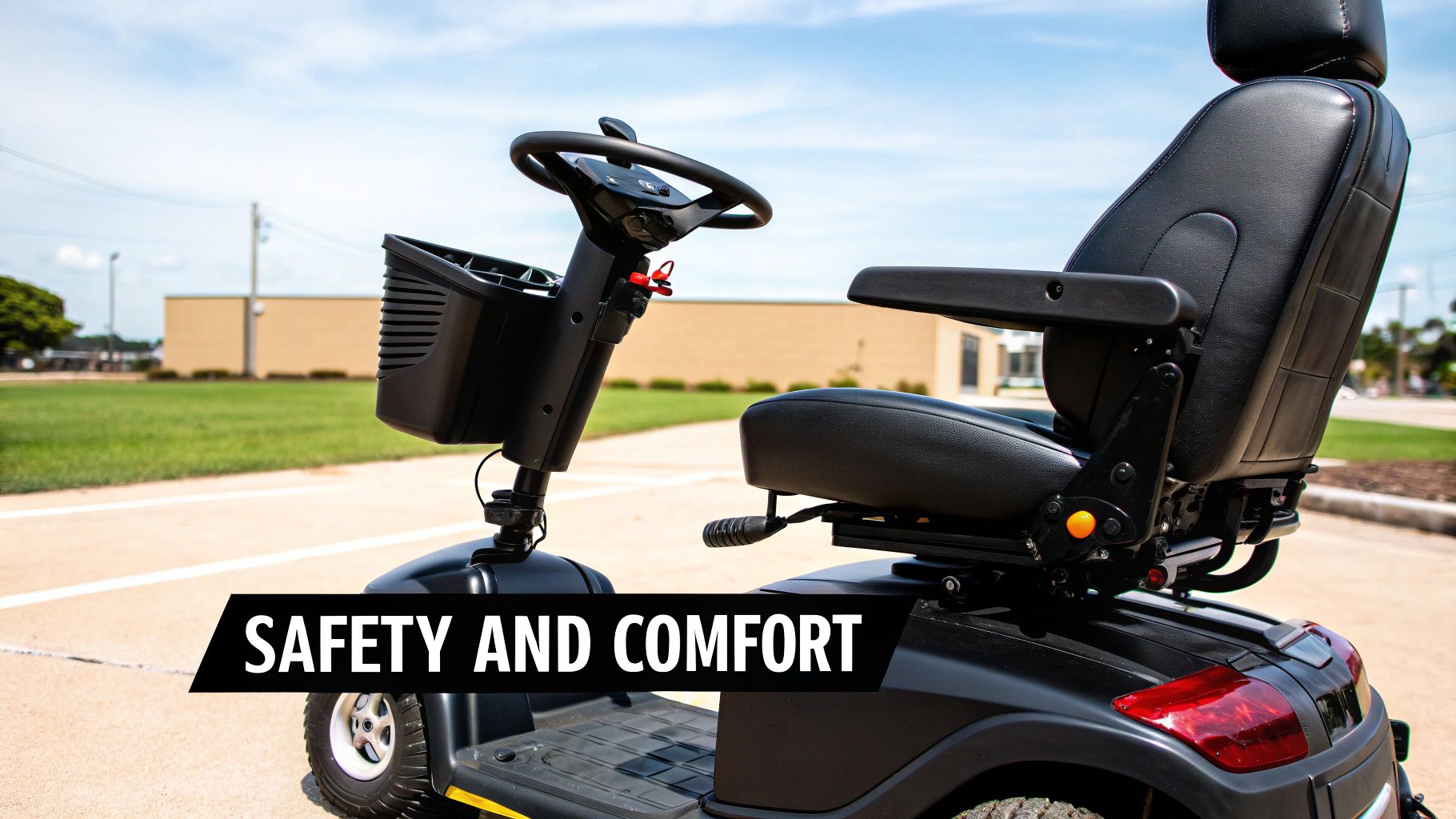
Think of the essential safety systems as your personal co-pilot, always working in the background to keep you secure. These features provide the confidence to navigate your world, whether you’re crossing a dimly lit parking lot or stopping on a steep driveway.
Core Safety Systems to Look For
A comprehensive safety package is a non-negotiable feature of a quality heavy-duty scooter. As you compare models, ensure these key components are included.
- Full Lighting Package: This should include ultra-bright LED headlights, rear tail lights, and turn signals. Good lighting is not just about seeing where you are going; it's about ensuring others see you, especially at dusk or on overcast days.
- Electromagnetic Brakes: This is the industry gold standard. The moment you release the throttle, the brakes engage automatically, bringing you to a smooth, complete stop. This prevents rolling, even on an incline.
- Anti-Tip Wheels: These small, secondary wheels at the back are a critical stability feature. They prevent the scooter from tipping backward during acceleration or while climbing a ramp.
These systems are fundamental for safe operation. Advanced heavy-duty mobility scooters equipped with these premium features often range in price from $3,000 to over $7,000, reflecting a significant investment in your safety and mobility.
Ergonomics and All-Day Comfort
While safety keeps you protected, comfort is what makes a scooter a pleasure to use every day. If a scooter is uncomfortable, you will be less inclined to use it. The best models focus on adjustability, allowing you to customize the fit to your body.
A high-quality captain's seat is central to scooter comfort. Look for seats with deep cushioning and multiple adjustment points, such as armrest width and height. A swivel function is also essential; it allows you to rotate the seat to the side, making it much safer and easier to get on and off without twisting your body.
Your scooter should fit you, not the other way around. Features like an adjustable tiller and a swivel seat aren't luxuries; they are essential for reducing strain on your arms, shoulders, and back during daily use.
This focus on ergonomics extends to other mobility aids. For example, understanding what is a lift chair and how it works highlights how assistive seating can significantly improve daily comfort and ease of movement. You should expect the same level of thoughtful design from your scooter.
An adjustable tiller, for instance, allows you to position the controls exactly where your hands naturally rest, preventing arm and shoulder fatigue on longer trips. By prioritizing these safety and comfort features, you ensure your scooter becomes a dependable partner for a more active and independent life.
How We Make Sure You Get the Perfect Scooter
Choosing a heavy-duty scooter is a significant decision—an investment in your freedom and daily life. At DME Superstore, we believe the purchasing process should feel as supportive and reliable as the scooter itself. We have structured our entire approach to transform a potentially complicated choice into a confident and rewarding journey, ensuring you feel supported long after your scooter arrives.
It begins with our product selection. We are selective about the brands we partner with, choosing only trusted, industry-leading manufacturers known for top-tier engineering and proven reliability. This means you are not sorting through countless unproven options; you are choosing from the best of the best, with every scooter backed by a reputation for quality.
Clear Information for Smart Decisions
Deciphering scooter specifications can be challenging. That's why we prioritize clarity and honesty on every product page. We present critical details—like weight capacity, turning radius, and battery range—in a simple, straightforward format that is easy to understand.
Our mission is to empower you with the knowledge needed to match a scooter to your real-world lifestyle. You’ll find detailed descriptions, high-resolution photos, and clear breakdowns of every feature, helping you make an informed decision from the comfort of your home. This transparent approach allows you to compare models with confidence, ensuring the scooter you choose is the perfect fit for your body, your environment, and your daily adventures.
Getting It to You, Hassle-Free
Once you’ve found your perfect scooter, delivery should be the easy part. That’s why we offer free nationwide shipping on all our mobility scooters, so there are no unexpected costs at checkout. We manage all the logistics, allowing you to focus on the excitement of regaining your mobility.
For those who desire a completely hands-off and effortless setup, we offer our premium White Glove Delivery service.
- A trained technician will deliver your new scooter at a pre-scheduled time that is convenient for you.
- They will bring it inside, unpack it, and handle the full assembly.
- The technician will then provide a complete tutorial on how to operate your scooter safely and effectively.
- Finally, they will clean up and remove all packaging materials, leaving you with a fully charged, ready-to-ride scooter.
This service is an excellent option for anyone who prefers not to manage a large, heavy box or who wants the peace of mind that comes with a professional setup and demonstration.
Payment Options That Work for You
We firmly believe that budget should not be a barrier to independence. To make this important investment more manageable, we offer several flexible payment solutions designed to fit your financial situation.
Your Investment, Your Way: We support your purchase with multiple payment pathways, ensuring you can get the mobility aid you need without financial strain. From direct FSA/HSA spending to manageable monthly payments, we put you in control.
All products on our site can be purchased using your Flexible Spending Account (FSA) or Health Savings Account (HSA) card. This is an effective way to use your pre-tax healthcare dollars to invest directly in your mobility. Simply use your card at checkout as you would any other credit card.
If you prefer to spread the cost over time, we’ve partnered with Affirm to offer simple, transparent financing plans. At checkout, you can apply for a loan and receive a decision in real-time. You’ll see the exact monthly payments and total cost upfront—with no hidden fees—so you can choose a plan that works for you. This straightforward process makes it easier than ever to invest in one of the best heavy duty mobility scooters on the market.
At DME Superstore, our support extends far beyond the sale. From our expert-curated product line and transparent specifications to our flexible delivery and payment options, every step is designed to ensure you make a confident, successful, and empowering purchase.
We've designed our entire process to give you peace of mind and unwavering support. The table below breaks down the key benefits you get when you choose to shop with us.
The DME Superstore Buyer Advantage
| Benefit | How It Helps You | Where to Learn More |
|---|---|---|
| Free Nationwide Shipping | Eliminates surprise costs at checkout, making your purchase more affordable and straightforward. | Automatically applied at checkout. |
| White Glove Delivery | A trained technician delivers, assembles, and demonstrates your scooter for a truly hassle-free setup. | View our White Glove Delivery details. |
| FSA & HSA Acceptance | Use your pre-tax healthcare dollars to invest in your mobility, making it a cost-effective choice. | Simply use your card at checkout. |
| Affirm Financing | Spread the cost of your purchase over time with clear, simple, and manageable monthly payments. | Select Affirm at checkout to apply. |
| Expert Customer Service | Our knowledgeable team is here to answer questions and guide you to the perfect scooter for your needs. | Contact our support team anytime. |
| Comprehensive Warranties | Every scooter is backed by a manufacturer's warranty, and we help you navigate any claims. | See our Warranty Policy for more info. |
Ultimately, our goal is simple: to make sure you not only find the right scooter but also feel completely supported and confident in your decision from start to finish.
Got Questions? We Have Answers.
When you're investing in a heavy-duty mobility scooter, a few questions always come up. Here are some straightforward answers to the most common ones we hear, helping you make your final choice with complete confidence.
Will Medicare or Insurance Help Pay for My Scooter?
This is a very common question, and the answer is complex: it depends on your specific circumstances. Medicare refers to mobility scooters as "Power-Operated Vehicles" (POVs), and coverage is subject to strict medical necessity guidelines. To be covered, a thorough evaluation by a doctor and a formal prescription are typically required to demonstrate that you are unable to move around your home with a cane or walker.
We always recommend that our customers first consult with their doctor and insurance provider. They can provide the clearest information regarding your specific eligibility. To facilitate your purchase, we accept FSA and HSA cards and also offer simple financing options through our partner, Affirm.
What Kind of Maintenance Does My Scooter Need?
Heavy-duty scooters are built for durability, but a small amount of regular care will keep them running smoothly for years. Think of it as basic vehicle maintenance—simple, yet essential.
A few key tasks to stay on top of:
- Battery Care: The most important rule is to keep your battery charged. Plug it in after each use to ensure it is always ready for your next trip.
- Tire Pressure: If your scooter has air-filled (pneumatic) tires, check the pressure regularly. Proper inflation provides the smoothest ride and helps maximize the range from each battery charge.
- Keep It Clean: A simple wipe-down to remove dirt and moisture goes a long way in protecting the frame and electronic components.
Your owner's manual is the best resource for maintenance information. It will contain a detailed service schedule and specific tips for your particular model.
Can I Take a Heavy Duty Scooter on an Airplane?
Due to their size, weight, and powerful batteries, most heavy-duty scooters are not suitable for airline travel.
Airlines have strict regulations regarding the dimensions and battery types allowed on board, and these larger, more robust models almost always exceed those limits. If you are a frequent flyer, we highly recommend considering a separate, airline-approved folding travel scooter. These are specifically designed to meet FAA requirements and simplify the process of navigating through an airport.
At DME Superstore, our goal is to help you find the perfect mobility solution that brings back your independence and improves your quality of life. We've hand-picked the best heavy-duty scooters in the industry, and we're here to help you find the one that's right for you.

