



Imagine regaining your independence with a mobility solution that travels and stores as easily as a suitcase. A foldable electric wheelchair offers exactly that—blending the robust power of a traditional electric wheelchair with the unmatched portability modern life demands.
This guide is your complete roadmap to understanding, choosing, and enjoying the freedom these innovative devices provide, helping you learn everything you need to know about this life-changing technology.
Your Guide to Effortless Mobility and Freedom

Life doesn’t stand still, and your mobility aid shouldn't hold you back. Whether you're planning a stress-free family vacation, enjoying a spontaneous trip to the park, or simply need a device that fits into a compact living space, the foldable electric wheelchair is designed for life on the go. It eliminates the logistical headaches often associated with larger, non-portable models.
This growing need for adaptable mobility solutions is reflected in the market's rapid expansion. The global electric wheelchair market, valued at USD 2.74 billion in 2025, is projected to surge to USD 6.56 billion by 2034, driven by technological advancements and aging populations. You can explore more data on electric wheelchair market trends to see just how these devices are changing lives.
What You Will Learn in This Guide
This educational guide moves beyond technical jargon to give you practical, real-world knowledge. We've packed it with clear explanations and actionable advice to help you feel confident in your decision-making process.
Here’s a preview of what we’ll cover:
- Decoding Key Features: We’ll break down essential specs like battery range, motor power, weight capacity, and folding mechanisms so you know what really matters for your safety and convenience.
- Foldable vs. Traditional Models: You’ll learn the distinct advantages of each type to see which one truly fits your daily activities and medical needs.
- Real-World Use Cases: From the frequent traveler to the at-home user, we’ll explore scenarios to help you find your perfect match.
- Confident Purchasing and Ownership: We will cover everything from financing options like FSA/HSA to routine maintenance tips that keep your chair running smoothly.
Our goal is to arm you with all the information you need to select the perfect model for your lifestyle, ensuring you have the support of a trusted partner every step of the way.
Decoding the Features of Your Future Wheelchair
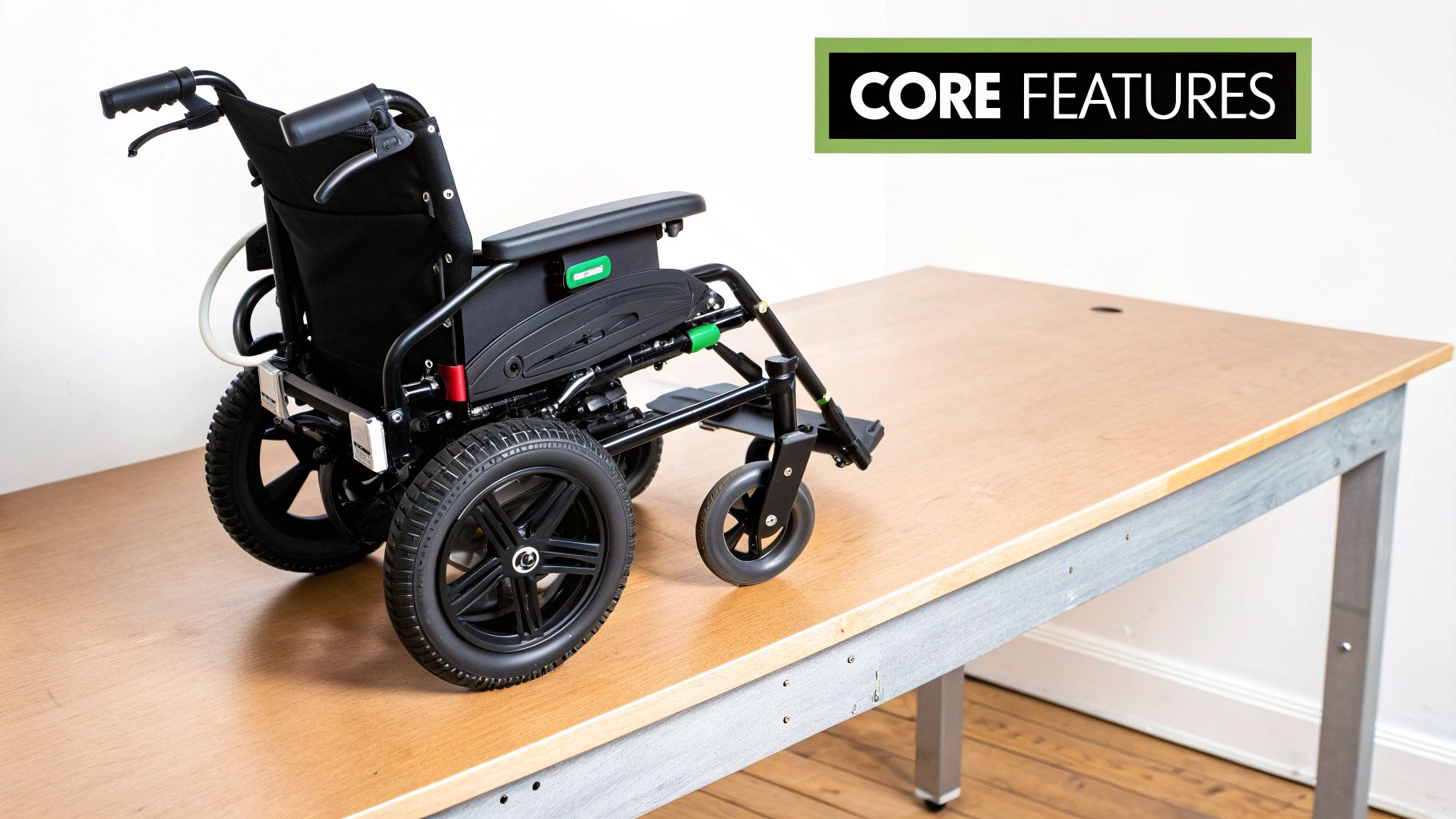
Choosing a foldable electric wheelchair can feel like learning a new language. You're faced with spec sheets full of terms like "turning radius" and "motor wattage" that don't mean much on their own.
Think of this section as a technical breakdown that connects features directly to real-world benefits. We'll explain the most important components so you can confidently read any product description and understand exactly how that chair will support your daily life.
To make comparing models easier, we've organized the most critical features into a quick-reference table. This will help you focus on what truly matters for your lifestyle.
Key Features at a Glance: What to Look For
| Feature | What to Consider | Why It Matters for You |
|---|---|---|
| Chair Weight | Total weight (with and without batteries). Is it light enough for you or a loved one to lift? | This is the #1 factor for portability. A 5-10 lb difference is huge when lifting it into a car trunk. |
| Folding Mechanism | One-step? Remote control? Does it require bending or strength? | A simple fold means you'll use it more often. Complicated mechanisms can be frustrating and limit spontaneity. |
| Battery Range | How many miles can it go on one charge? Is it airline-approved? | Your range determines your freedom. 10-15 miles is great for daily use; more is better for all-day adventurers. |
| Weight Capacity | What is the maximum user weight the chair can safely support? | This is a non-negotiable safety spec. Always choose a chair rated well above your own weight for durability. |
| Seat & Comfort | Seat width, depth, and cushioning. Are the armrests adjustable? | You'll be spending a lot of time here. A comfortable, well-fitting seat prevents fatigue and pressure sores. |
| Motor Power | Look for motor wattage and drive type (e.g., rear-wheel drive). | More power isn't just about speed—it's about torque to climb ramps and navigate grassy parks without struggle. |
| Turning Radius | How tight of a circle can the chair make? | A small turning radius is essential for navigating tight indoor spaces like hallways, kitchens, and elevators. |
Now that you have the big picture, let's dive into the details of what makes these chairs tick. Understanding these elements is the key to matching a wheelchair to your life, not the other way around.
The Engine Room: Motor and Drive System
The motor is the heart of your wheelchair. It’s what provides the power to get moving, climb inclines, and travel over different surfaces. A stronger motor isn't just about going faster; it’s about having more torque, which is the force needed to conquer a steep ramp or a grassy park without straining the chair's mechanics.
Just as important is the drive system, which determines which wheels receive power. You'll find that rear-wheel drive models are incredibly popular, holding 47.60% of the market share and showing the fastest growth. This is because they offer excellent stability and traction for outdoor use, making them a fantastic choice for active individuals. If you're interested in the data, you can dive deeper into the latest motorized wheelchair market report to see how these trends are shaping mobility.
Key Takeaway: A powerful motor and a stable drive system are not just about speed. They provide the confidence to tackle inclines and uneven terrain, turning potential obstacles into manageable paths.
Your Fuel Tank: Battery Life and Range
The battery is your wheelchair's energy source, and its range dictates exactly how far you can travel on a single charge. This is one of a user's most critical considerations, as it determines the freedom to enjoy a full day of activities without anxiety about power loss.
Manufacturers usually measure range in miles, but keep in mind that this number can be affected by user weight, terrain, and speed. Today's foldable electric wheelchairs almost universally use lithium-ion batteries. These lightweight power sources hold a dominant 61.60% market share because they offer a high energy density and a long lifespan.
- Standard Range: Many models offer a range of 10-15 miles, which is more than enough for daily errands, visiting friends, or navigating a large mall or airport.
- Extended Range: If you’re a frequent traveler or someone who spends most of the day on the move, look for models with extended-range options that can push beyond 15 miles.
- Airline Approval: This is crucial for travelers. Most lithium-ion batteries under a certain capacity (usually 300 Wh) are approved for flight, but you should always confirm with both the wheelchair manufacturer and your airline before you book.
The Foundation of Portability: Frame and Materials
The material used for the frame directly impacts two of the most important aspects of a foldable power chair: its overall weight and its durability. The ideal design finds a balance between being light enough to lift and a frame that's strong enough for the demands of daily use.
Two materials dominate the market for their unique properties:
- Aircraft-Grade Aluminum: This is the most common choice, offering an excellent blend of strength and low weight. It is also resistant to corrosion and provides a sturdy, reliable frame that is relatively easy for a caregiver to lift into a vehicle.
- Carbon Fiber: This is the premium material option. Carbon fiber is exceptionally strong yet significantly lighter than aluminum. Chairs made from it are the easiest to transport, but they typically come with a higher price tag.
The total weight of the chair—often listed as "product weight" or "weight without batteries"—is a number you should always double-check. A difference of just 5-10 pounds can feel massive when lifting the chair into the back of a car.
The User Experience: Comfort and Controls
Beyond the mechanics, the features you interact with every single day are what truly define your experience with the chair. The seat, backrest, and joystick are your main points of contact, and their quality and adjustability are paramount for long-term use.
Look for components that can be adjusted to create a personalized fit, such as armrests that can be raised or widened and a joystick that can be mounted on either the right or left side. A responsive joystick makes all the difference, providing smooth acceleration and precise maneuvering, which is essential for navigating crowded stores or busy sidewalks.
Another key specification to watch is the turning radius. A smaller radius means the chair can pivot in tighter spots, making it an invaluable feature for indoor use in narrow hallways or small apartments.
Foldable vs. Traditional Power Wheelchairs
Choosing a power wheelchair isn't just about selecting a device; it’s about finding the right partner for your daily life. The decision usually comes down to two main categories: the modern foldable electric wheelchair or the conventional, heavy-duty power wheelchair. While both serve the primary function of mobility, they are engineered for very different lifestyles and needs.
Think of it this way: one is like a versatile crossover SUV, perfect for city driving and weekend getaways. The other is a heavy-duty truck, built for demanding, all-day work and rugged terrain. One excels in adaptability and convenience, the other in raw power and specialized medical support. Neither is inherently better, but one will be a much better fit for your personal journey.
The Case for the Foldable Electric Wheelchair
The primary advantage of a foldable model is its incredible portability. The entire design is centered around the idea that your mobility aid should adapt to your life, not the other way around.
Consider these real-world scenarios where a foldable chair excels:
- The Active Traveler: If you’re frequently in a car, on a plane, or on a cruise ship, a lightweight, airline-approved foldable chair is essential. It can be tucked into a trunk or checked at the gate, simplifying travel logistics.
- The Urban Dweller: Living in an apartment or a home with limited storage space? A foldable chair that collapses down to the size of a large suitcase is a game-changer. You can store it in a closet instead of it taking up valuable living space.
- The Independent User or Caregiver: When you or a caregiver needs to lift the chair into a vehicle, every pound matters. Many foldable models weigh under 60 pounds, making them manageable enough to transport without needing a special vehicle lift.
The real magic of a foldable electric wheelchair is its ability to remove barriers. It makes spontaneous trips, family visits, and navigating tight indoor spaces so much less complicated.
This focus on portability isn't just a niche feature; it's driving major trends in the mobility market. With an aging global population, the demand for convenient, easy-to-store mobility aids is skyrocketing. In the U.S. alone, this market segment is projected to hit USD 1.41 billion by 2026.
When a Traditional Power Wheelchair Makes Sense
While foldable chairs offer unmatched convenience, traditional power wheelchairs remain the superior choice in areas where durability and specialized medical support are required. These chairs are built for intensive, all-day use and can be customized to a much higher degree to meet specific health needs.
A traditional model is often the correct medical choice if your needs include:
- Highly Specialized Seating: If you require advanced postural support—like power tilt, recline, or elevating leg rests—you'll find these features almost exclusively on traditional, non-folding frames. For users who spend most of their day in their chair, these systems are critical for health, circulation, and preventing pressure sores.
- Maximum Durability for Intense Use: For anyone who relies on their chair for nearly every moment of the day, the robust, rigid frame of a traditional model offers superior long-term durability. It’s built to withstand constant use, especially over varied and challenging terrain.
- Higher Weight Capacities: While many foldable chairs are designed for bariatric users, traditional heavy-duty models often provide the absolute highest weight capacities, sometimes exceeding 500 pounds, along with wider and deeper seating options.
In the end, the decision between foldable and traditional comes down to a simple trade-off: portability versus power and medical specialization. For a more detailed breakdown, you can also read our detailed comparison of foldable vs. non-foldable electric wheelchairs. The right choice is the one that best empowers you to live the life you want, without compromise.
Finding the Right Fit for Your Lifestyle
Technical specifications on a product page only tell you half the story. The true test of a foldable electric wheelchair is how it integrates into your daily life, transforming potential obstacles into non-issues. This is where features meet reality.
To find your perfect match, it helps to look past the numbers and imagine how a chair will perform in the situations you encounter most. We'll walk through a few common user profiles to help you connect features to your own lifestyle and goals.
This decision tree can help you visualize whether a foldable or a more traditional power wheelchair is the right starting point based on your main priorities.
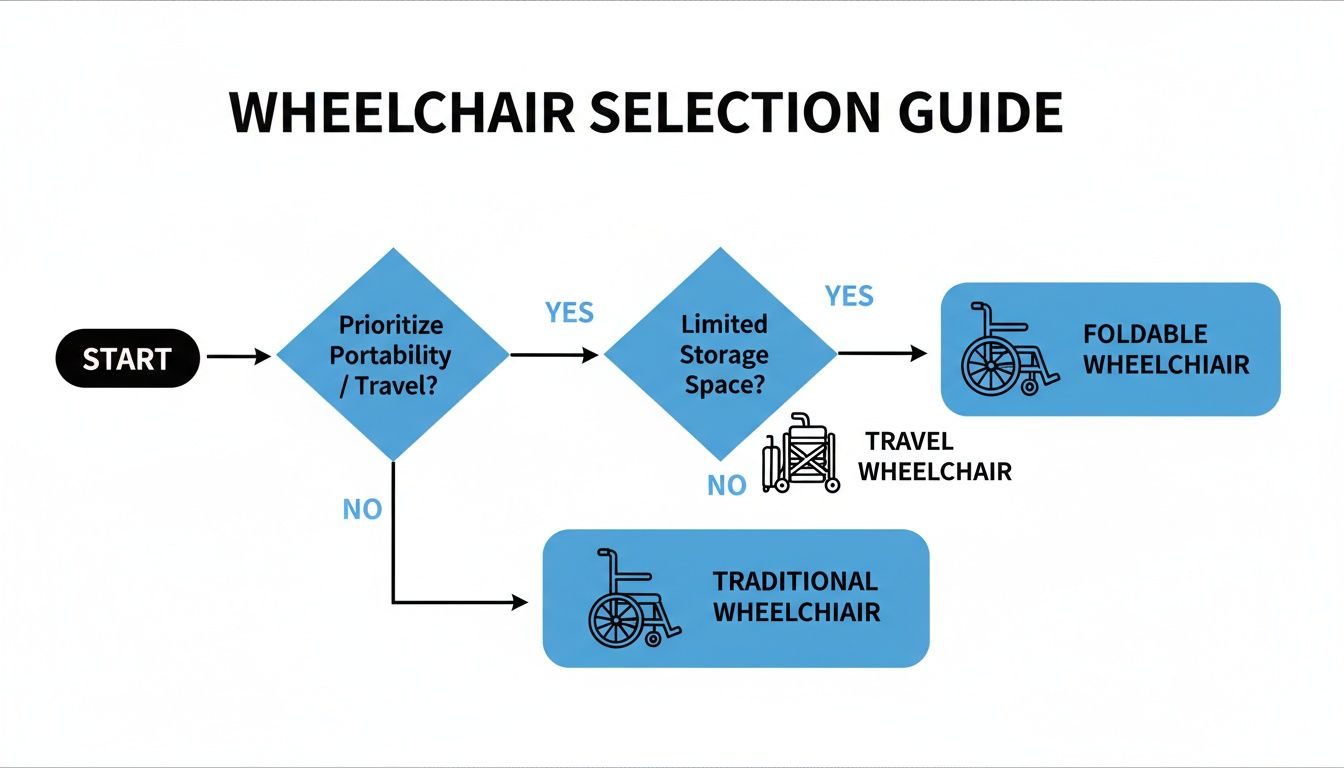
As you can see, if your life involves regular travel, tight storage at home, or needing others to lift your chair into a car, a foldable model is almost always the best way to go.
Meet the Globetrotter
Let's imagine a user we'll call Sarah, "The Globetrotter." Sarah flies several times a year to visit family or explore new cities. For her, the most important factor is a wheelchair that makes travel day as stress-free as possible.
The features that matter most to Sarah are:
- Airline-Approved Battery: This is a deal-breaker. She needs a lithium-ion battery that meets FAA regulations (usually under 300 Wh) so she can get through security and gate-check her chair without any issues.
- Lightweight Frame: Navigating a busy airport is chaotic enough. A chair that weighs under 60 pounds is much easier for airline staff to handle and streamlines the entire process from curb to gate.
- Quick-Fold Mechanism: Time is always a factor when trying to catch a connecting flight or when a taxi is waiting. A chair that collapses in one simple motion is a massive advantage over one that needs to be disassembled.
Sarah’s ideal chair is all about portability and compliance. A model with a moderate range of 10-12 miles is sufficient, as she can recharge it at her hotel each night.
Considering the Weekend Adventurer
Now, let's think about David, "The Weekend Adventurer." David loves hitting the road with his family for spontaneous trips to the park, farmers' markets, and family barbecues.
His son usually handles lifting the chair, so their priorities look a little different:
- Compact Folded Size: The wheelchair must fit into the trunk of their sedan and still leave room for luggage, a cooler, and other weekend essentials.
- Manageable Lifting Weight: Even though his son is strong, a chair under 55 pounds (or one that splits into lighter pieces) makes a huge difference when loading and unloading it multiple times a day.
- Durable Wheels and Motor: David’s adventures aren't always on perfectly paved surfaces. He needs a chair with enough power and sturdy wheels to handle grass at the park or a gravel path without getting bogged down.
David's perfect chair strikes a balance between being easy to transport and rugged enough for various weekend activities. A great example of a model that nails this convenience is the ComfyGo Majestic IQ-7000, which features a one-touch automatic folding system.
Supporting Bariatric Users with Active Lifestyles
Finally, picture Michael. He needs heavy-duty support but isn't willing to compromise on his independence or active community life. He's looking for a bariatric foldable electric wheelchair that’s both strong and portable.
For Michael, a chair isn't just about getting around—it's about staying connected and being able to fully participate in life. That requires a special blend of strength and convenience that specialized models deliver.
His non-negotiable features are:
- High Weight Capacity: Safety and stability are paramount. He needs a chair rated for at least 20% more than his body weight, typically in the 350-400 pound range, to ensure structural integrity.
- Wider, Reinforced Seat: For all-day comfort, a well-cushioned and adjustable seat that's 20 inches or wider is essential to prevent fatigue and provide proper support.
- Powerful Motors: A more robust motor system is a must. It provides the torque needed to confidently handle ramps and outdoor terrain without putting a strain on the chair.
When you connect these real-world needs to different people, the spec sheet starts to make a lot more sense. You might see yourself as a Globetrotter, an Adventurer, or someone needing that heavy-duty support, making it much easier to pinpoint the foldable electric wheelchair that will truly empower your lifestyle. And remember, finding the right fit can also include other tools for wellness, like a wheelchair accessible hyperbaric chamber, that support an active and healthy life.
Making a Confident Purchase and Ownership Plan
You've completed your research, compared models, and are ready to move forward. So, what happens between purchase and your first trip? This final part of the process—covering payment, delivery, and basic care—is where a great retail partner really shines. Knowing what to expect will help you feel confident and prepared long after your new chair arrives.
Flexible and Accessible Payment Solutions
An investment in your mobility is a significant decision, and you shouldn't have to shoulder the entire cost all at once. Thankfully, there are smart ways to make it more manageable.
- Financing Options: We partner with services like Affirm that let you break the total cost into smaller, predictable monthly payments. It’s a straightforward way to budget for your new chair without having to wait.
- FSA/HSA Eligibility: Many people don't realize that all of our mobility products are eligible for payment using Flexible Spending Accounts (FSA) and Health Savings Accounts (HSA). This is a huge advantage, as it allows you to use pre-tax dollars you’ve already set aside, providing a significant discount.
It’s also a good idea to familiarize yourself with medical necessity guidelines, as these are often the key to determining insurance coverage for durable medical equipment like foldable electric wheelchairs.
From Our Warehouse to Your Doorstep
Once you've made your decision, the delivery process should be the easiest part. We have streamlined our shipping to be as simple and stress-free as possible, ensuring your new chair arrives safely and ready to use.
We offer nationwide free shipping on every order, which means the price you see is the price you pay, with no surprise fees at checkout. Your wheelchair will be delivered right to your home, anywhere in the contiguous United States.
Need a little extra help getting set up? Our White Glove Delivery service is the perfect solution. A trained technician will not only deliver the chair but will also unbox it, handle all setup, and provide a complete tutorial on its use. This service offers total peace of mind, especially for those new to power mobility.
A seamless delivery experience is the first step toward confident ownership. Knowing your chair will arrive safely and be set up correctly removes a major source of stress from the purchasing process.
Simple Ownership and Maintenance Habits
Your foldable electric wheelchair is built for durability, but like any vehicle, routine care will ensure it performs optimally for years to come. These simple habits are easy to adopt and make a world of difference in the longevity and reliability of your chair.
Battery Care is King
The single most important maintenance task is proper battery care. To maximize its lifespan, try to charge it fully after any significant use and avoid letting it drain to zero. A full charge typically takes around five hours. If you're looking for more great advice, our guide on how to choose a wheelchair has a ton of valuable tips.
Quick and Easy Routine Checks
Beyond the battery, a few quick checks will keep everything in top shape. Regularly wipe down the frame and seat with a damp cloth to keep it clean. It's also smart to check the tire pressure every so often and make sure all the nuts and bolts feel snug. These small steps will help you spot minor issues before they can become bigger problems, ensuring your chair is always ready for your next adventure.
Here’s a simple checklist to help you stay on track.
Foldable Electric Wheelchair Maintenance Checklist
| Frequency | Maintenance Task | Simple How-To |
|---|---|---|
| Weekly | Wipe Down Frame & Seat | Use a damp, soft cloth to clean the frame, seat, and armrests. Avoid harsh chemicals. |
| Weekly | Check Tire Pressure | If your chair has pneumatic (air-filled) tires, check the pressure with a gauge and inflate as needed. |
| Monthly | Inspect for Loose Parts | Gently check that all nuts, bolts, and screws are snug. Don't overtighten, just ensure nothing is loose. |
| Monthly | Check Joystick & Controls | Make sure the joystick moves smoothly and all buttons respond correctly. Clean with a dry cloth if needed. |
| Annually | Professional Tune-Up | Consider having a qualified technician inspect the battery health, motor, and electrical components. |
Keeping up with these small tasks doesn't take much time, but it pays off by ensuring your wheelchair remains a reliable and safe partner in your daily life. A well-maintained chair is a dependable one.
Answering Your Most Common Questions
As you get closer to choosing the right chair, a few practical questions often arise. Here, we address the most common inquiries to provide clarity and help you move forward with total confidence.
Will Insurance or Medicare Cover My Wheelchair?
This is a critical question, and the answer is: sometimes, but it's never a guarantee.
Medicare Part B may cover a portion of the cost, but only if a doctor prescribes the device as a medical necessity for use inside your home. This requires extensive documentation proving that other mobility aids, like a walker or manual wheelchair, are insufficient for managing daily living activities.
Private insurance plans vary widely. The most effective approach is to contact your provider directly and ask about their specific policies for durable medical equipment (DME).
Pro Tip: Your doctor's prescription and a formal letter of medical necessity are your most powerful tools. This documentation is essential for any insurance claim you submit.
Is This Wheelchair Approved for Airline Travel?
For the most part, yes. Most modern foldable electric wheelchairs are designed for travel and use lithium-ion batteries that fall within FAA regulations (typically under 300 Wh).
However, it is vital to never assume. First, double-check the battery specifications with the wheelchair manufacturer. Then, you must contact your airline at least 48 hours before your flight to inform them you are traveling with a battery-powered mobility device. Each airline has its own procedure, and providing advance notice is the key to a smooth, stress-free airport experience.
How Long Will the Wheelchair and Its Battery Last?
A high-quality foldable electric wheelchair is a long-term investment. With proper care, it will serve as a reliable partner for many years.
- The Chair Itself: The frame and motors are built for durability. With routine checks and normal use, you can expect the chair to last for 5-10 years, sometimes even longer.
- The Battery: Think of the battery like the one in your smartphone—its lifespan is measured in charge cycles. A well-maintained lithium-ion battery will typically provide peak performance for 2 to 4 years before you may notice a reduction in its maximum range.
The best practice for maximizing battery life is to avoid letting it drain completely. Try to recharge it after any significant use. This simple habit will extend its longevity and keep you on the move for years to come.
Ready to find a mobility solution that actually fits your life? At DME Superstore, we've hand-picked a collection of the best foldable electric wheelchairs out there, focusing on reliability, convenience, and travel-readiness. Explore our collection of foldable electric wheelchairs and find the perfect partner for your next adventure.

