



When you're exploring the world of lightweight mobility scooters, the choices typically come down to two main designs: ultra-fast folding scooters and easy-to-lift disassembling scooters. Understanding the engineering behind each type and how it aligns with your daily needs is the key to selecting the right one for you. It's a choice between rapid setup and the lightest possible lifting weight.
Unlocking Freedom with a Lightweight Mobility Scooter
Choosing a lightweight mobility scooter is a significant step toward enhanced independence and a more active lifestyle. But what does "lightweight" truly mean in a practical sense? It’s not merely the total weight listed on a specification sheet. It’s about practical portability—the ease with which you can lift, store, and prepare the scooter for use in real-world scenarios. The right model can fundamentally improve your daily routine, transforming errands, travel, and social visits into seamless, stress-free experiences.
This demand for portable mobility solutions is a growing global trend. The mobility scooter market is projected to reach USD 3.43 billion by 2034, with much of this growth driven by a desire for active aging. According to the United Nations, one in six people worldwide will be 60 or older by 2030, highlighting the increasing importance of reliable mobility aids. You can learn more about these market dynamics in this detailed mobility scooter market report.
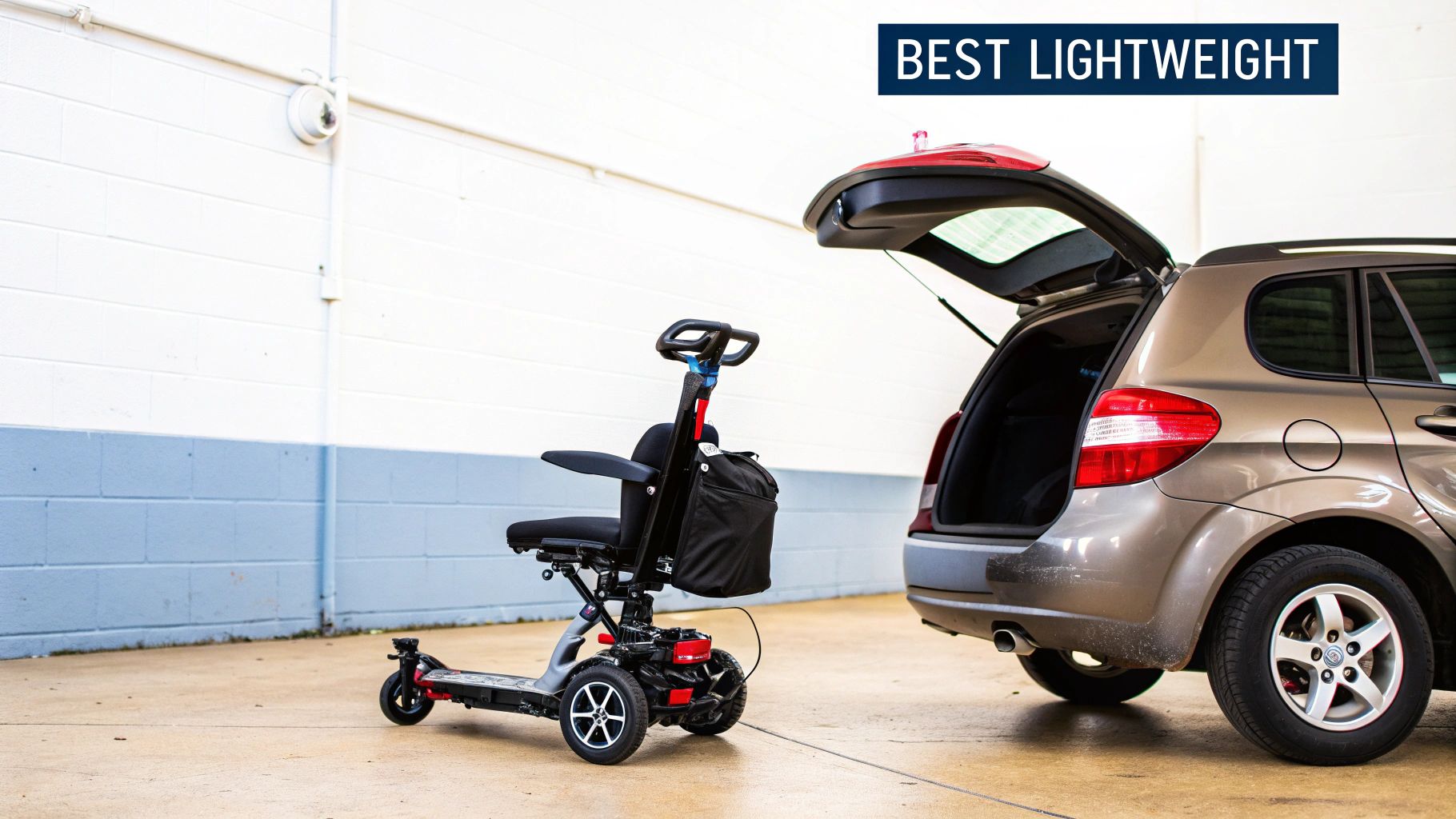
Core Benefits of a Portable Design
The advantages of a portable scooter extend far beyond simple transportation; they contribute to an overall improvement in quality of life. Here are a few key educational benefits:
- Effortless Travel: Understanding how to navigate airports, cruise ships, and hotels becomes simpler when your scooter is designed for easy transport.
- Simplified Storage: Compact designs teach valuable lessons in space efficiency, fitting neatly into car trunks, closets, or small apartments.
- Greater Independence: A portable scooter empowers users, making spontaneous trips to the park, grocery store, or family events a lesson in freedom, not logistics.
To begin your educational journey, it's helpful to understand the two primary categories of lightweight scooters. Each offers a distinct approach to portability.
Lightweight Mobility Scooter At-a-Glance Comparison
This table provides a quick, educational snapshot of how folding and disassembling scooters compare. Use it as a foundational learning tool to determine which style best aligns with your physical needs and daily activities.
| Feature | Folding Scooters | Disassembling Scooters |
|---|---|---|
| Transport Weight | Lifted as one complete unit (heavier) | Broken down into 4-5 much lighter pieces |
| Setup Speed | Very fast (often under 30 seconds) | Slower (requires assembly/disassembly) |
| Ideal User | Values speed and convenience above all else | Needs the lightest possible parts to lift |
| Common Use Case | Frequent car trips, running quick errands | Users with limited strength or caregivers |
Think of it this way: folding scooters are engineered for grab-and-go convenience, while disassembling scooters are designed to make lifting manageable for a wider range of physical abilities. We'll now delve deeper into the specific technologies and features of each type.
Decoding the Specs: What Really Matters in a Lightweight Scooter
When you start researching a lightweight mobility scooter, the specification sheet can seem complex. However, once you learn what to look for, those numbers tell a crucial story about a scooter's real-world performance. Understanding these details is the key to choosing a scooter that doesn't just function, but genuinely enhances your freedom.
It begins with the critical relationship between the scooter's own weight and its weight capacity—the maximum load it can safely carry. Manufacturers are making significant advancements with materials like carbon fiber and lightweight aluminum. These innovations allow them to engineer incredibly strong frames capable of supporting 300 pounds or more, while keeping the scooter's total weight manageable for lifting. This provides a solid, secure ride without cumbersome bulk.
Motor Power: It’s Not Just About Speed
The motor is the heart of your scooter, and its power output dictates where you can confidently travel. For indoor use on flat, smooth surfaces like a mall or grocery store, a standard motor is perfectly adequate.
However, if your daily life includes outdoor paths, grassy parks, or even simple inclines like a driveway, motor strength becomes a critical factor. A more powerful motor provides the necessary torque to ascend hills without significant loss of speed. This means you can explore more varied environments without concern for your scooter's performance.
Key Insight: Don't focus solely on top speed. The true measure of a motor's capability is its ability to handle inclines and power through uneven ground without losing momentum. That is the specification that translates to real-world freedom.
Battery Technology: The Engine of Your Freedom
A scooter's battery technology determines three vital aspects of its performance: travel range, charging time, and overall weight. You'll typically encounter two main types: the traditional Sealed Lead-Acid (SLA) and the more modern Lithium-Ion.
-
Sealed Lead-Acid (SLA): This is the conventional, more budget-friendly option. SLA batteries are reliable, but they are significantly heavier and require longer charging times—often 8-12 hours for a full charge. They are a practical choice if minimizing the initial purchase price is a primary goal and the scooter will not be lifted frequently.
-
Lithium-Ion: This is the current standard in premium lightweight scooters. Lithium-ion batteries are much lighter—shaving 10-15 pounds off a scooter's total weight—and they charge much faster. They also generally have a longer lifespan and are often the only type permitted for airline travel.
The choice represents a clear trade-off. An SLA-powered scooter may have a lower initial cost, but a lithium-ion model offers superior portability and convenience, representing a long-term investment in ease of use for frequent travelers or anyone who needs to lift their scooter regularly.
Navigating Your World: Turning Radius and Tire Design
Maneuverability is a crucial, yet often overlooked, aspect of scooter design. It's about how well your scooter handles the tight corners of your environment. This is determined by two key features: the turning radius and the tire design.
A scooter's turning radius is the minimum space required for it to make a circular turn. A tight turning radius, commonly found on three-wheel models, is a significant advantage for indoor navigation. It allows you to effortlessly maneuver through narrow hallways, crowded store aisles, and sharp corners in your home. In contrast, a four-wheel scooter offers greater stability but will have a wider turning radius.
Tires also play a significant role. Most lightweight scooters use solid, puncture-proof tires, which are excellent for their low-maintenance reliability on smooth surfaces. However, if you anticipate crossing grass, gravel, or uneven pavement, look for models with wider, more aggressive treads that provide better traction and a smoother ride.
Finally, consider the importance of the seat. For short errands, a basic padded seat may suffice. But for longer excursions, such as a day at a museum or zoo, a well-cushioned, supportive seat with adjustable armrests is essential for comfort. Features like a swiveling seat can also greatly enhance safety and ease of use, particularly for individuals with limited flexibility. By understanding these practical design elements, you can find a scooter that truly integrates with your lifestyle.
Folding vs. Disassembling Scooters: Which Is Right for You?
When choosing a lightweight mobility scooter, one of the most important decisions is understanding how it achieves its portability. Do you need a scooter that folds into a single piece, or one that breaks down into several lighter components?
There isn't one "best" answer; the optimal choice depends on your specific needs, physical abilities, and lifestyle. The goal is to find the perfect match for your daily usage patterns.
A folding scooter is designed for speed and simplicity. It’s ideal for the user who values a quick transition from storage to readiness. These models typically collapse into one compact unit in 30 seconds or less, making them an excellent choice for frequent car trips and errands. The process is a true grab-and-go experience.
The trade-off for this convenience is that the scooter must be lifted as a single unit. Even though advanced models like the Glion SNAPnGO Mobility Scooter are engineered to be as light as possible, lifting the total weight can still be challenging for some individuals.
This is where disassembling scooters, often called travel scooters, offer a distinct advantage. They approach portability from a different engineering perspective, prioritizing manageable lifting weight over setup speed.
The Advantage of Lighter Pieces
A disassembling scooter is designed to break down into four or five main components: the seat, the battery, the front tiller, and the rear motor section. For anyone with limited upper body strength or who cannot lift heavy objects, this modular design is transformative.
Instead of managing a single 50-pound unit, you are lifting four or five pieces that each weigh between 15 and 25 pounds. This difference often makes independent travel possible. The trade-off is the time required—it will take a few minutes to assemble and disassemble the scooter with each use.
This decision tree can help you learn which path makes the most sense based on your priorities.
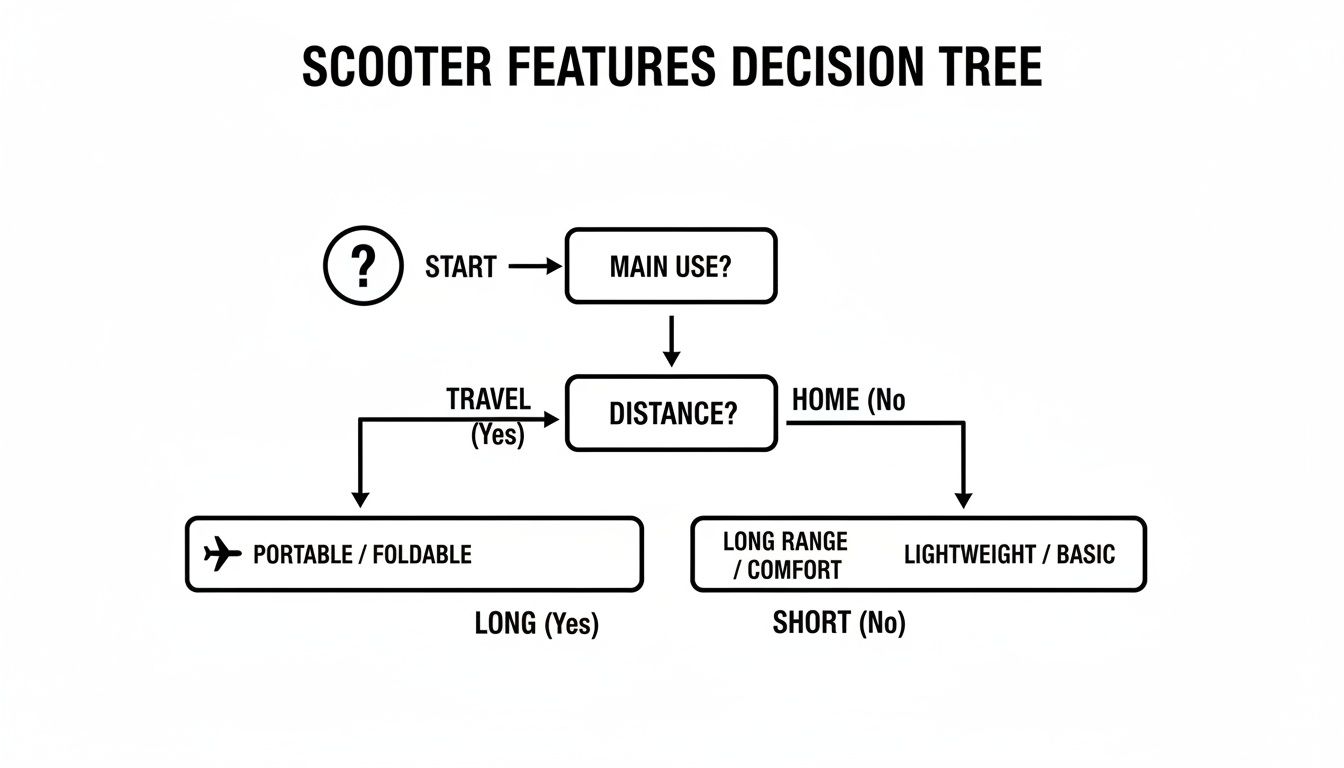
As you can see, the right choice is dictated by how and where you will use the scooter. Your daily routine is the best guide for selecting the right features.
Real-World Scenarios and Contextual Choices
Let's move beyond specifications and examine how these two designs function in everyday life. Context is essential when choosing a mobility scooter.
Scenario 1: The Frequent Driver
- Who they are: Someone who is frequently in and out of their car for errands at the post office, grocery store, and pharmacy.
- The better choice: A folding scooter. The ability to fold it in seconds and place it in the trunk saves significant time and effort during a busy day. The heavier single lift is a small trade-off for this level of efficiency.
Scenario 2: The Independent Senior in an Apartment
- Who they are: An older adult living alone who wants to join family on outings but has difficulty lifting heavy objects.
- The better choice: A disassembling scooter. Breaking the scooter into lighter, manageable pieces is the primary concern here. This empowers the user to lift each part into a car independently, enabling travel without needing assistance to load and unload their scooter.
Demand for these portable solutions is growing rapidly. The market for foldable and lightweight mobility scooters was estimated at around USD 500 million in 2025 and is projected to continue growing, driven by technological advancements and user demand. These scooters, often weighing between 35-50 pounds, can fold in seconds—a critical feature for the 1 in 4 adults over 65 who report mobility challenges.
The Core Decision Point: Choose a folding scooter if your priority is speed and convenience. Opt for a disassembling scooter if lifting the lightest possible piece is what matters most to you.
Ultimately, the best lightweight mobility scooter is one that removes barriers from your life, not one that introduces new ones. By honestly assessing your physical capabilities and how you intend to use your scooter, you can confidently select the design that will best support an active and independent lifestyle.
Matching a Scooter to Your Daily Life
Selecting the right lightweight mobility scooter is less about finding the best specifications on a chart and more about identifying a machine that integrates seamlessly into your daily routine. The ideal scooter for a frequent traveler differs greatly from what an apartment dweller needs for local errands.
Let's move beyond the technical data and consider real-world applications. By exploring common lifestyles, you can learn which features will genuinely make your day-to-day life easier and more independent.
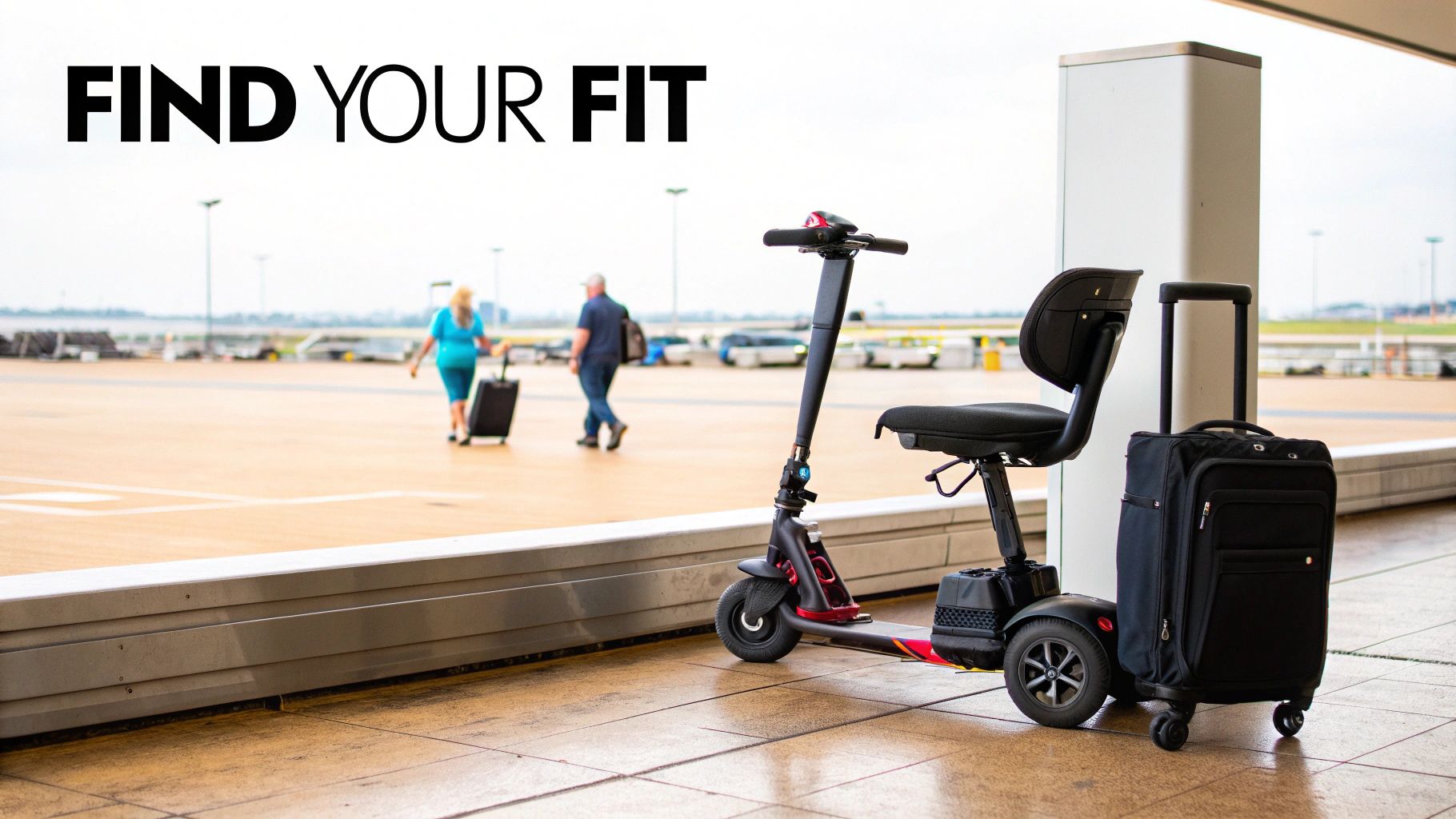
Think of your lifestyle as the ultimate blueprint. It will guide you to a scooter that you will not only use but enjoy using every day.
The Avid Traveler
For those whose lives involve airport terminals, cruise ships, and hotels, a scooter must be a reliable travel companion. It needs to be durable enough for transport yet nimble enough for navigating new places.
While portability is key, so is endurance. A long-range battery is essential for full days of sightseeing without the stress of finding a power outlet. Long travel days can also be physically demanding; learning about improving circulation naturally can help maintain comfort during extended periods of sitting.
Traveler's Feature Checklist:
- Airline-Approved Battery: This is mandatory. Look for FAA-compliant lithium-ion batteries that are powerful yet lightweight.
- Durable Frame: The frame must be engineered to withstand frequent handling and transport.
- Quick-Fold or Easy-Disassembly Design: Efficient design saves time and reduces stress in busy travel hubs.
- Long-Range Capability: Aim for a battery that delivers 10+ miles per charge to ensure peace of mind for all-day adventures.
The Urban Dweller
Life in an apartment or condo presents unique mobility challenges, such as tight hallways, small elevators, and crowded sidewalks. For the urban resident, maneuverability is paramount.
A scooter with a sharp turning radius can make the difference between easily navigating a store and getting stuck. As storage space is often limited, the scooter's dimensions are also a major consideration.
A great city scooter should feel like an extension of your own stride. It needs to be just as agile navigating your building's hallways as it is on a paved sidewalk, giving you total confidence to move through your neighborhood.
Urban Dweller's Feature Checklist:
- Tight Turning Radius: Three-wheel models often excel in this area, offering superior agility in confined spaces.
- Compact Footprint: Measure your storage space to ensure the scooter fits without creating an obstruction.
- Lightweight for Lifting: If your building has thresholds or steps, a model with lighter components is much more practical.
- Puncture-Proof Tires: Solid tires are a low-maintenance choice, ideal for smooth indoor floors and city pavement.
The Weekend Adventurer
If your ideal day includes visiting a park, attending a local festival, or watching a family sports game, you need a scooter that can handle more than just flat surfaces. The weekend adventurer requires a blend of easy transportability and outdoor capability.
This means a more powerful motor is needed to manage varied terrain like grass, packed dirt, and gentle slopes. While it must still be easy to load into a car, its performance at your destination is what truly matters.
Weekend Adventurer's Feature Checklist:
- Slightly Higher Ground Clearance: This feature is crucial for preventing the scooter from getting caught on uneven ground.
- Robust Motor: A motor with sufficient torque to confidently handle hills and mixed terrain is essential.
- Good Battery Range: You'll need enough power to enjoy a full day out without interruption.
- Comfortable Seating: A well-padded seat, ideally with armrests, significantly improves comfort during longer outings.
The Caregiver
For caregivers, the priorities often shift to simplicity, safety, and the ease of transporting the scooter for a loved one. The best scooter in this context is one with intuitive controls that does not require significant physical strength to get in and out of a car. Our guide on the best mobility scooters for seniors provides more educational insights into features that enhance safety and ease of use.
A disassembling scooter is often the preferred choice here, as lifting several lighter parts is more manageable and reduces the risk of strain.
Caregiver's Feature Checklist:
- Simple Controls: An uncluttered dashboard reduces user confusion and builds confidence.
- Lightest Possible Pieces: For a disassembling model, look for one where the heaviest piece is under 30 pounds.
- Swivel Seat: This feature is a game-changer, making it much safer and easier for the user to get on and off the scooter.
- Stability: A secure wheelbase, whether a three- or four-wheel design, provides essential security and peace of mind.
Keeping Your Scooter Safe On the Go and At Home
Acquiring a lightweight mobility scooter is about reclaiming your freedom. To ensure every outing is safe and successful, a bit of practical knowledge is invaluable. Understanding travel regulations and performing simple maintenance will keep your scooter reliable for years.
Whether you're planning a vacation by air or sea, preparation is key. Most airlines and cruise lines accommodate mobility scooters but have specific rules, particularly regarding batteries.
Traveling by Air and Sea
Before booking a flight, it is essential to contact the airline to confirm their policy on mobility devices. Most require a non-spillable battery, and if you have a lithium-ion battery, you will likely need to carry it on board with you. You can learn more in our detailed educational guide on airline-approved mobility scooters.
Cruise lines are generally more accommodating, but they still appreciate advance notice. Informing them at the time of booking ensures a smoother boarding process.
The demand for travel-friendly scooters is growing. The personal mobility device market is projected to reach USD 21,600 million by 2033, driven by innovations that make scooters lighter and easier to transport.
Simple Upkeep for Long-Term Reliability
You don't need to be a mechanic to keep your scooter in excellent condition. A brief monthly inspection can prevent common issues and extend its lifespan, ensuring it's always ready for your next adventure.
Your Monthly Maintenance Checklist:
- Wipe It Down: Use a damp cloth to clean any dust or debris from the scooter's body and undercarriage.
- Check the Tires: Inspect the treads for any signs of wear. Even with solid tires, good traction is essential for safety.
- Inspect Battery Contacts: Ensure the terminals where the battery connects are clean and free of corrosion. A quick wipe with a dry cloth is usually sufficient.
- Test Brakes & Controls: In a safe, open area, confirm that your brakes engage smoothly and the tiller responds correctly.
Everyday Safety and Awareness
Operating your scooter safely is as important as maintaining it. Your scooter provides incredible freedom, but your best safety feature is always your awareness of your surroundings.
When ascending or descending a ramp or incline, always approach it straight on, never at an angle, to maintain stability. In crowded areas like a mall or festival, reduce your speed to match the pedestrian flow.
Crucial Safety Tip: Ensure you are visible. Use your scooter's lights in dim conditions and consider adding a small flag or reflective tape for extra visibility in busy environments.
While your scooter is a fantastic tool for safe mobility, it's also wise to consider overall home safety. Learning how to prevent falls in elderly is a powerful step toward maintaining total independence. By combining smart scooter operation with regular upkeep, you’ll have a reliable partner in freedom for years to come.
How We Make Your Purchase Simple and Secure
Choosing the right lightweight mobility scooter is an important decision that should feel empowering. At DME Superstore, we view ourselves as your educational partner in this process, ensuring you find the perfect scooter with complete confidence.
We do much of the preliminary research for you. Our team has carefully vetted and curated our entire selection, focusing only on industry-leading brands known for their reliability and innovative design, such as Pride Mobility and Golden Technologies. This means you can focus on a collection of high-quality scooters that have already met our stringent standards.
Financial Flexibility and Peace of Mind
We believe that a budget should not be a barrier to independence. That’s why we have established several straightforward options to help you manage the cost of your scooter.
- FSA/HSA Eligibility: Every mobility scooter we offer is eligible for purchase using your Flexible Spending Account (FSA) or Health Savings Account (HSA). This allows you to use pre-tax dollars for a significant investment in your mobility.
- Flexible Payments: We have partnered with Affirm to offer payment plans that fit your budget. You can break down the total cost into manageable monthly installments, making the purchase more accessible.
This financial flexibility is supported by our commitment to your security and satisfaction long after your purchase. We stand behind every product we sell.
When you choose DME Superstore, you're not just buying a scooter; you're gaining a support system. We handle all the logistics so you can focus on what really matters—reclaiming your mobility and enjoying your newfound freedom.
Support That Goes the Distance
Our promise of a simple and secure purchase extends to every step of the process. We have worked to eliminate the common concerns associated with buying durable medical equipment online.
You will receive nationwide free shipping on every scooter. The price you see is the price you pay, with no hidden delivery fees. Once your scooter arrives, you have a 30-day return policy, providing ample time to ensure it is the right fit for your daily needs.
Furthermore, every scooter is protected by a comprehensive manufacturer's warranty. Should any issues arise, our team is here to assist you with claims or answer questions, providing you with peace of mind for years to come.
Common Questions About Lightweight Scooters
As you near a decision, several questions commonly arise. Getting clear, educational answers is the best way to feel confident in your choice. Here are the most frequent inquiries we receive.
What Is a Realistic Travel Range?
While manufacturers provide a maximum travel range, the actual distance you can travel on a single charge depends on several factors. Most lightweight scooters are rated for between 8 and 15 miles, but this should be considered a baseline.
Factors such as rider weight, terrain, and frequent starting and stopping will reduce the effective range. Battery technology is also a key variable. Scooters with modern lithium-ion batteries typically provide more consistent power output and a longer effective range compared to older sealed lead-acid types.
How Do I Know if a Scooter Is Airline Approved?
It's important to understand that airlines approve the battery, not the scooter itself. To be permitted on a flight, the scooter's battery must comply with Federal Aviation Administration (FAA) regulations. For nearly all travel scooters, this means having a non-spillable, dry-cell battery, with lithium-ion being the industry standard.
Before traveling, always take these two steps:
- Confirm that the scooter’s battery is listed as FAA-compliant in the product specifications.
- Contact your airline directly to inform them you are traveling with a mobility device and to confirm their specific procedures.
Should I Choose a Folding or Disassembling Scooter?
This decision involves a personal trade-off between the speed of setup and your individual lifting capacity. There is no single correct answer, only the choice that best suits your physical abilities and intended use.
The Central Trade-Off: Choose a folding model if your primary need is speed—getting it into a car quickly for frequent trips. Select a disassembling model if you require the lightest possible individual pieces to lift, making it more manageable to load and unload independently.
Understanding this core difference makes it easier to see which design aligns with your needs. The goal is to find a scooter that enhances your independence without creating a new physical challenge.
At DME Superstore, we simplify the process by offering a curated selection of top-rated lightweight mobility scooters. Every product is backed by our expert support and free nationwide shipping. Explore our collection and find your perfect mobility partner today.

