



You're helping someone who can sit comfortably in a recliner but struggles with the last few seconds of standing. The seat is low, the walker is slightly off to one side, and turning toward it means twisting while the legs are already working hard. A lift chair that swivels can make that transition more organized, but only when the chair, the person, and the room are treated as one system.
The most useful question isn't, “How far does it rotate?” Ask instead, “Can the user face the destination, lock the chair, place both feet, and rise without rushing?” This guide follows that transfer from sitting to standing, then examines fit, room clearance, supervision, and buying support.
Why Swivel Lift Chairs Change Daily Transfers
A typical morning transfer starts before the motor moves. An older adult sits in a stationary recliner, reaches for the arms, leans forward, and tries to turn toward a walker or caregiver while rising. If the chair faces the wrong direction, the person may twist through the hips and trunk while shifting weight onto uncertain feet.
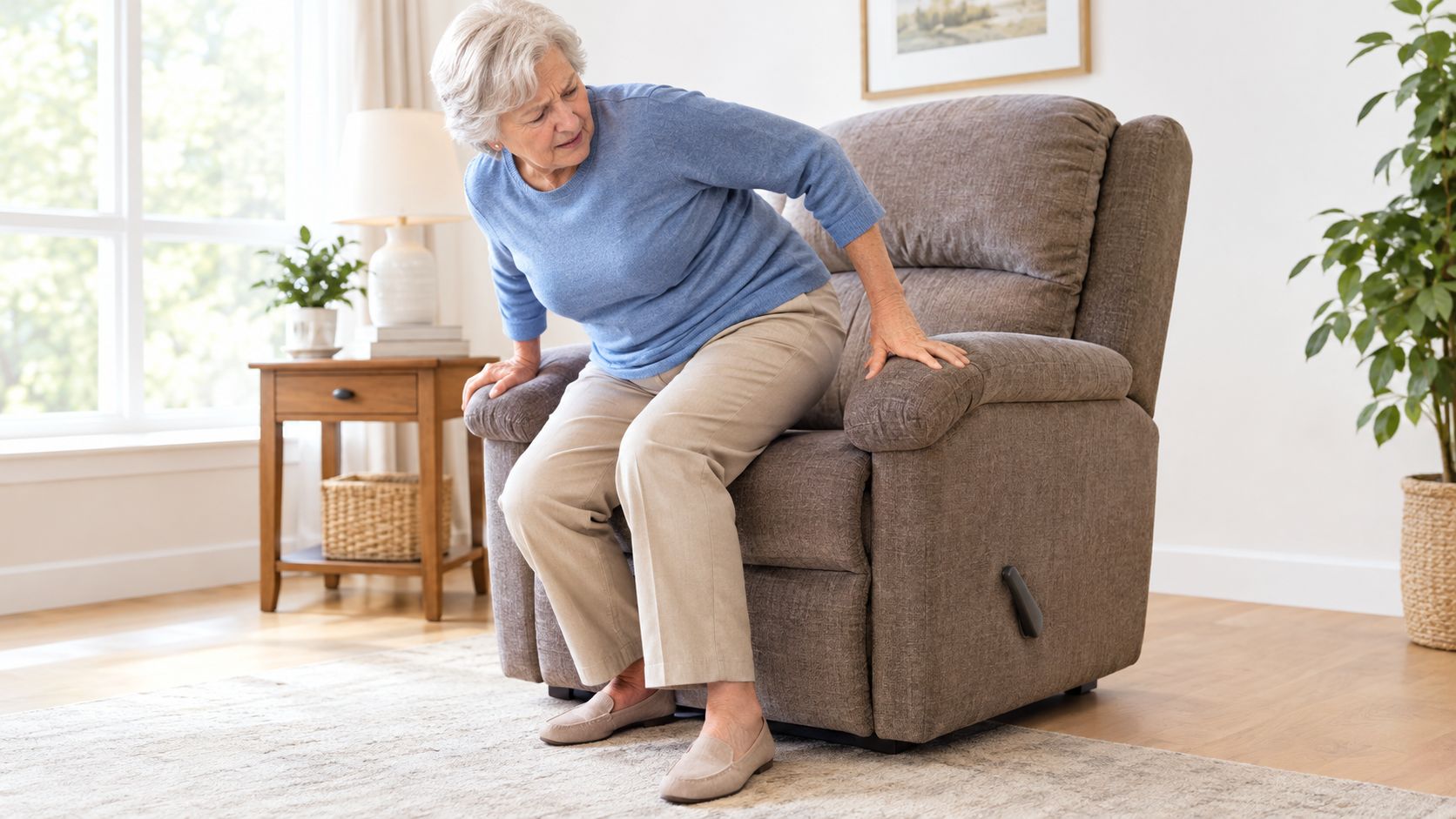
Lift chairs that swivel separate that difficult movement into manageable actions. The rotating seat helps the user turn toward the walker, wheelchair, bed, or side table. The powered lift then raises and tilts the seat so the person doesn't have to generate the entire sit-to-stand force alone.
The need is widespread, although that doesn't mean every older adult needs this type of chair. A U.S. Census Bureau analysis covering 2008–2012 found that nearly 40% of people aged 65 and older had at least one disability. Among the 15.7 million older adults identified with a disability, roughly two-thirds reported difficulty walking or climbing stairs.
The transfer is a sequence, not one motion
Consider a person whose chair sits beside a wheelchair. With a stationary recliner, they may need to stand while facing forward, then pivot toward the wheelchair. With a swivel model, the caregiver can help rotate the seat first, align the user with the transfer surface, stop the rotation, and activate the lift.
That sequence can reduce twisting and give the caregiver a clearer view of the user's feet and knees. It also supports dignity. The user takes part in the transfer instead of being pulled abruptly from a low seat.
Practical rule: Rotate for access, lock for standing, and keep the walker or wheelchair ready before the lift begins.
A swivel feature isn't a substitute for proper technique. Review safe patient transfer techniques with the care team, especially if the user has weakness on one side, recent surgery, poor balance, or difficulty following instructions. The chair should make a familiar transfer more controlled, not encourage the person to rush through an unfamiliar one.
How Swivel Mechanics Work With Powered Lifting
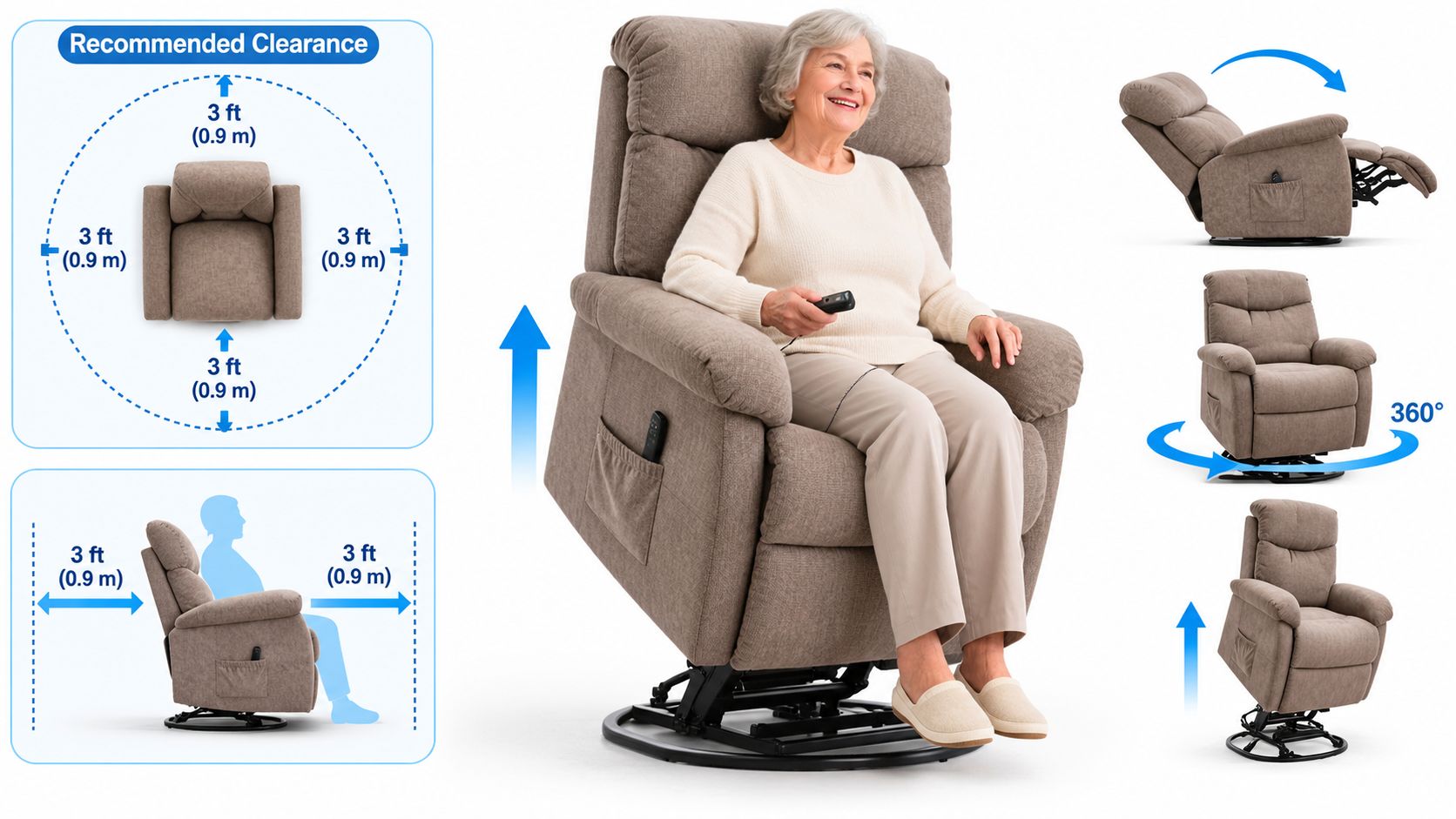
A swivel lift chair has two separate mechanical jobs. The powered lift mechanism tilts and raises the seat, while the swivel base rotates the seated user toward a destination. Think of the first function as changing the height and angle of the starting platform, and the second as turning that platform toward the safest exit path.
The lifting cycle should bring the user forward as well as upward. A purely upward movement may leave the person sitting back with the feet too far ahead. Forward tilt helps position the trunk over the feet, which is important for balance. The swivel should then be stopped and locked before the user attempts to stand.
Why the order matters
Use this workflow:
- Prepare the destination. Place the walker, wheelchair, or transfer surface where the user will move next. Remove footrests or obstacles that could catch the feet.
- Rotate while seated. Turn the chair only as far as needed to face the destination. Don't ask the user to stand while the base is still moving.
- Lock the swivel. Confirm that the seat is stable and facing the intended direction. A positive lock is more useful than a large rotation range.
- Activate the lift. Raise the seat until the user can place both feet securely and begin the final rise with control.
- Pause before walking. After standing, allow the user to stabilize. The chair has assisted the rise, but it hasn't completed the transfer to the walker or wheelchair.
A controlled study of 10 younger adults and 10 older adults found that a lifting-seat device significantly reduced trunk, hip, and knee angles, increased ankle dorsiflexion, lowered peak hip and ankle joint moments, and reduced peak muscle activity compared with an unassisted transfer. Those findings support the value of powered assistance, but they don't mean the user can ignore foot placement or balance. The study is available through this research on lifting-seat biomechanics.
For a plain-language overview of lift mechanisms and chair types, this lift chair buying guide can help families compare the basic functions before looking at individual models.
The distinction between lifting and swiveling also explains why a straight lift chair may suit one person while a swivel model suits another. If the user always faces an open path, rotation may add little. If the chair sits beside a bed, wheelchair, or narrow transfer area, controlled rotation can be the feature that makes alignment practical.
Key Features to Evaluate Before Buying
A good comparison starts with transfer performance, not upholstery. A chair may look substantial yet place the user too low, provide weak arm support, or rotate without a dependable lock. Compare each feature against the user's actual exit path.
| Feature | What to check | Why it matters |
|---|---|---|
| Seat height | Feet flat, knees supported, and enough room to lean forward | Affects the force and angle needed to rise |
| Seat depth | Back supported without the knees losing contact with the seat edge | Prevents slumping or sliding forward |
| Swivel control | Smooth rotation and a clear locked position | Keeps the chair stable before standing |
| Lift path | Forward tilt as well as upward movement | Helps bring the trunk over the feet |
| Armrests | Firm, reachable, and positioned for pushing | Gives the user a dependable support point |
| Remote | Large, understandable controls | Reduces confusion and awkward reaching |
Seat height deserves special attention. Seating research reports that higher seats reduce the hip and knee motion, strength, and exertion required to rise because the body travels a shorter vertical distance. That doesn't mean the highest chair is best. The user still needs stable foot contact and enough knee flexion to control the movement.
Compare the mechanism with the user's routine
A single-motor chair may be adequate when the user wants a straightforward lift and recline cycle. A dual-motor design can offer more independent positioning of the back and footrest, which may matter for someone who rests, naps, or needs a particular posture before standing. Choose based on the person's routine rather than assuming more motors automatically mean a safer transfer.
Weight capacity is another engineering boundary. Bariatric users need a frame and rotating base designed for the intended load, not just a wider cushion. Check the published capacity, seat width, and base stability together. A chair that supports the user but leaves too little room for the arms or walker can still create a poor transfer.
Look for battery backup when a power interruption could leave the user in a difficult position. Also inspect the remote, cord routing, fabric cleanability, and warranty terms. The 40 points of inspection checklist is useful for turning those details into a repeatable product review.
Sizing and Room Layout Considerations
The room often decides whether a swivel chair is useful. A chair can rotate beautifully in a showroom and become unsafe at home if its movement is blocked by a wall, coffee table, walker, heating vent, or power cord.
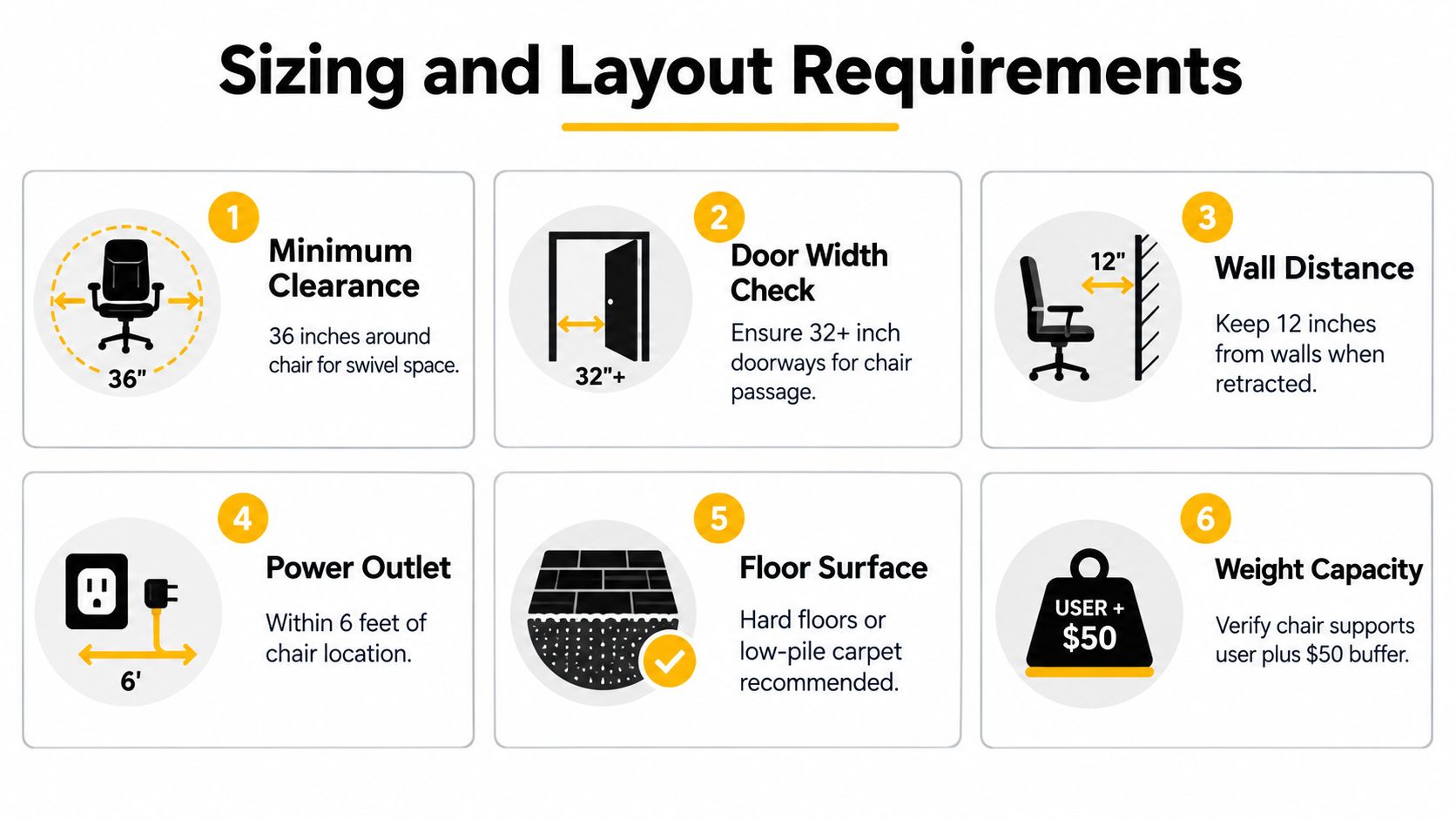
Before ordering, measure the full route, not just the space where the chair will sit.
- Entry route: Measure doorways, hallway turns, and the approach to the final room. Include packaging and the chair's widest dimension.
- Operating zone: Mark the area occupied by the chair when upright, lifted, and reclined. The user needs room to rotate without striking nearby furniture.
- Transfer side: Leave enough open space for the wheelchair, walker, or caregiver. The best swivel direction is the one that creates a clear path to the next surface.
- Wall and furniture clearance: Check the back, arms, footrest, and rotating edge. A wall that blocks rotation can turn a useful feature into a source of collision.
- Floor surface: Confirm that the base remains stable on the home's flooring. Thick carpet, uneven transitions, and loose rugs can affect movement and footing.
- Power access: Route the cord along the wall side and away from feet, wheels, and walking paths.
Only 1% of homes have five major accessibility features, including zero-step entry, single-story living, wide doorways and halls, lever handles, and wheelchair-accessible electrical controls, according to Pew Research Center's housing analysis. The same source reports that 38% of adults aged 65 and older expected to need home modifications or additional modifications to age in place in a 2025 poll.
For broader room-planning inspiration, these hall design ideas for Indian homes show how furniture placement and circulation paths can be considered together. The same principle applies in any home. If the chair can't rotate toward the bathroom or leaves no space for a caregiver, choose a different location or model.
Tall users need a separate fit check. Compare seat height, seat depth, and back height with the user's body rather than relying on labels alone. This guide to a lift chair for a tall person can help identify the measurements that deserve closer attention.
Safety Considerations and Fall Risks
A swivel lift chair reduces some demands of standing, but it introduces moving parts that must be used in the correct order. The user needs enough control to keep both feet positioned, understand the remote, and wait until the chair stops before rising.
The final seconds matter most
The lift cycle may bring the user close to standing, but the person still has to stabilize and begin walking. Place both feet under the body as far as the user's mobility allows. Keep the swivel locked, hold the walker only when it's positioned correctly, and avoid pulling on a rolling aid before the user is upright.
A 2007 study of 135 very old adults, with a mean age of 82.5 years, found that the time required to stabilize after reaching an upright position was the strongest predictor of total chair-rise time. The measured variables explained 81% of the variation in performance, as reported in the chair-rise study. The practical lesson is simple: don't judge a chair only by how high it lifts. Judge whether the user can pause, balance, and complete the transfer.
Rotation also needs supervision when the user has cognitive impairment. Ontario's Geriatric and Long-Term Care Review Committee documented three cases in 2018 involving people with cognitive decline who used power-recliner lift chairs to reach a standing position before falling to the floor without witnesses. The falls caused injuries, complications, and subsequent deaths, according to the Ontario review response.
The report involved different manufacturers and older, discontinued models, so it didn't assign the incidents to one brand. Its broader safety message applies to current products too. A power-recliner lift chair belongs in the home assessment, particularly when the user may press the remote unpredictably, stand before the motion ends, or forget to lock the swivel.
Supervision is part of the equipment plan. If the user can't consistently follow the sequence, the chair may require a caregiver nearby or a different transfer solution.
Ask an occupational or physical therapist to assess the setup when the user has poor balance, one-sided weakness, post-surgical restrictions, or repeated near-falls. The safest chair is the one whose controls, movement, height, and room position match the person's real abilities.
Who Benefits Most From Swivel Lift Chairs
The strongest candidates are people who need both powered help to rise and better alignment with the next transfer surface. A user may manage the lift but struggle to turn. Another may turn easily but lack the leg strength to stand from a low seat. The swivel function matters when both problems appear in the same daily routine.
Caregivers often see the benefit first. A chair positioned near a bed or wheelchair can rotate the user toward the destination instead of forcing the caregiver to guide a heavy pivot. That can improve positioning and reduce the temptation to pull under the arms. The caregiver still needs a clear path and appropriate transfer technique.
Users with lower-body weakness may benefit from the lifting motion because it changes the starting mechanics of standing. A systematic review of 17 studies involving 343 older adults and 225 younger adults found that older adults generally took longer to stand, used greater trunk flexion and postural sway, and produced lower ankle dorsiflexion torque during sit-to-stand transfers, as reported in this review of standing mechanics.
Match the chair to the person, not the label
A clinical review reports that, for adults aged 75–79, completing fewer than 11 chair stands for men or fewer than 10 for women is considered an indicator of increased fall risk, according to this chair-stand review. That threshold doesn't prescribe a particular chair, but repeated difficulty with chair stands deserves attention rather than dismissal as ordinary aging.
Bariatric users need more than a larger seat. Confirm the frame, lift system, swivel base, arm spacing, and room clearance as a complete package. In a smaller home, rotation may help the user approach the chair from a more practical direction, but only if furniture doesn't block the moving base.
The feature may be less helpful for someone who can't understand the controls or remain stable during the final rise. In those cases, supervised transfers, a therapist's assessment, or another assistive setup may be more appropriate. Home access also extends beyond the living room, so families planning a complete aging-in-place setup may review retrofit options for accessible bathrooms alongside the chair location.
Warranty, Financing, and Next Steps
Once the transfer workflow is clear, review the ownership details. Ask what the warranty covers on the frame, motor, control, lift mechanism, and swivel base. Clarify exclusions for upholstery, accidental damage, misuse, and normal wear, and find out how replacement parts and service are handled.
Keep the receipt, model information, and a record of the delivery condition. If a problem develops, photos and a clear description of the movement can make support easier. This warranty claim process explains the kind of information buyers should organize when requesting help.
Financing can spread the purchase cost over time through options such as Affirm, subject to approval and the terms shown at checkout. Review the total repayment obligation rather than focusing only on the installment amount. Also confirm return conditions, delivery access, and whether the selected chair can be brought into the intended room without creating a clearance problem.
Before ordering, write down the user's height, weight, seat-height needs, transfer destination, preferred swivel direction, doorway measurements, flooring, and supervision needs. That short list gives a product specialist something concrete to evaluate instead of relying on a generic recommendation.
The right lift chair isn't merely the one with the most functions. It's the one that lets the user rotate toward a clear path, lock the seat, place both feet, rise with controlled assistance, stabilize, and reach the next surface safely.
DME Superstore offers lift chairs and other home mobility equipment with clear specifications, compatibility information, warranty details, free nationwide shipping, and 24/7 chat support. Visit DME Superstore to compare lift chairs that swivel and get practical help choosing a model that fits the user and the room.
