



You may be watching a parent push hard against the arms of a low sofa, lean forward, pause, and try again. Their knees hurt, their balance shifts, and everyone in the room holds their breath. A lift chair for an elderly person can help with that specific transition, but it is not just a softer recliner. It's a powered transfer aid that must match the user's body, strength, balance, and home environment.
The safest buying decision starts with the moment the user rises. Upholstery and massage features matter, but chair geometry, lift movement, foot placement, arm support, and supervision matter more. This guide explains how lift chairs work, where they can help, and how to reduce avoidable risks.
Understanding Why Lift Chairs Matter
Standing from a chair looks simple until the body can no longer generate enough force through the hips and knees. A parent may scoot forward, place both feet on the floor, lean over the knees, and push against the armrests. If the seat is low or deep, that effort increases. A slight loss of balance can turn an ordinary transfer into a fall.
The need isn't limited to people with severe disability. The U.S. Administration for Community Living profile of older Americans reported that in 2022, 33% of adults aged 65 and older had a disability. Within that group, 21% had serious difficulty walking or climbing stairs, 13% had difficulty running errands independently, and 7% had difficulty dressing or bathing. Those figures help explain why powered sit-to-stand assistance can be relevant at home.

A lift chair raises and tilts the seated person toward standing. That movement can reduce the deep hip and knee flexion, forceful pushing, and balance demand involved in rising from a conventional chair. A 2021 biomechanical study of 28 healthy older adults found that two lifting-seat designs reduced knee and hip joint moments during transfers, although they increased ankle demand and changed the timing of movement (biomechanical study).
Assistance isn't prevention
A lift chair may support a safer transfer, but it doesn't guarantee fall prevention. The chair must be correctly sized, positioned on a level surface, and operated with the user's feet supported. A walker or wheelchair should be close enough to reach without a hurried turn.
Federal fall data give this concern real weight. In 2018, 28% of older adults experienced at least one fall during the previous year, representing approximately 35.6 million falls, and 10% experienced a fall-related injury, according to the ACL profile linked above. Families can use the guidance in how to prevent elderly falls alongside professional assessment.
The right way to view a lift chair is as one component of a safer home. It can preserve dignity by allowing a person to begin standing with less physical effort, but the user still needs a stable landing area, an appropriate mobility aid, and help when balance or judgment is unreliable.
Single vs Dual Motor Lift Chair Systems
The motor configuration changes how the chair moves, not just how many buttons appear on the remote. A single-motor chair generally coordinates the backrest, footrest, and lifting action. The movement is straightforward, which can suit someone who wants basic assistance and doesn't need precise positioning.
A dual-motor chair allows the backrest and footrest to move independently. The user may raise the legs while keeping the back more upright, or adjust the back without automatically changing the footrest. That flexibility can be useful for someone who spends long periods seated, needs careful positioning, or can't tolerate a synchronized recline.
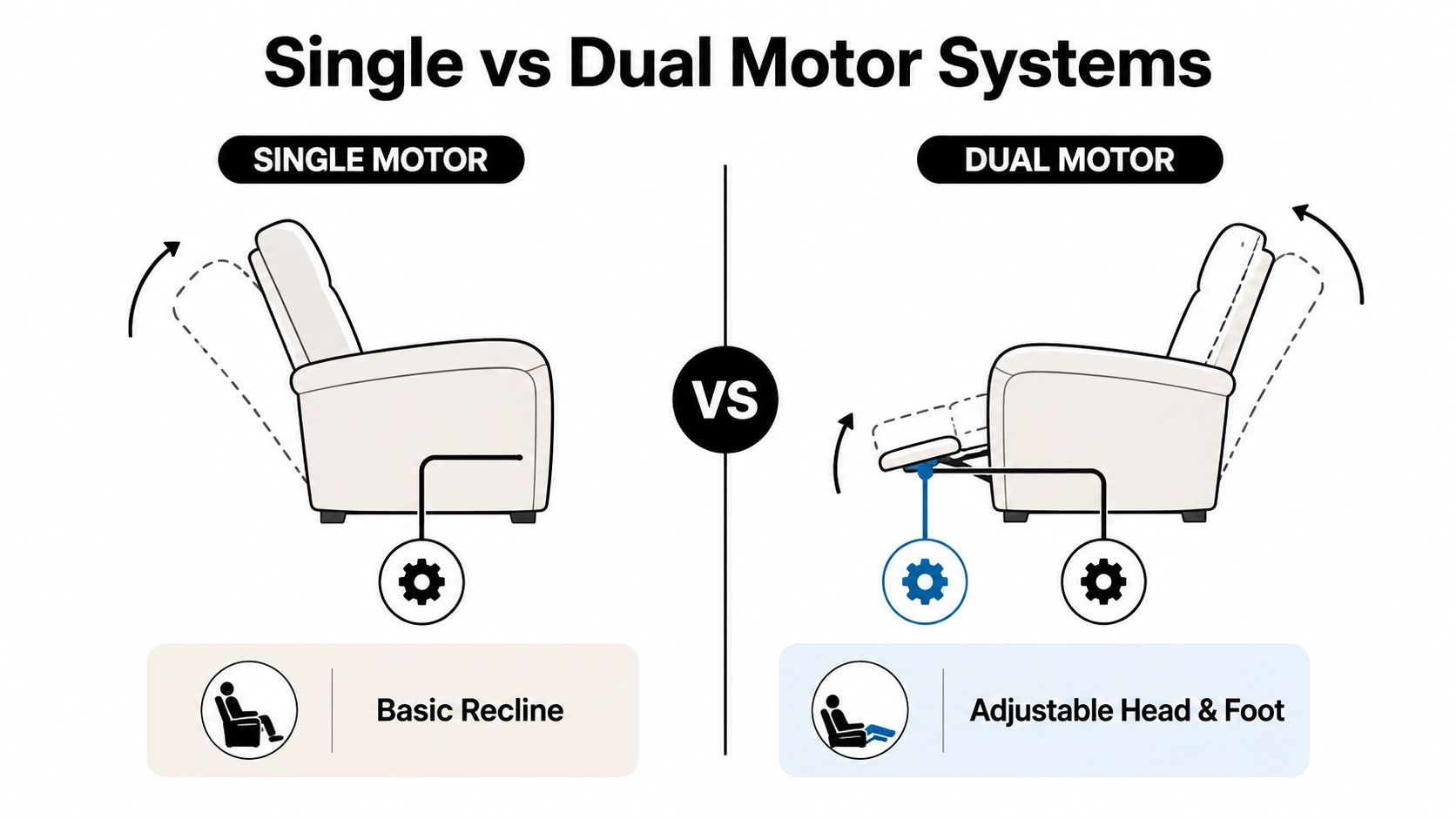
Match the system to the transfer
| Question | Single motor | Dual motor |
|---|---|---|
| Primary need | Basic lift and recline assistance | More individualized positioning |
| Movement | Several components move together | Backrest and footrest adjust separately |
| Control | Simpler operation | More adjustment choices |
| Useful for | A user with adequate control who prefers simplicity | A user who needs refined positioning or independent leg elevation |
| Main consideration | Less ability to fine-tune the transition | More controls may challenge users with limited dexterity or cognition |
A dual motor system isn't automatically safer. More adjustment can help one user and confuse another. A person with arthritis may appreciate a position that keeps the back relatively upright while the legs move, while someone with memory impairment may need a simpler remote with protected controls and supervision.
The lift trajectory matters more than the label on the motor. A biomechanical assessment of an electrically powered lifting chair found that approximately 15 degrees of hip-up inclination was adequate for its hip-up function, while a higher seat position was more effective for standing assistance (biomechanical lifting-chair assessment). The practical question is whether the chair brings the user forward while keeping both feet grounded.
For users who need a chair that reclines nearly flat, independent control may also support rest and positioning. A guide to lift chairs that lay flat can help families compare that feature with the user's actual transfer needs.
Critical Specs for Weight Capacity and Seat Width
A lift chair has to fit the person before it can assist the person. Start with the manufacturer's weight capacity, and never treat that figure as a casual suggestion. The frame, motor, lift linkage, and base work together under load. If the user approaches or exceeds the stated limit, ask the supplier or clinician about a model designed for that body size rather than assuming a stronger setting will solve the problem.
Seat width affects transfer control. If the chair is too wide, the user may not be able to keep the elbows close enough to the body to grip the armrests securely. Their pelvis can shift during the lift, and they may slide rather than rise. If the seat is too narrow, the hips and thighs can be compressed, making it harder to reposition and maintain comfort.
Measure the user, not the old chair
Have the user sit upright on a firm, straight-backed chair with both feet supported. Record the measurements that affect posture and standing:
- Seat height: Measure from the floor to the back of the knee while the feet are flat. The lift chair should let the user place both feet securely on the floor.
- Seat depth: Measure from the back of the hip to the back of the knee. Excessive depth can leave the knees poorly positioned and encourage sliding.
- Seat width: Measure across the widest part of the hips and thighs while seated. Compare that measurement with the chair's usable interior width, not just its outside dimensions.
- Armrest position: Check whether the user can reach both armrests without leaning sideways or pulling against unstable surfaces.
- Overall clearance: Measure doorways, turning areas, and the final placement zone before ordering.
The seat should support the thighs without pressing behind the knees. A seat that's too deep can prevent the user from sitting fully back while keeping the feet properly placed. A seat that's too wide can remove the stable side support needed during the final part of the lift.
For related mobility-equipment sizing, walker seat sizing help offers useful context on matching equipment dimensions to the person rather than choosing by appearance.
Fit rule: A chair that looks spacious isn't necessarily safer. The user should sit centered, keep both feet supported, and reach the armrests without twisting.
Read specifications carefully
Manufacturers may list overall width, seat width, seat depth, seat-to-floor height, and weight capacity as separate measurements. Compare all of them. A model with a generous weight rating can still be wrong if the seat height prevents flat-footed contact or the depth pushes the user forward.
Ask a physical therapist or occupational therapist to assess the fit when the user has significant weakness, poor balance, joint deformity, or difficulty following instructions. A few minutes of clinical review can prevent a costly chair from becoming an obstacle.
Safety, Positioning, and Transfer Techniques
The chair should support a clear U-shaped transfer path. Place it so the user can move from sitting to standing, turn or step toward the mobility aid, and continue along an unobstructed route. The exact arrangement depends on whether the user transfers to a walker, wheelchair, or another surface, but the principle is consistent: don't force a rushed pivot immediately after the lift.
Start with the room rather than the remote. Set the chair on a level floor with enough space for the footrest and lift movement. Keep cords, tables, rugs, pets, and medical equipment outside the moving area. The user's walker should be positioned where it can be reached after standing, but it shouldn't force the user to pull on the chair or twist toward the side.
A controlled transfer sequence
- Prepare the route. Remove objects between the chair and the walker or wheelchair. Turn on adequate lighting, especially for evening transfers.
- Sit fully back. The user should place the pelvis against the backrest and keep the feet supported as the chair returns to its lift position.
- Use the remote deliberately. Activate the lift only when the user is centered, with clothing and blankets clear of moving parts.
- Wait for stability. Once the seat reaches its raised position, the user should place both feet firmly on the floor and grasp the approved support surface.
- Stand and pause. Allow the body to settle before stepping away. A person who becomes lightheaded or unsteady needs assistance, not encouragement to hurry.
- Move to the aid. The user should step toward the walker or wheelchair without reaching far behind or pulling on the moving chair.
A 2021 study found that assistive seats can reduce hip and knee loading while increasing ankle demand. That matters for people whose ankles are weak or whose balance depends on controlled foot contact. The lift may make the first part easier while making the final transition more demanding.
The broader chair-safety problem is documented by the U.S. Consumer Product Safety Commission report on older-adult hazards. The report estimated 717,700 emergency-department-treated fall injuries associated with chairs among adults aged 65 and older, averaging 143,540 injuries annually, with an estimated rate of 264.2 chair-related fall injuries per 100,000 older adults. These figures apply to chairs broadly, not specifically to powered lift chairs, but they show why sitting, rising, reclining, and transferring deserve careful attention.
Consider cognition as seriously as strength
A user with dementia may operate a remote without understanding where the chair is moving or why standing must wait. The College of Occupational Therapists of Ontario response on power-recliner deaths describes three 2018 cases involving older adults with cognitive decline who used power-recliner remotes to raise themselves into standing, fell unwitnessed, and later died from injuries or complications. The report also notes that comparable cases weren't found in the medical literature, so this is limited but serious evidence, not proof of a population-wide risk.
Caregivers may need to supervise the full cycle, restrict remote access, and place the chair where a walker is immediately available. A gradual seat-lift mechanism should be distinguished from a spring-release or catapult design. CMS excludes mechanisms that jolt a user abruptly from sitting to standing.
For additional transfer guidance, review these safe patient transfer techniques. A clinician should assess users who can't maintain trunk control, follow the sequence, or remain stable after standing. A furniture guide such as review the perfect recliner with Critelli Furniture can help with general recliner ergonomics, but medical transfer decisions should remain individualized.
Beyond Medical Needs for Comfort and Lifestyle
A lift chair may be used for many hours, so comfort isn't a decorative extra. A user who refuses to sit in the chair because it feels stiff, hot, or awkward won't receive the intended transfer support. The chair has to fit daily life as well as clinical need.
Heat, massage, lumbar adjustment, and headrest positioning can make prolonged sitting more tolerable. They don't replace movement, skin checks, pressure management, or medical treatment, but they may support a routine the user can maintain. Massage should be gentle and appropriate for the person's health conditions, while heat requires caution when sensation is reduced or the user can't reliably operate the control.

Choose controls the user can manage
Large, clearly separated buttons are easier for many older adults than a small remote crowded with functions. Keep the control within reach without allowing it to become trapped beneath the user. If the person has tremors, weakness, vision loss, or cognitive changes, test the remote before purchase.
A wall-hugger design can preserve floor space in a small room by moving forward as it reclines. That still doesn't eliminate the need to measure the front and side clearance. The footrest must open without striking a table, wheelchair, or another person.
Upholstery also affects daily care. Easy-clean surfaces may suit a user prone to spills, while breathable, softer materials may feel better for long sitting. Avoid choosing fabric before confirming the chair's dimensions and transfer movement.
Comfort test: Ask whether the user can sit centered, reach the remote, rest both feet, and tolerate the chair's firmest support position. A chair that feels comfortable only when fully reclined may be difficult to use safely.
For shoppers comparing therapeutic features, HeatWave™ technology provides product-specific information. The useful question isn't whether a feature sounds luxurious. Ask whether it supports a real routine, such as resting after therapy, elevating the legs while staying upright, or reducing discomfort that otherwise causes the user to avoid the chair.
Navigating Medicare, FSA, and Financing Options
Payment rules often create more confusion than the chair mechanism. In the United States, Medicare coverage is not the same as buying a fully upholstered lift chair. CMS says coverage may apply to the seat-lift mechanism, not the household chair itself, and only when strict medical conditions and documentation requirements are met.
CMS requires documentation that can include severe hip or knee arthritis or severe neuromuscular disease, inability to rise from a regular chair, a treatment plan, and the ability to walk after standing, with a cane or walker if needed. It also requires evidence that appropriate therapies, such as medication or physical therapy, were tried and failed to enable the transfer. These rules appear in the CMS seat-lift mechanism coverage determination.
Use a written payment path
Before ordering, ask the prescriber and supplier to separate the medical mechanism from the upholstered chair. Confirm what documentation the clinician must provide, whether the user can walk after the lift, and what portion remains the buyer's responsibility. Don't assume a general statement such as “Medicare pays 80%” describes the full purchase.
Medicare rules are U.S.-specific. Buyers elsewhere should contact their national insurer, public-benefit program, or disability-funding service rather than applying U.S. assumptions to another system.
FSA and HSA use depends on account rules and required documentation. Ask the plan administrator whether the proposed purchase qualifies, keep the prescription or letter of medical necessity if requested, and retain the itemized receipt. Eligibility should be confirmed before payment, particularly when the purchase includes both medical and furniture components.
Financing can spread payments, but it doesn't change whether the chair is appropriate or covered. Review the full agreement, repayment terms, return policy, and warranty before accepting an installment plan. For general borrowing education, the BadCreditMD installment loan guide can help readers understand questions to ask before taking on credit.
Include ownership costs in the decision
A sound purchase plan includes delivery, assembly, service access, replacement parts, and warranty limits. Ask who handles a failed motor, whether the chair can be returned, and whether the company provides installation in the room where the chair will be used.
DME Superstore offers lift chairs and other durable medical equipment, with product specifications, compatibility information, warranty details, FSA/HSA payment options, and financing through Affirm listed as part of its purchasing resources. Its Medicare guidance on power lift chairs and Medicare can help families prepare questions, but it shouldn't replace confirmation from CMS, the insurer, or the prescribing clinician.
Installation, Delivery, and Maintenance Care
A lift chair can be correctly chosen and still become unsafe if it arrives in the wrong room, is assembled poorly, or blocks the user's route. Delivery planning should happen before the order is placed. Measure the entry door, hallway turns, room opening, and final position, then decide who will move and assemble the chair.
Threshold delivery generally means the item is brought to the entrance, while the buyer handles movement inside. White-glove service may include carrying the chair into the selected room, assembling it, removing packaging, and checking operation. For safety-critical equipment, professional setup can be worthwhile when the caregiver can't safely move a heavy chair or verify the lift movement.
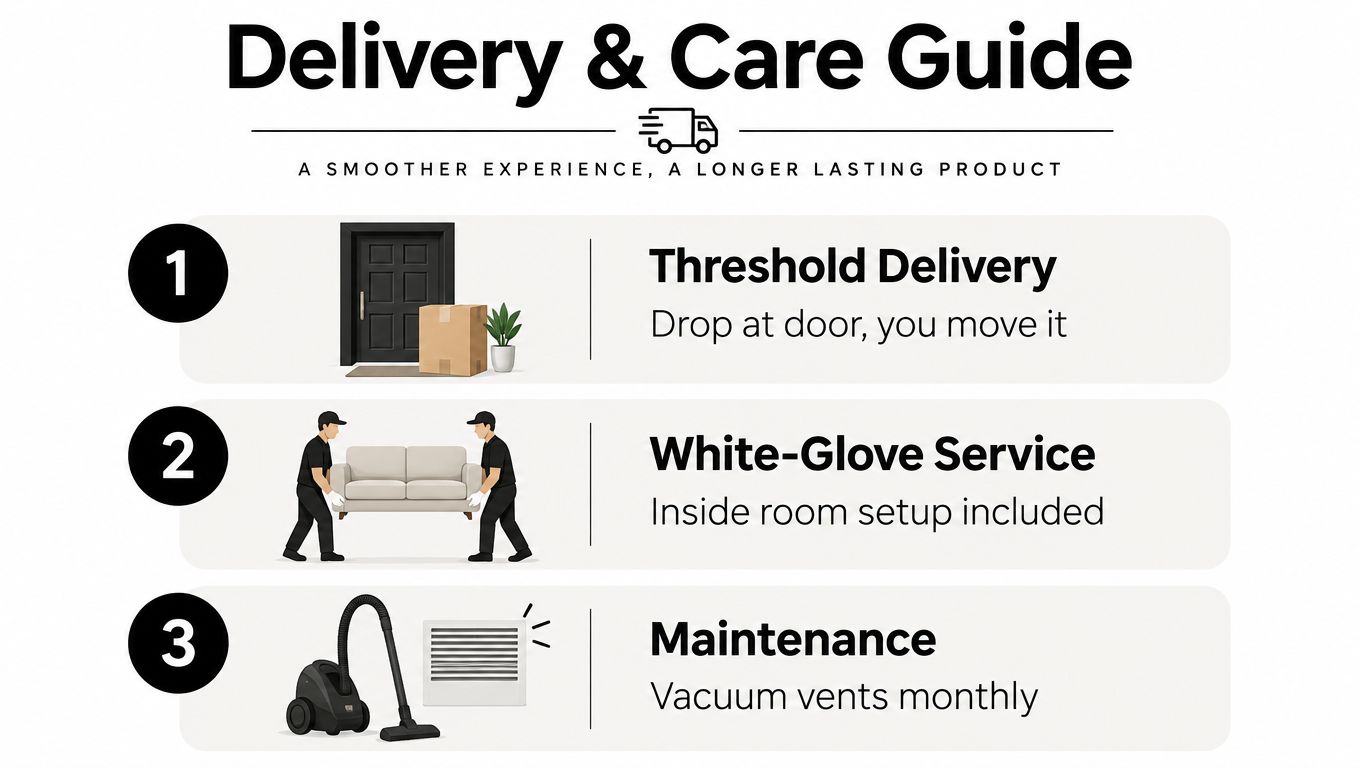
Confirm operation before the first transfer
After installation, test the chair without the user seated. Check the lift, recline, footrest, remote, power connection, and movement clearance. Then repeat the cycle with the user supervised, confirming that the seat raises them forward without sliding, losing foot contact, or forcing an unstable lean.
The final position should leave a clear route to the walker or wheelchair. Don't place a side table where the user must twist around it, and don't run the power cord across the walking path.
Keep a simple care routine
- Inspect the mechanism: Look for loose covers, unusual movement, damaged cords, or changes in the lift trajectory. Stop using the chair and contact the supplier if something doesn't operate normally.
- Clear the footwell: Remove toys, blankets, dropped objects, and pet items before activating the footrest or lift.
- Clean around moving parts: Vacuum dust and debris from accessible areas according to the manufacturer's instructions. Don't reach beneath a powered chair while it's connected to electricity.
- Test the battery backup: Follow the manual's procedure and replace batteries as specified. A backup is useful only if it works when the power fails.
- Review the remote: Keep buttons visible and make sure the user or caregiver knows which control returns the chair to a safe position.
- Recheck the room: Furniture shifts, new rugs appear, and walkers move. Reassess the transfer route whenever the room changes.
Maintenance principle: Never improvise a repair beneath the chair. Disconnect power and use the manufacturer or qualified service provider for mechanical and electrical problems.
A maintenance routine protects more than the motor. It preserves the predictable movement that lets the user coordinate feet, hands, trunk, and walker during the transfer. If the user's strength, balance, cognition, or walking aid changes, ask a clinician to reassess whether the chair remains suitable.
DME Superstore provides lift chairs and related home mobility equipment with detailed product specifications, FSA/HSA payment options, financing through Affirm, and delivery and support choices. Visit DME Superstore to compare models, confirm fit and safety features, and choose equipment that supports a more independent daily routine.
