



A late-night transfer can expose the limits of an ordinary recliner. The back may tilt, but the chair still leaves the knees bent, the feet dependent, and the user dependent on leg strength to stand. For an older adult recovering at home, that combination can turn a comfortable-looking chair into an awkward and unsafe place to rest.
Lift chairs that lay flat take a different approach. They combine powered standing assistance with a deep recline that can approach a bed-like position. The result is a hybrid, more supportive than a standard recliner and less permanent than moving immediately to full-time bed rest. The right model can help with daytime recovery, reading, napping, and transfers, but it still needs to be fitted and positioned like medical equipment.
When a Recliner Is No Longer Enough
Consider Maria, a caregiver helping her 78-year-old father after a hip replacement. At two in the morning, pain wakes him in his ordinary two-position recliner. He tries to push himself upright, but the chair has left his hips and knees sharply bent. His quadriceps are weak, and when he leans forward, his body slides toward the edge before he can get both feet securely under him.
That moment creates several problems at once. A standard recliner tilts the back, but it usually doesn't create a long, level resting surface. Weight can remain concentrated around the sacrum and heels, while a user with post-surgical movement restrictions may struggle to find a position that feels stable. If the chair doesn't provide lift assistance, standing also depends heavily on the user's arms and legs.

The bridge between chair and bed
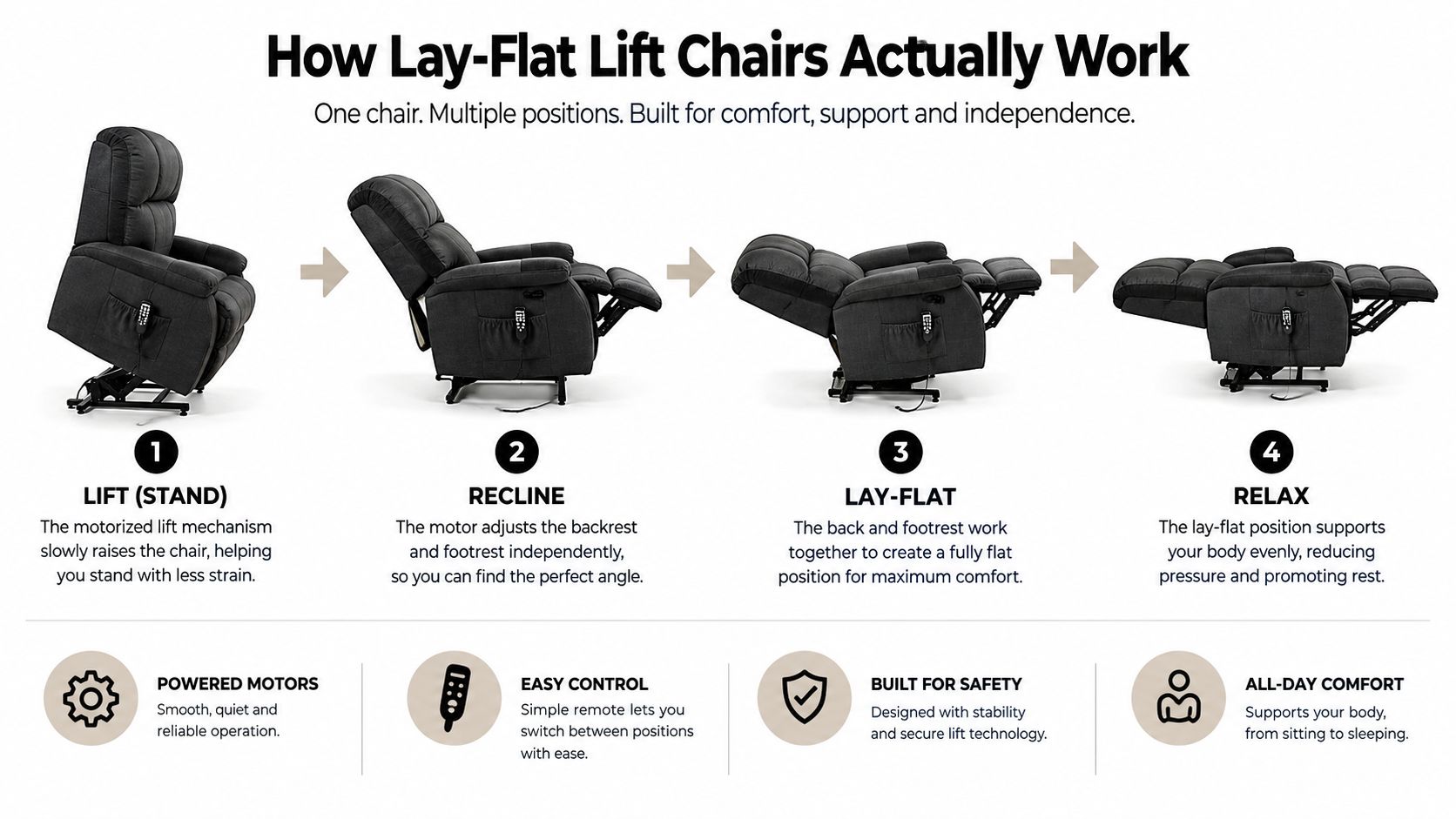
A lay-flat lift chair changes the sequence. The powered lift function raises and tilts the seat forward to support a controlled stand, while the recline function lowers the back and extends the leg rest. In a true infinite-position design, the backrest can reach 180 degrees and the footrest can extend independently to create a near-bed surface, as shown in published infinite-position product specifications.
That posture may feel more neutral for someone who can't tolerate a tightly flexed seated position. It can also give a caregiver more room to position a walker, assist with a transfer, or bring a bedside commode alongside the chair. The chair doesn't remove the need for clinical instructions, a clear floor, or supervision, but it can reduce the awkwardness of moving from rest to standing.
Practical rule: If the person can't rise from the chair without sliding forward, pulling hard on the armrests, or losing balance, the problem is no longer comfort alone. It's a fitting and transfer-safety issue.
A recliner isn't automatically suitable for overnight recovery. People with swelling, reflux, skin vulnerability, or limited bathroom access may need a bed and a clinician's guidance rather than a chair. For practical considerations about resting in a recliner during recovery, caregivers can also review this recliner sleep advice after surgery.
Before ordering, learn safe positioning and caregiver body mechanics through these safe patient transfer techniques. A lift chair can support a transfer, but it shouldn't be treated as a substitute for proper assistance when the user is unsteady.
How Lay-Flat Lift Chairs Actually Work
The phrase “lay flat” describes the chair's travel, not just its appearance in a product photograph. Buyers should identify how many independent movements the chair provides and whether the advertised sleeping position is genuinely flat.
Three mechanisms to separate
A two-position lift chair generally moves from upright to a reclined posture with the leg rest rising as the back tilts. The sourced product guidance describes this type as reclining to about 45 degrees. It may work for television viewing or short periods of rest, but it isn't the configuration to choose when the goal is a flat sleeping surface.
A three-position chair reclines farther, with examples reaching roughly 60 to 70 degrees. The back and leg rest commonly move together, which can be comfortable for napping but doesn't provide the independent adjustment needed to fine-tune the user's posture.
An infinite-position lift chair uses dual motors. One motor controls the backrest, and the other controls the footrest, so each section can stop at a chosen angle. Medical seating examples describe a full 180-degree recline, while an infinite-position seller describes both full-flat sleeping and a zero-gravity position in which the legs are raised above the heart. See this plain-language overview of how lift chairs work for a complementary explanation of the lifting and reclining functions.
Lift movement is a separate job
The lift portion uses a forward-tilting seat to bring the user toward standing. It isn't the same movement as lowering the back for sleep. That separation lets a user choose an upright transfer position without losing the chair's ability to recline later.
A hand control usually operates the motors, and some models include a backup battery pack so the chair can be moved during a power interruption. Ask whether the backup system is included, how it connects, and what the manufacturer says it can operate. A battery is useful, but it doesn't make an occupied chair safe to leave in an awkward position during an outage.
Steel scissor frames support the lifting action, but they also create moving pinch and crush points. Pride Mobility's owner documentation identifies the scissor and lift mechanisms as pinch or crush hazards and documents testing of its lift chair products against IEC 60601-1-2 electromagnetic compatibility requirements in the relevant manual. Keep hands, feet, pets, and loose objects away from the mechanism.
For people comparing powered seating with mobility equipment, the movement goals differ from those of a reclining electric wheelchair. A lift chair stays in one room and assists transfers. A wheelchair must support controlled movement through the home or beyond it.
The video below can help visual learners understand how powered positions relate to one another.
Specs That Change Fit and Safety
A lift chair can look roomy in a product photograph and still fit poorly. The user feels the actual seat width, depth, height, and support points, so measure the person first and compare those measurements with the manufacturer's specifications. This matters even more when the chair serves as a hybrid between a recliner and a short-stay rest surface. A near-flat position does not correct a seat that leaves the back unsupported or the feet poorly placed.
Read the specification sheet in order
Start with the user's height, weight, hip width, and lower-leg length. A capacity rating is a safety limit, not a comfort target. One sourced adult product example lists a 350-pound weight capacity, 21-inch seat height, 23-inch seat depth, and seat width of about 21 inches. Clinical seating examples describe adjustable widths around 20 to 23 inches and capacity in the 400-pound class, so one chair cannot fit every adult safely. The cited measurements and ranges are available in the published healthcare seating specifications, the manufacturer's product specifications, and the medical recliner materials.
Seat depth works like the distance between the back support and the knees. If it is too deep, the lower back may not meet the cushion. If it is too short, the front edge can press behind the knees. Seat height affects whether both feet can rest on the floor before standing. In the flat position, check that the footrest supports the heels instead of letting them hang over the edge.
Recline angle also needs careful reading. “Deep recline” may still leave the user partly flexed. Look for an explicit 180-degree or full lay-flat specification, then confirm whether the back and footrest move independently. Healthcare recliner materials describe a full 180-degree recline, while the usable surface and actual travel still depend on the model's dimensions. The advertised sleeping position must be flat enough for the intended rest period, not merely lower than a typical lounge position.
| Spec | Typical Range | Why It Matters |
|---|---|---|
| Recline angle | About 180 degrees for a true lay-flat design | Separates flat positioning from an ordinary napping recline |
| Seat width | Around 20 to 23 inches in clinical examples | Gives the hips room without allowing excessive side-to-side movement |
| Seat depth | Around 23 inches in a sourced adult example | Supports the lower back while keeping the knees clear of the front edge |
| Seat height | Around 21 inches in the sourced adult example | Affects foot placement and sit-to-stand control |
| Weight capacity | 350 pounds in the adult example and 400-pound class in clinical examples | Must exceed the user's weight with a meaningful safety margin |
| Motor configuration | Dual motors for independent back and footrest movement | Allows finer positioning and a true lay-flat posture |
| Surface and cover | Foam layers, gel overlays, breathable fabric, vinyl, or leather, depending on the model | Influences pressure distribution, heat, cleaning, and sliding |
| Battery backup | Model-specific backup operation | Helps during an outage, subject to the included equipment and use limits |
Pressure management is not established by the label “memory foam.” Examine the actual construction, including foam layers, gel overlays, breathable covers, and how the surface behaves when the user slides. A slick cover may wipe clean easily but increase sliding during transfers. Vinyl may suit incontinence care, while fabric may feel cooler and less clinical.
Motor type changes how precisely the user can adjust position. A single motor may coordinate the chair's movement, while dual motors allow separate back and footrest control. For frequent repositioning, check whether the hand control has large, clearly labeled buttons and can be mounted where a user with limited reach can operate it.
For a closer look at how cushion construction affects sitting posture, review this guide to seat cushion thickness. Use those material details and measurements to judge fit, rather than accepting a general promise of comfort.
Lift Chair vs Adjustable Bed vs Standard Recliner
The best option depends on the task. A flat-recline lift chair is often strongest when one person needs daytime positioning and powered standing assistance. An adjustable bed is generally more suitable for a dedicated full-night sleep environment or two people sharing a sleep surface. A standard recliner remains the simplest and least complex option, but it doesn't provide powered lift assistance or a true supine position.
| Feature | Lay-Flat Lift Chair | Adjustable Bed | Standard Recliner |
|---|---|---|---|
| Sleep posture | Can create a near-bed, flat surface | Designed around sustained bed rest and sleep | Usually leaves the user partly flexed |
| Pressure redistribution | Better than a partial recline when correctly fitted, but surface area is limited | More room for repositioning and mattress selection | Limited by the chair shape |
| Sit-to-stand transfers | Powered lift function supports one-person transfers when the user can follow instructions | Requires standing from the bed edge or another transfer aid | No powered lift assistance |
| Room footprint | Needs travel space behind, in front, and beside the chair | Uses a larger dedicated sleep area | Usually more compact when upright |
| Energy use | Requires powered movement and may use a backup battery | Uses powered adjustment if motorized | No electrical movement in a manual model |
| Long-term value | Useful for daytime recovery and mixed sitting needs | Stronger for regular overnight use | Suitable when lift and flat positioning aren't needed |
Match the furniture to the routine
A user who reads upright, naps during the day, and transfers to a walker may prefer a lay-flat lift chair. Someone who spends most of the night asleep, shares the room with a partner, or needs frequent turning has different needs that may favor an adjustable bed. A standard recliner can be reasonable when the user has adequate leg strength, doesn't need a flat posture, and wants simple seating.
Pressure management also depends on how long the user stays in one position and whether they can reposition independently. A chair isn't automatically a clinical sleep surface because its footrest reaches the backrest. Caregivers should ask a clinician whether the chair's width, surface, and posture fit the person's skin, circulation, reflux, and mobility needs.
A chair can be the right daytime tool and the wrong overnight surface. Those aren't contradictory conclusions.
Room access matters in addition to the furniture itself. Caregivers arranging an accessible home may find useful ideas in this guide to inclusive house call practice, particularly when a clinician or support worker needs to approach from the side. For households combining seating and sleep equipment, review the practical differences between chairs and adjustable beds before committing to one solution.
A hybrid setup can make sense. The lift chair handles daytime transfers, reading, and short rest periods, while the adjustable bed supports overnight care. That arrangement costs more in space and equipment, but it avoids forcing one piece of furniture to perform two incompatible jobs.
Room Clearance and Home Setup
A flat-recline chair needs more room than its upright silhouette suggests. The back travels toward the wall, the leg rest travels forward, and the lift cycle can change the chair's footprint as the seat tilts. Manufacturer manuals provide examples ranging from 14 inches to 65 centimeters behind the chair and around 40 centimeters in front, so the exact requirement must come from the model's instructions rather than a general rule.
Measure the complete travel path
Before ordering, use painter's tape to mark the chair's upright footprint on the floor. Then mark the additional rear and front clearance stated by the manufacturer. Leave a side approach for the caregiver, walker, or transfer aid. A chair can technically fit between two pieces of furniture and still be unusable if the user can't turn safely or the caregiver can't reach the controls.
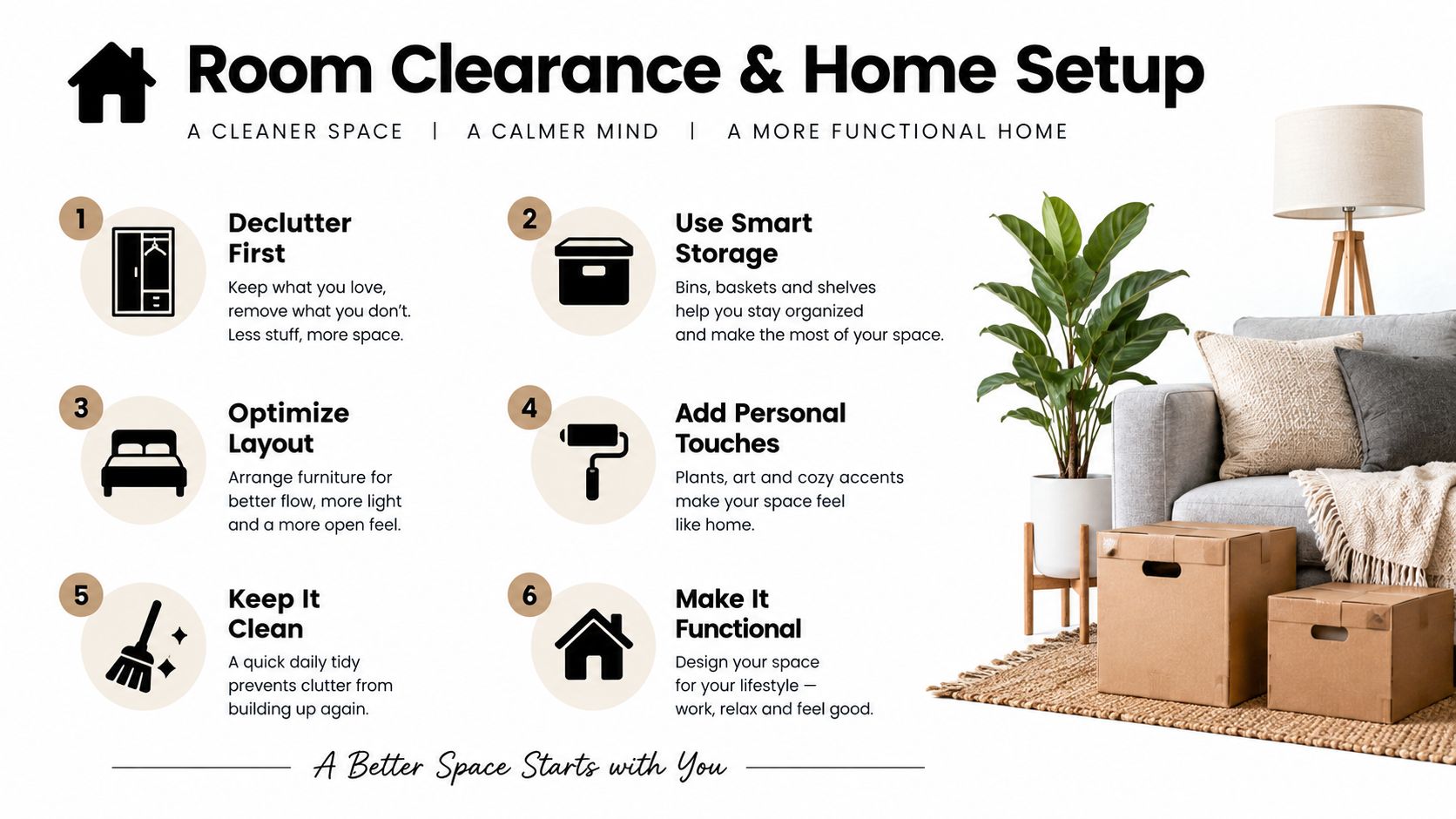
Use this short setup routine:
- Record the chair's closed and open dimensions: Include the manufacturer's rear and front clearances, not just the box dimensions.
- Mark the leg-rest path: Check that it won't hit a coffee table, wall, walker, or bedside commode.
- Reserve caregiver access: Keep the user's transfer side clear of furniture and electrical cords.
- Check the floor: Use a dry, level surface. Thick carpet can interfere with movement or conceal an unstable base.
- Locate the outlet: Place a grounded outlet within cord reach without running the cord across a walking path.
- Test the final position: Run the lift and recline cycle while the chair is empty, then inspect every pinch point.
Don't place the chair beside a radiator or other heat source. Avoid blocking a main walking route, even if the chair is normally kept upright. Keep children, pets, blankets, and storage bins away from the moving frame.
A wall-hugger label doesn't eliminate every clearance requirement. It may reduce rear travel, but the footrest still needs front space and a caregiver still needs side access. The safest room layout is the one that works in the position the user needs, not just the position shown in the showroom.
Cost, Insurance, and Financing
The financial question has three parts: the chair's purchase price, the amount an insurer may recognize, and the cost of owning and servicing the equipment. Two-motor infinite-position models, premium multi-motor chairs, and bariatric designs can occupy different price tiers, but exact retail amounts vary by brand, upholstery, capacity, delivery, and service arrangement. Treat a product page's price as a starting point, not as the complete cost.
Separate medical eligibility from retailer policy
FSA and HSA treatment may depend on the user's plan, the equipment's intended medical purpose, and supporting documentation. A Letter of Medical Necessity may be requested, but it doesn't guarantee reimbursement. Ask the plan administrator what wording, prescription, receipt, or diagnosis documentation it accepts before purchase.
Insurance coverage also varies. Medicare's lift-mechanism pathway can be conditional on diagnosis documentation and may cover only the qualifying lift component rather than every comfort feature, upholstery upgrade, or delivery service. Review the current requirements in this guide to power lift chairs and Medicare, then confirm the details with the supplier and the plan.
Medicaid waivers can differ by state and by program. A chair that qualifies under one waiver isn't automatically covered under another. Ask whether prior authorization is required, whether the supplier must be enrolled, and whether the program covers purchase, rental, repair, or only a specific medically necessary component.
Look past the monthly payment
Third-party financing, including services such as Affirm or CareCredit, can spread payments, but the advertised monthly figure doesn't show the full obligation. Check the annual percentage rate, total repayment amount, late-payment terms, and whether a deferred-interest offer charges accumulated interest if the balance isn't paid within the promotional period. Manufacturer payment plans may use different terms, so compare the written agreements rather than the headline payment.
Before checkout, ask the retailer:
- Warranty coverage: How long are the frame, motors, hand control, and electronics covered separately?
- Service location: Does a technician come to the home, or must the chair go to a depot?
- Parts availability: Are replacement motors, controls, and batteries available after the warranty period?
- Return conditions: Is there a return window, a restocking fee, or a delivery charge that won't be refunded?
- Fit responsibility: Who pays for return shipping if the chair doesn't fit the user or the room?
A lower purchase price can become expensive if the chair requires difficult returns or leaves the household without service during a repair.
Choosing the Right Model for You
A lift chair may need to serve two different purposes in the same room. During the day, it helps a user stand and sit. At night, a flat-reclining model can act like a short-stay rest surface, but it is still a chair with a moving mechanism, limited width, and different support from a bed. Choose the model around the user's actual routine, not around color, upholstery, or massage functions.
Start with a self-audit. Record the user's height, weight, hip width, lower-leg length, mobility limits, usual transfer method, and how often they expect to sleep or rest in the chair. Include caregiver needs. A caregiver may need side access, a clear path around the chair, or a hand control that can be operated without stretching across the user.
Turn the answers into specifications
A user who needs a flat sleeping surface should focus on an infinite-position, dual-motor model with an explicit full-recline specification. Separate motors let the back and footrest move independently, which can make positioning easier. Someone who only wants raised legs for a short nap may not need that mechanism. The choice affects price, room footprint, controls, maintenance, and the number of moving parts.
Compare the user's measurements with the exact model's published seat width, seat depth, seat height, and weight capacity. Keep a meaningful margin above the user's current weight rather than selecting a chair whose rating barely clears it. Use the published measurements as a screening tool, then verify the actual model, because cushions, armrests, and upholstery can change how much usable space remains.
The fit should support the user's posture without forcing the knees too high, the feet beyond the footrest, or the shoulders away from the back. A chair that feels comfortable for a few minutes may still cause sliding or pressure during a longer rest period.
Pressure-relief construction matters more as sitting time increases. Look for documented foam layers, gel overlays, a surface that does not trap excessive heat, and a cover that suits the user's cleaning routine. If the user slides forward, cannot reposition, or has skin concerns, ask a clinician or seating specialist to assess the chair instead of relying only on a showroom test.
Use a showroom or product-page checklist
- Measure the user: Record height, weight, hip width, seat-to-knee length, and lower-leg length.
- Confirm the mechanism: Verify independent back and footrest motors and the stated lay-flat angle.
- Check the capacity: Compare the published limit with the user's weight and allow a sensible buffer.
- Test the controls: Make sure the buttons are readable, reachable, and manageable with the user's hand strength.
- Inspect the transfer position: The chair should raise the user without forcing a forward slide or unstable lean.
- Plan the room: Confirm rear, front, and side clearance, plus a grounded outlet. Mark the chair's full travel path on the floor so furniture does not become an obstruction.
- Ask about backup power: Clarify whether a battery pack is included and what movement it supports.
- Read the warranty: Separate frame, motor, electronics, upholstery, and in-home service terms.
- Review returns: Confirm the return window, delivery conditions, and any restocking or pickup fees.

Questions buyers commonly ask
Are lay-flat lift chairs safe for nightly sleep
They can provide a contained flat-rest option, but a flat position alone does not show that nightly sleep is suitable for a particular person. Manufacturer manuals emphasize level flooring, adequate clearance, and keeping obstructions, pets, and children away from the mechanism. Pride Mobility's documentation identifies scissor and lift areas as pinch or crush points. United Kingdom guidance also discusses entrapment risks associated with riser and lift chairs under BS8474.
Ask a clinician to consider circulation, edema, reflux, skin protection, nighttime toileting, fall risk, and the user's ability to reposition. A bed may provide a more suitable sleep environment for someone who needs regular turning, a larger pressure-relieving surface, or access from both sides. Treat the chair as a short-stay rest surface unless a clinician and the manufacturer support a different use.
How do I verify FDA registration
Ask the manufacturer for the exact company name, product name, model number, and any applicable FDA establishment or device information. Use the FDA's official databases, then contact the manufacturer if the listing does not match. Registration or listing does not prove that the chair fits the user's needs, guarantee reimbursement, or replace clinical evaluation.
What documentation supports FSA or HSA reimbursement
Start with the plan administrator. Commonly requested materials may include an itemized receipt and a Letter of Medical Necessity, but requirements differ. Ask for written confirmation before paying. Keep the product specification, diagnosis-related documentation, prescription if required, and payment record together.
When will a standard three-position chair do the job
Choose a three-position chair when the user needs ordinary reclining and napping rather than a completely flat sleep surface or independent back and footrest adjustment. If powered standing assistance is the main need, that simpler mechanism may be adequate. If the user must rest flat, manage a post-surgical posture, or transfer with the chair fully raised, confirm those requirements before accepting a three-position model.
Request a written specification sheet, measure the room with the full travel path marked, and arrange an in-home trial before paying a deposit.
DME Superstore offers lift chairs with sleep and infinite lay-flat positions, along with other home medical equipment and product specifications for comparison. Visit DME Superstore to review available models, warranty and return details, and support options before choosing a chair for daytime transfers or overnight recovery.
