



Friday is discharge day. The rehab unit has handed you a supply list, the spare bedroom has a doorway that looks narrower than it did last week, and the home medical supplier wants one answer before the truck leaves: semi electric or full electric.
The two beds look almost the same in a showroom. Both raise the backrest and the knees at the push of a button, both hold a mattress on a steel deck, and both cost real money. The difference is the third movement, the one nobody mentions at the counter: whether the whole deck rises and falls by motor or by a hand crank at the foot of the frame.
That single movement decides who does the bending, whether a wheelchair transfer happens at the right height, and how much of the bill your insurer treats as medical necessity rather than convenience. The semi electric vs full electric hospital bed comparison gets much simpler once you stop counting motors and start counting the movements your day depends on.
Semi-Electric and Full-Electric Beds Side by Side
At 5:40 on a Tuesday morning, a daughter walks to the foot of her father's bed, grips the crank, and turns it a dozen times so he can sit up for breakfast. She'll do it again at lunch, again before his shower, and twice more before bedtime. Nobody sold her that crank as a feature. It came attached to a frame that looked identical to the powered one in the catalogue.
That morning routine is the whole decision in miniature. A semi-electric bed powers the backrest and the knee section from a handset and leaves overall height to a manual crank. A full-electric bed, often sold as total-electric, adds a motor for the whole deck so a handset or panel lifts the person to whatever height the task needs.
The one movement that separates them: both beds power the head and knee sections, and only the full-electric frame powers the height.
Aetna's clinical policy defines the category the same way, describing semi-electric beds as manual height adjustment paired with electric head and leg elevation, and it lists semi-electric billing codes including E0260 (Aetna clinical policy bulletin). Safety regulators draw the line in a different place. The FDA treats electrically and manually controlled beds as hospital-bed systems and applies the same entrapment guidance to both, so neither model gets a pass on rail and mattress fit (FDA hospital bed entrapment FAQ).
Here's the side by side view to hold in your head while you talk to a supplier.
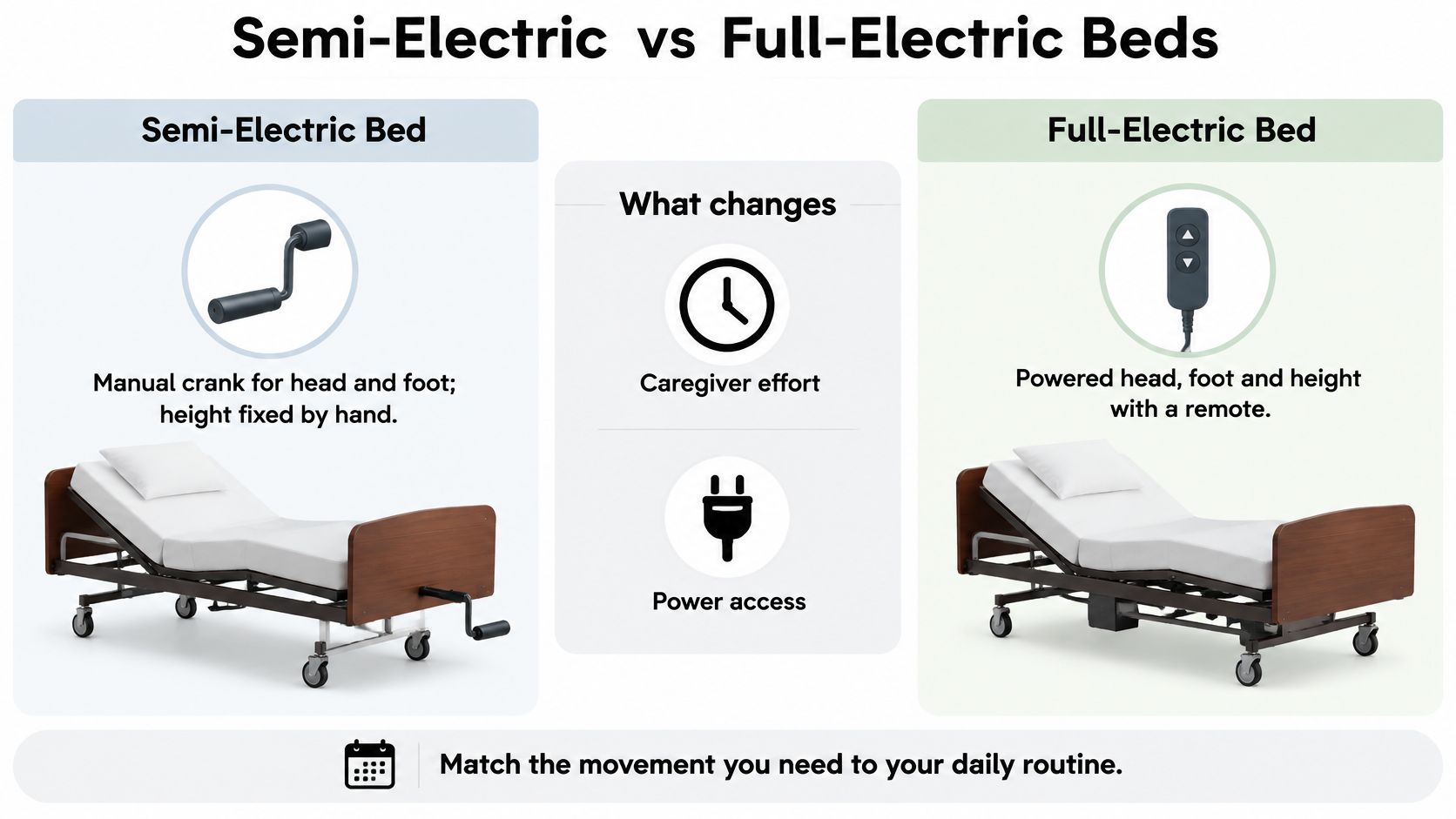
What Each Bed Powers
| Feature | Semi-electric | Full-electric |
|---|---|---|
| Backrest and knee section | Powered by motor, from a handset | Powered by motor, from a handset |
| Overall bed height | Manual, usually a crank at the foot of the frame | Powered with a handset or panel |
| Caregiver effort for transfers | Higher, cranking interrupts the transfer | Lower, deck drops to transfer height before you start |
| Repositioning for comfort and pressure relief | Supported | Supported |
| Typical price | Lower, because there's no height motor or extra actuator | Higher, because the frame adds a height motor and drives it from the handset |
Price follows the hardware. On a full-electric frame you're paying for a third motor, its actuator and the controls that drive it, not for a stronger deck or a better mattress.
If the bed will double as a recliner in a living space rather than sit in a clinical-looking bedroom, it helps to understand what powered positioning does for sleep comfort, and the Guynn Furniture & Mattress sleep guide covers that ground from the adjustable bed side.
So the useful question isn't how many motors a bed has. It's which movement your routine depends on. A crank is a minor nuisance at twice a week and a job at twice a day, and that job is what you're really shopping for.
How Height Control Changes Caregiver Effort
Bed height isn't a comfort setting. It decides whether a transfer happens at a safe angle or at whatever height the bed was left at the last time someone touched it.
The tasks that fill a caregiver's day each want a different working height. Helping someone swing their legs out and sit up works best with the deck low, close to chair height, so feet plant flat. Bathing at the bedside, changing a dressing, or changing linens works best with the deck raised toward your own waist, so you aren't folded over the mattress for twenty minutes. A full-electric frame lets one person set both heights from the handset without leaving the bedside.
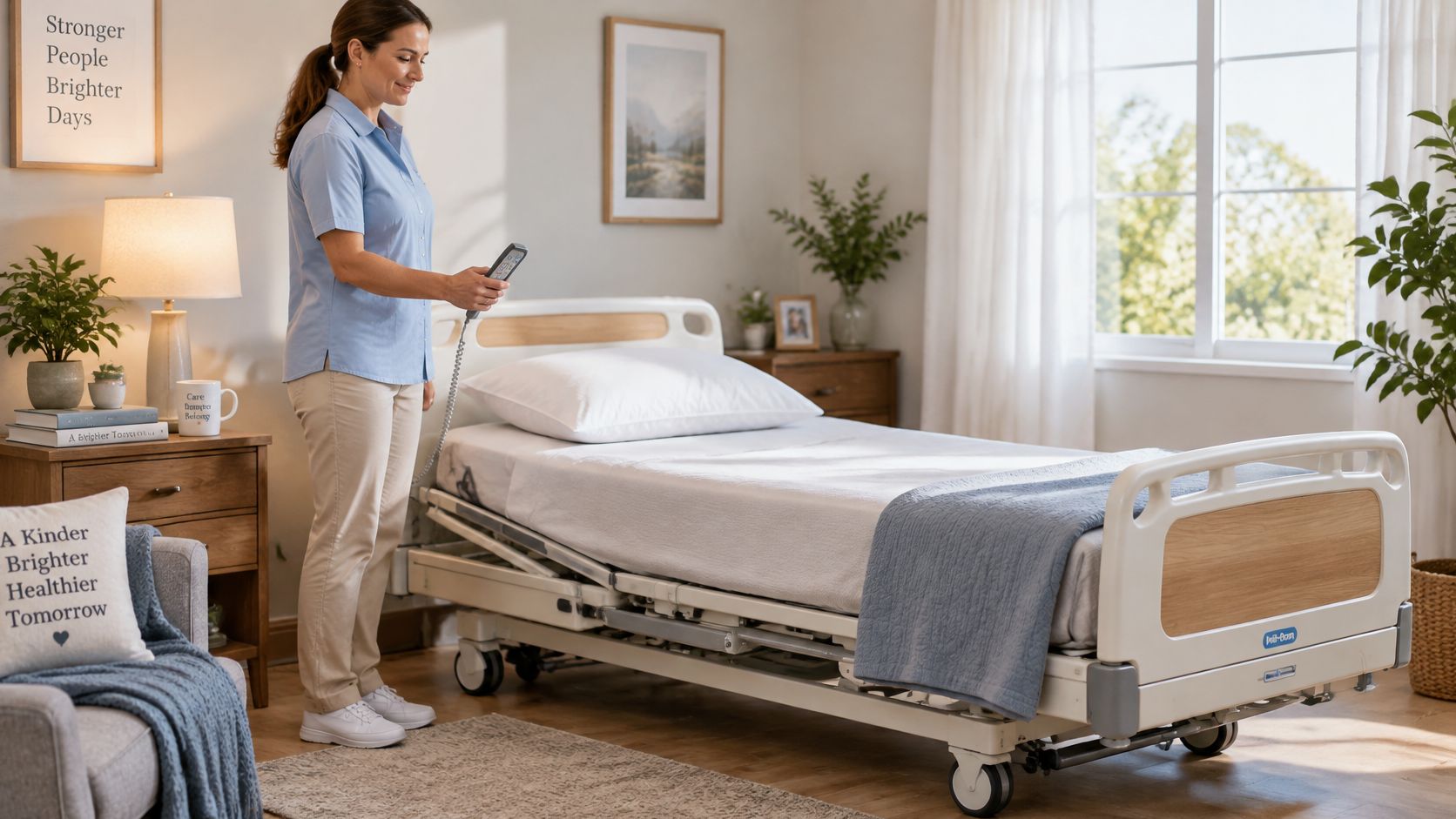
Semi-electric frames are not idle machines. Their head and knee motors carry the repositioning work that fills most of a day: sitting someone up for meals, easing breathing, changing alignment, relieving pressure over the sacrum and heels. What they can't do is move the platform without a walk to the foot of the bed and a turn of the crank. That walk is what kills the habit. After a week, many families stop changing height at all, and every transfer happens at whatever height the bed happened to be left at.
Massachusetts clinical guidance draws the same line for equipment approval. It treats semi-electric beds as appropriate when frequent or immediate position changes are required and the user can operate the controls, while total-electric beds must also show a documented need for variable height, safe independent transfers, and evidence that the option is the least-cost medically appropriate alternative (Massachusetts hospital bed medical necessity guidelines).
A hi-lo frame pushes that same idea further in both directions, dropping closer to the floor for fall safety and rising higher for care work, and the guide to hi-low adjustable beds explains how its range differs from a standard hospital frame.
Three Signals That Point to Full-Electric
- A caregiver already managing back strain. If bending over a mattress hurts on Sunday, adding a crank to every height change makes Monday worse.
- Several transfers a day. Every transfer is a fresh chance for the deck to sit at the wrong height, and the crank makes it tempting to skip the adjustment.
- Independent entry and exit from a wheelchair. A wheelchair seat height is fixed at roughly the same spot every time, and only a powered deck meets it without a second person turning a handle.
The short clip below shows height control in use, which is easier to judge than a spec sheet.
Two Signals That Point to Semi-Electric
- More repositioning than transferring. If the person mostly needs the head and knees adjusted and gets up twice a day with help, the extra motor buys very little.
- A caregiver who can work the crank without strain. A strong, available caregiver who can set the height in a few seconds removes most of the argument for the third motor.
The rule worth writing down: pay for the height motor when the day has more transfers than repositioning, and skip it when the day has more repositioning than transfers.
Why Entrapment Safety Depends on the Whole Bed System
An electric motor feels like a safety feature. It isn't. A bed is safe or unsafe because of how the frame, deck, rails and mattress fit together, and motors change none of those dimensions.
Entrapment happens when a body part, or the head, wedges into a gap created by the bed frame, the deck, the side rails, or the space those parts leave around the mattress. The FDA logged about 691 hospital-bed entrapment reports between January 1, 1985, and January 1, 2006, covering 413 deaths, 120 injuries, and 158 near-miss events where someone stepped in before an injury happened (FDA guide to modifying bed systems and using accessories).
Height control does have a genuine safety role. That same FDA guidance notes height-adjustable electric beds may be the best choice for staff and high-risk patients, and it reports that in the cited study, long-term-care residents were safest from injury when full rails were not used. Both statements point the same way. Bed height and rail choice are clinical decisions made for one person, not accessories you add at checkout.
The standard to ask about by name is IEC 60601-2-52, which covers the basic safety and essential performance of adult medical beds, including electrically and mechanically adjustable designs. Its risk framework addresses entrapment openings around side rails, headboards, footboards and the mattress platform, along with fall prevention and structural loading, and related guidance describes static loading at twice the safe working load or 4,000 N, whichever is greater (FDA recognized consensus standard listing).
Spec Sheet Items for the Frame and Mattress
- Safe working load. The number must clear the user's actual weight with margin, and you should ask what load the frame was tested to, not only what it is rated to hold.
- Mattress dimensions and type. The mattress is part of the gap calculation, and a mattress that is too narrow or too soft changes the openings around the rails.
- Minimum and maximum deck height. The lowest setting decides how far someone can fall and whether feet reach the floor. The highest decides whether a caregiver can work upright.
- Rail type and gap sizes. Half rails, full rails and assist bars create different openings, and the walkthrough on bed rail installation covers fitting a specific rail to a specific frame.
- A written entrapment assessment. Ask the supplier for the assessment covering the exact frame, mattress and rail combination you're buying, not a generic statement about the model line.
Bariatric and tall users need one more step. Confirm in writing that the manufacturer's risk assessment explicitly covers the user's weight and height, because a frame scaled for an average adult can leave wider gaps at the head and foot, and accessories designed for that frame may not close them.
Who Controls the Bed and Who Can Use It Safely
A father with Parkinson's disease can find the head-raise button on his pendant by touch. He cannot hold the pendant steady long enough to press a height button, and his daughter has watched him try while leaning his weight against the mattress. The bed technically has the feature. The household cannot safely use it that way.
That story turns into the question no motor count answers: who operates the bed, and under whose supervision? CMS coverage language assumes the patient can operate the controls, with exceptions written in for certain neurological injuries (CMS national coverage determination for hospital beds). The assumption carries weight for people with dementia, delirium, weakness, poor vision or limited hand function. A bed that a confused user can move is a different object from a bed that only adjusts when a caregiver decides to adjust it.
A full-electric frame does add something real here. It gives the caregiver a transfer tool that works without asking the patient to cooperate with a crank. The trade is more powered movement and more ways to trigger it by accident, which is why pendant lockouts and a rail policy matter as much as the motor itself.
Safety thinking has moved in the same direction. Standards for medical beds increasingly treat the home as a distinct environment rather than a smaller hospital ward: unsupervised users, cluttered rooms, beds operated by people who may not be able to report a problem. When you assess a bed, ask how its controls and clearances behave in that environment, not just how the spec sheet reads.
Control Assessment Checklist
- Pendant lockouts. Confirm the handset can be locked out so only a caregiver can change position.
- Who holds the caregiver controls. Decide whether the pendant lives on the rail, at the bedside, or in a caregiver's pocket, and whether the patient gets a second, limited control.
- Lowest safe height. Set a floor-level limit that matches the person's fall risk, and check it after every power cut or reset.
- Emergency lowering. Know the manual release or battery backup, and test it before the first night at home rather than during one.
- Power failure and cable plan. Route cords out of walking paths and decide what happens in an outage, since a powered deck that cannot move mid-transfer is a fall risk. The guide to safe patient transfer techniques covers how to finish a transfer when the bed can't help.
- Mattress and rail compatibility. Confirm the pair was assessed together, because rails fitted to the wrong mattress create the gap hazards that entrapment assessments are meant to catch.
Keep two ideas apart when you're choosing. Powered height is a caregiver ergonomics and transfer feature, and buying it mostly buys the caregiver's back some relief. Powered positioning of the head and knees is a posture, breathing and pressure-relief feature, and buying it buys the patient's comfort. A person can need one and not the other, and the control layout decides who in the household can use each one.
Medicare Coverage and What You May Pay Yourself
Two questions get tangled in almost every purchase: what will insurance pay for, and what does the upgrade buy? They have different answers, and blurring them is how families end up surprised at the counter.
Medicare Codes and Coverage by Bed Type
| Bed type | Example codes | Coverage position | Who it suits |
|---|---|---|---|
| Semi-electric | E0260, E0261, E0294, E0295, E0329 | May be covered when fixed-height-bed criteria are met and position changes are frequent or immediately necessary | Patients needing frequent repositioning who can operate the controls |
| Total-electric | E0265, E0266, E0296, E0297 | Not covered under the cited policy; powered height is treated as a convenience | Households that want powered height and accept a self-paid upgrade |
Read the policy language closely and you see what it is buying. The DME Medicare Administrative Contractors' 2024 guidance covers semi-electric beds as medically necessary when the underlying fixed-height-bed criteria are met and frequent or immediately necessary position changes are required, while total-electric beds are excluded because the powered height adjustment is classified as a convenience feature (CGS Medicare hospital bed policy). Positioning earns coverage. Height often doesn't.
Other payers write the same logic in their own words. One hospital bed and accessories medical policy allows powered head and foot adjustment when frequent repositioning or an immediate position change is medically required, with exceptions written in for some spinal-cord-injury and brain-damage cases (Paramount hospital beds and accessories policy).
None of those rules measure what the caregiver does. They don't count the number of transfers, the lifting a back injury makes impossible, or the falls prevented by a deck that drops to chair height. A denial of the height motor is a statement about the code, not about your mother's bathroom at 3 a.m.
For scale, the Medline MedLite Full-Electric Homecare Bed we stock lists at $699.00 as a bed frame only, $749.00 with half or full rails, and $819.00 to $929.00 in bed packages with a mattress. That's the out-of-pocket order of magnitude when the height upgrade falls outside coverage.
Five Steps Before You Accept a Code
- Ask the supplier for the written coverage criteria attached to the exact code they plan to bill, not a verbal summary.
- Have the physician document frequency, meaning how often position changes are needed and whether the patient can operate the controls.
- Confirm which code is on the order, semi-electric or total-electric, because the code decides the reimbursement more than the frame does.
- Ask whether the height function is an optional upgrade on the model being quoted, and what that upgrade costs as a self-pay difference.
- Compare that difference with the caregiver hours it saves, then decide with the number in front of you instead of a feeling.
If the paperwork side is unfamiliar, the explainer on whether Medicare covers hospital beds walks through eligibility and the documentation a claim needs. Rules also vary by payer and by plan, so confirm your own policy details with the insurer before the delivery date rather than after.
Choosing the Right Bed for Your Home Situation
Seven factors decide fit: how the person transfers, who is available to help and how strong they are, which heights the daily tasks need, the floor surface and whether the frame will roll or slide, power access near the head of the bed, how long the bed will be in use, and the budget you can spend.
Take a common case. A man in his sixties comes home after hip replacement for about six weeks, and his wife has a bad back. Both bed types handle his repositioning. What his wife needs is a deck that drops so he can stand with his feet flat and rises so she isn't bent over him during dressing changes.
Now change one variable. If the same man lives alone and manages his own transfers, the height motor does a different job, matching the deck to his wheelchair or walker so he isn't pushing up from a surface that's too high. Same bed, different reason.
Which Bed Type Fits Which Situation
| Situation | Better fit | Reason |
|---|---|---|
| Repositioning-heavy patient with a strong caregiver | Semi-electric | Powered head and leg control meets the need without a height motor |
| Caregiver with back strain doing several transfers a day | Full-electric | Lowering the deck cuts bending during bathing and dressing |
| Independent transfers at low height, bed mostly for rest | Semi-electric | Manual height rarely needs changing |
| Cognitive impairment with caregiver-held controls | Full-electric with lockouts | Caregiver controls height, but lockouts and rail policy must be verified |
| Wheelchair user needing bed-level transfers | Full-electric or lift-assist model | Lower deck matches wheelchair height |
| Tight budget, no documented height need | Semi-electric | Avoids paying for a convenience feature |
Lift-assist designs go further for the last two rows. A rotating Hi-Lo electric bed such as the Elevra Rotating Hi-Lo Bed adds a powered turn and lift assist that helps one caregiver move a heavier person without a second pair of hands.
Two accessories decide whether any of this works in practice. The mattress has to match the frame and the rails, and the guide to choosing a mattress for a hospital bed explains how thickness and support change the fit. If you're also adapting the bathroom at the same time, which most home care setups need, a reference on toilet bowl types from Nursing Assessment Australia helps you match the fixtures to a person with limited mobility and limited reach.
Start with the row that matches your household, then check that row against the coverage criteria before you order. Matching the bed to the routine matters more than matching it to a showroom display.
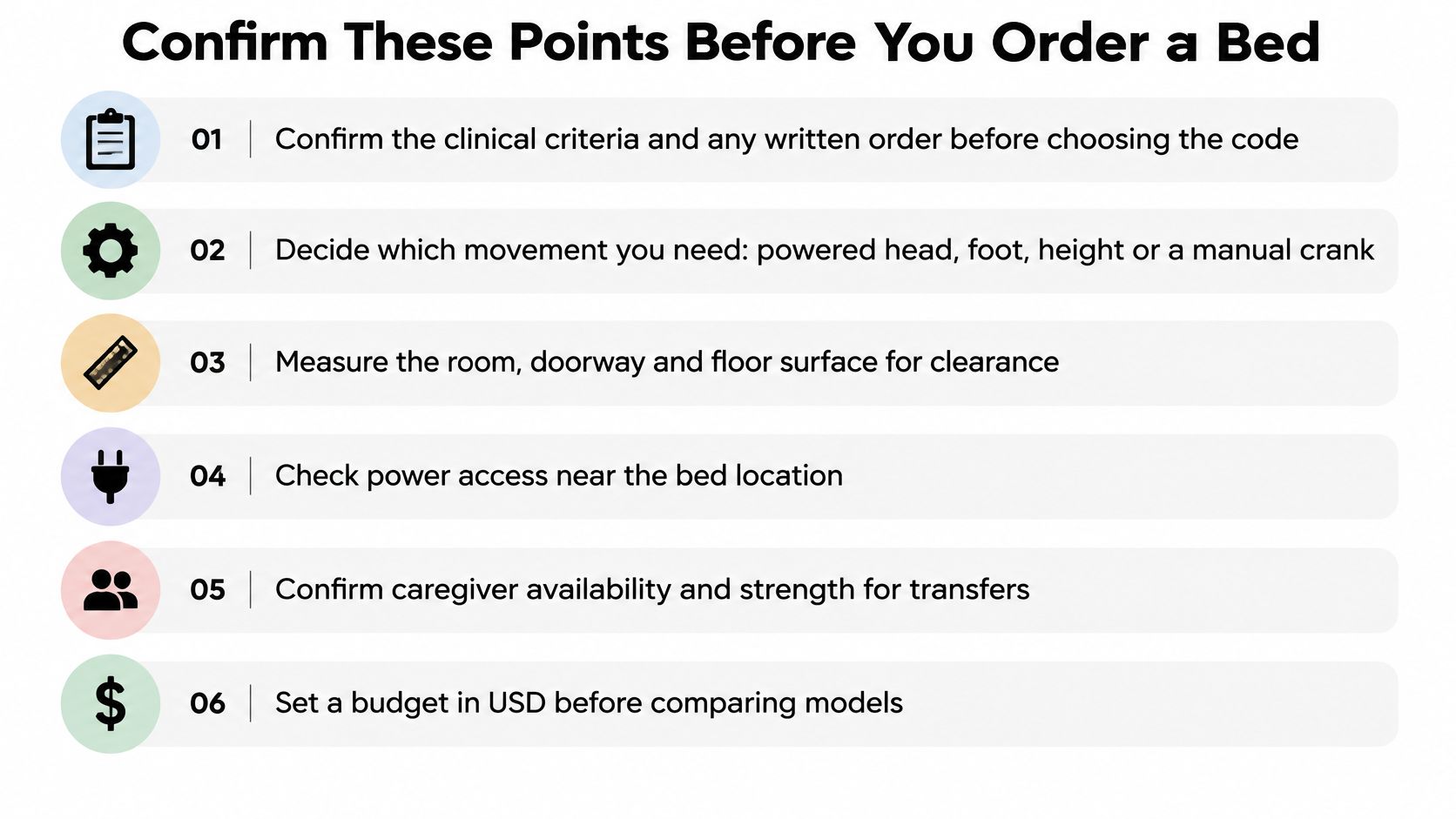
Confirm These Points Before You Order a Bed
- Confirm the clinical criteria and any written order first. Choose the code after the documentation, never the other way around, because the paperwork is what makes the bed eligible.
- Decide which movement you need. Powered positioning, powered height, or both. Write the answer down so the supplier quotes the right model.
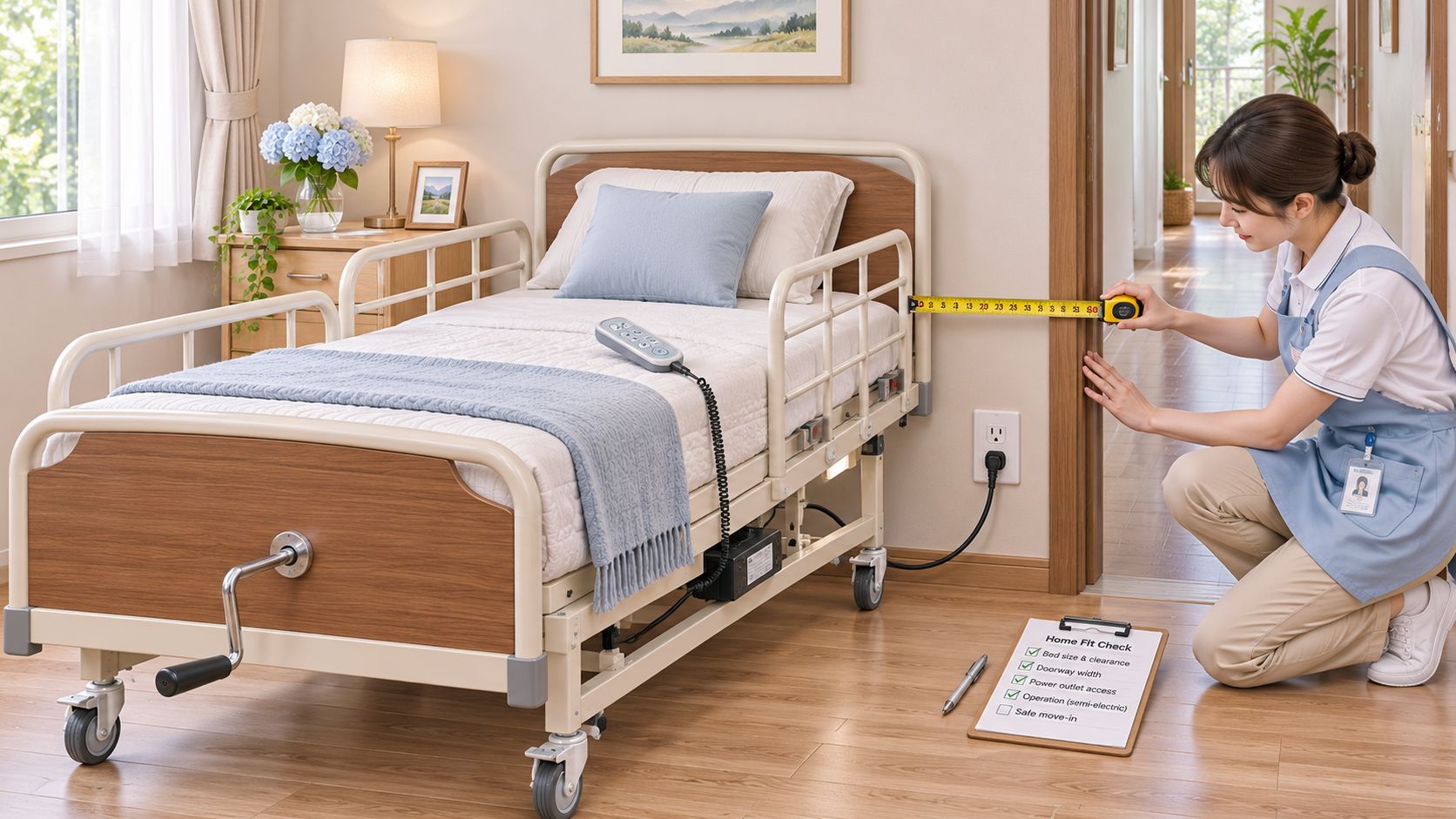
- Check the room, not just the bed. Confirm deck length, frame width and mattress size clear the doorway and leave space for a walker or wheelchair beside the frame.
- Compare height range and capacity against your measurements. The Medline MedLite Full-Electric Homecare Bed offers a 14.5 inch to 22.5 inch height range, a 450 lb weight capacity and 3 inch casters, so check the user's weight and the lowest height needed for a safe transfer. Lift-assist frames such as the EZLift Deluxe Bed, a full electric homecare bed, add a standing assist to that height control.
- Request the written entrapment assessment for the exact bed, mattress and rail combination, and keep a copy with the care plan.
- Ask about trial period, return policy and setup support before delivery day, so a wrong fit can be corrected without a second purchase.
Buy for the movement your daily routine depends on, then write down the reasons: coverage eligibility, the specific safety assessment, and the caregiver's workload. Those three sentences are the ones a supplier, a physician and an insurer will each ask you to repeat.
One more check belongs on the list before you sign anything. Ask who will examine the skin at pressure points once the bed is in place, because a powered frame changes position but doesn't prevent breakdown on its own, and the Vein and Wound Institute bedsore care guide explains the staging and turning routine that a mattress alone can't replace.
DME Superstore carries both bed types side by side, so you can compare a semi-electric frame with a full-electric model on the same deck and the same capacity, with height ranges, rail options and package prices listed clearly. Our homecare range includes full-electric beds with lift assist, like the EZLift Deluxe Bed, along with the rails and mattresses that make a specific bed safe for a specific person, and every product is FSA/HSA eligible with free shipping and a 30-day return policy on most items. Visit DME Superstore to compare models before the delivery date, and use the 24/7 chat if you want help matching a bed to the routine you're living.
