



A standard bed can turn a simple morning transfer into a difficult, risky routine. Your loved one sits on the edge with feet searching for the floor, while you bend forward, reach under an arm, and try to provide support without pulling or twisting. By the end of the week, both people may feel the strain.
Hi-low adjustable beds address that problem by moving the entire sleep surface vertically, not just raising the head or feet. The right model can sit low for nighttime safety, rise to a more suitable transfer height, and provide a practical working position for dressing, hygiene, repositioning, and other homecare tasks. The important question isn't whether a bed moves. It's whether its movement matches the user's body, mattress, mobility, and room.
The Caregiver Advantage of Hi-Low Beds
A daughter helping her father out of bed after hip surgery may perform the same movement several times each day. If the mattress sits too low, he has to rise from a deep seated position. If it sits too high, his feet may not rest securely on the floor. In either case, she may lean over the mattress, support his weight from an awkward angle, and repeat the motion while helping with clothing, toileting, or repositioning.
Independent guidance notes that caregivers commonly injure themselves while assisting someone out of a standard bed, and that an adjustable bed can make getting in and out easier while reducing strain on joints and caregivers' backs. The benefits of adjustable beds become more meaningful when you consider that the bed is also a work surface for the person providing care.
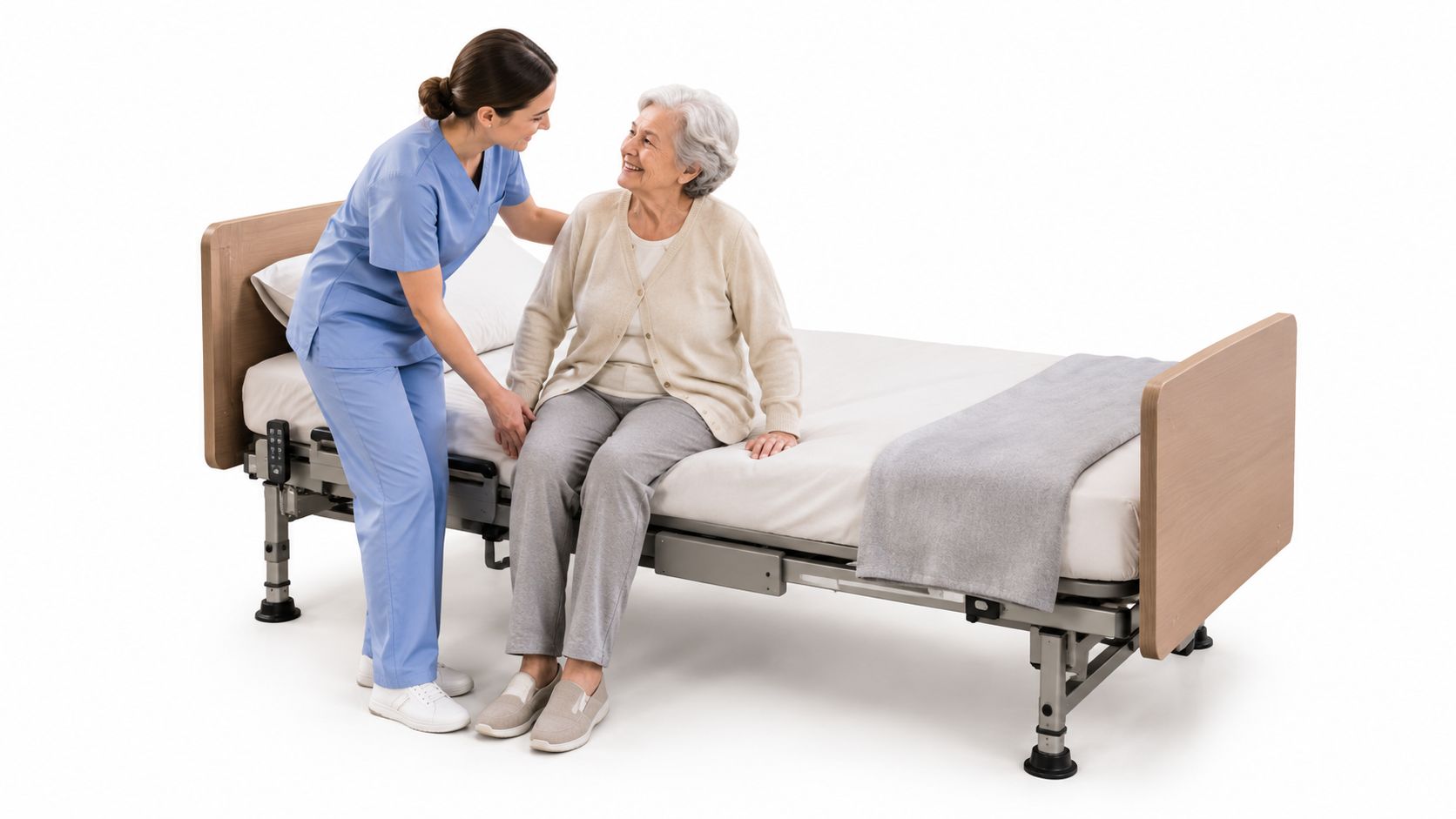
Where the height change helps
A standard adjustable base changes body position but keeps the frame at a fixed height. A hi-low bed adds powered movement for the entire platform, so the caregiver can raise the mattress before providing hands-on assistance and lower it again when the person is resting.
That flexibility is useful for several home situations:
- Post-surgery recovery: A higher transfer position can reduce the need for deep bending after procedures affecting the hips, knees, or back. The user still needs to follow the surgeon's transfer instructions.
- Aging in place: A person who can sit, stand, and return to bed with less assistance may retain more control over a familiar bedroom routine.
- Bariatric care: A suitable frame, mattress, and support accessories can give caregivers more room to work, but the complete system must be rated for the user and mattress together.
- Daily personal care: Raising the deck can make dressing, repositioning, and hygiene tasks easier for a caregiver to perform without leaning across the bed.
A hi-low bed isn't a substitute for transfer training or professional assessment. It also won't eliminate risk if the user has poor balance, cannot bear weight, or needs two-person assistance. It gives the caregiver a better mechanical starting point, which is very different from promising that the bed can manage a transfer on its own.
For readers comparing medical functionality with residential comfort, a practical resource on how to find better sleep with an adjustable base can help clarify the difference between comfort positioning and care-oriented height adjustment.
Practical rule: Choose the bed around the hardest daily transfer, not the most comfortable position in the showroom.
Core Mechanics and Safety Thresholds
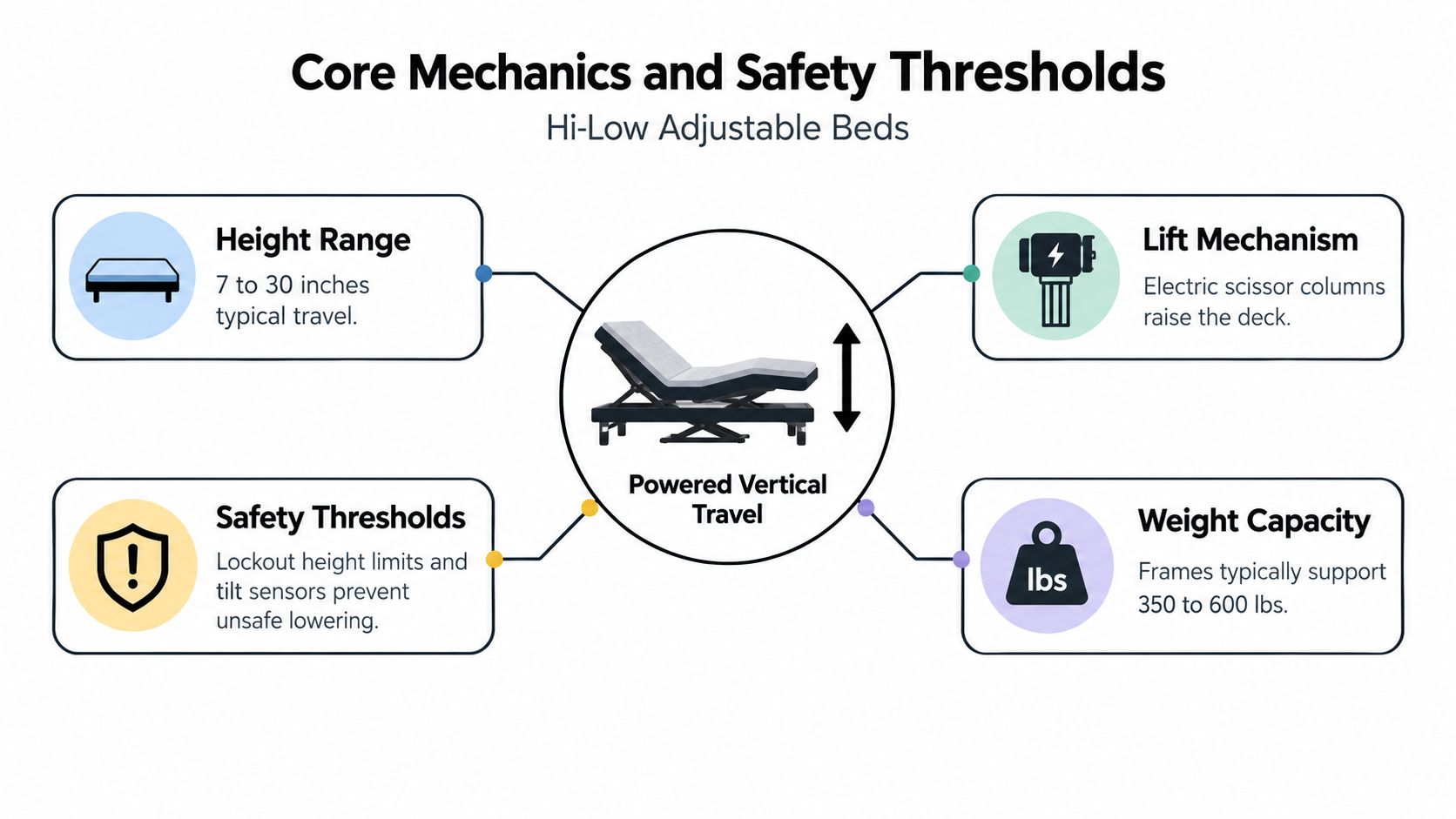
A person preparing to stand may need the bed at a different height than a caregiver performing wound care or changing linens. The defining feature of a true hi-low adjustable bed is powered vertical travel of the entire deck. Head and foot articulation can improve positioning, but those movements do not change the mattress's height above the floor. The hi-low mechanism moves the complete sleep surface, allowing one frame to support transfers at one height and caregiving tasks at another.
A typical frame provides about 7.5 inches of powered vertical travel at deck level. One major model moves from 13.25 inches to 20.75 inches. With a low-profile mattress, the floor-to-top-of-mattress range can run from 16.5 inches lowered to 24 inches raised, while a thicker mattress configuration can bring the top surface as high as 30.75 inches. These measurements come from the Flex-A-Bed hi-low bed specifications. They show why buyers must compare the complete sleeping surface, not only the frame specification. For a broader comparison of deck travel and other home-use frame functions, see our guide to electric hospital beds for home use.
The lower-leg measurement buyers miss
The lowest setting should match the user's body, especially the length from the floor to the knee. Safe sit-to-stand movement depends on placing both feet securely and generating force through the legs. Bed height that exceeds the user's stable foot-and-knee position can make the seated edge feel too high, while a setting that is too low may require excessive effort to rise.
Measure the user's lower-leg length as part of a wider transfer assessment, then compare it with the top of the mattress, not merely the deck. Mattress thickness, casters, and leg extensions all change the final sitting height. Even a small hardware change can alter the transfer geometry, so the same frame may suit one user and frustrate another.
The lowest point is not automatically the safest point. A very low bed can reduce the distance of a fall, yet a user who cannot place both feet securely or push up with control may still need a rail, transfer aid, or caregiver support. Low-bed use can remain unsafe without the right assistance, so pair the low setting with a reliable transfer method rather than treating low height as a complete safety solution.
Height is only one safety control
The FDA advises keeping an occupied bed in its lowest position with the wheels locked, then raising it for care tasks or transfers in and out of bed. Its guidance also discusses placing a high-impact mat beside a low bed when the mat will not create a trip or mobility hazard. Review the FDA bed safety guidance before setting up a fall-prevention plan.
The bed's history helps explain the purpose of these controls. Adjustable hospital-bed development includes a 1874 patent awarded to Andrew Wuest and Son for an adjustable hospital bed frame, Dr. Willis Dew Gatch's 1909 three-segment Gatch bed, patient controls appearing in 1949, Hill-Rom's first electric-engine bed in 1952, and its first fully electrical bed in 1956. These milestones are documented in the history of adjustable recovery frames. Modern homecare beds bring that positioning heritage into residential rooms, where floor clearance, transfer space, and caregiver access still need careful planning.
For a closer look at powered functions beyond vertical lift, this video offers a visual introduction to electric hospital-bed operation:
A safe setup combines the user's measurements, a compatible mattress, locked wheels, suitable rails or aids, and a transfer method the person can perform reliably. The bed supplies adjustable mechanics. It does not perform the transfer for the user.
Choosing the Right Mattress Configuration
A person may sit safely on the bed at one height and struggle at another. The frame controls movement, but the mattress determines where the body meets the edge. Added thickness can raise the sitting surface above the user's stable transfer position, even when the frame's lowest setting appears suitable. It also changes rail coverage, sheet fit, deck articulation, and the total load carried by the motors.
Start with pressure-care needs. A standard high-density foam mattress may suit someone who can reposition independently and mainly needs stable support and comfort. An alternating-pressure mattress cycles support across different body areas and may suit a person with increased pressure-injury concerns. A low-air-loss mattress uses airflow to help manage the skin environment when moisture and pressure control are part of the care plan. A clinician or wound-care professional should direct the choice for anyone with an existing wound or significant pressure risk.
Mattress Type Comparison
| Mattress Type | Primary Benefit | Ideal User Profile |
|---|---|---|
| High-density foam | Stable support with straightforward setup | Users seeking general comfort who can reposition with limited assistance |
| Alternating-pressure | Cycles support across different areas of the body | Users with pressure-care needs identified by a clinician |
| Low-air-loss | Helps manage the skin environment through airflow | Users who need added moisture and pressure management |
| Specialized medical air surface | Provides care-focused support within a compatible system | Users whose clinical plan calls for a more advanced pressure-relief surface |
Match thickness to the transfer plan
Measure the finished bed with the selected mattress installed. For example, a 6-inch low-profile mattress on a 13.25-inch deck produces roughly a 19-inch seated edge. A 10-inch therapeutic surface on that same deck raises the edge to about 23 inches. That difference can determine whether the user's feet reach a stable position and whether standing feels controlled.
As noted earlier, mattress thickness shifts the finished floor-to-top-of-mattress height. Ask the retailer for that completed measurement with the exact mattress, topper, overlay, or air system you plan to use. Compare it with the user's lower-leg length, because a seated edge near the feet-flat position generally supports a more controlled sit-to-stand transfer.
A hospital mattress will not fit every adjustable frame. Check the permitted length, width, thickness, flexibility, weight, and retention method. A surface that cannot bend with the deck may slide, buckle, or interfere with rails.
Sheet sizing creates another practical concern. Deep-pocket sheets can bunch as the head or foot section rises, while standard sheets may pull at the corners. Confirm the recommended dimensions and whether the manufacturer permits toppers, overlays, or air systems.
A guide to choose the right adjustable bed mattress explains flexibility and fit for general shoppers. DME Superstore's guide to a mattress for a hospital bed addresses considerations for a medical-care routine.
Measure the finished bed, not the empty frame. The transfer height is the distance from the floor to the top surface where the user sits.
Matching Features to Patient Needs
Start with the person's movement pattern rather than a list of premium features. Someone who walks independently and wants occasional help rising may prioritize a low setting and a simple remote. Someone who needs repositioning, pressure care, or assisted transfers may need compatible rails, a suitable medical mattress, locked casters, and controls that a caregiver can reach.
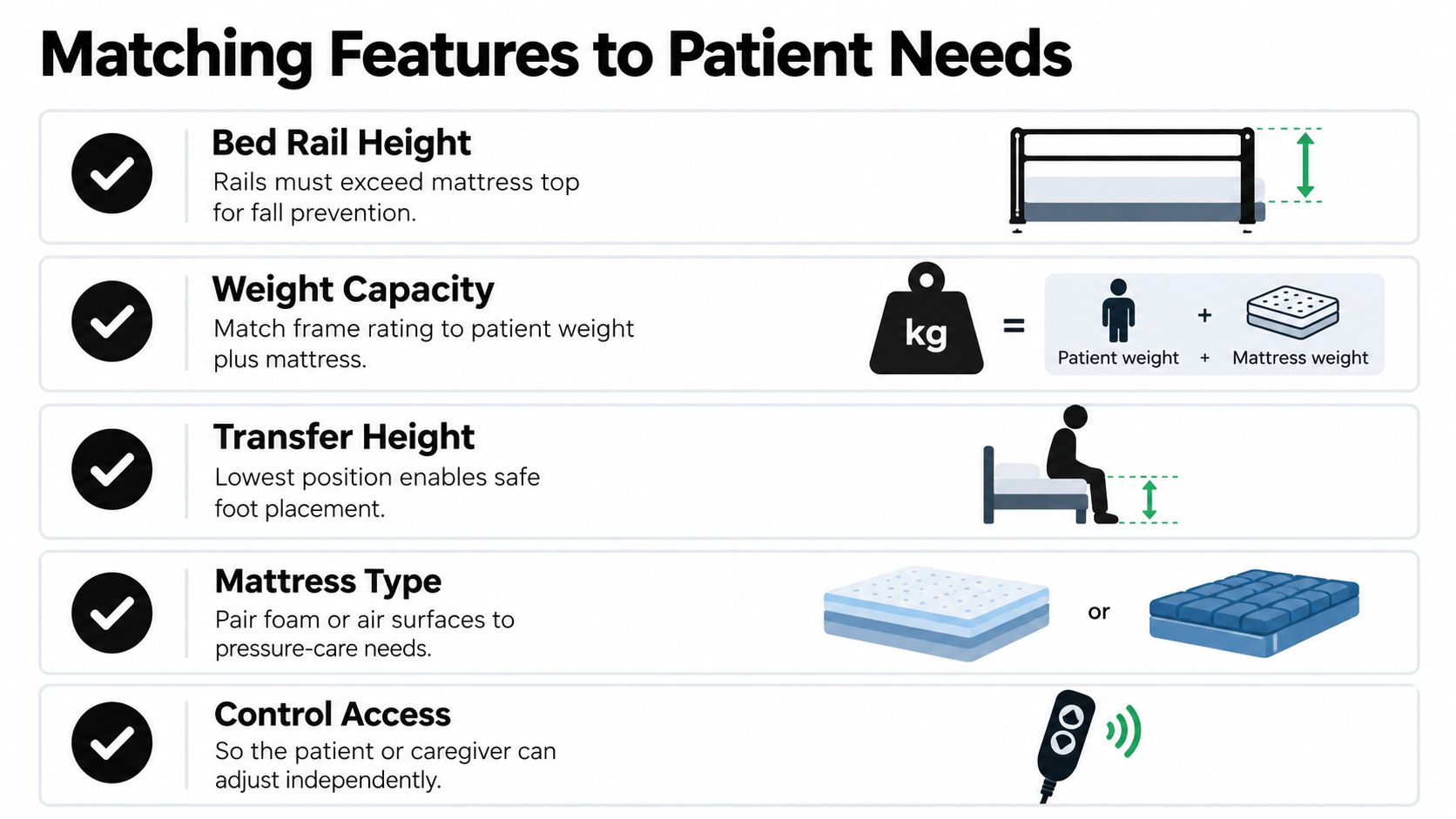
Use a patient-first decision sequence
- Describe the transfer. Does the user stand from the edge, pivot to a wheelchair, use a walker, or require hands-on support? The answer determines whether the lowest setting, a raised working height, a support rail, or a separate transfer aid matters most.
- Check the complete weight rating. Confirm that the frame rating includes the user, mattress, bedding, and any equipment placed on the bed. Bariatric users need more than a strong motor. They may also need a wider sleep surface, reinforced support, and enough room for the caregiver to work safely.
- Select articulation for the care plan. Head elevation may help a person who needs an upright position for meals or certain routines. Foot elevation can support comfort when the legs need to be raised. These positions should follow clinical advice when the user has respiratory, circulatory, post-surgical, or neurological needs.
- Test control access. A large, clearly marked remote may work well for one user, while another may need caregiver-controlled access because of limited dexterity, vision, cognition, or hand strength. Make sure the remote can be reached from the normal lying and sitting positions.
- Treat rails as a system component. A rail must be approved for the exact frame and mattress combination. It should provide a stable handhold without creating an entrapment risk or blocking an intended transfer.
Configuration details can change the result
Some hi-low beds are freestanding and may not accept a headboard. Height can also change with mattress thickness and leg extensions, as explained in the adjustable bed FAQ. Ask for written compatibility information before ordering a headboard, footboard, rail, caster, or mattress overlay.
A person with limited balance may need more than a low bed. A transfer pole, gait belt used by a trained caregiver, wheelchair positioning, or professional home assessment may be appropriate. Don't add a rail just because it looks reassuring. The rail must support the intended movement and remain compatible with the user's ability to get in and out.
For broader context on how adjustable positioning may relate to comfort and common health concerns, the adjustable base health guide offers a useful starting point. A medical bed decision still requires closer attention to transfer mechanics and accessory fit.
Navigating Insurance and Payment Options
Many families assume a doctor's note means insurance will automatically pay for a hi-low adjustable bed. That assumption can create a difficult surprise at checkout. One manufacturer FAQ states that insurance usually doesn't cover hi-low adjustable beds, so buyers should verify benefits directly rather than build a care plan around an expected reimbursement.
Coverage rules can vary by insurer, diagnosis, equipment classification, and documentation. Ask the plan administrator whether the exact product, mattress, rails, delivery, setup, and accessories are treated separately. Request the answer in writing, and ask whether prior authorization or a letter of medical necessity is required.
This durable medical equipment guide can help families understand why a product's medical purpose doesn't guarantee coverage. A bed may be designed for homecare and still fall outside a particular benefit.
Build the real purchase budget
The frame is only one part of the cost. Include the compatible mattress, rails or transfer supports, caster configuration, delivery, room preparation, and any service or warranty option. A mattress that changes the finished height may be clinically more appropriate, but it can also alter the budget and accessory requirements.
Families may also investigate FSA and HSA spending. Eligibility depends on the account rules and the buyer's documentation, so confirm the requirements before using pre-tax funds. A letter of medical necessity may be relevant for some purchases, but it doesn't replace the account administrator's decision.
Financing can spread the upfront payment when a safe bed is needed before a family can save the full amount. Affirm is one financing option offered through the publisher described in this guide, subject to its own approval terms and conditions. Read the total repayment obligation, not only the scheduled payment.
A sensible order is to verify coverage first, confirm the clinical configuration second, and compare payment methods third. Don't choose a cheaper mattress or omit a needed safety accessory just to make the frame price fit an incomplete budget.
Installation and Room Preparation
On delivery day, a bed can fit the bedroom and still fail in daily use. The doorway may be too narrow, the caregiver may have no transfer space, or the lowest setting may not match the user's lower-leg length. Mark the intended transfer side and measure the route from the entrance to that position before ordering. A few inches can determine whether the user can sit with feet stable on the floor or must slide forward unsafely.
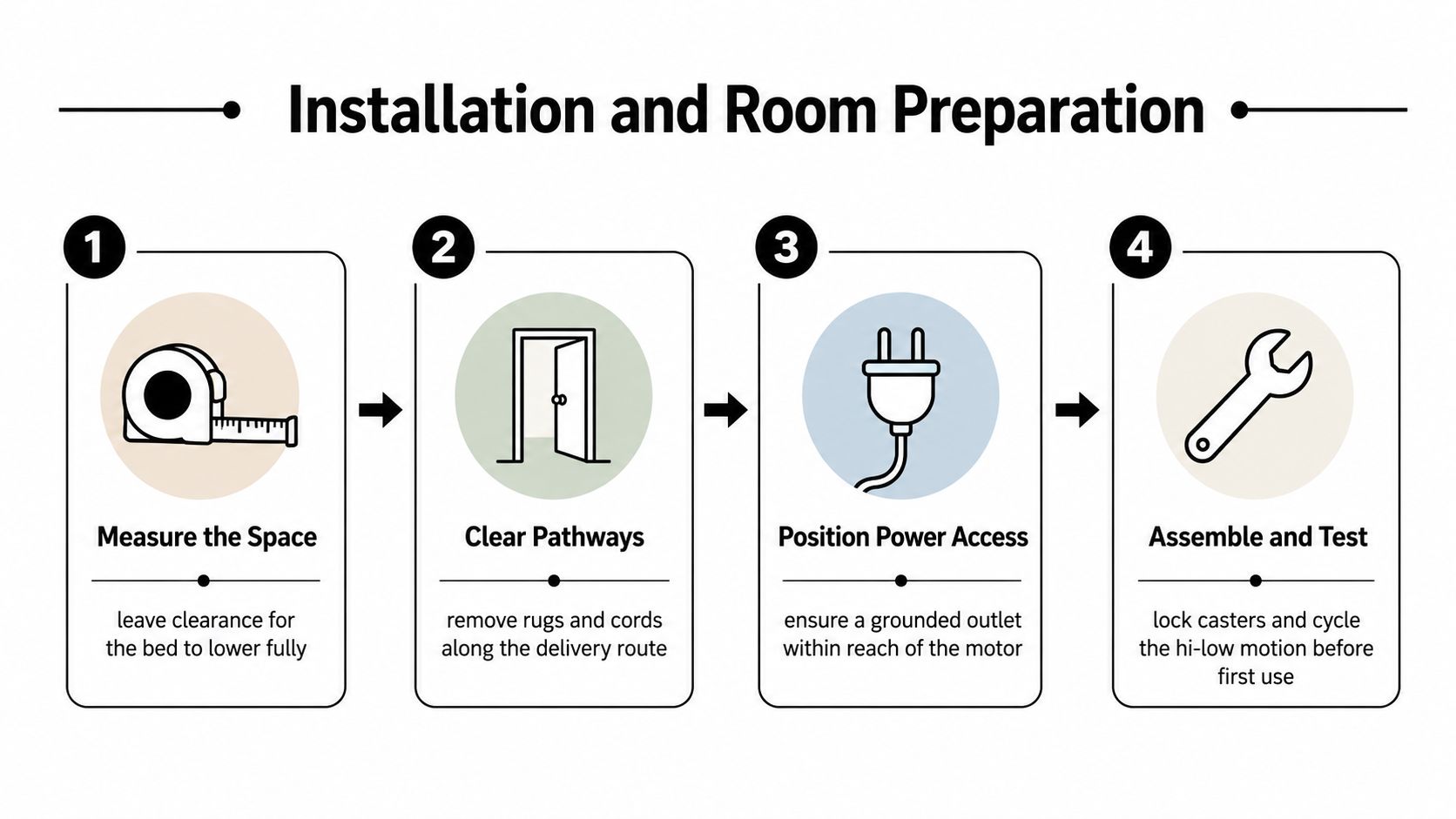
Prepare the room in sequence
- Measure the space: Check the bed's footprint, door and hallway clearance, and the space beside the sides and foot. Allow room for the platform to lower fully, for rails to operate, and for a caregiver to approach the transfer side.
- Clear the delivery route: Remove loose rugs, cords, small furniture, and other obstacles. A heavy frame may be difficult to turn through a narrow hallway, even when it fits in the bedroom.
- Position power access: Place the bed near a properly grounded outlet so the motor cord does not cross a walking route. Do not use an extension arrangement unless the manufacturer specifically permits it.
- Assemble and test: Lock the casters, inspect each connection, and cycle the hi-low movement with no user on the bed. Check that the mattress remains secure and that rails, cables, and accessories do not restrict movement.
A dedicated circuit may be appropriate if the manufacturer or an electrician recommends one, particularly when other high-load devices share the outlet. Keep the power supply dry, protect cables from moving parts, and unplug the bed before servicing electrical components. If the model has an emergency or battery function, test it before the bed is needed.
Plan for a controlled fall zone
As noted in the safety-thresholds section, FDA guidance supports a high-impact mat next to a low bed when it does not create a greater hazard. During installation, choose a mat at least as wide as the bed and long enough to cover the likely fall path. Secure or position its edges so a walker, wheelchair, or caregiver's foot cannot catch during a transfer. A mat that slides, curls, or blocks equipment can increase risk rather than reduce it.
Keep everyday items within safe reach, but outside walking routes. The remote, glasses, water, phone, and mobility aid should be accessible without becoming objects the user might trip over or grab at an unstable angle.
Maintain the moving parts
Follow the manufacturer's inspection schedule for motors, cables, casters, frame joints, rails, and mattress retainers. Watch for unusual noise, uneven lifting, delayed response, or movement that stops before its normal position. Stop using a malfunctioning lift and contact qualified service support instead of attempting an improvised repair.
If setup assistance would help, review the white-glove delivery service before ordering. Confirm whether it includes room placement, assembly, packaging removal, and operational testing.
Finalizing Your Hi-Low Bed Decision
The adjustable-bed category has moved well beyond a niche hospital product. One industry report valued the global adjustable beds and mattress market at $8.05 billion in 2025, reflecting broad adoption of motorized positioning platforms in residential and senior-care environments, as reported by Research and Markets. That growth gives families more choices, but more choices also make specification checking essential.
Use the following checklist before placing an order:
- Transfer height: Compare the lowest finished mattress height with the user's lower-leg length and actual sit-to-stand method.
- Vertical travel: Confirm how far the entire deck moves, not just how far the head or foot section articulates.
- Mattress fit: Verify thickness, flexibility, dimensions, weight, pressure-care function, and rail compatibility.
- Safety accessories: Check whether rails, transfer supports, locking casters, retainers, and fall mats suit the person's mobility.
- Room fit: Measure the delivery route, final footprint, caregiver access, and power location.
- User controls: Make sure the person or caregiver can operate the required movements reliably.
- Payment plan: Confirm insurance, FSA or HSA eligibility, financing terms, delivery charges, and accessory costs before checkout.
- Support after purchase: Review the warranty, service process, return policy, and availability of replacement components.
A standard adjustable base may be enough when the goal is head and foot positioning for comfort. A hospital bed may be more appropriate when the person needs a clinical frame, specific rails, frequent skilled care, or a prescribed support surface. A hi-low adjustable bed sits between those categories for families who need powered height adjustment in a bedroom-oriented design, but the right choice depends on the user's assessed needs.
Ask a physical therapist, occupational therapist, nurse, or qualified homecare equipment specialist to observe the transfer when the situation is complex. Provide them with the exact mattress and accessory specifications, because a recommendation based on the empty frame may not reflect the finished bed.
DME Superstore offers hi-low electric beds, pressure-relief mattresses, transfer aids, rails, and related homecare equipment with product specifications and compatibility information for comparison. Visit DME Superstore to review available configurations, use chat support for product questions, and select a setup that fits the user's measurements and daily care routine.

