



The discharge packet says hip replacement, home the same day, and under a heading that reads Hip Kit there are eleven items you're supposed to have. You're home by lunch. The walker is leaning against the hallway wall, the bathroom door is narrower than you remember, and the first thing you need to do is sit down.
That's the moment a generic list stops helping. Nobody who handed you that paper measured your toilet, counted your stairs, or asked whether your shower has a tub wall to step over. What follows is the version of that list a clinician would give you in person: what each item is for, which ones you buy before surgery, which ones you borrow, and which ones you don't order until someone on your care team confirms you need them.
Why the First Days Home Need the Right Gear
The first morning home starts earlier than anyone plans. You need the bathroom, the walker is folded where someone left it, and your leg doesn't feel like yours yet.
After hip replacement, mobility equipment is needed immediately, not eventually, because patients are expected to begin sitting up and walking soon after surgery, usually with a walker, crutches, or cane. The American Academy of Orthopaedic Surgeons treats walking with an assistive device, and safely managing two or three stairs, as the milestones that matter before home life becomes manageable.

That reframes the shopping question. Stability and a correct fit come first. Speed of transition comes last, and it's decided by your surgical and rehabilitation team, not by how you feel on a given morning.
What the Printed List Leaves Out
A generic kit doesn't say which items fit this toilet, this tub, or these stairs, and it can't carry your surgeon's weight-bearing orders. Those vary: full weight bearing may be permitted immediately or delayed for several weeks depending on the implant, the surgical approach, and your surgeon's instructions. Less pain is not permission to put the device away.
AAOS guidance also notes that patients may need help with cooking, shopping, bathing, and laundry for several weeks. That makes a walker tray or basket and a willing caregiver as practical as the walker itself, and it's worth lining both up before the day of surgery.
Three Labels for Every Item
Every piece of equipment in this guide gets one of three marks: buy before surgery, borrow or rent, or confirm with the therapist first. Sorting items this way is what keeps you from spending on gear that doesn't fit your bathroom, your anatomy, or your precautions.
Setting up the room ahead of time also makes recovering from surgery at home calmer, because the first week is about walking and resting, not about assembling furniture or hunting for a grab bar.
The Home Equipment Map by Recovery Job
Here is the whole map on one screen. Read it as a work order, not a wish list.
| Equipment | Job it covers | Usual timing | Get it how |
|---|---|---|---|
| Front-wheeled walker | Early walking with a wide base | First days to early weeks | Buy or arrange before surgery |
| Crutches or single cane | Walking once less support is safe | After therapist sees stable gait | Often later; do not switch for pain alone |
| Raised toilet seat or bedside commode | Sitting without a deep hip bend | From the first day home if the toilet is low | Buy before home only after measuring the toilet |
| Shower chair | Seated bathing in a walk-in shower | First baths, while balance is poor | Buy or borrow if the shower has no tub wall to step over |
| Tub-transfer bench | Seated entry into a tub-shower | First baths in a combination tub | Buy or borrow for a tub; skip for a walk-in shower |
| Grab bar or toilet safety frame | Steady sit-to-stand | While transfers are weak | Install or buy only if placement and weight rating are confirmed |
| Reacher, sock aid, long-handled shoehorn, dressing stick, long sponge | Dressing and washing without bending | Daily until bending limits ease | Buy the small set before surgery; many plans do not cover it |
| Firm chair with armrests | Safer sitting than a low sofa | All day from arrival home | Use what is already at home if the seat is high and firm |
| Walker tray or basket | Carrying small items | Several weeks of limited household tasks | Optional add-on; a caregiver is still needed for meals and laundry |
Mark Every Row Before You Buy Anything
Take a pencil to that table. Anything the home clearly lacks gets buy before surgery, because the day you come home is the worst day to shop. Anything you'll use for a short window gets borrow or rent, which is most shower chairs and tub benches. Anything whose need depends on a measurement or a precaution gets confirm first, and that includes raised toilet seats, grab bars, and safety frames.
Most hip kits fail at this point. Hospital and rehabilitation guidance routinely names a walker, a raised toilet seat or commode, shower equipment, a reacher, a sock aid, and a long-handled shoehorn, but the same guidance also says the occupational therapist should evaluate the individual's equipment needs. Providence's joint replacement handbook makes the practical consequence explicit: a raised seat helps a low toilet, but could be unnecessary or unstable if the bathroom already has an appropriately high, well-supported one.
Sorting rule: buy what your body and your floor plan already require, rent what a short phase requires, and confirm anything that depends on your surgeon's precautions.
One Job Per Tool in the Small Set
The cheap items are the ones people skip, and they're the ones that keep you from bending. A reacher picks up dropped items and clothes from the floor. A sock aid lets you put on a sock with the hip less flexed, and a long-handled shoehorn does the same for shoes. A dressing stick helps you pull pants up without reaching past your knee, and a long-handled sponge washes the leg you can't easily reach while you're sitting on a shower chair.
None of these are glamorous. All of them earn their few dollars in the first week. The trade-off is real, though: your arms and shoulders take over work your hip used to do, and the resulting soreness is worth raising with your care team. Many people find topical relief for sore hips useful for the muscular ache that comes with a new gait pattern.
What the Hospital Hands You and What It Doesn't
The walking aid is usually supplied or taught by the hospital. The rest of the list is generally on you, and UCSF's hip replacement guide notes that many insurance plans do not pay for these recovery aids. That's why the small dressing set is worth buying early rather than discovering the gap at the pharmacy counter.
Before discharge, practice one outfit and one sit-to-stand with the therapist. Ask them to watch you get up from the chair you'll use at home. Good safe patient transfer techniques are a learned skill, not instinct, and a therapist can correct your hand placement in about thirty seconds.
Then take your marked rows to the pre-op visit instead of ordering the entire kit online.
How to Choose the First Walking Aid
Choosing by product category is the wrong shortcut. A walker isn't "better" than a cane in the abstract; it's better when you can't yet load one leg without losing your balance.
A front-wheeled or standard walker is typically the highest-priority item right after total hip arthroplasty because it provides a broad base of support while postoperative weakness, pain, and impaired balance limit safe single-leg loading. Rehabilitation guidance recommends training patients before surgery to use an assistive device and to have equipment such as a walker, bed rail, shower chair, and, when appropriate, a raised toilet seat in place beforehand, as described in this review of post-arthroplasty rehabilitation guidance.
Fit Comes Before Category
Match the aid to four things and the decision usually makes itself. Height: the handles sit near wrist level with your elbows slightly bent, so you're not stooping or shrugging. Weight capacity: read the stated limit rather than assuming it's fine. Hand strength: grips and brakes have to be operable on your worst day, not your best. Stairs: the device you choose has to match the stair layout the therapist has already practiced with you.
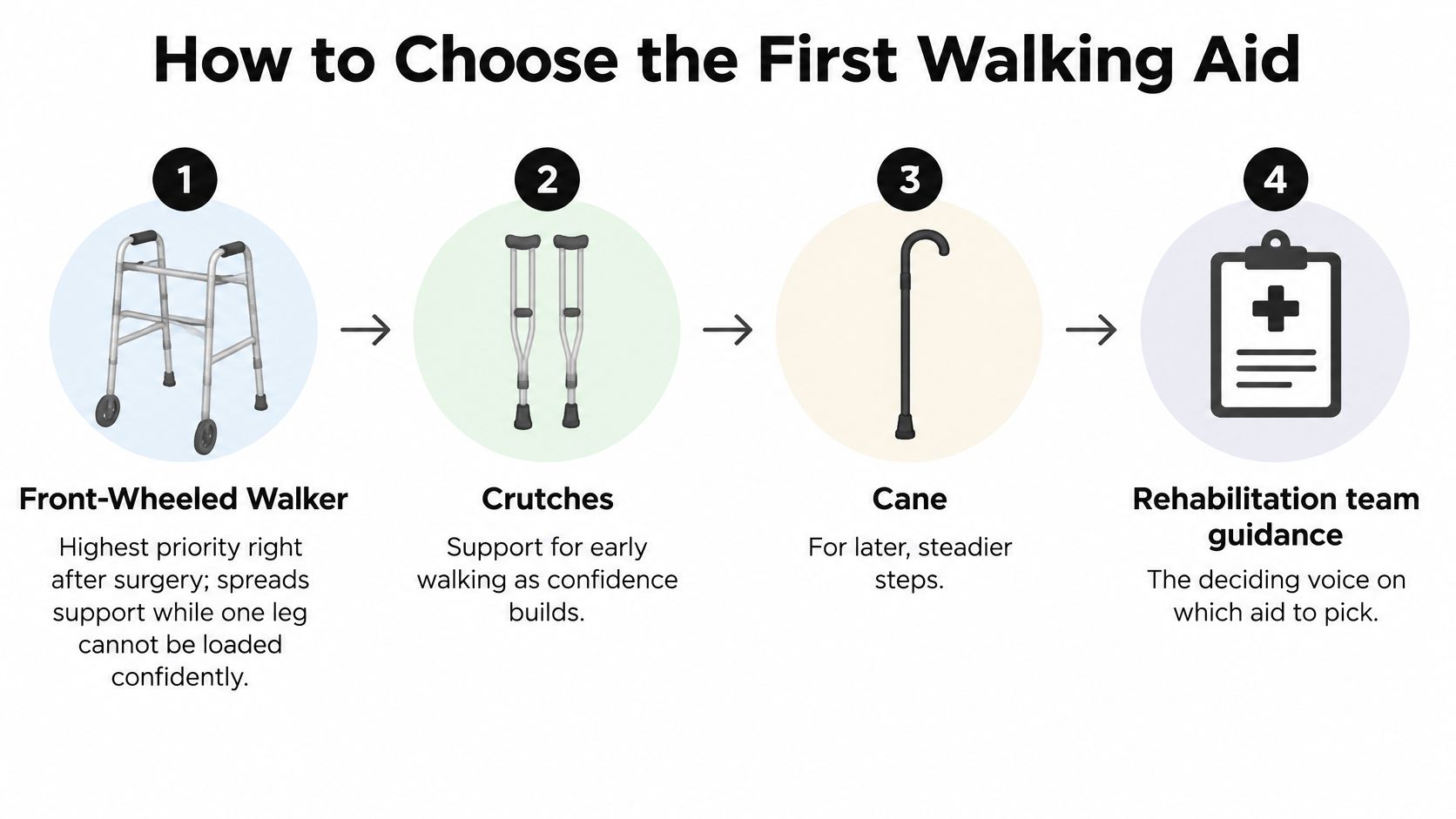
A cane on the side opposite the surgical hip is a later skill, not day-one equipment. Progression runs walker, then crutches or a single cane, then no device, and only when gait stays even at each step. If you want a closer look at the early-stage options, this guide to the best walkers for elderly users covers wheel configuration and fit.
Clearances Decide Whether It Works at Home
Walk your hallway with a tape measure before surgery. Furniture needs to move until paths are wide enough for the walker to pass and turn, and loose rugs, cords, and clutter need to go. Narrow halls and bathroom doors are the usual failure point. If the walker can't turn in the bathroom, a different device or a rearranged route is safer than forcing it through twice a day.
Stairs and Cars Are Separate Skills
Stairs get practiced with the therapist, and the rail needs to be on the side your stronger hand can grip. Car transfers are a separate skill again, so ask the therapist to practice getting in and out of a car with the chosen device before your first ride home.
That short video walks through the same progression from a clinician's viewpoint, which helps when you're explaining it to a spouse or caregiver who wasn't in the room for discharge teaching.
Photograph your tightest doorway and your stairs, and bring the measurements to your next therapy visit. Numbers end the guesswork faster than memory does.
Bathroom Gear That Matches the Actual Room
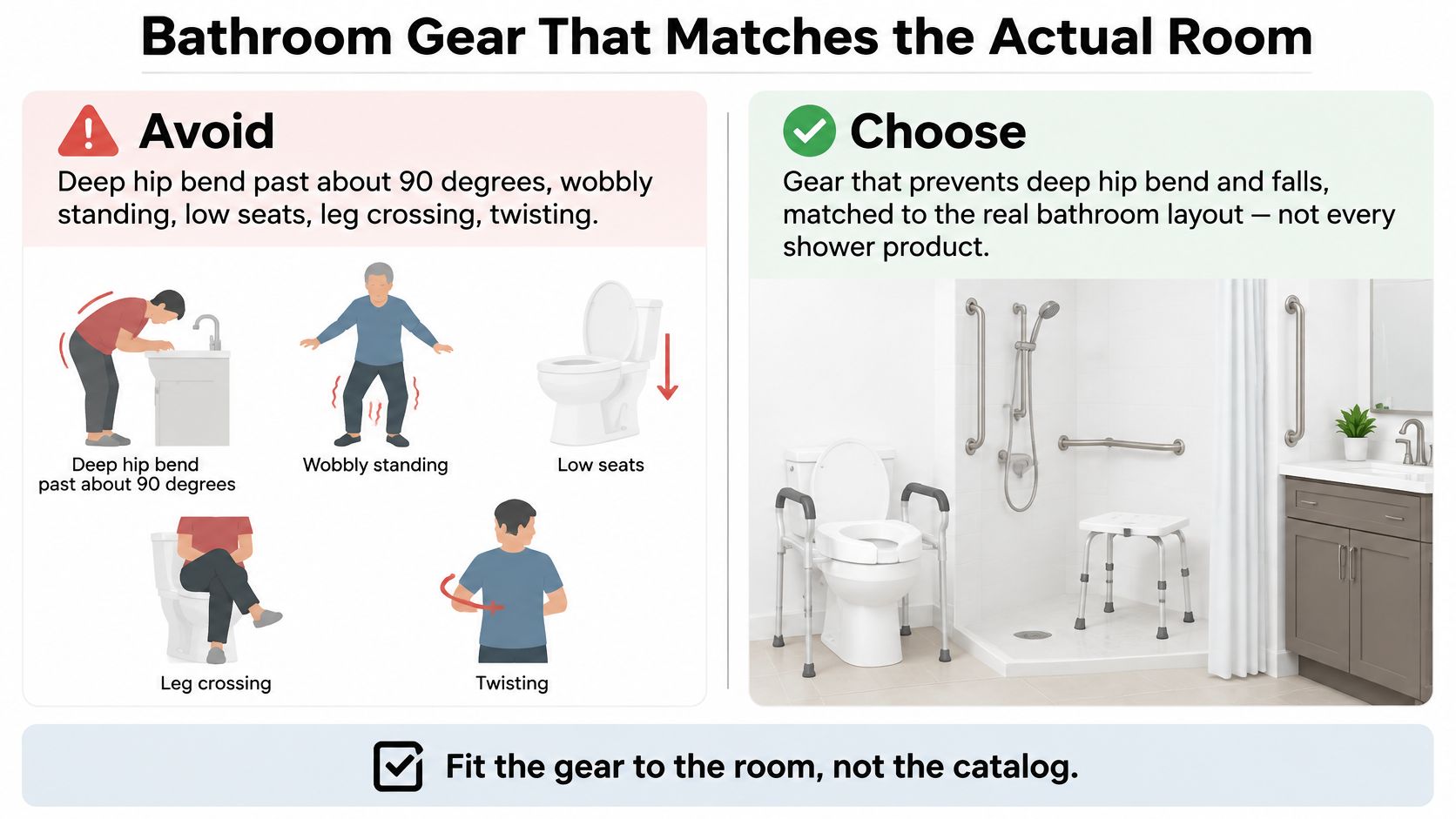
Bathroom equipment exists to prevent three specific events: a hip bent further than your precautions allow, a wobbly stand on a wet floor, and a fall during a transfer. It does not exist to fill a shelf with shower products.
Traditional precautions commonly limit combined hip flexion beyond 90 degrees, adduction past the midline, and internal or external rotation for approximately six weeks, though contemporary evidence suggests routine raised toilet seats and higher chairs aren't necessary for every patient after posterior-approach arthroplasty, according to this analysis of hip precautions and equipment. The precautions are the reason measurements matter. They are not a shopping list.
| Home feature | Better match | Why it helps | Check before buying |
|---|---|---|---|
| Low toilet | Raised toilet seat, safety frame, or bedside commode | Keeps knees lower than hips and eases sit-to-stand | Seat stability, armrest clearance, user weight limit |
| Toilet already high and well supported | Often no raised seat | An extra seat can be unnecessary or unstable | Therapist confirms height is enough for the precautions |
| Walk-in shower | Shower chair and handheld shower | Seated bathing on a wet floor | Chair width, non-skid feet, weight capacity |
| Tub and shower combination | Tub-transfer bench | Sit, then swing the legs in, instead of stepping over the rim | Bench spans the tub wall and locks |
| Weak sit-to-stand | Toilet safety frame or secured grab bar | Hands have a solid point during the transfer | Mount is structural, not a towel bar |
| Narrow bathroom door | Measure before choosing any rolling shower chair | A wide frame may not turn | Overall width versus the doorway |
Why Toilet Height Matters More Than the Catalog
A raised toilet seat isn't a convenience item. It helps prevent the hip from bending beyond 90 degrees, makes sitting down and standing up easier, and keeping the hips higher than the knees is the position to aim for, as Ohio State's total hip guidance sets out. A low sofa or a deep armchair works against you for the same reason, which is why a firm seat with armrests beats a soft one.
Tub or Walk-In Shower Changes the Answer
The two rooms need different equipment, and buying the wrong one is common. The University of Utah's guide to daily activities after hip replacement recommends transferring into a tub from a seated position when possible: sit on the shower chair or transfer bench first, then swing the legs in. That sequence only works with a bench that spans the tub wall.
For a walk-in shower, a chair and a handheld shower head keep you seated the whole time. Before buying, verify toilet compatibility, seat stability, armrest clearance, shower dimensions, and the user's weight capacity. Then clear the purchase with your surgeon or occupational therapist, who can confirm handrails versus renovation. Our bathroom safety equipment for elderly guide covers the sizing checks in more depth.
A grab bar has to be anchored into structure. A towel bar or a suction-mounted rail will move under load, and a moving bar is worse than no bar.
When Each Piece of Equipment Can Stop
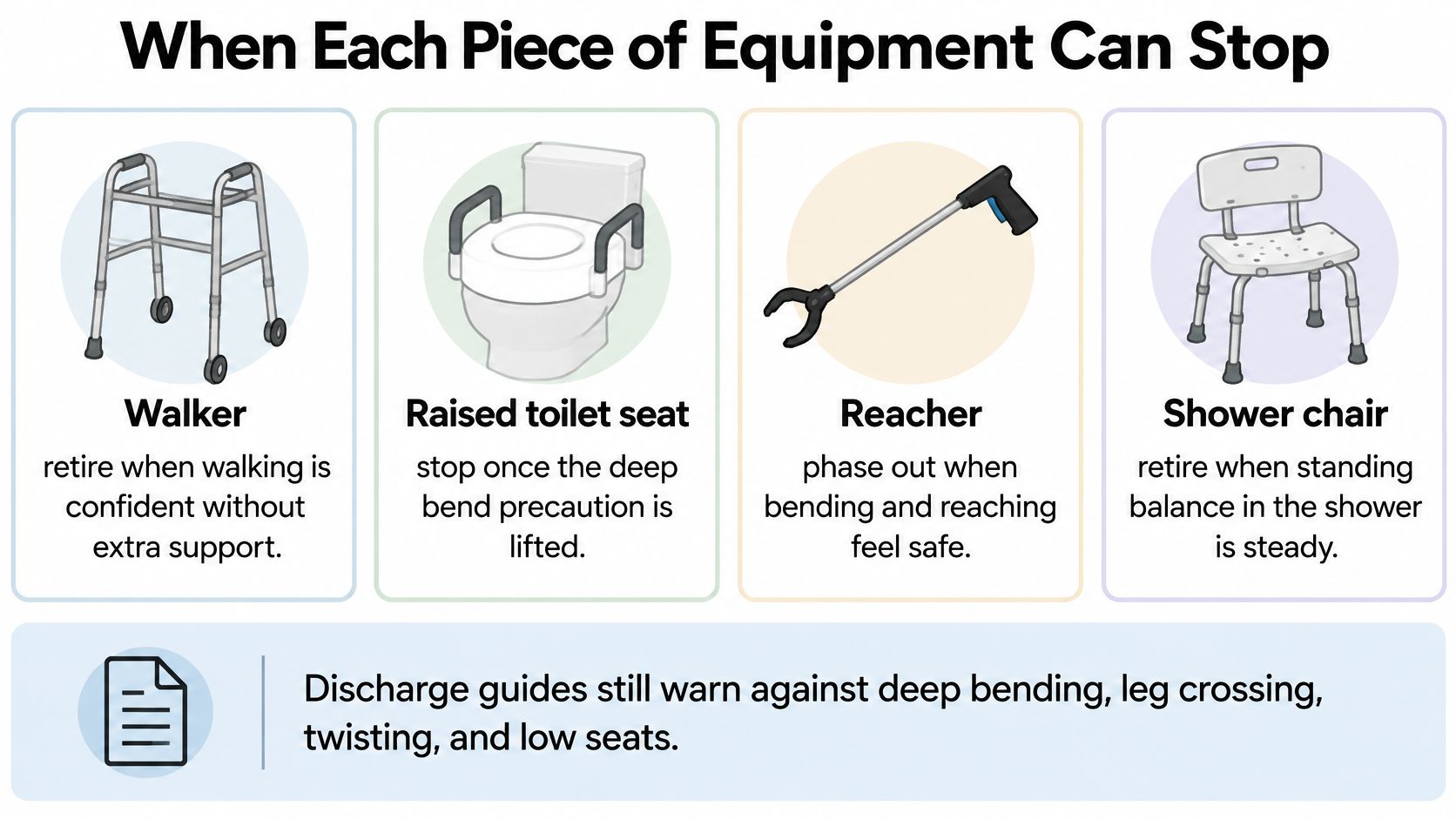
The question nobody answers at discharge is the reverse of the shopping list: when does each item go? A date on a calendar isn't the answer, and a printed guide can't give you one.
Many discharge guides still emphasize avoiding deep hip flexion, leg crossing, twisting, and low seating, while recommending raised toilets, firm chairs, walkers, and dressing aids. Yet these restrictions and equipment needs aren't identical for every patient, because guidance varies by surgical approach, surgeon protocol, stability of the implant, and functional progress, as Lahey Hospital's hip arthroplasty guidebook sets out.
Occupational therapy has also moved past handing out devices. Current practice includes home modification, car-transfer training, elevation techniques, exercise education, and tele-rehabilitation follow-up on how adaptive devices are being used.
What a Real Clearance Check Looks Like
Clearance is a set of observations, not a feeling. Use the table below at each follow-up and be specific about which aid you're asking to retire.
| Checkpoint | What to observe | Who confirms |
|---|---|---|
| Wound and healing | Healing as the surgeon expects, with no drainage or spreading redness | Surgeon or nurse |
| Balance | Stands and turns without grabbing furniture | Physical therapist |
| Sit-to-stand | Rises from the chair used at home without pushing on the arms | Occupational therapist |
| Stairs | Completes the home's stairs with the rail and device | Physical therapist |
| Gait | Walks without a limp or other gait change | Physical therapist |
| Car transfer | Gets in and out of a car safely after practice | Occupational therapist |
The Two Opposite Mistakes
The first mistake is retiring the walker because the pain eased while the walk still looks uneven. One rehabilitation protocol described in that same guidebook moves a patient from walker to crutches or cane only when they can do it without gait deviation. Improving pain with an abnormal gait is a reason to keep the device, not to shelve it.
The second mistake is keeping every aid indefinitely. Unnecessary support restricts activity and increases dependence, which is its own kind of setback.
Walking the length of a hallway competently doesn't mean you're ready for a curb, a crowded aisle, or a car door. Those are separate skills, and they get cleared separately.
Confirm the List Before Surgery Day
The work here is a short pre-op check, not a shopping spree. Block out an hour, take a tape measure, and leave the appointment with a marked list.
- Write down the orders. Note the surgeon's precautions, the weight-bearing rule, and whether stairs must be practiced with the therapist.
- Measure the room. Toilet height from floor to rim, shower type, the narrowest doorway, and the seat height of the chair you'll sit in all day.
- Take the notes to therapy. Walk out with every row marked buy before surgery, borrow or rent, or confirm first. a home safety assessment checklist can help.
- Arrange the walker early if the hospital isn't sending one home with you.
- Stock the small dressing tools in the bathroom before discharge, since many plans don't cover them.
- Move the sleeping spot to one level if stairs are the main hazard in your house.
Once the list is confirmed, comparing products gets straightforward, because you're checking specs against a person and a doorway rather than guessing. That's the moment to look at something like the Medline Aluminum Padded Shower Wheelchair Commode, which costs $374.45 and carries a 275 lb weight capacity, a 19-inch seat width, and a 26-inch overall width, numbers you can hold against your bathroom door. If the household needs a heavier-capacity walking aid, the Medline Heavy-Duty Bariatric Rollator at 500 lbs weight capacity in Blue runs $143.89. Check each product's stated weight capacity and seat width against your own measurements, then let the care team clear the final choice.
DME Superstore carries the items on your marked list in one place, from front-wheeled walkers and rollators to raised toilet seats, commodes, shower chairs, and transfer aids, with clear specs on each product page so you can compare seat width and weight capacity against your own measurements. If your therapist has confirmed a bathroom item or a walking aid, you can find it in our Bathroom & Shower, Manual Mobility, and Transfer Aids categories. Visit DME Superstore when your list is confirmed and shop the rows you need.
