



Nursing assistants had a musculoskeletal-disorder incidence rate of 166.3 cases per 10,000 workers in 2017, more than five times the all-industry rate of 30.5, according to OSHA's safe patient handling guidance. That's a useful starting point for choosing portable patient lifts for travel: the goal isn't to pack smaller equipment. It's to avoid replacing a familiar, supported transfer with an improvised manual lift.
Why Travel Changes the Lift You Need
A trunk-friendly lift can still fail at the doorway. At home, transfers are rehearsed around one bed height, one bathroom, one routine. On the road, those fixed points move.
Manual lifting and repositioning of patients is widely recognized as a major overexertion risk in healthcare. Family care is different from staffed care, yet the principle carries over: a trip should not replace a familiar supported transfer with lifting by hand because the usual hoist stayed home.
The smallest folded size is only the first check. The lift that travels well is the one whose capacity covers the user, whose sling fits the transfer, whose battery and charger match the journey, whose folded width clears the car and elevator, and whose footprint leaves room for safe legs and helper hands. Measure the hotel bathroom door, the bed clearance, the threshold, and the space beside the toilet before departure.
Travel-ready means usable at the destination.
One caregiver may manage rolling and charging. A second person may still be needed for positioning, uneven floors, or a tired evening transfer.
Portable Lift Types and Specs Side by Side
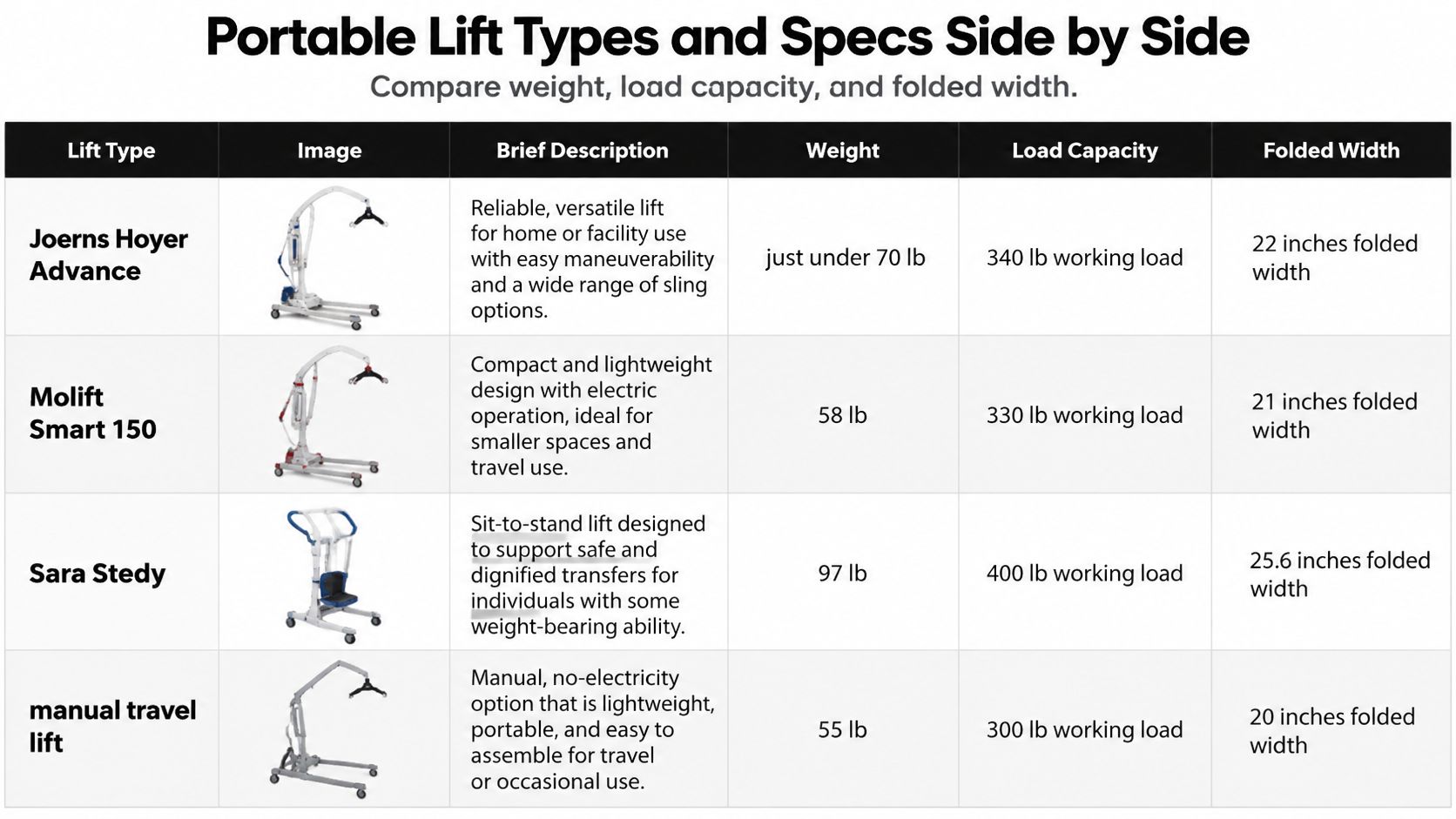
A lift's folded size answers only one travel question. Capacity, transport weight, and the deployed base dimensions each describe a different limit, so compare them separately.
| Lift or reference | Power | Rated capacity | Transport weight | Folded width |
|---|---|---|---|---|
| Joerns Hoyer Advance, 2024 review | Confirm the operating version on the product label | 340 lb working load, according to New Mobility's gear guide | Check the exact model's manufacturer specifications | Check the exact model's manufacturer specifications |
| Molift Smart 150 | Confirm battery and charger specifications for the exact model | Check the exact model's rated working load | 24 kg, about 53 lb, according to Credence Research's patient-handling equipment overview | Check the exact model's manufacturer specifications |
| ISO 10535:2021 mobile hoist minimum | The standard covers mobile hoist categories, not a particular power source | 100 kg, about 220 lb, minimum rated capacity, according to the FDA-recognized standard summary | Not a transport specification | Not a transport specification |
| Manual hydraulic portable lift category | Hydraulic pump, no battery | Check the individual model's rated working load | Check the individual model's manufacturer specifications | Check the individual model's manufacturer specifications |
| Powered portable lift category | Rechargeable battery | Check the individual model's rated working load | Check the individual model's manufacturer specifications | Check the individual model's manufacturer specifications |
Treat the table as a comparison framework, not a substitute for a model-specific specification sheet. For each lift, ask the manufacturer or supplier for rated capacity, transport weight, folded width, and the dimensions of the assembled base. The image below can help organize those measurements once you have them.
Read capacity before transport dimensions
Rated capacity is a ceiling, not a target. Follow the manufacturer's instructions for accounting for the patient, clothing, and accessories, and check the sling's rating as well. A lift's capacity does not make a lower-rated sling suitable.
ISO 10535 defines requirements and test methods for hoists and body-support units. Its current edition covers mobile sling-seat hoists, standing hoists, mobile hoists with solid seats, and stationary equipment. It excludes equipment intended to transport people between building levels. The 100 kg figure in the table is a standard minimum, not a guarantee that every advertised travel lift complies. Ask for the exact model's documentation.
Sling fit matters too. The guide to Hoyer lift sling types describes different support arrangements. Confirm that the sling fits the lift's attachment system and the user's transfer plan.
Separate lift weight from lifting capacity
Transport weight affects who can load and unload the lift. Folded width affects whether it can pass through a vehicle opening or fit in storage. Neither tells you how much clear floor space the lift needs while in use.
- Capacity: Check the lift and compatible body support against the intended load.
- Transport weight: Confirm whether you can handle the folded unit or its approved detachable components safely.
- Folded size: Measure the complete package, including its case, against the vehicle opening and storage area.
- Operating footprint: Get the base width and length, under-bed clearance, and lifting range separately.
Use manufacturer specifications for each exact model. A standing aid is not interchangeable with a full-body sling lift, and missing measurements for a particular device should remain questions to resolve, not estimates.
Powered or Manual Lifts on the Road
Before choosing a power source, establish how much the user can participate. Someone who cannot bear weight generally needs full-body support for these transfers. Someone who can bear some weight may be suitable for a sit-to-stand aid, but weight-bearing ability alone isn't enough: balance, cooperation, positioning, and the established clinical transfer plan also matter.
The FDA's patient-lift guidance distinguishes powered lifts, which generally use rechargeable batteries, from manual lifts, which operate hydraulically. It also emphasizes checking equipment before use and charging powered equipment according to its instructions.
A powered lift is like a laptop: electrical assistance is convenient, but you must manage the charge. A manual lift is like a bicycle: you supply the effort rather than depending on a battery. That analogy describes the energy source, not a guarantee that one type transfers faster or requires fewer caregivers.
Match the operating method to the itinerary
For powered equipment, inspect the charger's input-voltage label and confirm that the destination supply is compatible. A plug adapter changes the plug shape; it doesn't necessarily convert voltage. Identify a charging location that won't leave cables across the transfer route.
Plan what happens if the battery fails during a visit. Emergency lowering helps address a specific interruption, but it doesn't provide enough power for the rest of the trip. Any spare battery must be compatible with the lift and acceptable for the journey.
For manual equipment, assess the caregiver's ability to operate the pump repeatedly while maintaining safe positioning. Our manual hydraulic lift guide provides background on that operating method.
Electrical assistance can reduce pumping effort. It doesn't remove the need for sling placement, supervision, or required helpers.
A powered model may suit frequent transfers when the approved staffing arrangement is available. A manual model may suit unreliable electricity or extended periods without charging, provided the caregiver can operate it comfortably. Neither choice makes an otherwise unsafe solo transfer acceptable.
Before packing, rehearse a complete transfer at home using the actual travel sling, battery, and charger. Follow the prescribed transfer routine, inspect attachments, and practice emergency controls without improvising a loaded emergency. Lifts support transfers such as bed-to-bath or chair-to-stretcher; they aren't a way to move an unsupported patient outside the intended body-support system.
Air Travel Battery Rules and Check-In Steps
Watt-hours equal volts multiplied by amp-hours. A 24 V, 12 Ah battery therefore contains 288 Wh, close to the 300 Wh mobility-device allowance described in the FAA's wheelchair and mobility-device guidance. An amp-hour label alone doesn't establish compliance.
The first question isn't whether the lift folds. It's which transport rules the airline will apply to that exact device and battery. Don't assume a patient lift automatically receives the same handling classification as a wheelchair.
Understand the battery bands
The following bands distinguish ordinary rechargeable lithium battery rules from the special mobility-device provisions. The FAA's passenger battery guidance generally allows rechargeable lithium spares up to 100 Wh, requires carrier approval for 101–160 Wh, and excludes larger batteries from the ordinary passenger allowance.
Battery watt-hour bands and what they allow
| Battery rating | What the rules allow | What to do before flying |
|---|---|---|
| Up to 100 Wh | Generally allowed for rechargeable lithium spares, carried in the cabin | Read the Wh label and protect the battery |
| 101 to 160 Wh | Carrier approval required | Request written approval early |
| 161 to 300 Wh | Special mobility-device provisions only, not an ordinary spare-battery allowance | Confirm the lift qualifies and obtain handling instructions |
| Over 300 Wh | Outside the cited lithium-ion mobility-device allowance | Choose an accepted battery configuration or another travel arrangement |
Under IATA's battery-powered mobility-aid guidance, operator approval is required; removable lithium batteries are limited to 300 Wh for one battery, or 160 Wh per battery when two are required for operation, and permitted spares are one up to 300 Wh or two up to 160 Wh each. Removed and spare lithium batteries must be protected and carried in the passenger cabin.
Battery chemistry changes the procedure. IATA's passenger dangerous-goods guidance explains that gel-type non-spillable batteries can generally travel in the cargo compartment under the applicable conditions, while wet-cell batteries may require disconnection, removal, and protective packaging. Spillable batteries must remain upright during handling, and lithium-ion batteries must meet UN Manual of Tests and Criteria, Part III, subsection 38.3.
Complete the check-in routine before departure
- Read and photograph the label. Record chemistry, voltage, amp-hours, and the visible watt-hour rating. Obtain the manufacturer's lithium-battery test information and removal instructions rather than guessing from a sales description.
- Send the airline a device summary. Include the lift's weight, dimensions, battery chemistry, lithium-ion status, watt-hours, and whether the battery is removable. Request written acceptance for the actual itinerary, including connecting carriers.
- Get removal and packaging instructions. Remove the battery when required using the manufacturer's procedure. Protect exposed terminals from short circuits, prevent movement, and use suitable protective packaging. A removed spillable battery needs the airline's specified rigid packaging and handling arrangements.
- Pack the transfer system, not just the frame. Include the compatible sling, a suitable spare sling, charger, manual, and necessary approved accessories. Protect the lift against impact and accidental activation.
- Keep removed or spare lithium batteries with you. Tell airline staff where they are carried. Don't allow a battery-containing bag to be checked unexpectedly without resolving the battery handling first.
- Reconfirm close to departure. Check the airline's current requirements and carry its acceptance, the battery-label photograph, and operating instructions to check-in.
Don't automatically remove every battery, or automatically leave every battery attached. The correct procedure follows the battery type, device design, and airline's approved handling plan.
Our guide to airline-approved mobility scooters offers related travel-planning context, but scooter acceptance doesn't establish acceptance for a patient lift. A compact frame, a compliant battery, and airline approval are separate checks.
Handling Lifts on Hotel Floors and Thresholds
A loaded wheeled lift creates a different handling problem from an empty folded frame. Hotel carpet, a doorway lip, a ramp, or an uneven path can require substantial pushing and pulling, especially when the caregiver also tries to turn the base.
Ohio State's patient-handling ergonomics work identifies potentially unacceptable front-to-back lumbar shear forces under some floor-lift handling conditions. That's why caster performance, low rolling resistance, and a stable base matter alongside the advertised carrying weight.
Choose a lift for the surface it will cross. A small folded footprint won't compensate for casters that struggle on the hotel's carpet or a base that cannot approach the bed.
Measure the transfer route
Ask the property for measurements and photographs of the actual room category, not just confirmation that it's accessible. Use a tape measure at relatives' homes and sketch where the wheelchair, lift, and caregivers will stand.
- Bathroom doorway: Measure the clear opening with the door in its usable position, including any narrowing from handles or hinges.
- Beside the toilet and bed: Check approach space, caregiver access, and room to position the wheelchair.
- Under the bed: Confirm that the base legs can enter without hitting a solid platform, bed mechanism, or stored luggage.
- Across the floor: Identify carpet transitions, raised thresholds, loose mats, slopes, and outdoor surface damage.
- At the transfer surface: Check whether the lift's range can reach the bed or chair without forcing an awkward approach.
A room can admit the folded lift yet leave no space to open its base. Our guide to accessible thresholds can help you identify doorway issues to discuss with the property.
Keep turning and threshold crossing separate
Where the manufacturer permits a loaded crossing and the route is suitable, approach straight and turn only on level, unobstructed flooring. Don't pivot a loaded lift over a threshold, force it across an obstruction, or use it for a journey beyond its intended transfer function.
For sling application, raise an adjustable transfer surface to approximately knuckle height when appropriate. If the hotel bed cannot adjust, don't compensate by sustained bending or pulling the person toward you. Have the transfer plan reassessed.
Department of Labor/NIOSH guidance recommends two caregivers, one experienced and at least 18 years old, for powered-lift transfers of a non-weight-bearing person.
Backup plan: If the room cannot accommodate the approved transfer, change the room, equipment, or assistance arrangement. Don't replace the plan with an improvised manual lift.
Confirm the correctly sized sling, emergency-lowering operation, and availability of the trained helper before arrival. A fallback should be an established safe alternative, not a promise to work something out after check-in.
Cruise Ships, Cars and Other Trip Legs
For a cruise, send the line the lift's specification sheet before booking. Ask about cabin doorway clearance, bathroom layout, deployed base space, charging arrangements, and equipment handling. Confirm whether an accessible cabin accommodates the actual transfer routine, not merely the wheelchair.
Best Cruise Rates' ship comparison guide for first-time cruisers can help narrow the ship shortlist. Then obtain accessibility details directly from the cruise line, especially for gangways, tender boats, and shore excursions.
Check every handoff
- Car travel: Measure the trunk or rear-seat opening, loading height, and storage space. Confirm that the person loading the lift can handle its approved transport configuration, and secure it against movement.
- Vehicle transfers: Match the lift's reach and base access to the actual vehicle. Our guide to car-transfer patient lifts explains the equipment considerations.
- Trains, buses, and taxis: Ask each operator about equipment acceptance, storage, boarding, and assistance rather than assuming the flight arrangement applies.
- Ports and excursions: Keep written equipment acceptance and battery details available, and confirm what happens if the planned shore route is unsuitable.
A workable itinerary includes the journey from vehicle to room and from room to bathroom. Booking an accessible destination doesn't resolve every transfer along the way.
Choosing and Buying Your Travel Lift
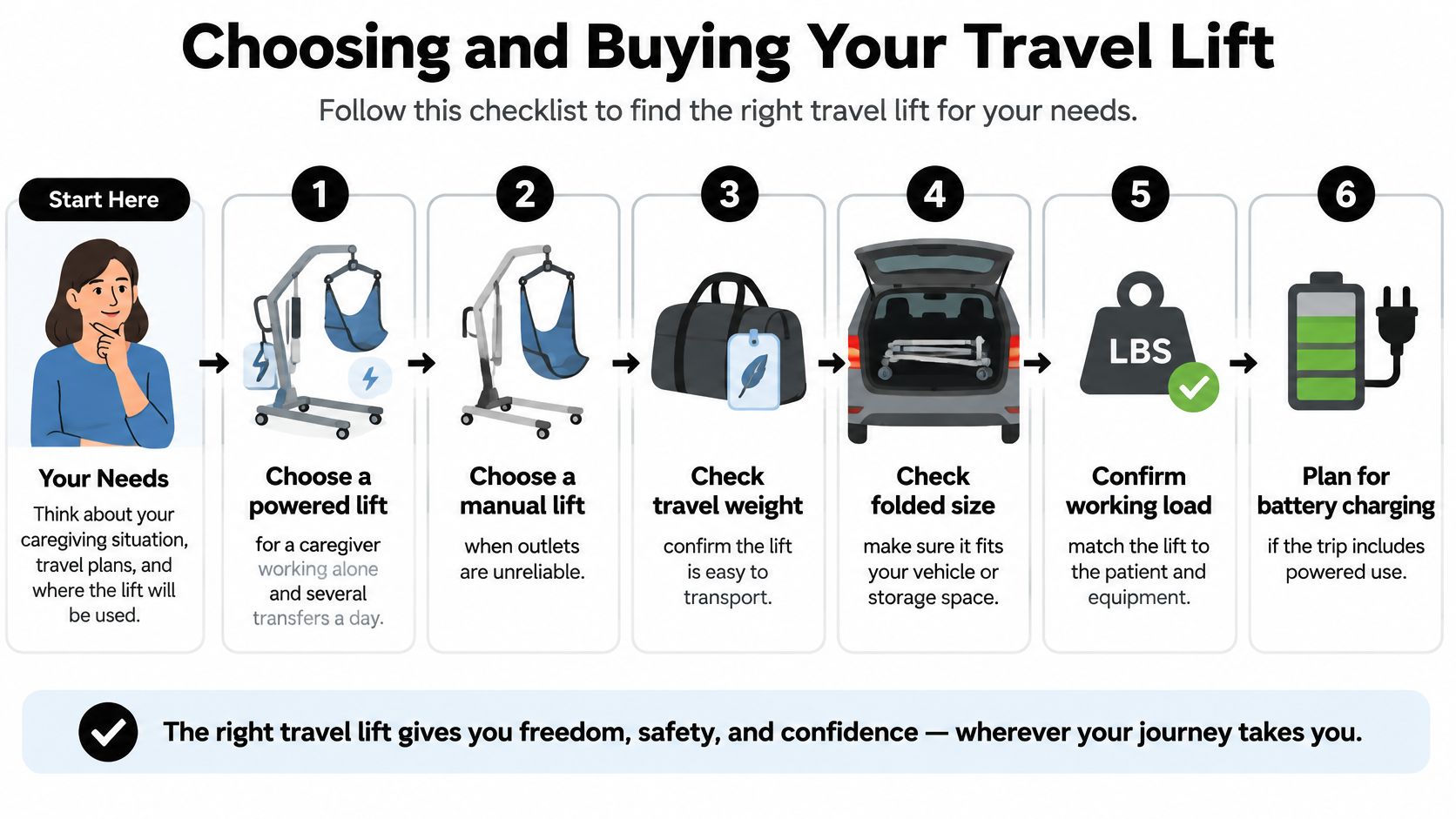
Start with the person's transfer needs, then select the operating method. Powered assistance may suit frequent transfers when the approved helper arrangement is available; manual hydraulics may suit unreliable charging when the caregiver can manage the pumping effort. Working alone isn't, by itself, a reason to approve solo powered-lift use.
Apply the purchase gate
- Load and support: Confirm the rated capacity, appropriate margin, sling compatibility, and clinical suitability.
- Transport acceptance: Obtain airline acceptance for the actual battery configuration when flying.
- Physical fit: Match transport dimensions and deployed base measurements to the vehicle and destination.
- Operating support: Confirm training, required helpers, emergency procedures, and a workable fallback.
Our options illustrate why product categories matter. The Freedom Aqua Powered Patient Lift is electric and waterproof, has a 300 lb weight cap, and weighs 47 lbs; its open-box offer starts at $1,650.00 for the lift only or $1,700.00 with a seat cushion, at 41% off. The Molift Transfer Pro is a sit-to-stand patient transfer aid, so it serves a different transfer need rather than automatically replacing a full-body lift.
Neither a waterproof label nor a portable description establishes flight acceptance. Check current product-page specifications, battery documentation, and compatibility before buying, and resolve missing information before committing to the trip.
DME Superstore offers portable patient lifts, transfer aids, and compatibility information to help you compare equipment for travel. Visit DME Superstore with your user's transfer requirements, room measurements, and airline battery questions, then check each candidate against those details before purchasing.
