



What exactly makes a mobility scooter “airline-approved”? It's a common question, and the answer is simpler than you might think. There isn't an official certification or a special sticker. A scooter is considered "airline-approved" if it meets the specific safety regulations set by the Federal Aviation Administration (FAA) and international air travel authorities. The most critical factor in these regulations is almost always the battery.
Unlock Your Freedom to See the World
The prospect of navigating a sprawling airport or exploring a new city can feel daunting if you have mobility challenges. However, the right equipment can transform travel from a source of anxiety into an opportunity for adventure. An airline-approved mobility scooter is designed to provide independence and confidence, from the check-in counter to your final destination.
This guide serves as an educational resource to help you understand the essentials of traveling with a mobility aid. We'll move beyond marketing claims and focus on the practical features and crucial regulations that matter most to the FAA and airline personnel. Understanding these details is the key to a smooth and stress-free journey.
What Really Matters for Air Travel
When planning to fly with a mobility device, your focus should be on two main areas: its battery and its physical design. The best modern travel scooters are engineered with these considerations in mind, balancing lightweight portability with durable performance. A solid understanding of these elements will prepare you for a successful trip.
- Battery Compliance: This is the most important consideration. Airlines enforce strict, non-negotiable rules for batteries, particularly lithium-ion batteries, to ensure the safety of everyone on board. We will explore these regulations in detail.
- Portability and Weight: Your scooter must be manageable for both you and the airline ground crew. This typically means it should be a foldable model or one that disassembles into lighter, more manageable components.
- Durable Construction: While lightweight design is crucial for travel, the scooter must also be robust enough to withstand the rigors of transit and provide reliable support at your destination.
Think of this guide as your personal travel consultant. Our goal is to demystify the entire process, from understanding the rules to picking the right scooter and breezing through travel day.
This journey starts with a simple but powerful idea: mobility challenges should never limit your horizons. With the right information and the right equipment, you can confidently plan your next adventure, knowing you have what you need to explore with comfort and dignity.
Let’s get you ready for takeoff. Your next adventure is waiting.
Understanding Airline Rules For Mobility Scooters
Navigating the regulations for flying with a mobility scooter can seem complex, but the core principles are straightforward. The key isn't a special "airline-approved" designation on the scooter itself, but rather the specifications of its battery.
Consider your scooter’s battery as having its own travel document. Just as a passenger needs a passport, the battery must meet specific safety standards set by the FAA and international aviation bodies. This "document" is defined by the battery's type and its power capacity, which informs the airline how to handle it safely.
The Passport For Your Battery
For nearly all modern, lightweight travel scooters, the battery of choice is lithium-ion. They offer an excellent combination of power, low weight, and efficiency. However, in aviation, they are classified as dangerous goods, which necessitates strict regulations.
To be approved for air travel, a battery's power is measured in watt-hours (Wh). This is the universal metric airlines use to verify its safety. You can almost always find the Wh rating printed directly on the battery's casing, in the user manual, or on the manufacturer's specification sheet.
The most important rule to remember is this: the FAA limits a single lithium-ion battery to a maximum of 300 Wh. This one number is the foundation for almost every airline's policy on mobility scooters.
That 300 Wh limit is the critical number. If your scooter uses a single battery that is at or below this capacity, you are well on your way to a smooth check-in process.
The demand for travel-friendly mobility scooters is booming—the global market is expected to hit USD 3.43 billion by 2034, driven by a generation that wants to stay active and see the world. This has pushed scooter makers to design models with powerful batteries that still fit perfectly within these airline rules.
This flowchart breaks down the first questions you should ask when planning a trip with your scooter.
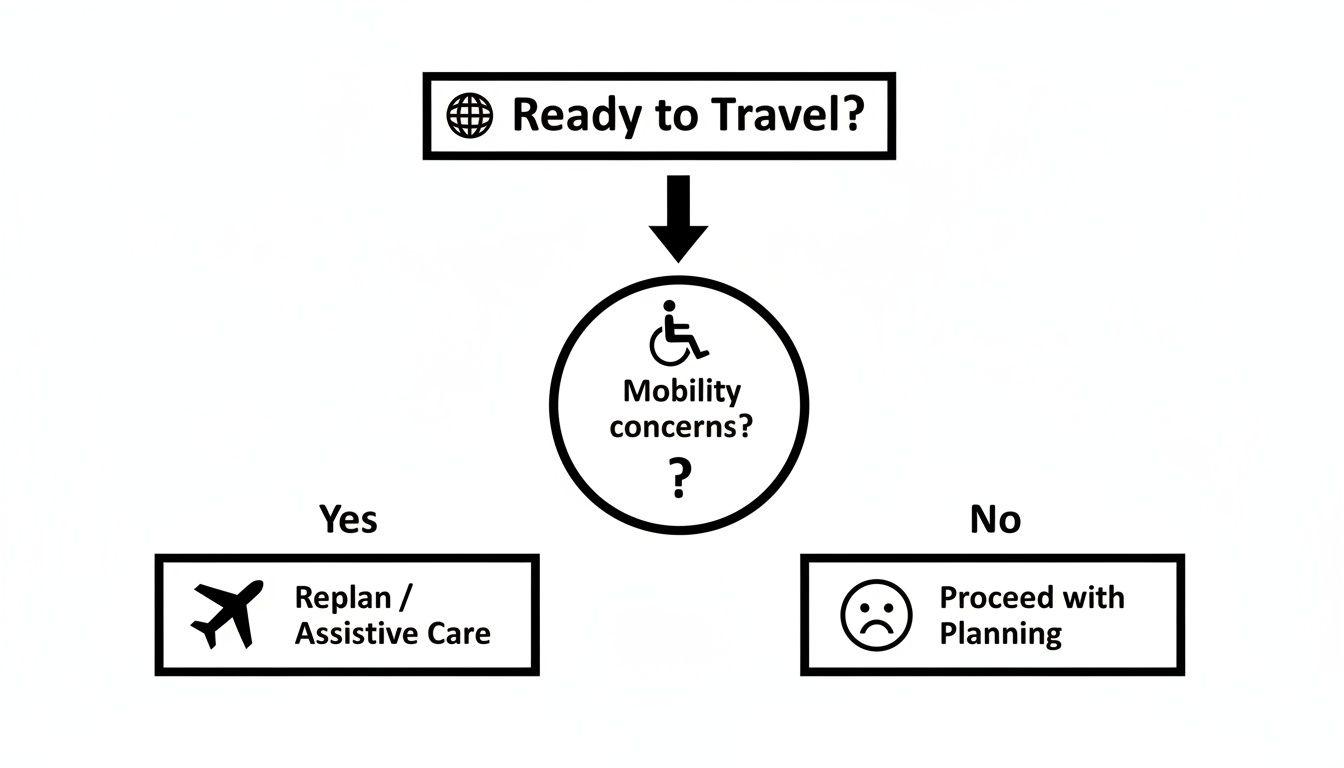
As you can see, getting your mobility plan sorted out from the very beginning is the key to a stress-free trip.
Mobility Scooter Battery Types and Airline Rules
To make things even clearer, here’s a quick-reference table that breaks down the common battery types you'll find in mobility scooters and how airlines typically handle them.
| Battery Type | Typical Watt-Hour (Wh) Limit | Carry-On Requirement | Best For |
|---|---|---|---|
| Lithium-Ion (Li-ion) | 300 Wh (for one installed battery) | Spares (up to 160 Wh each) must be carried on. | Lightweight, modern travel scooters. |
| Sealed Lead-Acid (SLA/AGM) | No Wh limit, but must be non-spillable. | Can remain installed in the scooter. | Older, heavier, non-folding scooters. Not ideal for air travel. |
| Nickel-Metal Hydride (NiMH) | No Wh limit, but less common. | Can typically remain installed. | Some older or specialized devices. |
This table highlights why lithium-ion is the standard for travel: it offers the best power for its weight while having clear, internationally recognized rules for transport.
Installed Batteries vs. Spare Batteries
Once you’ve confirmed your battery's watt-hour rating is compliant, the next step is to understand the packing requirements. Airlines have different rules for batteries installed in the scooter versus spare batteries you bring along.
Here’s a simple breakdown of the regulations:
- One Installed Battery (Up to 300 Wh): If your scooter operates on a single battery under the 300 Wh limit, it can typically remain installed when you check the scooter at the gate. The ground crew will then load the scooter into the cargo hold with the battery securely housed inside.
- Two Spare Batteries (Up to 160 Wh Each): If you plan to bring extra batteries for extended range, specific rules apply. You are generally allowed up to two spare batteries, but each one must not exceed 160 Wh.
- Carry-On Is a Must for Spares: This is a critical safety rule. All spare batteries must be removed from the scooter and carried with you into the airplane cabin. They are not permitted in the checked cargo hold. For safety, you should protect the terminals from short-circuiting by placing them in their original packaging, a battery pouch, or by covering the metal contacts with tape.
It’s also wise to know exactly what kind of battery you have, as some have unique handling rules. For example, lithium metal batteries (UN3090) have their own specific regulations. Knowing these details helps you show up prepared.
This system is designed for maximum safety. By keeping spare lithium-ion batteries in the cabin, the flight crew can monitor them and respond immediately if any issues arise. For a step-by-step walkthrough of this whole process with a real scooter, check out our guide on flying with your DashMoto Dash 3 electric scooter.
By understanding these core battery rules—the 300 Wh limit for an installed battery and the carry-on requirement for spares—you’ve already mastered the most challenging aspect of flying with your mobility scooter.
How to Choose the Right Travel Mobility Scooter
Now that you are familiar with battery regulations, you can focus on selecting the ideal scooter for your travels. Choosing the right airline approved mobility scooter is about more than just meeting FAA requirements. It's about finding a model that aligns with your physical needs, travel habits, and personal comfort.
Think of it like choosing luggage for a trip. A large suitcase is impractical for a short weekend, while a small backpack is insufficient for a long vacation. Your scooter should function as a natural extension of your mobility, not as cumbersome equipment that adds stress to your journey.
Folding vs Disassembling Models
The first major decision involves how the scooter is stored for travel. The two primary designs are folding and disassembling models. Each offers distinct advantages, and your choice will depend on your priorities.
Folding Scooters: These models are designed for maximum convenience. They typically collapse into a compact, trolley-like form with the pull of a lever or push of a button, allowing you to roll them easily to the gate. Their main benefit is simplicity, which can be invaluable for travelers who want to minimize physical effort.
Disassembling Scooters: These scooters are engineered to break down into three to five lighter, more manageable parts, such as the seat, battery pack, and frame sections. While this process takes a few extra moments, the primary advantage is that each individual component is significantly lighter than a complete folded scooter. This is highly beneficial if you or a travel companion will be lifting the pieces into a vehicle.
Your choice comes down to a simple trade-off: Do you want the one-step convenience of a folding scooter, or the lighter individual pieces of a disassembling model? Think about who will be handling the scooter and where you'll be storing it.
This corner of the market is booming. The travel mobility scooter market hit USD 755.9 million in 2025 and is expected to reach USD 1.25 billion by 2033. This growth is fueled by innovative, airline approved mobility scooters that are easier to use than ever, proving that convenience is what travelers really want.
Key Features for The Modern Traveler
Beyond how it packs down, a few other features can make or break your travel experience. Paying attention to these details will ensure your scooter is a help, not a headache, in busy airports and unfamiliar cities.
- Total Weight and Heaviest Piece: For a disassembling scooter, always check the weight of the heaviest component. Make sure it’s a number you can comfortably lift. For folding scooters, the total weight is what you need to focus on.
- Turning Radius: A tight turning radius is a lifesaver in crowded airport terminals, narrow cruise ship hallways, and bustling city sidewalks. A scooter that can turn on a dime makes navigating so much less stressful.
- Battery Range: How far do you plan to go in a day? A scooter with a 10-mile range is usually perfect for getting around the airport and doing some sightseeing. If you’re planning all-day excursions with no chance to recharge, look for models with extended-range battery options.
- Seat Comfort: You’ll be spending a lot of time on your scooter, so a comfortable, well-padded seat isn't a luxury—it's a necessity. Look for models with adjustable armrests and enough legroom to keep you supported all day long.
Matching a Scooter to Your Travel Style
The perfect scooter for a weekend city break might not be the best choice for a 10-day cruise. Take a moment to think about your typical trips to help narrow down your options and find the perfect match.
For the Cruise Enthusiast: Life on a cruise ship means navigating long corridors and fitting through tight cabin doorways. A compact scooter with an excellent turning radius is a must. Since you’ll be back in your cabin to recharge every night, a standard battery range is usually all you need.
For the Frequent Flyer: If you’re constantly catching flights, speed and ease of handling are everything. A lightweight, automatic folding scooter is a godsend when you're rushing between gates. Being able to pack it up in seconds makes the gate-check process smooth and painless.
For the Road Tripper: When traveling by car, your biggest concern is how easily the scooter fits in your vehicle. A disassembling model is often ideal here, since the lighter individual pieces are much easier to lift into a trunk. You can also find some fantastic options in our guide to the best mobility scooters for seniors, which covers a variety of models perfect for different lifestyles.
By carefully thinking through these factors—portability, key features, and your personal travel habits—you can confidently pick an airline approved mobility scooter that will truly upgrade your journeys and empower you to see the world with comfort and independence.
Your Essential Pre-Flight Preparation Checklist
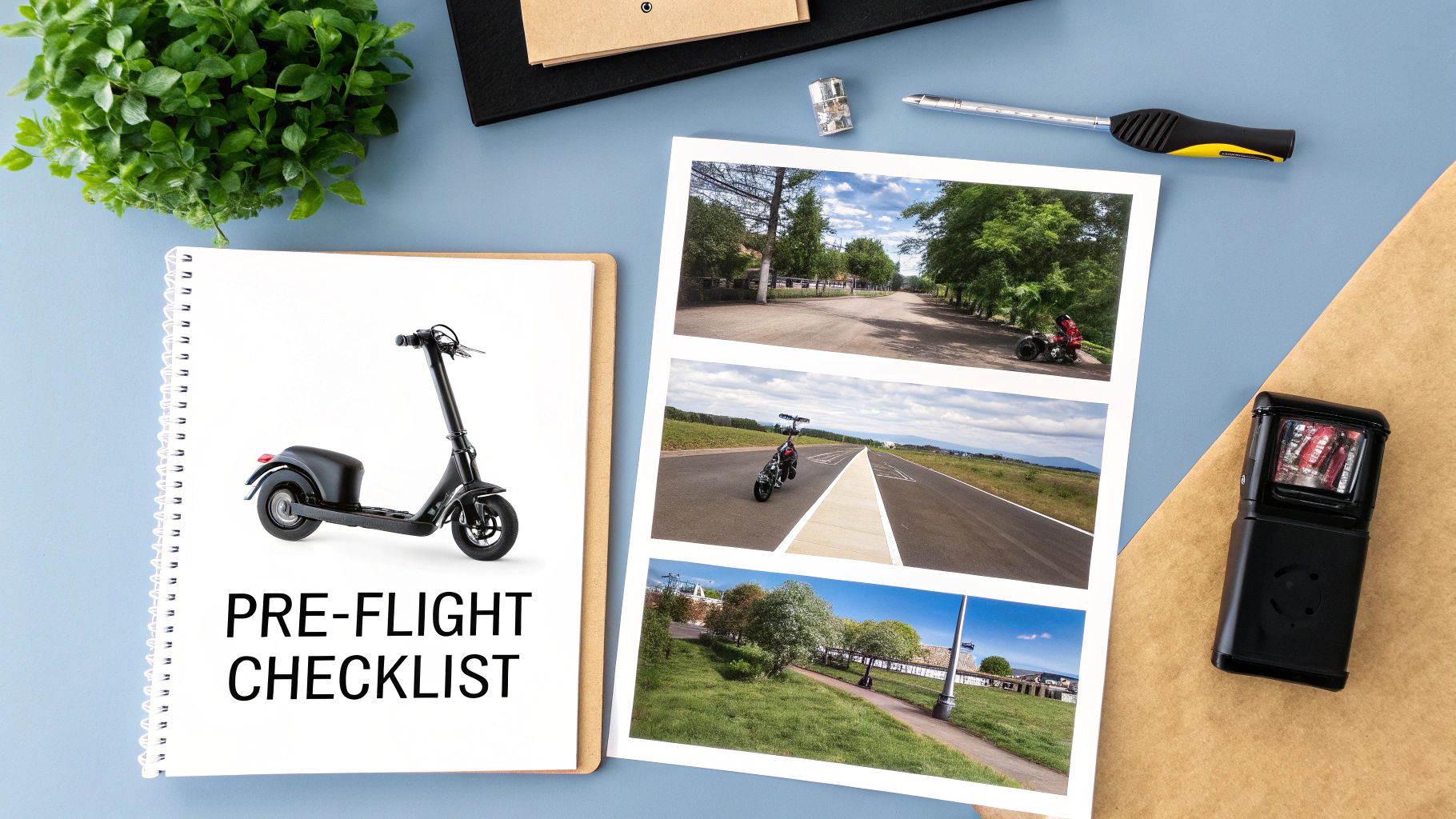
A smooth travel day is the result of simple, effective planning. Now that you understand how to choose an airline-approved mobility scooter, the next step is to prepare for your trip. This checklist provides a clear roadmap for a seamless departure, designed to eliminate guesswork and prevent last-minute issues at the airport.
Think of this process like packing a suitcase: a little organization beforehand prevents significant stress later. By completing these tasks in the days leading up to your flight, you can arrive at the airport feeling prepared, confident, and ready to enjoy your journey.
Step 1: Contact Your Airline Early
This is the single most important step in your preparation. Do not wait until you are at the check-in counter to inform the airline about your scooter. Provide them with advance notice.
Airlines require passengers traveling with a personal mobility device to provide notice at least 48 hours before their scheduled flight. This gives them time to make the right arrangements and make sure their ground crew is ready for you.
When you contact the airline, have this information readily available:
- Scooter Details: The make and model of your scooter.
- Dimensions and Weight: The scooter’s overall size (L x W x H) and its total weight.
- Battery Information: The type of battery (e.g., lithium-ion) and its watt-hour (Wh) rating.
This one phone call establishes clear communication and sets the stage for a smooth travel day.
Step 2: Assemble Your Document Packet
Having your paperwork organized is essential. Airline staff are trained to verify that your scooter's battery meets safety regulations, and providing the necessary documentation makes their job easier and your check-in process faster. Create a travel folder with printed copies of the following:
- Scooter Specifications Sheet: Print the official spec sheet from the manufacturer's website. This document contains the scooter’s dimensions, weight, and battery details in one place.
- Battery Safety Certificate (MSDS/UN 38.3): This is the "passport for your battery." The Material Safety Data Sheet (MSDS) or UN 38.3 test summary proves it has been tested and certified as safe for transport.
- Airline Contact Confirmation: Keep a copy of the email or a note of your phone call confirming you notified the airline.
Place these documents in a plastic sleeve and keep them in your carry-on for easy access.
Step 3: Prepare Your Scooter for the Journey
Before leaving for the airport, take a few minutes to prepare your scooter for transit. This protects your scooter and makes it easier for airline staff to handle.
The market for these devices is booming, partly because foldable, airline-approved mobility scooters are making air travel so much more accessible. The global foldable segment recently hit USD 1.2 billion as sales soared by 49% in recent years. Airlines are adapting to this trend by approving models with compliant batteries and manageable weights, which helps users avoid extra fees and hassles. You can learn more about how these scooters are transforming travel for the mobility-impaired on paiseec.com.
Here's how to get your scooter ready:
- Take Dated Photos: Use your smartphone to take clear photos of your scooter from all angles. This creates a timestamped record of its condition before the flight, which is crucial if you need to file a damage claim.
- Attach an Identification Tag: Place a sturdy luggage tag on your scooter with your name, phone number, and destination address. It is also helpful to add a tag with handling instructions like "Fragile" or "Handle With Care."
- Pack Essential Tools: If your scooter requires special tools for disassembly or adjustments, pack them in your checked luggage. A small Allen wrench or screwdriver can be very useful.
Following this checklist will enable you to approach the pre-flight process with complete confidence. You've done the preparation, you have the right documents, and your scooter is ready for travel.
Navigating the Airport on Travel Day
With your preparation complete, it's time for your travel day. A positive airport experience with a mobility scooter depends on two key factors: clear communication and knowing what to expect at each stage of the process.
This section will guide you through the entire airport journey, from your arrival at the curb to boarding the plane. View the airport staff as your partners; they are trained to assist passengers with mobility devices, and your preparation will make their job—and your journey—much smoother.
At the Check-In Counter
Even if you have already checked in online, your first stop should be the airline's check-in desk. This is your opportunity to formally notify the airline staff in person that you are traveling with a mobility scooter.
Inform the agent that you will be riding your scooter to the gate and will be gate-checking it there. Have your document packet—the scooter’s spec sheet and battery information—readily available. Presenting this information proactively demonstrates that you are prepared and helps them quickly verify your scooter's compliance.
Clearing the Security Screening
Passing through the Transportation Security Administration (TSA) checkpoint with a scooter is a standard procedure. As you approach the security line, a TSA agent will direct you to a lane that can accommodate your device. You will not need to get off your scooter to go through a standard body scanner.
Here is the typical screening process:
- Remain on Your Scooter: A TSA agent will ask you to move to the side for a manual screening.
- Pat-Down and Device Swab: The agent will conduct a standard pat-down and may use a swab to test your hands and parts of the scooter for prohibited substances. This is a routine safety check.
- Send Belongings Through X-Ray: Your carry-on luggage and any removable items from your scooter, like baskets or pouches, will pass through the X-ray scanner as usual.
To make the whole trip smoother from the start, you might even consider pre-booking reliable airport transfers to handle your luggage and get you to the terminal without any stress. The key is to just follow the agents' instructions patiently; they do this all day, every day.
The Gate-Check Process Explained
After clearing security, you can ride your scooter directly to your departure gate. The next important step occurs just before boarding: gate-checking your scooter.
Gate-checking means you can use your scooter all the way to the aircraft door. At that point, airline staff will take it to be stored in the cargo hold. Upon landing, it will be brought back up to you on the jet bridge.
Crucial Tip: Before you hand over your scooter, take the key out and remove any loose items like cushions or baskets. And this is your last chance to remember: any spare batteries you have must be carried into the cabin with you.
Double-check with the gate agent that your scooter is tagged correctly. It needs a tag with your destination and a special "gate-check" tag. This tells the ground crew it needs to come back to you at the jet bridge, not the main baggage claim. Adding a layer of protection with something like a durable NOVA XL Storage Travel Bag for mobility aids is always a smart move.
Upon Arrival at Your Destination
When the plane lands, it is advisable to remain in your seat until most other passengers have deplaned. This allows the ground crew sufficient time to bring your scooter from the cargo hold to the jet bridge. An airline employee will notify you as soon as it is ready.
Before you proceed, perform a quick but thorough inspection.
- Check for Damage: Look over the entire scooter. Are there any new dents, scratches, or broken parts?
- Test Functionality: Turn it on. Make sure the throttle, controls, and brakes are all working exactly as they should.
If you notice any damage, do not leave the gate area. Report the issue to a gate agent or another airline official immediately and file a damage report on the spot. Your pre-flight photos will serve as essential evidence in this situation. Once you are satisfied that everything is in order, you can confidently drive off the jet bridge and begin your trip.
Why Trust DME Superstore for Your Travel Scooter
Selecting the right travel scooter is an important decision, and choosing a knowledgeable and supportive supplier is equally vital. At DME Superstore, we provide more than just mobility products; we serve as a resource dedicated to helping you regain independence and explore the world with confidence.
We have curated a collection of airline approved mobility scooters from trusted brands like Pride Mobility and Golden Technologies. Every travel model in our selection has been chosen because it meets the strict FAA and airline regulations discussed in this guide, removing the guesswork from your decision-making process.
Support That Travels with You
We also streamline the process of gathering necessary documentation. All critical travel documents, such as battery compliance certificates and specification sheets, are available for download directly from our product pages. You can prepare your travel folder long before you begin packing.
Our whole goal is to make your travel dreams happen. From helping you choose the perfect scooter to answering a last-minute question at the airport gate, we're here to make sure your journey is smooth from start to finish.
This is why we offer 24/7 expert support. Our team is available by chat around the clock, ready to help whether you're planning at home or troubleshooting on the go.
Making Independence Accessible
We believe that mobility should be accessible to everyone. Our store is designed to make acquiring the right scooter a simple and straightforward process.
- FSA/HSA Eligibility: You can use your Flexible Spending Account (FSA) or Health Savings Account (HSA) funds for any of our mobility scooters.
- Flexible Financing: We've partnered with Affirm to offer easy payment plans, so you can get the scooter you need now and pay for it over time.
When you choose DME Superstore, you’re not just buying a product. You’re gaining a partner who is genuinely dedicated to helping you see the world, backed by the best products and support in the business.
Your Top Questions About Flying with a Scooter, Answered
Even with thorough preparation, it's natural to have a few remaining questions before traveling with a mobility scooter. This section addresses common concerns to provide a final layer of confidence, allowing you to focus on your upcoming trip.
Clarifying these details now can help alleviate logistical worries so you can look forward to your destination.
Do I Need a Doctor's Note to Fly with My Mobility Scooter?
Generally, no. For domestic flights within the U.S., a doctor's note is not typically required to fly with your personal mobility scooter. The airline's primary concern is not the medical reason for its use, but whether the device complies with safety regulations.
The most important documentation is the scooter's specification sheet and the battery's safety certificate, as these prove compliance with FAA rules. While a doctor's note is rarely necessary, it may be helpful for some international travel or if you require special assistance, but it is not a primary requirement.
What Happens if the Airline Damages My Mobility Scooter?
Airlines are legally responsible for the safe transport of your mobility device. Under the Air Carrier Access Act (ACAA), they are liable for any damage that occurs. This federal law provides you with important protections.
For this reason, it is absolutely critical to inspect your scooter the moment it is returned to you at the gate. If you discover any damage—such as a crack, deep scratch, or non-functional part—report it to an airline official and file a claim before you leave the airport. Your pre-flight photos will serve as crucial evidence to support your claim.
The ACAA is your most powerful tool in this situation. It's a consumer protection law that holds airlines accountable for your essential equipment. Knowing this law exists is the first step to getting a fast and fair resolution.
Can I Use My Scooter During a Layover?
Yes, absolutely. The gate-checking process is designed specifically to allow for this. When you deplane, the ground crew will bring your scooter to the jet bridge, enabling you to use it to navigate the airport to your connecting flight.
Upon reaching your next departure gate, you will simply repeat the gate-check procedure. The system is designed to ensure you maintain your mobility and independence throughout your entire journey.
Are There Weight or Size Limits for Scooters on Planes?
While the FAA does not set specific weight limits for mobility aids, individual airlines may have their own restrictions. These limits are often determined by the size of the cargo hold door on the aircraft, which can be a limiting factor, particularly on smaller regional jets.
This is a key reason why compact, foldable, and lightweight travel scooters are recommended. A model that weighs under 70 lbs is unlikely to present an issue on most aircraft. To be 100% certain, it is always a good practice to confirm any potential restrictions with your airline when you book your flight.
At DME Superstore, our goal is to empower you to travel freely and with total confidence. Our handpicked selection of airline-approved mobility scooters comes with easy-to-access battery documents and our 24/7 expert support, making us a reliable partner for every leg of your journey. Find your perfect travel companion and get ready for your next adventure.


2 comments
This was a helpful article for travelers looking into mobility options and the considerations involved when flying with special equipment. Accessibility is an important part of the overall travel experience, and smooth coordination between different airport services can make a big difference. In a similar way, airline crew transportation systems help ensure reliable movement and scheduling for airline teams. While reading about airport operations and transportation management, I came across this resource: https://mobisoftinfotech.com/solutions/airport-crew-transportation-management-software . It provides some useful information about managing crew transportation processes and was an interesting addition to the topic. Thanks for sharing!
This was a helpful article for travelers looking into mobility options and the considerations involved when flying with special equipment. Accessibility is an important part of the overall travel experience, and smooth coordination between different airport services can make a big difference. In a similar way, airline crew transportation systems help ensure reliable movement and scheduling for airline teams. While reading about airport operations and transportation management, I came across this resource: https://mobisoftinfotech.com/solutions/airport-crew-transportation-management-software . It provides some useful information about managing crew transportation processes and was an interesting addition to the topic. Thanks for sharing!