



Around 80 million people worldwide are likely to need a wheelchair for mobility, and in many countries access falls far below that need, according to the World Health Organization's assistive technology fact sheet. Among the hardest chairs to get right are the ones built for higher weights and larger body dimensions.
Most product comparisons stop at the rating printed in bold. A frame tested to hold a certain mass tells you something real about the steel and the welds. It says nothing about whether the seat matches a pair of hips, whether accessories like oxygen holders or bags push the actual load past the tested limit, or whether the cushion protects skin during a four hour afternoon.
Those are separate questions with separate answers, and they get mixed together constantly. A high capacity label clears the first question only. Settling the rest takes measured body numbers, a documented test rating and a pressure-care plan, in that order.
Bariatric Power Wheelchair Specs at a Glance
Two chairs can wear the same heavy-duty label and differ on every number that decides whether one of them works in your home. Set the specs side by side and a pattern appears: a bariatric power wheelchair is a wider, heavier machine with stronger drive motors and a larger battery, and those rows move together rather than one at a time.
| Spec | Standard powerchair (typical) | Bariatric power wheelchair (typical) | What to check |
|---|---|---|---|
| Weight capacity | 250-300 lb | 400-500 lb | Tested maximum occupant mass, and whether accessories count toward it |
| Seat width | 16-20 in | 20-26 in | Measured across the cushion, not the frame |
| Seat depth | 16-18 in | 18-22 in | Thigh support without pressure behind the knee |
| Chair weight without battery | 45-80 lb | 100-200 lb | Whether it fits your lift, ramp and vehicle |
| Battery | 24 V, 35-75 Ah | 24 V, 50-80 Ah | Voltage, capacity and whether the battery counts toward total weight |
| Drive motors | 24 V, 200-250 W | 24 V, 300 W rated or higher | Output rating for inclines and heavy loads |
| Range per charge | 10-15 miles | 10-20 miles | Figures tested under load and on the terrain you use |
| Turning footprint | 40-50 in | 45-60 in | Clearance in your doorways, aisles and bathroom |
Treat those as typical ranges and verify each one against the manufacturer's data sheet for the exact model. Options change them, and so does the seating system bolted to the frame.
Capacity is a tested maximum occupant mass, which is a different claim from the biggest number a retailer prints. Ask whether the figure covers the battery, the seating hardware, an oxygen holder and whatever the user carries every day.
Seat width is measured across the cushion at its widest point, never across the frame or between the armrests. A 22 inch frame can carry a 20 inch cushion, and the cushion is the part your hips sit on.
Range per charge shrinks with a heavier occupant, on indoor carpet, on slopes and in cold weather. What's published is the best case on flat ground with a fresh battery and an average load.
Chair weight without battery decides whether the unit fits a vehicle lift or a trunk, and whether one caregiver can manage the heaviest single part.
What the Extras Add to the Total
Options sit in the same font as core specs, so they read as free improvements. Each one adds weight, cost, and sometimes a limit of its own.
- Power tilt tips the seat and back as a single unit. It redistributes pressure without opening the hip angle, and the mechanism adds mass to the frame, so the rated figure only holds if the accessory sits inside the tested limit.
- Power recline opens the backrest independently. It suits users who need to change position often, and it makes the backrest design matter more, because a sliding backrest creates shear at higher body weights.
- Elevating leg rests raise the leg supports to ease swelling and pressure behind the thigh. They lengthen the chair at the front, so measure turning space with them raised, not folded.
- Swappable batteries let one pack charge while the other runs. They add a second battery to the load you store, lift and travel with.
Write these five numbers down before you compare anything: measured body weight including carried equipment, hip width, required seat depth, the narrowest doorway on your daily route, and the vehicle lift limit.
The measurement steps for those five numbers come later in this guide. Hold them beside the table and notice how many rows in a typical listing can't be checked against them at all.
Who Needs a Bariatric Power Wheelchair
Severe obesity is common enough in the United States that equipment planning has to account for it. National Health and Nutrition Examination Survey data for August 2021 to August 2023 found 9.4% of U.S. adults had severe obesity, with an age-adjusted prevalence of 9.7%, up from 7.7% in 2013 to 2014. Adults ages 40 to 59 carried the highest rate in the report, at 12.0%.
That percentage describes a population, not the person in front of you. Three situations usually point toward a bariatric model.
- Measured size exceeds the standard chair's limits. If the user's weight plus carried equipment sits at or above a standard powerchair's rated capacity, or the hips don't fit an 18 inch seat without pressing on the cushion edges, the standard category is the wrong starting point.
- Walking distance has collapsed. Someone who can cross a room but not a supermarket aisle gains more independence from powered mobility than from a walker alone.
- Pain or instability makes walking unsafe. WHO's African Region office lists musculoskeletal disorders, including osteoarthritis, among the health conditions associated with overweight and obesity, and a chair that removes long painful walks can keep a user active in other ways.
Say a caregiver's father walks a few rooms with a walker but can't manage a shop, and his current standard chair pinches at the hips and feels unsteady on the ramp. That's three signals at once: capacity, width and handling.
Three questions sort most cases at home.
- Can the user transfer safely into and out of the chair today, using the armrests and footplate they have?
- Does the current chair fail on weight or width, rather than on battery age or tyre wear?
- Does walking to the bathroom, the kitchen or the front door cause pain, breathlessness or a near fall?
If two answers are yes, the next step is a professional fitting rather than an order. The power wheelchair assessment process covers what a clinician measures and why each number matters.
Measure Your Body and Space Before You Buy
Six measurements decide the shortlist, and none of them comes from a catalogue. Take them at home, write them down, and bring the paper to the fitting appointment.
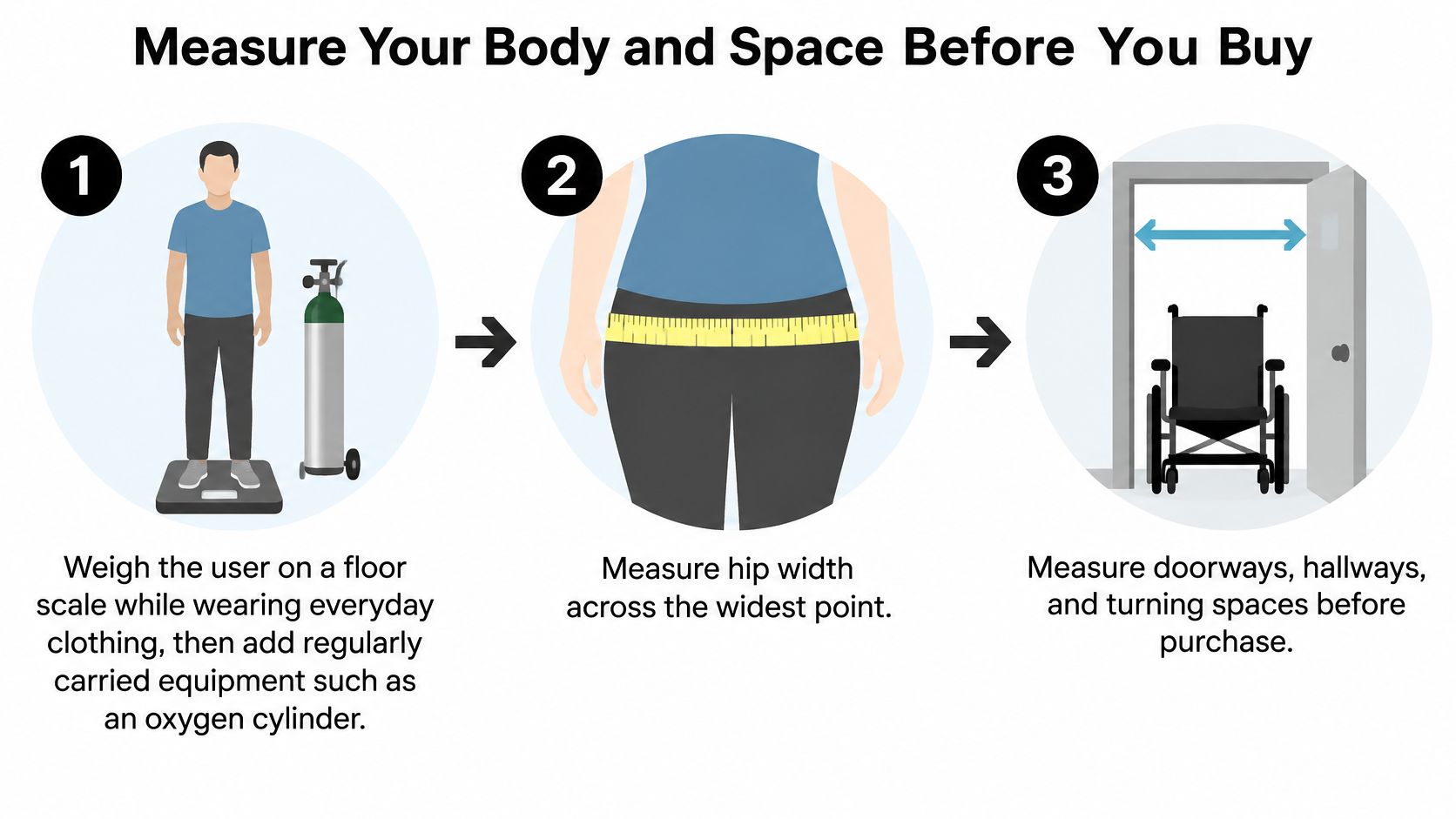
1. Weigh the user on a floor scale, in everyday clothing. Then add everything that rides on the chair: a portable oxygen concentrator, a ventilator bag, a heavy handbag. Equipment travels on every trip, so it belongs in the total. The common mistake is weighing in light clothes at a clinic and forgetting the cylinder that hangs on the back.
2. Measure hip width at the widest point, seated. Sit the user on a firm chair with the knees at a right angle and run a tape across the hips and thighs. Standing measurements understate seated width by an inch or more, which is enough to turn a comfortable cushion into a squeezing one.
3. Measure seat depth from the back of the buttocks to the back of the knee, then subtract a finger's width. A cushion that presses behind the knee pushes the pelvis forward and concentrates pressure where the thigh meets the calf. The deepest seat on offer is not automatically the most supportive one.
4. Note sitting height, armrest clearance and footplate position. Elbows should rest near the joystick without the shoulders hiking, and the thighs should sit level with the knees or slightly lower. A footplate set too low lifts the knees above the hips and rolls the pelvis backward.
5. Measure the narrowest doorway, the tightest turn and the vehicle lift limit. Take the doorway figure at the handle side, read the weight limit printed on the lift or ramp, and note the weight of each folded part. Measuring the front door and forgetting the bathroom is the slip that sends a chair back.
6. Compare every figure with the published maximum user weight and seat width, keeping a margin on both. A rating works like the load sign on a lift: it marks the ceiling, and margin is what keeps daily loads comfortably under it. That margin absorbs a winter coat, a full shopping bag and a denser cushion.
Body mass index can't do this work for you. The WHO Europe nutrition fact sheet sets obesity class I at a BMI of 30.0 to 34.9, class II at 35.0 to 39.9 and class III above 40. Because BMI depends on both height and weight, two adults in the same class can need very different chairs. It also says nothing about the load a chair carries day to day: that load is measured body weight plus whatever rides along, and add-ons such as elevating leg rests, oxygen equipment and seating components can carry limits of their own. Fit, posture, pressure management and transfer safety are what a professional fitting is for.
If the hip measurement falls between two seat widths, how seat width is measured on a bariatric wheelchair explains where the cushion edge should sit relative to the hip bone.
The turning check deserves its own walk-through with a tape in hand. Many power chairs need 45 to 60 inches of clear floor to turn, and that space has to exist in the kitchen, the bathroom and the bedroom, plus room to open a door while seated in the chair. Measure those three rooms before you settle on a model.
Verify the Tested Rating Behind the Weight Label
The highest number on the page isn't the safest chair. A 450 lb rating on one frame and 450 lb on another can mean different things, because what gets tested, and what the test load includes, isn't standardized across marketing departments.
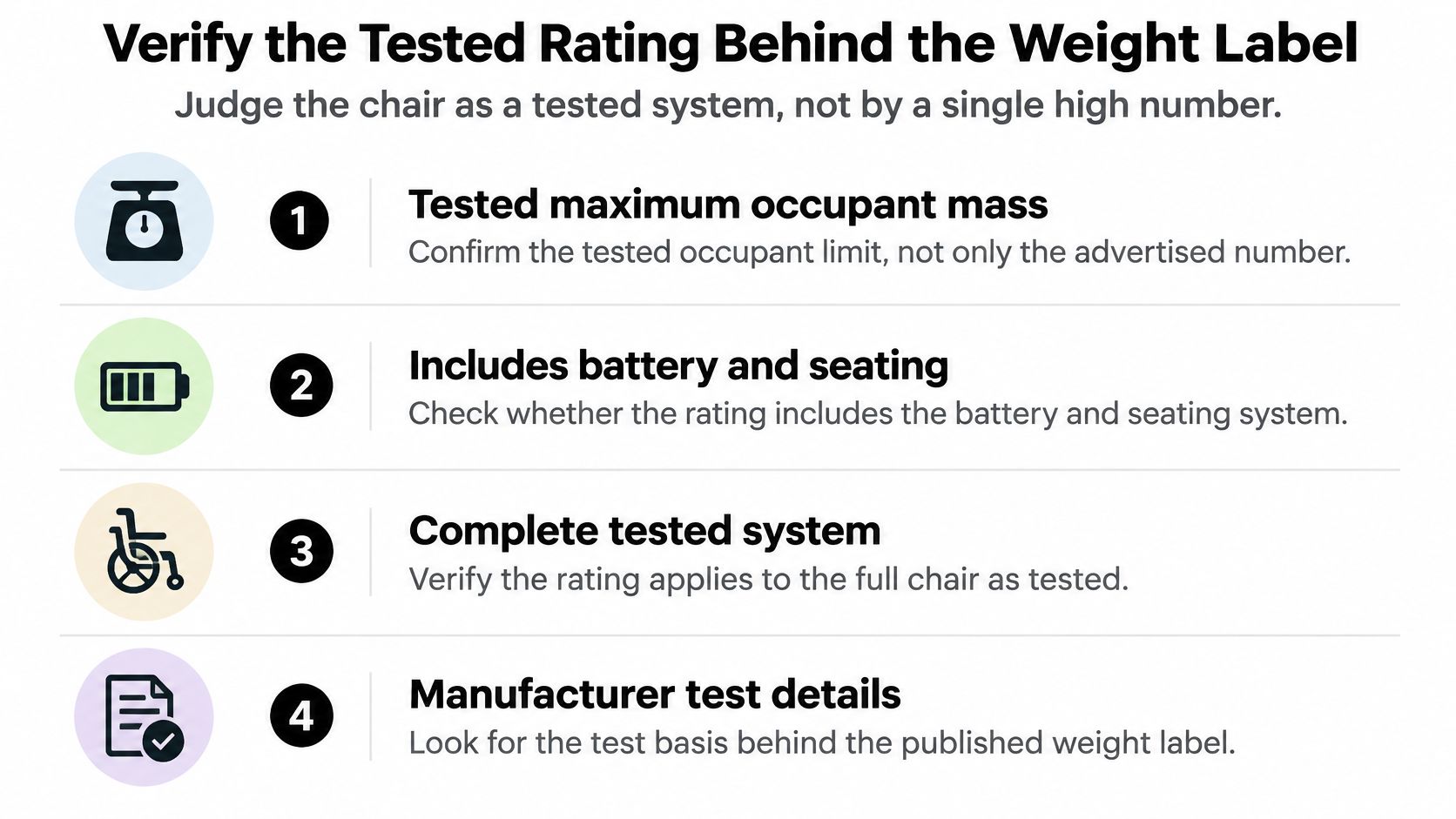
The ISO wheelchair standards guide covers static stability, seat and wheelchair dimensions, static, impact and fatigue strength, flammability, test dummies and test setup. Its measurement guidance also includes larger loading provisions written for bariatric applications. That's the gap between a documented test and a number chosen for a product page.
Run through this list before you shortlist anything.
- Tested maximum occupant mass. Ask for the tested figure in writing, not the advertised one.
- What the rating includes. A capacity that assumes no battery, no seating system and no leg rests is a different claim from one tested as a complete chair.
- Seat width and depth as tested. A wider seat changes where the load sits on the frame.
- Center of gravity with tilt or recline engaged. Position matters most in the configuration the user will run.
- Turning footprint and ramp or threshold limits. These decide whether the chair can leave the living room.
- The test basis. Documentation tied to recognized wheelchair test methods beats any label.
The engineering reason is simple. More occupant mass raises structural loads, and it shifts the combined center of gravity, which reduces rearward or lateral stability during braking, on inclines, over curb transitions and during seat recline.
A chair that holds its rating on level flooring may have very little margin left once a power tilt system, a reclined backrest and an oxygen cylinder are added. None of those items is unreasonable. Together they change the load the casters and anti-tip wheels are managing.
A round number on a product page is a question to ask the supplier, not a verdict on the chair.
Ask the supplier for the test documentation, compare the rated figure against your measured load plus accessories, and treat any rating that arrives without a test basis as unresolved. That single habit filters out most of the misleading comparisons in this category.
Pressure Care and Seating Fit for Daily Use
A frame can pass every structural test and still put the user's skin at risk. Prolonged sitting concentrates load at the buttocks and the backs of the thighs, and a seat that is too wide or too deep lets the pelvis slide. Each time the user pushes back into position, the skin drags across the cushion while the bone moves underneath. That dragging is shear, and shear is what turns sustained pressure into injury.
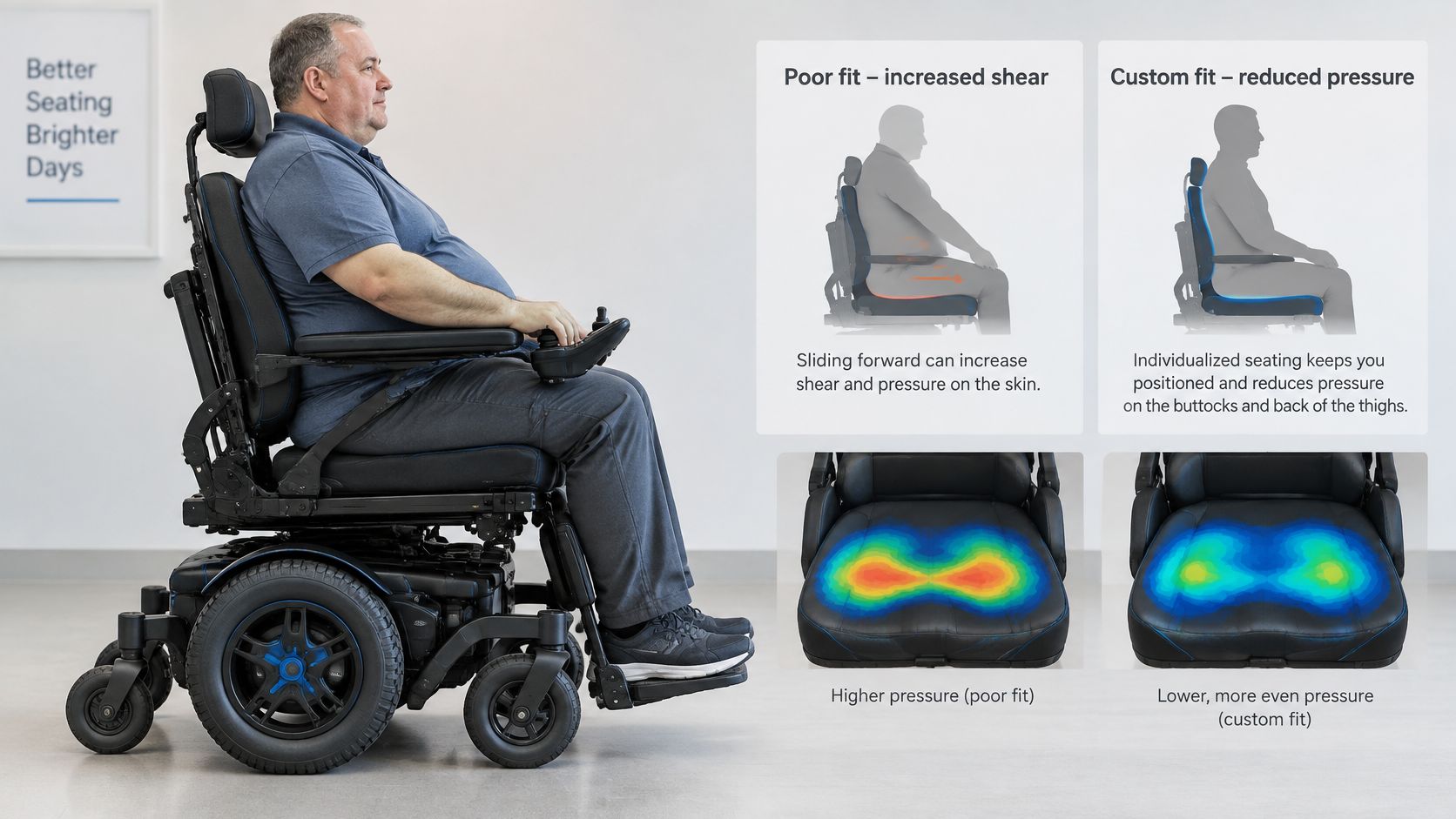
Capacity and skin safety answer different questions. A randomized clinical trial of 258 nursing home residents at risk of pressure injury found that a professional wheelchair and seating assessment produced safer, higher-level wheelchair function. The same trial found no statistically significant difference in pressure-injury incidence. Read that pairing carefully: assessment improves how the chair performs and how safely it is used, and no setup removes wound risk on its own.
Recline geometry changes the outcome too. In studies of powered-wheelchair recline systems, a two-slide backrest reduces body slip and measured buttock pressure compared with a non-slide backrest at larger recline angles. Slip is what produces shear and pelvic migration, so the hardware design matters as much as the angle you dial in.
The Risks That Outrank Body Weight
A 2025 umbrella review of pressure-injury risk identifies obesity, advanced age, diabetes, incontinence, immobility, impaired sensation, respiratory or perfusion problems and low physical activity as recurring risk factors among wheelchair users. In the same review's expert prioritization, immobility, a previous pressure injury, malnutrition, inability to perform pressure relief and sensory impairment all ranked above obesity.
That ranking is the useful part. Weight capacity works like a bridge rating: it tells you the structure holds the load, and nothing about the road surface on top. The strongest chair in the catalogue cannot reveal whether the user can shift position independently, whether sensation is intact, or how many hours a day the user sits without a break. Those answers decide cushion choice, tilt schedule and skin-check frequency, which is why a measured seat width and an honest picture of daily sitting time belong in the buying decision right alongside the capacity figure.
Here's how tilt and recline behave in practice.
What to Do This Week
- Fit a pressure-relief cushion matched to the user's risk level rather than the cheapest foam pad that came in the seat. A guide to choosing a wheelchair cushion breaks down the difference between foam, gel and alternating-pressure designs.
- Test tilt and recline with the user in the chair, then write down the angles that relieve pressure comfortably so a caregiver can repeat the same positions every day.
- Check skin twice a day at the sacrum, the buttocks, the heels and every point where the chair meets bone. Catching redness early is far easier than treating a wound.
- Book a seating evaluation with an occupational or physical therapist if the user has diabetes, reduced sensation or a history of wounds. Self-selection is where avoidable problems tend to start.
- Work on seated posture between checks. Regular exercises that improve posture to ease muscle tension support the trunk control that keeps a user upright in the seat instead of sliding forward.
Funding Options and What Each One Covers
A high weight rating can get a bariatric power wheelchair onto a shortlist, yet funding usually turns on a different file: measured body size, mobility limitation inside the home, accessories that add load, and pressure-care needs. A chair that holds 500 lb on paper can still fail clinically if the seat is too wide, the cushion does not match skin risk, or the user cannot reposition without help.
| Funding route | What it typically covers | Typical requirement | Question to ask |
|---|---|---|---|
| Medicare | Power wheelchair when coverage criteria are met | Face-to-face visit, documented mobility limitation at home, enrolled supplier | Does the bariatric model qualify under the coverage rules? |
| Private insurance | Often follows Medicare categories with plan-specific rules | Prescription and prior authorisation | Which suppliers are in network and what is the deductible? |
| Medicaid | State plan benefits | State criteria and supplier enrolment | What is the state weight or model limit? |
| FSA or HSA | Qualified medical equipment bought with a prescription | Letter of medical necessity or prescription | Is this chair an eligible expense under my plan? |
| Financing | Spreads the cost over monthly payments | Credit approval | What are the interest rate, term and total repayment? |
| Out of pocket | Full purchase price | None | What are the warranty, return window and trial period? |
Rules differ by plan, state and supplier, so confirm coverage in writing before you buy. Work through the routes in this order.
- Check whether the chair is covered in its bariatric form. Some criteria are written around standard powerchairs, and the higher-capacity version may need documentation that matches measured width, depth and accessory load.
- Confirm the deductible and the in-network suppliers. A supplier who is not enrolled can leave you paying the full amount and chasing reimbursement afterward.
- Ask the FSA or HSA administrator whether a prescribed chair qualifies. Get the answer in writing and keep it with the prescription.
- Compare financing against the total price. Look at the interest rate, the term length and the total repayment, not the monthly figure alone.
Coverage questions have a home in our guide to power wheelchair coverage under Medicare, which walks through the documentation a claim usually needs. Bring measurements to that conversation: seat width, seat depth, user weight with clothing and medical accessories, plus the cushion or tilt feature the clinician recommends.
A monthly payment is not a price. Multiply it out across the term before you compare it with any other route.
Paperwork is where claims fail. Keep the prescription, the letter of medical necessity, measurements and every receipt in one folder, the same filing habit shown by Thermo Recovery Wear reimbursement resources for prescribed gear. A reimbursement decision can take weeks, so do not place the order before the approval letter is in hand if you are relying on coverage.
Confirm Fit, Transport and Upkeep Before You Order
Three things are hardest to undo after delivery. Confirm that the measured weight sits below the rated limit with margin, that seat width and depth match your own tape, and that warranty and return terms exist in writing rather than in a chat window.
Transport is the step buyers skip. Check the folded weight of the heaviest part against the vehicle lift or trunk limit, confirm the ramp and threshold limits on the routes you use most, and secure the chair with tie-downs once it's inside the vehicle. A guide to power wheelchair transportation covers the loading sequence and the tie-down points that matter.
| Task | Interval | Why it matters |
|---|---|---|
| Check tyre pressure or solid tyre wear | Monthly | Uneven wheels reduce range and stability |
| Charge the battery fully | After each use, or at least weekly | Deep discharge shortens battery life |
| Inspect brakes and listen for drive motor noise | Every 3 months | Brakes hold the chair on slopes |
| Check frame, bolts and folding latches | Every 6 months | Loose hardware affects the load rating |
| Replace the battery | Every 1 to 2 years | Ageing batteries lose range and power |
| Professional service and seat inspection | Yearly | Confirms fit and the condition of the pressure cushion |
Send your measurements to a seating professional and ask which two models meet them. Two from our range show how published numbers compare: the Medline Guardian Extra-Wide Bariatric Wheelchair carries a 500 lb capacity, comes in seat widths of 20 to 26 inches and folds for transport, while the Pride Jazzy Carbon HD Bariatric Portable Powerchair is rated to 400 lb, weighs 32 lb without the battery and folds with a Quick Fold feature. Match each figure to your own list before you decide between them.
A bariatric power wheelchair only works when the tested rating, the seat dimensions and the pressure-care plan line up with the person using it, and that match is what DME Superstore's bariatric selection is organized around. You can compare high-capacity powerchairs, pressure-relief cushions and transport accessories with the weight ratings, seat sizes and warranty details printed on each product page rather than buried in a brochure. Visit DME Superstore when you're ready to check two models against the measurements you've taken.
