



You're standing in a pharmacy aisle or scrolling late at night, trying to help a parent who is unsteady in the kitchen but still wants to walk to the mailbox alone. A cane feels like too little. A wheelchair feels like too much. Then you see a walker with 4 wheels no seat and wonder if the missing seat is a smart simplification or a problem waiting to happen. That question, not the wheel count, should drive your choice.
How No-Seat Four-Wheel Walkers Compare With Other Walkers
| Walker type | Wheels | Built-in seat | Brakes | Best for |
|---|---|---|---|---|
| Standard walker | None (lifted each step) | No | None | Users who need maximum support and bear substantial weight |
| Three-wheel walker | 3 | Optional | Hand brakes on some models | Users who want tighter turns with moderate balance needs |
| Four-wheel walker without a seat | 4 | No | Hand brakes | Users with balance or endurance limits who can still load their legs |
| Four-wheel rollator with seat | 4 | Yes | Hand brakes | Users who need rest stops during walks |
The no-seat model sits in the middle. It rolls forward with each step, so you don't lift and set down the frame the way you do with a standard walker. That continuous movement can make walking feel more natural and less tiring for your arms. It gives you more stability than a cane, with two hands on a frame and four points on the ground, but it gives you no place to rest when you're tired, winded, or dizzy.
A standard walker has the widest, most planted base because it doesn't roll away. That support comes at a cost. Lifting it every step slows your gait and breaks your rhythm. A three-wheel walker turns in a tighter circle, which helps in small bathrooms and narrow hallways, but its narrower footprint tips more easily if you lean sideways. A rollator with a seat adds rest stops and often storage, which can extend how far you'll go. It also adds weight and a new risk if you sit or stand without locking the brakes.
Practical rule: Choose by balance, endurance, and brake control, not by the number of wheels alone.
If you're still sorting the basic categories, our overview of walkers with wheels and how they differ walks through the frame types before you narrow to a model. Use the table to rule out what doesn't fit your body first. Then look at features.
What a Four-Wheel Walker Without a Seat Does
Think of it as a rolling handrail you push ahead of you. It isn't a crutch you lift at each step, and it isn't a chair you carry with you. In plain terms, a walker with 4 wheels no seat is a rolling frame with four wheels, handlebars, and hand brakes, designed to support you while you're upright and walking.
The Two Jobs It Does Well
First, it provides continuous support while walking. Your hands stay on the handles, the wheels stay on the ground, and you don't lose your support point between steps. Health New Zealand guidance on walking frames states that most walking frames are four-wheeled and describes this configuration as a safe, stable option, while noting that wheels change how the device must be controlled compared with a fixed walker.
Second, it gives you controlled slowing. The same guidance explains that brakes may be unnecessary indoors or on very flat surfaces, but they become useful on slopes, near steps, or when a person tends to walk too quickly, giving Parkinson disease as an example. You should be able to apply and release those brakes easily, every time, without thinking hard about it.
Say you're walking a long clinic hallway. The frame keeps you steady, you squeeze the brakes gently as the floor slopes toward the entrance, and you stop fully before turning into the exam room. That's the device working as intended.
What It Does Not Do
It doesn't prevent falls by itself. The Centers for Disease Control and Prevention falls data reports that more than 14 million adults aged 65 and older, approximately 1 in 4, report falling each year in the United States, and falls are the leading cause of injury in that age group. A frame that rolls can support a person who is already at risk, but it can't fix weak legs, poor vision, medication side effects, or a cluttered hallway.
The walker supports the walking. It does not prevent the fall.
So ask the deciding question first. Do you need support while you stand and walk, or do you mainly need a place to rest? If rest is the main need, a seatless design is the wrong tool, no matter how light it feels in the store.
Who Should Use a No-Seat Four-Wheel Walker
Seven factors decide the match: balance, endurance, ability to bear weight through your legs, grip strength, ability to operate the brakes, cognition, and the environment where you'll use it. Miss one and a good walker on paper becomes a poor walker in your hallway. For example, numb feet can undermine balance, so it helps to understand the causes of neuropathy-related balance problems from Arizona Valley Acupuncture before you blame the device for unsteadiness that starts in your feet.
Clinical guidance in American Family Physician guidance on assistive devices treats this device as a balance-and-endurance aid, not a weight-bearing substitute for a standard walker or crutches. It suits relatively higher-functioning users who can maintain substantial lower-limb loading and need help with balance or reduced endurance. Because all four legs roll, it is less stable and can slide forward if the hand brakes are not applied.
That rolling is the risk mechanism. If you push down heavily, expecting the frame to hold you up like furniture, or you forget to brake, the frame can move away from you and increase fall risk. Look for independently operable hand brakes, stable wheel geometry, and height adjustment that keeps you upright with slightly flexed elbows. You should also show you can stop before turning or crossing a threshold, not just walk straight. Users with significant balance impairment, poor coordination, or cognitive impairment generally require a more stable device and professional assessment. A seatless design may reduce misuse as an improvised chair, but it doesn't remove the need for brake training and cognitive screening.
| Your situation | Suitable walker | Reason |
|---|---|---|
| Can bear substantial weight and needs help with balance | Four-wheel walker without a seat | Rolls with you while your legs carry the load |
| Needs rest stops during outings | Four-wheel rollator with seat | Built-in seat gives a place to stop, the no-seat model does not |
| Poor balance, weak grip or unreliable brake use | Standard walker or professional assessment | Unbraked wheels can roll away, a wider base is needed |
| Cognitive impairment affecting brake use | Clinical assessment before any wheeled walker | Safe braking depends on judgement that must be checked first |
| Needs weight support rather than balance help | Standard walker or crutches | Four-wheel models are not weight-bearing substitutes |
Notice the pattern in the table. A seat is a rest function, not a balance function. Adding or removing it doesn't fix weak grip or poor judgement about brakes. If you're comparing options for an older parent, our guide to the best walkers for elderly users can help you sort models after you've answered these fit questions accurately.
How to Check Brakes and Fit Before Your First Walk
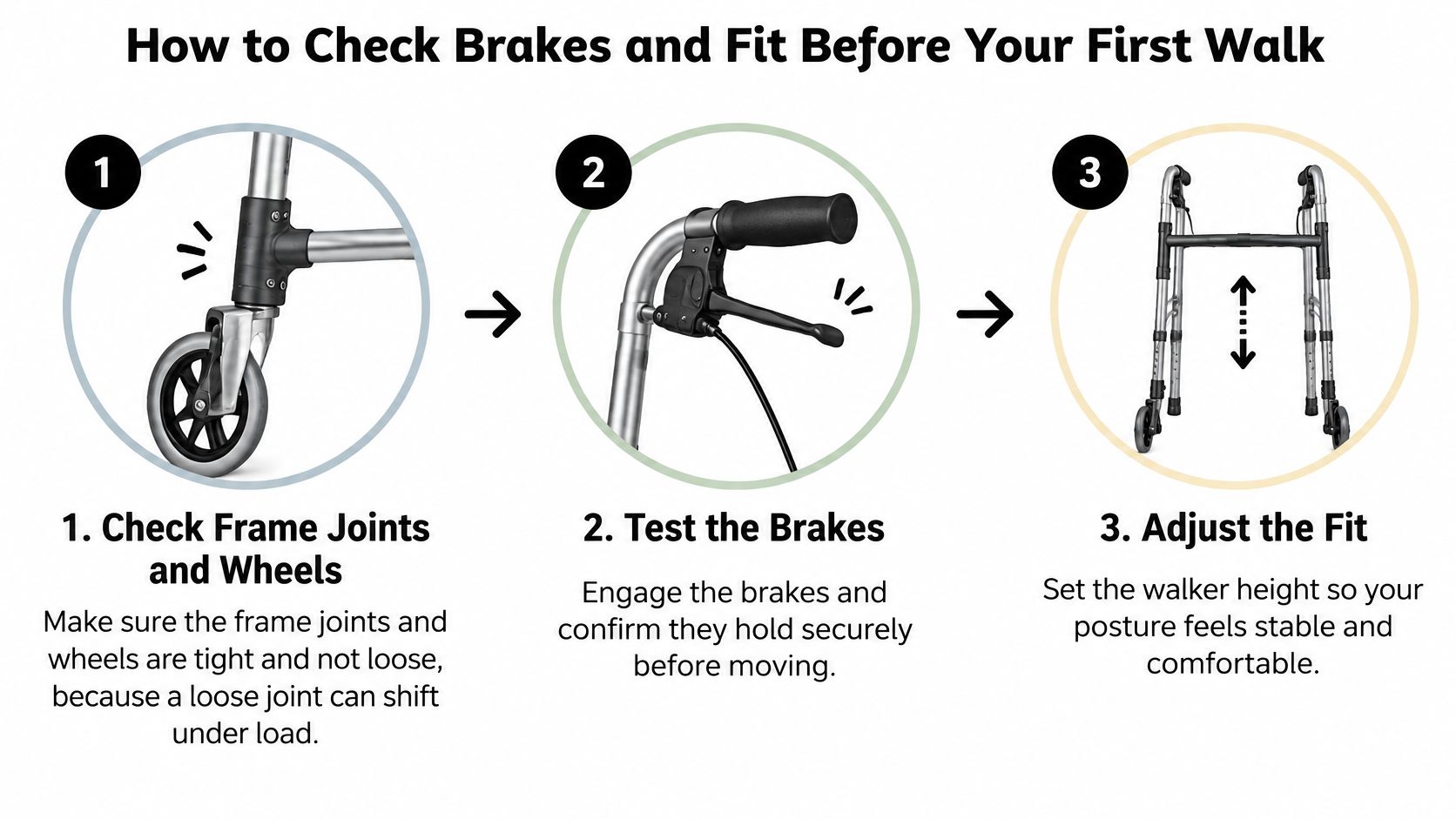
Don't learn brake control in a crowded store or on a slope outside your front door. Set up on a flat, dry floor at home, with another person nearby, and work through these checks in order. NHS Lanarkshire guidance on four-wheeled walking frames instructs users to check that frame joints are not loose and to test the braking mechanism before walking.
The Six-Step Setup
- Check frame joints and wheels: Wiggle each joint and spin each wheel. Tighten or stop if anything feels loose, because a loose joint can shift under load when you lean on it mid-step.
- Test the brakes the right way: Push down to test pressure brakes, or squeeze the handles to test lever brakes. Each side should grip firmly and release cleanly, because uneven braking pulls the frame sideways.
- Secure the brakes and push: Push the brakes into the locked position and confirm the wheels no longer move. Then try to nudge the frame forward. If it rolls, don't walk with it until it's adjusted, since a free wheel is the most common cause of a slide away from you. Our rollator brake adjustment guide explains cable tension if a brake feels soft.
- Set handle height: Stand inside the frame, arms relaxed. Adjust so you stand upright with your elbows slightly bent, not hunched over the handles or shrugging your shoulders to reach them. A height that's too low pulls you forward. Too high reduces your control.
- Walk, stop, repeat: Take a few steps on flat, dry floor. Stop fully and squeeze the brakes before each turn of direction. You're training the sequence, walk, slow, stop, then move again, until your hands do it without prompting.
- Practise the hard parts supervised: With someone present, practise a turn, a doorway, and a small threshold. First-time users often walk more slowly and with a less steady rhythm, so straight hallway success doesn't prove you're ready for a busy kitchen.
Floors to Avoid
Don't use a four-wheeled frame on stairs, and avoid wet floors, uneven surfaces, wet leaves, or ice. With no seat to pause on, a loss of wheel control on a slippery surface becomes an immediate hazard, not an inconvenience. Retest the brakes again whenever the floor changes, for example moving from tile to a ramp or from indoors to a sidewalk. That ten-second squeeze and lock check is cheap insurance.
Before every walk: joints tight, brakes grip, brakes lock, wheels stay put.
Turns, Thresholds and Slopes Where Stability Changes
Straight, flat walking is the easiest thing you'll do with this device. Stability drops when the task gets complex. An instrumented-rollator study of 10 users performing everyday tasks, including straight walking, 90-degree and 180-degree turns, obstacle crossing, backward walking, and a 50 mm step, found the combined stability margin was significantly higher during straight walking than during more complex tasks, and stability increased as the amount of body weight supported through the device increased. Lifting all four wheels over a curb reduced stability compared with keeping at least one wheel in ground contact.
That finding shapes your technique more than any feature list. Keep weight through your legs and through the handles steadily. Don't hoist the frame.
- Slow before every turn: Speed turns a controlled pivot into a slide, because the wheels want to keep rolling in the direction they face.
- Use several small changes of direction: Forcing one tight pivot twists the frame around its wheels. Small adjustments keep you inside the frame.
- Keep continuous wheel contact over small level changes: Lifting breaks your stability margin. Roll over a low threshold slowly instead of picking the walker up.
- Brake before a slope or curb: The frame will start moving before you can react on a decline. Slow, stop, look, then proceed.
A separate gait finding in that research noted first-time four-wheeled-walker use reduced walking velocity and increased stride-time variability. That's why the supervised practice with turns, doors, and obstacles in your setup matters. If you want a refresher on hand position and pacing, our instructions on how to use a rollator walker cover daily technique in more detail.
Why Removing the Seat Does Not Make It Safer
The common assumption sounds logical. Remove the seat, remove the temptation to sit unsafely, and the walker must be safer. The evidence doesn't support that shortcut.
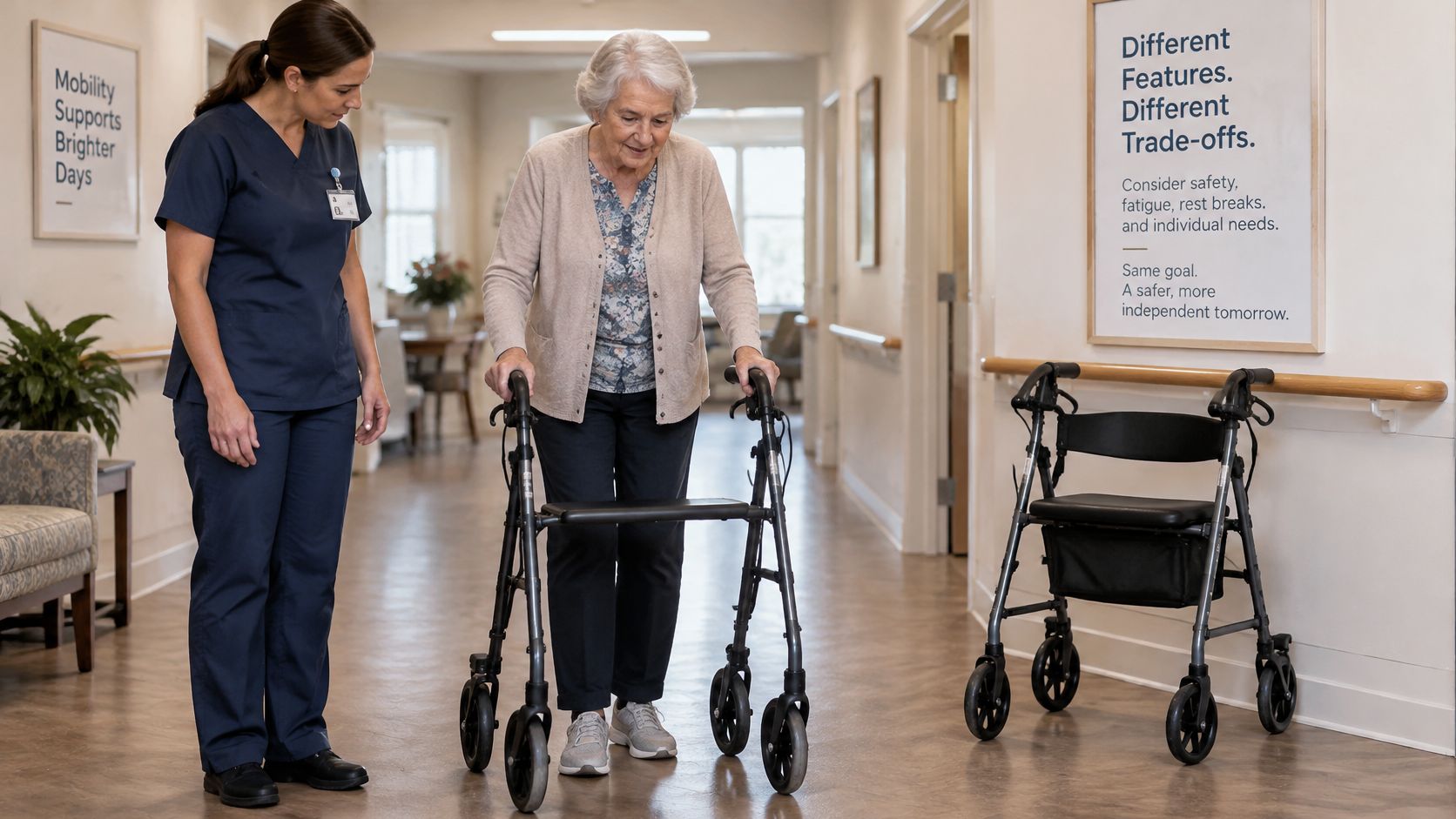
A review of wheeled walker falls in long-term care reports that 79.4% of observed falls involving wheeled walkers occurred among rollator users, backward falls were 16% more common with rollators than with two-wheeled walkers, and 83% of older users in an earlier study reportedly had difficulty fixing the brakes during sit-to-stand transfers. Four-wheeled devices improve maneuverability but can create backward instability during weight transfer, especially when users don't engage the parking brake.
Read those numbers carefully. They show that brakes and transfers are risky moments. They do not show that removing a seat prevents falls. A person who can't fix the brakes reliably still can't fix them on a seatless model. They've lost the option to sit when they need to.
Fewer features do not mean lower risk. Brake accessibility, wheel-speed control, turning stability, and individualized training may matter more than the presence or absence of a seat.
When the Seat Is the Safer Choice
Separate two functions in your mind. Continuous walking support is what every four-wheel walker provides. A rest or transport function is different, and a no-seat model cannot substitute for a wheelchair or be pushed with someone sitting on it.
Choose a seated rollator, or get a clinical assessment, if you regularly face:
- Fatigue that arrives suddenly: You need to stop now, not after finding a bench.
- Dizziness on standing or orthostatic symptoms: Sitting quickly can prevent a fall.
- Long distances with no seating: A planned route without chairs is a risk if your endurance varies day to day.
- Emergency rest needs: Shortness of breath or leg weakness makes a built-in seat a safety feature, not a luxury.
If none of those apply and you can control the brakes, a seatless walker may be perfectly appropriate. Judge the trade-off for the actual user, not the slogan.
Accessories and Compatibility Notes
Accessories change how a walker behaves, not just how it looks. Check compatibility before you clip anything on, and recheck the brakes afterward.
- Bags and baskets: A load hung on the handles or far in front shifts the centre of mass and can tip the frame. Count contents toward weight capacity and keep heavy items low and centred.
- Trays and clip-on tables: Fit only models the manufacturer lists as compatible. An attachment on the wrong frame can block brake reach and alter steering.
- Seat or backrest kits: Adding a seat kit turns a no-seat walker into a rollator-type model. Confirm the frame design and kit rating first, because the frame wasn't necessarily built to be sat on.
- Replacement parts: Wheels, brake pads, and cables wear over time. Retest them with the same joint, grip, and lock checks you used before your first walk.
- Tip and glide attachments: Rubber-tipped or glide feet suit flat indoor floors but reduce grip outdoors. Remove them on uneven ground.
Match any accessory to the exact model number, not a lookalike frame. Our roundup of walker accessories for the elderly lists common add-ons, but the rule stays the same. After every add-on, squeeze, lock, and push the brakes again, because a changed load alters how the frame slides and stops.
Choose and Test Your Walker Before You Buy
Run this checklist before you order, in this order.
- Seat decision: Confirm whether you need rest stops. That answer eliminates half the catalogue.
- Weight capacity: Add your body weight to bags and items you'll carry. A load near the limit shifts the centre of mass.
- Brakes: Check you can operate the brake type reliably with each hand, reaching the levers without strain.
- Height and width: Confirm the height range lets you stand upright with slightly bent elbows, and measure your narrowest doorway and gaps between furniture.
- Wheels and tread: Match wheel size and tread to the surfaces you use most, smooth floors at home or cracked sidewalks outside.
Read specifications carefully. For example, the ByACRE Ultralight Carbon Fiber Rollator is made of carbon fiber, weighs 10.6 lbs, and has a 285 lb weight capacity, and it's available with or without a backrest. Those three numbers tell you more than a photo does. A clinician or therapist can assess fit and brake use before regular use, especially after surgery or a recent fall. Compare the listed specifications on each product page, confirm the seat question, then capacity, then brakes.
At DME Superstore, we stock rollators, walkers, wheelchairs, and homecare equipment with clear specifications, compatibility notes, and warranty details on each product page so you can compare capacity, weight, and brake type before you buy. Browse our four-wheel walkers and seated rollators side by side, check the measurements against your doorways and the checklist above, and use our 24/7 chat support if you're unsure which frame fits your balance and rest needs.

