



How long do scooter batteries last? Most scooter batteries last roughly 2 to 6 years, with lithium-ion usually at the upper end of that span and sealed lead-acid at the lower end. Lithium-ion packs are commonly rated for at least 1,000 full charge cycles, and that cycle count, more than any calendar date, is what sets the clock for most riders.
The figure that reframes the whole question isn't a year count at all. A 2025 review of lithium-ion degradation reports that high temperature can increase degradation rates dramatically, by as much as 6.7 to 14 times in the literature it reviews. Two scooters bought in the same month and ridden the same miles can be years apart in battery health by year three.
Age also accumulates when nobody rides. Chemical processes keep working during storage: solid-electrolyte-interphase growth, lithium plating, electrode cracking, loss of active material and loss of lithium inventory all reduce capacity in a machine that sits in a hallway for weeks.
So the useful answer isn't a number of years. Know your pack's chemistry, know how much you discharge it, know how many full cycles that adds up to each month, and watch the conditions that speed all three up. Every one of those is observable on your own scooter, which is why the range is wide and the answer is still knowable.
Typical Scooter Battery Lifespan by Battery Type
Chemistry sets the outer limit before riding habits get a say. Three pack types cover nearly every mobility scooter on the market, and their rated cycle counts differ by a factor of six.
| Battery type | Rated cycle life | Expected lifespan at daily use | Main factor that shortens it |
|---|---|---|---|
| Sealed lead-acid (SLA) | 300-500 cycles | about 0.8 to 1.4 years | Deep discharges and heat |
| Deep-cycle lead-acid | 800-1,800 cycles | about 2.2 to 4.9 years | Depth of discharge and undercharging |
| Lithium-ion | at least 1,000 cycles | about 2.7 years | Heat, fast charging and repeated deep discharges |
The third column assumes one thing: a full charge of energy used every single day. Under that pattern, a 500-cycle sealed lead-acid pack runs out of rated cycles inside 18 months.
A charge cycle isn't the same as a charging session. The U.S. Department of Energy technology assessment defines a cycle as using an amount of energy equal to 100% of the battery's capacity, even when that energy is spent across several partial rides and top-ups. The same assessment places lithium-ion scooter batteries at a minimum of 1,000 full cycles and notes that some systems are designed for a warrantied life of more than 10 years.
Sealed lead-acid runs on a different scale. A technical report hosted by the U.S. Department of Energy's OSTI database puts typical sealed lead-acid life at about 300 to 500 cycles at 25°C (77°F), with the count moving up or down depending on cycling depth and operating temperature.
Two clocks run at once here, and they don't keep the same time. A battery ages through years even when lightly used, and it also ages through cycles, so a barely ridden pack with unknown storage history can sit closer to replacement than its mileage suggests. That's why a capacity-retention warranty tells you more than a single estimate in years or miles.
Reading the label on your own scooter
Find the battery, note the chemistry and the amp-hour rating, and match it to a row. Sealed lead-acid and deep-cycle lead-acid are both lead, but the deep-cycle version is built for repeated discharges and its rating shows it. If the label says lithium-ion, look for the cycle rating and the capacity-retention terms that come with it.
Honest bottom line: most scooters land between roughly two and six years, and that spread comes from chemistry and use rather than one fixed number.
Why Charge Cycles Matter More Than Years
Think of a battery as a bank account that takes no deposits. Every ride withdraws a little, and the account closes when the balance reaches zero, not when a page on the calendar turns.
The mental model is simple enough to sketch.
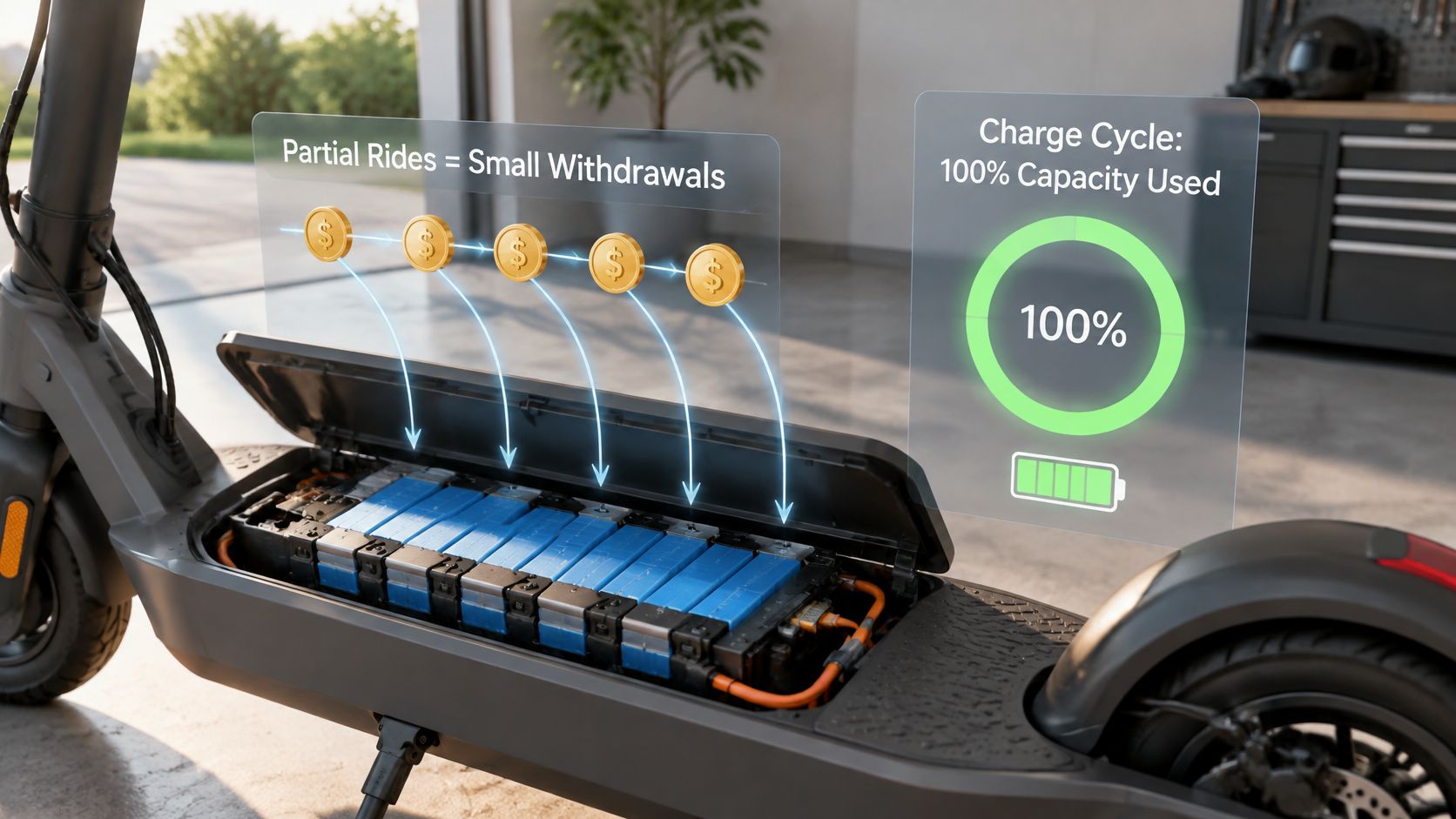
A cycle counts energy, not plugs. A 5-mile errand on a scooter that covers 20 miles from full spends a quarter of the pack, so four of those days spend one full cycle. A rider who tops up after every short loop and rarely empties the pack spends fewer cycles per mile than one who runs it flat, because deep discharges also shrink the number of cycles the pack can deliver in the first place.
The Pacific Northwest National Laboratory technical report benchmarks lead-acid scooter batteries at roughly 800 to 1,800 cycles. A commuter who uses one full cycle a day reaches that ceiling in about 2.2 to 4.9 years, while a rider whose daily trip drains a quarter of the pack takes four days to spend one cycle and stretches the same budget across a much longer calendar.
Depth of discharge changes the count, not just the pace
Discharge depth does more than stretch a budget; it changes the size of the budget. The same report cites a comparative study in which lead-acid delivered about 750 cycles at 100% depth of discharge but about 1,900 at 80%, while lithium-ion reached about 2,000 cycles at 100% and 3,000 at 80% under the study's stated test conditions.
What makes two cycle ratings comparable: the depth of discharge the test used, the temperature it ran at, and the capacity threshold that counted as end of life. A rating measured at 25% depth can't be lined up against one measured at 100%.
That's the buying trap. A listing boasting 3,000 cycles means little without its test conditions, and a pack rated at 1,000 cycles under gentle cycling can outlast a rival with a bigger headline number.
Charging habits sit inside the same arithmetic, and they only pay off with a charger that matches the pack's voltage and chemistry. Our guide to battery chargers for scooters walks through that matching so the top-ups you do count.
A self-check takes five minutes. Write down the miles you get from full to the low-battery warning, write down the miles you ride in a typical week, and divide. That's your full-equivalent cycles per week; multiply by 52, then divide the pack's rated cycles by the result for an expected service life in years.
How Usage Sets Replacement Timing
The same cycle budget turns into very different years once your weekly routine enters the math.
| Usage pattern | Lithium-ion at 1,000 cycles | Lead-acid at 800 cycles |
|---|---|---|
| Daily use, every day | about 2.7 years | about 2.2 years |
| Five days per week | about 3.8 years | about 3.1 years |
| Three days per week | about 6.4 years | about 5.1 years |
Turning weekly mileage into years
The method behind those cells is short division. Multiply rides per week by 52 to get cycles per year, then divide the rated cycle life by that figure. A five-day rider spends about 260 cycles a year, so a 1,000-cycle pack lasts roughly 3.8 years and an 800-cycle pack about 3.1. A three-day rider spends about 156 cycles a year and gets roughly 6.4 and 5.1 years from the same two packs.
Real fleets show how far those numbers move under hard use. A life-cycle analysis of shared e-scooters reports an approximate three-year battery lifetime for shared electric scooters and estimates that one battery is typically replaced during an e-scooter's operational life. Research summarized in the same work puts shared-scooter service lives anywhere from about 0.78 years and 1,400 kilometers in an earlier Brussels case study to roughly three years and 4,000 kilometers for newer, more efficient models, with optimized European operations reporting lives approaching 4.6 to 5 years.
Those are commercial machines running all day, so treat them as a stress test rather than an expiration date for a privately owned mobility scooter. What transfers is the pattern: usage intensity, heat, charging frequency and maintenance all move the replacement date, and so does whether the battery can be swapped on its own. The analysis notes that early e-scooters often lacked swappable batteries, so a failed pack could shorten the useful life of the whole vehicle, with swappable designs appearing around 2019.
Cost follows the same logic. Chemistry, capacity in amp-hours, whether the pack is a standard size that swaps without replacing the scooter, and whether your existing charger is compatible all drive the quote. Call a supplier with the model number and the amp-hour rating from the label and ask for a price on that exact battery.
Budget for a replacement somewhere between about two and six years out, and read the capacity-retention terms before you buy the scooter rather than after. Our guide to how to use a mobility scooter covers the daily routines, from charging schedules to route planning, that keep a pack near the top of its range.
What Shortens Battery Life and How to Protect It
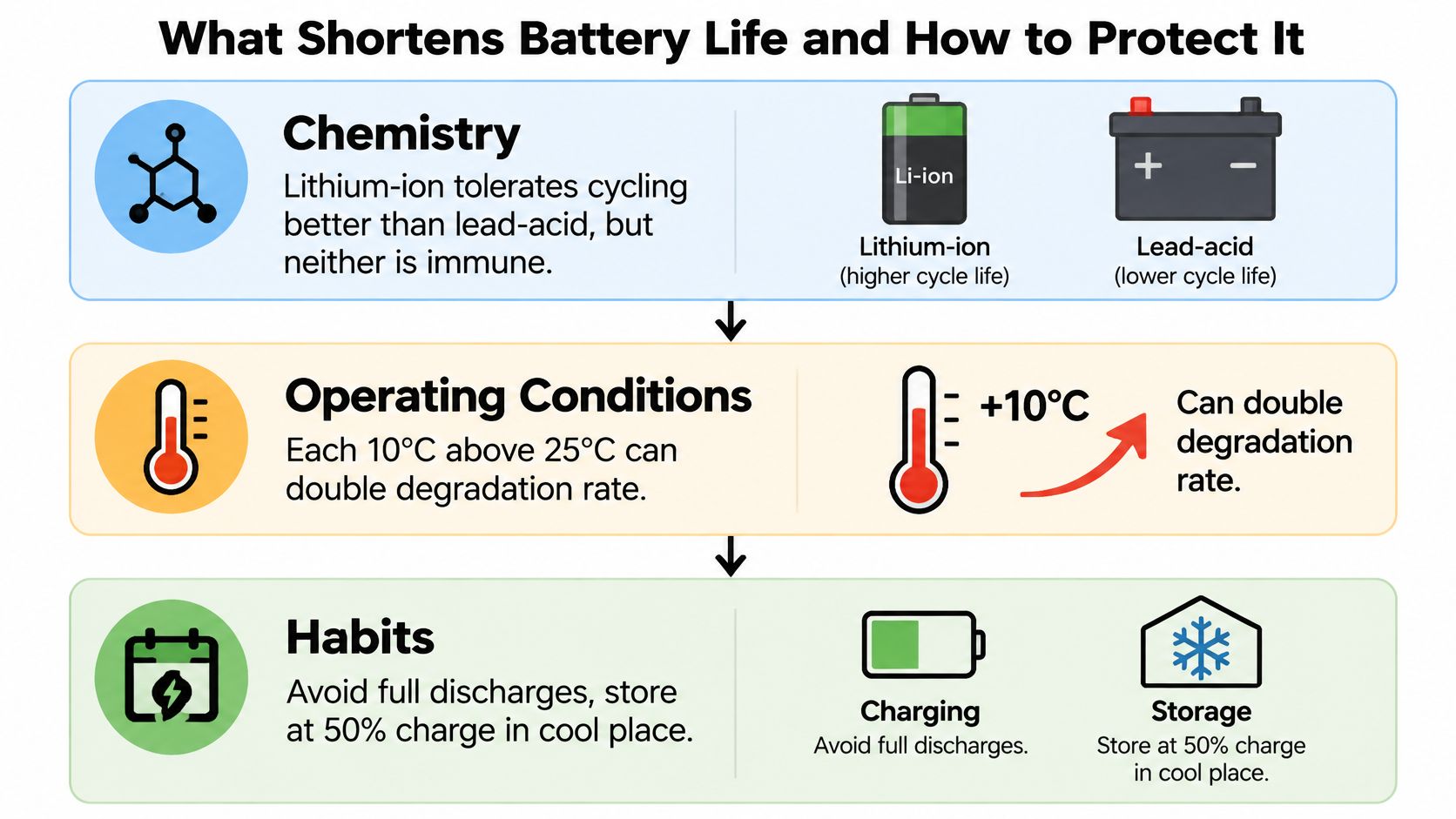
Identical packs fail at different rates because several stresses stack. Work down the stack from the one you can't change to the ones you control every day.
Chemistry sets the tolerance level
Lithium-ion handles repeated cycling better than lead-acid, but neither chemistry is immune to what follows. A pack cycled hard reaches the end of its rated life early no matter what the label promises, and a pack treated gently can beat its rating.
Heat and load decide the pace
Lead-acid cycle-life work collected in a battery degradation reference reports that each 10°C increase above a 25°C reference can reduce cycle life by about 50%, and that a full discharge produces roughly half the cycle life of a 70% depth of discharge.
Load does similar damage by another route. A heavier rider, a steep ramp, soft tires, a headwind or a cold morning all raise the current the motor pulls, which raises the effective depth of discharge for the same trip. Two riders can cover the same 6 miles and ask completely different things of the pack.
Two commuters on the same model show how the stresses compound. The first lives on a flat street, keeps the tires at the recommended pressure and parks the scooter in a hallway. The second climbs a steep hill twice a day, carries a heavy load and leaves the scooter in a sunbaked shed. By year two the second pack finishes each day lower, runs hotter and ages on every front at once.
The hierarchy below captures where each stress sits.
Fast charging adds heat of its own
Pushing a higher charging current shortens charge time but raises pack temperature, and temperature is what ages the cells. A quick charge in a cool room with a matched charger is fine. Repeated fast charging on a hot afternoon is where the wear accumulates.
Six habits that protect the capacity you have
- Recharge after most rides, not after the gauge hits zero. The U.S. Department of Energy battery primer states that discharges beyond approximately 80% of capacity can shorten the life of a typical traction battery, which makes shallow cycling a maintenance practice rather than a convenience.
- Use the charger the manufacturer specifies. A mismatched unit pushes current the pack wasn't designed for, and the same primer advises matching the charger to the battery.
- Unplug once the charge completes. Days at full voltage add stress, and the primer also recommends disconnecting the battery from the load after it reaches full discharge.
- Store cool and partly charged. For a long break, leave the pack around half charge in a dry room instead of a full charge in a hot garage.
- Keep tires at the recommended pressure. Soft tires raise rolling resistance and current draw, which is free range you're handing away.
- Keep the scooter out of hot cars and direct sun. Heat is the accelerator for every aging mechanism in the pack.
Care has a limit worth stating plainly. These habits slow the wear on capacity you still have; they don't restore capacity already lost. A pack down to half its original range keeps declining at a gentler slope.
For a full charging and storage routine, our guide to extending scooter battery life covers seasonal storage and charger matching in more depth.
Signs Your Scooter Battery Needs Replacing
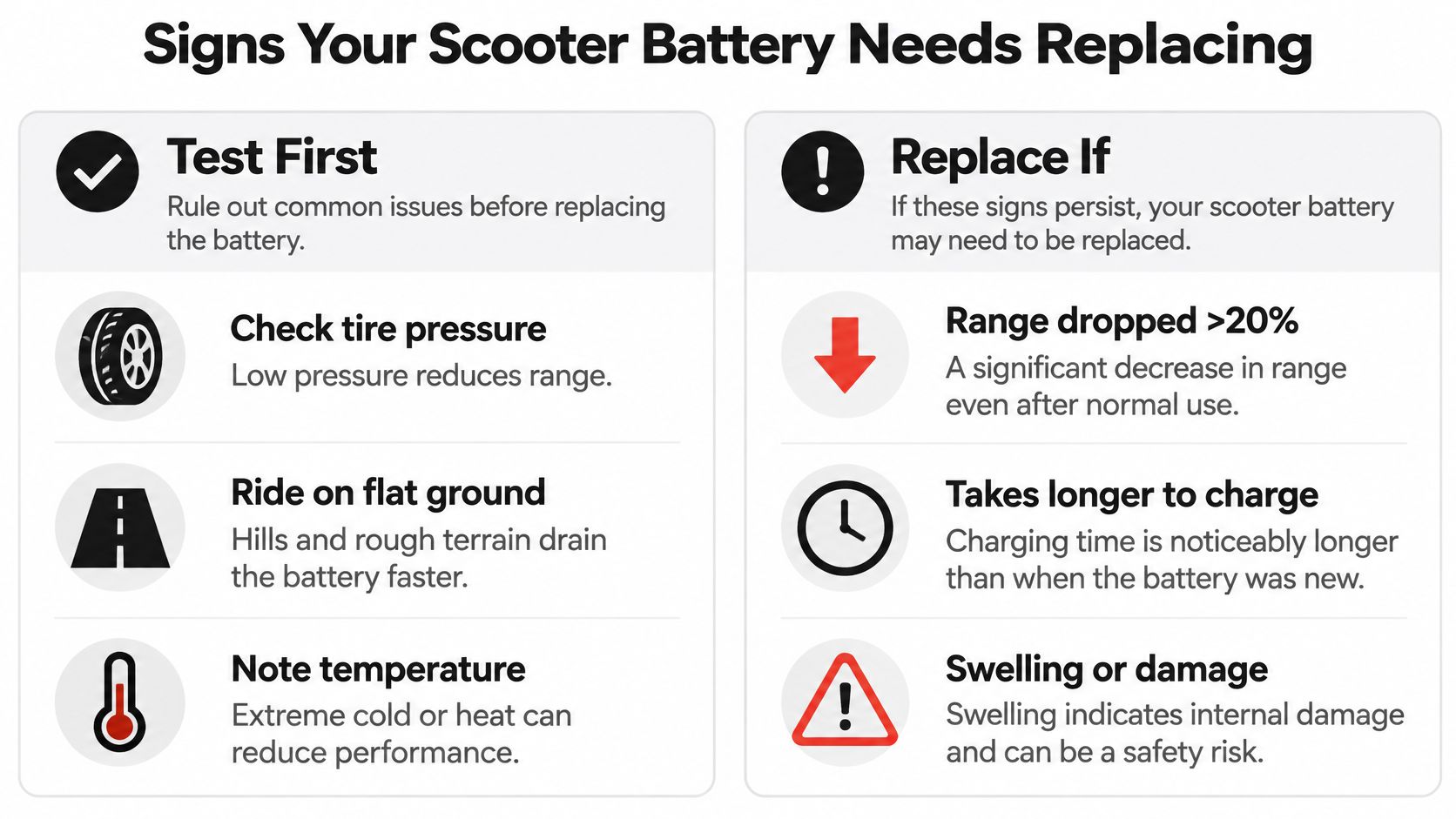
A shorter ride on a full charge is the most reported symptom and the most often misdiagnosed one. Range falls for reasons that have nothing to do with a dying pack.
Cold air, a heavier passenger, a steep hill, an underinflated tire or a headwind can strip a large share off a healthy pack's range for that trip alone. The battery isn't failing; the scooter is working harder than usual.
The repeatable test that settles it
Fully charge the scooter the way the manufacturer directs. Ride a set route on flat ground at moderate temperature, record the distance, and note the ambient temperature and payload. Repeat across several trips under similar conditions and compare the results.
Charging rate and temperature move the finish line itself. A 2025 SAE technical paper found that aggressive 2C charging drove tested cells to the 80% capacity end-of-life threshold in fewer than 200 cycles, while a different 1C charge and 2C discharge condition at 50°C retained more than 80% capacity beyond 600 cycles. Cell-level results like those can't be converted into a warranty schedule for a scooter, because chemistry, battery-management software, charger design, load and thermal control all differ. They do show how far conditions can shift the finish line.
A checklist keeps the two questions separate: is this the battery, or is this the ride?
| Symptom | Usually means | Check first |
|---|---|---|
| Range drops over several charges on the same route | Capacity loss in the battery | Run the full-charge distance test on flat ground |
| Range drops only on hills, with heavy loads or in cold weather | Riding conditions, not the battery | Retest at room temperature with normal payload and correct tire pressure |
| Battery loses charge overnight or the charger stops early | Cell degradation or imbalance | Measure voltage after a full charge and a rest period |
| Swelling, cracks, heat or a burning smell | Safety failure | Stop using the scooter and disconnect the battery now |
Symptoms that survive three comparable test rides point at the pack. Symptoms tied to one hill, one cold snap or one heavy shopping trip usually don't. If the scooter carries you to medical appointments or handles daily errands, the practical threshold is coverage: replace the pack when a full charge no longer completes your regular trips.
Swelling, cracks, unusual heat or a burning smell change the timeline to now. Stop using the scooter and disconnect the battery. Routine upkeep between tests, from tire pressure to clean terminals, is covered in our scooter maintenance guide.
Before You Buy a Replacement Battery
The replacement decision is simpler than the shopping that follows it. Buy a new pack when your tested range no longer covers the trips you make, not when the calendar says the battery is old.
- Match the specs on the label. Chemistry, voltage and amp-hour rating come from the existing battery or the manual, never from a guess.
- Check the fit and the electronics. Physical dimensions and any battery-management requirements decide whether the pack sits in the tray and reports correctly.
- Confirm charger compatibility. A new chemistry often needs a new charger, and a mismatched one can damage a healthy pack.
- Compare cycle ratings only at identical test conditions. Depth of discharge, temperature and end-of-life capacity threshold have to line up before two numbers mean anything.
- Read the warranty for capacity retention. Length matters less than whether it covers lost capacity rather than total failure alone.
- Confirm the pack comes out. Older scooters sometimes bury the battery, which turns a simple swap into a bigger job.
Ask the seller, including us, to confirm compatibility in writing before you order. DME Superstore publishes buying guides, including one titled How to Charge a Mobility Scooter Battery Safely, and our mobility scooter batteries listings make the spec match easier to check. If you're weighing two models, one that ships with a spare battery, such as the Golden Buzzaround GB120 Carry-On Travel Scooter we carry with a free extra battery, splits cycles across two packs and leaves you a backup while one charges.
The rule to keep: a battery is replaced when it stops doing the job the rider needs, not when it reaches a set age.
DME Superstore stocks replacement packs, matched chargers and travel scooters built around removable batteries, so you can plan a swap without guessing at specs. Our team can check a model number against a battery listing before you order, and our guides cover charging, storage and range planning for the trips you ride. Visit DME Superstore to compare models, spare-battery bundles and charger options for your scooter.
