



You're halfway across a grocery store when your legs suddenly feel heavy. There's no bench nearby, your hands are already busy managing your balance, and pushing through the fatigue may make each step less controlled. A rollator walker with seat gives you a walking frame and a resting place in the same device, but the seat only helps when you understand how to sit down safely.
The most important moment often isn't the walk itself. It's the transition from standing to sitting, when a rolling frame can move away from you if the brakes aren't fully engaged. This guide explains how rollators work, who they suit, how to choose the right fit, and how to build safer habits around every transfer.
Understanding the Rollator Walker with Seat
A rollator walker with seat is a wheeled mobility aid designed for people who can walk but may need support, improved endurance, or a place to rest during an activity. Instead of lifting the frame with every step, the user guides it forward on four wheels. Most models include hand-operated brakes, adjustable handles, a built-in seat, and storage beneath the seat.
That combination makes the rollator different from a standard walker. A standard walker is generally lifted and placed forward, while a rollator is designed to roll with the user. It can be useful in a hallway, shopping center, rehabilitation setting, or outdoor pathway when the user has enough standing balance and hand control to manage the device.
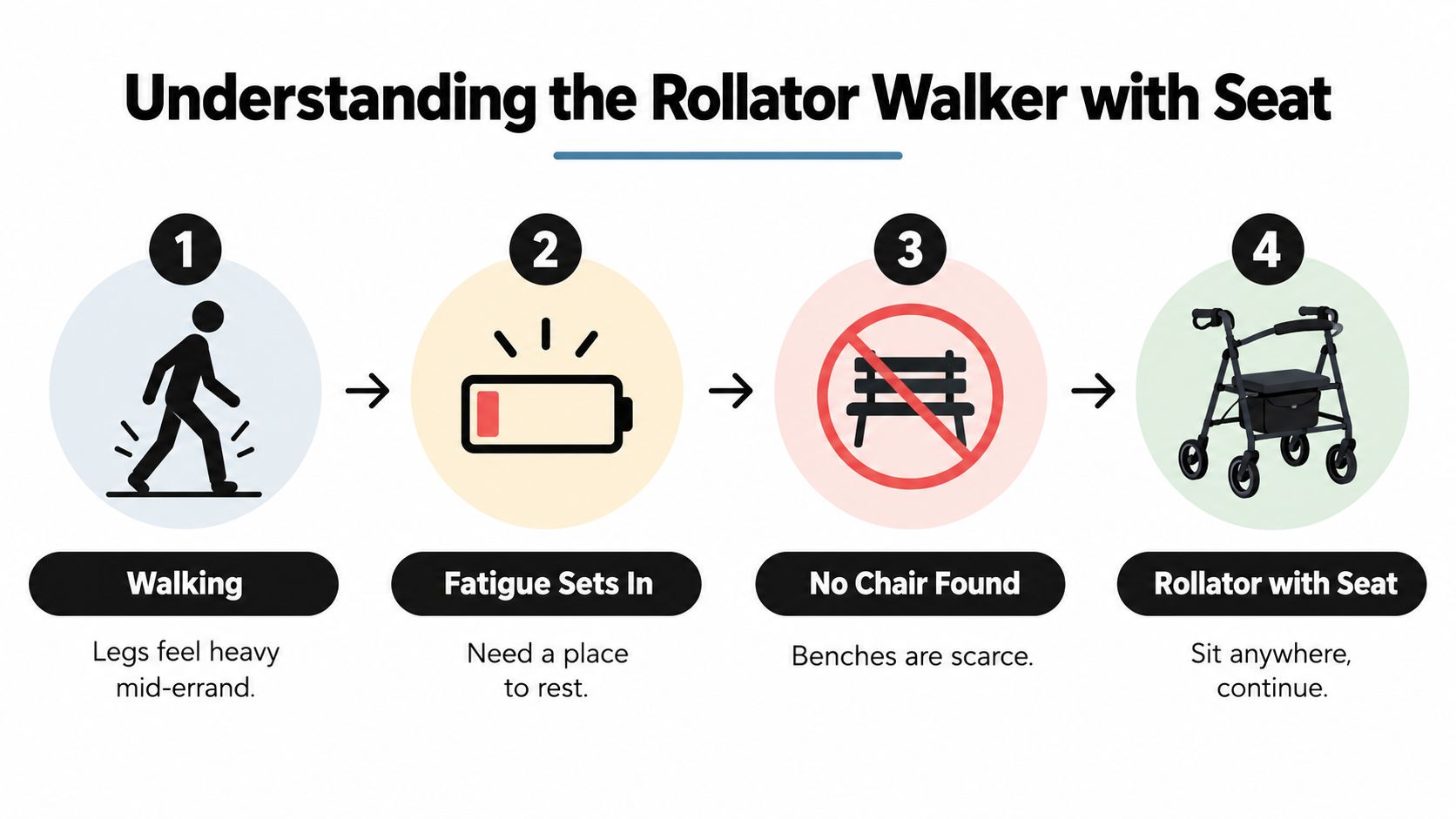
Why the seat is part of the design
The seat wasn't added just to make a walking aid more comfortable. In 1978, Swedish polio survivor Aina Wifalk developed the rollator concept as a wheeled walker with hand brakes and a built-in seat, according to the historical summary of the rollator's development). Earlier wheeled walkers existed, but Wifalk's design established the familiar four-wheel format used widely in major markets.
The seat supports a simple energy-management strategy. You walk while you have control, stop before fatigue becomes overwhelming, lock the brakes, and rest without searching for a chair. That can help someone continue an outing at a manageable pace, rather than treating fatigue as a reason to abandon the activity entirely.
A rollator isn't automatically right for every person who feels unsteady. It's mainly intended for users with adequate standing balance, functional hands, and enough judgment to control the brakes and frame. Someone who needs to place substantial body weight through the device, or who can't reliably manage the brakes, may need a different mobility aid and an assessment from a clinician.
The global market also reflects how established this product category has become. One market estimate values the rollator walker market at USD 85.33 million in 2025 and projects USD 142.10 million by 2034, with a projected 5.83% CAGR from 2026 to 2034. Four-wheel designs are prominent, with one estimate assigning them 48.6% of global market share in 2025. These figures come from the rollator walker market outlook, but market size doesn't determine whether a particular model is safe for you. Your balance, strength, environment, and ability to use the brakes matter more.
For a plain-language explanation of the device itself, see this guide to what a rollator walker is.
Core Safety Features and Weight Capacity
A rollator's seat creates a useful resting surface, but it also changes how the device must be handled. When you sit, your body weight shifts onto the frame and toward the rear. If the wheels can still roll, the seat may move away as you lower yourself, leaving you without the stable target you expected.
Most rollators use a loop-lock or hand-operated braking system. Pulling or squeezing the brake levers can slow the device. Pushing the levers into the parking position locks the wheels. The exact movement varies by model, so read the manufacturer's instructions and practice while standing beside the device before relying on it for a transfer.
Practical rule: Slow down with the hand levers, then engage the parking locks before you sit. Slowing is not the same as parking.
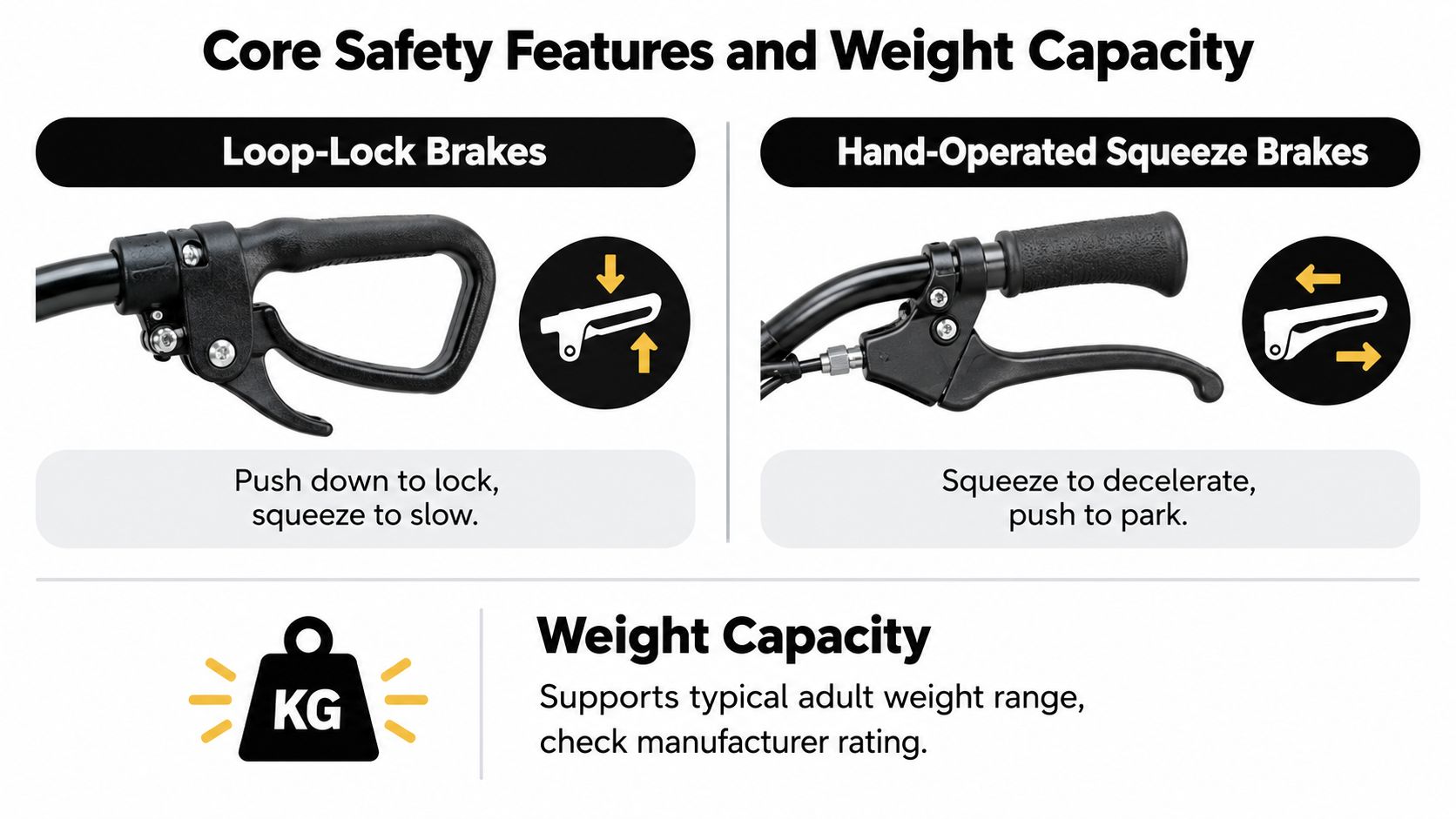
Brakes and seated loading
A user guide for rollators describes the process in two stages. First, squeeze the levers to reduce movement. Then engage the parking trigger so the walker remains still while you're seated. The same guidance advises checking that the device is completely unfolded before walking and taking extra care on sloping or steep ground. You can review those steps in the rollator user guide.
Before sitting, stand inside the frame rather than approaching the seat from an angle. Keep the rollator close, apply both parking brakes, and gently test whether it moves. If it shifts, don't sit. Correct the brake engagement or ask for help.
Brake reliability matters because reported injury pathways include unintended movement linked to faulty brakes and poor wheel traction. A 2023 review also identified walkers and rollators as having high trip-hazard rates among mobility-assistive products. The findings are discussed in this review of injuries involving mobility-assistive products. The lesson isn't that every rollator is unsafe. It's that a user must treat the brake system as a safety feature, not a convenience feature.
Weight capacity is a firm limit
Weight capacity includes more than the person's body weight. Clothing, bags, stored items, and the forces created during sitting or standing all place demand on the frame and brakes. A mainstream model may support around 300 to 330 pounds, while bariatric upright designs may reach 400 pounds, depending on the product's engineering and manufacturer rating. These specifications are discussed in product data for the Drive Clever-Lite LS walker.
Never choose a model by appearance alone. Check the listed capacity, seat width, frame construction, and brake design together. A bariatric model isn't just a wider version of a standard rollator. Its geometry, wheel size, and braking components are designed around a different load class. You can review options and considerations in this guide to bariatric rollator walkers.
Comparing Walkers to Rollators
The right mobility aid depends on what you need the frame to do. A standard walker usually offers a firm base for a person who needs substantial support through the arms or who must bear weight through the device. Because the user lifts and places it, the frame stays still during each placement, but that movement can be tiring and may slow progress.
A rollator is built for a different pattern. The user guides the frame while walking, manages momentum with the brakes, and may sit for a rest. That makes it more suitable for someone who has enough balance and judgment to control a moving device but needs help with endurance or stability over a longer activity.
| Consideration | Standard walker | Rollator walker with seat |
|---|---|---|
| Movement | Lift and place the frame | Guide the frame on wheels |
| Main support role | Firm balance and weight-bearing support | Moving support and resting assistance |
| Braking | Usually relies on placement and glide features | Requires active hand-brake control |
| Resting surface | Usually absent | Built-in seat on many models |
| Best fit | Users needing a more stationary base | Users with adequate balance who need mobility and rest |
A walker with wheels sits between these categories, but it shouldn't be treated as interchangeable with a rollator. Some wheeled walkers have front wheels and rear tips, while rollators generally roll on four wheels and include a braking system. Compare the product's wheel arrangement, brake operation, and intended use in the guide to walkers with wheels.
Match the aid to the person
A person who pushes heavily downward through the handles may need a standard walker or another clinically selected device, rather than a rollator. Rollators are designed to support movement and rest, not to act as a substitute for a fixed handrail or a full body-weight support structure.
Hand function matters, too. Someone who can't squeeze, hold, or lock the brakes consistently may be placed at risk during turns and transfers. Cognitive impairment combined with a walking device is also associated with recurrent falls in clinical guidance, so caregivers should seek professional input instead of assuming that a seat makes a rollator suitable.
The same thinking applies to the home environment. If a bathroom transition is difficult, a mobility aid may be only one part of the solution. A resource on curbless shower ideas for aging in place can help families consider the surrounding space, thresholds, and transfer points rather than focusing on the rollator in isolation.
How to Measure and Fit Your Rollator
A rollator that fits poorly can turn ordinary walking into a series of compensations. Handles that sit too high may raise the shoulders. Handles that sit too low can encourage trunk flexion, which may affect posture, fatigue, and brake control. Seat height affects the effort needed to sit down and stand up.
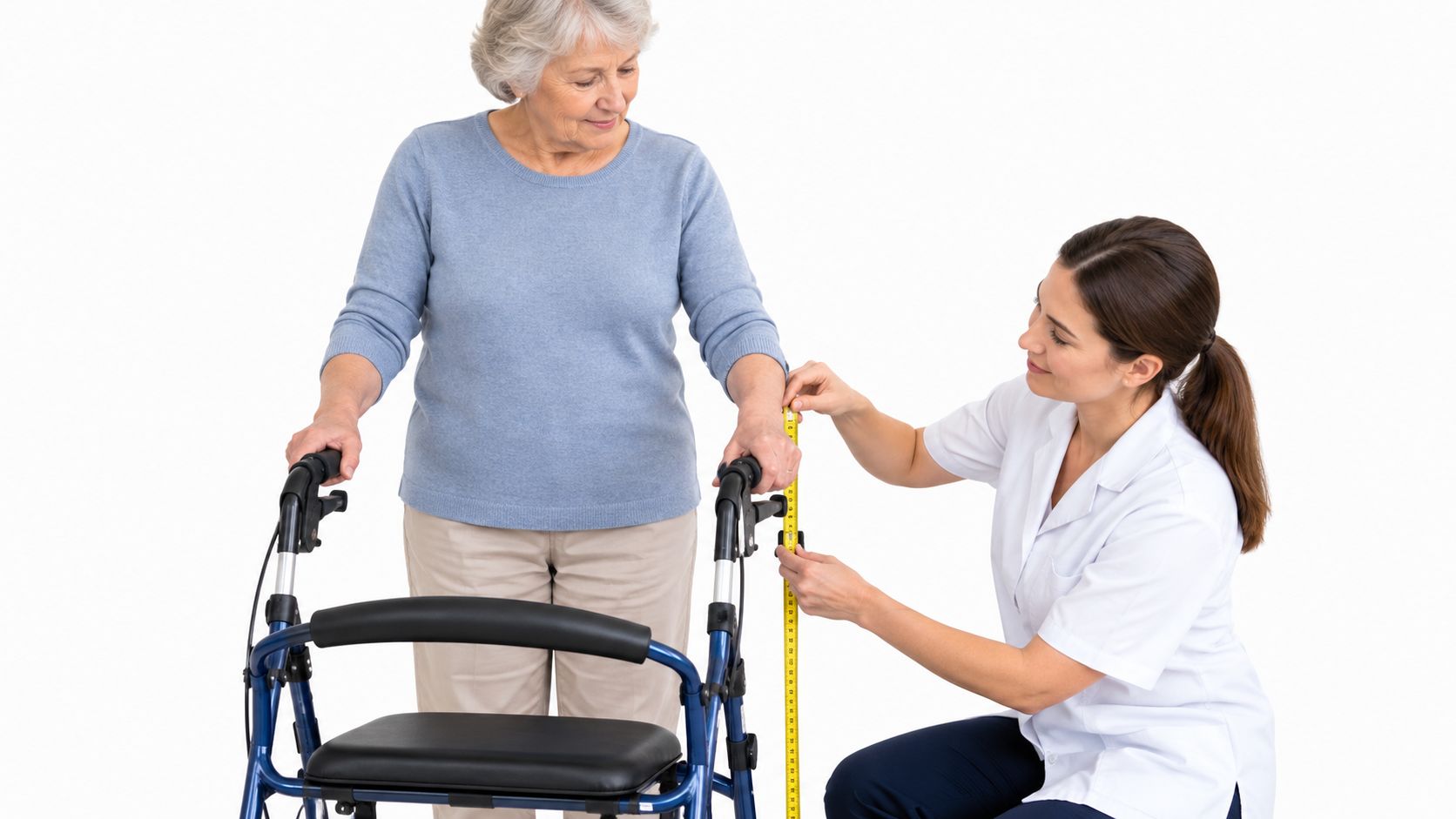
Start with handle height
Stand upright inside the rollator with your shoes on and your arms relaxed at your sides. Adjust the handles so your elbows remain slightly bent when your hands rest on the grips. Your shoulders should stay relaxed rather than lifted, and you shouldn't need to lean forward to reach the brakes.
Common handle-height ranges fall around 29.5 to 40 inches on standard models. Upright bariatric models may reach 41 to 50 inches, according to sizing information for rollators and walkers. Those ranges aren't a personal prescription. They show why an adjustable frame matters and why a user should test the actual model rather than selecting by a general height label.
Walk several steps with the brakes within easy reach. If your wrists bend sharply, your shoulders rise, or your back rounds, stop and reassess the adjustment. A clinician or physical therapist can observe your posture while you move and help identify whether the rollator is supporting your gait or encouraging unsafe leaning.
Check the seat height and width
Seat-to-floor height commonly falls around 18.5 to 22 inches, although educational and manufacturer guidance also lists models around 21 to 23 inches or 56 to 62 centimeters, depending on the design. Seat widths may range from 43 to 46 centimeters, while overall widths in one manufacturer guide range from 66 to 69 centimeters. These measurements are summarized in guidance on walker seat fit and stability.
To assess seat height, stand in front of the seat and back up until you feel the seat behind your legs. With the brakes locked, lower yourself slowly. Your feet should remain planted, and your knees shouldn't be forced unusually high or left dangling. If standing requires a powerful rocking motion or you can't push up securely, the seat may not fit your leg length or functional ability.
A comfortable seat is useful only when you can reach it, sit on it, and rise from it without losing control of the frame.
Seat width should allow stable contact without making you slide sideways. Also measure doorways, storage spaces, and the vehicle area where the rollator will travel. Product dimensions can differ substantially even when two models appear similar. Use the rollator dimensions guide to compare folded and overall measurements before purchase.
This video can help you visualize adjustment and use. Follow the product's own instructions if they differ from a general demonstration.
Mastering Safe Transfers and Usage
Walking and sitting are separate skills. A person may manage a rollator well across a smooth hallway but lose control during a turn, a stop, or a transfer. Research involving older adults in long-term care found that rollator falls commonly occurred during turning or weight transfer, not only during forward walking. That's why a safe routine must cover the moments between activities.
Stop before fatigue becomes severe. Bring the rollator close to your body, keep both hands on the grips, and turn with controlled steps rather than twisting around the frame. When you're ready to sit, apply the brakes fully and confirm that the wheels don't move before lowering yourself.
A controlled sit-to-stand pattern
Use this sequence each time:
- Stop completely. Don't try to sit while the rollator is still moving.
- Lock both brakes. Push the parking mechanism into position and test the frame gently.
- Position your body. Back toward the seat until it touches the backs of your legs.
- Lower slowly. Use the seat or arm supports as intended, keeping your feet under you.
- Pause before rising. Place your feet securely, lean forward as appropriate, and push from a stable seating surface, not by pulling the rollator toward you.
- Re-establish control. Once standing, keep the brakes engaged until you're balanced and ready to walk.
If you can't complete these steps reliably, ask a physical therapist, occupational therapist, or trained caregiver to assess the transfer. Families arranging broader mobility assistance may also find context in this resource on safe assisted living move-in support.
Terrain changes the demands on the device. Smaller wheels often maneuver more easily indoors, while larger wheels are generally better suited to uneven outdoor surfaces. Slopes deserve extra caution because a locked rollator can still be difficult to position, and a rollator with its brakes disengaged can gain momentum quickly. Keep bags light and centered, since uneven loading can affect how the frame turns and stops.
A practical demonstration of the full routine appears in this guide to using a rollator walker. Practice first in a clear, level area with another person nearby if you're learning the device for the first time.
Maintenance and Financing Options
A rollator's safety depends on its condition as much as its original design. Brakes can become less responsive, tires can wear, and folding hardware can loosen with use. A short inspection before an outing is easier than discovering a problem while sitting on the device away from home.
Build a simple inspection routine
Before walking, check that the frame is fully unfolded and that its locking mechanism is engaged. Look at the wheels for visible wear, cracks, embedded debris, or uneven contact with the floor. Roll the device forward slowly and test the brakes in a clear area.
The brake levers should slow the rollator smoothly, and the parking locks should hold it still when you apply gentle pressure. If the frame shifts while parked, don't use the seat until the problem is corrected. Loose screws, worn cables, damaged grips, or unusual rattling also deserve attention from the manufacturer, a qualified repair service, or a medical equipment provider.
Store the rollator where it won't be struck or exposed to conditions that could damage its components. Keep the seat and handgrips clean, but use only cleaning products that won't degrade the materials. Don't modify the frame, add an improvised cushion that changes seat stability, or exceed the stated weight capacity.
Plan the purchase carefully
Budget planning should include the complete fit, not only the frame price. Standard lightweight aluminum rollators are commonly engineered for 250 to 300 pounds and may weigh between 15 and 18 pounds, according to this guide to walkers with seats. A heavier-duty design may be appropriate when the user's body weight, seat width, or daily environment requires it.
Many rollators may qualify for FSA or HSA spending, but eligibility depends on the account and applicable rules. Confirm the purchase requirements before ordering. Financing through providers such as Affirm may also be available, depending on the product and checkout terms.
For buyers comparing models, DME Superstore offers rollators and rolling walkers with seats, including the Nova Medical GetGo Rolling Rollator Walker and the Triumph Mobility Essentials Lightweight Shopping Rollator with Seat. Product pages can help you compare specifications, accessories, warranty information, and available purchase options. A retailer's return policy and support access matter because a rollator that looks suitable online may not fit the user or the home environment.
Summary and Next Steps
A rollator walker with seat can support safer, more independent activity when the user and device are properly matched. The seat is valuable because it brings rest to the user, but it also creates a transfer risk if the brakes aren't locked before sitting.
Choose by function first. Consider balance, hand strength, braking judgment, terrain, seat height, handle height, width, and weight capacity. A professional fitting can reveal problems that aren't obvious from a product photo, especially when the user has a complex medical condition, recent surgery, or a history of falls.
Before buying, visit a showroom or ask a healthcare professional to observe walking, turning, sitting, and standing. Test the parking brakes, confirm that the user can reach the levers, and make sure the seat height supports a controlled transfer. The right rollator shouldn't take independence away. Used correctly, it can help make daily movement more manageable and rest more predictable.
DME Superstore offers rollators, walkers with seats, and other durable medical equipment with specifications that help you compare fit, capacity, and intended use. Visit DME Superstore to explore suitable models and choose a mobility aid that supports safer transfers and confident everyday movement.
