



Is adjustable bed lumbar support really supporting your lower back, or are you just raising your head and legs and trusting the marketing? That distinction matters. Two adjustable bases can use the same “lumbar support” label while producing very different results, because one may include a dedicated lumbar movement and the other may only offer head and foot elevation.
The lower back responds to where the base applies force, how the mattress transfers that force, and whether your sleeping position matches your body. A useful setup for a back sleeper may feel intrusive to a side sleeper. A position that eases lumbar spinal stenosis may be unsuitable during early post-surgery recovery. The right question isn't whether lumbar support sounds beneficial. It's whether the base, mattress, and adjustment pattern work together for your specific posture and symptoms.
Why adjustable bed lumbar support deserves a closer look
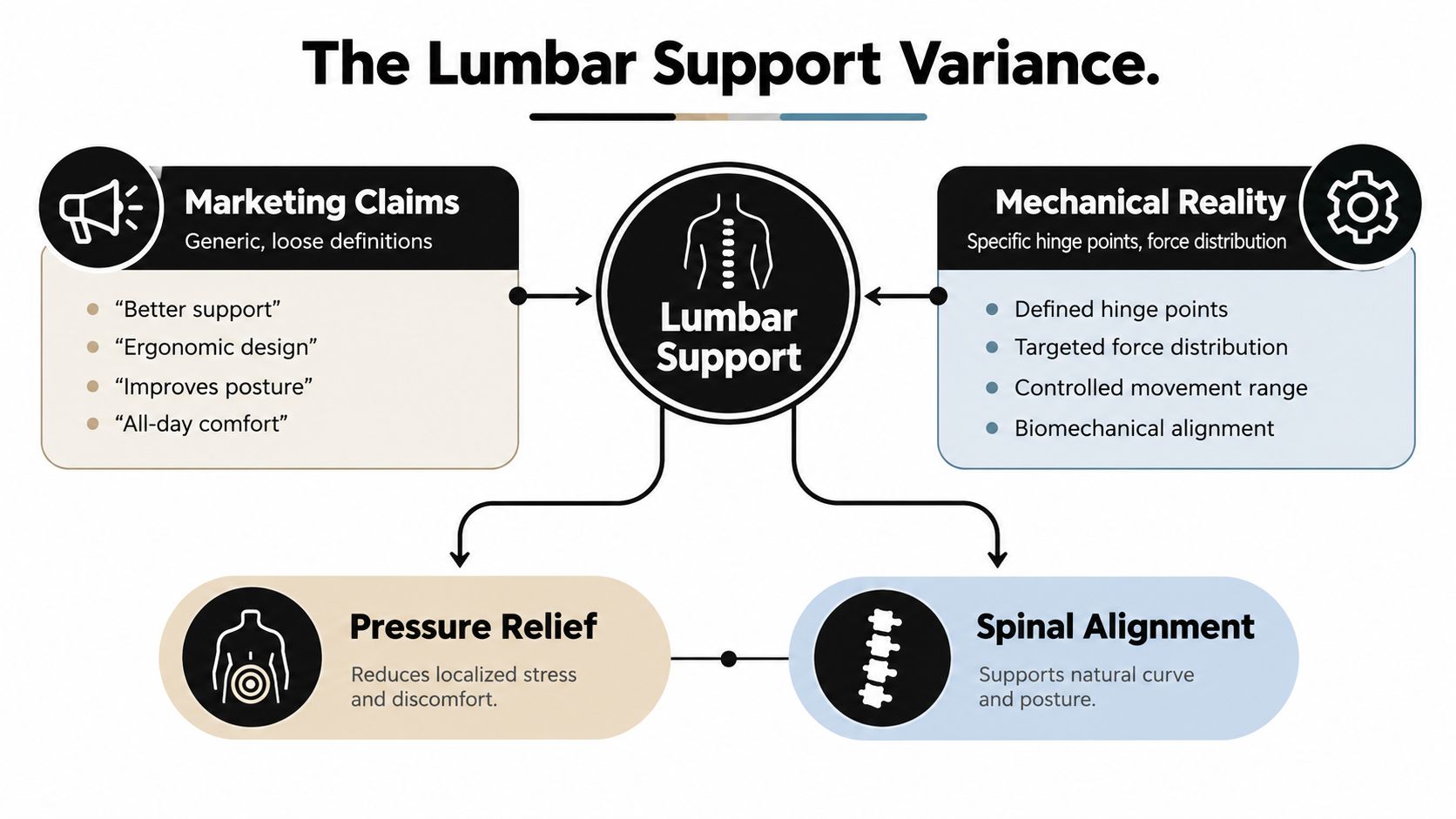
Marketing language often treats lumbar support as a general comfort feature. In mechanical terms, however, it should mean that the base changes support beneath the lower back independently from the head and foot sections. That difference can affect how your pelvis rotates, how your spine rests against the mattress, and where pressure accumulates while you recline.
A head section can lift your upper body without directly filling the space beneath the lumbar curve. A foot section can bend your knees and change pelvic tension without creating a dedicated midsection lift. Neither adjustment automatically proves that a base provides true lumbar articulation. If you're managing stenosis, herniated disc discomfort, or recovery after surgery, confusing generic elevation with localized support can lead to a setup that feels worse rather than better.
Comfort is not the same as correction
A reclined position may feel comfortable because it redistributes pressure or reduces the effort needed to hold your trunk upright. That subjective improvement matters, but it doesn't automatically show that the base has corrected spinal alignment or reduced a specific disc load. A 2019 biomechanical review found that researchers still couldn't justify target values for desirable spinal alignment and body-pressure distribution during sleep because the evidence was insufficient (review of sleep biomechanics).
That limitation shouldn't make you dismiss adjustable beds. It should make you more precise. Look for a genuine lumbar actuator or air bladder, a mattress that responds to the lift, and controls that let you reduce support as easily as you increase it. The practical guidance in this overview of adjustable bed benefits is useful for understanding the broader base, but lumbar articulation deserves its own evaluation.
Practical rule: If the product description only mentions “zero gravity,” “head lift,” or “foot lift,” ask where the lumbar section moves and how you control it.
The history of adjustable beds also explains why body-position support remains central. Dr. Willis Drew Gatch developed the Gatch Bed in 1909 to help post-surgical patients recover more safely and comfortably. Adjustable beds later reached residential consumers in 1974, initially supporting activities such as reading and watching television in bed (history of adjustable beds). That medical origin is relevant, but it isn't a guarantee that every modern consumer base provides therapeutic lumbar support.
How lumbar support on an adjustable bed actually works
The lumbar spine includes the inward curve through the lower back, commonly described across L1 to L5. When you lie flat, the mattress must support the pelvis, waist, and rib cage without allowing the middle of the lower back to sink too far or remain suspended. When you recline, the relationship changes. Your pelvis may tilt, your trunk may slide, and the mattress may need to support the curve differently.
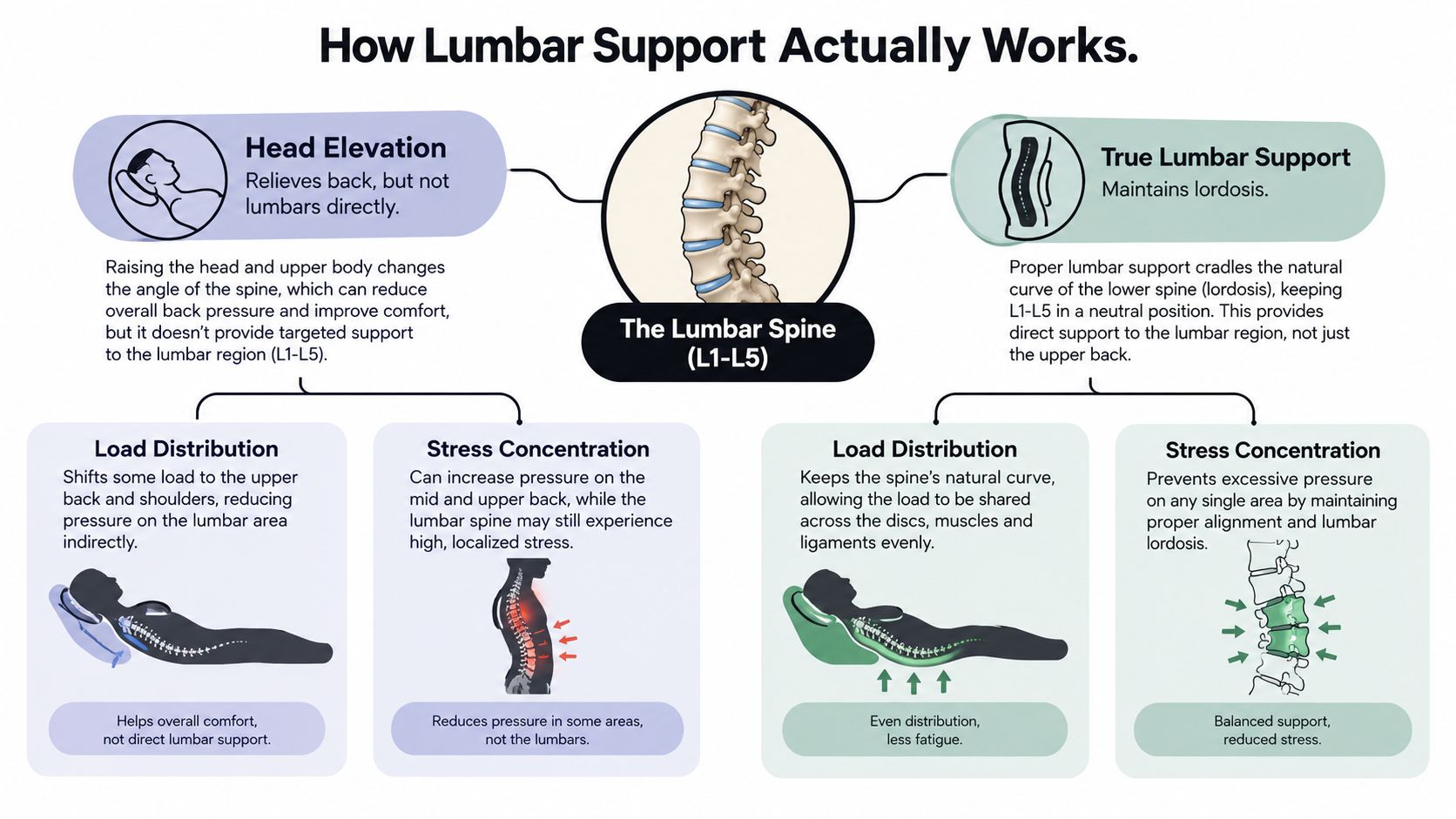
Head and foot elevation can help, but neither is identical to a lumbar lift. Raising the head shifts more of your trunk's weight toward the pelvis and sacrum. Bending the knees can reduce tension through the lower back and flatten part of the lumbar curve. A true lumbar section uses a separate movement to lift the midsection beneath the waist, helping fill the natural gap rather than relying on the head or foot hinge to create support.
Three movements that people often confuse
Head elevation changes your trunk angle. It can make reading easier and may reduce the sensation of strain for some people, but it doesn't necessarily support the lumbar curve directly.
Knee elevation introduces a bend beneath the legs. This can reduce pulling through the hips and lower back, especially when the upper body is also raised.
Lumbar articulation targets the middle section of the base. Technical implementations may use a dedicated motor, a short linkage, or an air bladder. Guidance on how lumbar mechanisms differ from ordinary elevation notes that this feature tends to work best for back sleepers on firmer, more responsive surfaces.
That final point is the mattress multiplier. A soft mattress may absorb the movement by compressing fully under your waist. A responsive medium-firm surface is more likely to transmit the base's lift to your body. The same actuator can therefore feel supportive on one mattress and excessive, vague, or completely ineffective on another.
The mechanism may also change pelvic tilt and the amount of work required from muscles alongside the spine. Those changes aren't automatically beneficial for every person. If lumbar lift creates a concentrated pressure point, your muscles may brace against it instead of relaxing. Start with minimal movement and judge the result by whether your lower back feels supported without being pushed forward.
Key features that define real lumbar articulation
Start with the mechanism, not the accessory list. A base with massage motors, USB ports, under-bed lighting, or a wireless remote may be convenient, but those features don't establish that the lumbar region moves independently. True lumbar articulation requires a localized support mechanism, usually a dedicated motor or an air-based chamber.
A dedicated motor physically raises a lumbar section through the platform. An air bladder changes pressure beneath the lumbar area and may offer a softer, more gradual sensation. Preset positions such as zero gravity, anti-snore, and flat can be useful starting points, but a preset isn't proof of lumbar control. Many presets rely mainly on head and foot angles.
Compare the movement systems
| Mechanism | How it works | Strengths |
|---|---|---|
| Dedicated lumbar motor | A separate actuator raises the midsection beneath the lower back | Direct, repeatable adjustment and independent control |
| Air bladder lumbar system | An inflatable chamber changes support beneath the lumbar zone | Gradual pressure changes and potentially softer contouring |
| Head and foot articulation only | The base raises the upper body and legs without a localized lumbar section | Simpler design, useful knee and trunk positioning, but no true lumbar lift |
A good remote should let you alter lumbar support without changing the head angle every time. Independent controls matter because the best head position for reading may not be the best position for sleeping. Wireless operation is convenient, while wired controls can be easier to locate and less dependent on charging. Neither option is more therapeutic.
Micro-adjustment is more important than a large collection of named presets. I look for movement in increments of 5 degrees or smaller, because a broad jump can take you past the point of comfort. Programmable memory positions are helpful when two users share a bed or when you want separate settings for reading, resting, and sleeping.
Separate useful features from therapeutic claims
Wall-hugging geometry can keep you closer to a nightstand as the head rises. That matters for someone who needs access to medication, a phone, or a drink, but it doesn't support the lumbar spine by itself. Massage motors may feel relaxing, yet they don't replace a stable lumbar contour. Under-bed lighting and USB ports improve access and convenience.
Ask the seller for written coverage of the lumbar actuator or air system. A base warranty that covers the lumbar mechanism for at least 10 years is a reasonable buyer preference, not evidence that the feature will treat a medical condition. If the manufacturer can't identify the lumbar component, its adjustment range, and its warranty coverage, treat “lumbar support” as an unverified marketing label.
How to set up your adjustable bed for lumbar support
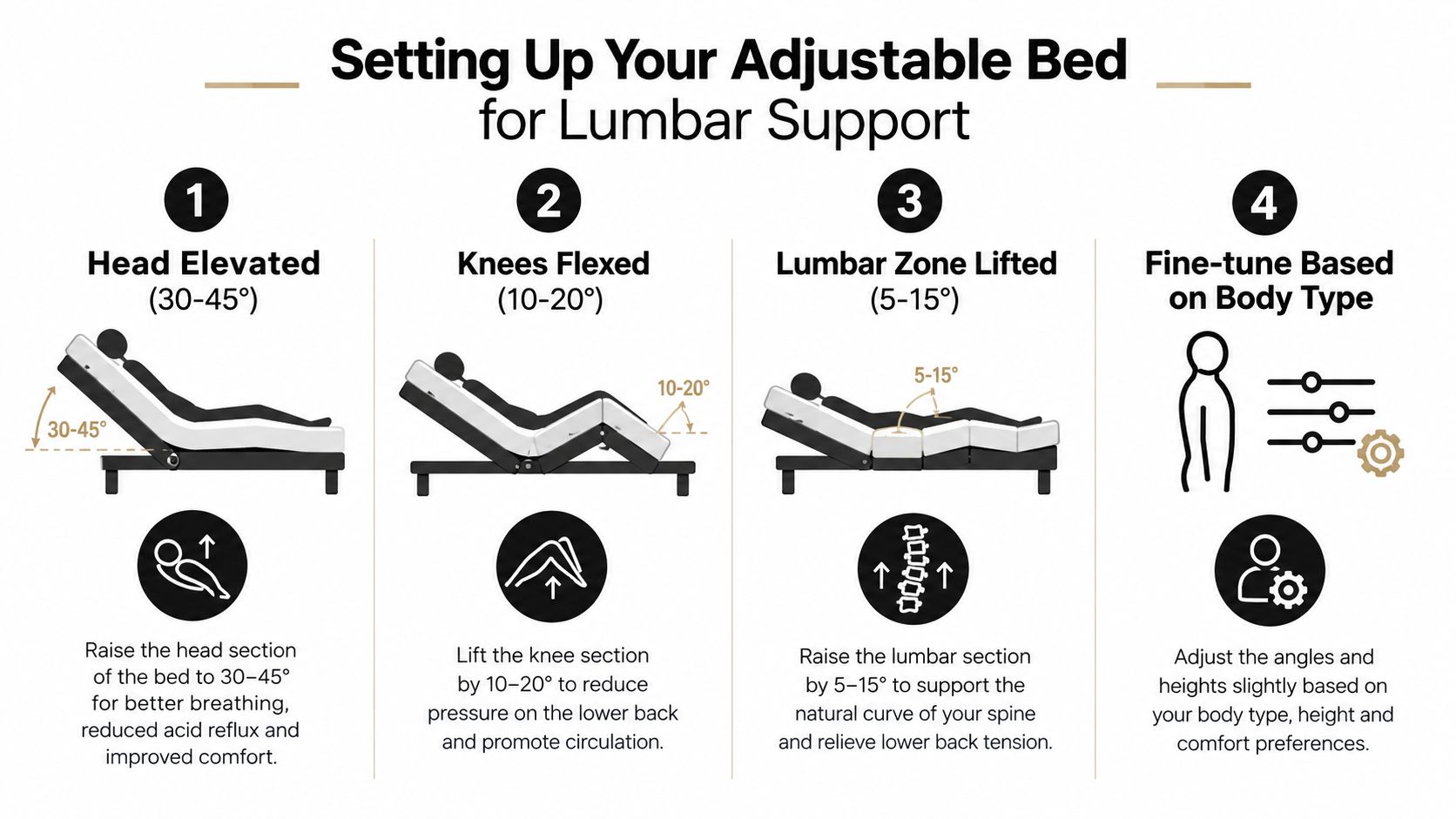
Begin with a position that reduces the feeling of lying completely flat without forcing your spine into a sharp bend. A practical starting point is a head elevation of 30 to 45 degrees with the knees slightly flexed at 10 to 20 degrees. If the base has a lumbar section, begin flat or use a gentle 5 to 15 degree lift. These are starting positions, not universal prescriptions.
Make one change at a time
- Start in zero gravity. Hold the position for about two minutes and notice whether your lower back feels evenly supported or whether one area feels compressed.
- Adjust the head section. Raise or lower it slightly until your neck, ribs, and pelvis feel stacked rather than pulled forward.
- Set the knee break. A slight bend can reduce tension through the hips and lower back. If your feet feel unsupported or your pelvis slides, reduce the leg elevation.
- Add lumbar lift slowly. Increase the lumbar section until you feel contact beneath the waist. Stop before the support becomes a hard pressure point.
- Test the combination. Lower one section while keeping the others still. This shows whether the base maintains comfort across positions or only feels good in one preset.
Your remote is part of the setup process, so learn how to save and reset positions. A guide to electric bed remote functions can help if the controls are unfamiliar. If the lumbar zone is fixed or absent, place a pillow beneath the knees rather than forcing the head section higher to solve a lower-back problem.
For side sleepers: Use less lumbar lift and a more noticeable knee break. Your side position needs room for the waist and shoulders to settle without pushing the pelvis out of alignment.
Back sleepers generally tolerate more direct lumbar contouring, particularly on a responsive mattress. Post-surgery users should be more conservative. Start with shallow head elevation, supported knees, and a flattened lumbar zone unless a clinician has advised otherwise. Incision location, surgical precautions, and the reason for surgery matter more than a preset label.
Finish with a 60-second nightly routine. Return the base to your chosen starting position, check that your pelvis isn't sliding, make one small adjustment if needed, and save the setting. Reset the base each morning so you can tell whether the position helps during sleep rather than only during an occasional reclining session.
What the research says about lumbar support and back pain
The evidence is more encouraging for perceived comfort, sleep quality, and back-pain symptoms than for definitive changes in spinal biomechanics. A 2024 in-home field study followed 27 participants across 951 nights over 8 weeks. Compared with sleeping flat, total sleep time increased by 6 minutes, light sleep increased by 5 minutes, and an objective BodyScore for deep-sleep quality improved by 2%. Participants also described greater comfort, easier sleep onset, less tossing and turning, better sleep quality, and feeling more rested (2024 adjustable-bed field study).
A separate multi-feature base study is particularly relevant because it included lumbar support. Over 6 weeks, participants reported 26% better perceived sleep quality, 45% less back pain, and a 29% greater feeling of being well-rested compared with baseline (field study of lumbar-support features). Those findings support lumbar adjustment as more than a decorative feature, while still leaving questions about which users benefit most and how much of the result comes from lumbar lift versus the full base configuration.
A 2025 field study found a different pattern. In adults without sleep disorders, changing from a flat bed to an adjustable base didn't change objective sleep metrics, but perceived sleep quality improved 15%, morning well-rested scores improved 18%, and back pain decreased 28% in the full sample. In the back-pain subsample, perceived sleep quality improved 16%, well-rested scores improved 20%, and back pain decreased 27% (2025 adjustable-base field study).
Read the evidence by outcome
| Outcome | Evidence strength | Typical finding |
|---|---|---|
| Perceived comfort and sleep quality | More encouraging | Users often report that a supportive reclined position feels better |
| Morning back pain | Promising but population-specific | Some field studies report meaningful symptom improvement |
| Objective sleep measures | Mixed | One adjustable-base study found no change, while another reported modest objective gains |
| Spinal alignment and pressure targets | Limited | Reviews say there isn't enough evidence to define ideal values for everyone |
The evidence base remains limited by short follow-up periods, small or specific participant groups, and differences between base designs. A head and foot incline alone shouldn't be treated as proof that a localized lumbar actuator changes spinal loading. People with persistent symptoms may need assessment that goes beyond an adjustable bed, including personalized lab-based therapies when a clinician recommends more targeted evaluation or treatment.
Balanced conclusion: Adjustable beds can provide real subjective benefits and may reduce back-pain symptoms for some users, but they should support a treatment plan, not replace diagnosis, rehabilitation, or medical advice.
For positioning details outside the base itself, body pillow positioning guidance can help side sleepers and people who need additional leg or pelvic support. Stop using a setting that increases pain, numbness, tingling, or weakness, and seek medical guidance for new or worsening neurological symptoms.
Mattress compatibility and pairing that makes the difference
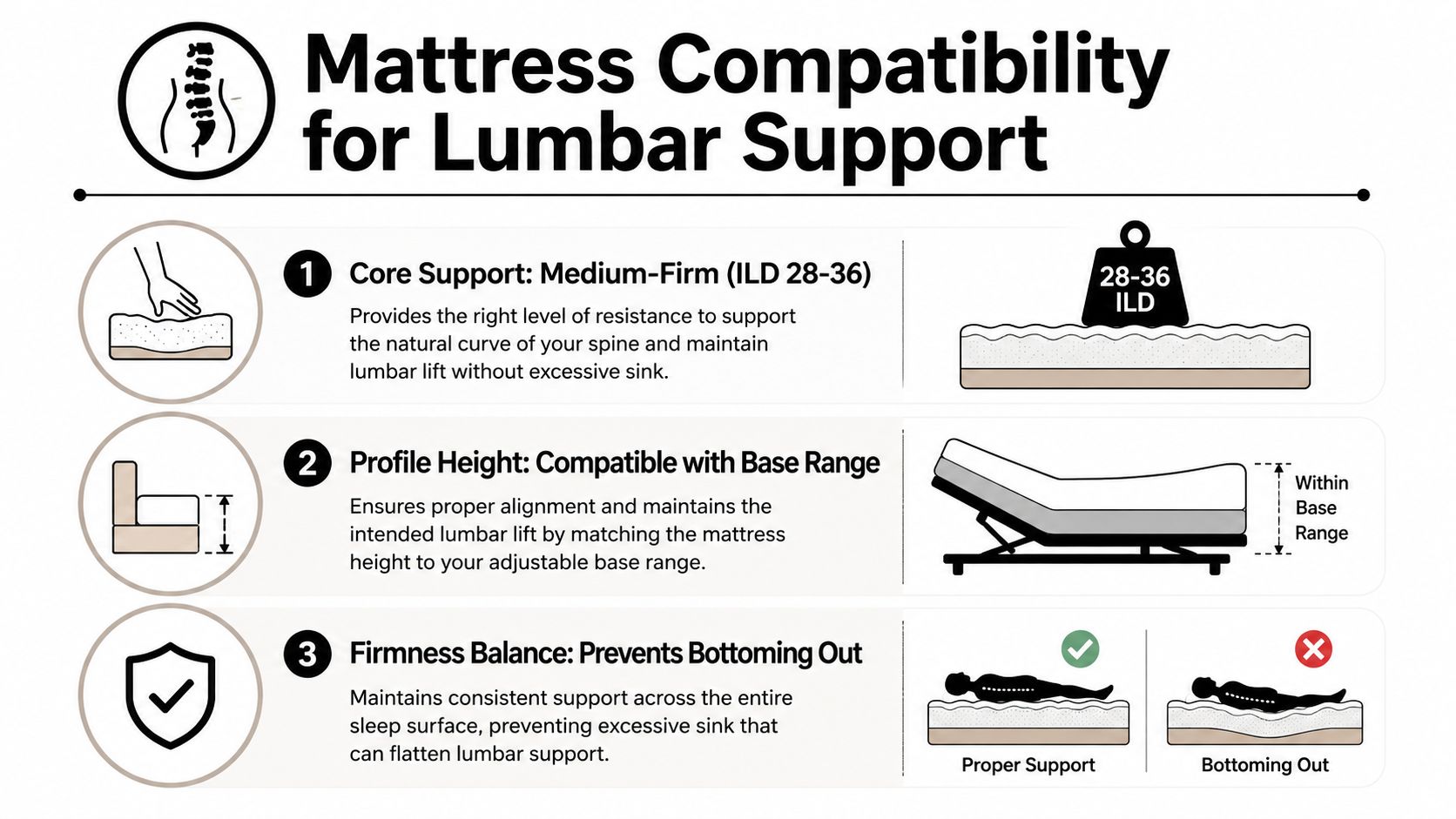
A lumbar actuator can only work through the mattress above it. If the mattress compresses too much, the lift disappears into the foam. If the mattress resists bending, the base may create a bridge, a gap, or pressure at the hinge points instead of a smooth contour.
A practical pairing starts with a medium to medium-firm core and an ILD of 28 to 36 in the comfort layer. Keep the total mattress profile under 14 inches if that matches the base manufacturer's range, and verify that the mattress has been tested for repeated bending. These figures are selection criteria, not universal laws. The base and mattress manufacturers' compatibility statements take priority.
Match the construction to the movement
Latex and pocketed coils can pair well when the construction bends smoothly and the coils are appropriate for an adjustable base. Pocketed coils with coil sections around 8 inches or taller may offer a useful balance of support and flexibility, but the manufacturer's approval still matters. Traditional Bonnell-coil innersprings often articulate less smoothly because their interconnected structure can resist localized movement.
All-foam mattresses can work when the foam layers flex without buckling. The risk is not foam itself. The risk is a deep, soft comfort layer that absorbs the lumbar lift or allows your hips to bottom out. Ultra-soft memory foam deeper than 4 inches deserves extra scrutiny when you need the base's lumbar movement to reach your body.
Airbeds with integrated chambers can create a different problem. Their internal air system may conflict with the base's moving platform or change support unpredictably as the bed articulates. Don't assume that an airbed's adjustability makes it automatically compatible.
Verify before you commit
Ask the mattress manufacturer to confirm the permitted bend radius, profile range, and base compatibility. Then test the mattress through the base's full movement range, including the lumbar section if present. Watch for bunching, exposed gaps, excessive stretching, or a lumbar lift that vanishes beneath the surface.
A detailed guide to adding an adjustable base can help you think through the installation and pairing process. For pressure concerns, compare the mattress's contouring behavior with the guidance in this pressure-relief mattress guide. The right mattress should contour around the lower back without bottoming out when the base raises it.
Choosing and dialing in the right setup for your needs
Choose the mechanism according to the person, not the feature count. Someone with lumbar spinal stenosis may value a head and knee position that feels better than lying flat, while a back sleeper who needs direct support may benefit more from a genuine lumbar motor. A side sleeper with shoulder pressure may need restrained lumbar lift and better shoulder accommodation from the mattress, not a more aggressive preset.
Post-surgical recovery requires the most caution. A base with multiple adjustment zones can be useful for getting in and out of bed, but the correct lumbar position depends on the procedure, precautions, incision, and clinician's advice. Pregnancy, limited mobility, and caregiver use also change the priorities. Easy controls, stable transfers, and access to the nightstand may matter as much as articulation.
Use a simple decision framework
- Chronic stenosis or position-sensitive back pain: Start by testing head elevation with a gentle knee break. Consider dedicated lumbar articulation only if it reduces discomfort rather than concentrating pressure.
- Back sleeper seeking contour: Prioritize a true lumbar motor or adjustable air bladder, independent control, and a responsive mattress.
- Side sleeper: Favor a flexible lumbar setting, shoulder-friendly comfort layers, and enough knee support to prevent pelvic rotation.
- Post-surgery user: Follow the clinical plan first. Keep the lumbar zone conservative until the care team approves more support.
- Healthy adult seeking comfort: Head and foot articulation may be sufficient if the mattress already supports the waist well.
For a structured product comparison, use this guide to electric adjustable beds, then inspect the actual mechanism rather than relying on the product name. The buyer checklist should include lumbar actuator coverage, independent head and lumbar controls, remote programmability, mattress compatibility, and a trial period that lets you retest posture at home.
Dial in the base over several nights instead of judging it after one brief session. Spend three nights with the zero-gravity preset, then three nights with a 30-degree head raise and knee break. Record morning pain, stiffness, comfort, and whether you woke feeling supported. Change one variable at a time, and return to the last comfortable setting if symptoms rise.
DME Superstore offers adjustable and electric beds, pressure-relief mattresses, mobility equipment, and homecare products with specifications and compatibility information to support a careful comparison. Visit DME Superstore to review adjustable bed options and choose a setup that fits your lumbar support needs, mattress, and daily mobility routine.
