



If the number printed beside a mobility scooter is 300 pounds, is that the heaviest rider, the scooter itself, or the whole loaded package a ramp will lift? Most listings treat a mobility scooter weight limit as one figure. In practice you are looking at three different measures, and the smallest one in your real route is the one that decides.
A rider who fits the seat can still be turned away by a van ramp, a taxi floor, or an aircraft hold. The way through that confusion is ordinary arithmetic: separate the rider rating from the scooter's empty weight, add what you carry, then test that total against every limit in the chain.
Typical Weight Capacities by Scooter Type
| Scooter type | Typical rider capacity | Typical scooter weight | Best for |
|---|---|---|---|
| Compact travel scooter | 220-275 lb (100-125 kg) | 35-70 lb | Car trunks, folding for trips, airline approval where listed |
| Standard 4-wheel scooter | About 300 lb | 80-150 lb | Daily outdoor errands and mixed terrain |
| Heavy-duty scooter | 350-400 lb | 110-200 lb | Larger riders, wider seats, sturdier frames |
| Bariatric or high-capacity model | 400 lb and above | 150 lb and above | Riders who need the highest rated capacity |
These ranges compare the occupant rating with the scooter's own weight. Capacity generally rises with frame strength, tire size, and battery size. A compact model built to separate or fold for transport tends to sit at the lower end, while a wider-seat outdoor scooter is designed for a higher rider rating. The table is a starting point, not a substitute for checking a specific model.
Compact travel scooters prioritize portability. Their typical rider capacities are 220-275 lb, and their empty weights often fall between 35-70 lb. That can make them easier to load into a car trunk or bring on a trip, when the airline lists the model as approved. Smaller tires can mean a less comfortable ride over cracked pavement, so consider the surfaces you use regularly as well as the number on the capacity label.
Standard 4-wheel scooters commonly have a rider rating of about 300 lb and weigh 80-150 lb. That added scooter weight may make a lift more practical than lifting the machine directly into a sedan. These models suit everyday outdoor errands, store aisles, and mixed pavement. If your regular route includes a hill, compare the specific model's rating and intended use rather than choosing by rider capacity alone.
Heavy-duty scooters typically carry ratings around 350-400 lb and weigh roughly 110-200 lb. Wider seats and sturdier frames support the higher capacity, but the scooter's own weight also matters for transport. The Pride Mobility Revo 2.0 4-Wheel sits at the upper end of the capacity range shown here, with a typical rating of 400 lb. That figure is the occupant ceiling, not a target to ride at every day.
Bariatric or high-capacity models generally start at 400 lb of rider capacity, and the scooter itself often weighs 150 lb or more. Seat width, frame construction, and motor design are part of that package. A higher rating describes the occupant load the model is built to support; it does not remove the need to consider how the scooter handles slopes or turns.
A useful shortlist includes some room below the stated ceiling. For example, a rider weighing 250 pounds is close to the 275-pound upper end of the compact travel range, so a standard scooter rated around 300 pounds may be a more comfortable category to compare. A rider weighing 330 pounds falls within the heavy-duty range shown, while a bariatric model may also be worth comparing for its higher capacity. These examples illustrate how to use the table, not a guarantee that every model in a category will fit.
Start with your body weight, then choose a category whose typical rider capacity leaves a margin. As a practical screening rule, consider the next tier if your weight is within about 20 percent of the category's ceiling. After that, compare the scooter's own weight with your car, lift, or travel arrangements. The types of mobility scooters differ in features such as turning radius and tire size, so capacity is a first filter rather than the only one.
Practical rule: Treat the published rider number as a ceiling you plan to stay under, not a score you try to reach.
What a Weight Limit Actually Measures
What does a scooter's published weight limit describe? Listings can use similar wording for three different figures: the rider capacity, the scooter's own weight, or its total loaded weight. Knowing which one you are reading prevents a capacity rating from being mistaken for a transport limit.
Rider capacity is the maximum occupant weight specified by the manufacturer. The listings described in the table above commonly show a rider capacity between 220 and 400 pounds. This is the number usually meant by “weight capacity,” and it applies to the rider, not to the combined weight of the rider and scooter.
Scooter weight, also called empty or unladen weight, describes the vehicle without a rider or shopping. Portable and standard models in the table often weigh about 35 to 77 pounds when designed for travel, while outdoor frames tend to be heavier. A removable battery may affect the figure, so check how the specification defines the scooter's weight.
Total loaded weight combines the rider, scooter, removable battery, baskets, and their contents. A ramp, hoist, taxi floor, or aircraft hold may be subject to this combined load, rather than the rider rating alone. The distinction is much like a luggage tag: one figure describes the passenger, another the machine, and the total includes both plus what is carried.
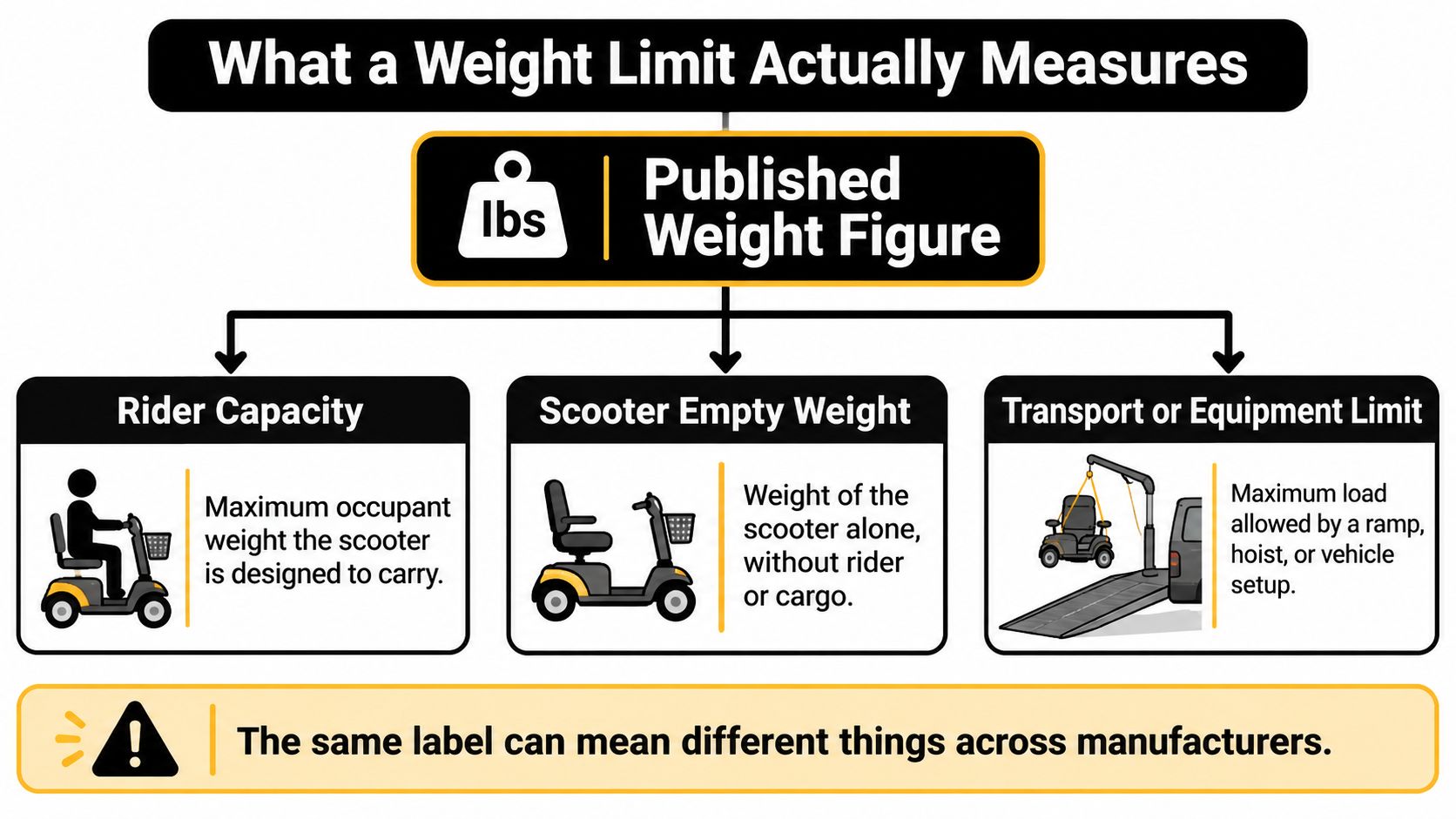
Vehicle ratings offer a useful parallel. How GVWR and GCWR differ helps explain why a vehicle's own weight and its weight with a load are separate measures. Applying the wrong figure to a ramp or vehicle can mean that the transport equipment is asked to handle more than its limit.
Rules that count the machine or the person
Road rules may use a different measure from the manufacturer's rider capacity. In the United Kingdom, government guidance on mobility scooters classifies road-legal powered mobility vehicles by unladen weight. Class 2 scooters must not exceed 113.4 kilograms (250 pounds), while Class 3 scooters must not exceed 150 kilograms (330 pounds). These are limits on the vehicle itself, not the rider's body weight. Both classes are limited to 4 miles per hour on pavements. Class 3 models may travel faster on roads, but require lights, indicators, a rear-view mirror, and an audible warning device.
Some jurisdictions count the rider within a laden-weight limit. That is a different measure from the unladen vehicle limits used in the UK guidance. A scooter that meets an unladen-weight rule may still exceed a total-load limit once its rider and carried items are included.
When comparing listings, identify which measure each page gives and check whether it uses pounds or kilograms. A figure of “300” without a unit or label cannot be compared safely with another “300.” One may describe the rider; the other may describe a combined transport load. A model can have adequate rider capacity and still be restricted by its empty mass, size, speed, or permitted use.
How to Calculate Your Total Loaded Weight
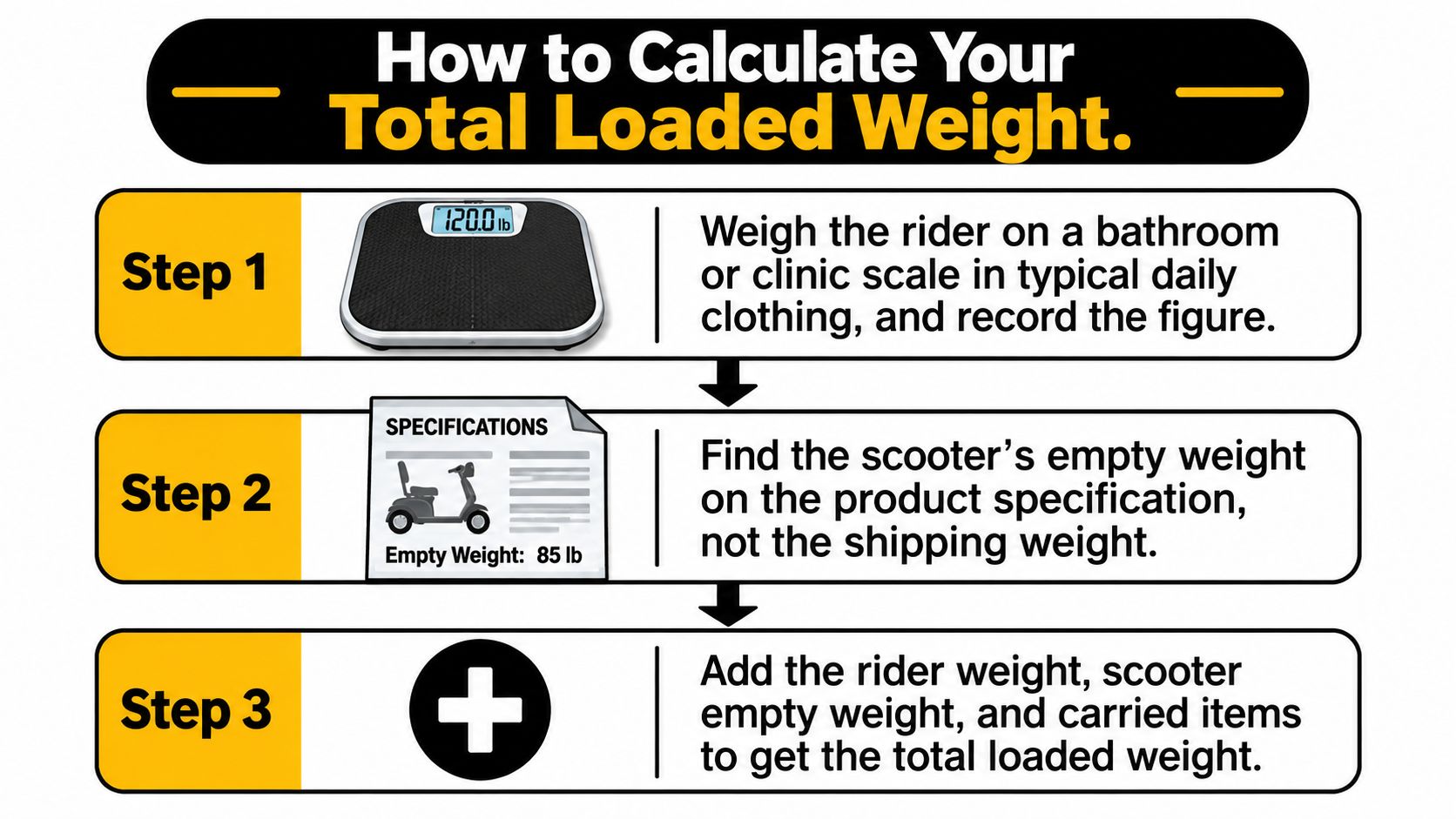
Build the total in the order you would pack the scooter for a real errand. Each line exists because buyers drop it and then wonder why a "300-pound scooter" feels wrong at the ramp.
- Weigh the rider in daily clothes. Use a bathroom or clinic scale in the shoes, coat, and layers you wear on an outing, and write the number down. Gym weight in a T-shirt undercounts a winter coat and shoes by enough to erase a small margin.
- Take empty weight from the specification, not the shipping weight. Shipping weight includes the carton and sometimes a spare carton of parts. The figure you want is the scooter as you roll it, which the spec sheet usually calls empty weight or kerb weight.
- Add a removable battery if it isn't already inside that empty weight. A second battery for a long day is several extra pounds sitting on the frame. If the spec already says "battery included," don't add it twice, and don't forget a spare you plan to carry.
- Add what the baskets hold. Groceries, a handbag, and a folded jacket are easy to treat as "not much." A realistic weekly shop is about 20 to 30 pounds. Massachusetts operating guidance sets a combined limit of 500 pounds for the rider and any gear in the baskets, which is why this line belongs in the sum. A 400-pound rider with 60 pounds of gear is already near that 500-pound combined figure.
- Add medical equipment that rides on the scooter. A portable oxygen cylinder, a spare cannula bag, or a small backpack of supplies is part of the load. If a caregiver hangs a bag on the tiller, count that too.
- Compare the sum with rider capacity, and keep about a 20 percent margin. Starts, braking, and small bumps load the frame harder than a parked scooter on a scale. The same Massachusetts guidance says not to operate on slopes greater than 8 degrees, about a 14 percent grade. Staying under the weight figure doesn't make a steep slope acceptable. Weight and terrain are separate checks, and the product page may mean rider-only capacity or total load. Read the label before you compare.
A worked total
Say the rider weighs 220 pounds in a coat, the scooter's spec says 45 pounds with the battery in place, and the basket holds 30 pounds of shopping. No oxygen cylinder on this trip.
| Item | Weight | Running total |
|---|---|---|
| Rider in daily clothing | 220 lb | 220 lb |
| Scooter empty weight, battery included | 45 lb | 265 lb |
| Groceries and bags in baskets | 30 lb | 295 lb |
| Total loaded weight | - | 295 lb |
| Rated capacity needed with 20% margin | - | 354 lb |
The running total is 295 lb. Twenty percent on top of that is 354 lb, so you shortlist scooters whose rider rating clears 354 pounds, not scooters whose rating merely clears 220. The 45-pound machine never belonged in the "I'm only 220" story.
Three slips show up over and over. People forget the battery because it lives under the seat and feels like part of the scooter rather than cargo. They count body weight from a doctor's note and skip clothes, bags, and oxygen. They copy the shipping weight off a courier label and treat it as rated capacity. Any one of those makes the 354-pound target look optional when it isn't.
Write the four numbers on the spec sheet itself: rider, empty scooter, basket load, and the margin target. A mental total always drops a line.
Transport, Ramps and Vehicle Loading Limits
Will the scooter, rider, and belongings fit within every limit on the way into the vehicle? A scooter's rider capacity does not determine what a ramp, hoist, bridge plate, or vehicle floor can carry. These transport systems support the combined load, so a scooter may meet its rider rating while exceeding a ramp's limit.
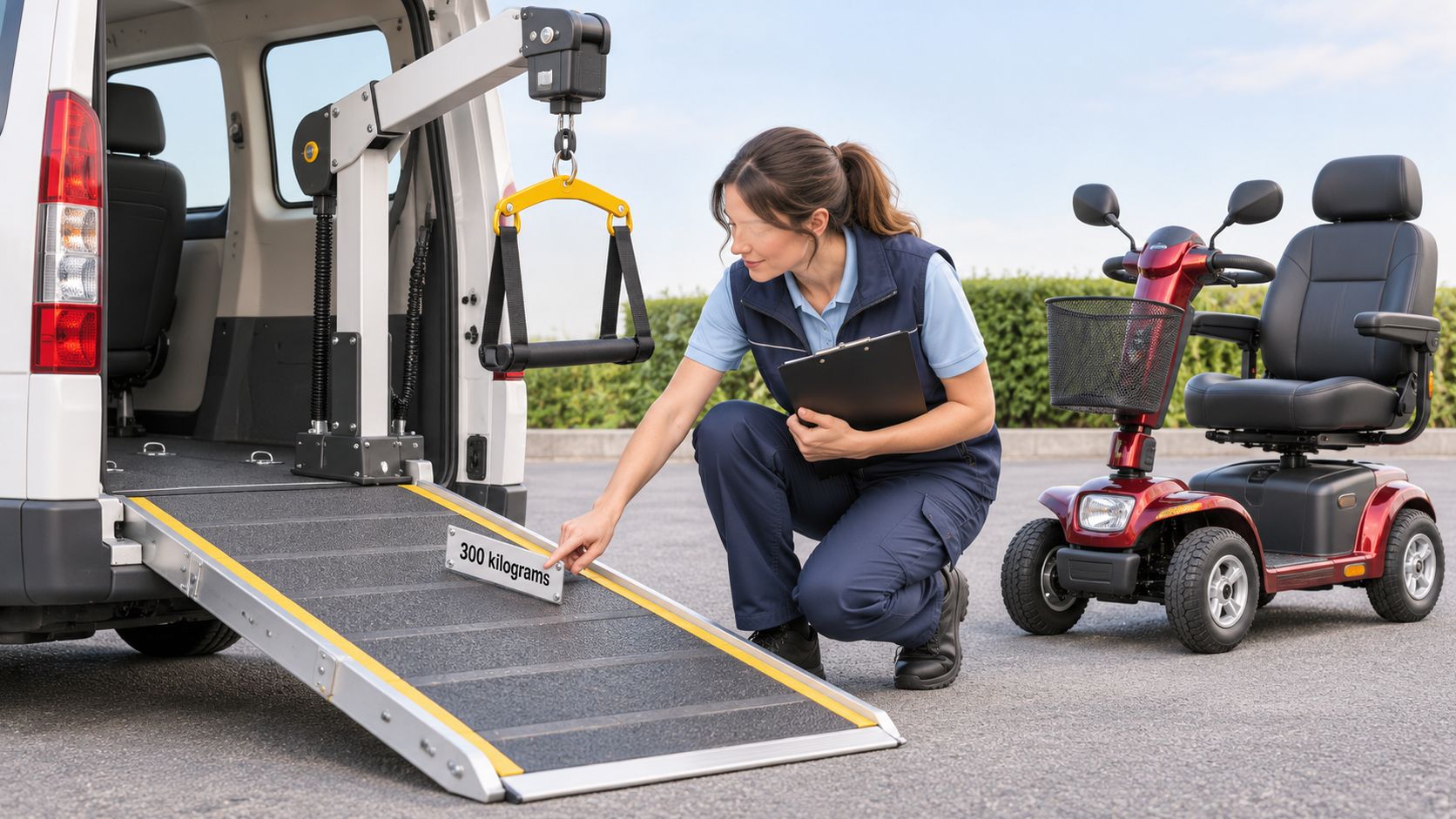
Queensland transport guidance gives a clear example: a 300 kg ramp or hoist must support the scooter, occupant, groceries, and any medical oxygen cylinder together. The guidance describes a Class 2 scooter weighing about 65 kg, leaving approximately 235 kg for the occupant and other items on that ramp. These figures describe a transport accessory's limit, not a universal scooter capacity. Check the safe working load of the equipment you will use.
U.S. transport guidance addresses a different question. Federal transit guidance explains when an electric scooter can qualify as a wheelchair under the ADA definition for covered transportation. A commonly cited benchmark defines a “common wheelchair” as no more than 30 inches wide, 48 inches long, and 600 pounds for the combined device and occupant. That figure is an accommodation benchmark, not a guarantee that a particular lift can carry the load. It includes the rider, scooter, batteries, accessories, and other equipment. For example, a 450-pound rider on a 125-pound scooter reaches 575 pounds before adding a bag or allowing for the ramp's own limits.
Three checks before you book the ride
Write down the maximum occupant mass, scooter kerb weight, maximum permissible total mass, and the safe working load of the ramp or lift. For each relevant limit, subtract the scooter and cargo to find the remaining occupant allowance. Use the lowest applicable limit, not the number printed on the scooter alone.
Check each part of the loading chain: the bridge plate, tie-downs, taxi or bus platform, and vehicle floor. The lowest capacity governs. Starts, stops, and transitions onto a slope can add force beyond a stationary load, so avoid planning to reach the rated limit exactly.
UK Department for Transport research found that 4 percent of surveyed occupied mobility devices exceeded 200 kg, and 2 percent exceeded 300 kg when an attendant was included. Researchers concluded that a transport limit of at least 275 kg, preferably 300 kg, would accommodate 98 percent of users. The research also identified boarding, alighting, and onboard space as barriers. If you travel with a heavier rider, compare the combined load with the ramp or lift limit before booking. Weigh the scooter and bags at home the night before, rather than discovering the total at the vehicle door. Venus Health's travel scale guide discusses portable scales for travel.
A scooter's folded size and weight affect how it is moved into a car, while a heavier frame may require a lift. The practical steps differ, but the same arithmetic applies: compare the total load with each transport component's rating. See this guide to transporting a scooter for more on planning the move. A scooter rating and a vehicle rating answer different questions.
Aircraft add a battery rule on top of the pounds
Air travel involves size, weight, and battery requirements. U.S. Department of Transportation rules require carriers to accept a battery-powered wheelchair or similar mobility device as checked baggage when baggage-compartment size and aircraft airworthiness allow it. Airlines must tell passengers before the cabin door closes if a device could not be loaded on that flight because of its size or weight. The FAA safety advisory also flags mobility devices over 400 pounds, so a heavy-duty scooter may require advance coordination even when carriage is legally protected.
Battery limits are a separate check. FAA guidance caps lithium-ion batteries used with wheelchairs and mobility scooters at 300 watt-hours. If a battery is removed because it is not adequately protected, it travels in carry-on baggage with its terminals protected against short circuits. A passenger may carry one spare up to 300 watt-hours, or two spares up to 160 watt-hours each. An installed battery can remain on the scooter only when protected against damage and short circuits. Meeting the scooter's rider rating does not, by itself, settle airline approval, battery handling, or packing requirements.
A short walkthrough of weighing and loading can help make the process clearer. Watch the sequence, then compare your scooter and belongings with the ramp you plan to use.
Stability on Slopes, Turns and Uneven Ground
A scooter's weight limit tells you how much rider and carried load its frame is rated to support. It does not tell you how stable the scooter will feel while turning, braking or crossing uneven ground. That also depends on center of gravity, wheelbase, tire contact, braking capacity and frame strength. A scooter may support its rated load on level ground yet feel less steady in a turn.
Two standards assess different parts of stability. ISO 7176-1:2014 sets static-stability test methods for electrically powered wheelchairs, including scooters traveling no faster than 15 km/h. It addresses how steep a slope a stationary scooter can sit on before it starts to tip. ISO 7176-2:2017 covers dynamic stability while the scooter is moving, including cornering, braking and climbing. The ISO 7176-1 standard text describes the static-stability standard. Passing a static test does not establish how the scooter behaves in motion.
The position of the load matters as well as its total. A lower center of gravity raises the incline angle at which a scooter can tip. A basket piled high or an oxygen cylinder mounted on the tiller places weight higher up, while a heavy battery mounted low keeps more mass closer to the ground. On an incline, weight shifts across the wheels, so a high load can make the inside wheels unload sooner during a turn.
What to check besides the badge
Keep these four checks separate. Each answers a different question.
- Rated capacity: The rider and carried items must fit below the limit, with some capacity in reserve. At the printed ceiling, there is no spare capacity for extra belongings.
- Dynamic stability: Ask how the scooter behaves while moving, not only how it performs on a stationary tilt test. Turns and stops put stability under different demands.
- Axle or bridge-plate loading: A single axle may approach a platform's limit even if the total mass seems acceptable. The platform supports the axle's load, not an even share of the total.
- Transport limits: A ramp, lift or vehicle floor has its own limit. A scooter that feels stable outdoors does not change the rating of a hoist.
Slopes, sharp turns, curbs and braking on wet pavement can reduce the stability margin even when the combined load is within the scooter's specification. Match the rated capacity to the rider and everything carried, then consider the route's surfaces and turns. A smooth mall floor and a cambered sidewalk place different demands on the scooter. The guide to how to use a mobility scooter covers speed, turning and curb cuts, practical habits that affect control once the scooter is moving.
A weight check can pass on paper while a hill, curb or wet stop still challenges the scooter's stability. Treat those as separate checks.
Matching Capacity to How You Use It
| Use case | Capacity margin | Key check |
|---|---|---|
| Indoor use and short errands | About 20% above total load | Turning radius and door width |
| Frequent outdoor or hilly routes | About 25% above total load | Stability rating and tire type |
| Travel by car or air | Total load within transport limits | Folded size, airline approval and battery rules |
| Heavier riders | Rated 400 lb or more | Seat width, frame strength and transport route limits |
Start from the trip you take most weeks. Capacity that is right for a hallway is not automatically right for a hill, and a folder that clears an airline scale can still feel nervous on broken pavement.
Indoor use and short errands need the rated capacity above your total load, plus a tight turning radius, more than a heavy outdoor frame. About 20 percent above total load is the baseline margin here. Door width and a three-point turn in a kitchen matter more than tire diameter. A three-wheel layout often turns tighter indoors. Many four-wheel scooters have caught up, but the trade-off is still real: tighter turning on three wheels, a calmer platform on four.
Frequent outdoor or hilly routes need more spare capacity because bumps and grades load the scooter beyond the static sum. Use about 25 percent above total load, and read the stability rating and the tire type before you care about top speed. Pneumatic or larger tires soak up broken sidewalks that a small solid tire telegraphs into the seat. Four wheels usually suit this use. The 20 percent idea from the category table is a different cut: that one says step up a tier when your body weight is already near a category ceiling. This 25 percent sits on top of total load for rough routes. Don't mix the two and then apply both twice.
Travel by car or air is a transport problem first. The total load has to fit the trunk, the lift, or the aircraft rules, and folded size matters as much as pounds. Airline approval, where a maker lists it, still leaves the battery rules to check. A scooter can be inside its rider rating and still need the battery removed or packed a different way. Confirm with the airline before travel day. The carrier makes the final call on what boards.
Heavier riders should look at the 400 lb and above tier, then measure seat width and look at frame section, not only the badge. The route's ramp or platform has to accept the full loaded total. Published research aimed at this group is thin, which is why the route check matters more than a slogan about "bariatric design." Australia's parliamentary inquiry reported that weight was raised repeatedly but was not established as a key safety concern, and that there wasn't enough research to say whether weight limits materially affect safety. A European assistive-mobility study, discussed in that same parliamentary report, modeled a 140 kg user on a medium three-wheel scooter and found axle loading close to a tram-boarding limit, with a risk of damaging a bridging plate and of tipping sideways when the vehicle decelerated. Under the printed capacity is not the same as safe on every platform.
For a heavier reader the practical sequence is short. Confirm the rated capacity on the product page, check seat width and frame strength in person if you can, and test the ramp or platform limit against the full loaded total. Our roundup of heavy-duty mobility scooters is a place to compare those frames once the margin and the route check are written down.
Confirm the Weight Limit Before You Buy
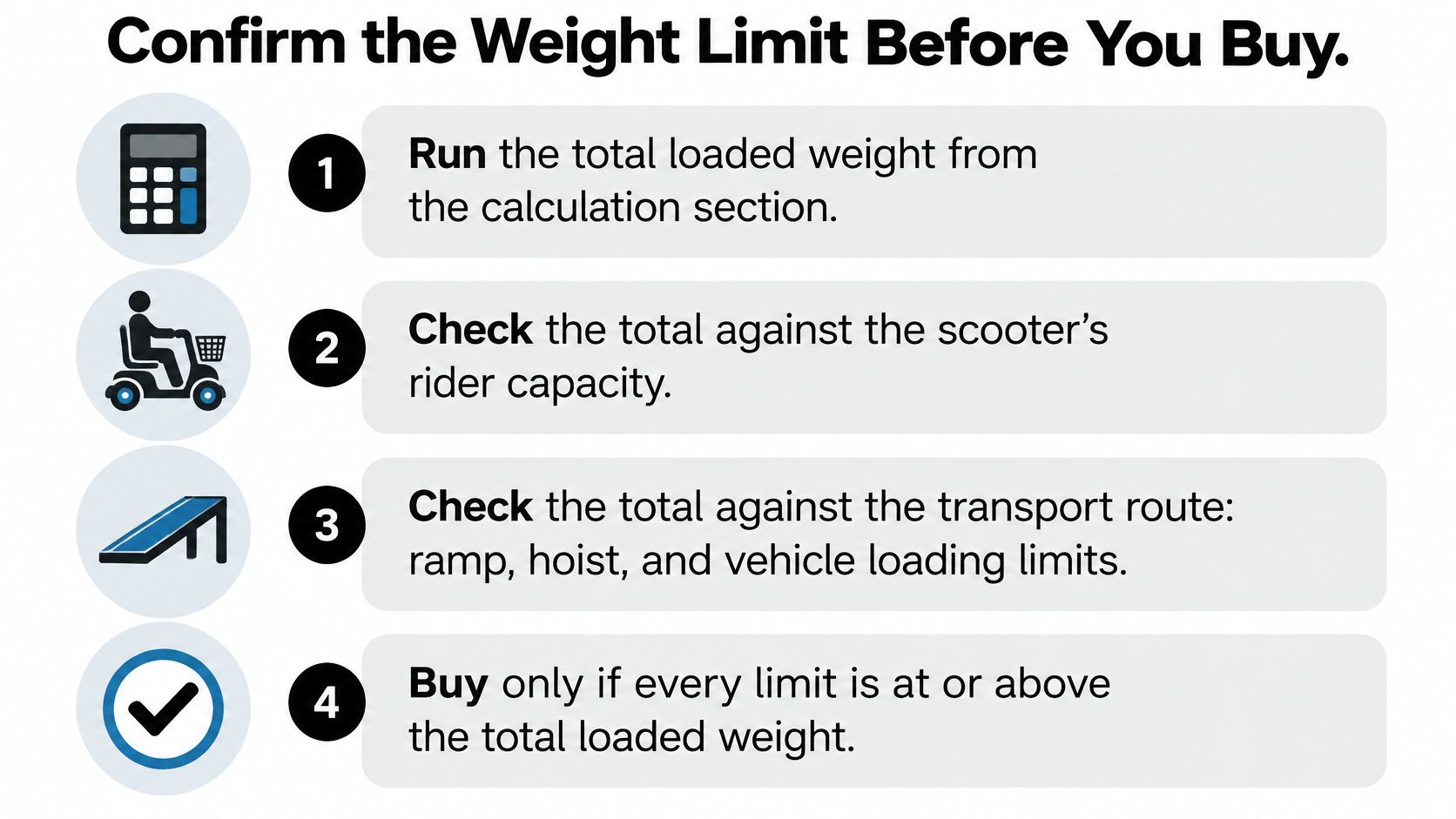
The decision is a filter, not another lesson. Run the total, test it against the transport route, and only then compare models that survive both. Buy only when every limit in that chain sits at or above the loaded weight you calculated.
Take the worked case: a 220-pound rider, 30 pounds of cargo, a 45-pound scooter, a 295-pound total, and a 354-pound target once the 20 percent margin is on. Three travel-oriented listings show how wide the spread is even among scooters that look similar in a photo.
The Pride Mobility Go Go Super Portable is FAA approved, weighs 41 lb, carries a 300 lb weight capacity, and has a range of 10 miles. The Golden Buzzaround GB220 CarryOn HD is FAA approved, weighs 77 lb, carries a 400 lb weight capacity, and has a range of 22 miles. The dashmoto dash 3 is an airline-approved travel scooter with a 375 lb weight capacity, a total weight of 42 lb, and a user height range of 4 feet 11 inches to 6 feet 6 inches.
Set those rider ratings next to the 354-pound target. The Go Go Super Portable's 300 lb capacity falls short of that target, so it drops out for this load even though 220 pounds of body weight looks fine on its own. The GB220 CarryOn HD at 400 lb clears 354. The dash 3 at 375 lb clears it as well. Between those two, the GB220 is the heavier machine at 77 pounds, which is the trade for the higher rating and the longer range. The dash 3 stays near 42 pounds, which is easier to lift, and the listed height band tells a tall or short rider whether the tiller and seat are even in range.
Seat comfort still belongs in the same pass. If you are also comparing a rollator for days you won't take the scooter, choosing the right walker seat is a useful companion check on width and sitting height. A scooter that clears the pounds and a seat that doesn't fit the rider is not a finished choice. For the wider buying sequence, from turning radius to battery range, see our guide on how to choose a mobility scooter.
Recheck every figure on the live product page before you order. Specifications move when a maker revises a battery or a seat. If your scale weight, your basket, or your ramp doesn't match this 295-pound example, rerun the sum. The method doesn't change. The model that survives it might.
DME Superstore carries mobility scooters with published weight capacities, empty weights, and travel approvals so you can match a rider rating to your loaded total and your ramp. Compare compact, heavy-duty, and bariatric frames side by side, including the Go Go Super Portable, the Buzzaround CarryOn HD, and the dash 3. Visit DME Superstore to check the current specs and choose the capacity that clears your numbers.
