



Most mobility scooters are limited to about 4 mph (6 km/h) in pedestrian areas and up to 8 mph (12 km/h) on permitted roads. The useful speed is the speed you can legally and comfortably use where you're going, not the highest number on the specification sheet.
That distinction matters because a road-capable scooter must slow to pedestrian pace when its rider moves onto a pavement, according to the UK Highway Code's mobility scooter rules. For an older adult visiting a pharmacy, or a caregiver planning a neighborhood outing, easy stopping and smooth steering may matter much more than a faster road setting.
Typical Mobility Scooter Speeds and Class Rules
The UK's scooter classes offer a useful benchmark for understanding how speed and setting fit together. They aren't universal product categories, so a scooter sold elsewhere shouldn't automatically be treated as a UK road-legal vehicle.
Under the UK mobility vehicle users' guidance, Class 2 scooters are limited to 4 mph, while Class 3 scooters may reach 8 mph on permitted roads and must have a control that limits them to pavement speed among pedestrians. The table translates those controlled speeds into a practical travel pace.
Typical mobility scooter speeds and pace
| Setting | Speed | Metric | Time for 1 mile | Meant for |
|---|---|---|---|---|
| Class 2 pavement scooter | 4 mph | About 6 km/h | About 15 minutes | Footpaths and pedestrian areas |
| Class 3 on a permitted road | 8 mph | About 12 km/h | About 7.5 minutes | Roads where a Class 3 scooter is allowed |
| Class 3 switched to pavement mode | 4 mph | About 6 km/h | About 15 minutes | Same scooter limited among pedestrians |
| Brisk walking pace | 3 to 4 mph | About 5 to 6 km/h | 15 to 20 minutes | The pace path rules try to match |
The walking row is a practical comparison, not a target that every pedestrian can maintain. Someone using a cane, recovering from surgery, or walking beside a child may move considerably more slowly. Matching the person beside you can require a much gentler setting than the scooter's pavement maximum.
The travel times also assume continuous movement. They don't include waiting at crossings, letting someone pass on a narrow path, navigating a shop entrance, or stopping to rest. Use them to understand scale, not to promise an appointment arrival time.
Understand what the speed control does
A speed limiter lets a road-capable scooter operate within the lower pedestrian limit without changing its motor. It's like entering a school zone in a car: the machine can go faster, but the place determines what's appropriate.
Don't confuse the speed selector with the accelerator lever. The selector establishes the available pace, while the lever controls movement within that setting. Before buying, make sure the rider can identify the controls, reach them comfortably, and reduce speed without looking away for too long.
Indoor and portable scooters also deserve a closer look at their low-speed behavior. A headline maximum won't tell you whether the scooter starts gently, inches through a doorway, or responds predictably when the rider releases the control.
Practical rule: Compare how comfortably the scooter moves slowly before comparing how quickly it moves at full speed.
Road capability requires more than a faster motor. Lighting, indicators, mirrors, a horn, braking equipment, and a speed indicator help the rider communicate and remain visible in a road environment. A fast product listing alone doesn't establish that the vehicle has the equipment or legal classification needed for road use.
For someone who mostly shops or attends medical appointments, transportation and fit may outweigh maximum pace. Can the scooter fit through the home's entrance? Can the caregiver load it into the vehicle? Can the rider turn without struggling with the tiller?
Our guide to how to choose a mobility scooter helps organize those questions alongside comfort, portability, and route requirements. Start with the places the scooter must work, then decide whether a higher-speed setting adds anything useful.
Path and Road Limits That Override the Brochure
Mobility scooter speed limits by place
| Place | Limit | Who it covers | Practical note |
|---|---|---|---|
| UK pavements and pedestrian areas | 4 mph, about 6 km/h | Class 2 scooters and Class 3 scooters in pavement mode | Shared with people on foot |
| UK permitted roads | 8 mph, about 12 km/h | Class 3 scooters with lights, indicators, mirrors, horn, and a speed indicator | Not a pavement speed |
| Singapore public paths from June 2026 | 6 km/h, about 3.7 mph | Motorised personal mobility aids, including mobility scooters | Aligned with a brisk walk; replaces the earlier 10 km/h path figure |
| Singapore transition through December 2028 | Existing devices rated up to 10 km/h have a transition period | Existing faster-rated aids only | Must still be ridden at no more than 6 km/h on paths |
| Australia pedestrian treatment | Cannot exceed 10 km/h to be treated as a pedestrian | Lower-speed scooters | Use the lowest practical speed in crowds or on rough ground |
The UK rows reflect the class-based distinction between pedestrian use and permitted road use. The Australia row describes pedestrian treatment, which is different from permission to ride at the device's maximum wherever pedestrians are present.
Singapore's government explanation of the Land Transport and Related Matters Act sets the public-path limit at 6 km/h from June 2026, with a transition period for existing devices rated up to 10 km/h through December 2028. Its Land Transport Authority guidance on personal mobility aids distinguishes the device's engineered capability from the speed at which it may be operated on paths.
A transition period isn't a faster riding allowance
That distinction is easy to miss. Permission to continue using an existing device doesn't necessarily mean permission to use its highest setting. The rider still has to follow the operating limit for the path.
Singapore's Ministry of Transport describes the accepted reduction from 10 km/h to 6 km/h. The practical direction is toward compatibility with people walking, rather than treating a mobility aid as a small road vehicle in pedestrian space.
For a caregiver arranging travel, check the destination's transport authority and the venue's accessibility information before departure. A US product page describes a machine, not the laws of every country where someone might take it.
- Check the route classification. A footpath, shared path, private walkway, and road may have different access rules.
- Check the facility's expectations. Hospitals, shopping centers, and visitor attractions may require a slower pace than public paths.
- Check the device category. Rules for recreational electric scooters don't automatically apply to medical mobility scooters.
Don't assume an empty path removes a legal restriction. Choose a device and setting that fit the destination even when there's no crowd.
Why Real Routes Are Slower Than the Spec
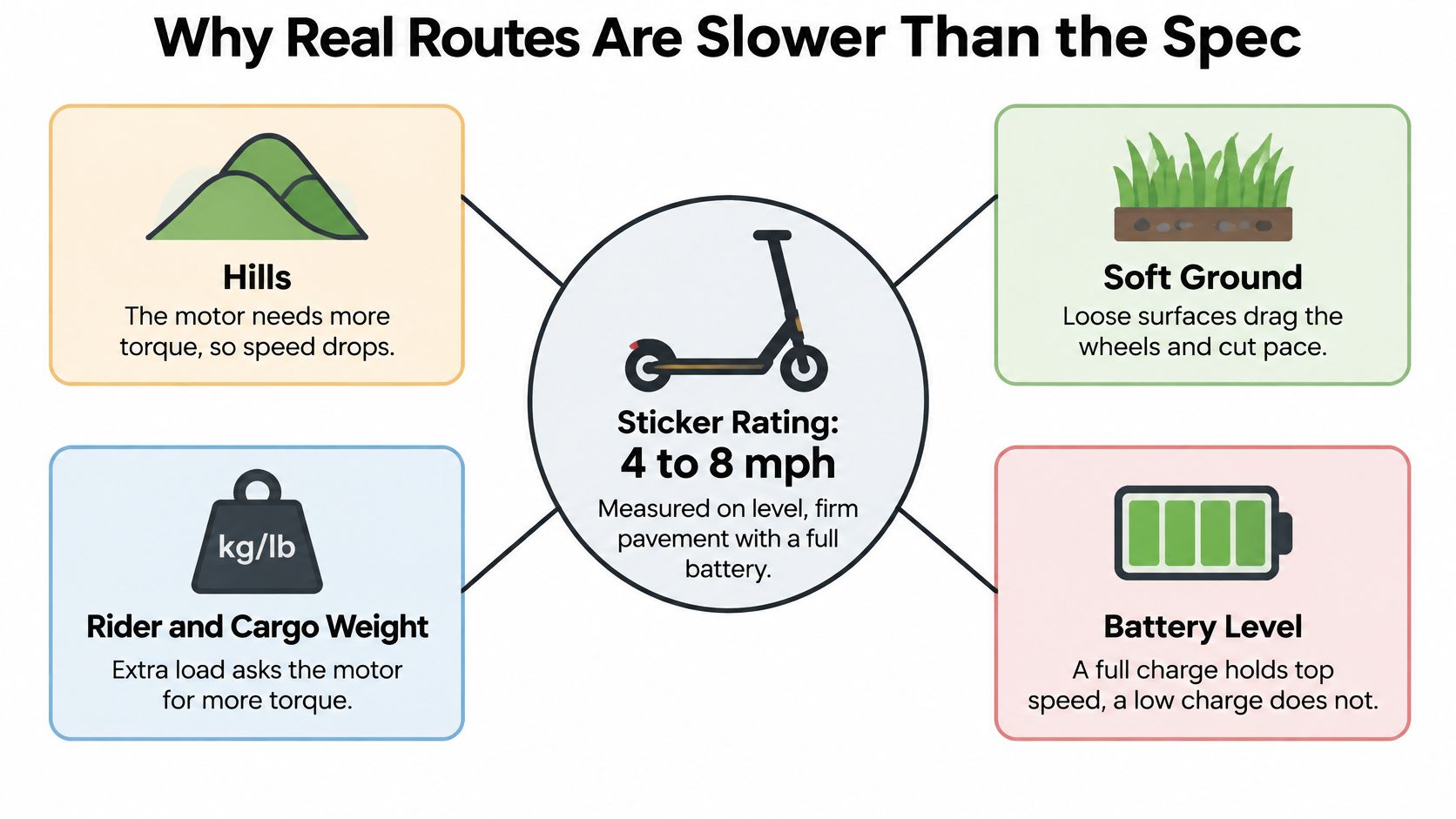
Pushing a loaded shopping cart up a ramp takes more effort than pushing it across a smooth floor. A mobility scooter faces the same basic problem: the motor must move the rider, the machine, and any cargo against the slope.
Braking deserves equal attention. The UK legal requirements for mobility scooters and powered wheelchairs specify stopping within a reasonable distance and being held on a gradient of at least 1 in 5. That requirement isn't permission to attempt any slope that looks manageable, and it doesn't replace the individual scooter's manufacturer-rated incline limit.
Conditions that cut real scooter speed
| Condition | What changes | What to check |
|---|---|---|
| Level firm pavement, full battery | Closest to the rated speed under suitable test conditions | Whether the maker tested on flat pavement |
| Gradient of 1 in 5 or steeper | Speed and acceleration can fall; holding and stopping become critical | Manufacturer's gradient limit and brake holding, never exceed the approved slope |
| Rider near the weight limit | Motor works harder and battery voltage can sag under load | Maximum user weight and how the maker counts bags and accessories |
| Soft ground, carpet, or low tires | Greater rolling resistance reduces pace | Tire type, appropriate pressure, and ground clearance |
| Cold weather or a low charge | Less available power can affect performance | Battery instructions, expected range, and whether an approved spare is practical |
A top-speed figure doesn't tell you how much pace a scooter will retain on your driveway. Ask how the manufacturer established that figure rather than assuming every model was tested under identical conditions.
The diagram summarizes the main differences between a specification-sheet rating and an everyday journey.
Compare the load and surface together
On an incline, the motor needs more torque. Under a demanding load, battery voltage can sag, and acceleration may feel less responsive. A scooter that feels comfortable on a showroom floor may behave differently with shopping bags on an outdoor ramp.
Tires are another practical consideration. Pneumatic tires need the pressure specified by the manufacturer; solid tires don't need inflation, but they don't remove the effects of rough surfaces. Our explanation of pneumatic versus solid tires helps connect tire choice with the surfaces the rider uses.
Before comparing models, collect these details:
- Load allowance. Confirm the maximum user weight and any separate basket or accessory limits.
- Hill capability. Compare the published gradient rating with the route, including the return journey downhill.
- Drive information. Read published motor power or torque alongside the manufacturer's intended use.
- Underbody clearance. Check whether transitions and uneven paving could catch the scooter.
- Test conditions. Look for the surface, charge level, and load used to establish performance.
For a bariatric user or someone recovering from surgery, a smooth start and dependable hill control may be more useful than a higher maximum. The fair comparison is performance with the intended rider on an approved, representative route, not performance with an empty seat.
Set the Right Speed Before You Move Off
A pre-trip routine should make the controls familiar before the scooter starts rolling. Don't wait until a doorway, pavement junction, or steep entrance to find the slower setting.
Keep the owner's manual accessible, especially when a caregiver and rider share responsibility for preparation. Our guide to how to use a mobility scooter provides a broader foundation for handling controls and planning movement.
Follow the route in order
- Identify the machine. Establish whether it's intended for pedestrian use only or also approved for the roads you plan to use. Don't infer road legality from its appearance or maximum-speed claim.
- Select the pedestrian setting before starting. If you're leaving a home hallway, shop, clinic, or sidewalk, begin with the lower mode and a gentle speed-control position. Leave enough room to stop before the first obstacle.
- Confirm road readiness before changing modes. Check lights, indicators, mirrors, horn, and the speed display where road equipment is required. Make sure bags haven't blocked a light or interfered with steering.
- Slow before entering a footpath. Make the change while you still have space and attention available. Don't enter a pedestrian area quickly and then search for the control.
- Check slope suitability without improvising a hill test. Read the manufacturer's gradient limit and inspect the route. If braking, traction, or holding ability is uncertain, arrange a supervised assessment rather than attempting a steep slope alone.
- Reduce speed for the people and surface ahead. Crowds, broken paving, wet entrances, pets, and narrow turns call for more restraint than an open, level stretch. A legal maximum isn't a recommended cruising speed.
- Verify destination rules before travel. Check public-path rules and venue requirements, including any transition provisions for older devices. Save the relevant guidance so a companion can refer to it during the trip.
Make the routine easy to repeat
A caregiver can help by keeping a short checklist with the scooter's charging instructions. Use the same names for controls that appear in the owner's manual, rather than family shorthand that another helper won't recognize.
A rider should be able to select a slower pace without feeling hurried or losing sight of the route.
If the person struggles to release the control, judge gaps, or steer while checking surroundings, pause the outing. A clinician or mobility assessment can help determine whether different controls, training, or another mobility device would better support safe use.
Match Speed to the Trip Not the Top Number
The fastest scooter isn't automatically the most useful scooter. Australian product-safety guidance on reducing mobility scooter accidents advises reducing speed in crowded areas and on rough terrain, exactly where many everyday errands take place.
An open waterfront path may look inviting, but the rider still needs to account for walkers, crossings, surface changes, and local rules.
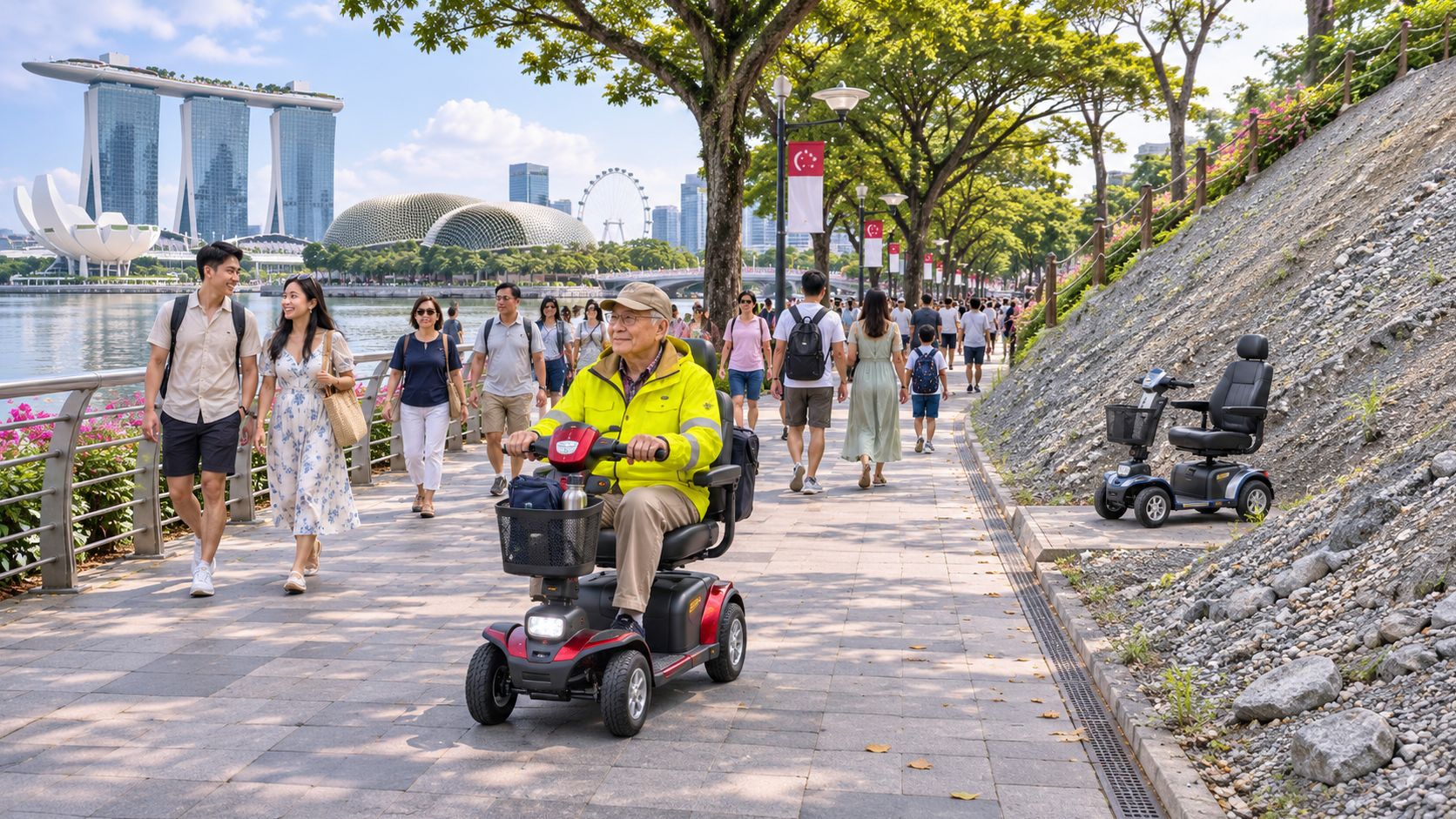
The UK mobility vehicle users' guide connects road capability with both location-specific speed controls and equipment requirements. That makes usable speed a better shopping criterion than maximum speed alone.
A pharmacy visit calls for a gentle creep
Say a caregiver accompanies a parent from the car to a pharmacy counter. The difficult parts aren't the open stretches. They're the entrance mat, automatic doors, aisle ends, and people stepping backward from shelves.
Choose a low, easily controlled pace before entering. Leave room to stop without startling a pedestrian, and pause rather than squeezing through a closing gap. Select the lowest comfortable indoor setting.
A shared-path outing calls for compatibility
On a neighborhood sidewalk or park path, the goal is to travel comfortably with other people, not repeatedly catch them and brake. Give walkers time to notice the scooter, and wait for a clear passing opportunity.
When planning a social outing, Approved Experiences Traveler's group trip ideas for retirees can help you identify activities to discuss with companions. Then confirm accessible surfaces, resting places, and scooter permissions with the actual venue. Select pedestrian mode and reduce it further where people gather.
A demonstration can supplement the owner's manual, but it shouldn't replace model-specific operating instructions.
A permitted-road errand calls for a route decision
A road-capable scooter can make sense when a regular errand includes roads where that vehicle is allowed. The rider must be comfortable looking ahead, checking mirrors, signaling, and managing the approach to junctions without becoming overwhelmed.
Higher speed leaves less time before reaching a stopped pedestrian or an unexpected obstacle. It also means more momentum to manage when slowing, so a confident straight-line ride isn't enough to establish safe handling. Select road mode only on a suitable permitted road, then change to pedestrian mode before entering a footpath.
Don't confuse a faster journey with a longer usable journey. Battery range is a separate comparison, and our guide to how far a mobility scooter can travel helps you plan the return trip as well as the outward leg.
Choose the lowest speed that completes the trip comfortably, with enough control to stop, turn, and share the space.
A steep driveway needs its own suitability check regardless of the trip type. Neither confidence nor a higher speed rating compensates for an incline outside the manufacturer's limits.
Choose Pavement Pace or a Road Capable Scooter
Choose from the route outward. If the scooter will mainly serve home corridors, shops, and sidewalks, prioritize smooth pedestrian-speed control, manageable dimensions, and a comfortable seating position.
A road-capable model is worth considering when a regular route includes permitted roads and the rider can use the required controls confidently. Don't pay attention to road speed while overlooking the lower setting needed at either end of the journey.
Write down the journey before comparing scooters
Prepare a short route profile rather than starting with a list of attractive models.
- Longest regular trip. Include the return journey, likely detours, and where charging is available.
- Steepest ramp or driveway. Record the surface and arrange to establish its gradient safely if it's unclear.
- Heaviest expected load. Include the rider and carried items, then follow the manufacturer's definitions for user, total-load, and basket limits.
- Tightest space. Measure the doorway, storage area, or turn that the scooter must negotiate.
Compare those notes with the owner's manual and product specifications. A missing speed-setting detail is a reason to pause the purchase, not assume the scooter will work appropriately everywhere.
Our guide to types of mobility scooters can help narrow the category before you compare individual specifications. A portable scooter, a heavy-duty model, and a road-oriented scooter solve different problems, even when some specifications overlap.
Make control the deciding factor
DME Superstore's product pages provide specifications, accessory compatibility, and warranty information that help buyers compare mobility equipment. Use those details to judge the whole fit, including range, transportation needs, rider capacity, and the speed control appropriate to the route.
For someone recovering from surgery, consider whether fatigue or discomfort affects steering during a longer outing. For a caregiver, consider whether the scooter can be transported and prepared without an awkward lift or complicated setup.
The best answer to “How fast do mobility scooters go?” is therefore both a number and a place. Choose pavement pace for pedestrian journeys, and consider road capability only when the route and rider justify it.
DME Superstore offers mobility scooters, powerchairs, and practical buying guides to help you compare equipment for everyday travel. Visit DME Superstore with your route, load, and transport notes, then compare speed settings alongside range, capacity, and comfort before choosing.
