



Your father is coming home after a hip fracture, and you're trying to arrange a rollator and a bed before discharge. One supplier offers doorstep shipping, another offers setup, and a third talks about rental paperwork. You're making decisions quickly, but you still don't know who'll help if the bed stops moving or the rollator needs a replacement brake.
Choosing a home medical equipment company means looking beyond the product photo and advertised price. The right purchase includes equipment the person can use, delivery that gets it into place, and a clear repair path when something goes wrong.
What a Home Medical Equipment Company Supplies
A daughter arranging her father's recovery may start with a simple shopping list: a walking aid and somewhere safe to sleep. Then she discovers that suppliers sell, rent, deliver, assemble, and service different equipment, sometimes through separate arrangements. A bed frame may not include a mattress, and shipping may not include carrying it into the bedroom.
A home medical equipment company, often called a durable medical equipment supplier, provides reusable equipment intended for ongoing use at home. Durable medical equipment, or DME, includes items such as wheelchairs and homecare beds rather than disposable supplies. Many retailers also stock consumables, so the store's full inventory can be broader than the term DME suggests.
Equipment categories and the daily needs they meet
| Category | Typical products | Who it usually helps |
|---|---|---|
| Mobility | Rollators, manual wheelchairs, power scooters, powerchairs | People with balance problems or limited walking distance |
| Beds and pressure relief | Full-electric homecare beds, alternating-pressure mattresses | People who spend long hours in bed or are at risk of pressure injuries |
| Bathroom and shower safety | Shower wheelchair commodes, sliding transfer benches | People with difficulty bathing or transferring safely |
| Transfer and lift aids | Lift chairs, transfer aids, electric beds with lift assist | Caregivers and people with limited upper-body strength |
| Respiratory | Portable oxygen concentrators | People with chronic lung conditions who need prescribed oxygen away from home |
| Hearing | OTC hearing aids | Adults with perceived mild to moderate hearing loss |
At DME Superstore, our main categories include Power Mobility, Manual Mobility, Bathroom & Shower, Bedroom, Living Room, and Transfer Aids. We also carry Bariatric Equipment, Caregiver Kits, Incontinence, DME For Kids, OTC Hearing Aids, Nutritional Supplements, Respiratory, Skin Care & Beauty, and Wound Care.
Those categories help organize shopping, but they shouldn't determine the starting point. Begin with the daily task that's hardest: standing from a chair, getting into the bath, reaching the bathroom, or changing position in bed.
Renting and buying solve different problems
Say the father needs a full-electric homecare bed for about six weeks after his fracture. In that hypothetical short recovery, renting is often the practical route to compare, while a rollator or manual wheelchair expected to be used for years is usually considered for purchase.
Rental and purchase rules can differ by item and payer. Before paying, get a written explanation of which arrangement applies, whether rental payments ever convert to ownership, what happens when the rental ends, and who owns the device.
Start with the task: Describe what the person can't safely do today before choosing a product category.
A caregiver who cannot safely assist a standing transfer needs more than a comfortable chair. That situation calls for an assessment of the transfer itself, including whether a lift or another aid is appropriate.
How to Judge a Provider Before You Order
The right device fits the user's body, home, and daily routine. A company should help you verify those details and explain what support remains available after delivery.
Provider criteria to compare before ordering
| Criterion | What to check | Why it matters |
|---|---|---|
| Warranty | Length, parts and labor coverage, extended warranty options | Unclear coverage can leave substantial repair costs with the buyer |
| Delivery | Free shipping, white-glove delivery and setup | Large beds and scooters are hard to carry, assemble, and position alone |
| Returns | Return window length and any restocking terms | A wrong size or fit may only become apparent during use |
| Eligibility | FSA or HSA eligibility, insurance and Medicare supplier status | Determines available payment routes and reimbursement requirements |
| Financing | Payment plan length, monthly amount, interest terms | Smaller payments can come with a higher total cost |
| Specifications | Weight capacity, dimensions, compatible accessories | Helps prevent buying equipment that won't fit the body or home |
| Used and bariatric options | Open-box condition grade, bariatric model range | May reduce purchase cost or provide higher weight capacity |
Read the details behind each promise
A warranty may cover a motor but exclude a battery or charge separately for labor. We offer Extended Warranties, but compare the actual terms for the chosen product rather than assuming every component has identical protection.
We also offer White Glove Delivery. Our explanation of white-glove delivery service can help you distinguish in-home assistance from ordinary shipping. Confirm the work included in your order, especially if stairs, assembly, or packaging removal are involved.
Our 30-day return policy is another reason to read the item-specific terms before checkout. Confirm when the window begins, whether an opened or assembled item qualifies, and whether return freight or restocking charges apply.
Payment eligibility needs the same precision. A retailer's FSA/HSA offering doesn't establish Medicare enrollment, network participation, or coverage for a particular device.
For financing, compare the financed total with the cash price. For specifications, compare overall width with the route through the home, not just seat width. For open-box equipment, review condition, included accessories, and warranty terms; for bariatric equipment, check seating dimensions as well as capacity.
Get service answers in writing
Before ordering, use phone or chat to settle these questions:
- Repair responsibility: Who diagnoses a fault, and who performs the repair?
- Parts availability: How are compatible replacement parts identified and ordered?
- Response expectations: When should you expect an initial reply and a repair update?
- Downtime support: Is a loaner or rental available, and who pays for it?
A helpful sales conversation should leave you with specific answers, not just reassurance that the product is covered.
Matching Equipment to Your Home and Body
An expensive mistake is buying equipment that can't reach the room where it's needed. Take a tape measure, a notepad, and the product's complete dimensions through the actual route from the entrance to the bedroom and bathroom.
Measure clear openings with doors in their normal open position. Include handles, furniture, hallway corners, and the space needed to approach a doorway, not merely the opening itself.
Home readiness checks before you order
| Check | Requirement or example | Why it matters |
|---|---|---|
| Doorway and hallway width | Measure the narrowest point the device must pass, including turns | Scooters and wheelchairs need maneuvering clearance as well as straight-line space |
| Ramp slope | Running slope no steeper than 1:12 under the U.S. Access Board's ADA standards | Under that standard, a 24-inch rise needs at least 24 feet of ramp run, before landings |
| Ramp cross slope | The same standard limits cross slope to 1:48 | Side-to-side tilt can make wheeled equipment harder to control |
| Bathroom access | Turning space, toilet or tub height, transfer route | Helps determine whether a commode, bench, or lift is needed |
| Floor surface | Thresholds, loose rugs, carpet, uneven flooring | Affects powerchair traction and walker stability |
| Caregiver strength | Ability to lift, fold, and load the device | Helps identify the need for lift assistance or a lighter model |
| Charging and storage | Suitable outlet location and storage space | Keeps charging practical without obstructing the walking route |
The ramp's running slope is its lengthwise incline; cross slope is its side-to-side tilt. Use these accessibility standards as planning references, and have a qualified installer confirm landings, edge protection, door clearances, and applicable local requirements rather than treating ramp length alone as a complete design.
Match the person, not just the floor plan
The WHO wheelchair-provision guidance estimates that approximately 80 million people require wheelchairs and recommends individualized assessment, selection and fitting, user training, and follow-up. This is a service process, not a catalog choice.
An appropriate wheelchair, as defined by WHO, must meet the user's needs and environment, provide proper fit and postural support, remain safe and durable, and be obtainable, maintained, and serviced affordably.
Before recommending a manual chair, rollator, or scooter, assess seat width and depth where relevant, propulsion method, terrain, transfer ability, and caregiver capacity. A powerchair can have enough battery range and still be unsuitable because the user can't turn from the hallway into the bathroom.
Plan bedside access and practice
For bedroom planning, our guide to electric hospital beds for home use provides context for comparing bed functions. Measure space for the caregiver, transfer equipment, and access to controls.
If you're comparing a residential adjustable base with a care bed, Indian River Furniture's resource on adjustable beds for snoring and reflux offers useful background on positioning. It isn't a substitute for clinical advice or a bed assessment for someone who needs assisted care.
During the first week, arrange practice with a trained helper. The user should rehearse transfers, braking, controls, and the route to the bathroom before attempting unfamiliar tasks alone.
Pressure-Relief Beds and Surfaces Compared
A parent who spends most of the day in bed may need both easier positioning and protection from sustained pressure. Those are related needs, but they aren't the same purchase.
A full-electric homecare bed adjusts bed height and head and foot positions. A pressure-relief surface manages pressure between the body and mattress. Buying an adjustable frame doesn't establish that the included mattress meets the person's skin-care needs.
Compare the frame and package separately
| Option | Price or configuration | Decision point |
|---|---|---|
| Medline MedLite Full-Electric Homecare Bed, frame only | $699.00 | Requires a separately selected compatible mattress |
| Medline MedLite with half or full rails | $749.00 | Rail selection needs an individualized safety assessment |
| Medline MedLite packages with a mattress | $819.00 to $929.00 | Confirm the included mattress type and suitability |
| Elevra Rotating Hi-Lo Bed | Rotating Hi-Lo electric bed with lift assist | Consider when rotation and assisted movement are needed |
| EZLift Deluxe Bed | Full-electric homecare bed with lift assist | Consider when lift assistance is part of the care plan |
The Medline MedLite has a 450 lb weight capacity, a 14.5- to 22.5-inch height range, and 3-inch casters. Compare its height range with the user's transfer needs and the caregiver's working position, not just the available bedroom space.
The package price also needs careful reading. A mattress included with a bed isn't automatically an alternating-pressure or low-air-loss mattress, and rails shouldn't be treated as universal fall-prevention accessories.
Understand what powered surfaces can do
A network meta-analysis of support surfaces found that powered active-air surfaces probably reduce pressure-ulcer incidence by about 58%, and powered hybrid-air surfaces by about 78%, compared with standard hospital surfaces. The analysis also indicated that active-air surfaces may be less comfortable, making tolerance part of the selection decision.
These findings concern prevention under the studied conditions, not a guarantee for an individual user. Existing wounds need clinical assessment, and a surface doesn't replace repositioning, skin inspection, moisture management, or attention to nutrition.
A pressure-relief mattress supports a care plan. It doesn't replace the people carrying out that plan.
Before buying, confirm pump reliability, power-failure response, mattress dimensions, user capacity, frame compatibility, noise, and cleaning requirements. Ask what the caregiver should do if the pump alarm sounds overnight.
Our guide explaining what a low-air-loss mattress is helps distinguish that technology from other surface types. For general comfort comparisons, Gorins Furniture & Mattress discusses best pressure-relieving mattress options; use that background separately from a clinician's recommendation for pressure-injury prevention or treatment.
How Insurance, Medicare and FSA Funds Pay
U.S. healthcare spending on durable medical equipment was estimated at $78 billion in 2024, according to CMS's Office of the Actuary as reported by HME Business. For an individual household, the immediate question is more practical: which payment route applies to this exact item?
Medicare Part B generally covers qualifying equipment ordered as medically necessary and furnished by a Medicare-enrolled supplier. That doesn't mean every retail purchase qualifies, and rental and purchase rules can differ.
Payment routes for home medical equipment
| Payment route | Who it fits | Key requirement | Watch for |
|---|---|---|---|
| Medicare Part B | Beneficiaries with a qualifying prescription | Medically necessary equipment furnished by an enrolled supplier | Cost-sharing after the deductible; different rental and purchase rules |
| Private insurance | People with employer or marketplace plans | In-network supplier and prior authorization if required | Approval delays and network limits |
| Medicaid | Eligible low-income people | State program requirements | State-specific coverage and approved product lists |
| FSA or HSA funds | Account holders buying eligible items | Eligible item and proof of purchase | Keep receipts and confirm whether a medical necessity letter is needed |
| Direct purchase with financing | People paying directly | Credit approval through the financing partner | Interest rate and payment-plan length |
| Veterans discount | Eligible veterans buying direct | Eligibility for our Veterans Lifetime Discount | Confirm that the selected item qualifies |
Separate eligibility from approval
An eligible product isn't the same as an approved claim. Your insurer may require a particular supplier, documentation from the treating clinician, or authorization before delivery. Ask the insurer to confirm those requirements before you commit to a nonreturnable item.
We list FSA/HSA eligibility among our features. Confirm the exact item's eligibility with your account administrator, retain the itemized receipt, and establish whether supporting medical documentation is needed.
Our guide to a letter of medical necessity explains the document's purpose. Having a letter doesn't by itself guarantee payment, so match the paperwork to the payer's actual requirements.
Compare what you'll owe
Ask for the expected out-of-pocket amount in writing, including delivery services, accessories, and any recurring rental charges. Establish who submits the claim and whether you must pay first and seek reimbursement.
We also offer a Veterans Lifetime Discount for eligible veterans. Confirm its application to the chosen item rather than assuming it combines with every other offer.
Coverage rules differ by plan and state. Before ordering, confirm the exact requirements with the insurer or account administrator and the prescribing clinician, especially when the equipment is needed for discharge.
What to Do When Equipment Fails at Home
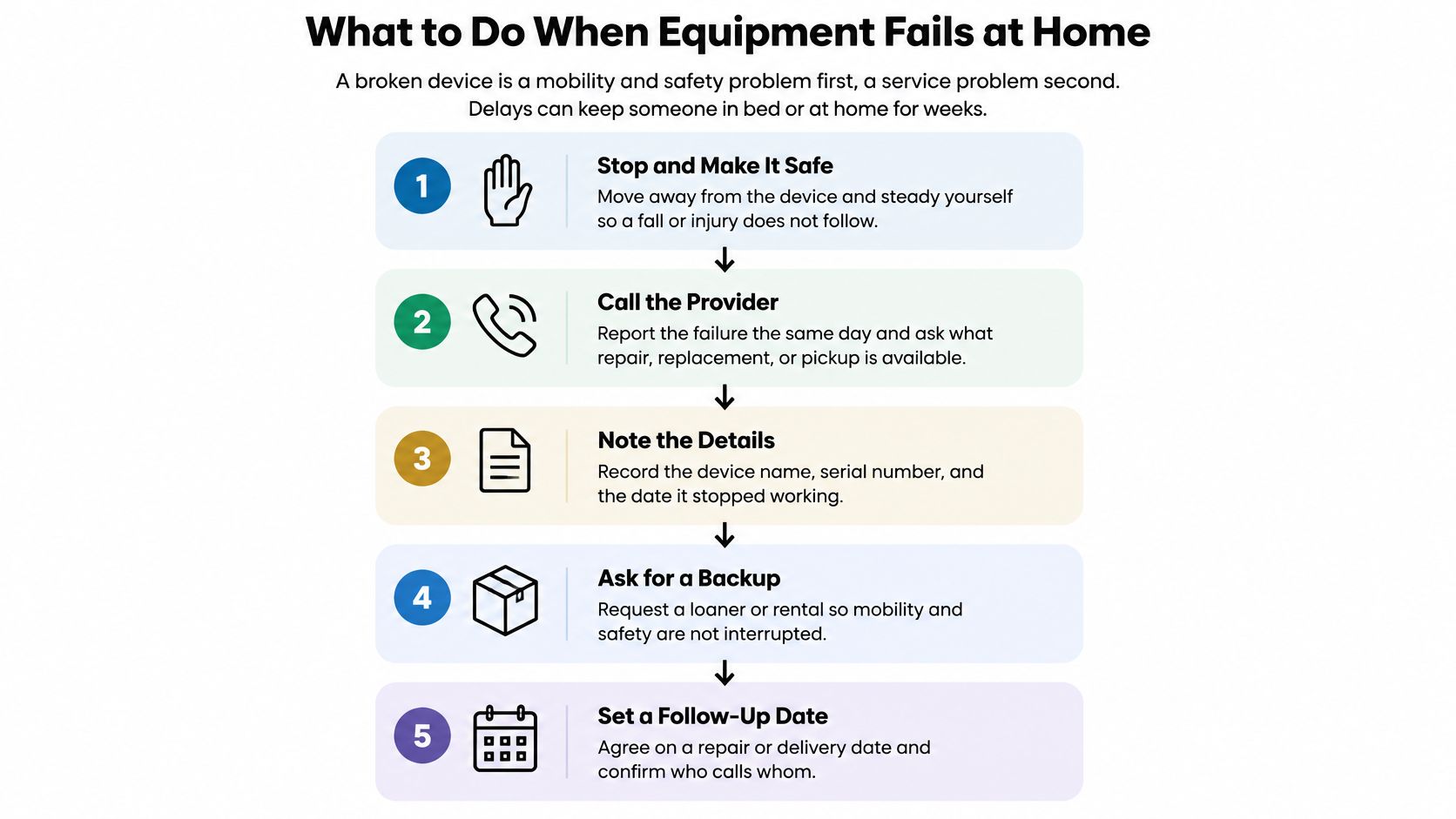
A broken device is a mobility or safety problem first and a service problem second. A 2025 wheelchair-user survey discussed in Idaho's Medicare teaching materials reported lengthy approval and repair waits, with some users confined to their homes or beds for weeks or months while awaiting parts.
Keep a simple response plan where the user and caregiver can find it. This visual summarizes the immediate priorities.
Follow a documented repair routine
- Stop using the faulty device safely. Arrange a safe position or assisted transfer before troubleshooting. Check warranty coverage and exclusions for wear items, and don't attempt unsupported electrical or structural repairs.
- Document the fault. Photograph visible damage and record the model, serial number, purchase date, and symptoms. Capture error messages without repeatedly operating unsafe equipment.
- Contact the provider. Request an expected response time and a separate parts lead time. Use our warranty claim process guide to prepare the information needed for a claim.
- Request temporary equipment. If repair will take more than a few days, ask about a compatible loaner or rental. Confirm its fit, delivery arrangements, and charges before accepting it.
- Establish repair or replacement. Request a written decision on whether the damage is repairable and whether the warranty covers the proposed work. Don't approve a paid repair without knowing the total scope.
- Keep a communication log. Record every call, contact name, reference number, and promised update. Set a follow-up date rather than relying on an open-ended callback.
- Escalate approval problems. Involve the insurer or clinician when replacement requires authorization or changed documentation. If failure creates an immediate medical emergency, seek emergency assistance instead of waiting for routine service.
Prepare for downtime before it happens
A cheaper device can cost more overall when compatible parts are unavailable or the user needs paid assistance during repairs. Keep the manual, receipt, warranty, charger details, and service contacts together, with an accessible copy for the caregiver.
For additional equipment context, the video below can accompany your written preparation. Model-specific instructions and the treating team's advice should guide actual use.
Before checkout: Know who'll restore safe use, not merely who'll deliver the box.
Confirm the Provider and Order With Confidence
Once you've chosen a suitable category and gathered measurements, use the final conversation to confirm the order rather than restart the search. DME Superstore sells durable medical equipment online with free shipping, Extended Warranties, and White Glove Delivery services for large beds and scooters.
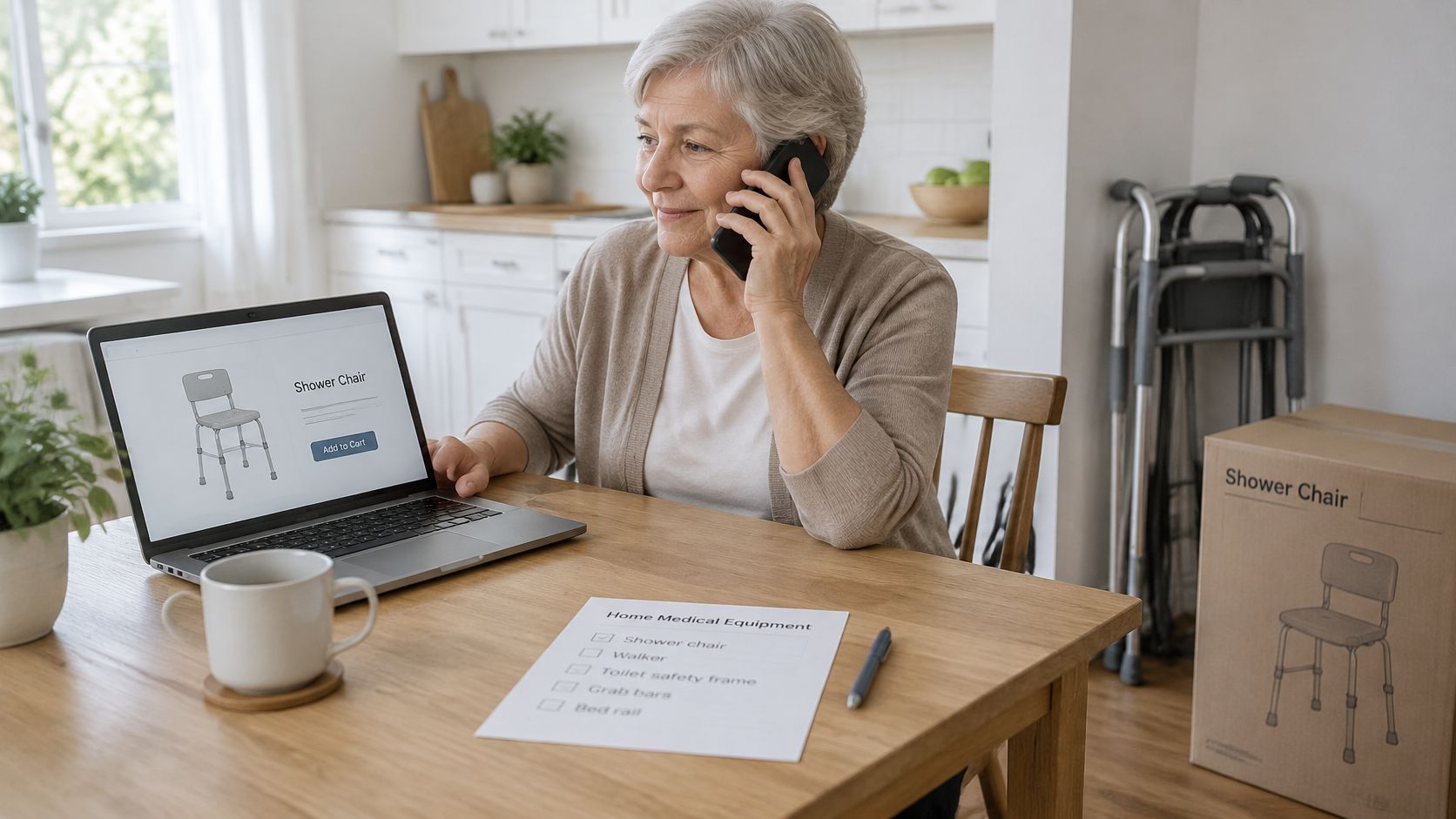
Keep your measurements and product notes beside you while completing the purchase.
Complete the final confirmation
- Read back the fit details. Call us at 1-888-376-1658 or open chat with the model name, user's weight, narrowest doorway, and entry rise. Ask staff to check those details against the equipment specifications.
- Name the repair route. Confirm who performs repairs, which parts are wear items, and the expected arrival time for a common replacement part. Record any service commitments.
- Settle payment documentation. Confirm the exact item's FSA/HSA status and whether your administrator needs a medical necessity letter. Save the receipt with the order confirmation.
- Specify delivery and return terms. For a large bed or scooter, arrange white-glove service and confirm the in-home setup included. Get the 30-day return window, applicable exclusions, and any restocking fee in writing.
- Write down the financed total. Record the monthly payment, number of months, and interest. Place that total beside the shelf price before accepting the agreement.
Order only when the device fits the body and the home and a written repair path is in place.
DME Superstore offers mobility aids, homecare beds, pressure-relief surfaces, and everyday safety equipment, with delivery and warranty options to consider alongside the product. Visit DME Superstore with your measurements and care needs, then confirm fit, setup, and the repair path before placing your order.
