



The most common advice about high low beds is also the most misleading: lower the bed and falls will stop. Lowering the sleeping surface can reduce the distance of a potential fall, but clinical evidence doesn't show that a low bed, by itself, prevents people from falling.
The more useful way to understand these beds is as transfer and caregiving equipment first. A high low bed lets a person get in and out at a workable height, then lets a caregiver raise the frame for bathing, dressing, repositioning, or clinical care. The lowest setting is still important, but it's one part of a wider safety plan that includes mobility assessment, lighting, supervision, and a clear path to the bathroom.
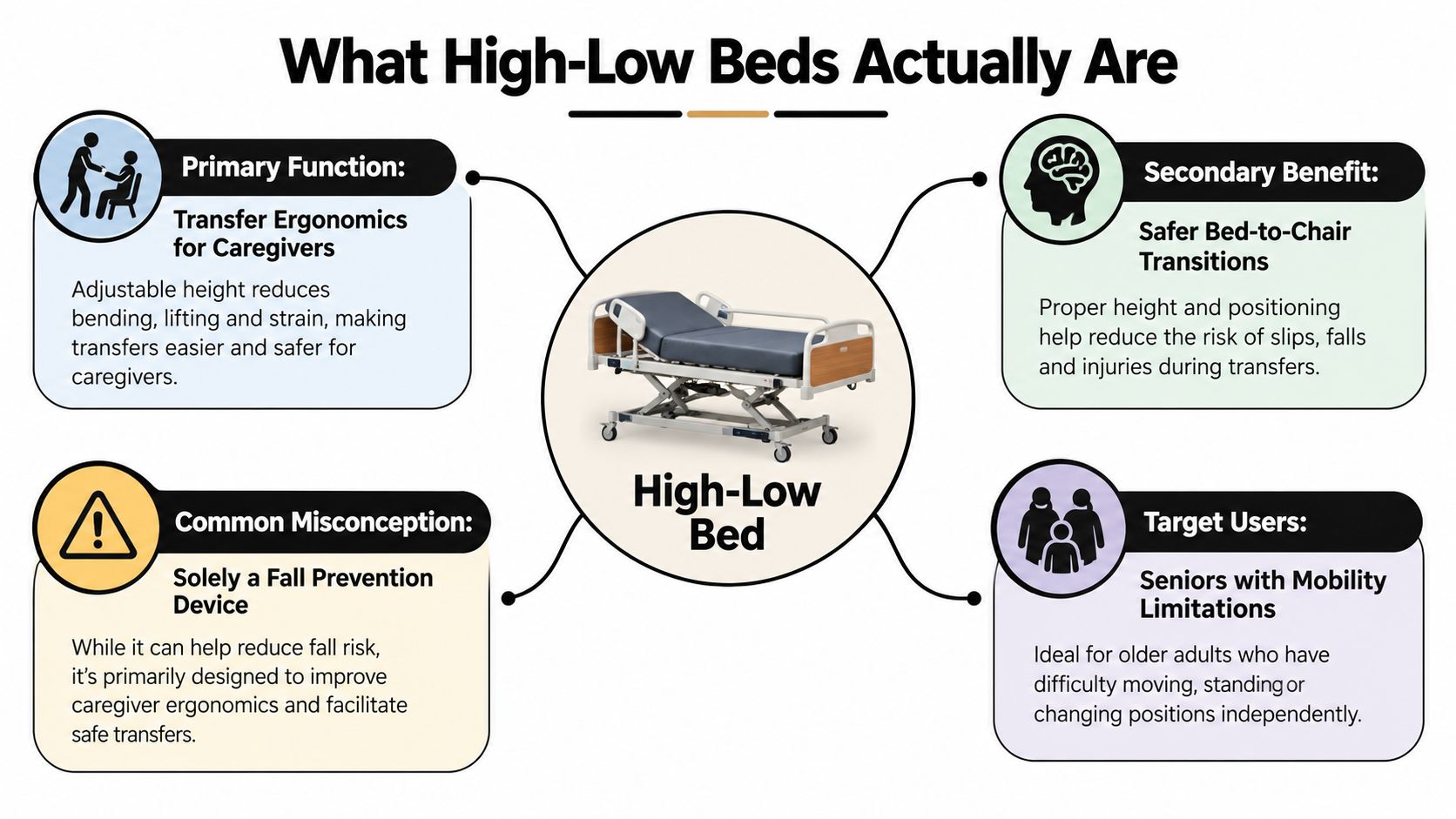
What High Low Beds Actually Are
High low beds are usually marketed as fall-prevention devices. Their strongest practical value, however, is transfer ergonomics. The bed can move down for rest and egress, then rise to a safer working height for the person providing care.
Think about a kitchen counter. Chopping vegetables at shin height would force you to bend repeatedly, while working at shoulder height would make control difficult. A useful counter sits near your working level. Caregivers need the same principle at the bedside. A bed that's too low can strain the back during care, while a bed that's too high can make transfers unstable for the person getting up.
A high low bed is a hospital-style adjustable bed with a vertically movable frame or deck. Depending on the design, it can approach floor level for sleeping and be raised toward a caregiver's working height for transfers and procedures. The exact range varies by model, so buyers should look at the height from the floor to the top of the mattress, not only the frame specification.
The parts that make the bed useful
Most high low beds combine several systems:
- A height-adjustable frame changes the entire sleeping surface.
- An articulating deck raises or lowers the head and knee sections.
- Lockable casters keep the bed stable during transfers and care.
- Compatible rails or assist devices may support repositioning, but they must be selected as part of the complete bed system.
- A hand control or crank lets the user or caregiver change the bed position.
This differs from a standard adjustable bed. A standard adjustable base may raise the head and legs, but it often doesn't provide the same broad vertical travel. That difference matters when the bed must line up with a wheelchair, commode, or caregiver's working position.
The medical adjustable bed guide can help readers distinguish ordinary positioning features from the high-low function used in clinical and homecare settings. The right model isn't merely the one that goes lowest. It's the one that supports safe transfers, effective care, and a practical resting position for the individual using it.
Who Uses High Low Beds and Why
A high low bed makes sense when the person in bed and the person helping them have different physical requirements. The user may need a lower transfer surface, while the caregiver needs the bed raised to avoid repeated bending and awkward reaching.

Consider an older adult with limited leg strength receiving morning care from a spouse. The spouse may raise the bed while helping with dressing or hygiene, then lower it before the person rests. The important feature isn't a marketing label. It's the ability to create one height for caregiver spinal safety and another for independent or assisted standing.
A person recovering from a stroke may need frequent position changes during rehabilitation. In that situation, powered head and knee movement can make repositioning easier, while vertical adjustment can help a therapist practice a bed-to-chair transfer. The bed should be configured around the person's movement ability, not left at one height for every task.
A resident with dementia may attempt to leave bed without calling for help. A low sleeping position can reduce the distance to the floor, but it won't address confusion, wandering, poor lighting, or an unsafe route to the bathroom. Staff still need an individualized plan that considers observation, toileting routines, footwear, and whether rails would encourage climbing.
Practical rule: Match the bed feature to the task. A low position serves rest and harm reduction, while a raised position supports care and controlled transfers.
A person with higher body weight may need a bariatric frame, a suitable mattress, and equipment rated for the combined load of the user and accessories. Manual repositioning can become unsafe when the bed, mattress, rails, and patient exceed what the caregiver can manage. In that setting, powered adjustment and appropriate weight capacity are clinical requirements, not luxuries.
Hospital and hospice settings use the same basic logic. They may place more emphasis on cleanable surfaces, rapid adjustment, dependable controls, and compatibility with clinical accessories. At home, buyers often care more about room fit, noise, appearance, and whether a spouse can operate the controls without assistance.
Watch the adjustment sequence and transfer principles in practice before choosing a model:
The home care equipment guide for elderly users is useful when a bed is only one part of a larger setup involving walkers, transfer aids, bathroom equipment, or mobility devices. The person's daily routine should determine the equipment combination.
Key Features and Specifications That Matter
A specification sheet can make a bed look impressive while leaving out the detail that affects daily safety. Evaluate the complete setup, including the frame, mattress, rails, controls, casters, and accessories.
Height range and working height
The lowest deck position matters for users who may roll or fall from bed, but the mattress-top height is the measurement that affects the person's body. A thick mattress can make a frame's low setting much less low in practice.
The highest position matters during transfers and care. Caregivers generally need the bed near a comfortable working level for dressing, hygiene, turning, and repositioning. A clinical source reports that a bed height above approximately 120% of a patient's lower-leg length can create unsafe foot placement and transfer instability, while an excessively low bed can make standing harder for someone with weak hip or knee extension. See the clinical discussion of bed height and transfer safety for the reasoning behind assessing the individual rather than choosing a universal height.
Lift mechanism and power behavior
Manual crank systems don't depend on electricity, but they require physical effort and may be slower to adjust. Electric actuators offer push-button control and finer positioning, but buyers should ask what happens during a power failure and whether a backup control or emergency lowering method is available. Combination systems can balance flexibility and reliability, provided the caregiver understands which functions are powered and which are manual.
Capacity and mattress pairing
Separate patient weight, safe working load, and accessory load in the specification. The safe working load may include the patient, mattress, rails, pump, bedding, and other equipment. A bariatric user may therefore need more than a frame that merely supports the person's stated body weight.
Mattress compatibility is equally important. Foam mattresses, alternating-pressure overlays, and low-air-loss surfaces can have different thicknesses and support requirements. A mattress that is too thick can undermine the intended low position, while an incompatible surface may interfere with articulation or pressure-care goals.
The details that affect routine use
Ask about rail configurations, assist bars, caster brakes, bed length extensions, emergency controls, and compatibility with lifting equipment. Rails can help with repositioning for some users, but they can also create entrapment or climbing hazards.
| Specification | Typical Range | Why It Matters |
|---|---|---|
| Vertical adjustment | Varies by model | Creates a low resting position and a raised care or transfer position |
| Mattress-top height | Depends on frame and mattress | Determines actual transfer height and fall distance |
| Lift mechanism | Manual, electric, or combined | Affects effort, control, noise, and power-failure planning |
| Safe working load | Model-specific | Must account for the user, mattress, rails, pump, and accessories |
| Mattress compatibility | Manufacturer-specific | Prevents excessive height, poor articulation, or pressure-care problems |
| Rail and assist options | Configuration-specific | Can support movement, but may also introduce entrapment or climbing risk |
Readers comparing ordinary positioning features may also benefit from this overview of the benefits of an adjustable bed, although a medical high low bed has additional requirements around transfers, controls, rails, and clinical compatibility. For heavy users or demanding care routines, review the full specifications in a heavy-duty adjustable bed frame resource before relying on a general-purpose adjustable base.
Electric vs Manual and Other Model Choices
The right model depends on who adjusts the bed, how often it moves, and what happens if the user can't operate it independently. A manual bed may work well for occasional care, while a powered model can be safer when the bed changes position throughout the day.
Comparing the main bed types
Manual crank beds avoid dependence on a wall outlet. They're useful when a caregiver can safely turn the crank and the bed won't need frequent adjustment. The trade-off is effort, slower positioning, and less precise control.
Semi-electric beds typically motorize head and foot articulation while using a manual crank for height. They can suit short-term recovery when the bed needs some powered positioning but vertical adjustment is occasional.
Full-electric beds allow powered height, head, and foot adjustment from a hand control. They're often more appropriate for long-term care, frequent transfers, and users whose caregivers can't safely operate a crank.
| Model Type | Height Adjustment | Head/Foot Adjustment | Best For | Trade-off |
|---|---|---|---|---|
| Manual crank | Manual | Manual or limited powered function | Occasional care with an able caregiver | Requires physical effort |
| Semi-electric | Manual height | Powered | Short-term recovery | Height changes remain labor-intensive |
| Full-electric | Powered | Powered | Frequent care and long-term home use | Needs power-failure planning |
| Bariatric electric | Powered, model-specific | Powered | Users requiring higher capacity | Requires more room and compatible accessories |
| Ultra-low design | Powered or manual, model-specific | Usually adjustable | Users needing a very low rest position | May make standing and caregiver access harder |
A guide to electric hospital beds for home use can help explain which controls are powered and which functions remain manual. Don't assume that “electric” means every movement is available from the hand control.
Rails are a separate decision
Full-length rails, half rails, assist bars, and no-rail configurations serve different purposes. An assist bar may help a person turn or sit up, while a full-length rail may limit movement but create a temptation to climb over it. FDA-linked guidance recommends assessing the dimensions of the complete hospital-bed system to reduce entrapment hazards in hospitals, nursing homes, and private residences. The hospital-bed entrapment guidance supports treating the mattress, rails, handles, and accessories as one system.
Specialty features also need a clinical reason. Trendelenburg positioning may be relevant for a prescribed care plan, while cardiac chair positioning can assist certain respiratory or cardiac routines. A low-boy design may be useful for a person at high risk of rolling from bed, but it isn't automatically better for someone who struggles to stand from a low surface.
The Truth About Fall Prevention and Bed Height
Lowering a bed can reduce the height of a potential fall. That doesn't mean it reliably prevents the fall itself.
A large randomized controlled trial involving 10,937 patients across 18 hospital wards compared conventional beds with low-low beds. Bedroom falls occurred at a median rate of 2.2 per 1,000 occupied bed-days in units using low-low beds, compared with 1.7 per 1,000 occupied bed-days in units without them. Falls with injury were also slightly higher in the low-low-bed units, at 1.7 versus 1.2 per 1,000 occupied bed-days. These findings are reported in the low-low bed evidence review.
A systematic review found no evidence that low beds reduced falls or fall-related injuries, and some studies showed higher fall rates. That result may partly reflect selection bias, because staff often assign low beds to people already considered high risk. The systematic review of low beds and fall prevention supports a broader plan rather than a single equipment purchase.
Use a two-zone approach
At night or during unattended rest, the bed may be kept in its lowest safe position. During daytime care, the caregiver can raise it to a height that supports safer movement and reduces back strain. After the task, the bed should return to the planned resting position.
The lowest setting still needs to be assessed against the user's body. A nursing-home study reported that beds above 120% of a resident's lower-leg length can create foot-placement instability. In that study population, 93.9% of residents had beds higher than that threshold, and more than 75% had beds higher than 140% of lower-leg length. The study of bed height and resident falls supports using the lowest practical position for getting in and out, then raising the bed temporarily for care.
Fall risk also depends on cognition, nighttime confusion, mobility aids, floor surfaces, lighting, alarms, toileting needs, footwear, medication effects, and supervision. A floor mat can help reduce harm in some arrangements, but it isn't a substitute for a clear plan.
A low bed changes the consequences of a fall. It doesn't remove the reasons a person may leave bed unsafely.
A low position may be the wrong choice if a restless person tries to climb over rails, becomes trapped between components, or cannot stand from the mattress safely. The bedroom safety guidance for elderly users should be applied alongside an individualized assessment of transfer ability and behavior.
How to Choose and Set Up the Right Model
Begin with the person, not the product photograph. A safe setup depends on the user's body dimensions, transfer method, mattress, mobility aid, caregiver workflow, and available space.
Measure before ordering
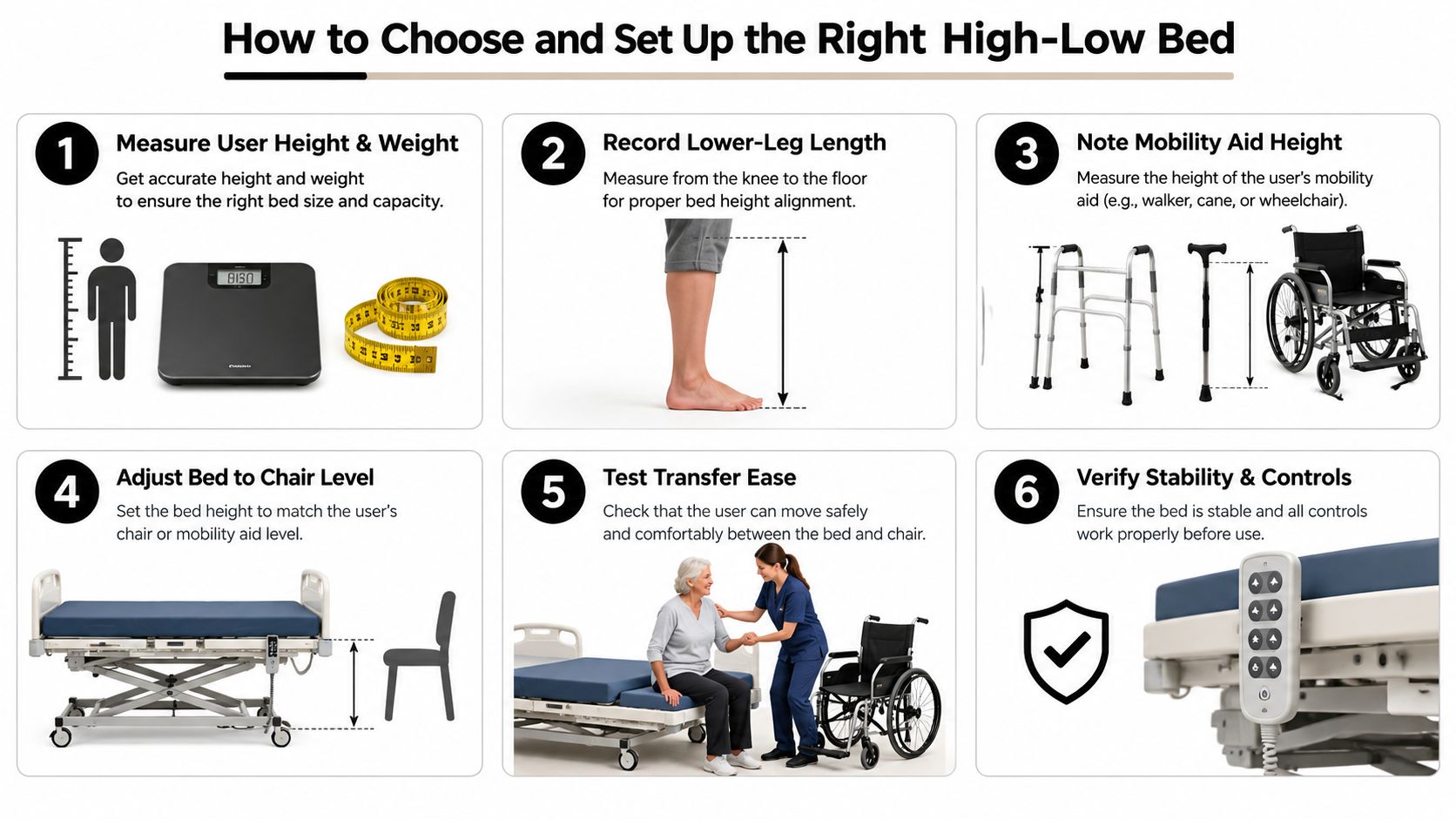
Record the user's height, weight, lower-leg length, and the height of the wheelchair, walker, commode, or other device used during transfers. Lower-leg length helps establish a workable sitting and standing height, while weight and body dimensions guide frame capacity and size.
Measure the room around the bed, including space for transfers and care on the sides and at the foot. Check the doorway for delivery access and consider ceiling clearance if a homecare ceiling lift may be used. A bed that fits the room but blocks the bathroom route is not a safe setup.
The mattress must match the frame's dimensions and attachment system. Don't assess the low setting using the bare deck. The final measurement is from the floor to the top of the installed mattress and any overlay.
Set the two working heights
Set the low position so the user can rest with an appropriate fall-distance plan while retaining a safe way to stand. Set the working position so the caregiver can provide care without prolonged bending or reaching. These settings may differ for independent transfers, assisted transfers, hygiene care, and repositioning.
Then lock the caster system before the user sits, stands, or transfers. Test the bed with the actual wheelchair or commode, because a few inches of mismatch can change whether the user pivots safely or reaches for an unstable surface.
Run the setup before the first night
Perform a dry-run transfer with the user while a second helper observes if the situation is complex. Check whether the user can place both feet, whether the mattress compresses unexpectedly, whether rails obstruct the movement, and whether the caregiver can reach the controls.
Keep the hand control and manual within reach, and make sure the user knows which control changes height. A flashlight can help with nighttime orientation. For delivery planning, a practical medical equipment moving guide from TLC Moving & Storage can help families prepare the route and protect the home during installation.
Pressure care also affects setup. International guidance recommends keeping the head of the bed as flat as clinically feasible and maintaining head-of-bed elevation at 30 degrees or lower when elevation is necessary, while supporting the person to limit sliding and shear. The international pressure-injury clinical practice guidelines should take priority when respiratory or aspiration concerns require a different position.
Buying, Financing, and Getting Started
There are three practical ways to obtain a high low bed. You can buy new from a medical equipment supplier, purchase refurbished equipment from a reputable dealer, or rent for a short post-acute recovery period. Rental can make sense when the need is temporary, while purchase may be more practical when care needs are expected to continue.
Because verified prices vary by model, capacity, mattress, delivery, and setup, don't rely on generic price bands. Ask for an itemized quote that separates the bed, mattress, rails, pressure system, delivery, assembly, and service. A manual frame, semi-electric model, and full-electric bariatric system can represent very different purchases.
| Purchase Option | Typical Price Range | Best For | Insurance Coverage |
|---|---|---|---|
| New manual bed | Varies by supplier and configuration | Basic care with an able caregiver | May depend on medical-necessity rules |
| Refurbished bed | Varies by condition and warranty | Budget-conscious buyers who can verify safety | Often requires supplier and payer review |
| Semi-electric bed | Varies by features and accessories | Short-term recovery or moderate care | May be available when criteria are met |
| Full-electric bed | Varies by capacity and functions | Frequent transfers and long-term care | Subject to plan, documentation, and eligibility |
| Short-term rental | Varies by rental period and delivery | Temporary rehabilitation or hospice use | Depends on the payer and rental arrangement |
Medicare Part B, Medicaid waivers, VA benefits, private payment, HSA or FSA funds, and supplier payment plans may each apply in different circumstances. Coverage usually depends on medical necessity, eligibility, documentation, and the supplier's billing process. A clinician may need to document the person's condition, mobility limitations, and required equipment, while the supplier handles the applicable paperwork and claim submission.
For families comparing payment plans, this overview of consumer retail financing for mattress retailers offers useful general context, but medical-equipment financing and reimbursement terms still need to be confirmed with the supplier and payer.
Use the coming week to complete the setup:
- Measure the room, doorway, transfer path, and outlet location.
- Confirm mattress and accessory compatibility.
- Ask whether the electrical controls have a backup plan.
- Request an in-home assessment when transfers or room layout are complicated.
- Schedule delivery with assembly and setup verification.
- Test the bed with the actual user before signing off on the installation.
DME Superstore offers high low beds and related homecare equipment, including mattresses, transfer aids, mobility products, and caregiver equipment, with product specifications and compatibility information for comparison. Visit DME Superstore to review available options, confirm the setup that fits the user's needs, and speak with support before ordering.
