



A family caregiver usually notices the problem at bedtime. The mattress feels too low, the person can't sit up without help, and the standard adjustable base hesitates when both the sleeper and mattress put pressure on the mechanism. The product page may say “heavy duty,” but that label alone doesn't tell you whether the rating covers the mattress, whether the capacity applies per side, or whether a bed rail will create a dangerous gap.
A heavy duty adjustable bed frame should be treated as durable medical equipment, not as a comfort upgrade. The right choice supports transfers, repositioning, recovery, and safer caregiving. The wrong one can flex, strain its motors, become incompatible with accessories, or create entrapment hazards. This guide focuses on the specifications that deserve scrutiny before you place an order.
Who Needs a Heavy Duty Adjustable Bed Frame
A daughter caring for her father after surgery may need to raise the head of the bed so he can breathe, eat, or get out with less assistance. A spouse with limited mobility may need a stable surface that allows repeated repositioning without forcing a caregiver to lift the entire body. A bariatric user may need more than a comfortable angle. They may need a frame engineered for a substantially higher combined load and more demanding daily transfers.
Standard adjustable bases often suit ordinary sleep and lounging needs. They may fall short when the load is higher, concentrated unevenly, or paired with a dense mattress and caregiver assistance. Structural flex can affect alignment, while an overworked motor may struggle during articulation. Those failures aren't merely inconvenient when the user depends on the bed for safe positioning.

Three common use situations
- Bariatric sleep and transfers: The frame needs a verified load rating, reinforced support, and stable operation when weight isn't perfectly centered.
- Post-surgery recovery: Head and leg articulation can make getting in and out easier, but only when the mattress bends correctly and the frame remains stable.
- Long-term family caregiving: Repeated adjustments, side transfers, rails, handles, and over-bed equipment make compatibility as important as capacity.
The category has moved beyond a niche comfort product. The United States adjustable bed frames market was estimated at USD 1,199.4 million in 2024 and is projected to reach USD 1,614.8 million by 2033, with a projected 3.4% CAGR from 2025 to 2033, according to market guidance summarized by BedPlanet. That broader adoption includes homecare users, couples, and people who need stronger support than a mainstream base provides.
My recommendation: Buy for the hardest realistic use, not the easiest night. If the bed will support a heavy mattress, shared sleeping, regular transfers, or caregiver assistance, demand documentation that addresses all of those conditions.
“Heavy duty” should mean a reinforced mechanical system with a clearly stated capacity and compatible accessories. If the listing uses the phrase but hides the load definition, motor details, or mattress requirements, keep looking.
Understanding Weight Capacity Ratings
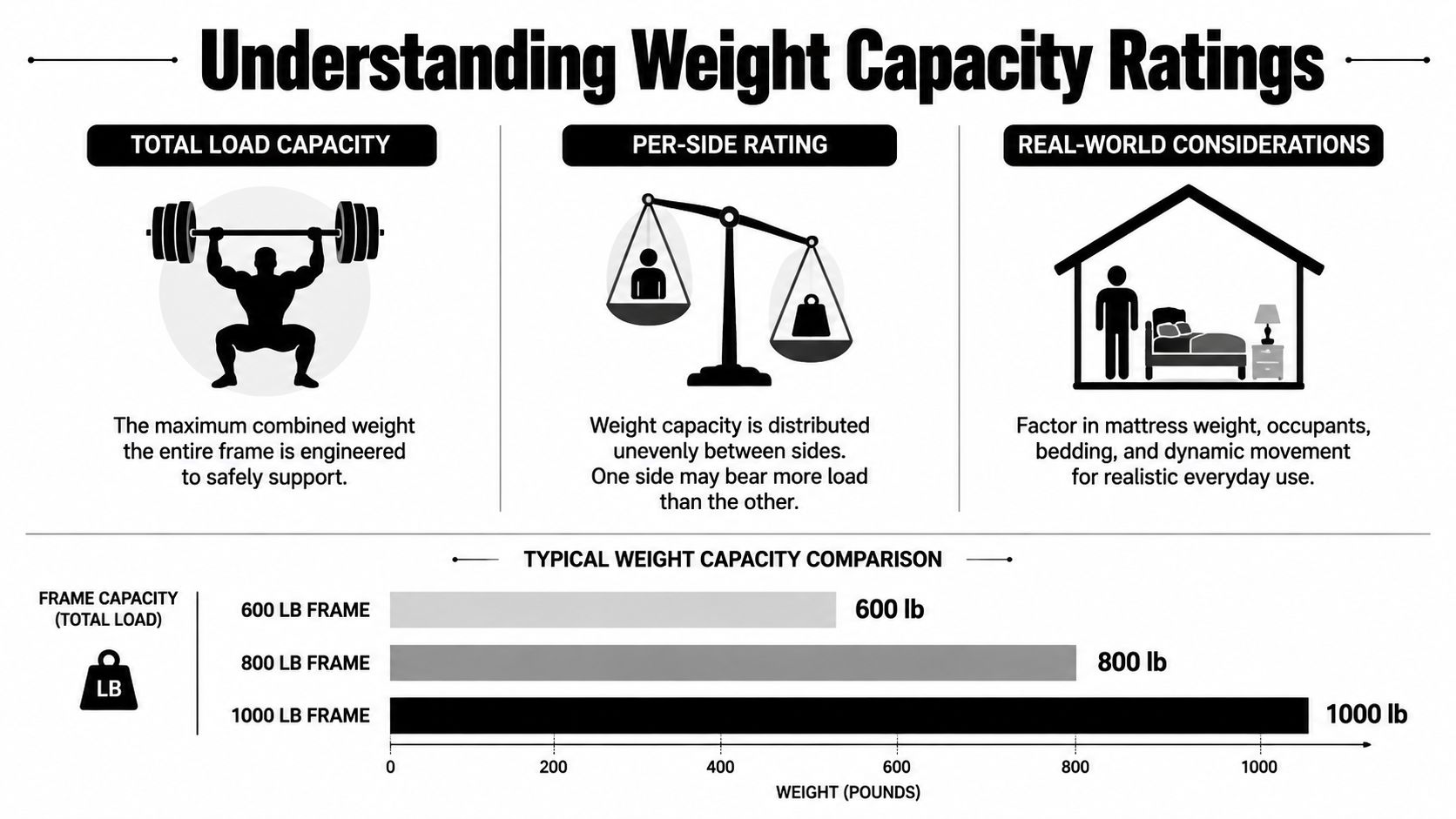
Weight capacity is the first specification to verify, and it's also the one most likely to mislead buyers. Industry guidance describes typical adjustable-bed capacities of 300 to 650 pounds, while heavy-duty versions reach about 850 pounds. Some manufacturer manuals specify maximum loads from 900 to 1,000 pounds, including the mattress and bedding, as documented in this adjustable-bed capacity guide.
The number only helps when you know what it measures. A total-load rating applies to everyone and everything supported by the base. A per-side rating may apply separately to each half of a split configuration. An 850-pound rating per side is not the same purchase decision as an 850-pound total rating. Ask the seller to state the rating in writing and identify whether it applies to one platform, the complete bed, or each side.
Read the fine print, not the headline
Your calculation should include:
- The sleeper or sleepers: Use the actual combined user weight, not an estimate based on an ideal future weight.
- The mattress and bedding: Confirm whether the manufacturer includes them. Some manuals define capacity as the entire supported load, while others make the wording less clear.
- Accessories and assistance: Rails, handles, overlays, and caregiver support can affect the load or the way it is distributed.
- Concentrated pressure: A person sitting at the edge creates a different mechanical demand from someone lying evenly across the surface.
Evenly distributed weight is a design requirement on many products. One manual specifies a 650-pound maximum, including the mattress, and warns that the load must be distributed evenly across the frame. It also states that the head or foot sections aren't designed to support or lift the full load alone. You can review that heavy-duty adjustable-bed manual before comparing similar specifications. Another manual lists a 700-pound total load, including the mattress, and gives the same warning about even distribution and individual platforms, as shown in this adjustable-bed assembly manual.
For medical equipment context, a bariatric hospital bed bundle can list a 750-pound capacity that includes the patient, mattress, rails, and accessories, according to the Invacare BAR750 product description. That wording is the standard you want: explicit, complete, and tied to the actual configuration.
If you also need mobility equipment, compare the bed decision with the user's transfer needs in this guide to bariatric wheelchairs. Don't assume a rating shown in a product title answers the capacity question. Make the seller define the number.
Essential Specs and Features to Evaluate
Capacity gets the initial attention, but the frame's daily performance depends on its complete design. Use the following checklist while reading a product page or speaking with a DME specialist.
Motor and frame construction
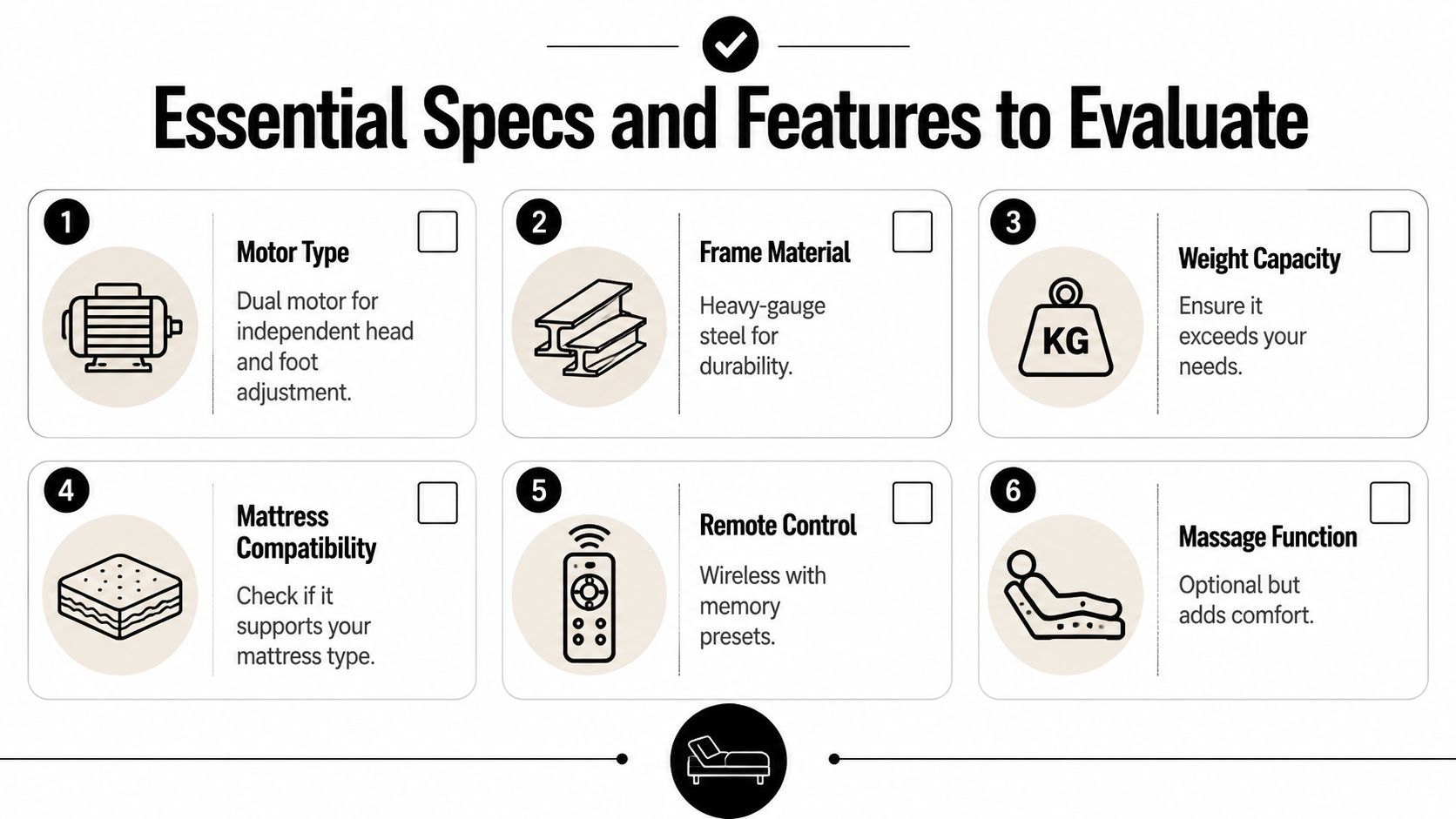
Motor configuration: A dual-motor system can adjust the head and foot sections independently. That matters when a user needs the upper body raised while keeping the legs lower, or when a caregiver wants a repeatable position without manually repositioning pillows.
Reinforced steel: Look for heavy-gauge steel, braced joints, and a platform designed to resist flex. A high capacity with no explanation of the frame construction is an incomplete specification.
Articulation range: Ask for the actual head and foot adjustment range, along with any restrictions for the mattress. The useful question isn't “Does it incline?” but “Can it reach the positions the user needs without binding, sliding, or losing stability?”
Usability features that affect care
Wall-hugging movement: A wall-hugging design keeps the user closer to a nightstand as the bed rises. That can reduce reaching and make call buttons, water, and personal items easier to access.
Programmable remote: Wireless controls with memory presets help users return to familiar sleep, reading, or transfer positions. Large, clearly labeled buttons are preferable when vision, dexterity, or cognition is limited.
Leg height: Adjustable legs affect transfer height and caregiver posture. Check whether the lowest setting allows safe access and whether the raised position works with existing furniture or equipment.
Night lighting and USB placement: Under-bed lighting can help with nighttime orientation. USB ports should sit where the user can reach them without stretching across a moving joint.
Massage: Massage is optional. It shouldn't outrank structural capacity, motor reliability, mattress compatibility, or emergency operation.
A product comparison can help you review frame styles beyond adjustable mechanisms, so explore Futonland bed frames for additional construction and sizing context. For adjustable-bed-specific considerations, consult DME Superstore's guide to electric adjustable beds. Keep the priorities in order. A decorative feature can't compensate for an unclear load rating or a weak accessory interface.
Mattress Compatibility and Accessory Pairing
The mattress is part of the mechanical system. A frame can be structurally strong and still perform poorly if the mattress resists bending, slides during movement, or places excessive stress on the hinge areas.
| Mattress Type | Articulation Flexibility | Typical Weight Range | Best For |
|---|---|---|---|
| Foam | Usually bends readily when designed for adjustable bases | Varies by construction | Users who want predictable articulation and pressure distribution |
| Hybrid | Depends on coil design and foam layers | Varies by construction | Users seeking a balance of contouring and responsive support |
| Innerspring | Often less flexible, especially with rigid edge systems | Varies by construction | Users whose specific mattress is approved for the selected frame |
The table uses qualitative weight descriptions because mattress weight varies by size, materials, density, and construction. Don't buy based on mattress type alone. Verify the exact model's compatibility with the base, including thickness, flexibility, retaining bars, and warranty conditions. A useful outside reference for comparing mattresses that support more weight can supplement, but it can't replace the frame manufacturer's compatibility statement.
Therapy surfaces need their own review
Pressure-redistribution products aren't interchangeable accessories. A hospital guide lists a low-air-loss pressure-redistribution mattress at 500 pounds, another at 350 pounds, and a separate pressure-redistribution therapy surface at 300 pounds, as shown in this hospital mattress and accessory guide. Those limits demonstrate why the therapeutic purpose and load rating must be evaluated together.
Rails and transfer handles deserve the same discipline. Confirm that the accessory is designed for articulating beds, fits the exact frame, and won't interfere with movement. An over-bed table should remain stable through articulation and shouldn't become a transfer obstacle. For hospital-style mattress selection, review this guide to a mattress for hospital use.
Practical rule: Never add a rail, handle, overlay, or therapy surface because it “looks compatible.” Obtain written compatibility information for the exact bed and accessory combination.
Safety Risks Most Buyers Overlook
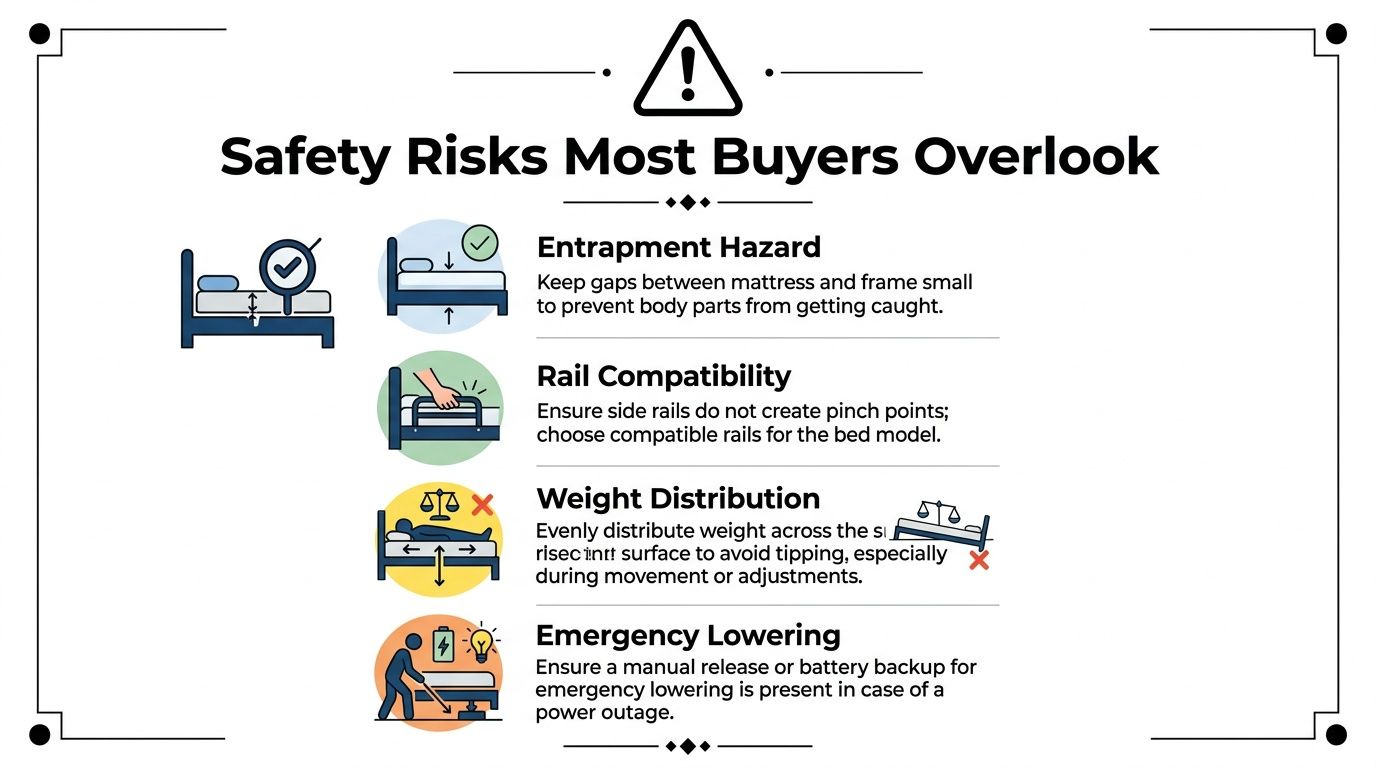
A heavy-duty rating doesn't make an adjustable bed automatically safe. Articulating frames change shape, and every change in geometry can affect the space between the mattress, platform, rails, and nearby equipment. Add-on products can create entrapment points that weren't present in the original configuration.
Safety materials identify seven entrapment zones associated with bed systems. The risk increases when a user is frail, confused, unable to reposition independently, or dependent on others for transfers. Heavy loads can also compress the mattress and alter gap dimensions, so a setup that appears acceptable when empty may behave differently during use.
Treat rails and handles as safety equipment
Some bedside support products are specifically designed for adjustable beds and state compliance with ASTM F3186-17, while addressing all seven entrapment zones, as described for the EZ Click adjustable bed handle. That doesn't mean every product with a similar appearance offers the same protection.
Before installation, check the following:
- Frame fit: Confirm the handle or rail attaches to the intended structural points, not a decorative panel or moving section.
- Gap behavior: Test the bed flat, raised, and lowered. Examine spaces beside the mattress, at the hinge areas, and around the accessory.
- Compression: Repeat the check with the user's actual mattress and bedding. Don't rely on an empty-bed inspection.
- Movement: Operate every articulation function slowly and watch for pinch points, shifting rails, or mattress displacement.
- Emergency lowering: Identify how the bed returns to a safe position during a power interruption and ensure the caregiver can perform the procedure.
For detailed installation concerns, use this guide to bed rail installation. If the user can become trapped, climb over a rail, or slide into a gap, stop using the accessory and seek a professional assessment. Side rails can also increase fall risk when users attempt to exit over them.
Installation and Long-Term Maintenance
Delivery day is part of the purchase decision. A heavy adjustable frame may need clear access through doorways, a suitable outlet, enough floor clearance for movement, and a room layout that leaves caregivers space to work. If the buyer can't safely lift or assemble the equipment, arrange professional delivery rather than treating setup as a weekend furniture project.
DME Superstore explains the practical role of white-glove delivery service, including the value of having equipment brought into position and prepared for use. Confirm exactly what the service includes before scheduling. Delivery into the room isn't always the same as assembly, accessory installation, mattress placement, or removal of existing furniture.
The first-use protocol
After assembly, test the frame before the user relies on it:
- Inspect the base: Check legs, fasteners, cables, retaining hardware, and clearances.
- Test each movement: Raise and lower the head and foot sections separately, then together if the design allows it.
- Listen and observe: Stop for grinding, stalling, unusual vibration, frame shifting, or uneven movement.
- Check loaded behavior: Follow the manufacturer's directions for testing with the approved mattress and normal bedding.
- Verify emergency operation: Locate the manual release, battery backup, or other lowering method described by the manufacturer.
Maintenance should follow the product manual, not a generic schedule. Inspect bolts and connections periodically, keep moving parts free of obstructions, manage remote batteries, and keep cords away from pinch zones. Don't lubricate motors or joints unless the manufacturer specifically permits it. Unapproved lubricant can attract debris or affect warranty coverage.
Contact the seller or manufacturer when the frame sags, develops new noise, stops at inconsistent positions, overheats, or moves unevenly. Document the model, serial information, purchase record, photographs, and a clear description of the problem. Warranty exclusions commonly involve unauthorized modifications, incompatible mattresses, overloaded use, water damage, and accessory installation outside the manufacturer's instructions, so read those terms before making changes.
Payment Options and Smart Questions Before You Buy
A high-capacity bed is a substantial household purchase, but payment convenience shouldn't replace specification review. DME Superstore states that its products are eligible for FSA/HSA spending, subject to the account holder's plan rules and any required documentation. Pre-tax payment can reduce the effective cost when the purchase qualifies, but confirm eligibility with your plan administrator before checkout.
Financing through Affirm may spread the purchase into scheduled payments, with approval and terms determined by the financing provider. Open-box inventory and price-match policies may also change the final price. Compare the complete delivered cost, including the frame, mattress, accessories, delivery, installation, and any return-related charges.
Ask these questions before ordering
- Capacity definition: Is the stated rating total or per side?
- Included load: Does it include the mattress, bedding, rails, handles, and caregiver assistance?
- Distribution: Does the manufacturer require even weight distribution?
- Mattress approval: Is my exact mattress model approved for this base?
- Accessory safety: Which rails and transfer handles are tested for this frame?
- Power failure: What emergency-lowering method is available?
- Returns: Does the return policy cover opened, assembled, or used equipment?
- Warranty: Which components are covered, and what actions void coverage?
- Support: Who handles troubleshooting, replacement parts, and warranty claims?
DME Superstore offers product specifications, compatibility information, warranty details, open-box options, financing through Affirm, a 30-day return policy on most items, and 24/7 chat-based support. Treat those services as risk-management tools, not substitutes for confirming the load calculation. The right answer is a documented answer that matches the user's actual mattress, accessories, and care routine.
Visit DME Superstore to compare adjustable beds, bariatric solutions, mattresses, and transfer accessories with product specifications in view. Use the store's chat support to verify capacity definitions, mattress compatibility, accessory fit, delivery options, and warranty requirements before you commit.

