



A morning appointment may start with a few comfortable steps from the car to the entrance. By the time the appointment ends, the same person may be too tired, unsteady, or sore to walk back. A family caregiver then faces an awkward choice: bring a rollator and hope walking remains manageable, or bring a transport chair that may be unnecessary for most of the outing.
A wheelchair walker combo is designed for that changing situation. It can support walking when the user has enough strength and control, then provide seated transport when a caregiver needs to push. That flexibility can be useful, but only when the person, device, and environment work safely together. A hybrid device isn't automatically safer than separate equipment, and its convenience shouldn't replace a proper fit assessment.
Understanding the Wheelchair Walker Combo
Consider an older adult who walks from the living room to the kitchen with a wheeled walker. Around the house, that support may be enough. During a museum visit or a medical appointment, however, the distance, waiting, and fatigue can make continued walking unrealistic. A caregiver may need to convert the device, help the person sit, and push them for the rest of the trip.
A wheelchair walker combo, sometimes called a rollator transport chair, combines a wheeled walker and a caregiver-propelled transport chair in one folding frame. The two functions are distinct:
- Walker mode: The user stands behind the frame, places controlled weight through the handgrips, advances the device, and operates the brakes.
- Transport mode: The user sits in the chair while a caregiver pushes. The caregiver manages direction, stopping, surfaces, and the user's foot placement.
The seat also creates a common misunderstanding. A rollator seat is generally a place for a stationary rest on a level surface, not proof that the device functions like a full-time wheelchair. Before choosing a model, families can review what a rollator walker is and compare its walking function with the chair function.
Practical rule: If the user needs to propel the chair independently, a typical wheelchair walker combo probably isn't the right category.
A transport chair generally relies on a caregiver because its rear wheels aren't designed for practical self-propulsion. A standard wheelchair may support independent movement with large rear wheels, while a power chair uses a motor and controls. The combo sits between these options. It suits someone who can still stand and walk with support in at least some situations, but who may need assisted seating when endurance, pain, distance, or safety changes.
That distinction matters during transfers. The person must be able to stand, position themselves, follow brake instructions, and maintain enough control to use walker mode. The caregiver must be prepared to switch roles, from allowing supported walking to controlling a seated passenger.
Who Benefits from Combination Mobility Devices
A common real-world pattern looks like this: a person walks from the parking lot into a clinic with decent control, then fades halfway to the elevator, or gets shaky after a long store aisle and needs to sit right away. In those situations, a combo can help, but only if the person and the device work safely together. The question is not just, “Would a two-in-one be convenient?” It is whether the frame, brakes, seat height, and caregiver support match the user's balance, strength, attention, and transfers.
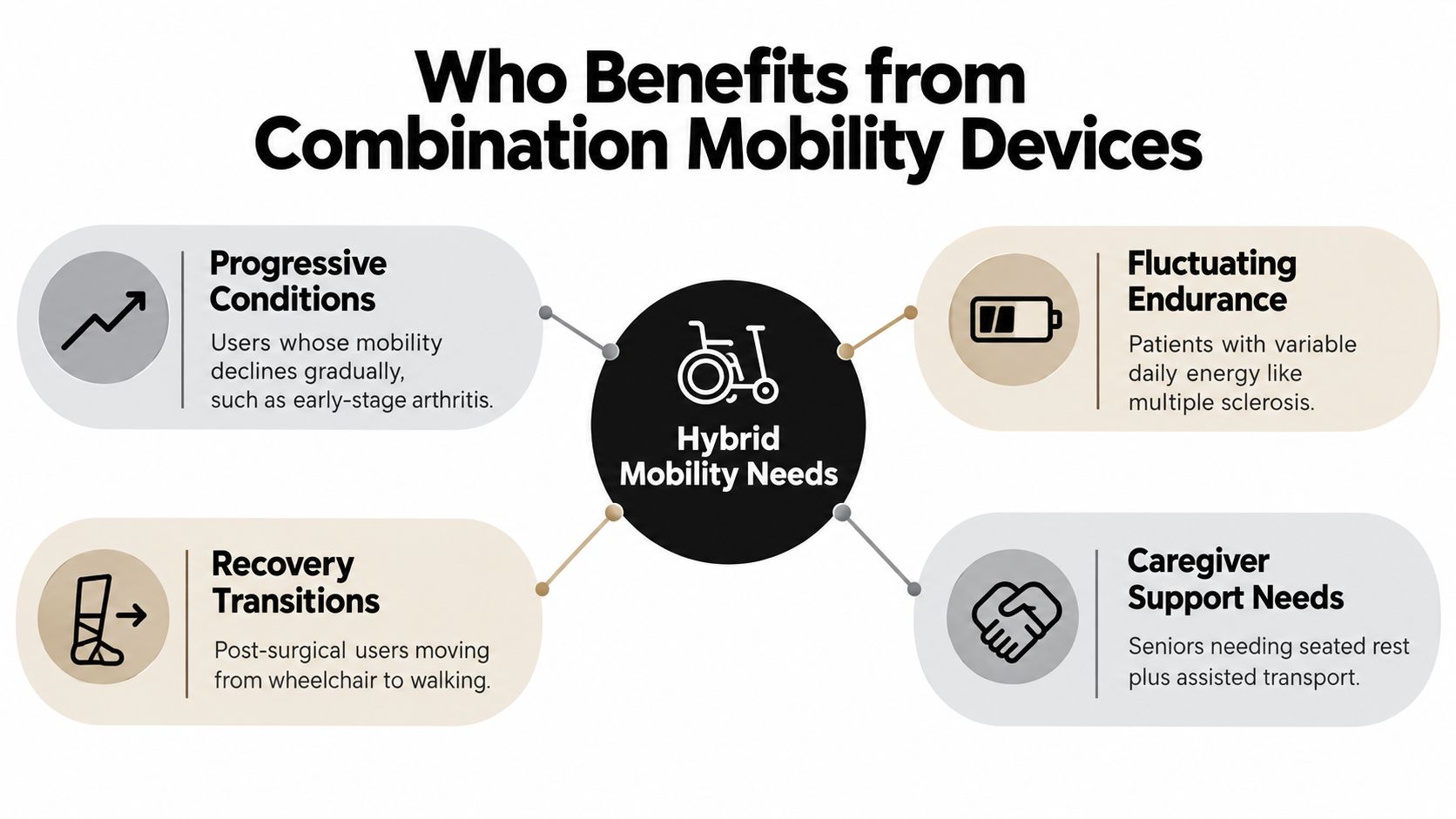
That is why the best candidates are people whose mobility changes within the same day or outing. Someone recovering from surgery may walk short distances as strength returns but need seated transport through a large hospital. A person with variable fatigue may handle part of a shopping trip in walker mode and need a push on the way back. Another user may walk safely at home but want a backup seat at an airport, museum, or outdoor event.
The need is also broader than any single diagnosis. What matters is endurance, balance, transfer ability, braking control, cognition, and expected progression. A caregiver should watch the whole human-device system: Can the user rise from the seat without pulling the frame off line? Can they stay upright while steering? Do they know when the brakes must be locked, and can they follow that sequence every time? Families who are still learning the basics of support for walking should start there before assuming a combo will solve every mobility problem.
Mobility needs change over time
Mobility is rarely fixed. A 2023 study of older adults found that 30.5% changed their mobility-device pattern at least once, and 8.3% used a walker plus wheelchair combination (National Health and Aging Trends Study analysis). That fits what clinicians and caregivers often see. The same person may need one level of support in the morning, another after fatigue sets in, and a different setup in crowded public spaces.
Older federal survey data show how often walking support and seated mobility overlap in the same population. The 1994 National Health Interview Survey on Disability estimated that 7.394 million people used at least one mobility device, including 1.799 million walker users and 1.564 million wheelchair users. Among adults aged 65 and older, 4.544 million used some type of mobility device, including 1.395 million walker users and 863,000 wheelchair users (National Center for Health Statistics data).
Those numbers do not mean all of these users need a hybrid. They do show why combined walking and transport needs come up so often.
Match the device to the person
A combo may work well as a bridge during recovery, a long-term option for fluctuating endurance, or a backup for occasional transport. It is often a poor fit for someone who needs full-time wheelchair seating, independent propulsion, heavy weight-bearing support through the arms, or close postural support.
Communication matters too. A person may walk fairly well in a quiet home and become unsafe in a noisy, crowded setting. Resources on four best practices for inclusive care can help families keep the user involved in choices about equipment, timing, and assistance instead of making decisions around them.
Comparing Combos to Separate Wheelchairs and Rollators
The central trade-off is simple: one device is easier to coordinate, but separate devices can perform each job better. A standard rollator usually focuses on walking support, maneuverability, and a brief rest seat. A dedicated transport chair focuses on seated positioning and caregiver-controlled movement. A combo adds the second function without requiring two frames, but the frame, folding hardware, back support, footrests, and chair components can make it heavier and less specialized.
A dedicated transport chair may offer more supportive seating and smoother movement over bumps when its wheel design is better suited to the route. A standard rollator may feel easier to lift, turn, and advance during active walking. The hybrid becomes attractive when the user switches between modes and storage or transport space is limited.
| Feature | Wheelchair Walker Combo | Standard Rollator | Dedicated Transport Chair |
|---|---|---|---|
| Primary purpose | Supported walking plus caregiver-pushed seating | Supported walking with rest seating | Caregiver-pushed seated mobility |
| User propulsion | Walking in walker mode, not usually self-propelling when seated | User walks behind the frame | Caregiver pushes |
| Seating | Convenient for rest and short transport, depending on design | Usually intended for brief stationary rests | Designed primarily for seated transport |
| Convenience | One folding device for two functions | Simple walking-focused setup | Specialized chair function |
| Main compromise | Added complexity, weight, and possible comfort limits | No dedicated transport function | Requires a separate walking aid |
| Best question to ask | Will the user change modes during the same outing? | Is walking support the main need? | Is seated transport the main need? |
The frame isn't the only issue. Compare seat width, seat depth, back support, footrest position, wheel size, folded bulk, and caregiver handling. A device that fits in a trunk but leaves the user cramped may fail in daily use. A highly comfortable chair that cannot be lifted or stored may also become impractical.
Families should distinguish a transport chair from a standard wheelchair before buying. The differences affect independence, caregiver workload, and route planning, as explained in this comparison of transport wheelchairs and standard wheelchairs.
Choose the equipment that performs the user's most important task safely, not the product with the longest feature list.
Key Features That Dictate Safety and Comfort
A safe wheelchair walker combo is a coupled human-device stability system. The user's posture, hand pressure, brake use, seat position, and movement interact with the frame and wheels. A sturdy-looking frame can't compensate for poor adjustment or a user who can't control the device.
Start with the contact points
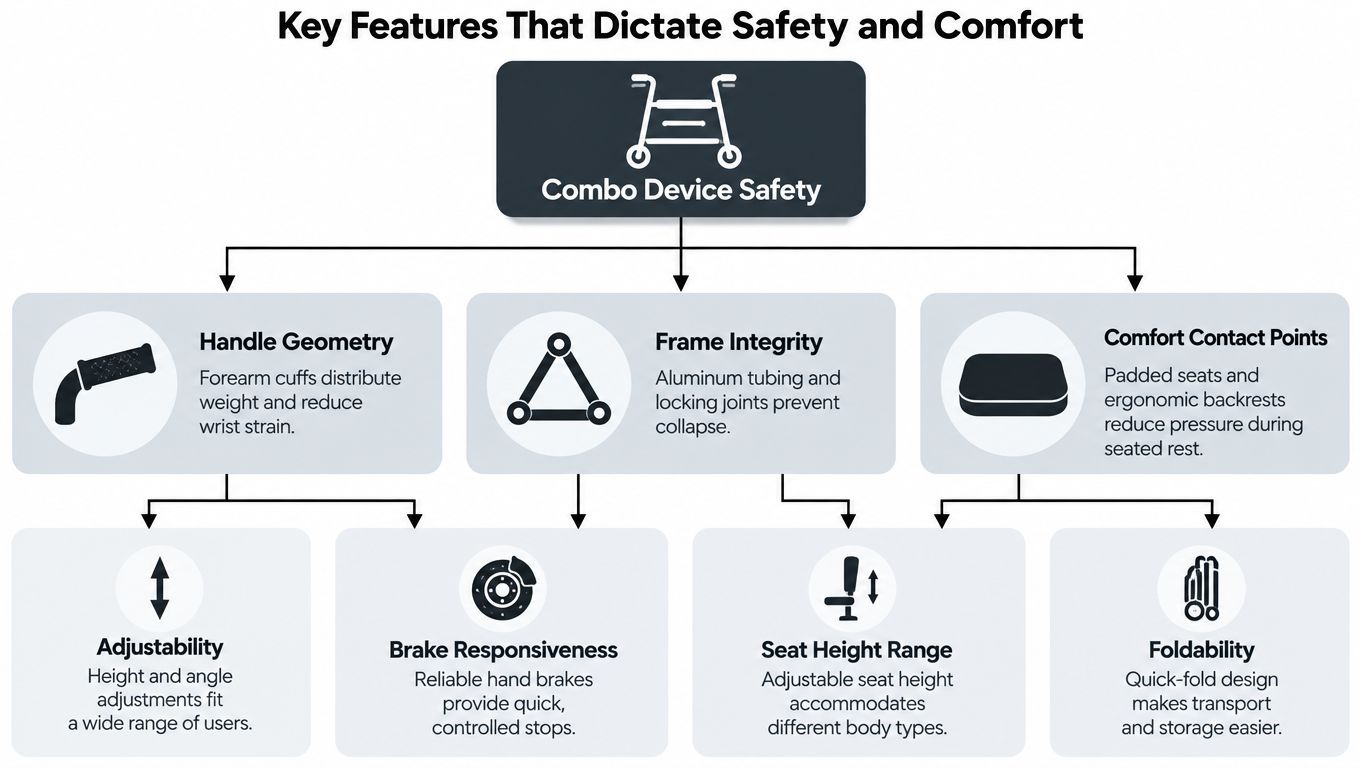
Handle geometry affects how the user loads the device. Controlled studies show that forearm-supported rollators expand walking activity safely for older users by enlarging the contact area and reducing the wrist and grip force needed to maintain an upright trunk position (controlled rollator study). Forearm platforms may help a person with painful wrists, weak hands, or limited grip, but only if the cuffs, handles, and brake controls fit the user.
A conventional handgrip may be appropriate for someone with reliable grip and elbow control. Forearm support may be useful for another person, but it can also make transfers and braking more complicated. The user must still reach the brakes and move safely from walking position to seated position.
Review these features during an in-person trial:
- Handle adjustment: The user should stand upright without leaning heavily forward or shrugging.
- Brake access: The user should reach and squeeze the brakes without losing balance.
- Locking brakes: The parking locks must engage completely before sitting or standing.
- Seat contact: The seat should support the user without forcing the knees or hips into an awkward position.
- Foot support: Transport-mode footrests should allow stable placement without blocking transfers.
Check the frame as a system
Wheel size influences how the device responds to thresholds, cracks, and uneven pavement. Larger wheels may roll more easily over some outdoor surfaces, while smaller wheels can reduce bulk and work well indoors. Frame material and folding joints matter too, because loose hardware, incomplete locks, or damaged tubing can change the device's behavior.
Watch this demonstration before a hands-on trial, then repeat the movements slowly with supervision.
A product's rated capacity is only one part of the decision. The caregiver should consider the user's actual posture, the load through the handgrips, the terrain, and whether the frame remains controllable during turning and stopping. A guide to choosing the right rollator can help organize those checks before comparing specific hybrid designs.
Clinical Red Flags and Safety Mismatches
A two-in-one label doesn't mean universal suitability. The walking mode requires standing balance, reliable steering, controlled hand pressure, and brake operation. The chair mode requires safe sitting, stable posture, caregiver control, and a surface suitable for stopping.
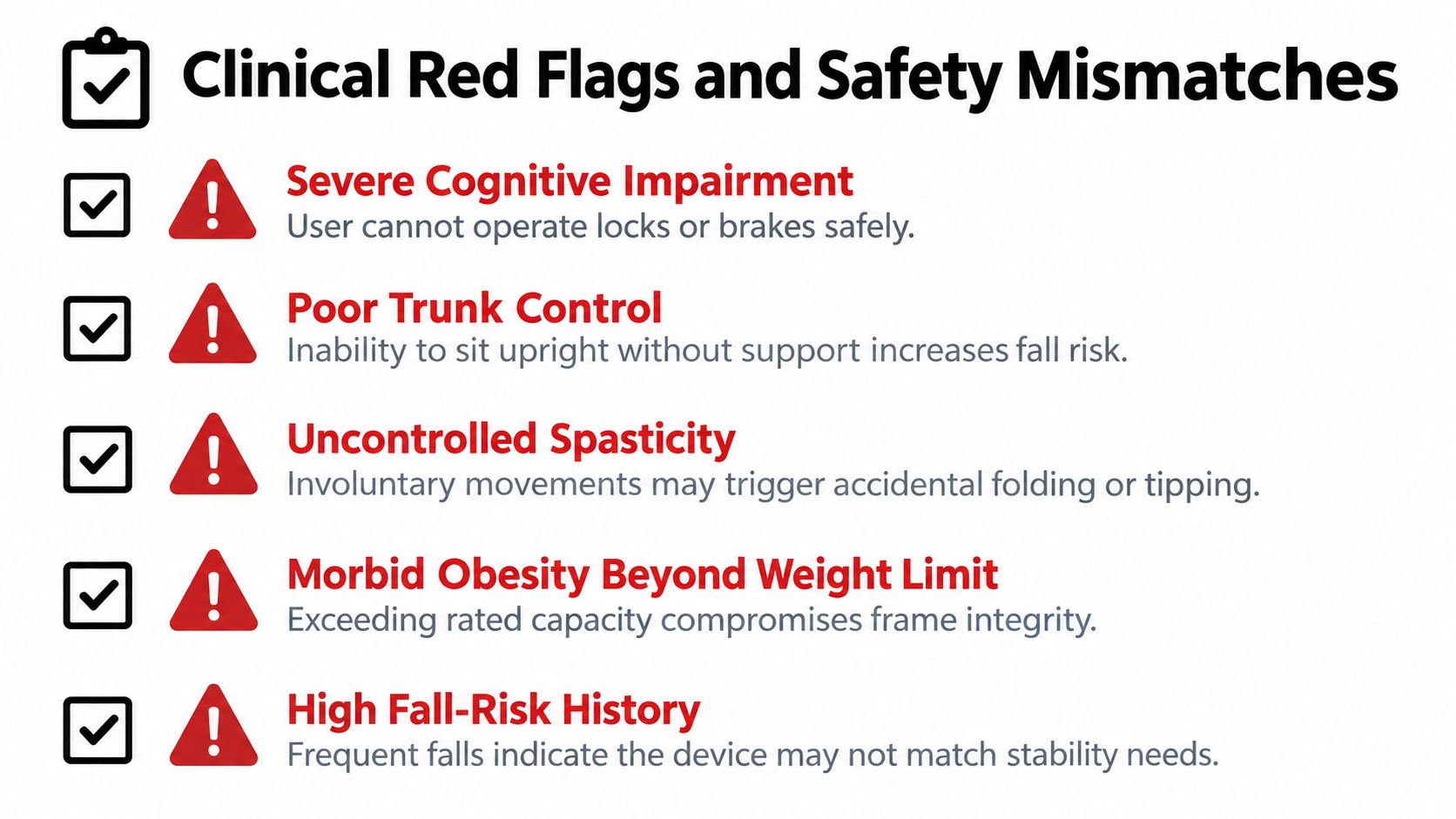
A wheelchair walker combo may be clinically mismatched when the user can't bear weight reliably, doesn't understand the brakes, has severe cognitive impairment, or needs a level of trunk support the device doesn't provide. A person who frequently falls may need a more stable or more closely fitted mobility system rather than a convenient hybrid.
Pause when these signs appear
- Unreliable weight bearing: The user can't remain standing or control the frame in walker mode.
- Poor brake control: The user can't squeeze, release, or lock the brakes consistently.
- Cognitive or communication barriers: The user can't follow instructions for sitting, standing, or mode changes.
- Postural instability: The user can't sit upright safely without support the product doesn't provide.
- Device defects: Wheels, folding joints, brakes, seat attachments, or frame tubing show damage or looseness.
In an analysis of 10,974 emergency-department cases involving defective assistive devices among older adults, 70% of injuries involved walkers, and nearly half of injured patients were admitted to hospital (analysis of defective assistive devices). That finding doesn't mean walkers cause falls. It reinforces the need to match the device to the user and inspect it before use.
Sitting on the walker seat requires the brakes to be locked, the device to be positioned on a level surface, and the user to sit in a controlled way. The caregiver should remain close during early practice and confirm that the frame doesn't roll, twist, or fold unexpectedly. Broader senior home safety tips can help address the surrounding environment, but they can't correct an unsuitable mobility aid.
If a physical or occupational therapist would question the user's ability to control the device, get that assessment before purchasing.
Measuring for the Perfect Fit and Stability
Fit starts with the person, not the product listing. A caregiver can collect useful measurements at home, but a therapist or qualified DME professional should help when balance, posture, pain, or transfers are uncertain.
Measure standing and seated positions
- Set the handle height: Have the user stand upright in their usual shoes with arms relaxed. Adjust the handgrips so the elbows remain slightly bent and the shoulders stay relaxed. If the user hunches forward, reaches down, or lifts the shoulders, the height may be wrong.
- Check the seat height: The user should be able to sit and rise without the seat forcing the knees into an unstable position. Test the transfer with the brakes locked and a caregiver nearby.
- Measure seat width: Allow enough room for comfortable clothing and posture without letting the user slide sideways. Excess width can reduce stability during transport.
- Measure seat depth: The seat should support the thighs without pressing behind the knees. A seat that's too deep may encourage slouching; one that's too short may leave inadequate support.
- Confirm footrest position: In transport mode, the feet should rest securely without dragging, swinging into wheels, or blocking a safe transfer.
The user's weight must remain within the manufacturer's rated capacity, but capacity alone isn't a fit assessment. Consider hip alignment, trunk control, hand strength, and whether the user can operate every control in the position where it will be needed.
Test movement before regular outings
Begin on a level indoor surface. Practice walking in a straight line, stopping, turning, backing up, sitting, standing, folding, and changing modes. Then test the route gradually, with attention to thresholds, doorways, slopes, and surface changes.
Instrumented research found that greater loading of the rollator through properly adjusted handgrips increases the combined stability margin, while lifting all four wheels simultaneously over an obstacle significantly compromises safety (instrumented stability study). The conservative curb rule is simple: don't hop a seated or loaded combo over an obstacle. Keep at least one wheel in contact when stepping up a curb, and ask for assistance when the route exceeds the user's control.
Transport Realities and Purchasing Considerations
A combo has to work beyond the showroom. Before buying, measure the car-trunk opening, storage area, doorway, elevator, and any route where the device will be used. A folded frame may be narrow but still awkward to lift, and removable footrests can reduce the load handled at once while adding parts that must be stored and attached correctly.
Public transit requires separate planning. A 2026 exploratory study of 44 rollator users, with a median age of 85.5, found that devices were used for walking by 100% of participants, transport by 82%, and seating by 75%; 20.5% of devices had observed defects, and 12.7% of participants reported accidents, mainly on public transport (home-environment study). The study described concerns including unsafe buses, low platforms, difficult elevators, bulky designs, folding mechanisms that didn't stay locked, and uncertain front-wheel alignment.
Inspect before every outing
- Check the brakes: Confirm that walking brakes and parking locks engage fully.
- Watch the wheels: Look for wobble, poor alignment, excessive wear, or resistance.
- Test the frame: Verify that folding joints, seat attachments, back supports, and footrests lock correctly.
- Plan the route: Contact transit operators before travel because accessibility rules and vehicle layouts vary.
- Practice loading: The caregiver should rehearse lifting, folding, securing, and unloading without rushing.
Coverage also needs careful verification. CMS defines HCPCS code E0150 as a folding combination device that integrates a standard wheeled walker with a seat and a transport chair (CMS article on E0150). CMS policy states that E0150 is noncovered for dates of service from October 1, 2025 through September 30, 2026, because CMS determined it didn't meet the durable medical equipment definition during that period. Beginning October 1, 2026, CMS determined that it meets the DME definition. Coverage still depends on benefit-category, medical-necessity, statutory, and regulatory requirements, so confirm the current rule and supplier documentation before ordering.
DME Superstore offers manual mobility aids and hybrid products alongside power mobility equipment, with product pages that provide specifications and compatibility information. Families comparing a manual combo with a powered option can also review portable electric wheelchair options for adults, but a powered chair isn't a substitute for assessing whether the user can safely stand and control a walker.
DME Superstore offers rollators, wheelchairs, hybrid mobility products, and related durable medical equipment with specifications that help caregivers compare fit, capacity, and intended use. Visit DME Superstore to review mobility options and contact the team before choosing a wheelchair walker combo for your family's daily routes.
