



When deciding between a transport wheelchair and a standard wheelchair, the choice ultimately comes down to a fundamental question: who will be propelling the chair?
A transport wheelchair is specifically designed to be pushed by a caregiver, prioritizing lightness and portability. In contrast, a standard wheelchair empowers the user to propel themselves, offering greater independence. Your decision will depend on the user's physical capabilities, level of independence, and the environments where the chair will be used.
Choosing Your Ideal Mobility Aid
Selecting the right wheelchair is a significant decision that directly impacts daily life, freedom, and comfort for both the user and their caregiver. This choice is not merely about transportation; it's about finding a tool that seamlessly integrates with a person's lifestyle, physical needs, and surroundings.
A transport wheelchair serves as a lightweight, portable solution, ideal for travel and short outings. A standard wheelchair, however, is engineered to provide greater autonomy for individuals who can and wish to move independently. The first step is to understand their core design differences, as each is built with a specific purpose in mind.
Transport vs. Standard Wheelchair: At a Glance
For a quick overview, this table highlights the key distinctions between the two types of wheelchairs, helping you see which one aligns best with your needs.
| Feature | Transport Wheelchair | Standard Wheelchair |
|---|---|---|
| Primary Propulsion | Pushed by a caregiver or companion | Self-propelled by the user |
| Rear Wheels | Small (8"-12"), no hand rims | Large (20"-26"), with hand rims |
| Average Weight | Lighter (15-25 lbs) | Heavier (30-45+ lbs) |
| Primary Use Case | Travel, appointments, short-term use | Everyday independent living |
| Portability | Folds compactly for easy car transport | Folds well, but is generally bulkier |
This comparison clarifies how each chair is designed for a distinct role—one for assisted mobility and caregiver convenience, the other for user independence and daily use.
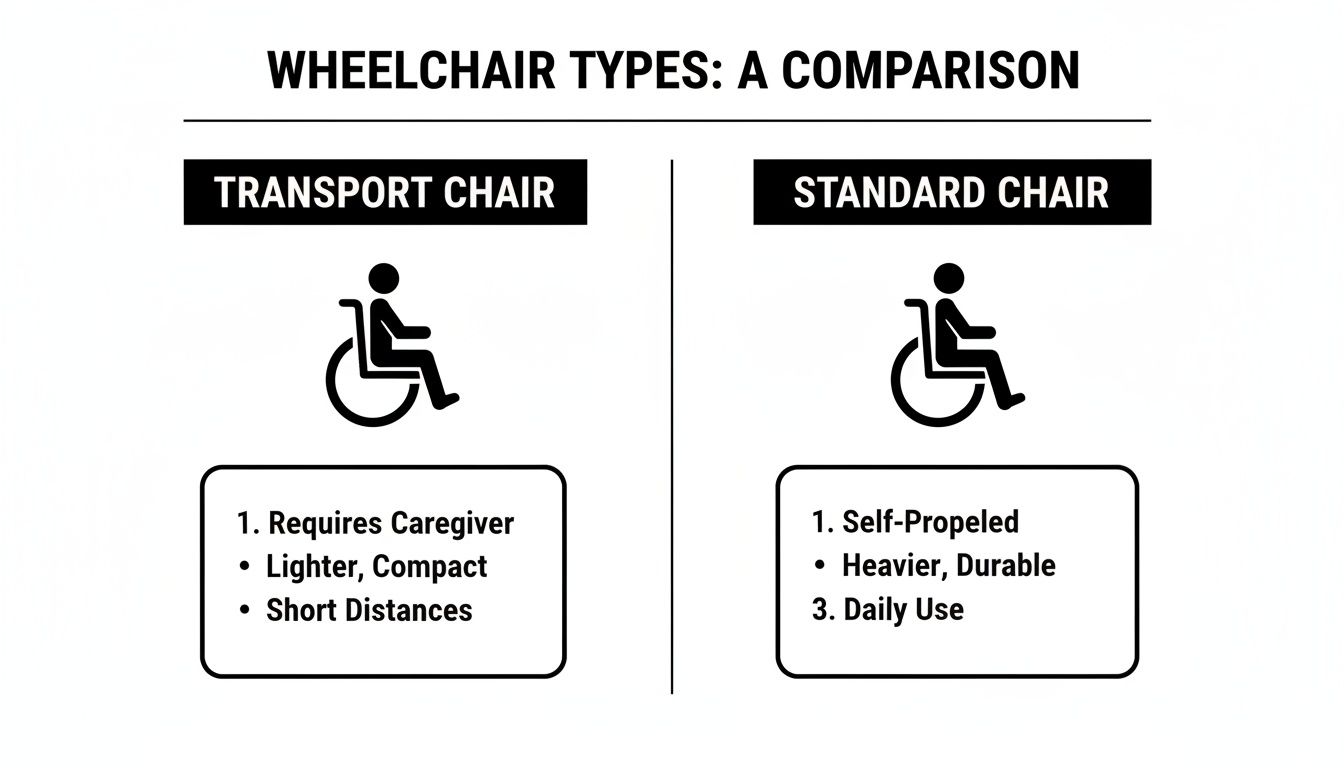
As the image illustrates, the design of each chair is purpose-built. It is either optimized for a caregiver's convenience or engineered to empower the user's independence.
The most critical factor in your decision is the user's upper-body strength and their desire for autonomy. If self-propulsion is the goal, a standard wheelchair is the most suitable choice. If a caregiver will always be present, a transport chair’s portability offers significant advantages.
For a more comprehensive look at all the factors involved, our full guide on how to choose a wheelchair is an excellent resource. It will walk you through everything you need to consider before making a final decision.
What Is a Transport Wheelchair?
At its core, a transport wheelchair is designed for a single primary function: to be pushed by a caregiver. It is a mobility tool centered around the concept of assistance. Unlike a standard wheelchair, a user cannot propel themselves, and this fundamental difference dictates every aspect of its design, from its wheels to its push handles.
The most noticeable feature is the wheel size. A transport chair has four small wheels, typically between 8 and 12 inches in diameter. The large rear wheels with hand rims are absent, which is central to its design. This small-wheel configuration makes the chair significantly lighter and more compact.
Designed for Portability and Assistance
Because they lack heavy, large-diameter wheels, transport chairs are considerably lighter than standard models, with most weighing between 15 and 25 pounds. For a caregiver, this means folding the chair and lifting it into a car trunk is a manageable task, not a strenuous effort. This is a major benefit for anyone making frequent trips.
The focus on assisted mobility is also evident in the safety features. The brakes are designed for the caregiver, not the user. You will find attendant-operated brakes on the push handles, allowing the person pushing to control the speed or lock the wheels securely without having to bend down. This gives the caregiver complete control, which is crucial when navigating ramps or busy sidewalks.
The true value of a transport wheelchair is measured by how much easier it makes life for the caregiver. Its lightweight frame and simple folding mechanism are engineered to reduce the physical strain of attending appointments or social visits.
When Does a Transport Chair Make the Most Sense?
A transport wheelchair excels in specific scenarios. It is not intended as a full-time, primary wheelchair but rather as a convenient tool for getting from one place to another with assistance.
Consider these common situations where it is the ideal choice:
- Medical Appointments: Simplifies movement from the parking lot, through clinic doors, and down long hallways.
- Travel: It is a perfect companion for airports, cruise ships, or any vacation where space is limited. It folds down compactly and is easy to transport.
- Post-Surgery Recovery: Provides a safe way for someone temporarily unable to walk or propel themselves to move around with support.
- Navigating Tight Spaces: The smaller frame and wheels make maneuvering through narrow doorways and cramped hallways at home much easier.
For anyone with limited upper-body strength, someone recovering from an injury, or any user who will always have a companion to assist them, a transport chair is an incredibly practical choice. To see a great example of a model built for this purpose, check out the NOVA Medical Lightweight Transport Chair. It perfectly demonstrates the balance of user comfort and caregiver convenience that defines this category.
What Is a Standard Wheelchair?
While a transport wheelchair is designed for assistance, the standard wheelchair is built from the ground up for independence. It is the chair for someone who has the upper-body strength and desire to navigate their world on their own terms.
The most prominent feature is the large rear wheels, typically 20 to 26 inches in diameter, which are equipped with push rims. These rims allow the user to grip and propel the chair forward, backward, and make precise turns. This design is robust enough to handle various terrains, from indoor floors and sidewalks to grassy parks and uneven pavement.
Built for Daily Independence and Durability
A standard wheelchair should be viewed less as a temporary aid and more as a reliable daily tool. Its frame is noticeably more robust than a transport chair's because it is built to withstand the rigors of everyday life. This adds weight—most models weigh between 30 and 45 pounds—but that is the trade-off for a durable, long-term mobility solution.
This sturdiness makes it suitable for a wide range of activities, whether you're running errands, attending community events, or simply moving around your home. The user is in control, making all decisions about where to go and when, without needing a caregiver for every movement. It fosters a powerful sense of self-reliance.
At its core, a standard wheelchair is about restoring personal freedom. For anyone who can self-propel, it is the key to staying active, independent, and engaged with the world on their own schedule.
Who Benefits Most from a Standard Wheelchair?
The ideal user for a standard wheelchair is anyone who wants to take an active role in their own mobility. It is an excellent match for individuals who:
- Have the upper-body strength and coordination to propel themselves.
- Need a primary wheelchair for daily, long-term use both inside and outside the home.
- Value the independence to navigate their community without constant assistance.
- Require a versatile chair that can handle different types of terrain.
While it is heavier and less compact than a transport chair, its design prioritizes user empowerment above all else. For a great example of a model that balances durability with practical features, take a look at the ProBasics Standard K2 Wheelchair. Ultimately, the transport wheelchair vs. standard wheelchair debate always comes back to one thing: assisted convenience versus personal independence.
When comparing a transport wheelchair to a standard one, you quickly realize it’s not just about technical specifications. The design of each chair has a profound impact on the user's freedom, comfort, and daily life. Let's examine the design elements that truly matter.
Weight and Portability
The first thing any caregiver will notice is the weight. A typical transport wheelchair weighs a manageable 15 to 25 pounds. This makes it easy to fold, lift, and place into the trunk of a car. Its lightweight frame is intentionally designed for the convenience of the person pushing it.
On the other hand, a standard wheelchair is built for long-term use, prioritizing durability and user independence, which naturally adds weight. These models typically weigh between 30 and 45 pounds, sometimes more. While they are still foldable, the extra weight can be a significant challenge for a caregiver who has to lift it frequently.
This weight difference is a major factor in the wheelchair market. In a global market valued at around $6.25 billion in 2026, manual wheelchairs are dominant, holding a 62% market share. Because transport chairs can be 25–40 lbs lighter than standard self-propelled models, they make car travel possible for the 55.5% of adult users who rely on it. This highlights how crucial transport wheelchairs are for accessible, caregiver-assisted mobility. You can explore these trends in the full industry analysis from Fortune Business Insights.
Wheel Design and Propulsion
The wheels reveal the fundamental difference in philosophy between these two chairs. One is designed for pushing, and the other is built for self-propulsion.
-
Transport Wheelchairs: Feature four small, caster-style wheels, typically 8 to 12 inches in diameter. They are designed to be pushed from behind and are excellent for navigating tight indoor spaces like narrow hallways or doctor's offices. However, their small size makes them less suitable for bumpy sidewalks or grassy areas.
-
Standard Wheelchairs: The iconic feature is the pair of large rear wheels, usually 20 to 26 inches in diameter, with built-in push rims. This design gives the user the power to move themselves, offering an incredible sense of autonomy. These larger wheels can easily handle sidewalk cracks, grass, and other uneven surfaces, providing a much smoother and more capable outdoor ride.
A transport chair’s small wheels are perfect for nimble, indoor navigation when a caregiver is in control. A standard chair’s large wheels are engineered for empowerment, giving the user the independence to tackle various environments.
Braking Systems and Safety
Safety is non-negotiable, and the brakes on each chair are designed for the person in control—either the caregiver or the user. A reliable braking system is your first line of defense against unwanted movement, especially on ramps or during transfers.
A standard wheelchair typically has wheel locks located near the front of the large rear wheels. The user can easily reach down and engage them before standing up or transferring, ensuring the chair remains stationary. This gives the user direct control over their stability.
Transport wheelchairs, in contrast, place the brakes in the caregiver's hands. Most models feature attendant-operated brakes on the push handles, which function like bicycle brakes. This allows the person pushing to manage speed on inclines and lock the wheels securely without bending over—a significant advantage for both convenience and safety.
Comfort and Customization Options
Comfort is critical for preventing pressure sores and ensuring the user can sit for extended periods without pain. While both types of chairs offer basic comfort, their potential for customization is vastly different.
Transport chairs are built for short trips, so their comfort features are generally more basic. You will find standard nylon or vinyl upholstery and perhaps padded armrests. While footrests are included, they often have limited adjustability.
Standard wheelchairs are meant for all-day, everyday use, which is reflected in their wide array of customization options. These can include:
- Seating: A wide selection of pressure-relief cushions and contoured backrests for tailored support.
- Armrests: Many models offer height-adjustable or flip-back armrests, which make transferring from the side much easier.
- Footrests: Elevating leg rests are a common and crucial option for anyone needing to keep a leg raised due to an injury or medical condition.
The ability to precisely tailor the fit of a standard wheelchair to a user's specific body and medical needs is one of its greatest advantages. This level of personalization is a key reason to choose it over a transport chair for long-term use.
Putting It All Together: Choosing Your Wheelchair in the Real World
Understanding the technical specifications is one thing, but the true test is how a wheelchair fits into your life. The best choice always comes down to the situations you face every day. Let's walk through some common scenarios to see where each chair proves its worth.
By picturing how you will actually use the chair, you can move past the feature lists and make a decision that genuinely supports you and your caregivers.
Scenario 1: The Frequent Traveler
Imagine you are constantly on the go, whether it's road trips to see family or flights for a vacation. Your biggest hurdles are airports, hotel rooms, and unfamiliar places. Here, portability is essential.
For travelers, the transport wheelchair is the clear winner. Its lightweight frame is easy for a caregiver to place in a car trunk or hand off to airline staff. It folds compactly to fit in a hotel closet or the corner of a cruise ship cabin. Its smaller wheels are perfect for gliding across smooth airport terminals and navigating tight spaces.
A standard wheelchair, on the other hand, can be cumbersome for travel. Its heavier frame makes loading and unloading a strain, and its bulkier size takes up valuable cargo space. For anyone who travels often, the convenience of a transport chair removes a significant amount of stress.
Scenario 2: Daily Life at Home
Now, picture someone living at home who wants to remain as independent as possible. The goal is to move freely around the house, get the mail, or run errands in the neighborhood without needing constant assistance.
This is where the standard wheelchair excels. The large rear wheels are designed for self-propulsion and user control. You can move from the living room to the kitchen, answer the door, and manage daily routines on your own terms. This sense of autonomy is incredibly important for maintaining quality of life.
The ability to self-propel is the heart of independence. For everyday living at home, a standard wheelchair offers a level of freedom a transport chair simply can't match.
In this scenario, a transport wheelchair would feel restrictive, tethering the user to a caregiver for every move and creating a feeling of dependence that the standard chair is specifically designed to overcome.
Scenario 3: Post-Surgery Recovery and Short-Term Use
Consider someone facing a temporary mobility issue, such as recovering from knee surgery. For a few weeks or months, they need a safe way to get to doctor's appointments and move around the house but lack the strength to propel themselves.
The transport wheelchair is the perfect fit here. It is a safe, straightforward solution for short-term, caregiver-assisted mobility without the expense or complexity of a standard chair. Its primary job is to get someone from Point A to Point B with minimal effort for everyone involved.
This need is growing globally. In Europe, where the wheelchair market is expected to reach $1.795 billion by 2029, an aging population is driving demand for transport chairs. They are proven to reduce caregiver injury risk by 25% during transfers and can cut transport times by 40% compared to standard chairs. You can find more data in this thorough wheelchair market analysis.
Scenario 4: Life in a Community Living Facility
Finally, consider the environment of an assisted living or residential care community. Residents have a wide range of needs. Some are completely independent, while others rely on staff and family for outings and appointments. It’s a setting where both chairs have a vital role.
-
Standard Wheelchairs are ideal for residents who can still self-propel. They empower individuals to go to the dining hall, join activities, and visit neighbors on their own schedule, preserving a crucial sense of independence within the community.
-
Transport Wheelchairs are the go-to tool for staff and family. They are used for taking residents to medical appointments, group outings, or even for a walk around the gardens when someone is unable to push themselves.
In a community setting, the choice is often not one or the other but about having the right tool for the right job. A facility will likely have a fleet of transport chairs for assisted trips, while a resident might own a standard wheelchair for personal, independent use.
Making the Right Choice: Your Wheelchair Buying Guide
You've learned the differences between a transport and a standard wheelchair. Now it's time to make the final decision. This is about choosing a tool that will deliver long-term value and support. A few key questions will point you to the best chair for your situation.
Think of this as your buyer’s checklist. Answering these questions before you start browsing specific models will provide significant clarity.
Your Buyer’s Checklist
Your answers will serve as your personal roadmap. Be honest about your daily reality.
- Who is in control? This is the most important question. Will the user be propelling themselves most of the time? If so, you need a standard wheelchair. If a caregiver will always be pushing, a transport chair is the more practical option.
- Where will it be used most? Consider the primary environments. Is it for moving around the house on smooth floors? For frequent car trips that require folding and lifting? Or will it need to handle outdoor terrain like sidewalks, grass, and uneven pavement?
- What are the user’s measurements? A proper fit is essential for both comfort and safety. You will need to measure the user's hip width (adding 1-2 inches for the seat width) and consider their height and weight to ensure the chair is a stable, supportive match.
A wheelchair that fits correctly is safer and more comfortable. A chair that is too wide, too narrow, or does not provide the right support can lead to poor posture, painful pressure sores, and instability during transfers.
Navigating the Purchase
Once you know which type of chair you need, the next step is considering the financials. One of the biggest reasons manual and transport wheelchairs make up 62-80.5% of the market is their affordability.
Transport chairs often fall in the $100–$200 range, while standard models are typically between $200–$400. This accessibility is crucial for the 80 million people worldwide who rely on a wheelchair for mobility. You can learn more about wheelchair accessibility and costs to see the full global picture.
At DME Superstore, we aim to make this process as simple as possible. All of our products are eligible for FSA/HSA (Flexible Spending Account/Health Savings Account) funds, allowing you to use your pre-tax dollars for the purchase. We also partner with Affirm to offer flexible payment plans, so you can break the cost into manageable monthly payments.
We also provide free nationwide shipping on every order, so the chair you choose is delivered right to your door without any surprise fees. It's all part of ensuring you can confidently invest in your mobility.
Frequently Asked Questions
Choosing between a transport chair and a standard wheelchair often comes down to a few key questions. Here are answers to the most common inquiries we receive from customers.
Can I propel a transport wheelchair myself?
No, you cannot. Transport wheelchairs are designed only to be pushed by a caregiver or companion. The small rear wheels do not have the large push rims needed for self-propulsion. If independence and the ability to move on your own is a priority, a standard wheelchair is the only suitable option.
Which wheelchair is better for travel?
For almost any kind of travel—flying, cruising, or road trips—the transport wheelchair is the clear winner. Its primary advantages are its lighter weight and more compact, foldable design. A companion will find it much easier to lift the chair into a trunk, navigate a crowded airport, or store it in a tight space.
The core trade-off is simple: a transport chair prioritizes caregiver convenience and portability, while a standard chair prioritizes user independence and all-terrain capability.
Are heavy-duty options available for both types?
Yes, absolutely. Both transport and standard wheelchairs are available in bariatric or heavy-duty models. These chairs are constructed with reinforced frames, wider seats, and more durable components to safely accommodate higher weight capacities. Regardless of your size, there is a secure and reliable option designed for you.
How do I determine the correct seat width?
Getting the seat width right is critical. An improper fit can be uncomfortable and may lead to poor posture and pressure sores over time. To measure correctly, have the user sit on a flat surface and measure the widest point across their hips or thighs. Then, add one to two inches to that measurement. This extra space ensures a fit that is snug and supportive without being too tight.
At DME Superstore, our goal is to empower you with the knowledge to select the perfect mobility aid for your life. Feel free to explore our full range of transport and standard wheelchairs to find a solution that delivers freedom, comfort, and peace of mind.

