



It's 2 a.m. and your spouse is sitting on the edge of the bed, feet planted, rocking forward for momentum that won't come. You step in to lift under one arm, and your back protests before they're even standing. That moment, repeated night after night, is usually when families start looking for a different kind of help.
An electric bed riser won't solve every transfer problem by itself. What it can do is change the starting height, and that small change often decides whether standing up feels manageable or frightening.
Why People Consider an Electric Bed Riser
People don't shop for this device because they want a taller bed for storage. They shop because a parent can't push up from a low mattress after hip surgery, or because a caregiver is bending too far during dressing and repositioning. The bed hasn't changed. The person using it has.
What the device actually does
An electric bed riser is a powered lifting system that raises the whole bed frame up and down. That's different from an adjustable bed that bends the head and foot sections while the frame stays at one height. If you're comparing those comfort features, resources like the Indian River Furniture adjustable base explain articulation well, but a riser solves a separate problem, which is transfer height.
Adjusting a bed is similar to adjusting a chair before you sit. A chair that's too low makes you drop the last few inches and struggle to rise. A chair that's too high leaves your feet dangling. A bed works the same way, except you're doing it half asleep, sometimes with a walker waiting nearby.
Research points to why fit matters more than a single ideal number. In a CDC-indexed laboratory study of 24 healthy adults, medium bed heights of roughly 20 to 26 inches produced the lowest difficulty scores, the highest stability ratings, and vertical ground-reaction forces below 1,000 newtons.
A riser isn't a one-size upgrade. It's a way to match the bed to the legs, strength, and balance of the person who has to get out of it.
That distinction shapes everything that follows. Height is a personal measurement, not a prize for going higher. For broader context on lighting, pathways, and nighttime hazards around the bed, see this guide to bedroom safety for older adults at home. This article stays focused on whole-frame height, not wedges, toppers, or pillows.
Types of Electric Bed Risers and How They Differ
Shoppers usually meet three categories, and the names sound more alike than the products are. Sorting your own bed into the right category first prevents the most common ordering mistake.
The comparison below shows the three forms side by side.
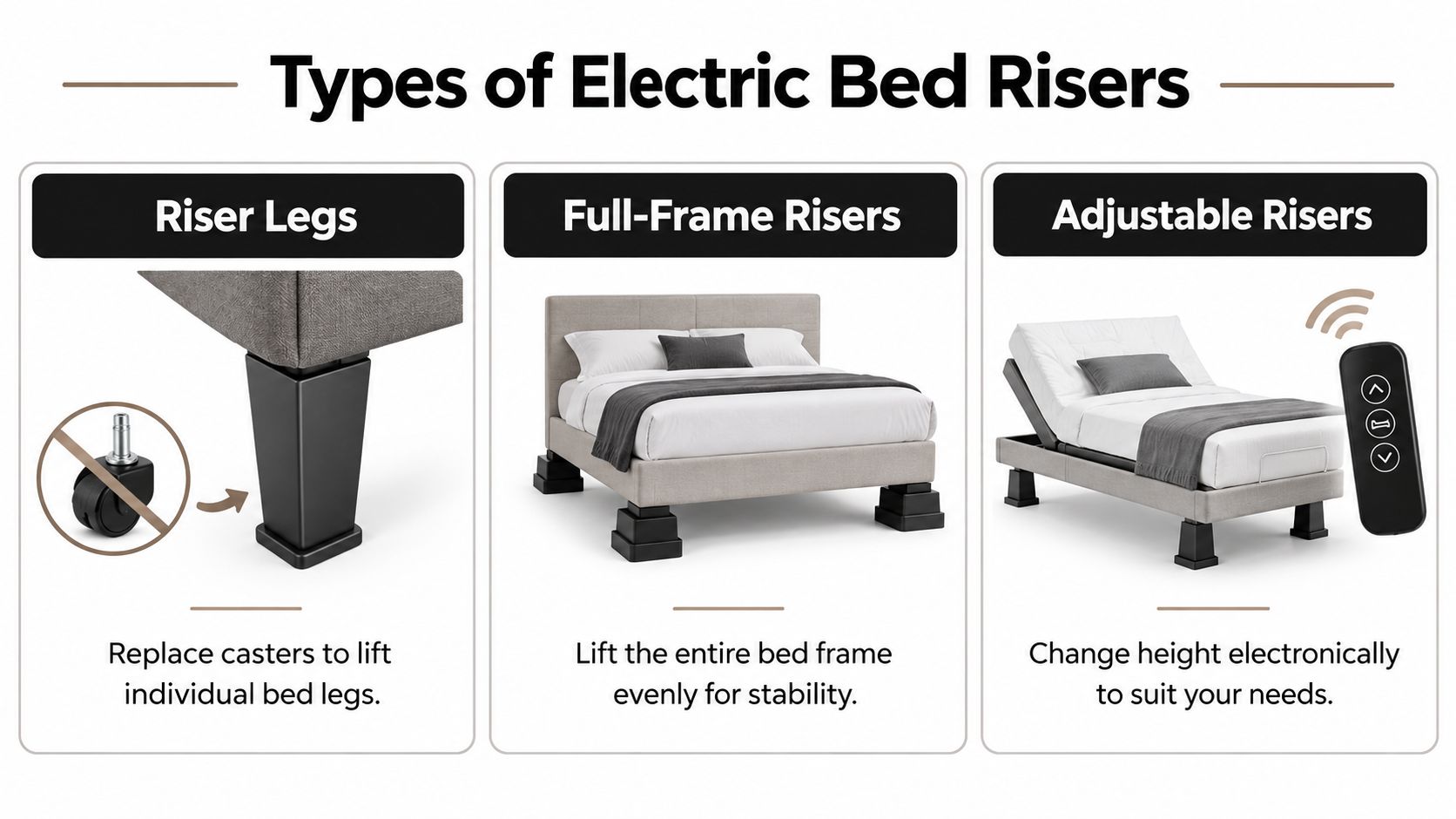
The three categories you'll see
- Riser legs: Powered or fixed supports that replace casters or existing legs and lift each corner. They suit simple frames but depend heavily on leg strength and even loading.
- Full-frame riser bases: A platform or scissor-style base that sits under the entire frame and lifts it evenly. This usually feels steadier because the load path is shared.
- Height modules for adjustable beds: Systems built to work under or within an existing adjustable or electric bed, so articulation and height change can coexist when the manufacturer allows it.
Compatibility signals matter more than marketing photos. Check whether your headboard and footboard attach to the frame or stand separately, whether the foundation moves with the bed, and whether casters are load-bearing. If you're still deciding between frame styles, it helps to compare adjustable bed frame options before adding a lifting layer underneath.
Electric bed riser types at a glance
| Type | Best for | Key tradeoff |
|---|---|---|
| Riser legs | Light, simple frames | Less forgiving of uneven floors |
| Full-frame risers | Stability and even lifting | Larger footprint under the bed |
| Adjustable-bed modules | Existing powered beds | Manufacturer approval is essential |
That push toward adjustability has a history. A randomized trial of 10,937 patients across 18 hospital wards found no significant reduction in bedroom falls for low-low beds, with bedroom falls and falls with injury slightly higher in the low-bed units. Fixed low isn't automatically safest, which is why purpose-built high-low beds that change height on demand exist alongside add-on risers.
Safe Working Load, Duty Cycle, and Other Numbers That Matter
Spec sheets look intimidating until you translate them into household terms. Think of a warehouse shelf. The rating on the shelf isn't just for the boxes you plan to store today. It's for everything that will ever sit on it, all at once.
These four specifications deserve your attention first.
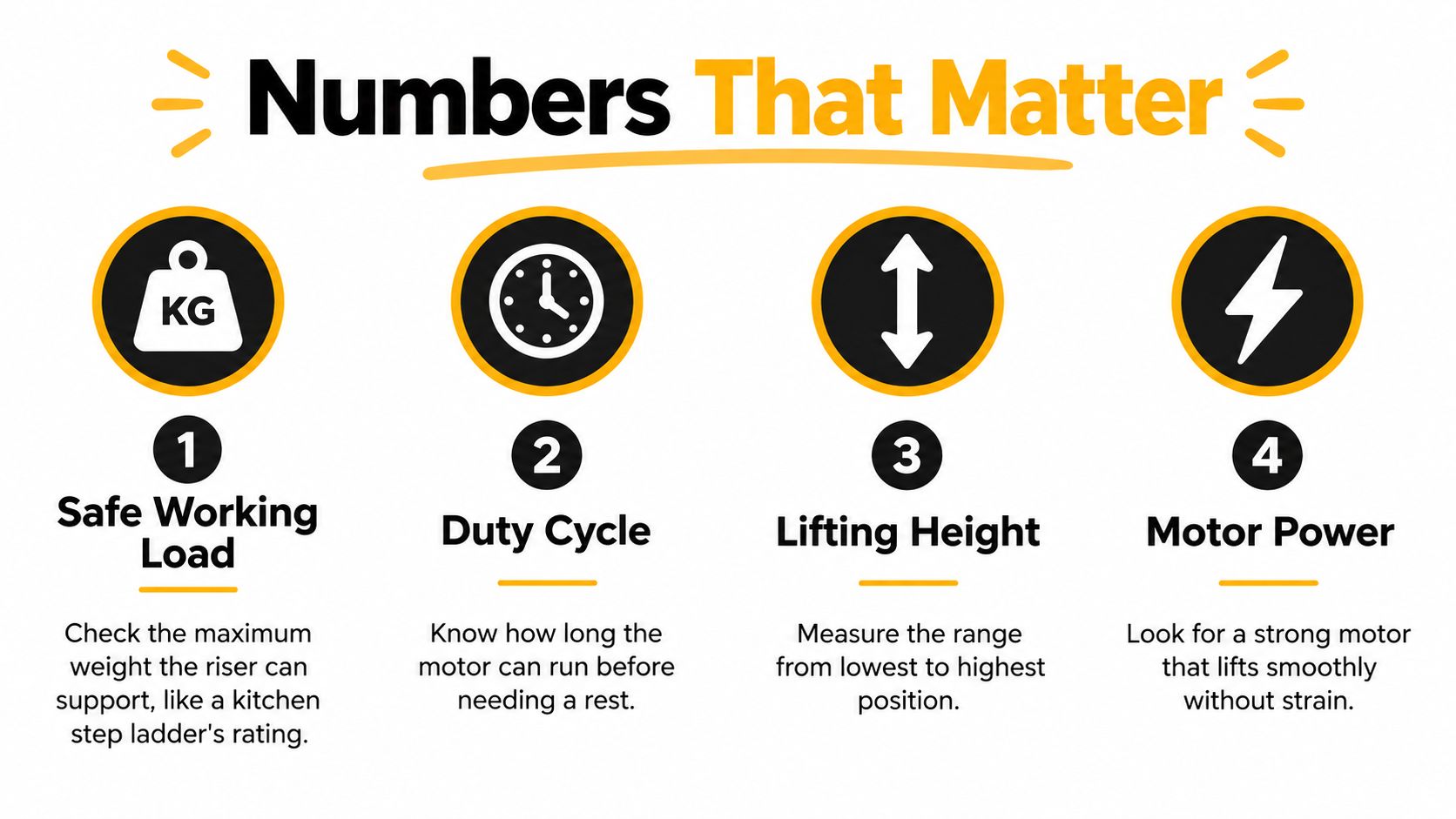
Reading the label like a clinician
Safe working load, or SWL, is the big one. It includes the person, mattress, bedding, headboard, footboard, side rails, and every attached accessory. It does not mean occupant weight alone. A representative powered riser-bed specification lists a 500 lb total safe working load, a deck-height range of 7 to 26 inches, IP44 protection for the control box and actuators, and a 10 percent actuator duty cycle of 2 minutes on followed by 18 minutes of cooling in that same specification.
Add every load before you compare models. A heavy mattress and solid headboard can consume a surprising share of capacity, which is why shoppers who need headroom often review guidance on a heavy-duty adjustable bed frame built for higher total loads alongside riser specs.
- Duty cycle: The motor's rest pattern. Running it repeatedly beyond its rating heats the actuator and shortens its life, much like overworking a small appliance without pauses.
- IP44: Protection against solid objects larger than 1 mm and splashing water in that specification context. Splash resistant doesn't mean you can hose it down or soak it.
- Height range: Useful only when you add mattress thickness on top of the deck measurement.
Practical rule: Treat the duty cycle as a limit, not a suggestion, and treat SWL as a whole-bed budget, not a body-weight promise.
For equipment used as a medical bed, IEC 60601-2-52 is the safety framework that addresses stability, moving-part clearances, entrapment, side rails, and safe-working-load testing. You don't need to memorize the standard. You do want to know whether a serious product was designed and tested with it in mind.
Finding the Right Height for the Person Who Uses the Bed
A caregiver raises the bed for dressing, but the user's feet no longer reach the floor when sitting. That mismatch is why a single recommended height can mislead. Fit the setting to the person, mattress, footwear, and care tasks, rather than assuming that higher is safer.
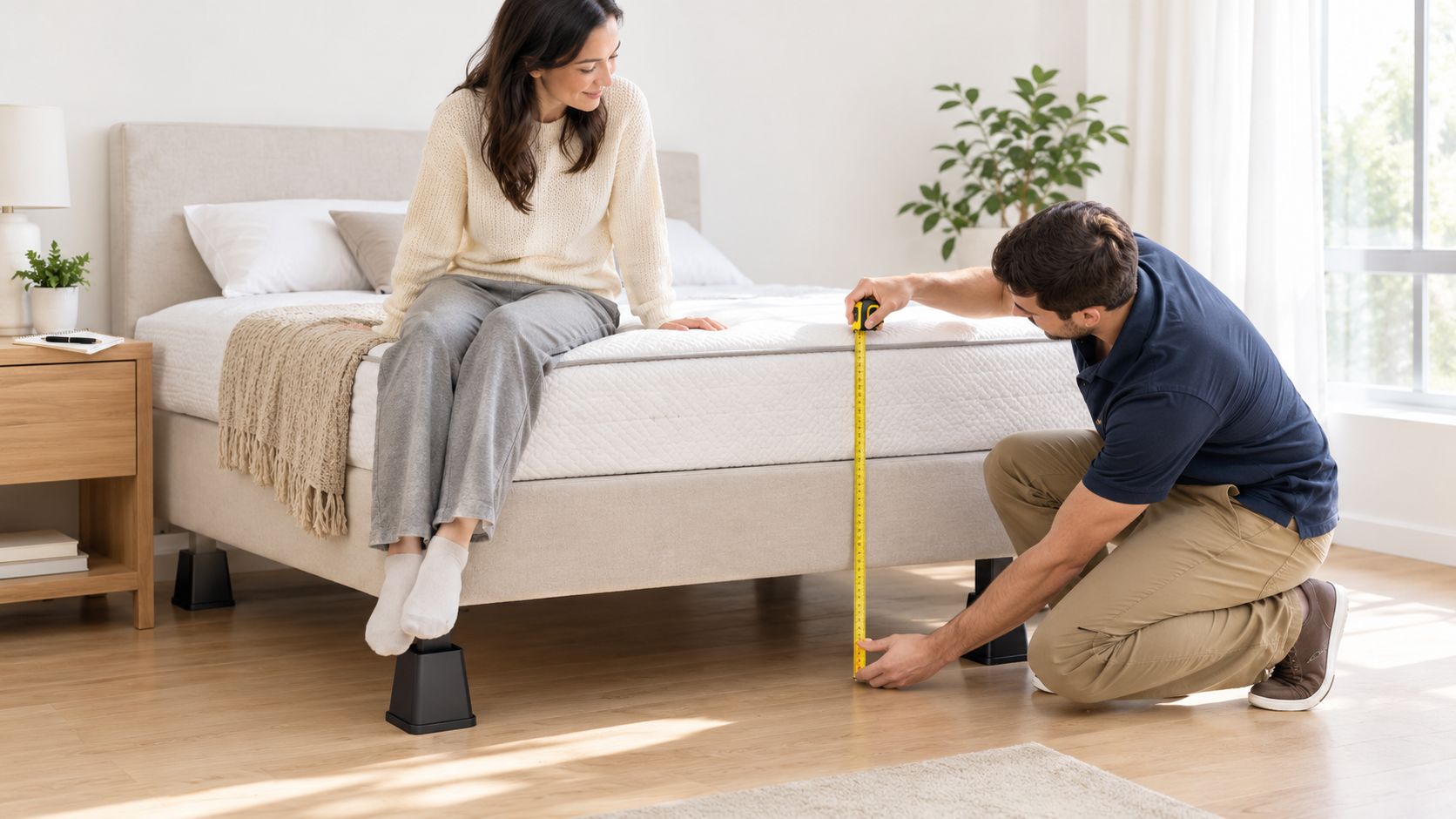
Start with a simple home measurement. Have the user sit at the bed's edge in their usual footwear, with feet flat if possible. Measure from the floor to the top of the mattress under their weight. Then measure the lower leg, from the floor to the crease behind the knee while seated. The compressed mattress matters: a soft surface sinks, so its useful sitting height differs from the empty bed's height.
Compare the measurements as a guide, not a prescription. Research indicates bed surfaces above roughly 120 percent or below about 80 percent of lower-leg length can make transfers more difficult. The same source summarizes a commonly cited target near knee height, around 21.3 inches for men and 19.5 inches for women, and a separate study in which medium heights of 51 to 66 centimeters were associated with the lowest difficulty and highest stability during sit-to-stand transfers.
Those figures describe research settings, not a guaranteed fit for every person. Body proportions, strength, balance, footwear, and mattress compression all affect the result. A supervised transfer can show what a tape measure cannot.
With a helper present, test a few bed settings using a controlled sit-to-stand. Watch how the user's feet, knees, hips, and hands move. Feet that dangle suggest the surface may be too high for a stable start. If the hips sit below the knees, standing may require more effort. Feet flat on the floor and a steady push are signs of a workable setting to try again.
Use the bed like an adjustable workstation: one position may suit one task, while another works better for a different person or activity. A caregiver may need more height for dressing or repositioning, while the user needs a lower setting for standing. Record the settings that work, and consider a small range with two remembered positions rather than one fixed height. Recheck after changes in shoes, mattress, or strength.
Compatibility With Frames, Mattresses, Rails, and Transfer Aids
A bed can rise smoothly and still leave a rail, mattress, or transfer aid out of position. Raising the frame changes the geometry of the whole setup: rail height relative to the mattress shifts, reaching distances change, and gaps may widen. Check compatibility as a set of measurements for the user, mattress, and caregiver, rather than assuming a higher setting is safer.
Use this visual checklist before buying or changing the setup.
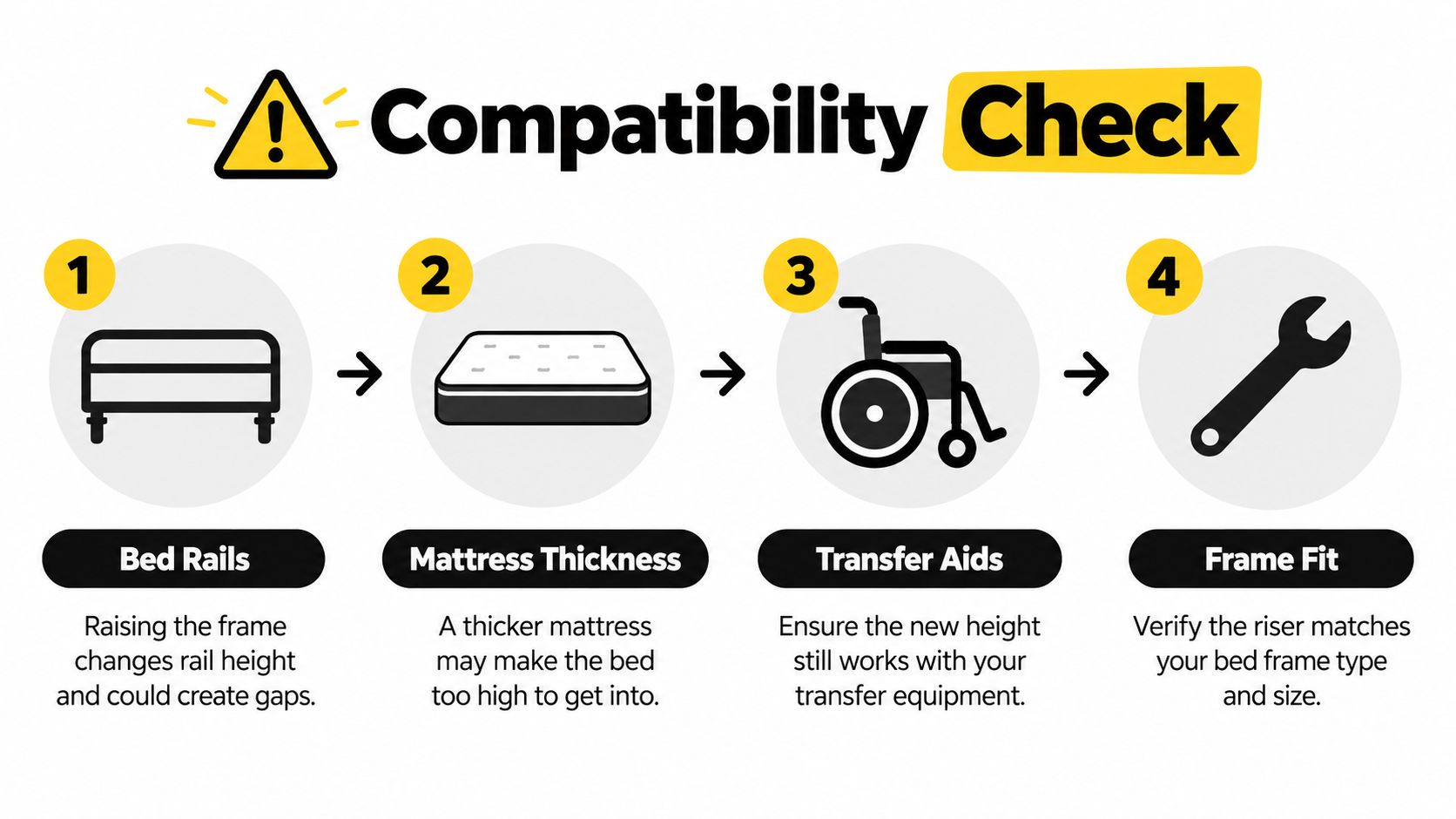
The FDA advises that the bed frame, rail, and mattress leave no gap large enough to entrap a person's head or body. It warns that rails can encourage climbing, and falls from that height can cause serious injury or death. Where appropriate, consider lower rails or no rails. A rail does not automatically improve safety.
Mattress thickness can change both rail coverage and the size of an entrapment gap. Before reattaching a rail, review guidance on bed rail installation and positioning after setup changes.
Check the setup from the user's and caregiver's positions. Does the frame sit securely on the riser without rocking? Does the mattress stay supported at its edges? Can a transfer pole, lift, or wheelchair still line up with the bed at the selected height? These checks are like fitting adjoining pieces: a change to one can affect how the others meet.
Also find out how the bed can be lowered if power fails. For bariatric users or anyone using a mechanical lift, ask the manufacturer to confirm compatibility and arrange a professional assessment. An advertised capacity alone does not establish that the combined setup is safe.
If replacing the base as well as considering a riser, Choosing a bed base in Norwich offers background for distinguishing base features from riser features.
Installing an Electric Bed Riser Safely
Good installation starts before a toolbox opens. You're planning clearances, power, and floor contact first, because fixing those after the bed is lifted is awkward and sometimes unsafe.
Check that the floor is level where each support will sit. A riser on an uneven floor can rock, drift, or load one actuator harder than the others. Confirm headboard clearance through the full travel range, and make sure you can reach a grounded outlet without stretching cords across a walkway.
The sequence in plain language
Remove bedding and the mattress so you're not wrestling weight you don't need. Take off casters or legs only as the manufacturer directs, seat the riser or supports squarely, and secure frame brackets snugly without crushing tubing or distorting the frame. Over-tightening is a quiet error. It can damage mounting points and make later adjustments harder.
Reconnect power and controls, keep actuator vents unblocked, and lock any casters before the first raise. Run the bed slowly through its full range with no one on it. Listen for grinding, clicking, or ratcheting, and watch whether all sides move together. One corner lagging behind isn't a quirk to ignore.
If movement looks uneven, sounds strained, or stops mid-travel, stop and troubleshoot. Don't test it with a person on the bed to see whether it improves.
Reinstall the mattress and rails only after that empty test, then recheck gaps and total height. Practice the transfer routine you will use, drawing on principles from safe patient transfer techniques for home caregivers, with a helper present for the first attempts.
Call a professional installer when the setup is bariatric, the floor is noticeably uneven, the frame is antique or custom, or you can't confirm how load travels through the legs. That's not a failure of DIY spirit. It's recognizing that a lifting device under a occupied bed leaves little room for improvisation. Keep the manual, remote instructions, and emergency lowering method where nighttime caregivers can find them without searching.
Choosing an Electric Bed Riser That Fits the Buyer
A bed that feels easy to enter may still be too high for a safe, steady transfer. Start with the person's measurements, then check how the mattress and riser change the final bed height. That order keeps a high maximum setting from becoming the main selling point.
Match the choice to the user and caregiver
For someone whose body weight leaves little load headroom, add the sleeper, mattress, frame furniture, rails, and accessories before comparing the total with the product's documented safe working load. The structure needs room within its rating; a smooth motor cannot make an overloaded setup safe.
A caregiver may use the controls several times a day. Check that the bed moves steadily, the remote is easy to operate in dim light, and the controls can be positioned or locked to prevent accidental presses. Also confirm what happens during a power outage.
For a person with limited mobility, the lowest setting may matter more than the advertised maximum. At the user's usual sitting position, their feet should reach the floor rather than dangle. Then consider whether a raised setting supports standing without making the transfer feel unsteady.
Use these questions as a shopping worksheet:
- Load and build: Does the published capacity cover the complete bed setup with room to spare?
- Controls and motion: Can the user or caregiver stop the bed at the needed height, and does it move evenly?
- Compatibility proof: Has the manufacturer confirmed the specific frame, mattress, and rail combination?
- Ownership basics: Are warranty terms, replacement parts, and service instructions clear?
A long feature list can distract from fit. Massage modes and decorative finishes do not resolve unclear load ratings or a height range that fails the user's measurements. If comparing full bed systems alongside risers, apply the same four questions to adjustable and rotating beds and to bariatric models before comparing prices.
Write down the user's lower-leg measurement and the mattress thickness, then compare them with the product's deck-height range. The deck is the surface supporting the mattress, so its listed height alone is not the final sitting height. Add the mattress thickness to estimate where the user's feet will meet the floor. If the product information does not let you make that comparison, choose a model with clearer specifications.
Quick Reference and Common Questions
If you remember only a short routine, make it this one. Measure first, match load second, verify compatibility last. Each step catches a different kind of mistake, and skipping the final check is how safe-looking setups become unsafe.
Three questions buyers ask most
Will an electric bed riser work with my existing adjustable bed? Sometimes, but never assume. Articulating bases have moving parts, motors, and clearances underneath that a riser can block or strain. You need explicit manufacturer approval for that exact pairing, not a general claim that it fits most beds.
What does weight capacity mean in real terms? It's a whole-system budget. The mattress, bedding, headboard, rails, and accessories all spend part of it before the sleeper gets in. That's the practical meaning of safe working load from earlier, and it's why two beds with the same headline rating can perform very differently once furnished.
What happens in a power failure? Find out before installation day ends. Some systems have battery backup or manual emergency lowering, and some don't. Practice the method, keep instructions nearby, and never leave a user stranded at a height they can't safely exit.
Daily habits matter as much as purchase decisions. A study of adult acute-care inpatients found 51.4 percent of all fall incidents and 56.0 percent of injurious falls occurred during activities involving the bed, and it recommends returning an adjustable bed to its lowest practical position after care is completed rather than leaving it raised, as reported in that study.
Use height deliberately. Raise for a task or transfer, then return the bed to the resting position you've tested.
Higher isn't automatically safer, and lower isn't either. The safest setting is the one your measurements suggest and a supervised test confirms for that specific person, on that specific bed, in their usual footwear.
Ready to compare adjustable beds, accessories, and compatibility details with your measurements in hand? Visit DME Superstore to explore durable medical equipment for safer transfers and more comfortable home care, with clear specifications to help you choose confidently.
