



You're standing beside a patient who's been on the ventilator for days, and a nurse has just activated a bed that begins a slow, controlled side-to-side motion. The family hears the mattress move and immediately asks the same questions anyone in that moment would ask: what is this bed doing, why did the team choose it, and does this same approach make sense anywhere outside the ICU. Those are the right questions, because a rotating bed in hospital settings is a specialized tool, not a generic comfort upgrade.
That distinction matters for hospital procurement teams, ICU and step-down nurses, family caregivers, and DME buyers comparing homecare beds. Some rotating systems are built for continuous lateral rotation therapy, while others sold for home use are aimed at helping a person sit, stand, or transfer. The evidence, the setup, and the safety rules are not the same, so the bed type has to match the care setting.
When a Bed Starts Turning on Its Own
A rotating bed gets ordered when a team is trying to solve a very specific bedside problem. The patient may be too unstable to turn manually as often as the skin and lungs would like, or the care team may be trying to reduce the burden of repeated lifting and repositioning. In that setting, the motion is part of treatment, not a convenience feature.
The first thing clinicians usually clarify is whether the bed is being used for pulmonary support, pressure redistribution, or caregiver handling. Those goals overlap, but they don't always travel together. A device that helps one problem can leave another one unchanged, or even make it worse, so the order has to be tied to the patient's risk profile and the unit's protocol.
For people shopping outside the ICU, confusion starts here. A rotating homecare bed can help with transfers or assisted positioning, but that doesn't mean it carries the same clinical purpose as a kinetic therapy system used for a ventilated patient. If you're trying to compare bed styles, an overview like this remote-control bed guide helps show how ordinary electric adjustments differ from specialized rotation.
The short version is simple. Rotation is a clinical intervention first, a comfort feature second. Once you separate those two ideas, the rest of the evidence becomes much easier to read.
What a Rotating Hospital Bed Actually Does
A patient who cannot tolerate frequent manual turns may be placed on a bed that shifts the body gradually from side to side. The frame changes the contact areas between the patient and the mattress, much like a controlled see-saw, while keeping the movement repeatable for the care team. In continuous lateral rotation therapy, or CLRT, the bed rotates as a unit rather than raising the back or leg sections.
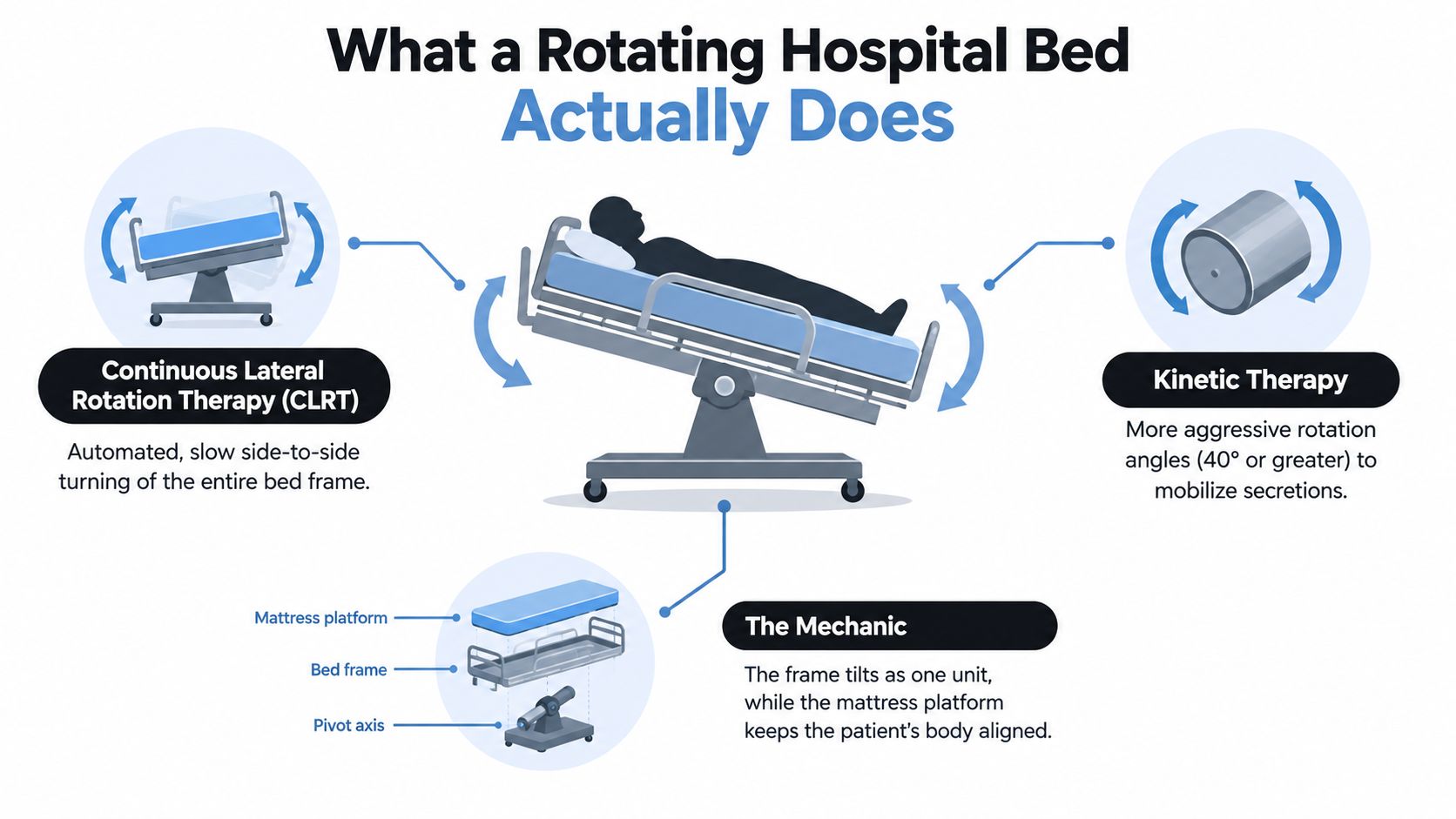
CLRT and kinetic therapy are not the same as a home adjustable bed
Kinetic therapy generally uses a more pronounced rotation pattern, with defined angles and a structured cycle. An ordinary adjustable or rotating homecare bed may instead support comfort, sitting, transfers, or basic positioning. Both products can advertise rotation, yet the movement, controls, intended users, and clinical protocol may differ substantially.
For a purchasing team, the questions should be specific: How far does the frame tilt? Is the angle programmed or manually selected? What does one rotation cycle involve? Can caregivers safely complete hygiene, transfers, and line management while the bed is moving? For home use, the central question may be whether rotation assists turning, transfer support, or positioning rather than providing ICU respiratory therapy.
The clinical evidence applies to a defined population. A 2006 systematic review of 15 prospective clinical trials involving 1,169 mechanically ventilated patients found that kinetic therapy was associated with lower odds of nosocomial pneumonia. The pooled odds ratio was 0.38, with a 95% CI of 0.28–0.53 and p < 0.001 PMC review. That finding supports consideration of structured rotation for selected ICU patients. It does not establish that every rotating bed produces the same outcome, or that rotation alone prevents pressure injuries or replaces clinical judgment.
A purchasing team that confuses these categories can select a device whose evidence base does not match the setting. The intended patient, rotation protocol, caregiver workflow, and safety requirements should determine whether the system is appropriate.
Pressure Redistribution Across the Body
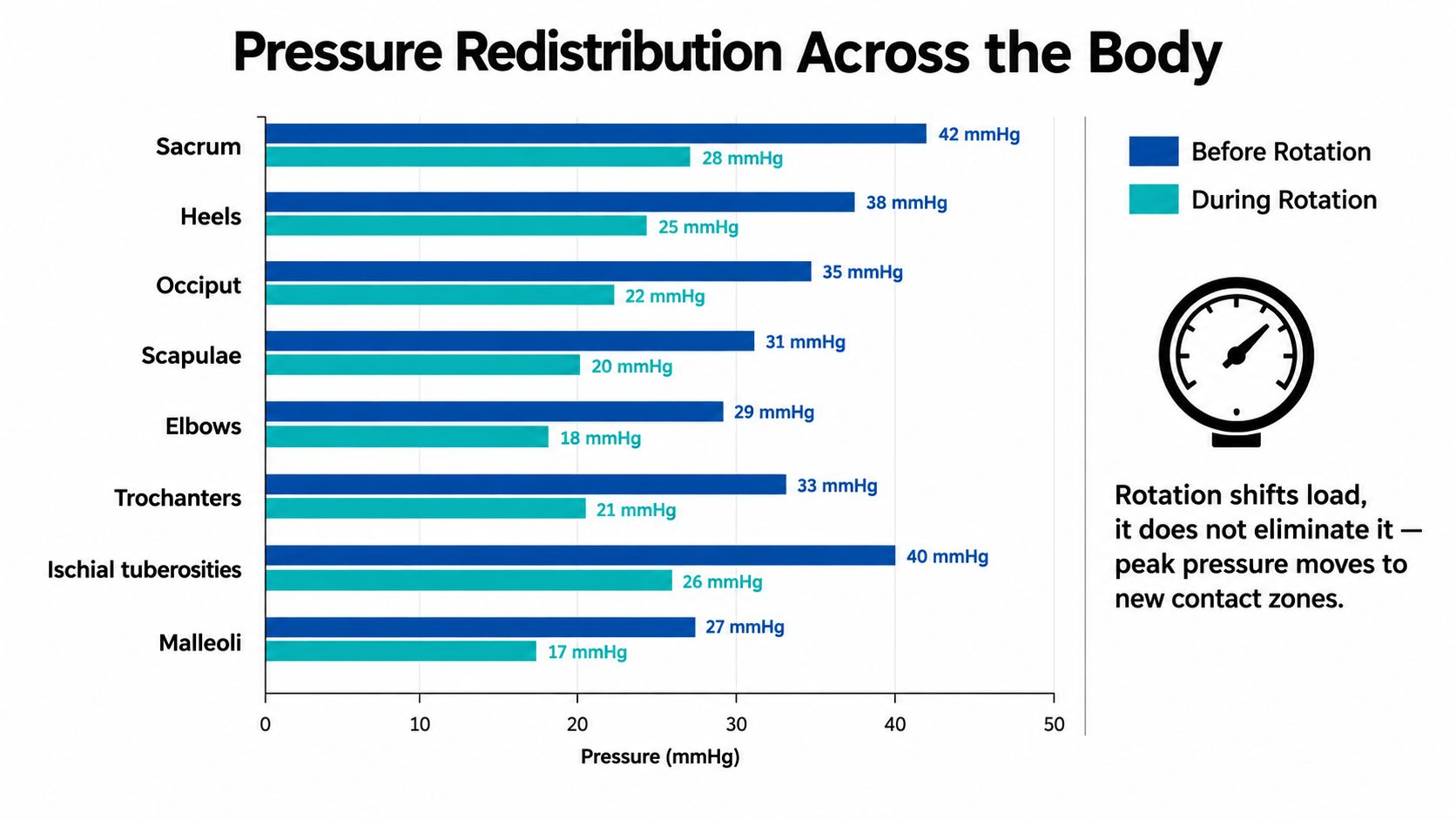
A patient may feel relief at one contact point while pressure rises at another. Rotation changes the body's relationship with the mattress, much like moving a load across several supports. It redistributes force rather than removing it, so the angle, mattress, timing, and skin checks all remain important.
Why angle matters more than people expect
A repeated-measures study of eight high-risk anatomical sites found that continuous lateral turning significantly reduced peak and mean pressures at most sites at 15°, 30°, and 45°, compared with a neutral supine position pressure study. The result supports a practical point for clinical buyers: pressure relief depends on where the load moves, not on how far the bed tilts alone.
The most effective angle differed by body region. The study found roughly 30° at the occiput, 15° at the left scapula, 45° at the right scapula and sacrum, 15° at the right heel, and 30° at the left heel. A single programmed angle therefore cannot be assumed to protect every vulnerable area. Greater tilt may shift force toward another contact zone rather than improve protection throughout the body.
Angles above 30° caused discomfort, and greater tilt increased pressure at the right greater trochanter under some conditions. In the same repeated-measures study, these findings make the maximum advertised angle less informative than the system's repeatability, pause timing, and effect on other body regions.
Rotation also does not replace routine prevention. Skin inspection, moisture control, nutrition review, repositioning decisions, and appropriate support surfaces still matter. Guidance on how carers prevent skin damage complements the bed's movement. An alternating-pressure mattress addresses pressure at the mattress level through a different mechanism, as explained in this alternating-pressure mattress overview.
Rotation shifts load, it does not eliminate it. Assess the angle, cycle timing, mattress pairing, comfort, and skin response after each cycle.
Respiratory Outcomes and the Trade-Offs Behind Them
As established above, the 2006 review showed lower pneumonia odds without a mortality or length-of-stay benefit review. That finding applies to selected mechanically ventilated patients, not automatically to ordinary rotating homecare beds.
One trial showed benefit and harm at the same time
A 2012 randomized trial involving ventilated patients with cardiogenic shock reported hospital-acquired pneumonia in 10 kinetic-therapy patients versus 28 receiving standard care, with p < 0.001 trial. The same trial reported pressure ulcers in 10 kinetic-therapy patients versus 2 standard-care patients, also with p < 0.001. Rotation may improve one clinical outcome while creating a different skin-management problem.
The trial also reported one-year all-cause mortality of 41% versus 66%, with p = 0.028. That result is clinically important, but it does not prove that continuous lateral rotation is suitable for every patient. These participants were critically ill, mechanically ventilated, and closely monitored. A hospital protocol cannot be transferred directly to long-term care or home use.
A rotating frame also differs from an ordinary rotating homecare bed. Continuous lateral rotation therapy is a structured clinical intervention, with programmed movement, patient selection, and surveillance. A homecare bed may rotate mainly to assist transfers, comfort, or caregiver handling, without evidence that it prevents pneumonia or pressure ulcers.
Protocols therefore matter as much as the machine. Skin checks, mattress selection, respiratory assessment, and clear stop criteria should be coordinated. The balance between pressure-injury prevention and respiratory support is covered in our guide on pressure injury prevention versus breathing support.
Bottom line: rotation can support breathing outcomes while worsening skin outcomes. Choose the bed, mattress, monitoring schedule, and caregiver responsibilities as one plan.
How Rotating Beds Compare With Other Support Surfaces
A rotating frame answers a different clinical question from a mattress. Hospitals may compare it with standard ICU beds, alternating-pressure surfaces, and low-air-loss mattresses. Mattress-level products manage pressure and microclimate at the body surface. Frame-level rotation adds programmed lateral movement, which may support repositioning but does not replace skin assessment.
| Surface | Primary Indication | Evidence Strength | Supervision Level | Typical Care Setting |
|---|---|---|---|---|
| Rotating bed | Lateral turning for selected patients | Mixed, population-specific | High | ICU, step-down, selected long-stay care |
| Standard ICU bed | Baseline support and access | Established baseline | High | ICU and acute care |
| Alternating-pressure surface | Pressure redistribution | Depends on patient and protocol | Moderate to high | Hospital, long-term care, homecare |
| Low-air-loss mattress | Microclimate and pressure support | Depends on system and use | Moderate to high | Hospital, wound care, homecare |
Protocols matter as much as hardware
A systematic review of three randomized trials comparing rotating beds with conventional ICU beds found no clear reduction in pressure-ulcer incidence. The same review described a separate trial in older adults in which a 30° lateral tilt every three hours reduced ulcer incidence from 11% to 3%. These findings point to a practical distinction: rotation may help deliver a turning schedule, while outcomes still depend on patient selection, mattress performance, technique, and follow-up.
The comparison is therefore less about choosing one universal winner and more about matching the surface to the care situation. A standard ICU bed may provide access and positioning without powered rotation. An alternating-pressure surface changes loading over time while the patient remains in place. A low-air-loss mattress addresses heat and moisture as well as pressure support. Each option has limits.
For procurement teams, assess the unit's patient population, staffing pattern, tolerance for movement, and monitoring capacity. A rotating bed can be paired with a pressure-redistributing mattress, but it cannot replace repositioning decisions, skin checks, or a documented prevention protocol. For homecare buyers, confirm whether the bed's rotation is intended for clinical lateral rotation therapy or mainly for transfers, comfort, and caregiver handling. Those functions should not be treated as equivalent evidence of pressure-ulcer prevention.
Safety, Entrapment, and Articulated-Position Testing
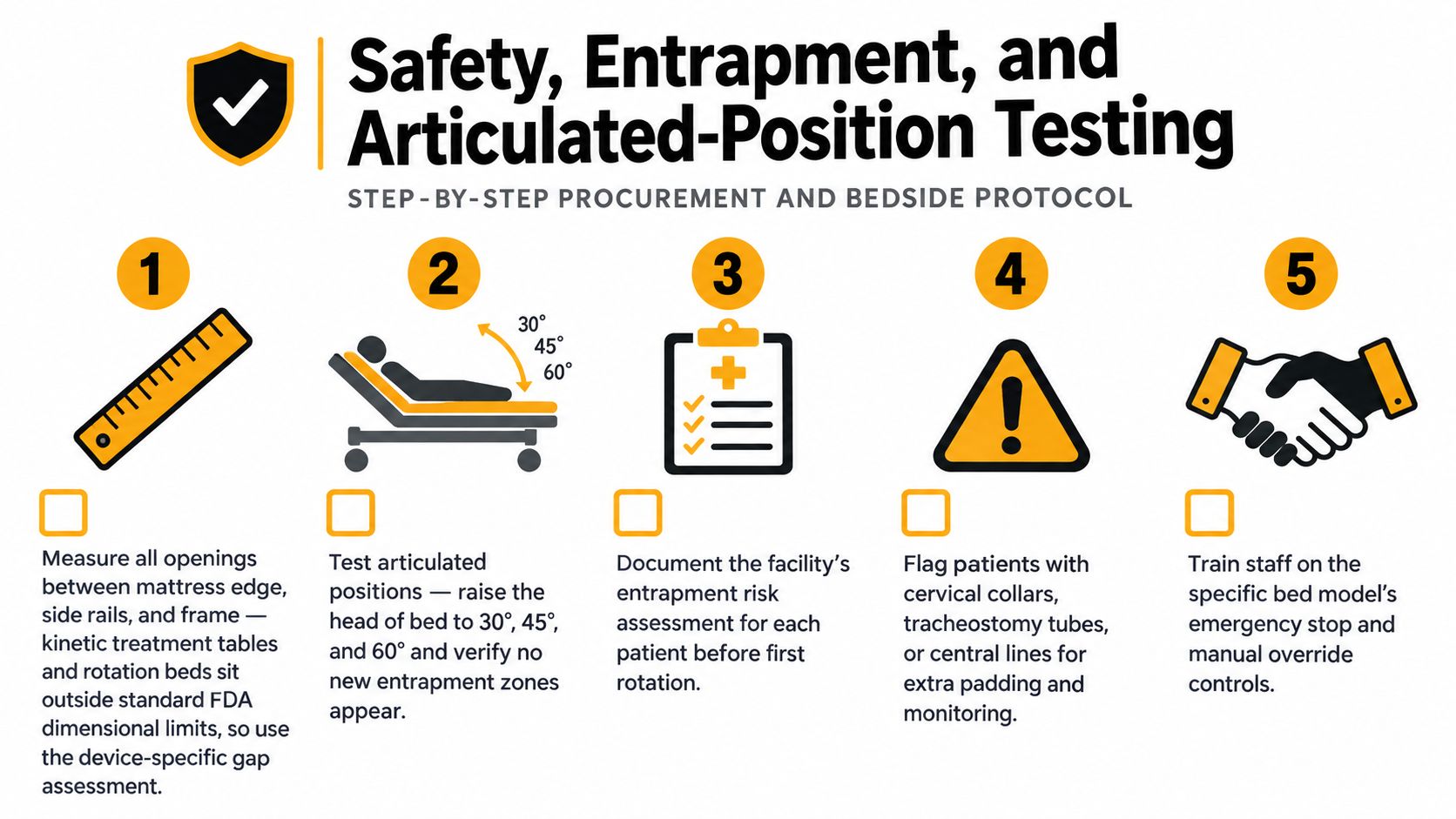
FDA guidance treats kinetic treatment tables and rotation beds differently from ordinary hospital-bed systems for entrapment dimensions, but that does not mean they're exempt from safety review FDA guidance. The practical lesson is blunt. Special design doesn't cancel the need to check rails, mattress edges, frame gaps, and accessory fit in the actual operating position.
Test the bed where the patient will actually be
FDA also notes that articulation changes the entrapment profile, so clearance in a flat position isn't enough FDA FAQ. If the head is raised or the knees are lifted, a rail that looked safe at first can behave differently. The same logic applies to a rotating bed during its cycle.
Practical rule: evaluate the bed in the positions it will really use, not just in the showroom position.
The safety review should include line routing, tubing placement, alarm behavior, and a clear emergency flatten process. If a patient has a cervical collar, tracheostomy tube, or central line, the team should plan extra padding and monitoring before the first rotation. The most common mistake is treating the motion as self-explanatory and skipping the bedside briefing.
A caregiver-safety angle matters too. A biomechanical evaluation found that a bed feature designed to assist turning reduced caregivers' spinal loading and pulling forces, which is helpful for staff safety, but it doesn't remove the need for training biomechanical evaluation. In practice, that means the bed model's emergency stop, manual override, and alarm logic should be reviewed before anyone uses it on a real patient.
The same principle applies to accessories. Bed rail installation guidance is worth reviewing whenever rails, pads, or add-ons are being changed, because the wrong accessory can alter the hazard profile faster than people expect.
Procurement, Protocols, and Knowing When Not to Use One
Buying a rotating bed is a clinical decision, not just a purchasing decision. Start with the patient population, then check whether the bed's motion matches the actual goal. If the patient needs pulmonary support in a highly monitored ICU, that points to one kind of system. If the patient needs help getting in and out of bed at home, that points to a different product class altogether.
A procurement checklist that actually helps
Use the same review lens across every vendor conversation:
- Population fit: confirm whether the evidence matches mechanically ventilated ICU patients, long-stay patients, or home users.
- Surface compatibility: check mattress and overlay fit, because the frame can't solve a bad support-surface pairing.
- Weight and size limits: confirm the maximum patient weight before the bed is ever placed on a unit or in a home.
- Alarm behavior: ask what the bed does when motion is interrupted, blocked, or overridden.
- Training load: budget staff time for line management, patient communication, and emergency flatten drills.
- Service and maintenance: verify who handles repairs, preventive maintenance, and downtime coverage.
If the discussion shifts toward home care, remember that rotating homecare beds are a separate category. A product like the Med-Mizer ActiveCare Rotating Hospital Bed is built around assisted entry and exit, which is a different use case from ICU kinetic therapy. If you're also reviewing home linen setup and bed fit, hospital corners from SouthShore Fine Linens can be useful for understanding mattress presentation and sheet management around a fixed bed surface.
The clearest “no” is just as important as the clearest “yes.” A rotating bed is not the right answer for unmonitored home use when a person can still reposition safely, for patients outside the device's weight limits, or for situations where repositioning protocols and a standard pressure-redistribution surface already meet the goal. It's also a poor substitute when the care team really needs a lift system, a better mattress, or a different transfer strategy.
A good buyer walk-through ends with one sentence of honesty. The evidence supports selective use, not universal promises. If your team needs a rotating hospital bed, pressure-relief surface, or homecare alternative, DME Superstore can help you compare options, specs, and compatibility details, so you can match the bed to the patient instead of forcing the patient to fit the bed. Visit DME Superstore to review current product details and choose the right setup for your care setting.
