



You're sitting at the kitchen table after helping your parent out of the recliner again. You've found a powered lift chair that might make standing easier, but the next question is harder: will Medicaid help pay for it, or will your family have to cover the purchase?
Lift chairs covered by Medicaid aren't a simple yes-or-no benefit. The answer depends on your parent's medical needs, the exact Medicaid plan, and whether the program considers the lifting equipment separately from the furniture around it.
Why Lift Chair Coverage Feels So Confusing
A retailer shows you a complete chair. A benefits representative may be discussing only a device inside it. Both people use the words lift chair, but they aren't necessarily describing the same covered purchase.
That mismatch explains much of the confusion. Think of a lift chair as two products in one: a household recliner and a mechanism that helps someone move from sitting to standing. Medicaid may cover the medically necessary component without paying for the complete upholstered chair.
A Medical Device Inside Household Furniture
A car offers a useful analogy. If a benefit paid for an engine needed to solve a documented problem, you wouldn't assume it also paid for leather seats, an upgraded interior, or every feature surrounding that engine.
The analogy isn't a billing rule, but it helps separate the questions families need to ask:
- Medical function: What equipment addresses the person's inability to stand?
- Furniture purchase: What part of the price is for the chair, upholstery, or comfort features?
- Coverage decision: Does this particular Medicaid plan recognize the mechanism, the complete chair, or neither?
The history can add another layer of misunderstanding. Medicare has covered seat-lift chairs as durable medical equipment since 1978, according to a U.S. Department of Health and Human Services Office of Inspector General report. That historical Medicare benefit doesn't establish automatic Medicaid coverage.
Ask for the Covered Component
When someone says a lift chair is covered, ask them to identify exactly what they mean. A verbal answer about the product category isn't enough to decide whether to place an order.
Practical rule: Ask what the program will authorize and what the supplier will bill, not just whether it covers lift chairs.
You don't need to become a billing specialist. You need a clear description of the covered equipment, the medical conditions attached to approval, and any remaining purchase costs. Those answers let your family compare options without mistaking a partial benefit for a fully paid chair.
How Medicaid Treats Durable Medical Equipment
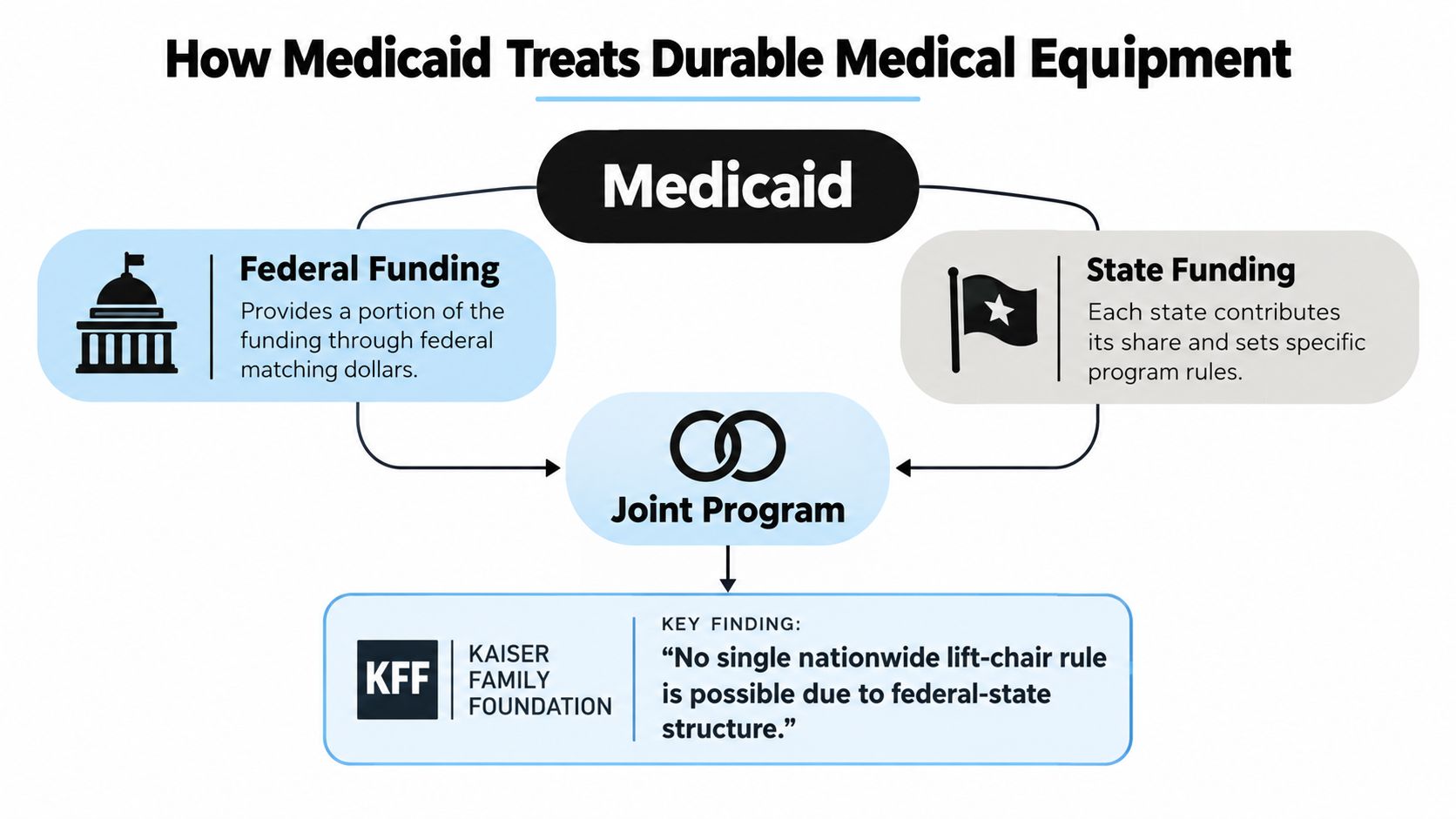
Medicaid is jointly financed and administered by the federal government and individual states. Within federal requirements, states establish their own covered equipment categories, medical-necessity standards, authorization procedures, and payment limits.
Think of separate pharmacies sharing a federal label, rather than a single store with an identical inventory everywhere. The shared program name doesn't mean every state uses the same equipment policy.
The Benefit Category Isn't the Approval
The Kaiser Family Foundation identifies medical equipment and supplies as a state-defined Medicaid benefit. Its Georgia entry, for example, lists medically necessary equipment as covered and records a $3 copayment, but that entry alone doesn't establish lift-chair eligibility for an individual applicant (KFF Medicaid medical equipment and supplies comparison).
A broad equipment benefit is the starting point, not a promise that every product qualifies. Your plan still needs to identify whether the requested equipment falls within its covered categories.
For terminology help, this guide to what is considered durable medical equipment can help you distinguish medical equipment from ordinary household purchases.
Separate Clinical Rules From Billing Rules
A clinician determines the patient's functional needs. The Medicaid program decides whether those needs meet its benefit requirements, while the supplier prepares the equipment request and billing information.
For clinics that need help interpreting billing terminology, MedicalVirtual's medical coder resource is a place to explore coding support. Coding assistance doesn't replace the treating clinician's assessment or the Medicaid plan's coverage determination.
Keep these questions separate:
- Clinical eligibility: Does the patient meet the program's functional criteria?
- Administrative eligibility: Is authorization required, and can this supplier bill the plan?
- Payment scope: Which components and charges does the benefit include?
Federal Medicare guidance provides a clinical and technical reference for seat lifts. It isn't a substitute for the applicable Medicaid policy. When an online explanation discusses Medicare, don't assume its instructions describe your state's Medicaid benefit.
Medical Necessity Rules That Drive Eligibility
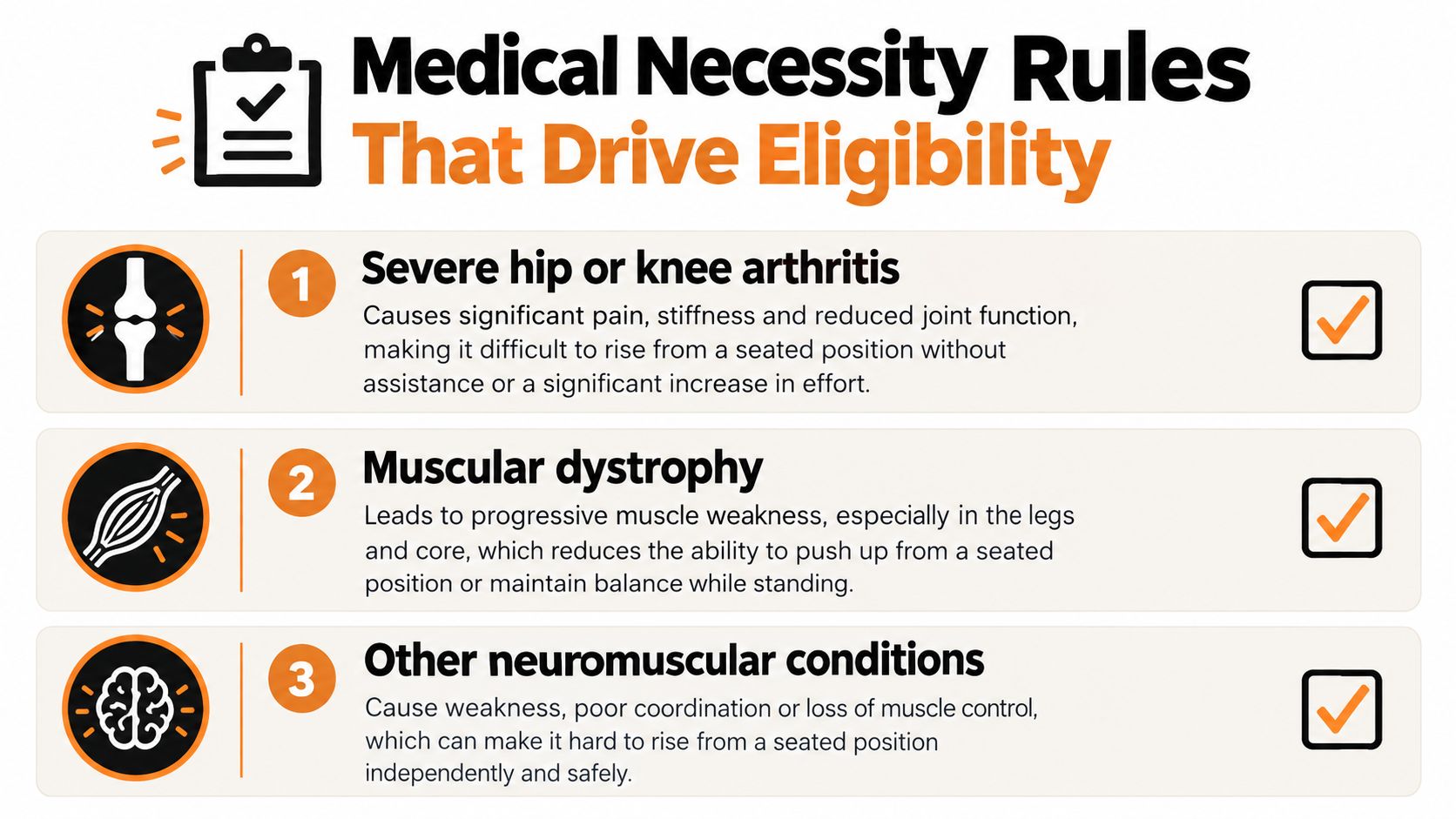
A diagnosis matters, but the functional problem is what connects the diagnosis to the equipment. Someone may have arthritis and still rise safely from a normal chair. Someone else may have a documented condition that makes the same movement impossible.
CMS policy recognizes medically necessary seat lifts prescribed for severe hip or knee arthritis, muscular dystrophy, or another neuromuscular disease when the person can benefit therapeutically. Its Medicare criteria also address the treatment plan, inability to rise, walking after standing, and whether the alternative would be chair or bed confinement (CMS national seat-lift coverage guidance).
Document Both Sides of the Transfer
Think of the lift as a bridge across a specific gap: moving from seated to standing. The clinical assessment needs to establish what happens before the transfer and what the person can do afterward.
A helpful evaluation addresses:
- The underlying condition: Which diagnosis explains the loss of strength or mobility?
- The failed transfer: Can the person rise from a normal armchair, rather than only having difficulty with a low or unusually soft seat?
- Function after standing: Can the person walk once upright, and with what assistance?
- The expected benefit: How would powered elevation support the prescribed treatment plan?
For example, a clinician might evaluate someone who cannot rise independently but can walk with an appropriate mobility aid after standing. That's a different clinical situation from someone who needs equipment to transfer between a bed and wheelchair.
These are illustrative situations, not automatic approval categories. The Medicaid policy must define the applicable test.
Comfort Alone Doesn't Establish Necessity
Reclining, leg elevation, and soft cushioning may matter to the user, but they don't explain why a seat-lift mechanism is medically necessary. The record should focus on the transfer problem rather than the appeal of a more comfortable chair.
Ask the clinician to address treatments already tried, such as medication, physical therapy, or occupational therapy, where the plan requires that information. Don't describe an intervention as unsuccessful unless the medical record supports that conclusion.
Device design matters too. The CMS guidance cited above requires smooth, patient-controlled operation that assists sitting and standing, and excludes spring-release devices that abruptly propel the person upward. A product label alone doesn't show that its lifting action or controls suit the patient.
The Mechanism Versus the Chair Reimbursement Split
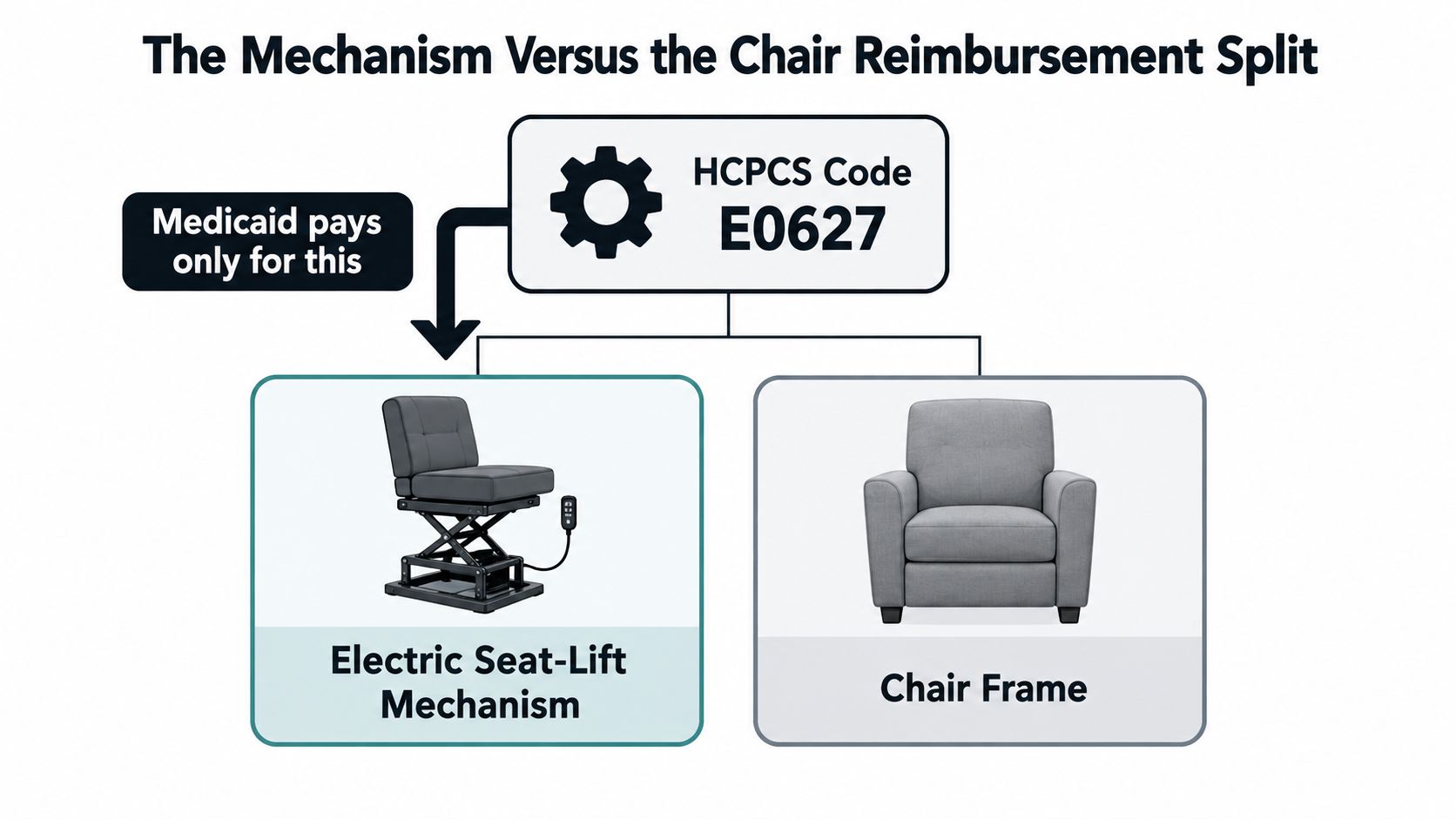
HCPCS code E0627 typically identifies an electric seat-lift mechanism. It's a billing identifier for the lifting equipment, not a blanket authorization for every feature attached to a recliner.
Under CMS statutory guidance, the covered durable-medical-equipment component of a seat-lift chair is the mechanism, not the chair itself. When the mechanism is incorporated into a recliner, payment is limited to the amount payable for a seat lift without the recliner feature (CMS seat-lift statutory ruling).
Read the Diagram as a Starting Point
The illustration captures the mechanism-only approach, but it isn't a universal Medicaid payment rule. A state policy may recognize a combination chair and mechanism, so the written benefit takes precedence over a simplified diagram.
A sandwich analogy helps with an itemized quote: the functional middle layer may qualify, while the surrounding layers don't necessarily qualify. In a chair, those surrounding costs can include cushioning, upholstery, reclining features, upgraded frames, heat, massage, or a rotating base.
Don't assume those features are covered because they come in the same box. Equally, don't assume every nonmechanism charge is automatically your responsibility without checking the state's actual policy and the supplier's billing arrangement.
Ask for an Itemized Estimate
Before signing, ask the supplier to separate:
- Requested covered equipment: The component or combination product being submitted for authorization.
- Furniture and upgrades: Charges outside the requested medical benefit.
- Other services: Delivery, setup, and any optional service charges.
- Your proposed responsibility: What you would owe if coverage is approved, partial, or denied.
A prescription explains the medical request. An itemized estimate explains the purchase you're agreeing to make.
For a comparison of the federal program's approach, the guide to power lift chairs and Medicare can help you recognize Medicare terminology. Keep that comparison separate from your Medicaid determination.
A supplier's retail price and a program's payment allowance answer different questions. Ask for both, along with a written explanation of any proposed balance, before treating an authorization as permission to purchase.
State by State Variability and How to Verify Coverage
Iowa and Louisiana show why the equipment's exact name matters. Their policies don't offer different answers to the same recliner purchase. They address different kinds of lifting equipment and different functional needs.
Side-by-Side Look at Iowa and Louisiana Lift Coverage
| Coverage Element | Iowa Medicaid | Louisiana Medicaid |
|---|---|---|
| Equipment addressed | Combination lift chair and mechanism | Patient-transfer lift |
| Functional focus | Inability to rise from a normal chair, with retained household walking ability | Inability to transfer or achieve necessary movement while confined to a bed, chair, or room |
| Caregiver consideration | Includes a lack-of-caregiver-assistance condition | Considers whether a caregiver cannot safely transfer the beneficiary |
| Important limitation | Excludes people requiring a wheelchair for activities of daily living | Covers hydraulic lifts and excludes electric lifts under this patient-lift policy |
| Documentation or components | Lists E0627, applicable modifiers, and medical-necessity documentation | Treats slings or seats as lift components covered only as replacement items |
The Iowa column reflects its Medicaid lift-chair equipment policy. That policy lists E0627, modifiers NU, UE, or RR, and a CMS-849 medical-necessity certificate, with supporting evaluation when needed.
The Louisiana column reflects its Medicaid patient-lift policy. Its hydraulic-lift coverage should not be read as approval for a powered recliner-style seat lift.
Identify the Correct Equipment Policy
A seat lift helps a person rise from the chair they're sitting in. Patient-transfer equipment addresses moving a person who cannot complete a necessary transfer. Confusing those categories can send a family down the wrong authorization path.
When you contact your own program, ask:
- Policy identity: What is the current written policy for a seat-lift mechanism or combination lift chair?
- Benefit scope: Does the policy address the equipment you are considering?
- Functional exclusions: How does it treat wheelchair use, walking distance, and available caregiver help?
- Submission requirements: Which forms, assessments, and participating suppliers are required?
Write down the policy name and save a copy rather than relying on a general equipment brochure. Ask the representative to confirm that the policy applies to your exact Medicaid plan.
The same category-checking habit is useful for other home accessibility purchases. This guide to whether insurance covers wheelchair ramps addresses another situation where a practical home need and an insurance benefit may not align.
These examples explain what to investigate. They aren't a substitute for checking the policy currently applicable to your family.
Documentation and the Ordering Workflow
A useful application tells one consistent story across the clinician's notes, equipment order, assessment, and supplier submission. Think of a passport application: the information on the form needs to match the underlying documents.
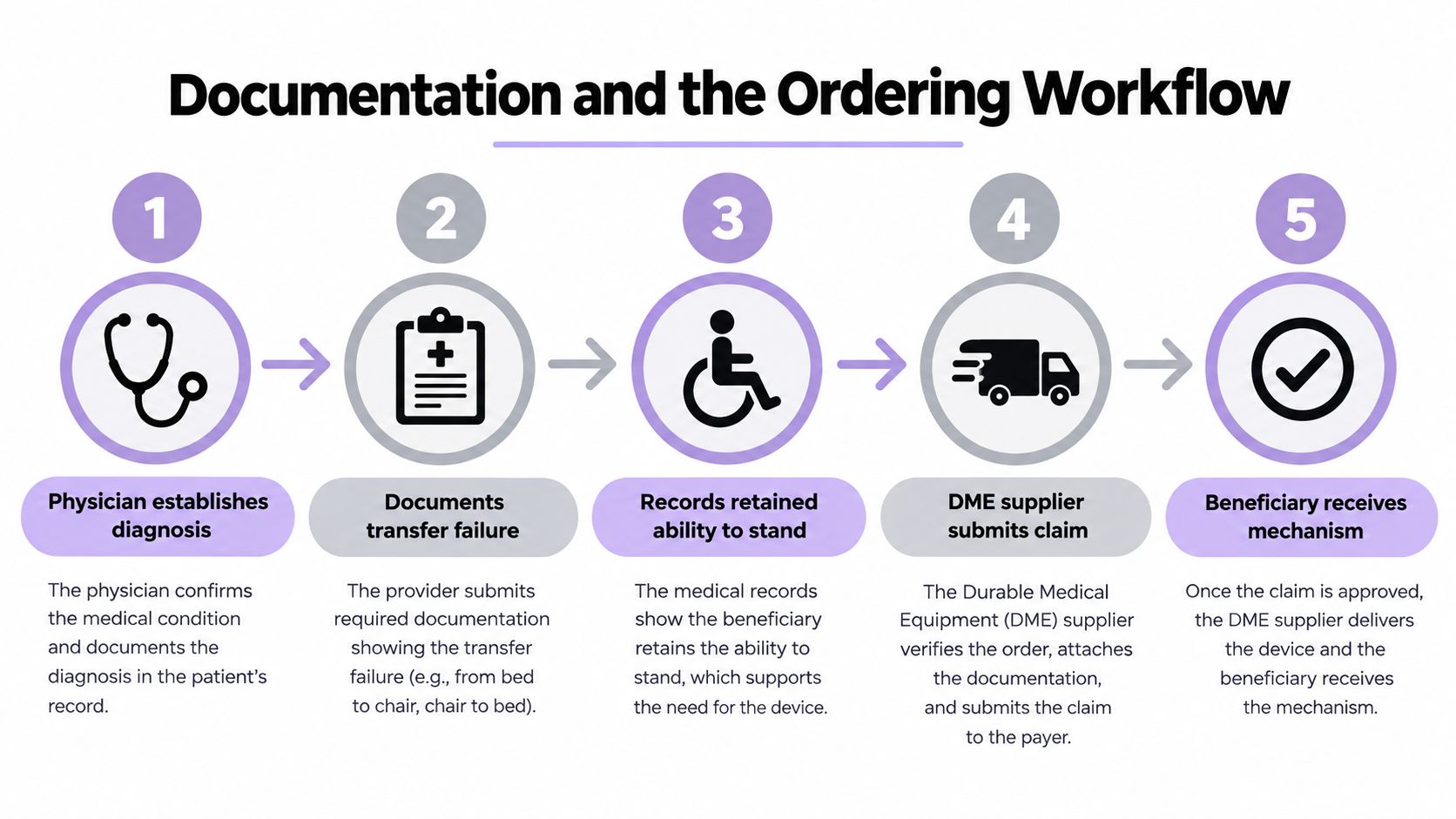
A Medicaid DME training manual calls for a provider order and detailed documentation describing the diagnosis, inability to stand from a normal chair, post-transfer walking capacity, and why a standard chair or caregiver assistance is insufficient (Medica DME documentation training manual).
Start With the Clinical Record
The workflow illustration is a simplified overview, not a promise that submission leads to approval. Its standing-related step also needs careful interpretation: the clinician should record what the patient can do after assisted elevation, including retained walking ability, rather than merely whether the patient can stand.
Prepare for the appointment with concrete observations. Describe the chair used, what happens during an attempted transfer, who helps, and how the person moves once upright.
- Clinician: Establish the diagnosis, assess transfer function, and document relevant treatments and expected benefit.
- Patient or caregiver: Give an accurate account of daily function and available assistance.
- Supplier: Match the ordered equipment to the applicable benefit and obtain the required supporting records.
If you need help understanding the narrative document, this explanation of a letter of medical necessity provides useful background. A letter should support the required forms, not replace them when the plan requires a specific certificate.
Confirm the Administrative Path Before Ordering
Ask the supplier whether it is enrolled or otherwise authorized to serve your Medicaid plan. Don't assume that selling medical equipment means a retailer can submit Medicaid claims for your purchase.
The supplier should then verify the required certificate or state-equivalent form, applicable coding and modifiers, and whether prior authorization is necessary. The Iowa example above illustrates why a generic prescription may not complete the application.
Keep the authorization request consistent with the equipment order. If the clinician requests one type of mechanism but the supplier proposes a different product, resolve that discrepancy before submission.
Finally, request written confirmation of the authorized equipment and your financial responsibility before arranging delivery. Keep copies of the order, assessments, authorization decision, itemized estimate, and communications. Good recordkeeping won't guarantee coverage, but it gives everyone the same information when a question arises.
Appeals, Denials, and Alternatives Worth Knowing
A denial can mean the equipment is excluded, the clinical criteria weren't established, or the submission lacked required information. The next action should match the reason, not repeat the original request.
Respond to the Written Reason
Request the written denial and ask the plan to identify the policy provision it relied on. Follow the appeal instructions and deadlines in that notice rather than assuming every state uses the same process.
- Missing evidence: Ask the clinician or supplier to supply the specific assessment, form, or clarification identified.
- Disputed function: Request a clinical explanation addressing the plan's stated transfer or mobility criterion.
- Benefit exclusion: Ask whether the decision identifies the correct equipment category and what review options remain.
- Further review: Contact the state Medicaid office about the applicable appeal or fair-hearing pathway.
Before resubmitting: Correct the identified problem. Don't change the description of the patient's abilities merely to fit a coverage rule.
Compare Alternatives Without Losing the Clinical Goal
If coverage remains partial or unavailable, ask retailers about financing, open-box equipment, and models without optional comfort upgrades. Compare total financing costs, return conditions, and warranty coverage before choosing.
For an FSA or HSA purchase, confirm the eligibility of the specific expense with the account administrator. Don't assume every furniture feature or service charge qualifies.
Ask whether standard delivery will meet your needs or whether white-glove setup is necessary; either choice can affect the total purchase cost. Bariatric options should be selected for appropriate fit and capacity, not just because a discounted model is available.
If the clinician identifies a different transfer need, compare the equipment categories described in this sit-to-stand lift chair guide. Choose equipment that addresses the actual transfer safely, rather than stretching the medical explanation to match an available benefit.
Your Verification Checklist and Common Questions
Keep a short record beside your phone when contacting the plan. Ask for written answers or the relevant policy document whenever possible.
Coverage Questions to Save
- Exact plan: Confirm the Medicaid program and benefit policy that apply to the member.
- Covered purchase: Ask whether it recognizes E0627, a complete combination chair, or another equipment category.
- Clinical assessment: Find out which functional findings and forms the clinician must provide.
- Authorization: Confirm whether approval is required before ordering and which supplier can submit.
- Other insurance: If the person also has Medicare, ask whether Medicare must process the mechanism first.
- Purchase responsibility: Obtain an itemized estimate and clarification of replacement restrictions.
Common Family Questions
Does using a wheelchair automatically mean denial?
Don't apply a universal answer. The Iowa example contains a specific wheelchair-related exclusion; ask how your own plan evaluates wheelchair use and daily mobility.
What if the person uses a walker?
Explain what the person can do after rising, including the assistance required. Medicare's seat-lift local coverage determination provides a reference for post-standing ambulation, but your Medicaid plan must confirm its own test.
Does having a caregiver disqualify someone?
Caregiver availability and safe transfer assistance aren't necessarily the same thing. Ask which circumstances the policy considers.
When can a chair or mechanism be replaced?
Request the plan's replacement rules rather than assuming a standard interval.
Check the state Medicaid portal and the participating supplier's current instructions before submitting. Save the written policy with your paperwork so your family and clinician are working from the same requirements.
DME Superstore offers lift chairs, transfer aids, and educational guides for comparing home mobility equipment. Visit to review chair specifications and options, then confirm Medicaid coverage and supplier eligibility with your plan before purchasing.
