



A family caregiver often notices the problem before anyone else does. Your loved one spends most of the day in bed, can't turn without help, and now has a red area over the tailbone or heel that doesn't seem to fade. You may be comparing mattresses late at night, wondering whether an alternating pressure pad with pump is necessary, how loud it will be, and whether you could set it up incorrectly.
These systems can provide active pressure redistribution, but they aren't interchangeable inflatable pads. Pump flow, cycle timing, cell design, patient weight, positioning, and the difference between an overlay and a replacement mattress all affect performance. This guide explains those details in practical terms, so you can discuss the right support surface with the person's clinician and avoid buying equipment that doesn't fit the care situation.
Understanding the Alternating Pressure Pad With Pump
When someone can't reposition independently, the same parts of the body may carry pressure for hours. A caregiver might help with meals, medication, and hygiene, yet still worry about what happens between repositioning rounds. An alternating pressure system adds an active layer of support during those stretches.
An alternating pressure pad with pump is a powered support surface made from air cells. The cells connect by hoses to an electric pump, which fills and releases selected cells in a repeating pattern. As some cells soften, neighboring cells continue supporting the body, shifting the areas that carry load. The purpose is to reduce prolonged pressure beneath vulnerable areas, especially where bone sits close to the skin.
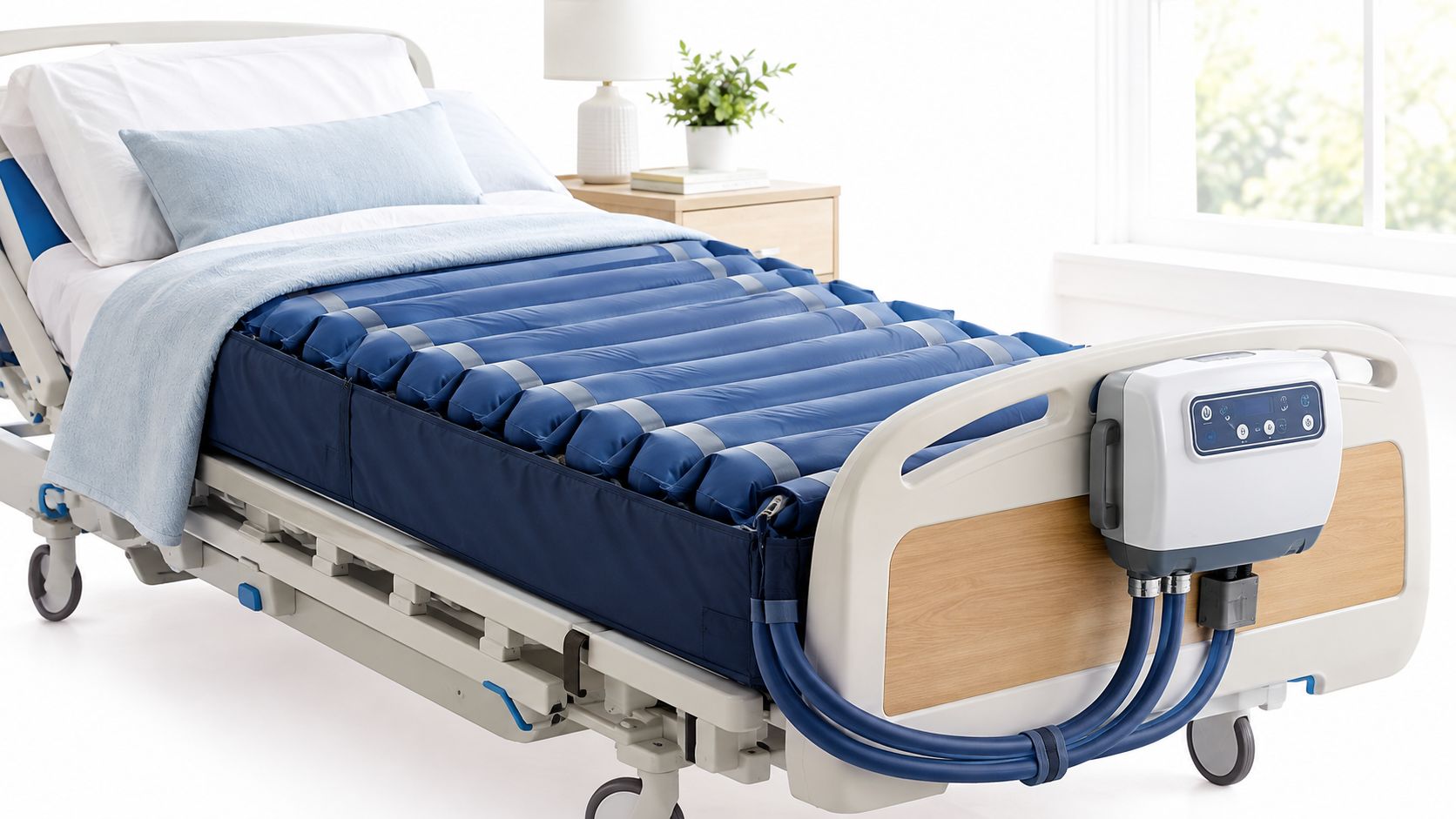
Overlay or replacement mattress
An overlay sits on top of an existing mattress. It can be practical when the underlying mattress is supportive, the person needs an added pressure-management layer, and replacing the entire bed surface isn't appropriate. The base still matters. A sagging or uneven mattress can undermine the overlay's ability to support the body evenly.
A replacement system takes the place of the existing mattress. It provides the complete support surface and may be more suitable when the person has very limited mobility, spends extended periods in bed, or needs a more advanced low-pressure system. The choice should follow an assessment of the person, the bed frame, their weight, positioning needs, and any existing wound.
Practical rule: The pad is only one part of the system. The pump, hoses, mattress base, cover, settings, and daily care routine all influence whether the equipment works as intended.
The cover also touches fragile or sensitive skin, so fabric matters. For broader guidance on choosing materials that feel comfortable against easily irritated skin, review this breathable fabrics for sensitive skin guide. For an example of an overlay-style system, compare the Medline AirOne APP alternating pressure pump and pad.
How Cyclic Inflation Protects Vulnerable Skin
Pressure injuries develop when tissue remains compressed and blood supply becomes inadequate. The sacrum, heels, hips, elbows, and other bony areas deserve special attention because they can bear concentrated pressure when a person lies in one position.
An alternating system changes the contact pattern beneath the body. It doesn't lift the entire person at once. Instead, the pump controls groups of cells so that support moves gradually from one area to another.

The pressure-shifting sequence
Think of the cells as rows of small air cushions. Depending on the model, every second, third, or fourth cell may deflate while the remaining cells stay inflated. The sequence creates a moving support pattern rather than a permanently fixed pressure map.
- The pump fills selected cells. Air enters one group while another group remains inflated or begins releasing air.
- Contact pressure changes. The body settles slightly as a cell softens, reducing the load carried by the tissue above it.
- Neighboring cells support the body. The next group carries more of the load while the first group recovers.
- The pattern repeats. The system continues cycling as long as it has power and remains correctly connected.
The clinical rationale is to imitate the small, regular movements people make naturally during sleep. The evidence base describes natural human movement at roughly 5-minute intervals, while one reviewed model uses a 7.5- or 10-minute cycle to resemble that pattern. These settings aren't universal prescriptions. The correct cycle depends on the equipment and the person's tolerance.
Why interface pressure matters
Interface pressure means the pressure between the body and the support surface. A pad can feel soft while still placing excessive load on the sacrum if its inflation pressure, cell geometry, or sequence is poorly matched to the user.
Laboratory evaluation found that pressure relief was sensitive to inflation pressure, cycle time, and inflation sequence. A low-pressure 2-cell design kept sacral interface pressure below clinically relevant thresholds of 30, 20, and 10 mmHg significantly longer than a 3-cell, high-pressure design, with p < .001 in that evaluation. The finding shows why a product's control logic matters as much as the fact that it contains air cells. (Clinical evidence on alternating-pressure pump systems)
The pump's movement isn't a replacement for skin checks, repositioning, moisture management, or wound care. It's a support tool that can reduce continuous loading while the broader care plan addresses the person's needs. For additional prevention guidance, see this complete guide to preventing pressure ulcers with an air mattress.
Clinical Benefits and When to Upgrade Support Surfaces
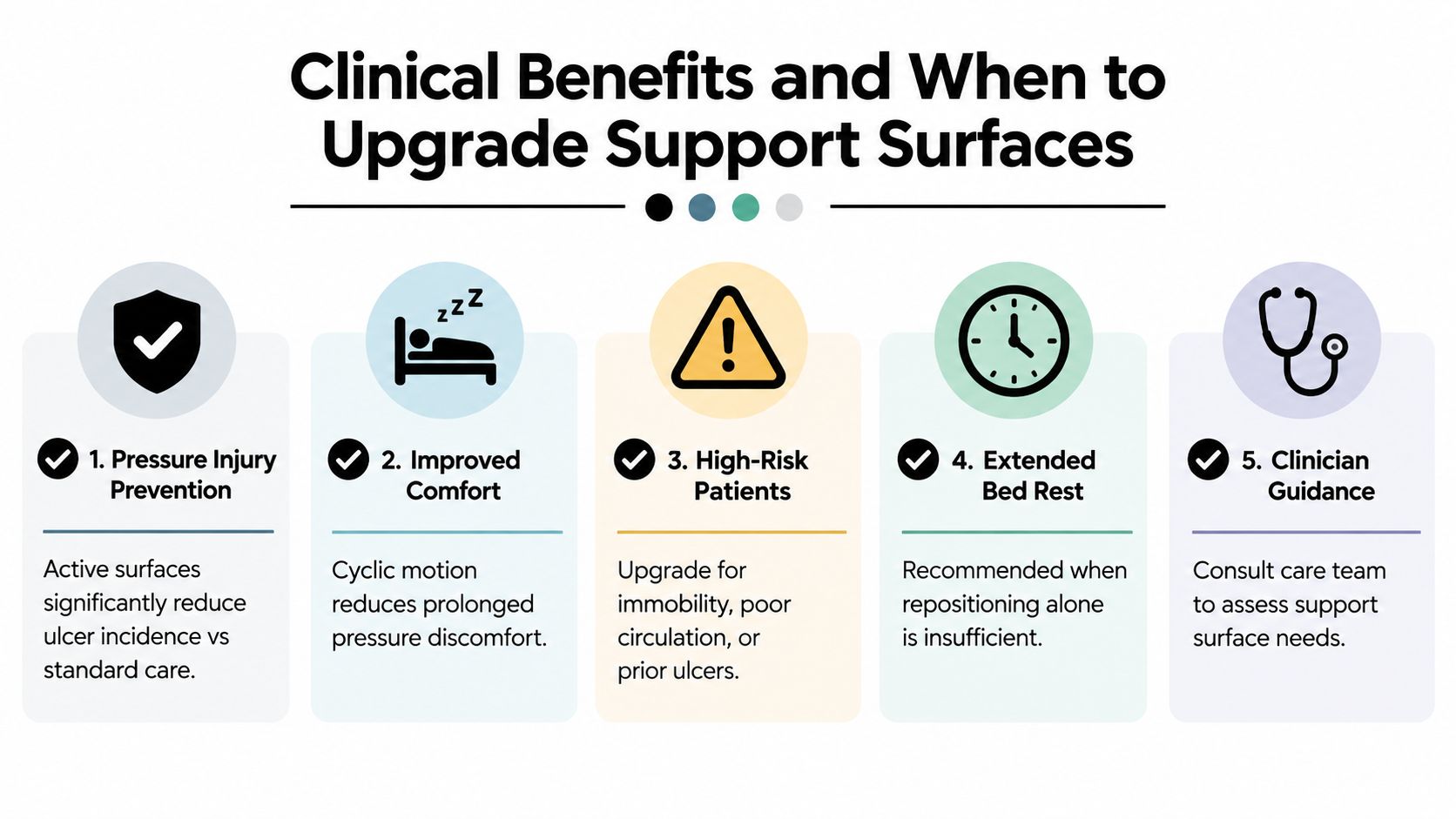
Clinical evidence supports a careful, qualified view of alternating pressure surfaces. A Cochrane review summarized four studies with 830 participants and reported fewer new pressure ulcers with alternating-pressure surfaces than with undefined standard hospital surfaces. The same review reported 83 of 1,125 participants, or 7.4%, developing pressure ulcers on alternating-pressure surfaces, compared with 117 of 1,122, or 10.4%, on foam surfaces. The certainty of that evidence was low, so those results shouldn't be treated as a guarantee for every person or mattress. (Cochrane review of alternating-pressure active air surfaces)
The comparator changes the interpretation. In another trial included in that review, 12 of 186 participants, or 6.5%, using alternating pressure developed a new ulcer, compared with 9 of 172, or 5.2%, using reactive water. That difference illustrates why the question isn't whether active air works. It's which surface is being compared, how the study was designed, and how closely the equipment matches the individual.
Practical signs that a dynamic surface may be needed
The NSW Agency for Clinical Innovation identifies several situations in which clinicians should consider upgrading to a dynamic support surface:
- Positioning fails: The person can't be positioned without leaving pressure on the injury.
- The surface bottoms out: The static support surface no longer keeps the body adequately supported.
- Healing stalls: An existing pressure injury shows no evidence of improvement.
- Red marks appear: Persistent or concerning red areas develop despite the current care plan.
These signs don't tell you which model to buy. They tell you that the current support strategy deserves prompt clinical review. A clinician may recommend an alternating system, another low-pressure surface, a positioning change, or a combination of interventions. (NSW guidance on mattress upgrade and selection)
Prevention isn't the same as wound treatment
A person with an existing wound needs more than an equipment purchase. Guidance cited in the evidence base says people with grade 3 or grade 4 pressure ulcers should at minimum use an alternating pressure mattress or another low-pressure system. The same evidence base also notes limited certainty around how active surfaces affect healing, and it warns that small-cell overlays may be inappropriate in some situations. (NICE pressure ulcer guideline)
For anyone with an open wound, worsening redness, drainage, fever, increasing pain, or a change in skin condition, contact the care team promptly. The surface should support a wound-care plan, not replace assessment or treatment.
A pressure-relief mattress can be one part of a broader setup. This pressure relief mattress resource can help you compare categories, but the clinical decision should account for mobility, wound stage, body shape, weight, and the person's ability to tolerate repositioning.
Key Technical Specifications and Pump Features
Two pads can look similar in a product photograph and behave very differently under a person's body. Read the specification sheet as a clinical document, not just a comfort description.
A useful procurement benchmark describes a powered alternating-pressure overlay with an air pump or blower, sequential inflation and deflation, an inflated cell height of at least 2.5 inches, and cycling characteristics intended to provide adequate lift while keeping interface pressure generally below 32 mmHg. Product specifications commonly list pump flow around 4 to 10 LPM and cycle times from 5 to 20 minutes. These are benchmarks and specification ranges, not universal settings for every patient. (Clinical practice guideline for Pro-care Auto)
Compare the features that affect performance
| Specification | Clinical Benchmark | Why It Matters |
|---|---|---|
| Cell height | At least 2.5 inches for powered overlays in the cited specifications | Adequate height helps the system maintain lift and reduces the risk of bottoming out |
| Pump flow | Commonly around 4 to 10 LPM | Flow affects how quickly cells fill and whether the pump can maintain support |
| Cycle time | Commonly 5 to 20 minutes | Timing changes how often pressure shifts and must suit weight, risk, and turning tolerance |
| Cell pattern | Alternating groups, such as every second, third, or fourth cell | The pattern determines how pressure moves beneath the body |
| Interface pressure | Generally below 32 mmHg in the cited benchmark | Indicates whether the system is designed to reduce concentrated loading |
| Pressure control | Adjustable inflation or comfort control | Allows clinical staff or caregivers to follow the prescribed setup rather than relying on one fixed level |
Flow and timing must work together
A pump with higher flow isn't automatically better. If the cells inflate too aggressively, the surface may feel firm or create unwanted pressure. If flow is too low for the user and mattress, the system may struggle to provide lift, especially when the person is repositioned or the bed angle changes.
Cycle timing also changes tissue response. Research summarized in the clinical guidance reports that 1-in-2 alternating patterns and shorter or longer cycles can materially change pressure distribution. Match the setting to the person's weight, turning tolerance, position, and ulcer risk, rather than choosing a number because it sounds more therapeutic.
A device manual illustrates how manufacturer settings can differ. One listed system presets alternating mode at 10 minutes on 60 Hz power or 12 minutes on 50 Hz power, with a comfort range from 40 to 90 mmHg on its pressure-adjustment knob. Those values describe that model's mechanical configuration, not a safe target for every user. (Alternating pressure and low air loss mattress system manual)
For a product example with pump and pad specifications, review the Drive Medical Med-Aire alternating pressure pump and pad system.
Alternating Air vs High-Specification Foam Mattresses
Powered air isn't automatically superior to high-specification foam. The right comparison asks what the person needs from the surface, how long they stay in bed, whether they can reposition, and whether the household can manage a pump, hose, power connection, and regular checks.
A large NIHR study found similar prevention outcomes overall. Across the trial, 160 of 2,013 patients, or 7.9%, developed at least one grade 2-or-worse ulcer. The alternating-pressure group had 70 of 1,015, or 6.9%, compared with 90 of 998, or 8.9%, in the high-specification foam group, but the final follow-up did not establish a statistically clear advantage for alternating pressure. (NIHR summary of pressure-redistributing mattresses)
What each surface adds
| Alternating air pad with pump | High-specification foam mattress |
|---|---|
| Continuously shifts support through programmed cell changes | Provides static pressure redistribution through material design |
| Requires electricity and a functioning pump | Needs no power |
| May create pump noise or a changing sensation | Operates silently |
| Requires setup, hose management, and monitoring | Usually simpler to install and maintain |
| Can be appropriate when static support no longer meets the need | May be sufficient when risk and mobility are lower |
Cochrane found uncertainty when alternating-pressure surfaces were compared with other reactive surfaces, while suggesting possible benefit against standard foam in some settings. That mixed evidence supports individualized selection rather than a universal upgrade rule.
A quieter, simpler foam surface may be the more sensible choice when it provides adequate support. Active air becomes more compelling when pressure management has outgrown static comfort.
Comfort also includes the surrounding environment. If you're evaluating a pad for a guest bed, convertible setup, or temporary sleeping surface, this guide to a pull-out mattress pad at Meliusly may help with general mattress-fit considerations. It isn't a substitute for clinical pressure management, but it highlights why the underlying bed arrangement matters.
Sizing Setup and Daily Maintenance Best Practices
Correct setup starts with the person, not the ulcer grade. Clinical guidance says alternating pressure equipment should be allocated according to patient weight, and the inflated cells must support the body in every position, including when the backrest or knee break is raised. A pad that works while someone lies flat may not provide the same support when the bed is articulated.
A practical setup sequence
- Confirm the weight range. Check the manufacturer's minimum and maximum user weight, then verify that the chosen overlay or replacement system fits the bed frame.
- Inspect the base. For an overlay, make sure the mattress underneath is stable, level, and free from deep sagging.
- Secure the pad. Follow the manufacturer's orientation marks and straps. Keep the air cells aligned with the body rather than shifted toward the head or foot.
- Connect the hoses. Push each connection fully into place. Route hoses away from wheels, feet, bed mechanisms, and sharp edges.
- Inflate before transfer. Allow the system to reach operating support before placing the person on it, following the product manual.
- Check support in working positions. Test the surface with the backrest and knee break raised if those positions are part of daily care.
- Adjust only as directed. Use the pressure control to match the user and the manufacturer's guidance. Don't compensate for an unsuitable weight range by turning the dial to an extreme.
Daily checks prevent small faults from becoming clinical problems
Run your hand over the surface and look for cells that stay flat, disconnected hoses, unusual alarms, or a pump that runs continuously. Listen for hissing and inspect the cover for tears. A loss-of-pressure alarm may indicate a loose connector, kinked hose, puncture, or pump problem, so don't silence it and assume the mattress is still therapeutic.
Keep the cover clean according to the manufacturer's instructions, dry it fully before replacing sheets, and avoid tight bedding that restricts cell movement. Never place sharp objects beneath the user, and keep the pump's air intake clear.
Escalation point: If the mattress bottoms out, the person develops persistent redness, or the system can't maintain inflation, contact the clinician or supplier rather than improvising a repair.
For practical cleaning concerns after incontinence, consult this guide on removing urine smell from a mattress. The product manual remains the authority for disinfectants, drying, and component care.
Choosing the Right Model for Your Care Environment
A caregiver may choose an alternating pressure pad that fits the bed but still fails to support the person properly. Select the model by matching the user's weight, mobility, wound status, body position, and time in bed with the bed frame, room layout, outlet access, caregiver availability, and tolerance for pump noise or movement.
For a higher body weight, confirm the system's rated capacity and whether its pump can maintain lift across the full surface. A pump with inadequate flow may leave cells underinflated, even when the dial is set high. In a small bedroom, place the pump where it will not block walking paths or pull on hoses. If the head or knee section is raised during care, verify that the cells continue supporting the body in those positions.
Match the system to the clinical situation
- Overlay system: Use it when the existing mattress is suitable and the clinician considers an added powered layer appropriate.
- Replacement system: Choose it when the current mattress is inadequate or a complete therapeutic support surface is needed.
- Low-pressure system: Discuss it with the care team for a serious existing wound, especially a grade 3 or grade 4 injury.
- Hybrid surface: Ask whether features such as low air loss address moisture or microclimate concerns in the care plan.
Before ordering, check weight capacity, dimensions, inflated cell height, pump flow, cycle timing, cycle options, power requirements, warranty coverage, replacement parts, and return policy. Cycle timing determines how long each group of cells stays inflated, while flow affects how reliably the system reaches and maintains its intended pressure. These controls should suit the user and the care plan, not compensate for an unsuitable weight range.
Confirm that the system fits the bed's width, length, side rails, and articulation. A useful overview of mattress categories and selection considerations is this detailed guide to medical air mattresses. DME Superstore offers alternating-pressure and low-air-loss systems with product specifications, compatibility information, warranty details, financing through Affirm, FSA/HSA eligibility, and chat-based support.
Do not purchase based on “alternating pressure” alone. Ask the care team what support level is appropriate, then compare flow, cycle control, weight range, cell height, fit, and service terms against that recommendation.
DME Superstore also lists alternating-pressure and low-air-loss systems for home care. Visit DME Superstore to review models, payment options, and chat support before choosing an alternating pressure pad with pump.
