



Margaret is 72 and standing in a pharmacy aisle with two canes in her hands. One is a plain adjustable aluminum model. The other has a polished shaft and a handle that looks more comfortable. Her therapist recommended a cane, but nobody explained what to check before she bought one. She's wondering whether the lighter cane is safer, whether the handle will suit her arthritic fingers, and whether either tip will grip the tile at home.
That hesitation is reasonable. A metal walking cane isn't safe because its shaft is made from aluminum, steel, or another strong material. Fit, tip condition, handle comfort, and walking technique determine whether the cane supports your balance or becomes one more thing to trip over. The guidance below is the conversation Margaret needed before choosing.
What a Metal Walking Cane Really Does for You
Margaret first needed to understand what a cane could and couldn't do. A cane is a balance and weight-sharing tool, not a replacement for a crutch and not merely a fashion accessory. Medical guidance notes that a properly used cane can support roughly 15% to 20% of a patient's body weight, depending on the person and the situation. Clinical guidance on cane use and gait mechanics explains why correct positioning matters more than carrying a cane.
A cane performs three practical jobs:
- It widens your base of support. The cane tip gives you another contact point with the floor, helping you steady yourself when your weaker leg feels uncertain.
- It gives your hand information. Pressure and movement through the shaft provide a sensory point of contact, which can help you judge uneven pavement, rugs, or a change in flooring.
- It communicates your needs. A visible cane signals that you may need more space, a slower pace, or extra time at a doorway or checkout line.
The right cane also depends on why you need it. Someone recovering briefly after knee surgery may need a height-adjustable model during rehabilitation, then move away from it as strength returns. Someone managing long-term arthritis may need a dependable everyday aid, a comfortable handle, and replacement tips that are easy to find. For background on how arthritis can affect pain and movement, the Interventional Pain Management arthritis guide offers useful medical context.
When a cane isn't enough
A cane may be the wrong device for someone with significant weakness in both legs, poor coordination on both sides, or a recent stroke affecting balance. Those situations may call for a walker, rollator, or more supervised rehabilitation plan. A guide to canes for older adults can help families compare basic options, but a clinician should assess anyone whose balance is deteriorating or who has fallen repeatedly.
A large U.S. study of older adults found that mobility-device use is closely tied to fall risk. Among older adults with a prior fall history, 49.6% fell again the following year, compared with 21.1% of people with no device use and no prior falls. The same research also notes that an average of 129 Americans age 65 and older were treated each day from 2001 to 2006 for falls involving walkers and canes, totaling more than 47,000 injuries annually. The full study and its cited injury analysis show why choosing and following up on a cane deserves care.
Margaret left the pharmacy with an adjustable cane that matched her body and her reason for using it. She didn't leave believing that metal alone would prevent a fall. She left ready to learn how the material, fit, tip, and her own technique would work together.
Aluminum, Steel, and Titanium Compared
Think of cane materials as familiar kitchen objects. Aluminum feels like a lightweight everyday pot, steel resembles a cast-iron skillet, and titanium is closer to a high-end bicycle frame. The analogy isn't perfect, but it makes the main trade-off clear: lighter materials are easier to carry, while heavier materials can feel more substantial under repeated loading.
Aluminum is the most practical starting point for many users. It's lightweight, resists corrosion, and can be formed into adjustable shafts. A durable design typically pairs an anodized aluminum shaft with stainless-steel adjustment hardware, because stainless steel resists deformation and abrasion. Procurement guidance recommends a stainless-steel adjustment pin at least 6 mm in diameter, with electroplating to reduce corrosion risk. This cane construction guidance provides the relevant specification.
Steel can feel solid and reassuring, especially in a fixed-length cane. That strength comes with extra weight, which may matter to someone who carries the cane during long outings or has limited arm endurance. A chipped finish can also expose steel to rust, so the coating and storage conditions deserve attention.
Titanium occupies a specialty position. It can offer a strong, lightweight shaft, but buyers may encounter fewer choices and higher prices. It makes the most sense when reducing hand and arm fatigue is a major priority and the buyer accepts the added cost of a premium construction.
A practical material comparison
| Property | Aluminum | Steel | Titanium |
|---|---|---|---|
| Typical role | Adjustable everyday cane | Fixed-length or heavy-duty cane | Premium lightweight or specialty cane |
| Main advantage | Light, corrosion-resistant, and easy to adjust | Substantial feel and strong repeated loading | High strength with low weight |
| Main concern | Can dent if mishandled | Heavier and vulnerable to rust if the finish chips | Usually costs more and may offer fewer options |
| Best fit | Most older adults who need daily adjustability | Short trips or users who prefer a heavier feel | Users prioritizing low weight for frequent use |
Independent product data show how aluminum canes combine adjustable geometry with defined limits. One aluminum cane class is specified from 75 cm to 97.5 cm in height with a 135 kg maximum user weight, while a multi-foot model uses aluminum in the upper tube and steel in the lower and base sections with a 100 kg maximum load. Research on cane-assisted gait found inexperienced users transferred about 7.2 ± 2.5% of body weight through the cane before training. The World Health Organization walking-cane specification document helps explain why shaft strength, handle stiffness, and technique all matter.
For most older adults, aluminum is the sensible default. Steel suits stationary use or short trips when a heavier feel is acceptable. Titanium suits a buyer willing to pay for lower weight during demanding daily use. For a familiar example of an adjustable aluminum design, see the Medline aluminum offset cane with gel grip.
Metal vs Wood and Carbon Fiber Walking Canes
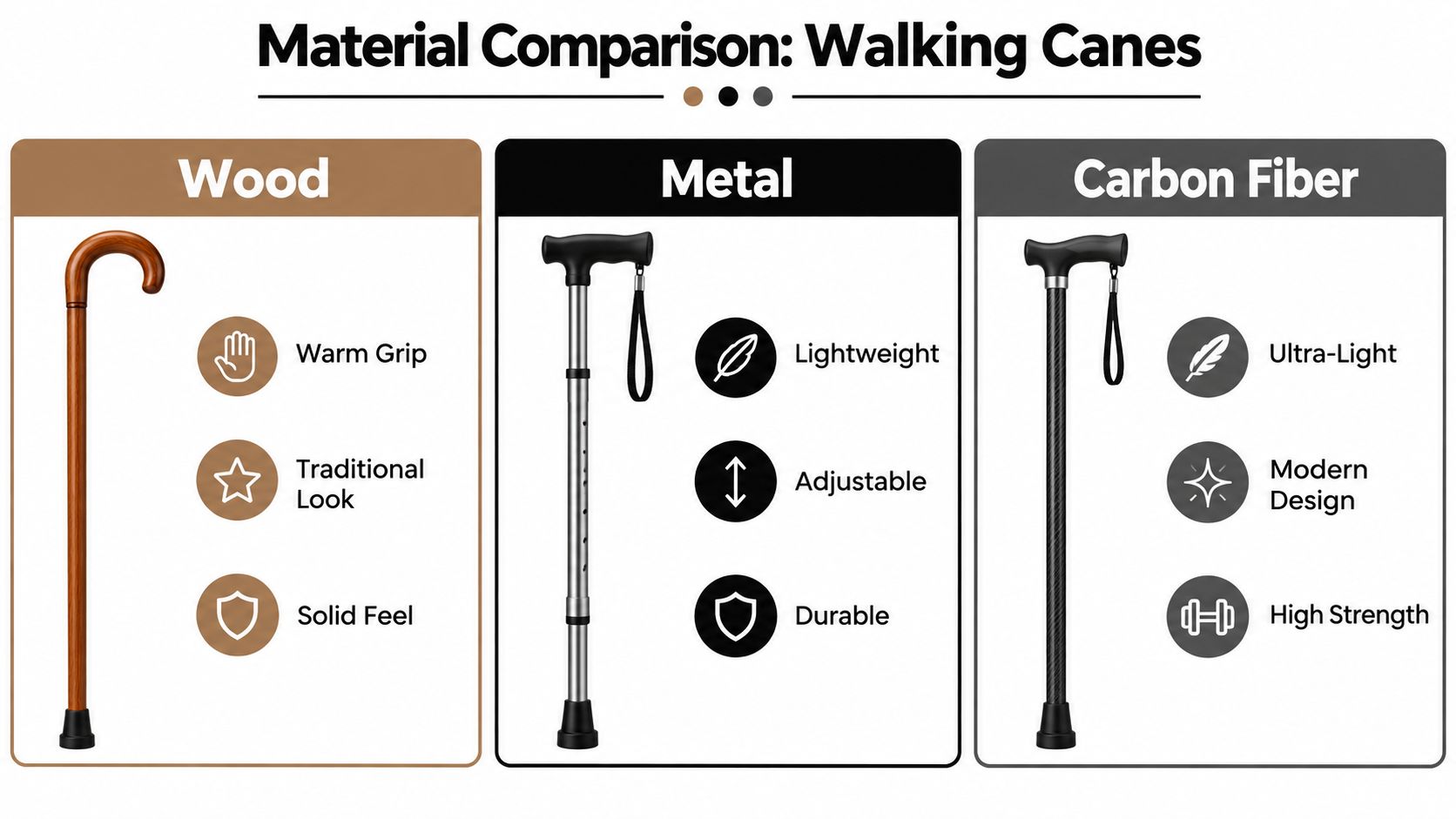
Metal sits between traditional wood and newer carbon fiber. That doesn't make it universally superior. It makes metal useful for people who want a blend of adjustability, serviceability, and everyday durability.
A wood cane offers warmth in the hand and a classic appearance. Crook and derby handles can feel familiar, and a fixed shaft may appeal to someone who wants a traditional object rather than a medical-looking aid. Wood can't be adjusted after manufacture, however, and a drop or damp storage can lead to cracking, splintering, or other damage.
Carbon fiber appeals to travelers and users who count every ounce. It absorbs vibration well, resists corrosion, and can provide a modern appearance. The trade-offs are practical. Carbon fiber models can cost considerably more than metal, may offer fewer handle choices, and may have a smaller ecosystem of replacement parts.
Choose around the user, not the label
A wood cane may suit someone who values appearance, warmth, and a fixed height. Carbon fiber may suit a frequent traveler who wants a very light aid and accepts limited repair options. Metal is often the most forgiving choice for long-term daily use because the shaft can be adjusted, tips and ferrules are commonly replaceable, and designs range from basic pharmacy models to decorative shafts.
The serviceability point deserves more attention than it receives. A cane eventually needs a new tip, an adjustment pin may need checking, and a handle may need replacement or tightening. A material that supports ordinary maintenance can remain useful longer than a technically advanced model that's difficult to repair.
Metal also offers useful design variety. Folding aluminum canes can fit into a car or travel bag, while offset handles can help place the user's weight more directly above the tip. Those features may improve convenience, but they don't remove the need for correct fitting.
The decision is therefore straightforward:
- Choose wood for a fixed-height cane with traditional appearance and a warm hand feel.
- Choose carbon fiber when minimal weight and vibration control matter more than price or replacement convenience.
- Choose metal when you want adjustable length, familiar replacement parts, and predictable everyday maintenance.
The strongest material on paper won't help if the cane stays in a closet because the grip hurts or the height feels wrong.
How to Fit a Metal Cane to Your Body
A cane should be fitted to your body, shoes, posture, and usual walking conditions. Use the shoes you normally wear, stand on a flat surface, and ask another person to check your position if possible.
Start at the wrist crease
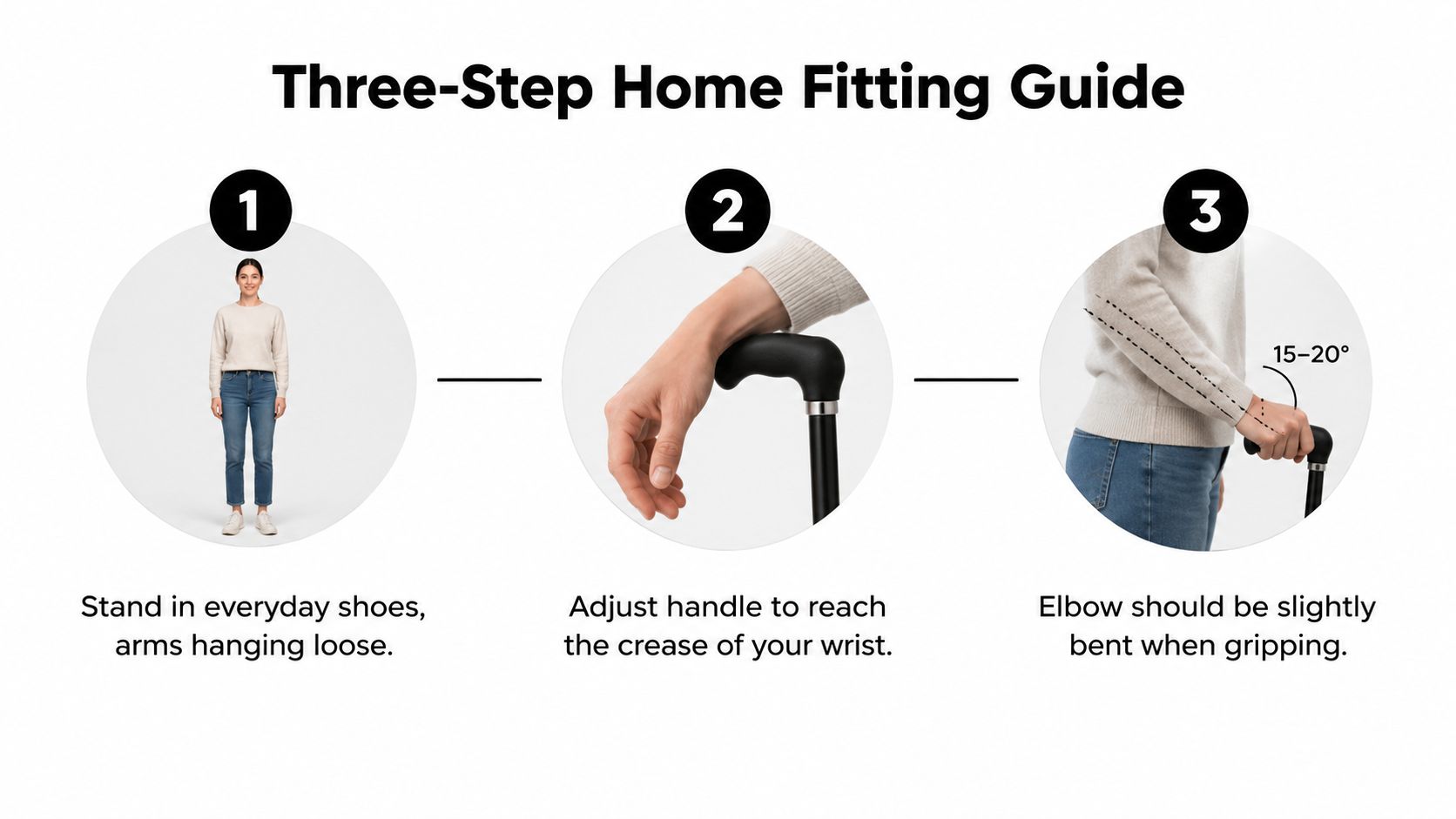
Stand upright with your arms relaxed at your sides. The top of the handle should reach the crease of your wrist, not your fingertips. This rule gives the cane a useful starting height while avoiding the common mistake of choosing a shaft that is too short.
If the handle sits too low, you may lean toward the cane and hike your shoulder. If it sits too high, you may bend your arm excessively and struggle to place the tip accurately. An adjustable aluminum shaft makes these corrections simple, but the locking mechanism must engage completely after adjustment.
Check your elbow and tip
Grip the handle while standing naturally. Your elbow should remain bent about 15 to 20 degrees, a position repeated in medical fitting guidance because it supports efficient control and weight transfer. The American Academy of Family Physicians fitting guidance also places the cane tip roughly 15 cm, or about 6 inches, from the lateral edge of the toes.
Place the tip beside the foot, in line with the toes. Don't let the cane cross in front of your legs, where it can interfere with your steps. A short self-check helps: while holding the cane correctly, see whether the heel of the opposite foot can lift slightly as the cane bears some weight. If your shoulder rises or your torso tilts, revisit the height.
For a push-button cane, press the button, extend or shorten the shaft, and confirm that the button has fully emerged through one adjustment hole. For a twist-lock cane, tighten the collar firmly without forcing it. If leg swelling or footwear changes make your height feel different later in the day, ask a clinician to verify the setting rather than repeatedly guessing.
Watch this fitting demonstration after reading the steps:
A fixed-length cane can be appropriate when a professional has measured it accurately and the user won't share it with anyone else. An adjustable cane is more practical for changing shoes, travel, or a caregiver who needs to fine-tune the setting.
Handle Shapes and Cane Tips That Change Everything
The handle is where your hand controls the cane, while the tip is where the cane meets the ground. A good shaft with the wrong combination can still feel unstable, painful, or awkward.
A derby handle suits many older adults because it provides a broad, familiar place to rest the hand. An ergonomic palm grip can reduce concentrated pressure for someone with arthritis, provided the left- or right-hand shape matches the user. An offset handle places the grip more directly above the shaft, helping transfer pressure down toward the tip.
Match the hand to the handle
| Handle + Tip Pair | Best For | Watch Out For |
|---|---|---|
| Derby handle + single rubber tip | General indoor and outdoor walking | Replace the tip when its tread becomes smooth |
| Ergonomic palm grip + single rubber tip | Arthritis, tender joints, or reduced grip tolerance | Hand-specific designs may not suit both sides |
| Offset handle + quad base | Users wanting a broad support footprint | The larger base can catch on rugs or feel less nimble |
| Fritz handle + articulating tip | Users who want a traditional grip with ground contact that follows movement | Moving parts need regular inspection |
| T-grip + compact rubber tip | Users who prefer a simple, narrow grip for short use | It may offer less palm support during heavier loading |
| Crook handle + self-standing tip | Users who need to set the cane down and retrieve it easily | The base can add weight and affect placement |
Tip choice should follow the surfaces you use. A single rubber tip is generally practical for tile, hardwood, linoleum, pavement, and other ordinary walking surfaces. A quad base can provide a broader footprint, but its extra width may reduce maneuverability around furniture and rugs. Specialized ice-pick or articulating designs belong in specific outdoor conditions, not as automatic upgrades for indoor use.
A worn rubber tip is one of the most common ways a sound cane becomes unsafe. Look for cracks, thinning, hardening, or a smooth contact patch. A cane that slips on a clean floor may need a new tip before it needs a new shaft.
For a compact example that combines portability and a pivoting contact point, review the Nova folding cane with pivot tip. A self-standing design can also be convenient beside a bed, although it shouldn't replace good lighting and a clear path during nighttime trips.
Weight Capacity, Safety, and Everyday Technique
A product's weight rating is not a suggestion. It tells you the maximum load the manufacturer has assigned to that model, and it should be considered alongside how heavily the user leans on the cane.
Some manufacturer guidance lists maximum patient weights of 100 kg for folding canes and 110 kg for other models. The relevant walking-cane instruction manual shows why buyers should read the specific model's limit instead of assuming that every metal cane has the same capacity. A person's body weight, clothing, and anything carried against the cane all affect real-world loading.
Use the cane on the opposite side
Hold the cane on the side opposite the weaker or painful leg. If the right knee hurts, hold the cane in the left hand. This arrangement helps shift load away from the affected side while keeping the cane and weaker leg working together.
The normal sequence is simple:
- Move the cane and weaker leg forward together.
- Place the cane securely before shifting weight.
- Step through with the stronger leg.
- Repeat without rushing.
On stairs, use the railing whenever it's available. Going up, lead with the stronger leg. Going down, move the cane and weaker leg first, then bring the stronger leg to the same step.
Safety rule: The cane should assist your movement, not pull you sideways or force you to reach across your body.
Inspect before a small problem becomes a fall
Check the joint for wobble, squeeze the tip to feel for weakness, and look for a bent shaft or cracked handgrip. Retire a cane with a new creak, dent, loose adjustment pin, or tip worn flat until it has been repaired or replaced.
These checks matter because cane users are already a higher-risk group. In one home-care cohort, cane use was associated with an overall fall-rate IRR of 1.42, with an IRR of 1.60 for men and 1.28 for women using a cane indoors. In adults with spinal cord injury, cane users had 160% greater numbers of fall-related injuries, corresponding to a relative risk of 2.60. The epidemiological review provides context for treating fit, training, and equipment condition as part of safety rather than optional extras.
For additional guidance on selecting the right level of support, see this practical resource on support for walking.
Care, Maintenance, and Buying Checklist
A metal cane doesn't need complicated maintenance. It needs regular attention to the small parts that touch your hand, your body, and the floor.
Follow a simple monthly routine
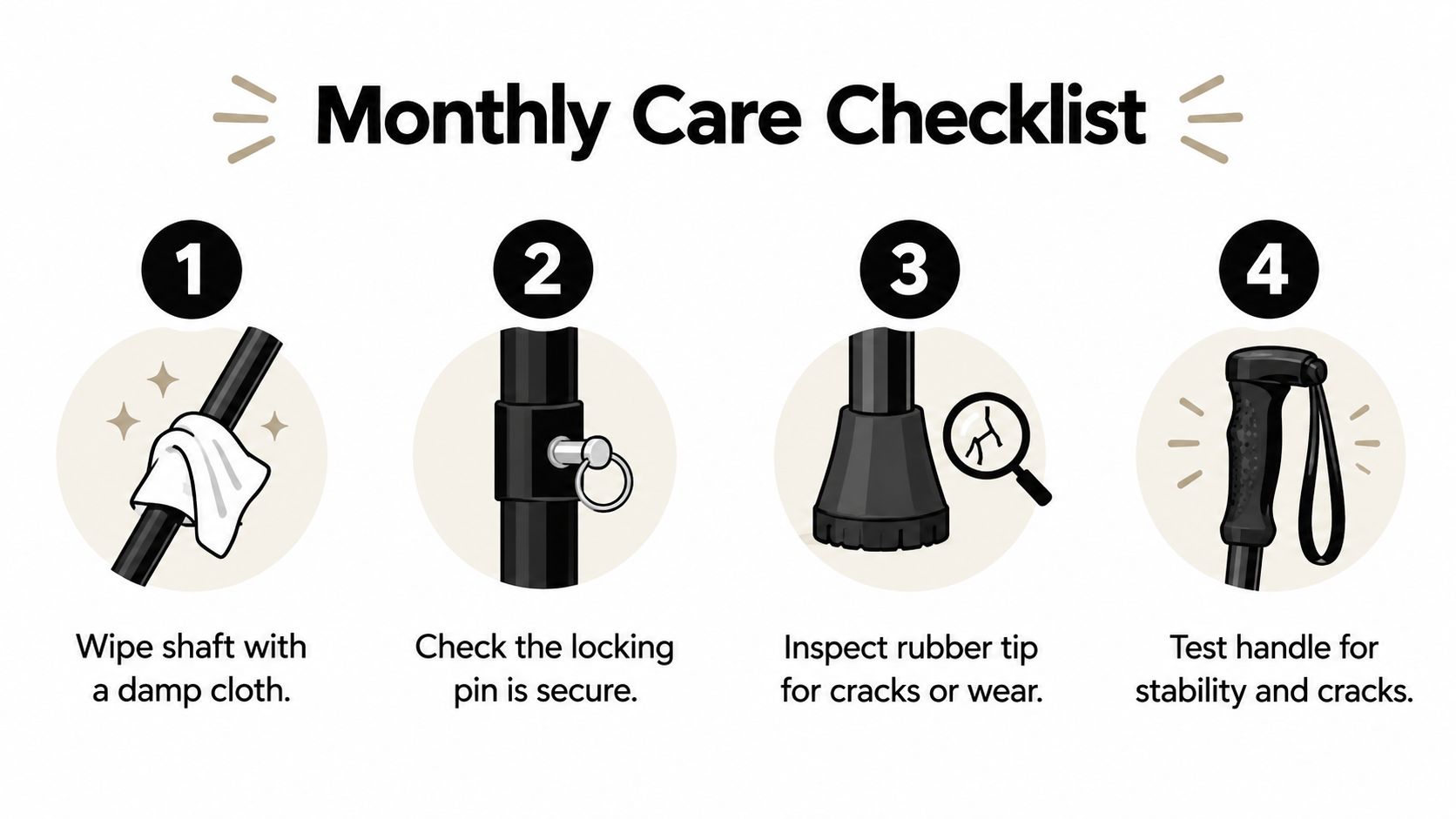
Wipe the shaft with a damp cloth, then dry it before storage. On an adjustable aluminum cane, press and release the locking pin to confirm that it moves cleanly and sits securely in the selected hole. Don't use a cane if the button only partially engages.
Inspect the rubber tip for cracks, missing material, hardened rubber, or a tread that has worn flat. Check the handle for looseness, cracks, sharp edges, or damaged fasteners. A replacement tip can matter more than buying a completely new cane when the shaft and handle remain sound, but the replacement must match the shaft diameter and model.
Store the cane in a dry area away from prolonged dampness. Avoid leaving it in a wet closet or a hot, cluttered car trunk, where moisture and rough handling can affect the finish, locking hardware, and tip. Replacement components are easier to manage when you know the cane's brand, shaft diameter, and tip style. A parts guide for walking cane replacement components can help you identify what needs changing.
A caregiver-ready checklist
Print or copy this list into your phone before shopping:
- Confirm the need: Is the cane appropriate, or does the user need a walker or rollator?
- Check the height: Does the handle reach the wrist crease in everyday shoes?
- Confirm the elbow: Does the user maintain a comfortable 15 to 20 degree bend?
- Choose the handle: Does it match grip strength, arthritis, hand size, and hand preference?
- Match the tip: Is the tip suited to indoor floors, pavement, rugs, or specialized outdoor conditions?
- Read the rating: Does the stated maximum patient weight suit the user's needs?
- Test the lock: Does the adjustment pin fully engage without wobble?
- Inspect the base: Is the rubber intact, flexible, and evenly shaped?
- Plan replacements: Can you easily obtain the correct tip and other compatible parts?
- Practice the sequence: Can the user move the cane and weaker leg together without crossing the cane in front?
The best purchase is the one the user can adjust, grip, place, and maintain without hesitation.
Putting It All Together for Long-Term Confidence
A month after her pharmacy visit, Margaret no longer compared canes by appearance alone. She checked her height in the shoes she wore most often, kept her cane on the side opposite her painful leg, and replaced the tip when its contact surface began to look worn. The cane felt ordinary because she had made its use routine.
Four habits support that confidence: correct height, an intact tip, a secure and comfortable grip, and consistent inspection. Recheck the fit at least yearly, and reassess it sooner if posture, footwear, strength, or swelling changes. Replace a tip every six to twelve months when its condition requires it, rather than waiting for a fixed date if wear appears earlier.
The choice between aluminum, steel, and titanium matters, but it matters less than whether the cane suits the person using it. A lighter shaft can be easier to carry, while a stronger or heavier model may suit a different user. None of those advantages can compensate for a loose handle, a worn tip, the wrong height, or a cane held on the painful side.
A metal walking cane prevents falls only when the person using it trusts it. Trust comes from fit, function, and small routines repeated often.
DME Superstore offers adjustable canes, quad canes, folding models, replacement parts, and other mobility equipment for older adults, caregivers, and rehabilitation needs. Visit DME Superstore to compare cane specifications, compatible accessories, and support options before choosing the model that fits your daily routine.
