



You've returned from an outing, the battery gauge is low, and the usual charger isn't where you left it. A spare from another scooter fits the socket, so it's tempting to plug it in. But a matching plug doesn't mean matching electronics, and the wrong charger can leave the pack overheating instead of charging safely.
Learning how to charge a mobility scooter battery starts with identifying the pack and its approved charger. The charging routine then follows the battery chemistry, while the room you choose determines whether you can supervise it without blocking your escape route.
Identify Your Battery Type and Charger Before You Plug In
Check the battery label before choosing a charger. AGM and gel batteries can sit in similar heavy cases, but their charging settings differ. A familiar-looking plug is not enough to confirm compatibility.
Scooter battery types and what each needs
| Battery type | How to recognise it | Charging behaviour | Main risk |
|---|---|---|---|
| Sealed lead-acid (AGM) | Heavy sealed case, often labelled AGM or sealed; may use two 12 V batteries | Three stages: bulk, absorption, then float | Overcharging can cause heating, gassing and electrolyte loss |
| Gel (VRLA) | Sealed pack labelled gel or VRLA, often in a heavy case | Lower absorption voltage than AGM; use the charger's gel setting | Excessive voltage can permanently damage gel cells |
| Lithium-ion | Often a lighter or removable pack labelled lithium or Li-ion, usually with a built-in management system | Constant current, then constant voltage, stopping at full charge | Overcharging or battery damage can cause overheating and fire |
| Unknown pack | Label missing or unreadable | Do not charge until the chemistry and approved charger are identified | Check the scooter manual or contact the seller before charging |
VRLA means valve-regulated lead-acid; it does not identify a gel battery by itself. Check for an explicit AGM or gel label before selecting a charger setting.
Check the charger label
Compatibility depends on the charger's output voltage, current rating and connector polarity as specified by the scooter or battery manufacturer. Check those details along with the physical connector:
- Output voltage: Match the specified charger output, not just the battery's nominal voltage.
- Current rating: Use the approved rating rather than choosing a stronger charger to charge faster.
- Connector fit: Pins and keyways must match without force.
- Polarity: Identical-looking connectors can have different positive and negative connections.
A generic adapter may bypass protections the original system relies on. The guide to battery chargers for scooters explains what to compare on charger labels. Use the scooter or battery manual to confirm the correct charger model before plugging it in.
How to Charge Lead-Acid and Gel Batteries Step by Step
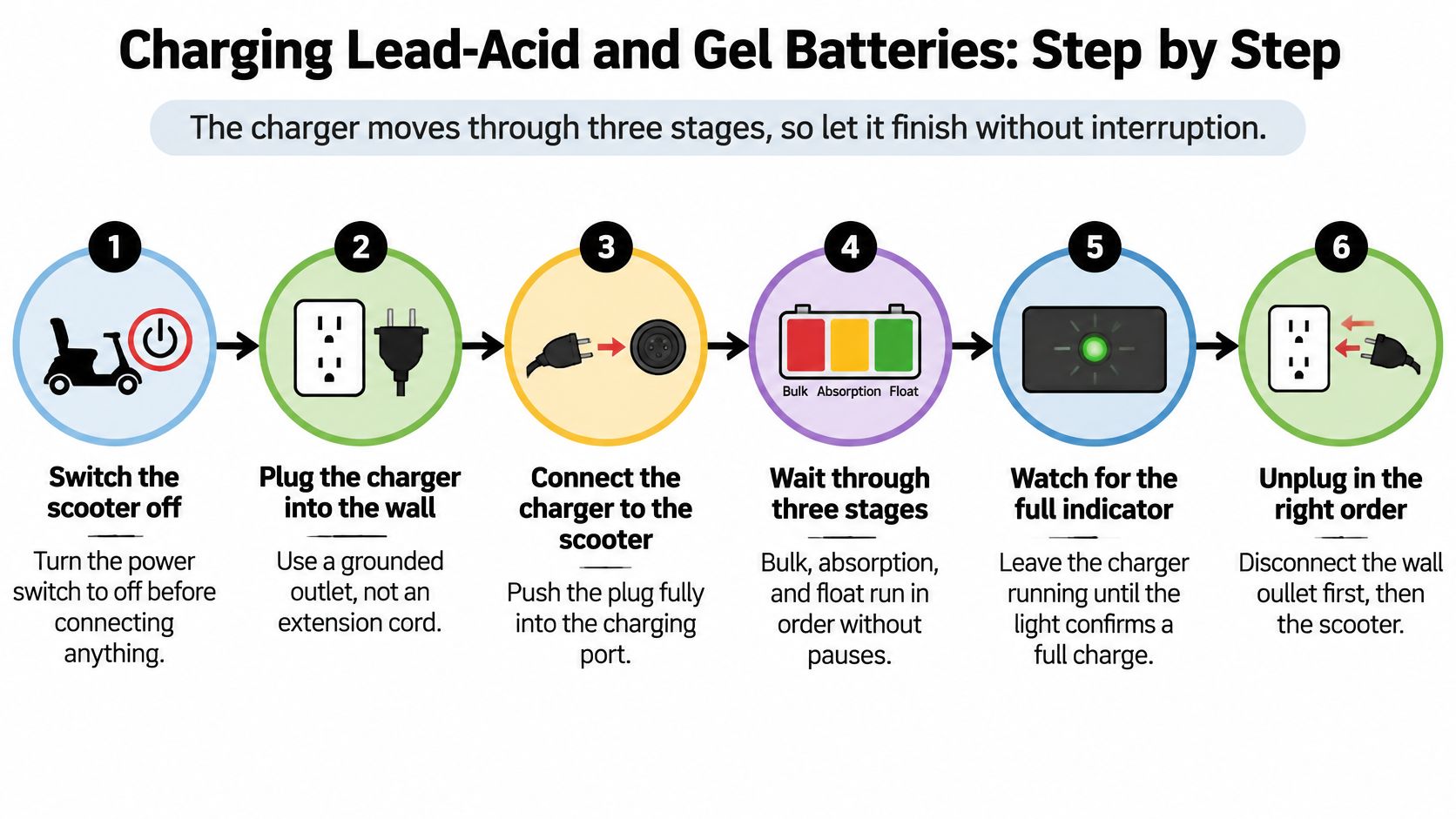
The approved charger moves through bulk, absorption and float. Your job is to let it complete that sequence without unnecessary interruptions, while remaining available to notice a fault.
Follow the connection sequence
- Switch the scooter off. Remove the key if fitted so nobody accidentally operates it during charging.
- Inspect the battery and connector. Look for swelling, corrosion, frayed wiring or moisture. Don't connect damaged or wet equipment.
- Park in a cool, ventilated spot. Keep the charger on a hard, stable surface away from paper, curtains and upholstery so heat can dissipate.
- Connect the charger to the scooter, then the wall outlet. Seat the plug fully without forcing it. If your manufacturer specifies a different sequence, follow that sequence.
- Wait for the completion indication. Absorption finishes charging after the initial bulk stage, so an apparently high battery gauge isn't a reason to disconnect early.
- Disconnect mains power first, then the scooter. Follow any shutdown procedure in the manual and pull plugs by their bodies, not their cables.
- Record the indicator state and charging time. A simple log helps you notice when a familiar charging pattern changes.
Use the written sequence and your manual if the connection order shown in a diagram differs.
Understand the voltage and lights
The Victron Energy lead-acid charging guide gives benchmarks of approximately 2.30 V per cell for float and up to 2.45 V per cell for faster charging, corresponding to roughly 13.8–14.7 V for a nominal 12 V battery. These are technical references, not settings to apply blindly; the scooter manufacturer's specification takes precedence.
After absorption, the charger reduces voltage to float rather than continuously applying the higher charging voltage. Excessive voltage can cause heating, gassing and electrolyte loss; insufficient charging encourages sulfation and lost usable capacity. Gel batteries need their specified profile, not an improvised AGM setting.
Indicator rule: Green doesn't universally mean full. Check what steady lights, flashing lights and alternating colours mean for your exact charger.
The overview of mobility scooter batteries helps distinguish replacement types before you order. A normal charge shows the expected indicator progression without unusual warmth, smells or interruptions.
How to Charge Lithium-Ion Scooter Batteries
Unlike lead-acid systems that use a float stage, lithium-ion packs shouldn't remain connected after reaching full charge. Their charging cycle can be shorter, but the manual, battery condition and approved charger determine the actual duration.
A removable pack gives you more choice about where to charge, not permission to leave it unattended.
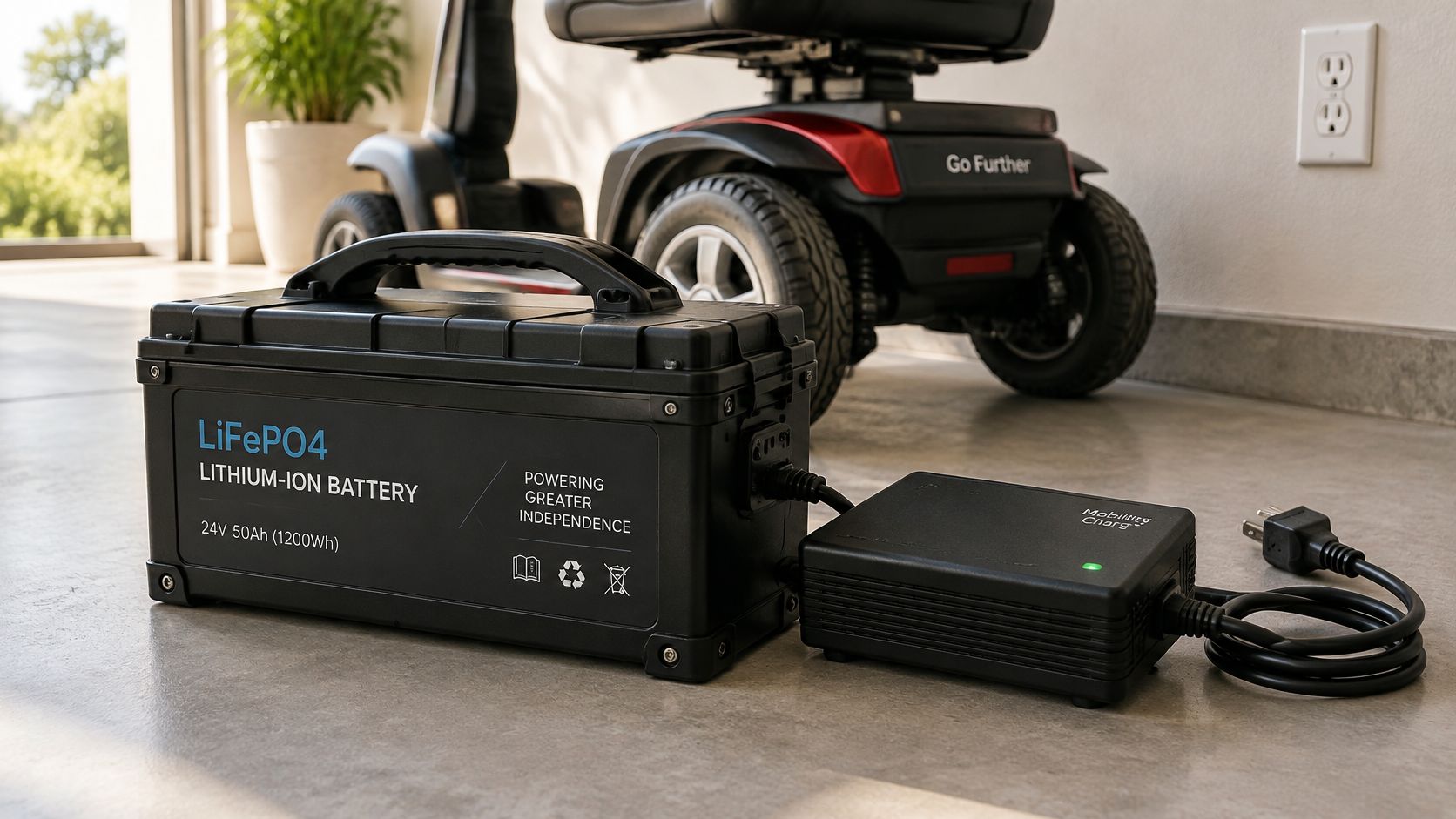
Use an attended charging routine
- Charge while you're awake and in the same room. You need to notice abnormal sounds, smells or indicator behaviour.
- Choose a flat, dry surface. Keep the scooter or removable battery away from children, direct sunlight, liquids and walkways.
- Use a wall outlet directly. Don't use a power strip or an overloaded socket, and follow the manual's connection order.
- Watch for full and unplug promptly. The battery management system helps control the cycle, but it isn't a substitute for supervision.
- Handle removable batteries according to the manual. After disconnecting power, remove the pack if instructed and allow it to cool before storage. Don't lift a pack you can't handle securely.
- Don't charge while sleeping. An automatic charger still needs the charging session to end when the pack is full.
The New York State consumer lithium-ion battery safety guide warns that overcharging can lead to overheating, explosion or fire. Observe the battery itself as carefully as the surrounding area.
For related micromobility context, Punk Ride LLC's resource on protecting your e-bike battery while charging is useful supplementary reading, not a replacement for scooter-specific instructions. When comparing mobility scooters with lithium batteries, check whether charging is permitted on the scooter, off it, or both.
This video provides an additional visual reference; your model's manual remains the authority.
Investigate a changed charging pattern
A warm pack at the start of charging needs a check against the manual's temperature guidance before continuing. Let a recently used battery return to an acceptable charging temperature.
If charging takes noticeably longer than specified or never reaches full, disconnect both ends when safe and inspect for heat or damage. Retry with the same approved charger only if the equipment is undamaged and the manual permits it; a repeated fault needs professional assessment.
Charging Habits That Extend Battery Life
For an idle lead-acid scooter, remembering the maintenance charge is often the most useful habit. Everyday battery shortfalls frequently develop through repeated undercharging or prolonged discharged storage, rather than a single interrupted session.
Build a chemistry-specific schedule
| Situation | Practical charging habit |
|---|---|
| Lead-acid scooter used regularly | Recharge after each journey rather than waiting for a deep discharge |
| Lead-acid scooter parked for an extended period | Put the manual's maintenance-charge schedule on your calendar |
| New lead-acid pack | Perform conditioning only if the battery manufacturer specifies it |
| Lithium-ion scooter | Charge for the range you need, reach full when appropriate, and disconnect at completion |
| Any scooter in storage | Follow the pack's storage-charge and temperature requirements |
The Bischoff & Bischoff battery guide recommends charging its lead-acid batteries at least once per month when unused and to 100% whenever time allows; its initial conditioning routine calls for discharge to the low-battery indication, charging for at least 12 hours until full is indicated, and repeating at least three times, with maximum capacity reached after three complete charging cycles.
That conditioning procedure is manufacturer-specific. Don't apply it to lithium packs or deliberately run an unfamiliar battery flat, and don't use the stated duration as permission to charge while sleeping.
A charger timer can remind you to check progress. It can't confirm that the battery has completed the correct charging cycle.
Keep a parked scooter at a moderate temperature and record charge dates on a handle tag or phone note. For broader maintenance habits, consult battery lifespan advice from Rider 18, while keeping e-bike recommendations separate from your scooter's requirements.
The guide on how to extend battery life offers further maintenance context. Your battery manual sets the exact schedule, not a generic timer.
Choosing a Safe Place to Charge at Home
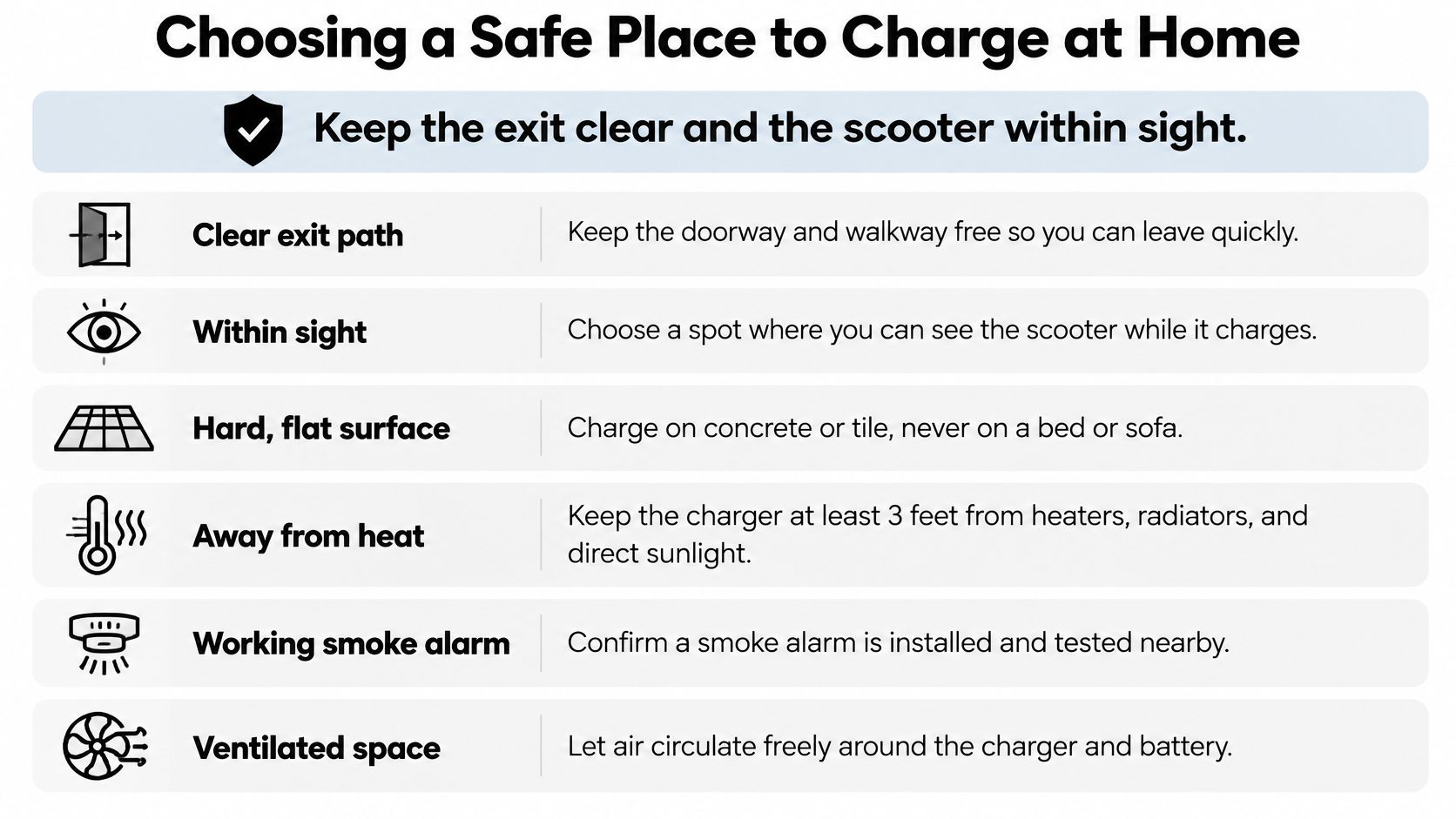
An apartment hallway may be convenient for parking, but it can block an escape route. Choose a charging spot with clear access, a stable surface and enough space to check the equipment while it charges.
Give each room a clear verdict
- Living room: Use a hard, stable surface, away from curtains and upholstered furniture. Keep access clear, and make sure the battery stays dry and out of direct sunlight.
- Kitchen: A hard floor can work if the scooter is away from sinks, cooking heat, tea towels and busy walkways.
- Bedroom: Charge elsewhere. Keep charging equipment out of sleeping areas.
- Hallway or stairwell: Don't charge or store the scooter here. It can obstruct evacuation.
- Garage: Use it only if it is dry, ventilated and has a clear exit path. Avoid freezing conditions, hot spots, fuel and workshop combustibles.
- Shared building: Ask the manager about a designated charging area. In assisted living, involve staff rather than setting up beside a bed.
Check the whole location, not just the nearest socket.
Plan for storage as well as charging
Keep the battery and charger uncovered. Blankets, clothing and protective covers can trap heat.
Lithium-ion batteries can cause fires, so consider where the battery will remain between charges as well as where it will charge. Follow the Consumer Product Safety Commission's charging-safety guidance and keep a damaged battery away from exits.
Unplugged doesn't mean a damaged battery is safe to store beside an exit.
Between charges, keep the battery away from direct sunlight and from heat-producing equipment. Outdoor storage can expose it to moisture or temperature extremes, so it is not automatically the safer choice.
Fixing Common Charging Problems
Start with the simplest safe check: does the outlet supply power, and are the plugs fully seated? Connection and setting problems are worth ruling out before assuming the battery needs replacement.
Don't open a charger casing, bridge terminals or use a different adapter to wake a battery. If the charger or connector is very hot, skip troubleshooting and stop charging.
Match the symptom to the first check
Charging symptoms, causes and first fixes
| Symptom | Likely cause | First fix |
|---|---|---|
| Charger light stays off | No mains power, tripped socket or loose connector | Try another known-working outlet and reseat both plugs with power disconnected. Get help if the outlet trips again or the charger remains unresponsive. |
| Full indicator but short range | Aged pack or no conditioning cycles | For a lead-acid pack whose manual prescribes conditioning, complete that routine, then arrange a capacity test if range remains poor. Don't condition lithium by deep discharging it. |
| Charging stops early | Low-voltage cutoff or battery protection | Let the pack rest, then inspect accessible cables and connectors. Stop if protection trips again or anything is damaged. |
| Will not charge after long idle | Deep discharge, protection mode or sulfation | Stop and have a technician assess the pack before attempting to force a charge. |
Separate battery faults from scooter faults
A full indicator confirms the charger has reached its completion condition. It doesn't prove the battery can deliver its original usable capacity under load.
Before condemning the pack, compare similar journeys and check tyre pressure, carried load and whether a brake appears to drag. Hills, soft tyres and resistance can reduce range even when charging works correctly.
Indicator interpretation also matters. Some chargers show a standby light when disconnected, while others use flashing patterns for faults; photograph the pattern and compare it with the manual rather than guessing from the colour.
A technician can test capacity, check connections and assess a paired lead-acid pack without relying on the dashboard gauge alone. Bring the charger as well as the battery information, because replacing a battery won't correct a faulty charging system.
When to Stop Charging and Get Help
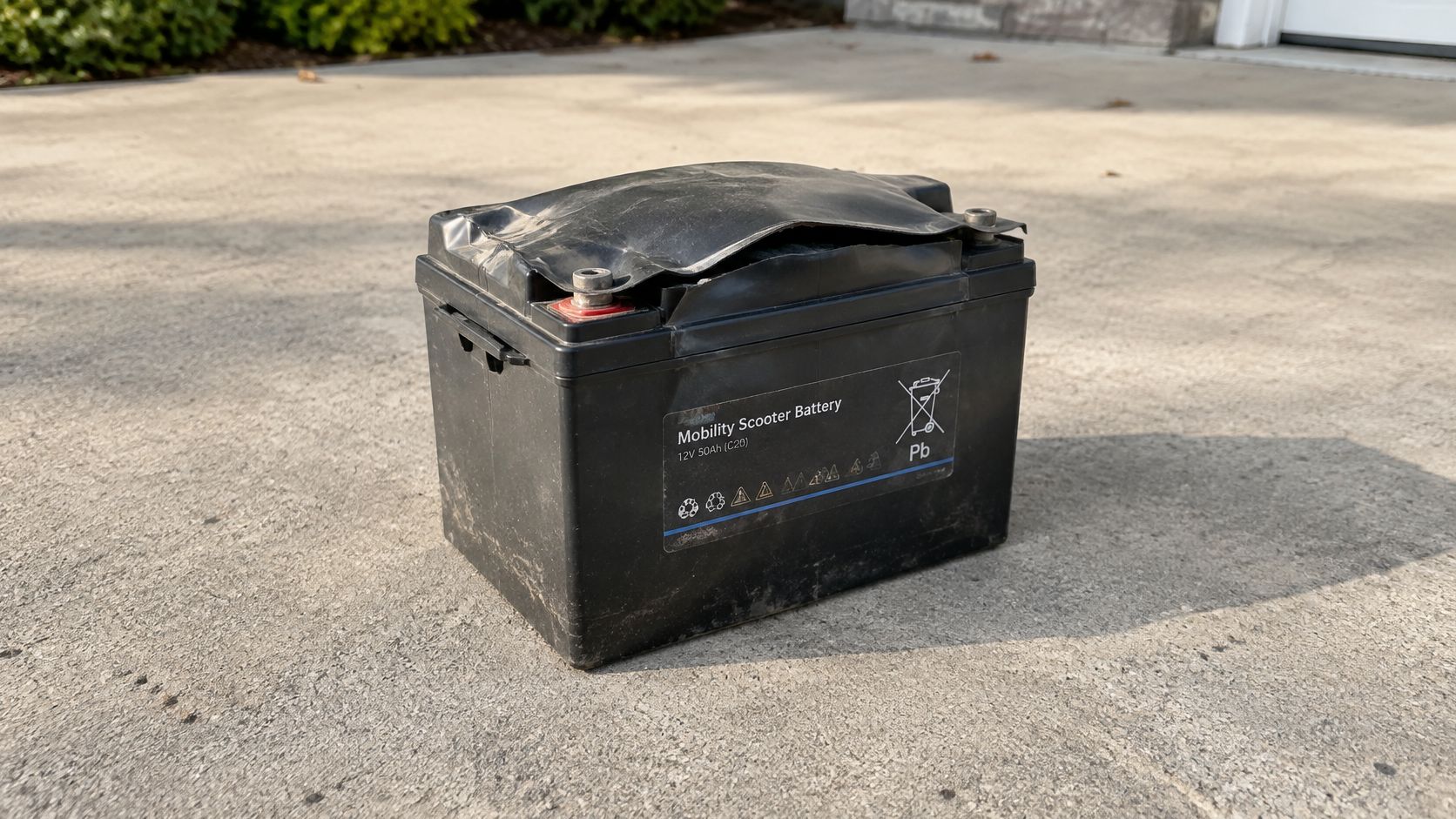
A warning sign means stop charging, not try another charger. Swelling, bulging, fizzing, hissing, a sharp chemical odour, unusual heat, smoke or a damaged charger cable all require action.
A distorted case is a reason to retire the battery from use, not press it back into shape.
Make the situation safe first
- Disconnect at the wall only if it's safe. Don't approach smoke, flames or a dangerously hot pack to reach the plug. Leave the area and call emergency services if there's an immediate fire risk.
- Keep people away. Maintain a clear, ventilated space, but move the equipment away from people only when you can do so safely.
- Record identification details after the danger has passed. Note the scooter model, battery designation and charger serial number.
- Arrange professional advice and disposal. Don't recharge a damaged battery or put it in household waste. Ask the retailer or a licensed battery recycling service how to handle and transport it.
The CPSC micromobility safety guidance reinforces using the supplied or manufacturer-approved charger and avoiding incompatible equipment.
Match the replacement before ordering
A manufacturer, local mobility dealer or DME Superstore can help identify an appropriate replacement. DME Superstore offers 24/7 chat support, and its product pages list battery and charger specifications and warranty information; have the labels ready when asking for compatibility confirmation.
Use the mobility scooter battery buying guide to prepare your questions, not to substitute appearance for model matching. Keep the manual and a photograph of the charger label together for future reference.
DME Superstore offers mobility scooters and charging-related product information to help you compare battery systems and compatible equipment. Visit DME Superstore with your scooter model and battery details ready, and ask for help confirming the correct charging setup before ordering.
