



You're helping someone shower from a seat, and the fixed shower head is aimed for a standing person. Water hits the wall, their shoulders get cold, and rinsing their hair means asking them to tilt back or stand. That small mismatch is where an adjustable shower head either helps a person stay independent or leaves them waiting for help.
What an Adjustable Shower Head Changes at Bath Time
A woman sits on a shower seat after surgery. She can wash her front on her own, but the overhead spray lands behind her. To rinse shampoo, she'd have to stand, turn, and hold on with a wet hand. Her daughter ends up reaching in with a cup, both of them getting soaked, both a little tense about balance.
An adjustable shower head changes that scene because water follows the body instead of the other way around. The head may tilt to a new angle, slide lower on a bar, or lift out of its holder on a hose. The seated user can bring the spray to her hair, then to her feet, then set it back. She doesn't need to stand for the rinse.
Who notices the difference most
Older adults notice it first when standing for a full shower gets tiring. A person with weak grip or shaky balance notices it when reaching up feels risky. Someone home after surgery notices it when turning under a fixed stream hurts or isn't allowed yet. Caregivers notice it too, because they can rinse one area without spraying the person's face or soaking a bandage that should stay drier.
If you're thinking about falls more broadly, practical steps for preventing elderly falls at home covers the rooms beyond the shower. If water quality is also on your mind while you shop, a separate guide on choosing a filter for your shower from Water Filter Advisor explains that decision on its own terms.
What you'll learn to judge
You'll learn what adjustable includes, since sellers use the word for three different movements. You'll learn which features change independence and which ones only add spray patterns. You'll also learn how the head fits with a seat, grab bars, home water pressure, and safe temperature.
The test isn't whether the head moves in a store. It's whether the person bathing can move it from where they actually sit or stand.
Later sections separate marketing adjustability from reach a person can use alone. A head that slides, tilts, and sprays in many patterns can still fail if it's parked too high, needs a hard twist, or loses its spray in a low pressure home. That's the gap to watch for.
How Adjustable Shower Heads Control Spray and Flow
Three layouts cover most products you'll see. A tilting head stays on a fixed arm and changes angle only. A sliding head moves up and down a vertical bar, like a coat on a rack you can reposition. A handheld unit sits in a holder but lifts out on a hose, so the hose works like an extension of your arm.
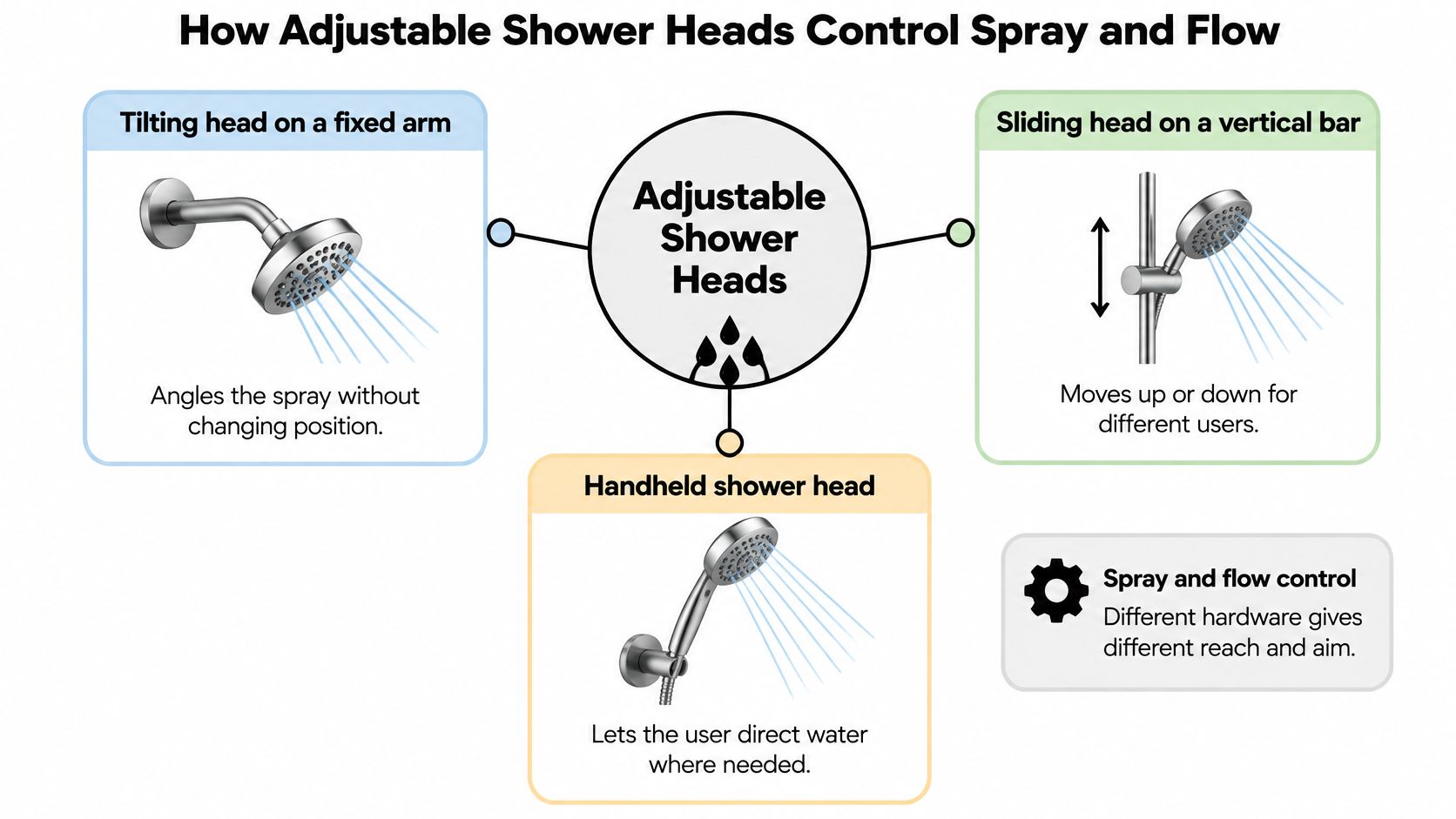
Those are different adjustments, and not every product does all three. Tilting helps a standing user aim water away from the face. Sliding helps two people of different heights share one shower. Lifting the head out helps a seated user rinse legs and feet without bending under a fixed stream.
Angle, height, and handheld are not the same promise
Read the product name carefully. Height adjustable may mean the holder slides, but the head never comes off. Handheld means it comes off, but the holder may sit at only one height. A combination does both, which suits a shared bathroom where one person sits and another stands.
- Tilting head on a fixed arm: Angles the spray without changing position. Good for small aim changes, limited for seated bathing.
- Sliding head on a vertical bar: Moves up or down for different users. Helpful if the controls on the holder are easy to work.
- Handheld shower head: Lets the user direct water where needed. Most flexible for seated use and caregiver help.
Why more spray modes don't mean more water
Spray settings change how water leaves the face of the head. They don't raise the legal ceiling on how much water can flow. The Energy Policy Act of 1992 established a national maximum of 2.5 gallons per minute, measured at 80 pounds per square inch, for showerheads manufactured after January 1, 1994, as the EPA WaterSense at Work guidance on showerheads and diverters explains.
A 2010 clarification also treated a product with multiple nozzles as one showerhead, so combined output counts. Changing from a wide spray to a focused one can't lawfully push the total over the limit. That's why the spec that matters is maximum flow rate, not the count of mist, rain, and massage settings. If low flow models interest you, this overview of 1.5 GPM shower heads explains that end of the range.
Reach Grip and Seated Use That Actually Work
A bar can slide high enough for a tall standing adult and still strand a seated user. That's the plain difference between height adjustable and accessible. The question isn't "Does it move?" It's "Can this person move it, aim it, and put it back from the position they bathe in?"
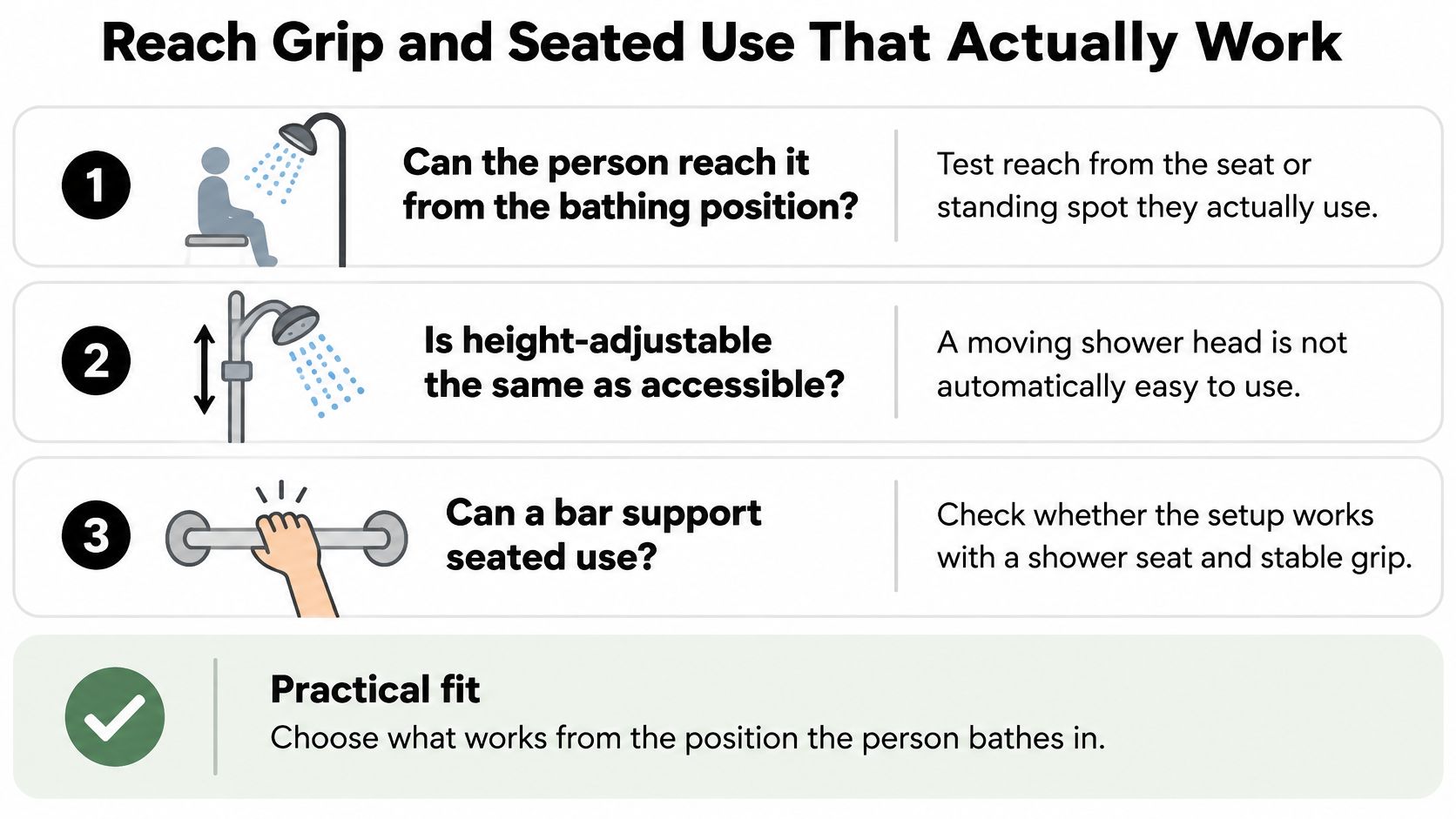
U.S. accessibility guidance requires the operable portion of a handheld unit to be reachable no higher than 48 inches above the shower floor, and controls must work with one hand using no more than 5 pounds of force without tight grasping, pinching, or wrist twisting, according to the U.S. Access Board bathroom guide. A vertical bar may extend higher, but only if the user can still bring the unit back into that reach range.
Run the seated reach check at home
Sit where the person will sit, on the seat if you have one. If you're still choosing seating, this guide to PVC shower chairs covers that piece. From that spot, mime the whole shower without water first.
- Remove it: Can they lift the head out one handed, without standing or leaning far?
- Aim it: Can they reach hair, torso, and feet while the hose pulls gently, not dragging the head sideways?
- Replace it: Can they find the holder by feel and set the head back without a twist or a hard push?
Small parts that cause big trouble
Hose drag is easy to miss in a store. A stiff hose pulls against a weak hand the whole shower. A holder that needs a twisting collar to slide can defeat someone with arthritis. Small dials for changing spray patterns can be hard to turn with soapy fingers.
Practical rule: If a control needs two hands, a pinch, or a wrist twist, it doesn't pass, no matter how far the bar slides.
Households share showers, so build one habit early. Whoever uses the head up high returns it to the lower position afterward. Otherwise the next person starts the shower unable to reach the very tool meant to help them. If you're planning bigger changes around the shower, you can explore accessible bathroom remodeling ideas from Task Masters Inc. for layout context beyond the fixture.
Test reach from the seat, not from the doorway. That's where independence is won or lost.
Features That Matter More Than Extra Spray Modes
A spec sheet lists mist, massage, and rain settings in large type. The numbers that decide whether rinsing feels easy or endless sit in smaller type. Learn to read for usable water first, and treat spray patterns as a comfort extra.
The federal maximum is 2.5 gallons per minute, while WaterSense labeled heads are limited to 2.0 gallons per minute, a 20 percent reduction, as the EPA WaterSense support statement for showerheads describes. The label also means spray force and coverage were evaluated, so a certified head isn't saving water only by producing a weak spray.
Pressure testing tells you what a single number can't
Homes don't all deliver the same pressure. WaterSense testing checks flow at 20, 45, and 80 psi, covering low, typical, and high household pressures, per the same EPA support statement linked above. At 45 and 80 psi, measured flow must remain at least 75 percent of the rated flow. At 20 psi, it must remain at least 60 percent.
That matters in an older home where pressure already shortens spray reach. A restrictive setting on top of low pressure can turn rinsing into slow work. The person sits longer, gets colder, and may need a caregiver to finish. A head that holds up at low pressure protects independence, not just comfort.
Flow Limits and What They Do Not Promise
| Standard | Maximum flow | What else it checks | Buying caution |
|---|---|---|---|
| Federal maximum | 2.5 gpm | Total flow limit only | Doesn't guarantee force or coverage at your home pressure |
| WaterSense | 2.0 gpm | Spray force and coverage, plus flow at three pressures | Still test whether the spray reaches the seated user |
| Stricter state limit | 1.8 gpm in California, Hawaii, and Washington, per EPA materials on WaterSense efficiency and state limits | Local compliance | Lowest flow isn't automatically best if rinsing takes longer |
Check your state rule before you order, since a compliant product in one place may not meet a stricter limit in another. Then ask the harder question. Does the strongest useful spray reach the user's body without constant repositioning? If it doesn't, the lower number on the box hasn't bought you much.
Grab Bars Seats and Safe Water Temperature
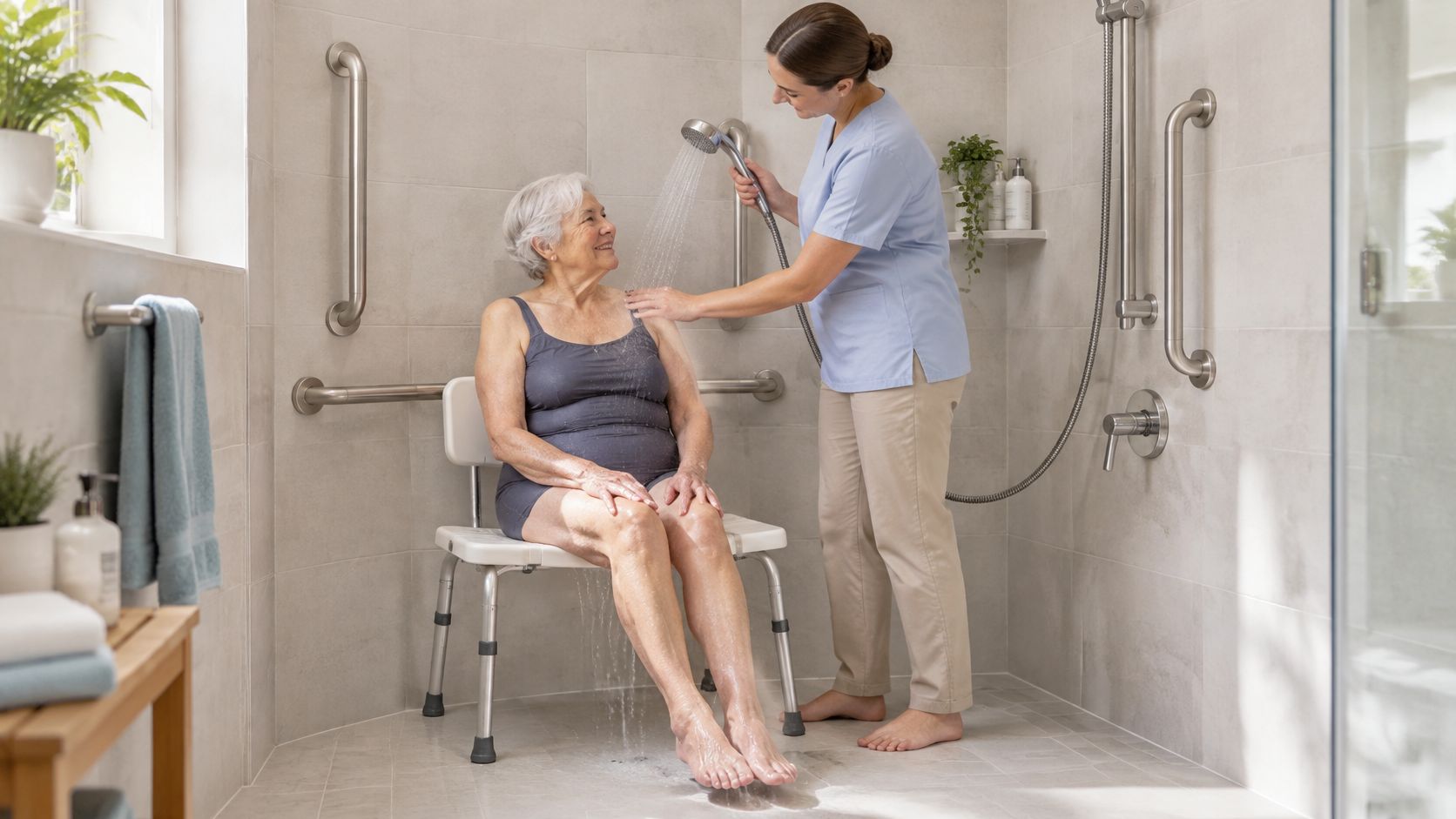
A shower is shared space. The head, hose, seat, and grab bars all compete for the same few feet of wall, and a good product in the wrong spot creates new problems. Plan the layout as one scene, not as separate purchases.
Three common scenes, three interference checks
A man showers seated after surgery, one hand on a grab bar. If the slide bar was mounted over that grab bar, he must let go to adjust the spray. That's a trade no one should make. If you're adding bars, this guide on how to install grab bars in the bathroom helps you place support before fixtures crowd it.
A caregiver washes a parent's feet while the parent stays seated. The hose needs to reach the floor without crossing the path the parent uses to transfer onto the seat. A hose looped across that path is a trip and tangle risk during the most unsteady moment.
A standing spouse only needs the angle changed. The holder should still sit where a wet hand can find it without looking up into the spray. Shared bathrooms work when each user can reset the setup for the next person.
Aiming water is not controlling temperature
Changing height or angle does nothing to limit heat. In covered accessible facilities, shower water temperature is limited to 120 degrees Fahrenheit, according to the U.S. Access Board bathing rooms guide. EPA guidance also recommends routing replacement fixtures through a thermostatic mixing valve to reduce the risk of thermal shock or scalding.
The valve sets the maximum temperature before water reaches the user. The shower head only decides where that water lands.
That separation matters when sensation is reduced or reaction time is slower. It also matters when a caregiver holds the spray and may not feel the water on their own skin first. By the time the seated person reacts, hot water has already landed. Rely on the valve for scald protection, and use the adjustable head for aim, reach, and comfort.
How to Choose an Adjustable Shower Head
Two handheld heads can sit side by side on a shelf, both advertising five spray modes, and behave completely differently once water pressure, hose weight, and a seated reach enter the picture. Mode count tells you little about those things. The product page has to answer harder questions before it earns a place in the bathroom.
Work through the page in a set order. Find the rated maximum flow first, and note whether a WaterSense label is shown. Then look for any description of how the spray performs at the pressure a real home supplies, since a figure measured under ideal conditions may not match what comes out of an older wall pipe. A page that lists spray modes but hides flow and pressure information hasn't given you enough to decide.
A checklist you can use on any product page
- Flow and certification: Rated maximum flow is stated, and any WaterSense claim is documented.
- Pressure performance: The page describes how the spray holds up at household pressure, with some basis beyond a single best case figure.
- Seated reach: The holder sits where the person can reach it from the seat or standing spot they actually use.
- One-handed controls: The head lifts off and returns without a tight pinch or twist, and any dial is big enough for soapy hands.
- Hose behavior: The hose reaches where it needs to go, and its weight and stiffness won't pull the head out of a weaker grip.
- Clearance: The hose route and holder leave grab bars and the transfer path to the seat open.
Watching someone handle the setup on video can reveal grip and holder details that photos hide, like how much force the cradle takes or whether the hose coils back across the user's lap.
Don't treat the lowest advertised flow as the automatic winner. If weak coverage stretches the shower or means a caregiver has to stay longer, it hasn't served the user. Flow limits also vary by state and locality, so compare the rated maximum flow on the listing with the rule that applies where the shower will be installed.
Where to compare with specs in front of you
DME Superstore is one place to compare bathroom and shower safety equipment alongside related homecare items, with product pages listing specs, compatibility accessories, and warranty details. It offers nationwide free shipping, a 30 day return on most items, FSA and HSA eligible purchasing, and chat support. For example, its handheld range includes the Drive AquaSense Shower Spray with three adjustable spray settings and the Nova Medical Deluxe Handheld Shower Head with an extra long hose and five settings, so you can apply the checklist above to real listings.
If the job grows past swapping a head and into valve or pipe work, that's the point to bring in professional help such as plumbing services from Stultz Plumbing. Work behind the wall is a different project from choosing a fixture.
Keep It Working and Take the Next Step
Upkeep protects the adjustments you chose so carefully. Mineral buildup slowly blocks spray holes, and a head that once rinsed well turns into a weak mist. Wipe or soak the face as the maker directs, and check that the spray pattern still looks even.
Three checks that preserve reach and spray
- Hose check: Look for kinks, stiffness, or a hose that pulls the head out of a seated user's hand.
- Holder check: Confirm the head still comes off and goes back with one hand, without extra force.
- Position check: Return the head to a lower, reachable spot after a taller user finishes. That habit is maintenance, not tidiness.
If water runs unexpectedly hot, don't try to fix it by switching spray settings. A worn valve is a scald risk, and it belongs with someone qualified. The head aims water. The valve controls heat. Mixing up those jobs leaves the underlying problem in place.
Your next step, in one sitting
Sit in the seat or stand in the spot that's used, and measure the height you can reach comfortably. Write down that reach, the flow limit that applies where you live, the holder style you need, and any conflicts with bars or the seat. Then compare adjustable shower head options with those notes in hand. For the wider setup around the shower, this roundup of bathroom safety equipment for elderly users helps you think in matched pieces.
A full remodel isn't required for a safer shower. A reachable handheld setup, a stable seat, and secure bars can change bath time on their own. What matters is that the person bathing can reach the water, aim it, and put it back without standing or calling for help.
Bring your reach measurement, flow notes, and clearance list to DME Superstore, where you can compare adjustable and handheld shower heads alongside seats, grab bars, and other bathroom safety equipment with clear specs on each product page. Nationwide free shipping, a 30 day return on most items, and chat support make it easier to order with confidence and adjust if the fit isn't right. Start with the shower head that matches your bathing position, and build the rest of the setup around it.
