



You are standing in a mobility showroom watching a tall parent, partner, or patient try another walker. The handles look close enough on the label, yet the shoulders roll forward, the eyes drop to the floor, and the walk already looks tiring after a few steps. That moment is why choosing an upright walker for tall person use should start with measuring and testing, not with hunting for the tallest label on a product page.
Why Tall Users Need a Different Approach to Walker Fitting
The tall adult reaches the end of the aisle, straightens up, and asks a familiar question. Does anything go higher? It sounds like a comfort request, but it is really a safety question. If the grips sit too low, the user has to fold at the waist to load the frame. That forward posture changes how weight moves through the arms, where the body sits inside the base, and how easily the user can brake, turn, or stop.
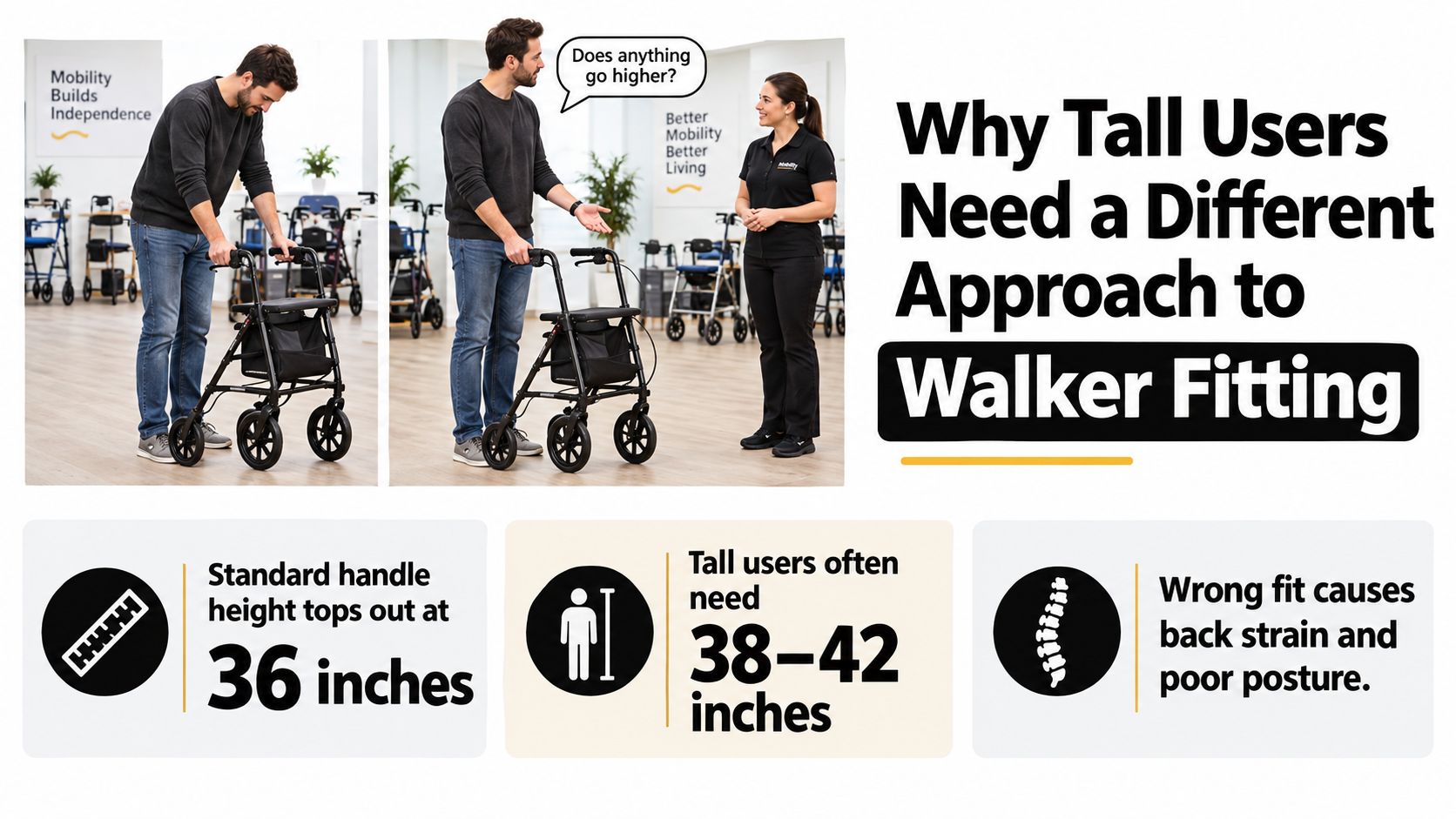
This is not a rare sizing problem. CDC analysis of the 2016 Behavioral Risk Factor Surveillance System found that 22.2% of U.S. adults reported at least one disability, with mobility disability the most common type at 13.0%, and prevalence rising to 27.4% among adults aged 65 and older. Millions of people therefore need walking support, and they do not arrive with identical proportions, strength, balance, or posture.
Fit Changes What the Walker Can Do
A walker that is too short does more than feel awkward. It can pull the trunk forward, shift effort into the back and shoulders, and make the user push down at an angle that is harder to control. A walker set too high creates a different problem, because lifted shoulders make steady weight transfer tiring. For a tall user, the useful question is not whether the frame can be touched. It is whether the user can stand close, stay upright, and control the device while moving.
A tall label tells you a frame extends farther. It does not tell you whether this person's wrists, elbows, shoulders, and stride line up with it.
That distinction matters at home, where the route includes a bathroom turn, a kitchen threshold, and a chair the user must leave without pulling the frame toward them. Readers who want broader background on support for walking will recognize the same principle across mobility aids. The device has to fit the task, not only the person standing still.
Think of fitting as a short clinical protocol you can repeat. Measure the body first, translate that measurement into specifications, compare the right walker family, then test walking, turning, braking, and sitting. If one step fails, a taller specification alone won't fix it.
The Wrist-Crease Rule and How to Measure at Home
Physical therapists do not start by asking for overall height and reading a chart. They look for a landmark on the user's own arm, because two people of the same height can have different torso, arm, and leg proportions. That is why the wrist-crease rule is so useful for a tall buyer. It turns a vague search for an upright walker for tall person use into a measurement you can check before money is spent.
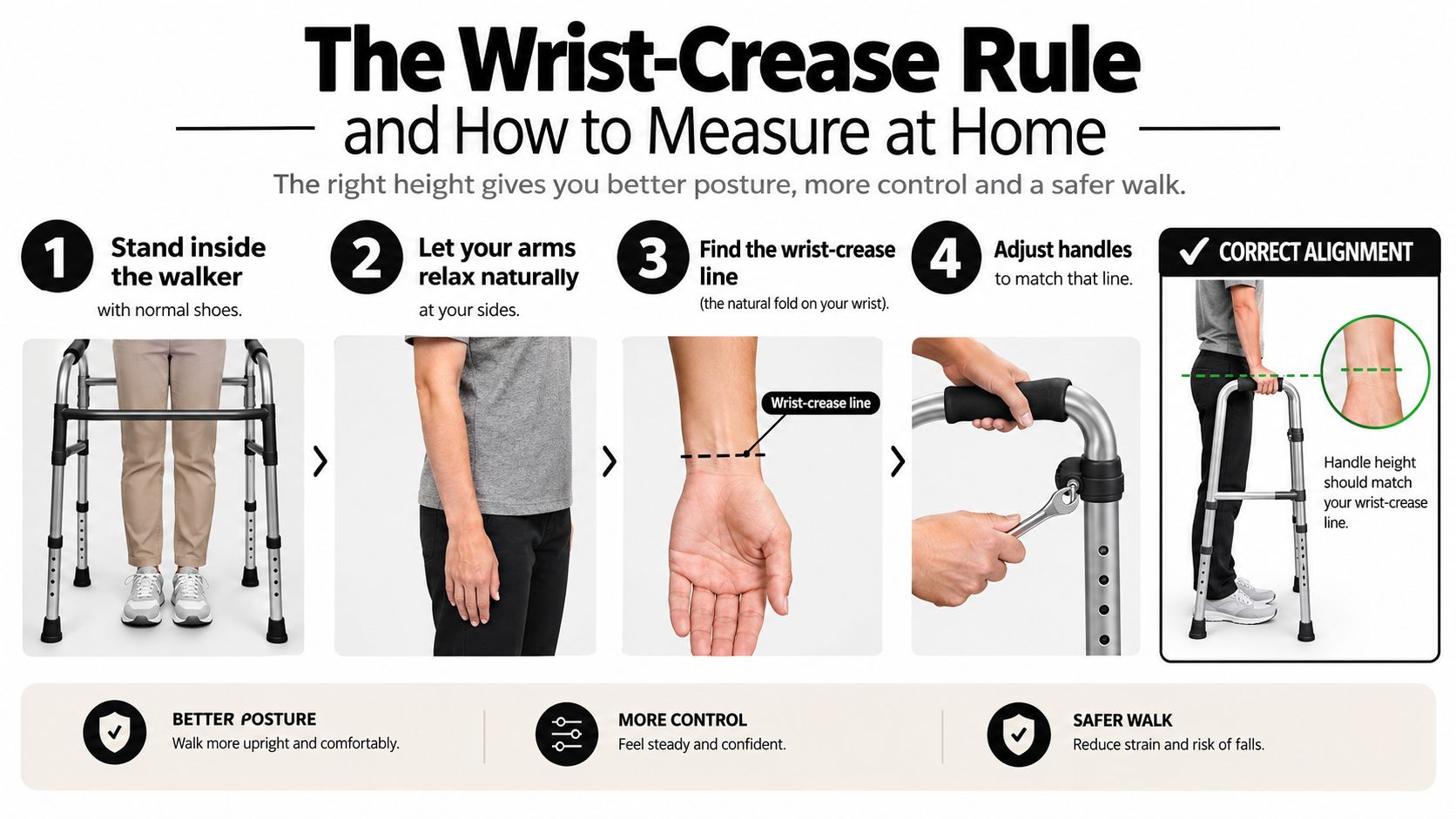
Mayo Clinic guidance on walker grip height recommends that the grips align with the crease on the inside of the wrist while the shoulders stay relaxed and the elbows remain bent at about 15 degrees, a position designed to reduce unnecessary shoulder and back stress. Some clinicians use the ulnar styloid, the bony prominence at the wrist, as the reference point instead. Both landmarks aim at the same idea. The hands should meet the grips where the arms naturally fall.
A Four Step Home Measurement
You don't need special equipment, but you do need consistency. Use the shoes the person normally walks in, because measuring barefoot and walking in raised footwear changes the result.
- Stand inside or beside the frame: Ask the user to stand as upright as is comfortable, without forcing a military posture.
- Relax the arms: Shoulders should drop naturally, with arms hanging at the sides and no shrugging to meet the handles.
- Mark the wrist crease: Note where the inside wrist crease lines up against the frame, then set both sides evenly at that level.
- Grip and check the elbows: The elbows should stay slightly bent, the trunk should remain upright, and the wrists should not bend sharply upward.
Sizing an upright walker for a tall person is like fitting a golf club with a professional fitter. A small change in length changes the angle of the whole swing, and the player starts compensating somewhere else. Walker height works the same way. If the elbows lock straight, the user may lean to create support. If the elbows bend too much and the shoulders rise, the frame is stealing effort that should go into walking.
Standing Still Is Only the Starting Point
Once the static position looks right, ask the user to walk. Watch whether the head comes up, whether steps stay inside the frame rather than chasing it, and whether the shoulders creep upward after a short distance. Recheck both handles after the walk, because one side set lower than the other can twist the posture. A good home measurement gives you a target height to compare against product specifications, and it also tells you when a supposed tall model still falls short for this particular body.
Specifications That Matter for a Tall User
Once you know the wrist level, product pages become easier to read. You are no longer asking whether a model sounds tall. You are asking whether its usable range reaches the measured point with room to adjust, and whether the rest of the frame supports safe control at that height.
Maximum handle height comes first, but the top setting should not be the only setting that works. A frame that barely reaches the wrist leaves no room for different shoes, posture changes, or a small correction after a trial walk. Adjustment increments matter for the same reason. Smaller, even steps make it easier to land near the wrist crease instead of choosing between slightly too low and slightly too high.
Do not treat a lower setting as a stability trick. A study of 10 older adults using front-wheeled walking frames found that lowering the frame 2 cm below the clinically recommended setting did not increase stability, the lower setting reduced it, while narrow frames were less stable than standard-width frames under the test conditions. For tall users, that finding points in a clear direction. Keep the handles at the fitted height and look for stability in the base, not in forced stooping.
Walker Specifications for a Tall User
| Specification | What to Look For | Why It Matters for a Tall User |
|---|---|---|
| Maximum handle height | A range that reaches the measured wrist level with adjustment room left | Prevents forward folding just to load the grips |
| Adjustment increments | Even settings on both sides that lock securely | Helps fine tune elbow bend without one side sitting lower |
| Frame width | A base wide enough to feel planted, yet able to pass home doorways | Supports side to side control during turns and transfers |
| Brake lever reach | Levers the user can squeeze and lock without leaning forward | Keeps stopping power available while the trunk stays upright |
| Seat height and clearance | A seat the user can approach, sit on, and rise from with feet placed securely | Reduces twisting and heavy dropping during rest breaks |
| Folded dimensions | A folded shape that fits the car and storage space, with a lifter identified | A walker that cannot travel or be stored is less likely to be used |
| Weight capacity | A rating with comfortable room for the user, clothing, and sitting forces | The frame must support walking load and seated rest, not one or the other |
Wheel position and behavior deserve a close look too. Wheels that track predictably on the user's actual floors help the frame stay close instead of drifting ahead. If you are comparing listings, a guide to rollator walker dimensions can help you translate width, height, and folded size into room by room decisions.
Retailers such as DME Superstore list tall and upright models alongside standard rollators, which makes side by side specification checks practical. Use your wrist measurement as the filter, then rank the remaining options by brake reach, base width, seat access, and folded size. That order keeps marketing language from outranking fit.
Upright, Forearm-Support, and Standard Rollators Compared
Three walker families tend to appear on a tall user's shortlist, and they solve different problems. An upright posture walker raises the support points so the torso can stay more vertical. A forearm-support walker lets part of the load travel through padded forearm rests rather than only through the hands. A standard rollator keeps the familiar wrist level grips and often feels simpler to steer in tight spaces.
The visual comparison below is useful for seeing those posture differences at a glance before you compare individual models.
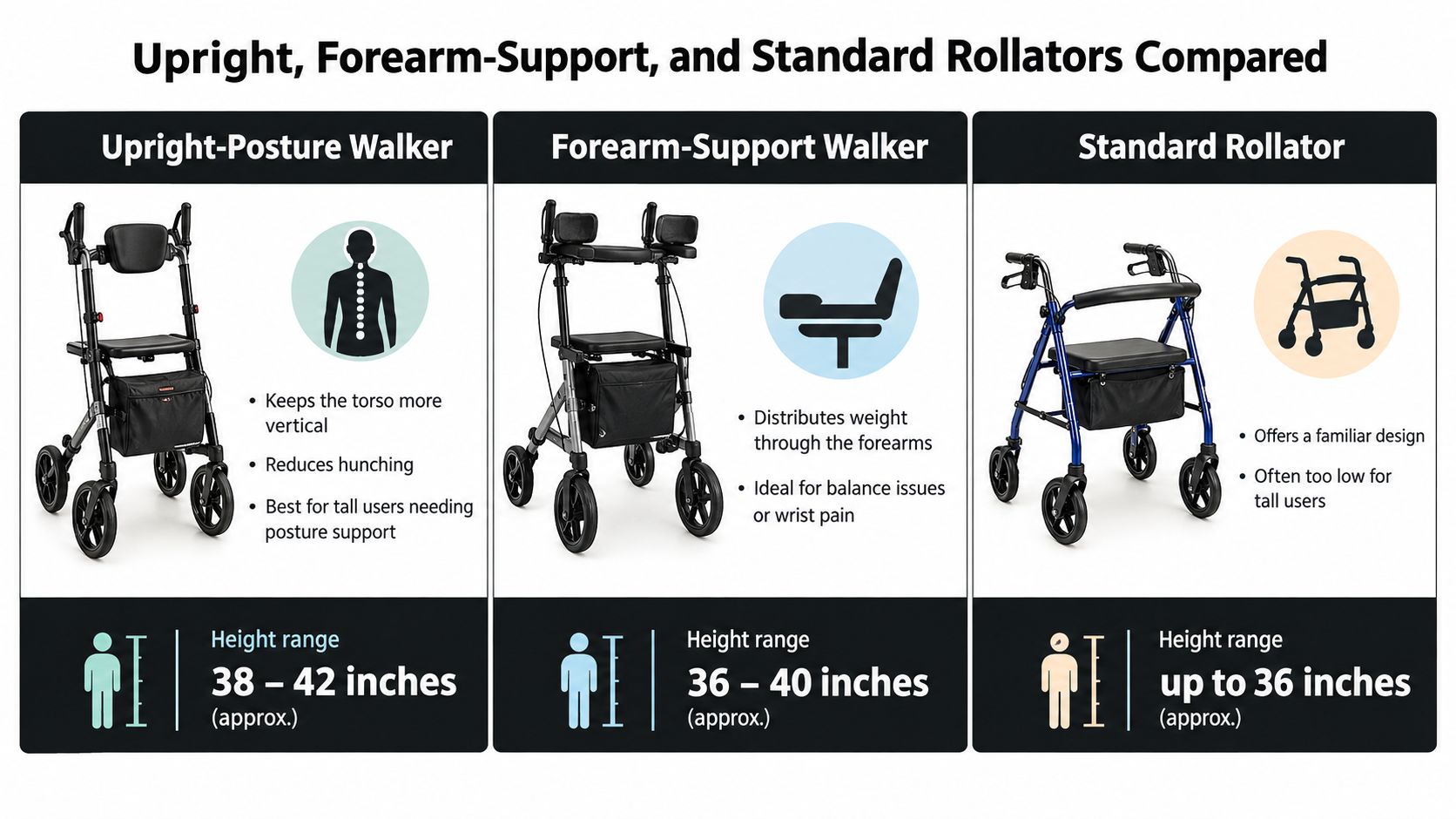
Upright designs can reduce the urge to hunch over low handles, especially for someone who immediately folds toward a standard frame. The trade-off is reach. Higher supports and brake controls must still sit where the user can operate them without stretching forward or lifting the shoulders. A larger upright frame may also need more room to turn in a small bathroom or between a bed and dresser.
Forearm-support models need a more detailed check. Clinical assistive-device guidance on elbow flexion commonly specifies approximately 15 to 30 degrees of elbow flexion when using a walker, and an upright walker with forearm supports needs enough vertical adjustment for the forearms to rest securely without shrugging or slumping. Judge the platform height, grip position, and wrist alignment together. A forearm rest at the right height with an awkward grip can still tire the hands and weaken brake control.
Standard rollators should not be dismissed just because they look conventional. For a tall user whose wrist measurement falls within the frame's real adjustment range, a standard model may offer easier turning, simpler folding, and familiar brake placement. The problem arises when the user has to stoop to use it. At that point the familiar design is asking the back and shoulders to pay for a sizing mismatch.
A short demonstration can make arm position and brake reach easier to picture before an in person trial.
Grip strength, arthritis, balance, home layout, and the ability to use both hands should guide the family choice. Someone with painful wrists may prefer forearm loading, while someone with weak shoulders may find high supports tiring. Readers comparing broader options for older adults can also review guidance on the best walkers for elderly users, then return to the wrist measurement to narrow the list. Height opens the conversation, but control during real tasks should finish it.
A Task-Based Assessment You Can Run at Home or in a Store
A walker can pass the standing test and still fail in the hallway. That is why the final check should imitate daily life. Walk, turn, stop, sit, and rise while someone watches posture and hand position. If possible, test on surfaces similar to home and leave enough time for fatigue to show, because a fresh thirty second trial can hide problems.
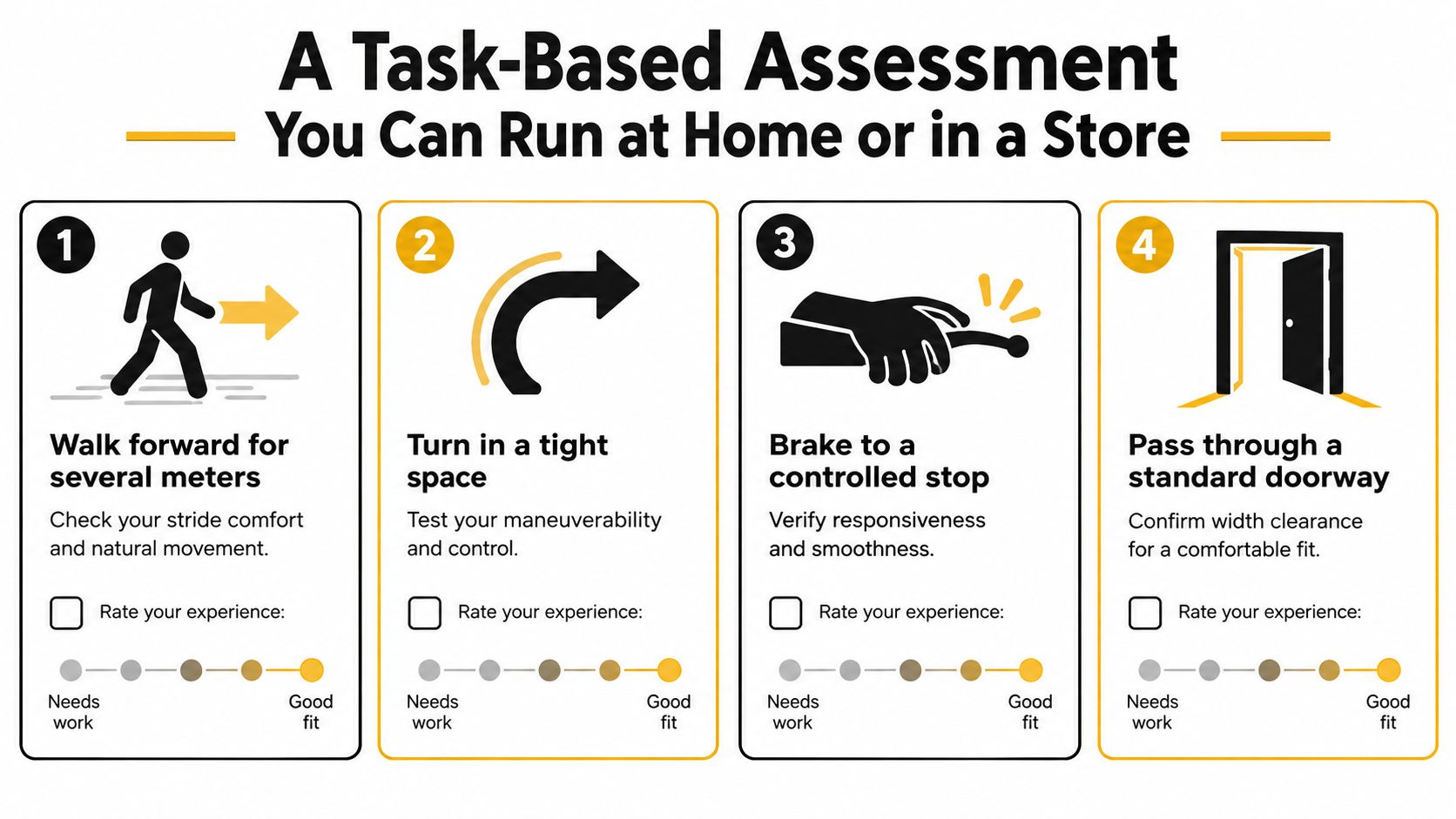
Four Tasks to Score Honestly
- Walk forward: The user should stay close to the frame, look ahead rather than down, and keep the elbows slightly bent without the walker running away.
- Turn in a tight space: Turns should be slow and controlled, with no clipped furniture, sharp twisting, or need to lift and drag the frame into place.
- Brake to a controlled stop: Both brakes should engage and lock without a forward lunge, painful squeeze, or confusion about which lever does what.
- Sit and rise: The user should back up to a chair or the walker seat, feel it behind the legs, lower with control, then rise without pulling the walker toward the body.
Pay special attention to reaching. A tall user may look upright while walking straight, then lean outside the base to open a door or reach a counter. Move the walker closer before reaching and see whether the frame allows that safer position in the actual space.
Store test rule: If the user cannot brake, turn, and rise from a chair while staying upright, the walker has not passed, even if the handle height number looked perfect online.
These tasks matter because University of Waterloo research on assistive mobility technology highlights transfers, turning, stopping, and reaching as important fall-risk tasks and notes that about 50% of rollators are abandoned because of usability problems such as poor maneuverability, difficult brakes, and limited reach. A careful trial is therefore not extra fussiness. It is how you avoid buying equipment that ends up parked in a corner.
Posture during these tests also connects with the user's wider care plan. For someone whose walking tolerance is limited by back or leg symptoms, spinal stenosis self-care tips from Midwest Pain & Wellness may be a helpful companion resource alongside device fitting, provided the treating clinician agrees. Technique matters too, and a refresher on how to use a rollator walker can help families rehearse the same stop, brake, turn, and sit sequence at home.
Why the Tallest Available Walker Is Not Automatically the Safest
The tallest frame on the page can look like the safest answer for a tall person. Sometimes it is the right answer. Sometimes it solves stooping while creating a longer reach to the brakes, a wider turn in a narrow hall, and a harder transfer from a low chair. Safety depends on whether the user can control the whole device in the rooms where it will be used.
Consider a tall user with arthritis in both hands. The highest upright frame may bring the forearm supports to a comfortable level, yet the brake levers may demand a squeeze that becomes unreliable when the hands are sore. Another user may have strong hands but a small bathroom, where a large frame forces rushed, angled turns. In both cases, maximum height has answered only one part of the problem.
The Trade-Off in Plain Terms
- What extra height can help: It can reduce forward folding, keep the gaze up, and let the arms load the frame from a more natural position.
- What extra height can cost: It can increase reach demands, complicate tight turns, and make folding, lifting, or storing the walker harder for the user or caregiver.
Neither side of that list cancels the other. The task based assessment decides which side matters more for this person. Can the user keep both hands in contact while walking? Can the brakes be locked before sitting, every time, including on a tired afternoon? Does the frame stay close during a turn instead of pulling the body after it?
Home fall prevention also belongs in the decision, because thresholds, rugs, cords, and cramped furniture can defeat a well fitted walker. Practical steps from guidance on how to prevent elderly falls should accompany the purchase, especially clearing the bed to bathroom route and the turn into the kitchen.
A taller frame that forces the user to hunch is a poor fit. So is a taller frame the user cannot brake, turn, or rise with safely. The better question is smaller and more demanding. Can this person, with this grip and balance, control this walker through walking, turning, stopping, and sitting in this home?
Bringing It All Together and When to Involve a Clinician
A sound shortlist for an upright walker for tall person use can now be built in order. Start with the wrist measurement, use it to screen maximum handle or forearm support height, then compare frame width, brake reach, seat access, folded size, and weight capacity. Choose the walker family that matches grip, balance, and home layout, and keep only models that pass walking, turning, braking, sitting, and rising.
The fitting anchor stays the same throughout. The American Academy of Family Physicians guidance on walker height sets a walker's correct height at approximately the patient's wrist crease when standing upright with the arms relaxed at the sides, and recommends confirming that the elbows remain slightly flexed while holding the walker. Set both sides evenly, confirm brake reach without leaning, and recheck after a real walk rather than trusting the first static pose.
When Professional Fitting Should Come First
Ask a physical therapist, occupational therapist, or prescribing clinician to verify the setup when the walker will carry substantial weight, when surgery or a fracture limits weight bearing, or when a neurological condition affects balance or movement. Arthritis with major grip loss, frequent falls, confusion about brake use, and rapidly changing strength also justify professional assessment. A clinician can watch transfers and turns, adjust the frame during movement, and say clearly when an upright model is not the safest family for that user.
For a tall person, the reward for this slower process is practical. The walker stops feeling like something to bend toward and starts feeling like support that meets the body where it already stands. Measure first, test the tasks, and let control in real rooms make the final decision.
If you are ready to compare tall, upright, and forearm-support models against your wrist measurement and home route, visit DME Superstore to review walker and rollator specifications, sizing details, and related home safety equipment in one place. Bring your task based checklist with you as you shop, and choose the frame you or your loved one can walk, turn, brake, sit, and rise with confidently.
